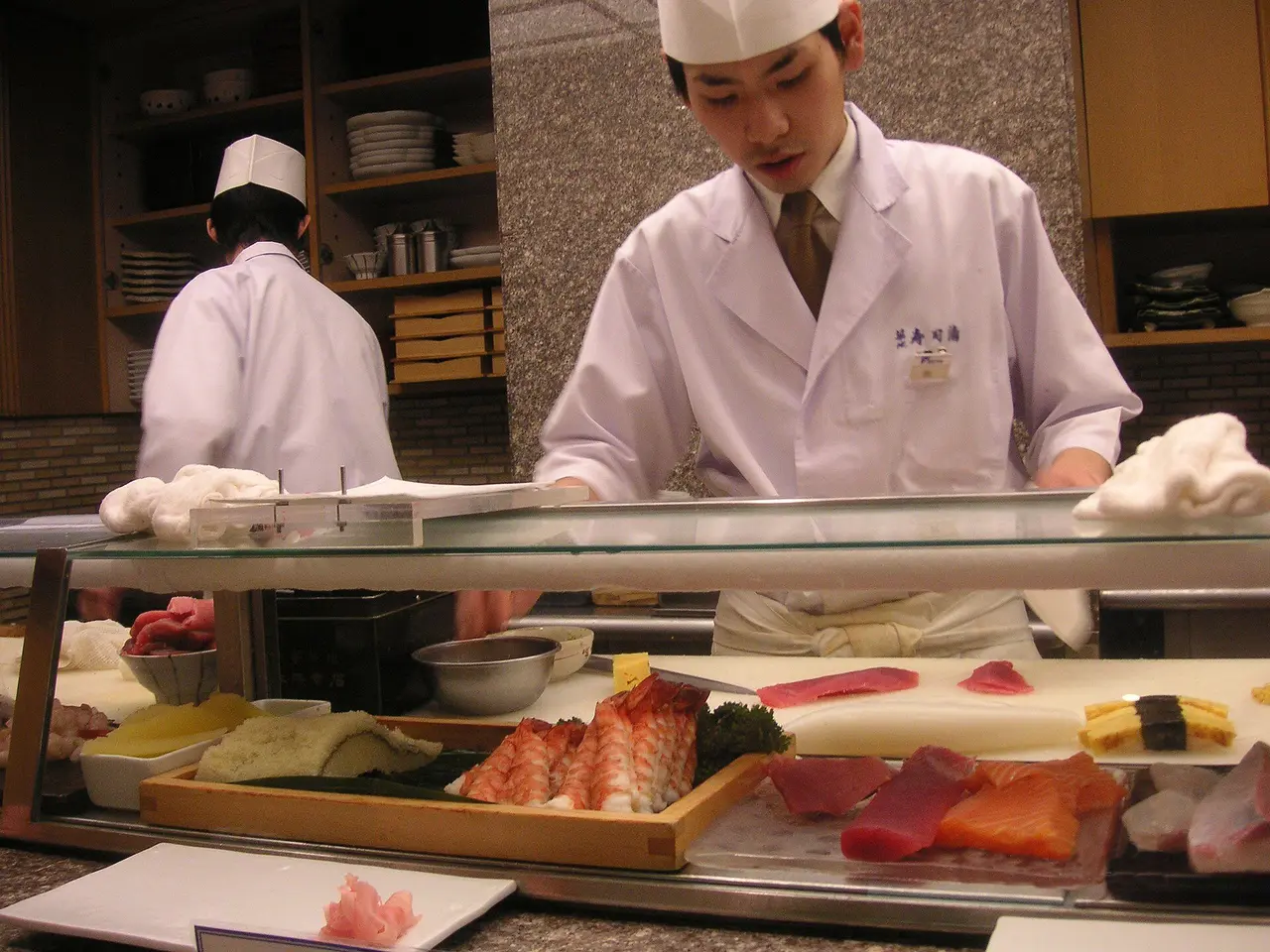
To cook sushi rice properly, use Japanese short-grain rice, rinse it until the water runs almost clear, drain it, cook it with roughly the same volume of water as rice (about 1 : 1 to 1 : 1.1), let it steam for another 10–15 minutes, then mix it while hot with vinegar seasoned with sugar and salt, cutting and fanning so the grains stay separate and glossy, and keep it at about body temperature for shaping. Sushi rice is not only about flavour: the vinegar lowers the pH and makes the rice safer to hold at the counter, but it still has to be used within a time limit. This lesson is written the way an itamae (sushi counter chef) coaches a kitchen assistant, with a worked example of rice, vinegar and food cost for a counter selling 120 pieces of nigiri and 20 maki rolls a day.
By the end of this lesson, you will be able to:
- Choose the right rice for sushi, tell new-crop from older rice and adjust the water accordingly.
- Rinse, drain and cook rice with the correct water ratio in a rice cooker or a heavy pot.
- Mix seasoned sushi vinegar in three flavour styles, and fold and fan the rice without crushing it.
- Hold and store sushi rice during service by a time rule, label it and deal with leftovers correctly.
- Calculate rice, vinegar and food cost for a day's sales with figures that add up.
Learning Asian cooking properly? Japanese dishes are step 5 of the roadmap, after food safety and raw seafood, knives and core seasonings, high-heat wok cooking and dim sum. See the 8-step Asian cuisine cook roadmap to learn in the right order.
How sushi rice differs from ordinary rice
Sushi rice (shari, sushi-meshi) is short-grain white rice seasoned with vinegar, sugar and salt. At a Japanese sushi counter the rice matters as much as the fish: a good piece of nigiri has rice whose grains are separate yet hold together when shaped, with a balanced sour, sweet and salty taste, served just warm.
What the vinegar does
Vinegar gives a clean sourness that sets off rich fish, and it lowers the pH of the rice. Plain cooked rice at room temperature is a good place for bacteria to grow; properly acidified rice slows that growth a great deal. So mixing the vinegar in the right ratio is a food safety matter, not just a matter of taste.
Rice temperature for shaping
Sushi rice is used at about body temperature. Rice that is too hot warms raw fish quickly and spoils its freshness; cold rice turns hard, the grains separate, it is hard to shape and the vinegar tastes harsh. Rice for maki rolls can be a little warmer than for nigiri.
Choosing rice for sushi
Short-grain japonica rice
Sushi rice is short-grain or round-grain japonica rice, high in amylopectin, so it cooks up tender and glossy with grains that cling just enough. In Vietnam you can buy imported Japanese rice and Japanese varieties grown locally; both work if the grains are even and few are broken. Ordinary long-grain rice cooks up loose and is hard to shape; glutinous (sticky) rice is far too sticky and is not used.
New-crop and older rice
New-crop rice holds more moisture and needs slightly less cooking water; older rice is drier and needs slightly more. Whenever you change to a new batch, cook a small test batch and record the water. Good rice smells lightly fragrant, not musty, with translucent grains and few chalky ones.
Storing dry rice
Keep it in a closed bin in a cool, dry place, off the floor, away from weevils and damp. Label the delivery date and use first in, first out (FIFO).
Rinsing, draining and cooking
- Weigh the rice according to your sales plan (see the worked example).
- Rinse: pour in cold water, stir quickly and drain the first water straight away (it is the cloudiest, and the rice absorbs it fast). Wash gently with your palm, without scrubbing hard enough to break grains, and change the water 3–5 times until it runs almost clear (Figure 1).
- Drain in a sieve for about 30 minutes, or soak for about 30 minutes then drain, following your kitchen's recipe; the aim is for each grain to absorb water evenly from outside in.
- Measure the water: by volume about 1 : 1 to 1 : 1.1 (rice : water). By weight, 1 kg of rice takes about 1.2 litres of water. You can add a small piece of kombu, removed before boiling or when the rice is done.
- Cook in a rice cooker (on the sushi setting if it has one) or a heavy pot with a tight lid.
- Rest: when the cooker switches to keep-warm, leave the lid on for another 10–15 minutes so the steam spreads evenly; do not lift the lid halfway.
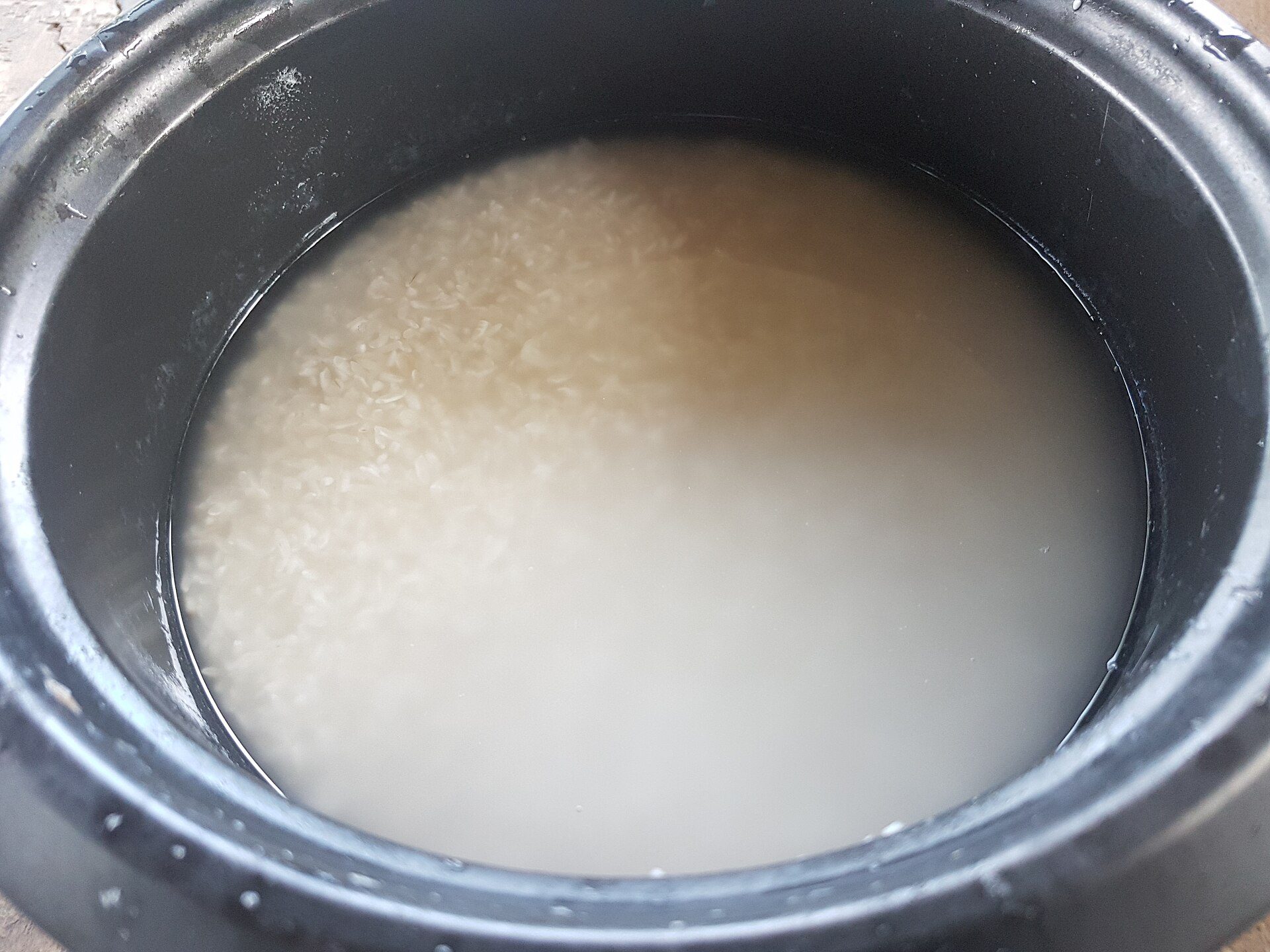
Photo: Obsidian Soul / Wikimedia Commons, CC0

Why less water than ordinary rice
Sushi rice absorbs more liquid when the vinegar goes in. If you cook it with the full water for everyday rice and then add vinegar, it turns mushy and sticks to your hands when shaping. Your cooker may need a few percent more or less; record your kitchen's standard ratio after 2–3 test batches.
Rice cooker or heavy pot
A commercial rice cooker gives repeatable results and suits a busy counter. A cast iron or heavy pot gives fragrant rice and lets you control the heat, but needs watching: high heat to the boil, low for about 12–15 minutes, then off to rest. Whatever you use, do not cook a batch bigger than the pot can handle, or the bottom turns mushy while the top stays underdone.
The vinegar ratio for sushi rice
Sushi vinegar (sushi-zu) is rice vinegar, sugar and salt. A common ratio is about 13–15% vinegar by weight of raw rice, with sugar and salt adjusted to the restaurant's style. The table below is for 1 kg of raw rice, as a reference point for the head chef to adjust to their own recipe.
Ratios for 1 kg of raw rice
| Style | Rice vinegar | Sugar | Salt | Suits |
|---|---|---|---|---|
| Balanced, slightly sweet | 150 ml | 60 g | 15 g | Everyday sushi counters, Vietnamese guests |
| Clean and sour, less sweet | 130 ml | 25 g | 18 g | Nigiri with rich fish, traditional style |
| Sweeter | 150 ml | 80 g | 15 g | Rolls, family sushi sets |
Mixing the vinegar
Put the vinegar, sugar and salt in a small pan over very low heat and stir until dissolved, without letting it boil, or the vinegar loses its aroma. Cool it, pour it into a clean bottle and label it with the date. Making a larger batch to last a few days keeps the flavour consistent between batches of rice; store it as your kitchen specifies.
Folding and fanning the rice
- Wipe a wooden mixing tub (hangiri) or wide stainless tray with a clean wet cloth so the rice does not stick.
- Turn the freshly rested rice into the tub and spread it out.
- Pour the vinegar evenly over the surface across the back of a wooden paddle (shamoji).
- Cut diagonally through the rice with the paddle and turn it gently, never pressing or stirring in circles, which crushes the grains.
- Fan at the same time (an assistant or a hand fan) so steam and the sharp vinegar smell escape and the grains turn glossy (Figure 2). This usually takes about 5–10 minutes.
- Gather the rice to one side, cover it with a clean damp cloth and keep it warm until use.
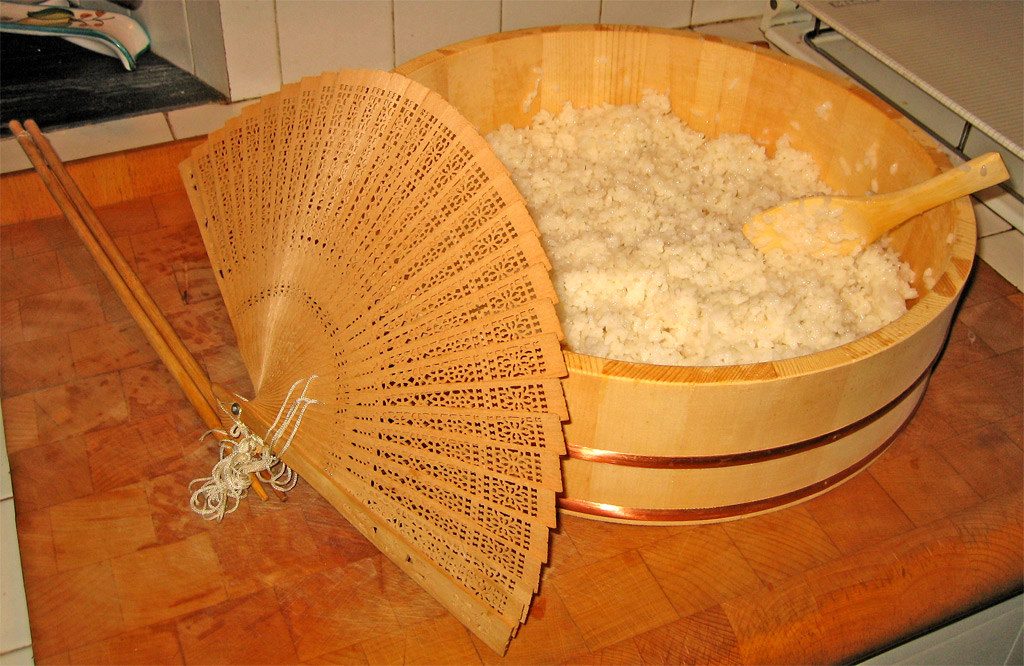
Photo: fugzu / Wikimedia Commons, CC BY 2.0

Properly made rice looks like Figure 3: whole, glossy grains that still hold together when shaped, with no crushed grains or pasty clumps.
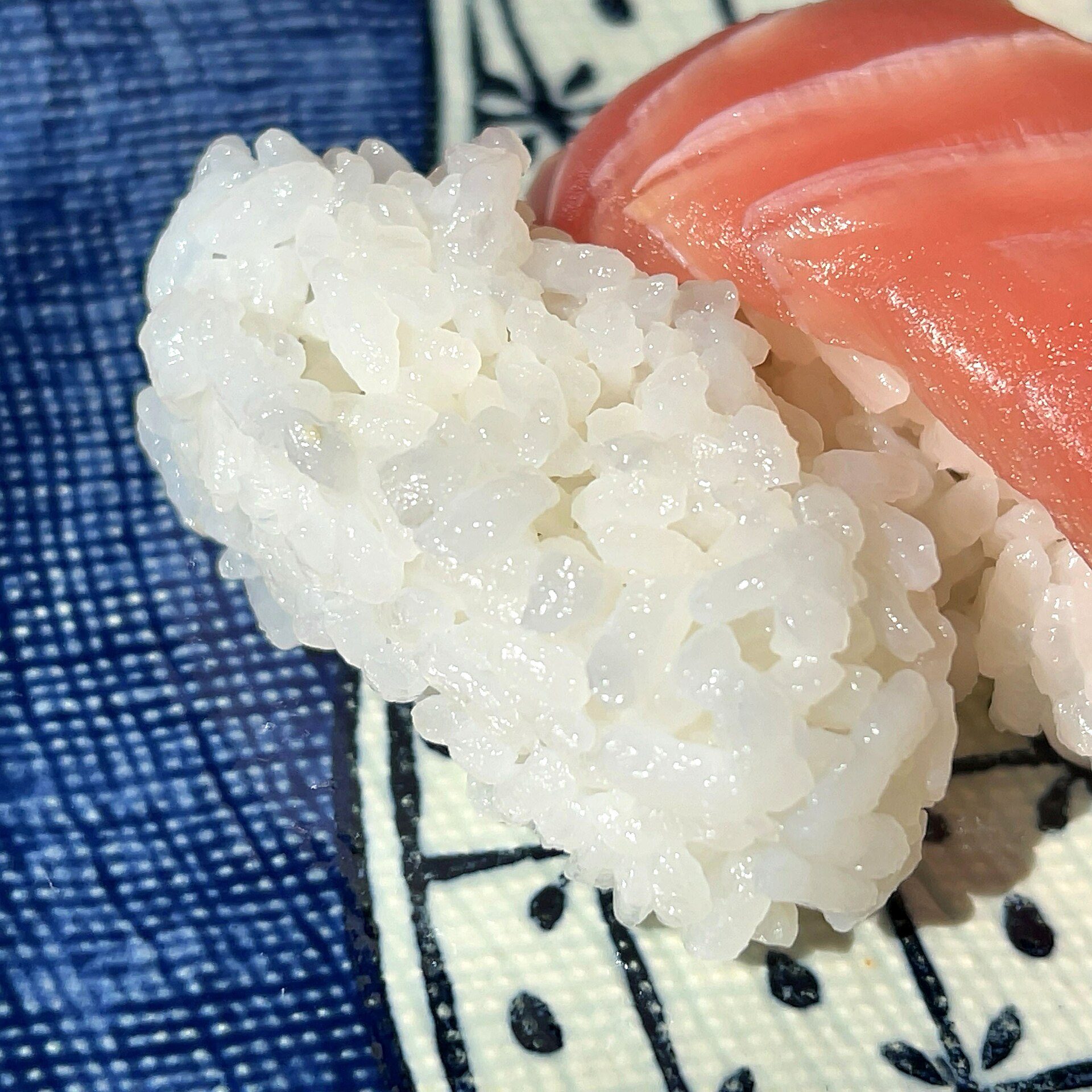
Photo: Asanagi / Wikimedia Commons, CC0

Holding sushi rice and food safety
This is where many new cooks go wrong: sushi rice looks clean and has vinegar in it, so it tends to sit out all day. Sushi rice is ready-to-eat, served with raw fish, and the guest does not cook it again; any mistake goes straight into the guest's mouth.
Holding rice during service
Keep mixed rice in a wooden or insulated container with a lid, covered with a damp cloth, in a clean spot away from heat and away from the raw meat and fish area. Do not chill sushi rice and then take it out to shape: the grains harden and lose their tenderness, and condensation makes the rice wet. Label every container with the time mixing finished.
The 4-hour rule and pH
Many sushi kitchens follow this principle: sushi rice held at room temperature must be used within about 4 hours of mixing; after that it is thrown away, never mixed into a new batch. Many international food safety codes treat rice acidified to a pH of about 4.6 or below as a condition for holding it unrefrigerated, together with an approved procedure and pH measurement with test strips or a meter. In Vietnam, follow your restaurant's food safety plan and the current rules of the authorities; where there is no pH procedure, the time rule is the safest approach.
Leftover rice at the end of service
Sushi rice past its time limit or left over from a previous shift is discarded. Never re-season yesterday's leftover rice to sell. If the kitchen makes fried rice from plain cooked rice, that rice must be cooled quickly and refrigerated right after cooking, not taken from sushi rice that has been sitting at the counter.
The raw fish that goes with it
Fish served raw must be sashimi grade from a supplier with clear traceability, frozen to kill parasites as required (many international guidelines use about −20°C for 7 days, or colder for a shorter time), thawed in the fridge and kept below about 4°C until cutting. Boards, knives and cloths for raw food are kept separate, as you learned in step 1 (Figure 4).
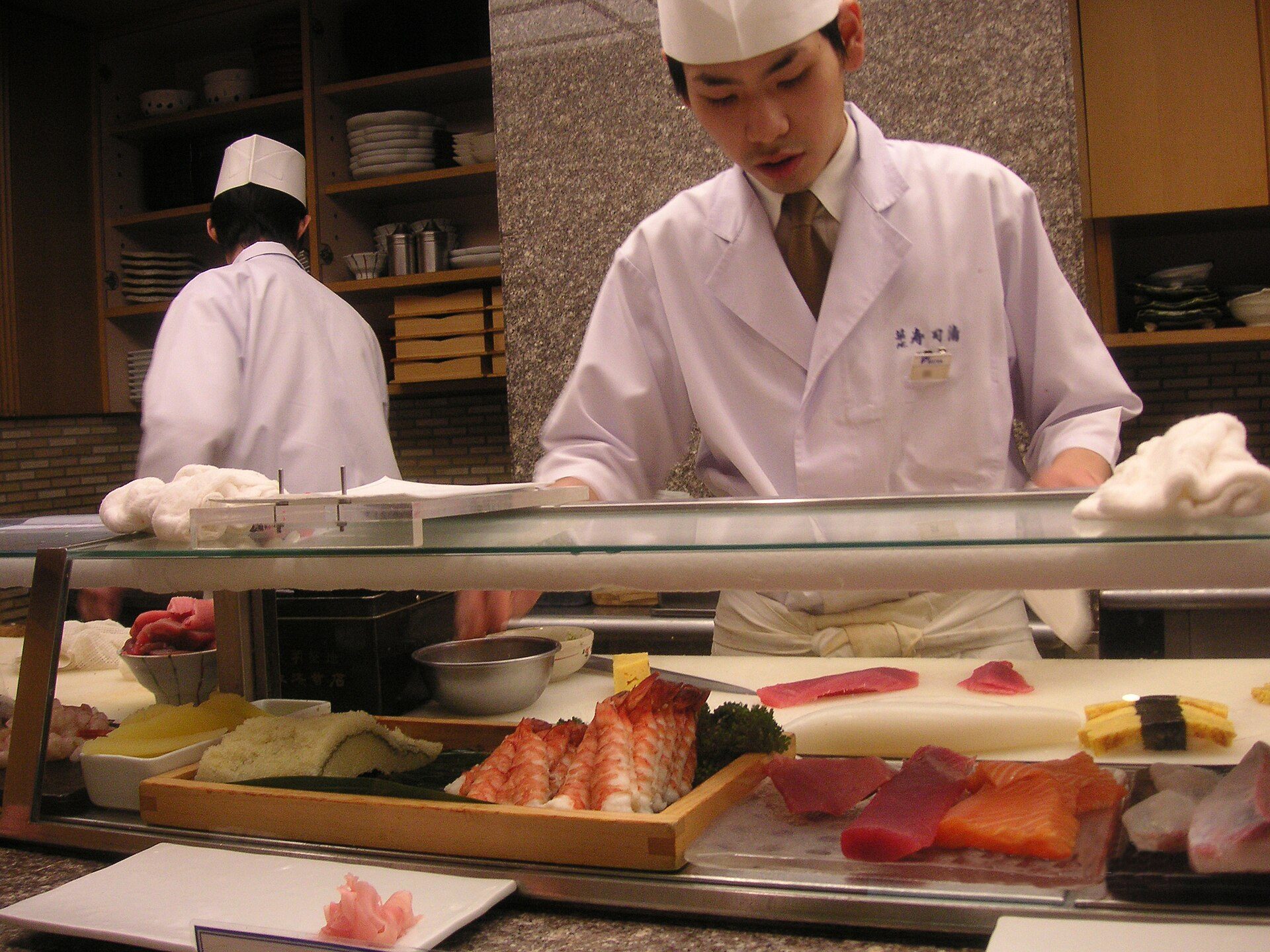
Photo: DinkY2K at English Wikipedia / Wikimedia Commons, CC BY-SA 3.0

Safety warning: Steam from rice cookers and heavy pots is very hot when the lid comes off; lift the lid away from your face and hands. Never plug in or unplug a rice cooker with wet hands, and check the cable for cracks. Sashimi knives are very sharp: cut in one long drawing stroke, lay the knife parallel to the edge of the board when not in use, and never leave a knife hidden in a sink of water. Sushi rice past its time limit must be discarded; raw fish must be fit to eat raw and kept cold throughout. Ask guests about allergies (fish, shellfish, sesame, soy); advise pregnant women, young children, older people and anyone with weakened immunity to consider cooked dishes. If a guest shows signs of a severe allergic reaction (difficulty breathing, swollen lips or tongue), call emergency services at once (115 in Vietnam).
Worked example: rice for 120 nigiri and 20 maki rolls a day
A sushi counter in a food court opens from 10:30 to 19:00 and sells about 120 pieces of nigiri and 20 small maki rolls a day. The kitchen uses the "balanced, slightly sweet" vinegar style from the table above.
Working out rice and raw rice
- Rice for nigiri: 120 × 18 g = 2,160 g.
- Rice for maki: 20 × 90 g = 1,800 g.
- Total sushi rice needed: 2,160 + 1,800 = 3,960 g, about 4 kg.
- From kitchen experience, 1 kg of raw rice gives about 2.3 kg of sushi rice after seasoning.
- Because of the 4-hour rule, cook two batches: a lunch batch of 1 kg raw rice (about 2.3 kg sushi rice) and an afternoon batch of 0.8 kg (about 0.8 × 2.3 = 1.84 kg). Total 2.3 + 1.84 = 4.14 kg, leaving 0.18 kg for losses.
Water and vinegar
| Batch | Rice | Cooking water | Vinegar | Sugar | Salt |
|---|---|---|---|---|---|
| Lunch | 1.0 kg | 1.20 litres | 150 ml | 60 g | 15 g |
| Afternoon | 0.8 kg | 0.96 litres | 120 ml | 48 g | 12 g |
| Total | 1.8 kg | 2.16 litres | 270 ml | 108 g | 27 g |
Schedule and food cost
Lunch batch: rinse at 8:30, drain until 9:10, cook until about 9:55, rest until 10:10, mixing and fanning done by 10:20, use until 14:20. Afternoon batch: start rinsing at 13:00, mixing done by about 14:50, use until 18:50; any rice left after its limit is discarded, even though the counter stays open until 19:00.
Rice food cost (2026 reference, varies with the rice and supplier): rice 1.8 kg × 50,000 VND = 90,000 VND; 270 ml rice vinegar about 32,400 VND; sugar, salt and kombu about 8,600 VND. Total 90,000 + 32,400 + 8,600 = 131,000 VND (about 5 USD) for about 4.14 kg of rice, or about 131,000 ÷ 4.14 ≈ 31,600 VND per kg, roughly 570 VND for each 18 g rice ball. Imported Japanese rice can cost several times more than Japanese varieties grown in Vietnam; recalculate whenever you change rice.
Common mistakes when cooking sushi rice
Mushy rice that sticks to your hands
Sign: the rice sticks to your hands and shaped pieces slump. Cause: starch not rinsed off, too much cooking water, stirring the rice like dough. Fix: rinse until the water is almost clear, reduce the water for the batch of rice, and only cut and turn gently.
Dry rice with hard grains
Sign: loose grains with a slightly hard centre that break when shaped. Cause: too little water, skipping the draining or resting step, fanning too long, chilling the rice. Fix: check the water ratio, rest for a full 10–15 minutes, fan just enough and cover with a damp cloth.
Harsh or flat vinegar taste
Sign: a sharp sourness that hits the nose, or no sourness at all. Cause: boiling the vinegar, pouring it over rice that has already cooled so it does not soak in, inaccurate measuring. Fix: dissolve the vinegar mix over low heat without boiling, season the rice while hot, and measure with scales and jugs.
No mixing time recorded
Sign: nobody knows what time a container of rice was mixed. Cause: no label, old and new batches combined. Fix: one container per batch, labelled with the time mixing finished and the discard time.
Frequently asked questions
What is the vinegar ratio for sushi rice?
A common reference for 1 kg of raw rice is about 130–150 ml rice vinegar, 25–80 g sugar and 15–18 g salt, depending on the restaurant's style. Start at 150 ml vinegar, 60 g sugar and 15 g salt and adjust to your guests' taste.
Which rice should I use for sushi?
Short-grain or round-grain japonica rice with even, unbroken grains and a light fragrance. Japanese varieties grown in Vietnam work for everyday counters; imported rice is usually used in high-end restaurants.
How long can sushi rice be kept?
At room temperature, many kitchens set a limit of about 4 hours from mixing, then discard it, unless the restaurant has an approved pH procedure. Never keep sushi rice overnight to sell the next day.
Can sushi rice go in the fridge?
For safety, chilling slows bacteria, but the rice turns hard, loses its tenderness and is no longer suitable for shaping nigiri. At the counter, the right approach is to cook batches that match demand and follow the time rule.
Do I need a special pot for sushi rice?
No. A commercial rice cooker with a sushi setting gives consistent results; a heavy pot with a tight lid still makes excellent rice if you manage the heat and rest it long enough.
Practice and self-assessment
- Cook three small batches of 500 g rice at three water ratios (1 : 1; 1 : 1.05; 1 : 1.1 by volume), and record how tender each is and how well it shapes.
- Mix vinegar in two styles from the table, season two batches of rice, have three people taste them and note their comments.
- Shape 20 rice balls of 18 g and weigh each one.
- Draw up a cooking schedule and rice and vinegar calculation for a counter selling 80 nigiri and 10 maki rolls, following the example.
Self-assessment criteria
- Pass: the grains are whole and glossy, do not stick to your hands and hold their shape; the sour, sweet and salty taste is balanced.
- Pass: at least 16 of the 20 rice balls weigh 17–19 g.
- Pass: every rice container is labelled with mixing and discard times; the rice and vinegar calculations add up.
- Not yet: holding sushi rice across shifts, mixing old and new batches, or using fish that is not fit to eat raw.
Once your sushi rice is consistent, carry on with shaping nigiri, rolling maki, cutting sashimi and tempura in this same step, then move on to the next roadmap step: Korean dishes: kimchi, hot pot, BBQ and banchan, where you learn to make kimchi, marinate grilled meats and control fermentation.
Keep learning Asian cooking: after Japanese dishes come Korean kimchi, hot pot, BBQ and banchan, then an Asian counter menu project for 30 portions. See the 8-step Asian cuisine cook roadmap.