To pan-sear a beef steak properly, pat a steak about 2.5–3 cm thick completely dry, season with salt, sear it in a heavy pan heated until the oil just starts to smoke until both sides have a brown crust, then check the core temperature and take it off about 3–5°C below the doneness the guest ordered, and rest it for 5–8 minutes before slicing. Most steaks that go wrong in a new cook's hands fail because the pan was not hot enough and the meat stewed in its own juice, because doneness was guessed by eye instead of with a thermometer, or because the steak was cut straight off the pan. This lesson is written the way a chef de partie coaches a commis, with a worked example of four steaks at three different doneness levels with black pepper sauce, including food cost.
By the end of this lesson, you will be able to:
- Choose the cut and thickness and prepare a steak so that it browns evenly.
- Read a doneness chart with core temperatures when pulled from the pan and after resting.
- Sear, baste with butter and measure core temperature in the right place with a probe thermometer.
- Rest the steak for the right time, slice across the grain and make a black pepper sauce in the same pan.
- Work out the food cost of one steak and work safely with hot oil, flames and knives.
Learning Western cooking properly? Heat techniques are step 4 of the roadmap, after food safety, knife skills, stocks and the five mother sauces. See the 8-step Western cuisine cook roadmap to learn in the right order.
Why searing a steak needs the right technique
Searing cooks the surface of the meat very quickly at high heat. Once the surface is dry and hotter than about 140°C, sugars and proteins react to form a fragrant brown crust (the Maillard reaction). If the surface is still wet, the heat goes into evaporating water instead, and the steak "boils" in its own juice: grey, with no crust.
Choosing the cut
- Striploin (sirloin): a strip of fat along one edge, firm grain, clear beef flavour; common in mid-range Western restaurants.
- Ribeye: well marbled, tender and rich, holds up well at medium.
- Tenderloin (fillet): the most tender, very lean, dries out if overcooked; usually served rare or medium rare.
Thickness decides the method
Steaks 2.5–3 cm thick are the easiest to control: there is enough time to build a crust before the centre overcooks. Steaks thinner than 2 cm cook through very fast and are hard to keep rare. Steaks thicker than 4 cm should be seared for the crust and then finished in the oven so the centre cooks evenly.
Preparing the meat, the pan and your tools
Preparing the steak
- Take the meat out of the fridge (0–5°C) and leave it at room temperature for no more than about 20–30 minutes to take the chill off.
- Pat both sides and the edges completely dry with paper towel.
- Salt either just before searing, or at least 40 minutes ahead and keep it chilled; salting about 10–15 minutes before is the worst timing, because the salt has just drawn moisture to the surface.
- Add ground pepper after searing or while basting, because pepper burns and turns bitter at high heat.
Pan, oil and thermometer
Use a cast iron pan or a heavy-based stainless steel pan that holds heat well; thin non-stick pans are not suited to long high heat. Use an oil with a high smoke point such as refined canola or sunflower oil; add butter only at the end, because butter burns at a lower temperature. A digital probe thermometer is essential kit for a commis: fast and accurate to 1°C (Figure 1).
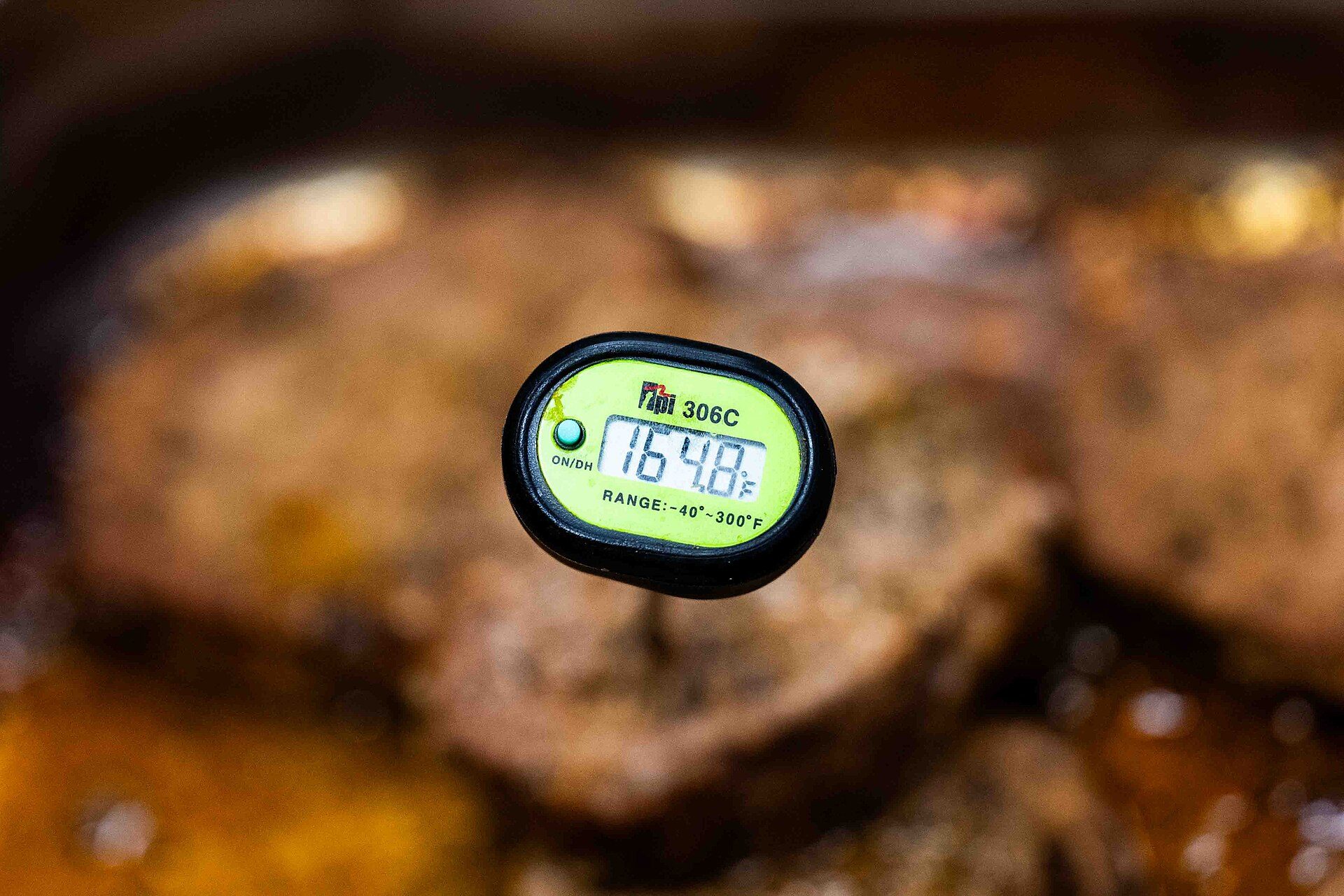
Photo: U.S. Air Force photo by Airman 1st Class Zachary Jakel / Wikimedia Commons, Public domain

Setting up your station (mise en place)
Before you light the burner, lay out: dried steaks, salt, pepper, oil, cubed butter, crushed garlic, sprigs of rosemary or thyme, tongs, a large spoon for basting, the thermometer, a resting rack over a tray, and dry cloths. Once the pan is hot there is no time to look for things.
Steak doneness levels and core temperatures
Doneness is named after the colour and temperature at the centre of the steak. Looking at it or pressing it is only an estimate; in a professional kitchen, the thermometer decides.
Doneness chart
| Doneness | Centre colour | Pull from pan at | After resting |
|---|---|---|---|
| Rare | Bright red, cool in the middle | about 46–48°C | about 50–52°C |
| Medium rare | Red-pink, warm | about 51–53°C | about 55–57°C |
| Medium | Light pink | about 56–58°C | about 60–63°C |
| Medium well | Slightly pink in the middle | about 61–63°C | about 65–67°C |
| Well done | Grey-brown, no pink | about 66–68°C | from about 70°C |
These are common kitchen figures; each restaurant may differ by 1–2°C according to the head chef's standard. Figure 2 shows a medium-rare slice: an even red-pink centre with a thin brown edge.
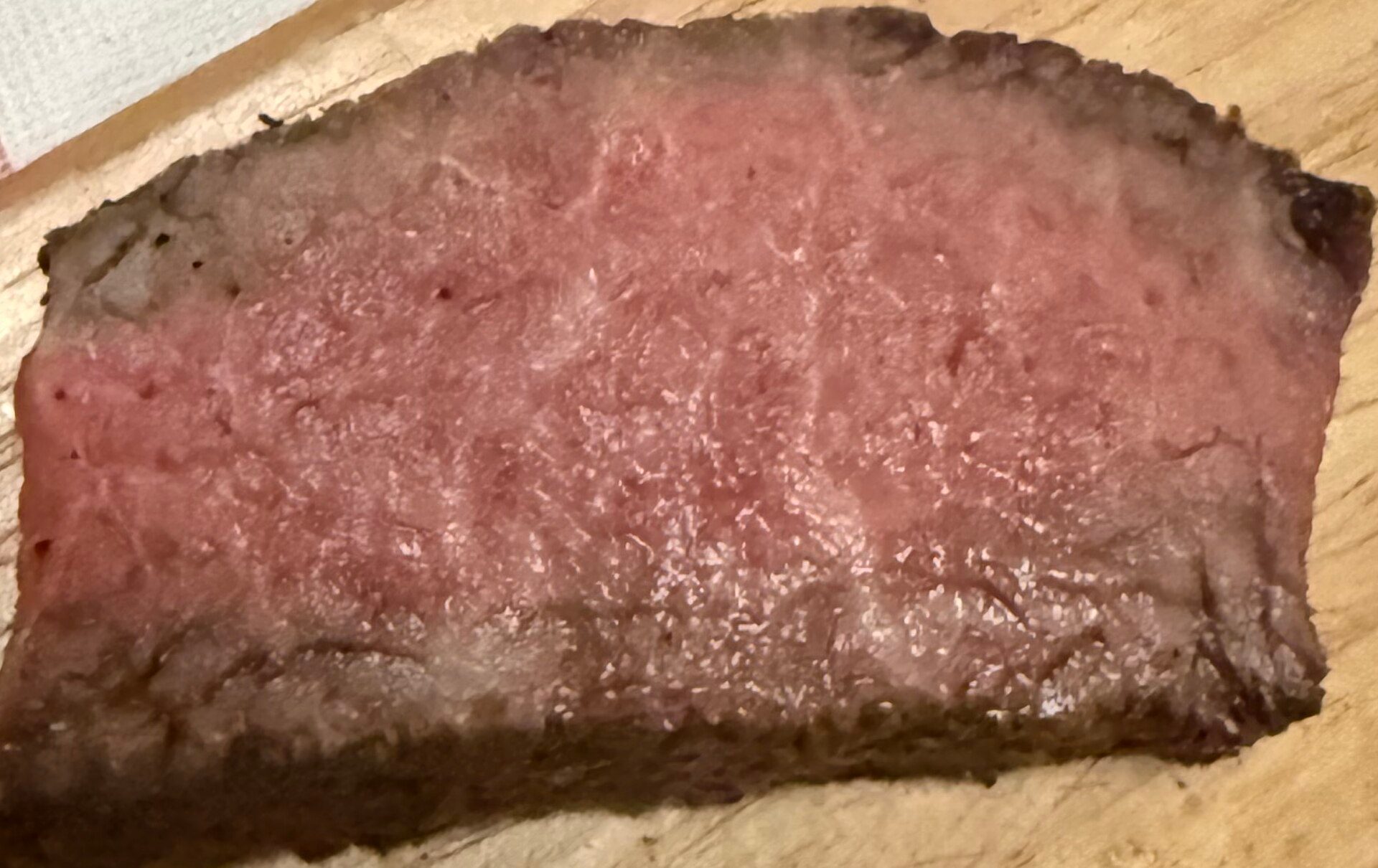
Photo: LuvsMG481 / Wikimedia Commons, CC BY-SA 4.0

What carryover cooking is
When you take the steak off the pan, the surface is much hotter than the centre, and heat keeps moving inwards, so the core rises another 2–5°C while it rests. The thicker the steak and the hotter the pan, the bigger the carryover. That is why you pull early rather than waiting for the core to reach the target.
Measuring the core in the right place
Insert the probe from the side into the very centre of the thickest part, not touching bone and not going through to the pan. Read it when the number stops rising. Wipe the probe with an alcohol wipe or clean paper between steaks to avoid cross-contamination.
Searing step by step
- Heat the pan over high heat for about 3–5 minutes, add a thin layer of oil and wait until it shimmers and just begins to smoke.
- Lay the steak in the pan away from you, so the oil spits forwards, not towards you.
- Leave it alone for about 2 minutes to build the crust; do not press or move it.
- Turn it. From here you can turn every 30–60 seconds so both sides cook evenly and the core heats gradually.
- Stand the steak on its edge with tongs and render the fat strip for about 30–60 seconds until golden and crisp.
- Lower to medium heat, add butter, crushed garlic and herbs; tilt the pan and spoon the foaming butter over the steak continuously for about 1 minute (Figure 3).
- Check the core temperature; take the steak off about 3–5°C below the target, as in the chart.
- Place it on a rack over a tray, rest for 5–8 minutes, then slice.
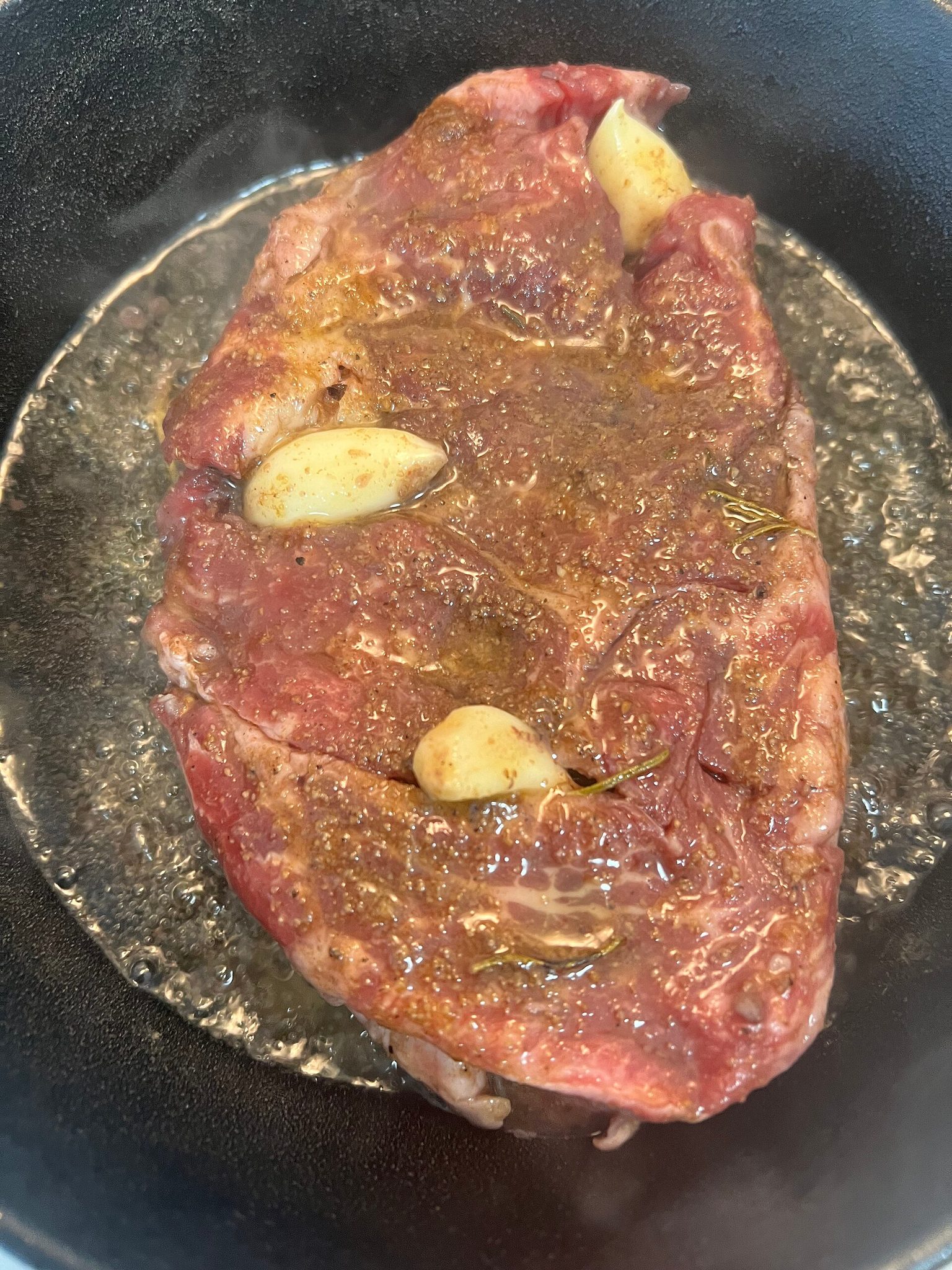
Photo: HaJunkiyada / Wikimedia Commons, CC BY-SA 4.0

Reference times for a 2.5 cm steak
In a hot cast iron pan, on high then medium heat, a 2.5 cm striploin usually needs about 4–5 minutes in total for rare, 5–6 minutes for medium rare and 7–8 minutes for medium. These figures only tell you when to start measuring; a different stove, pan or fridge temperature changes them a lot. Always decide with the thermometer.
Thick steaks: sear, then oven
For steaks thicker than 4 cm or on the bone: sear both sides and edges for about 4–5 minutes, then move the whole pan (if the handle is ovenproof) or the meat on a tray into an oven at about 180–200°C, checking every 3–4 minutes. Another option is to bake at a low oven temperature first and sear last (reverse sear), which cooks the centre more evenly but takes longer at service.
Resting the steak: why and for how long
Straight off the pan, the outer fibres are tight and the juices are pushed towards the centre. Cut it now and the juice runs across the board, the steak eats drier and the core has not yet reached temperature. Resting lets the heat even out and the juices settle.
Resting time
For a 200–300 g steak 2.5–3 cm thick: about 5–8 minutes. Large or bone-in steaks: about 10 minutes or more. An easy rule used in many kitchens is to rest for about half the searing time, with a minimum of 5 minutes.
Resting properly
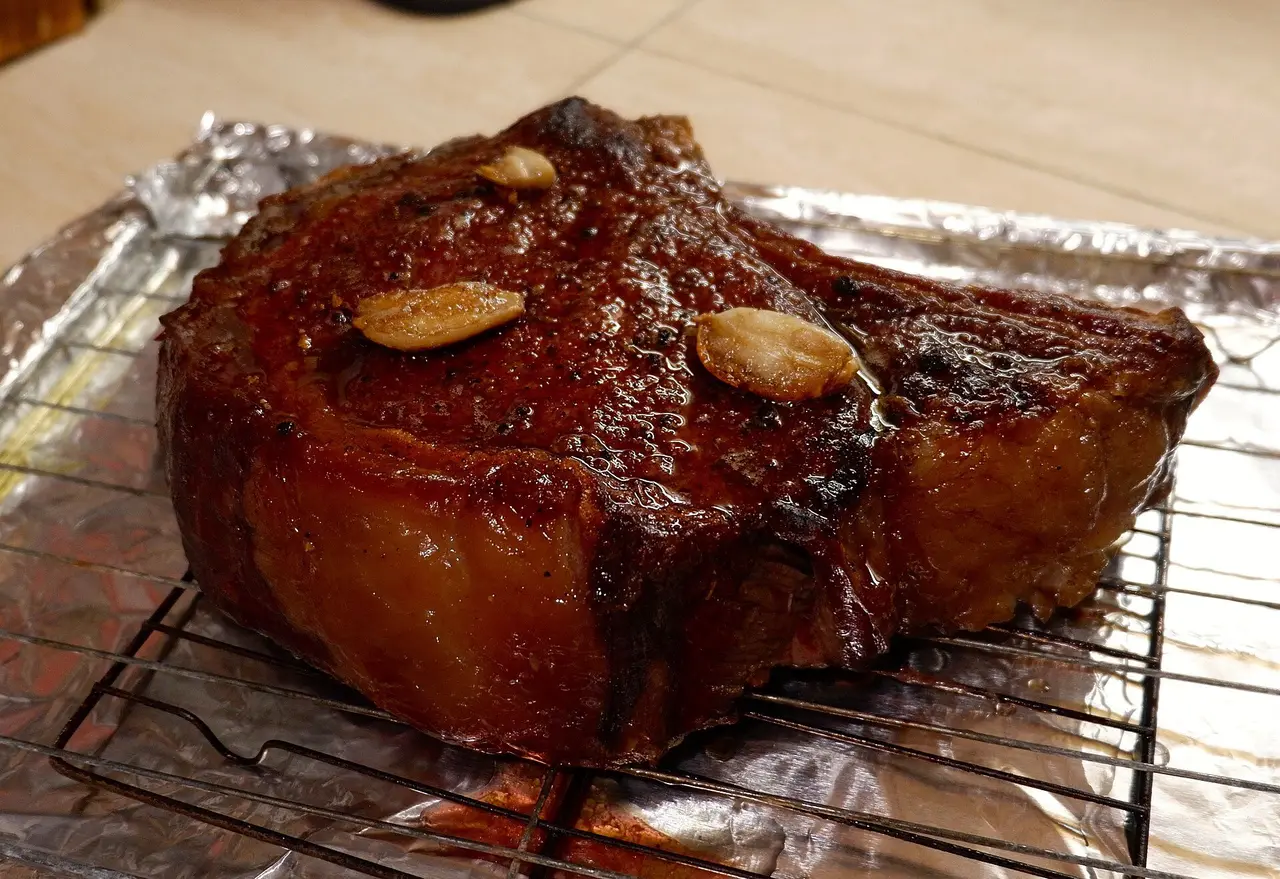
Put the steak on a rack over a tray so the underside does not sit in liquid and soften the crust (Figure 4). You can tent it loosely with foil in a cold kitchen, but do not wrap it tightly, because steam softens the crust. The juice that collects in the tray goes into the sauce.
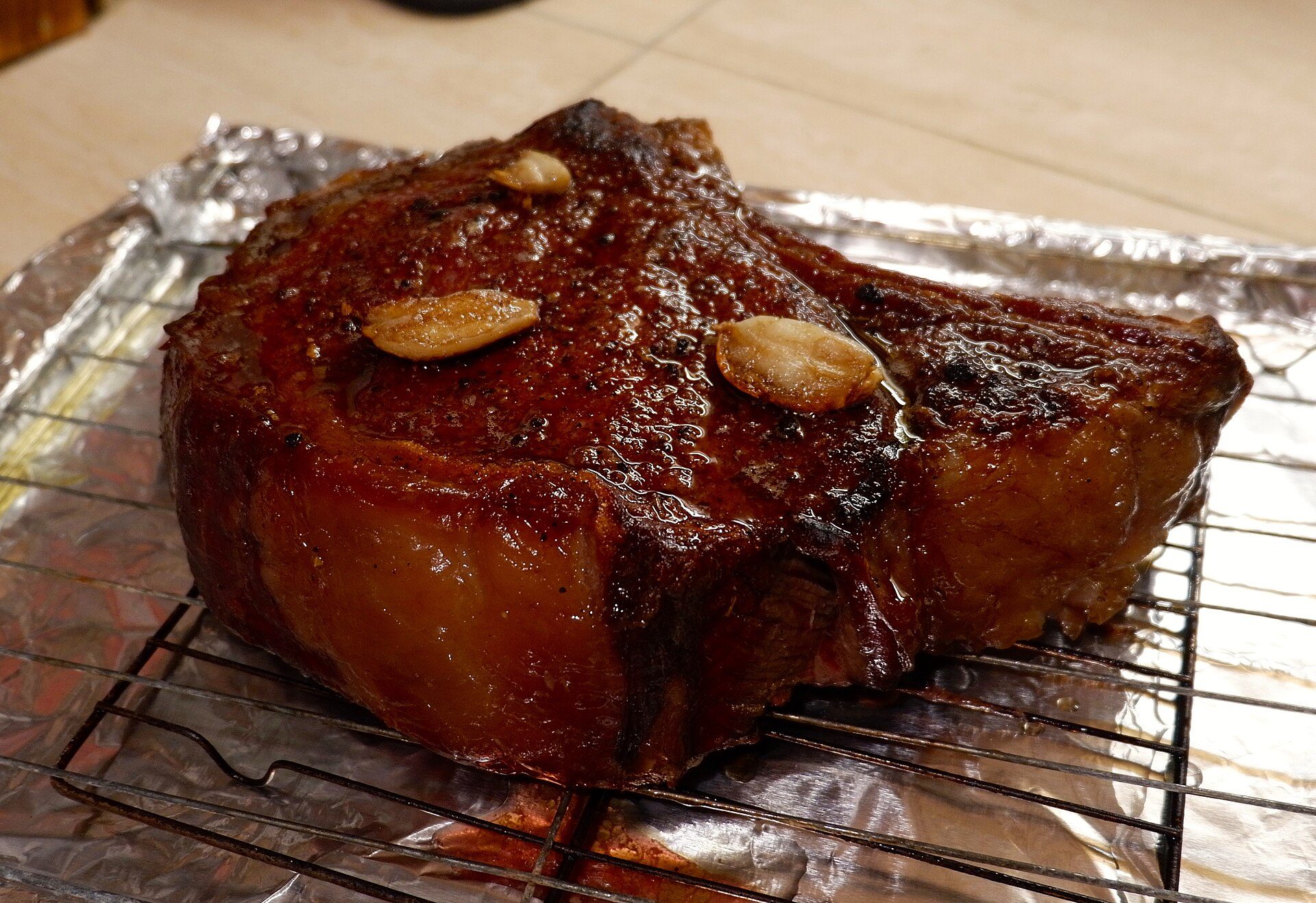
Photo: Key West Wedding Photography / Wikimedia Commons, CC BY 2.0

Slicing across the grain
Find the direction of the grain (the parallel lines of muscle fibre) and cut at right angles to it, in slices about 1–1.5 cm thick. Cut along the grain and the slices are chewy even when perfectly cooked. Use a sharp knife and draw it in one long stroke instead of sawing.
Black pepper sauce from the searing pan
A French-style pepper sauce (au poivre) uses the brown residue on the bottom of the pan (the fond) for depth of flavour. The method below makes about 200 ml, enough for four portions.
Ingredients for four
- Black peppercorns, crushed, 1 tablespoon (about 8 g); shallots, finely chopped, 20 g; butter 15 g.
- Brandy 30 ml (optional); rich beef stock or demi-glace 150 ml; whipping cream 60 ml; salt.
Method
- Once the steaks are resting, pour off most of the fat, keeping about 1 tablespoon and the brown fond. If the fond is burnt black, discard it and make the sauce in another pan.
- Medium heat: add butter and shallots and cook for about 1 minute until soft; add the crushed pepper and stir for about 30 seconds until fragrant.
- If using brandy: take the pan off the heat, add the brandy, return to the heat and cook off the alcohol, scraping up the fond.
- Add the stock and reduce by about half.
- Add the cream and simmer gently until the sauce coats the back of a spoon (nappe); add the resting juices and season with salt.
Do not boil the sauce hard after adding cream, or it may split. Many restaurants in Vietnam adjust the sauce for local guests with less pepper or a touch of sweetness; follow your head chef's recipe (Figure 5).
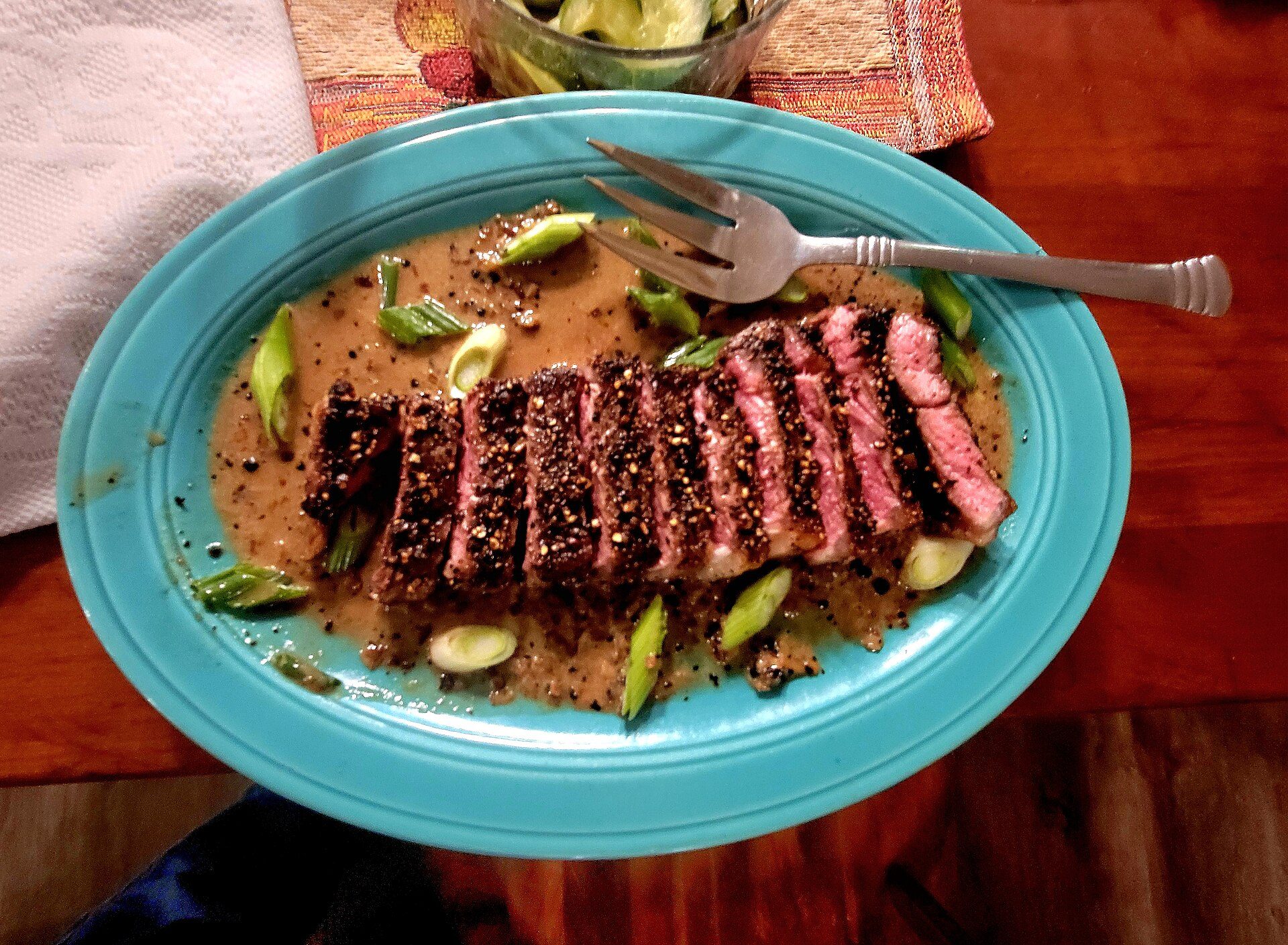
Photo: Cullen328 / Wikimedia Commons, CC BY-SA 4.0

Safety with hot oil, flames and knives
Safety warning: Oil at searing temperature can spit and burn: dry the meat, lay it away from you and wear a long-sleeved chef's jacket. Hold cast iron handles with a dry cloth or oven glove; a wet cloth conducts heat fast and causes steam burns. Always take the pan off the heat before adding alcohol, never pour from the bottle, and keep your face and hair back; if it flares, cover it with a lid and do not throw the pan. If oil in the pan catches fire: turn off the heat, cover with a metal lid or a fire blanket, and never use water. Keep steak knives sharp, use a non-slip board, and pass a knife by laying it on the bench rather than hand to hand. Cool minor burns under cool running water for about 20 minutes; large, badly blistered or facial burns need emergency care.
Food safety with rare steak
In a whole-muscle steak, bacteria sit mainly on the surface, so searing the outside well reduces the risk; that is why rare steak is served in restaurants. Minced beef and needle-tenderised meat (where surface bacteria can be pushed inside) must be cooked through. For pregnant women, young children, older people and anyone with weakened immunity, many food safety guidelines advise cooking whole cuts of beef to at least about 63°C; ask guests and follow your restaurant's menu policy.
Boards, knives and storage temperature
Raw meat uses its own colour-coded board (usually red), and tongs for raw and cooked meat are never shared. Steaks waiting for service are kept chilled at 0–5°C, first in first out (FIFO), as learned in step 1.
Worked example: four steaks, three doneness levels, pepper sauce
A table of four orders 200 g striploin steaks, 2.5 cm thick: one rare, two medium rare and one medium. The station has two cast iron pans.
Order of work
- Pan 1: the medium steak (longest) goes in first; pan 2: the two medium-rare steaks go in about 1 minute later; the rare steak goes into pan 1 once the medium steak has reached the basting stage.
- Pull by thermometer: medium at about 57°C, medium rare at about 52°C, rare at about 47°C.
- During the 5–6 minute rest, make the pepper sauce in pan 2 and plate the garnish, so all four steaks go out together.
Food cost (2026 reference, varies by supplier and cut)
| Ingredient | Calculation | Cost |
|---|---|---|
| Imported beef striploin | 0.8 kg × 700,000 VND/kg | 560,000 VND |
| Pepper sauce (pepper, shallot, butter, stock, cream, brandy) | Batch for 4 | 60,000 VND |
| Oil, basting butter, garlic, herbs | Batch | 40,000 VND |
| Vegetable garnish | 4 × 15,000 VND | 60,000 VND |
| Total food cost, 4 portions | 720,000 VND | |
Check: 560,000 + 60,000 + 40,000 + 60,000 = 720,000 VND, so 720,000 ÷ 4 = 180,000 VND (about 7 USD) per portion. If the restaurant targets a 30% food cost, the minimum menu price is about 180,000 ÷ 0.30 = 600,000 VND per portion. Striploin prices in Vietnam can range from about 450,000 to 1,200,000 VND/kg depending on origin and grade; when the meat price changes, recalculate with the same formula.
Common mistakes when searing steak
Watery, grey meat with no crust
Sign: a brief sizzle that dies away, liquid pooling around the meat. Cause: the pan is not hot enough, the steak was not dried, or too many steaks went into one pan. Fix: preheat the pan long enough, dry the meat, and sear only 1–2 steaks in a 24–28 cm pan.
Burnt crust, cold raw centre
Sign: a bitter, scorched surface and a cold middle. Cause: full heat the whole time, meat straight from the fridge, a very thick steak. Fix: lower the heat once the crust forms, take the chill off the meat, and finish thick steaks in the oven.
Overcooked past the order
Sign: the guest ordered medium rare and it is medium when cut. Cause: pulled at the target temperature, forgetting carryover. Fix: pull 3–5°C early and record your results each time to calibrate for your own kitchen.
Bitter or split sauce
Sign: a burnt taste or a film of oil on the sauce. Cause: the fond was burnt black, the pepper was toasted too long, or the sauce boiled hard after the cream went in. Fix: discard burnt fond, toast the pepper briefly, and simmer gently once cream is added.
Frequently asked questions
What are the steak doneness levels?
Five common levels: rare, medium rare, medium, medium well and well done, distinguished by centre colour and core temperature after resting, from about 50–52°C (rare) to about 70°C and above (well done).
What core temperature is a medium-rare steak?
About 55–57°C after resting; because of carryover, pull it from the pan at about 51–53°C depending on thickness.
How long should I rest a steak?
About 5–8 minutes for a 200–300 g steak 2.5–3 cm thick, about 10 minutes or more for large or bone-in steaks. Rest it on a rack so the crust stays dry.
How do I keep pepper sauce from turning bitter?
Use crushed peppercorns rather than fine ground pepper, toast them for only about 30 seconds, discard any burnt fond, and do not boil hard after adding cream.
Should I turn the steak many times?
Leave it for about 2 minutes first to build a crust. After that, turning often helps both sides cook evenly; what matters is a hot pan and measuring the core, not the number of turns.
Practice and self-assessment
- Sear three striploin steaks of the same thickness: one rare, one medium rare, one medium. Record the pull temperature, the temperature after resting and the searing time.
- Cut each in half and photograph the cross-sections in the same light; compare the colour with the doneness chart.
- Make a batch of pepper sauce for four, recording the yield and the time.
- Work out the food cost of one steak using the real meat price where you buy.
Self-assessment criteria
- Pass: the core temperature after resting is within the target range for all three steaks.
- Pass: an even brown crust on both sides with no wet grey patches; a thin grey band under the crust.
- Pass: the sauce coats the back of a spoon, is not bitter and has not split; the food cost figures add up.
- Not yet: guessing doneness without a thermometer, slicing without resting, or pouring alcohol into a pan while it is on the flame.
Once you can sear to the right doneness, move on to the next roadmap step: Pasta, risotto, salad and soup, where you learn to cook pasta al dente, the common pasta sauces, risotto, Caesar salad and how to keep food hot for batch service.
Keep learning Western cooking: after heat techniques come pasta, risotto, salad and soup, plating and recipe cards, and a three-course set menu project for 20 guests. See the 8-step Western cuisine cook roadmap.