A car battery that drains overnight or after a few days parked (so the engine will not crank) usually has one of three causes: too much current draw with the ignition off, because of aftermarket accessories or electronic modules that do not "go to sleep"; a weak battery that can no longer hold a charge; or an alternator that does not charge enough. The way to find the real fault is to work in order: check the battery and charging system first, then measure the parasitic draw once the car is asleep with a DC clamp meter or a multimeter in series, and finally pull fuses one at a time to narrow down the circuit causing the drain.
By the end of this lesson, you will be able to:
- Read the resting voltage of a 12 V battery, estimate its state of charge and check charging voltage with the engine running.
- Measure parasitic draw with a DC clamp meter or a multimeter in series without waking the car up.
- Pull fuses or measure voltage drop across fuses to find the circuit causing the drain.
- Recognise six common culprits: dashcams, trackers, aftermarket head units, modules that stay awake, stuck relays and leaking alternator diodes.
- Work out how many days a car can sit before it cannot start, and quote the repair for the customer.
Learning automotive electrics properly? Starting, charging and battery drain is step 3 of the roadmap — after battery, airbag and 12 V safety and reading wiring diagrams and using meters. See the 8-step automotive electrician roadmap to learn in the right order.
Why a car loses charge with the engine off
When the engine is off and the car is locked, the battery still powers a few things: the clock and radio memory, the body control module listening for the key, and the alarm. This small current is called parasitic draw. It is normal as long as it is small. A car drains its battery when this draw is abnormally high, or when the battery no longer has enough capacity to cope with a normal draw.
How much draw is normal
Many training materials use a reference of roughly 20–50 mA (milliamps) for a passenger car once the modules are asleep. Newer cars with many modules can be a little higher, older cars usually lower. Right after locking, the draw can be several hundred mA or over 1 A for a few minutes to a few tens of minutes, then falls as the modules go to sleep one by one. The exact limit and sleep time for each model are in the manufacturer's repair information — check them before drawing conclusions.
A weak battery or poor charging
A worn battery (sulphated, or with a failed cell) has very little real capacity left, so even a normal draw can flatten it. A weak alternator, a slipping drive belt or a car that only does short trips means the battery is never fully recharged. The symptoms look exactly like a high parasitic draw, so always check the battery and charging first.
Quick maths: how many days the car can sit
Charge lost per day (Ah) = draw (A) × 24 hours. A starter battery should not be discharged much below about half its capacity; lower than that, many cars struggle to crank and the battery wears out faster. The table assumes a fully charged 60 Ah battery, with 30 Ah as the "usable" part.
| Draw | Lost per day | Days parked (30 Ah) | Verdict |
|---|---|---|---|
| 30 mA | 0.72 Ah | about 41 days | Normal |
| 50 mA | 1.2 Ah | about 25 days | Upper end of normal |
| 100 mA | 2.4 Ah | about 12 days | Needs checking |
| 300 mA | 7.2 Ah | about 4 days | Clear drain |
| 1 A | 24 Ah | under 1.5 days | Something stays on |
These figures are estimates only: an old battery, or one that was not full to begin with, gives fewer days.
Tools you need
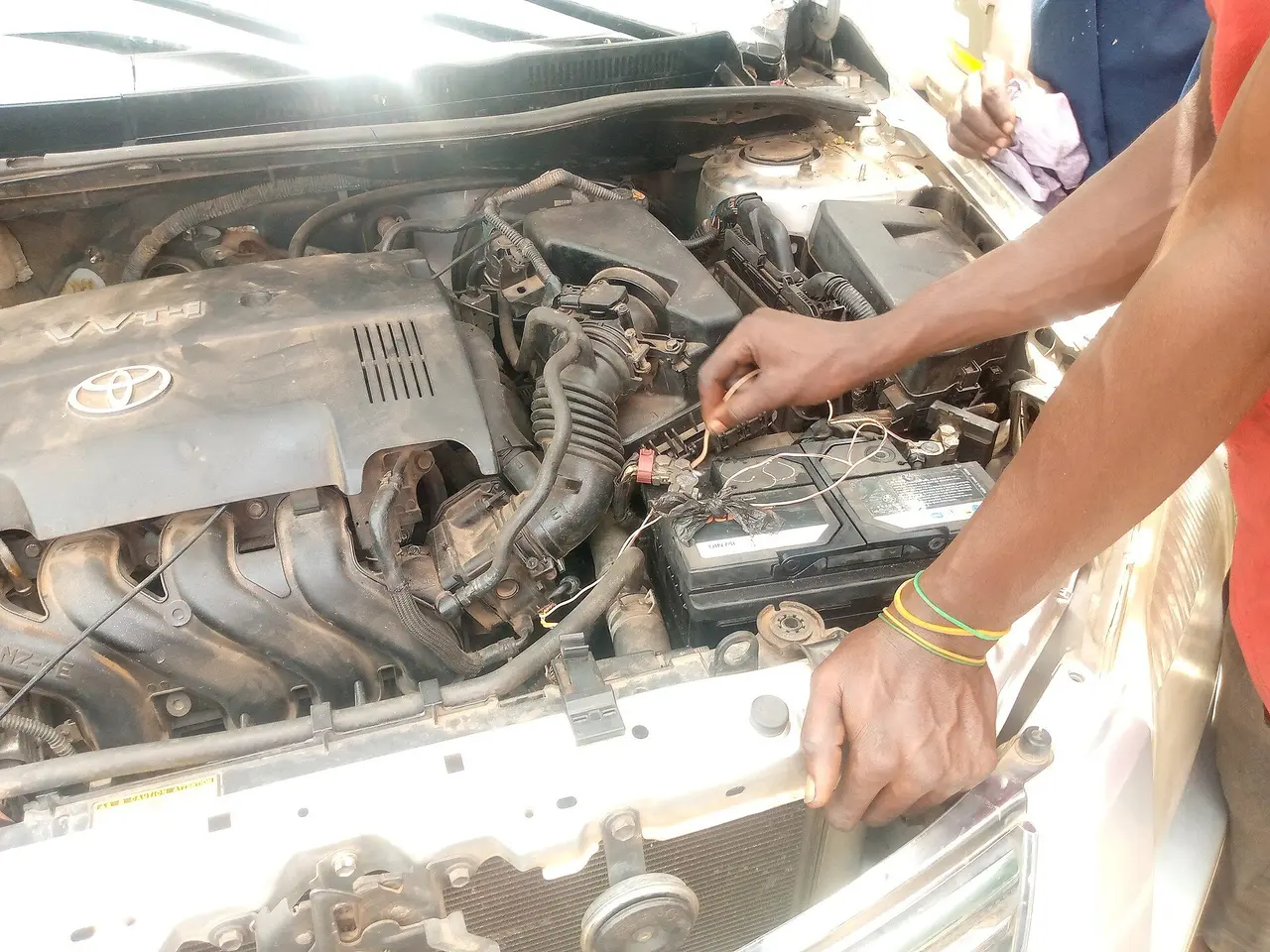
You do not need expensive equipment, but you do need the right kind of tools. Figure 1 shows the scene you will meet most often: checking the battery in the engine bay.
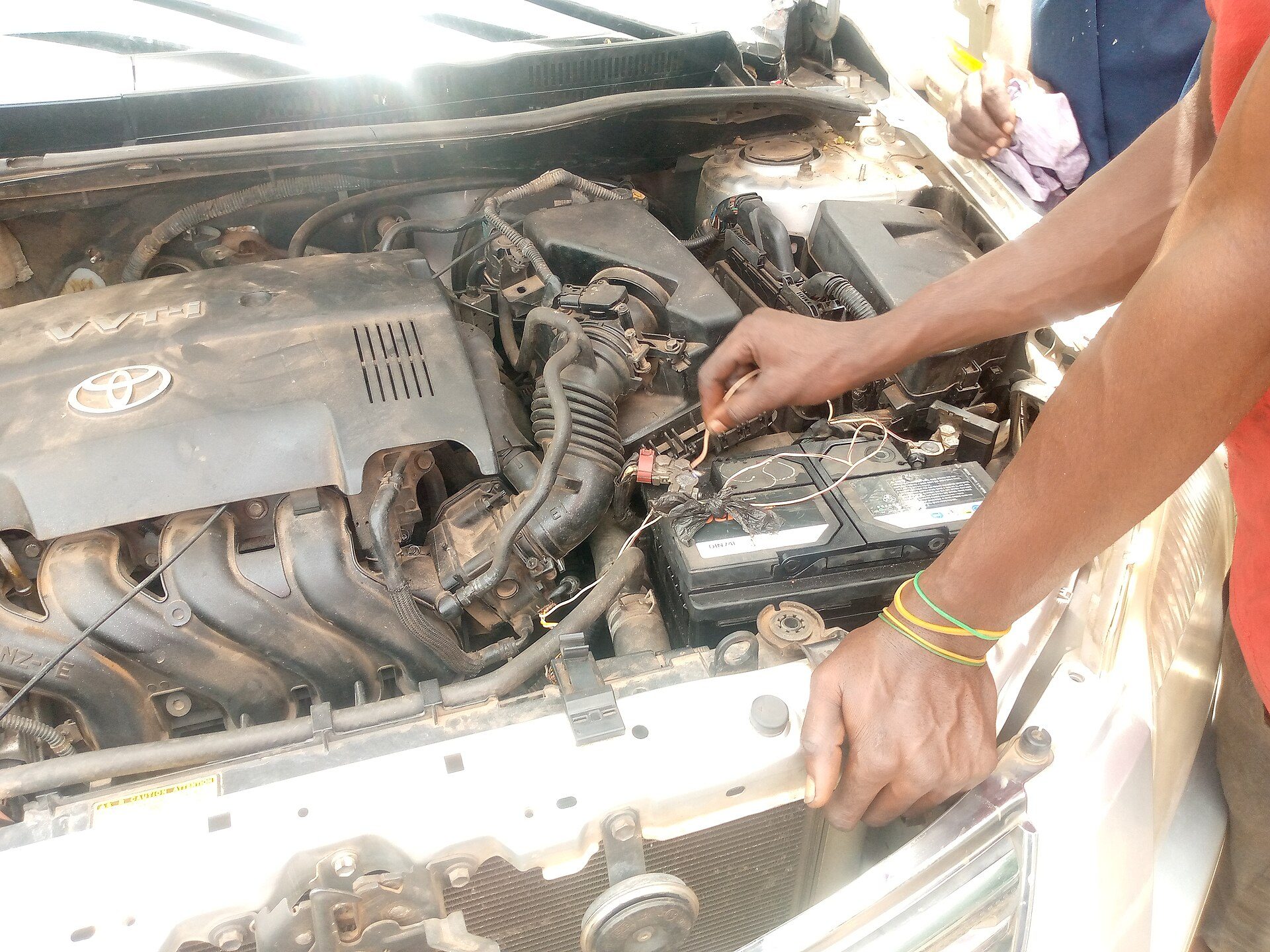
Photo: Azorbli / Wikimedia Commons, CC BY-SA 4.0
Multimeter
Used to measure battery voltage, charging voltage and, in series on the 10 A range, current (Figure 2). A typical multimeter has a separate 10 A socket, usually protected by an internal fuse. If you are not yet confident choosing ranges and plugging in the leads, review the lesson on how to use a multimeter (in Vietnamese) from the residential electrician career.
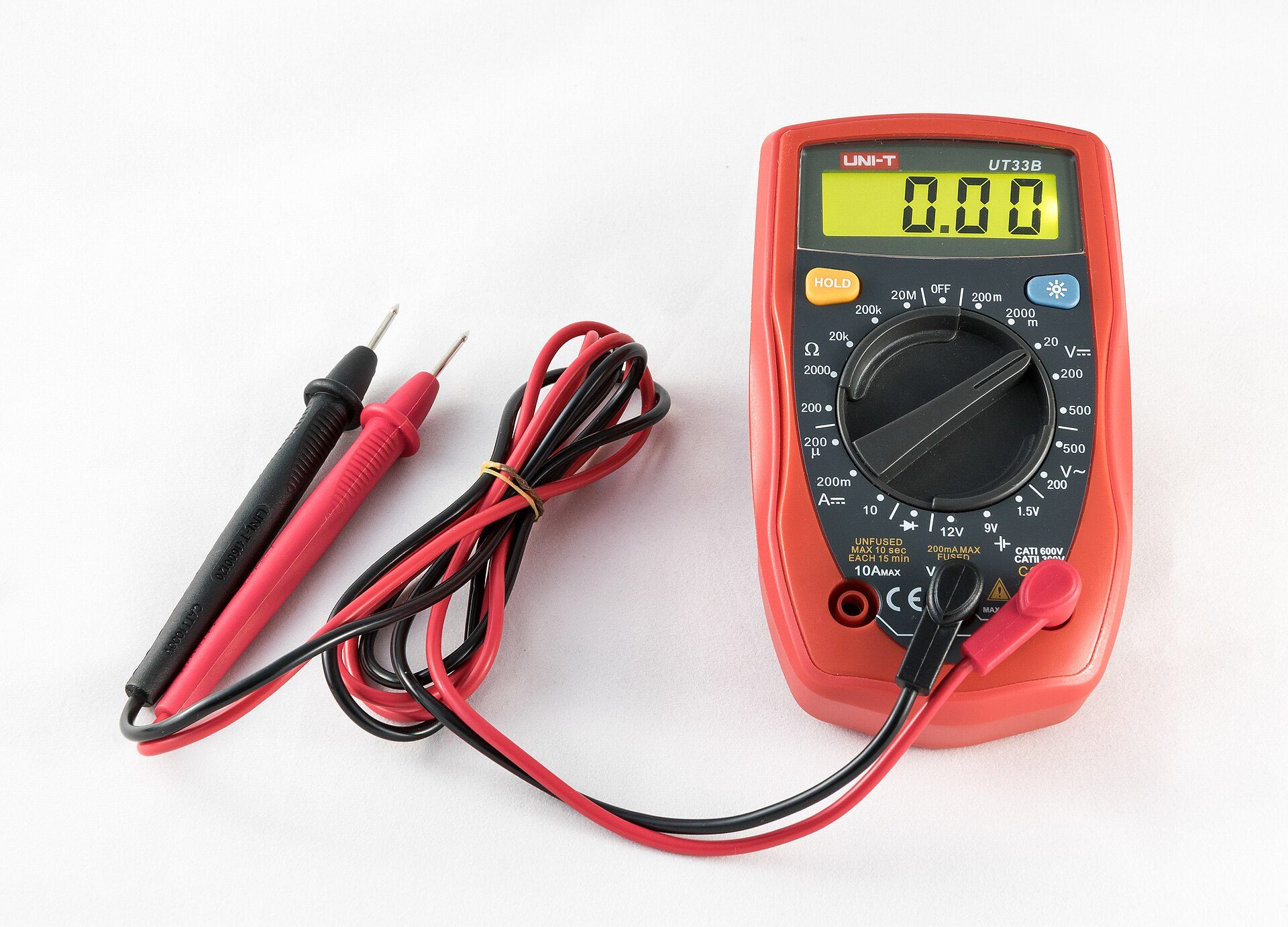
Photo: Jacek Halicki / Wikimedia Commons, CC BY-SA 4.0
Clamp meter: it must measure DC
A clamp meter measures current without breaking the circuit, so the car keeps power and does not wake up. But many cheap clamp meters only measure alternating current (AC), like the one in Figure 3 — useless for car electrics. You need a DC clamp meter with a Hall-effect sensor, a zero button and a mA range or a resolution of 1–10 mA.
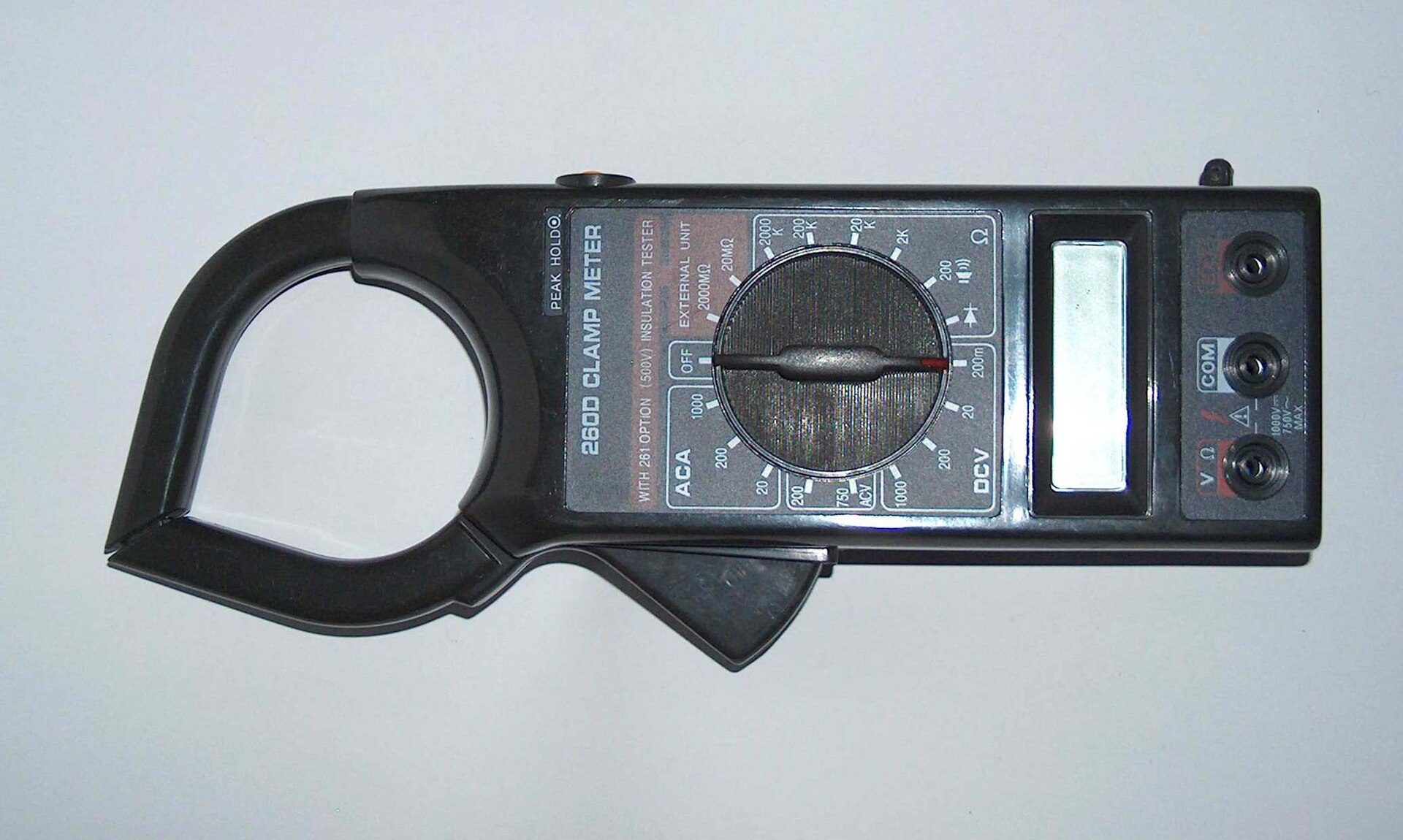
Photo: No machine-readable author provided. Redecke~commonswiki assumed (based on copyright claims). / Wikimedia Commons, Public domain
Other supplies
A fused jumper lead with crocodile clips, the fuse box diagram for the exact model, a fuse puller, a battery charger, gloves and safety glasses.
Step 1: check the battery and charging system
Do not measure parasitic draw on a battery whose condition you do not know, or you may spend a whole session hunting a drain that does not exist.
Measure resting voltage
Resting voltage is the voltage after the car has been off for at least a few hours, with no load. Measuring straight after a drive gives a falsely high reading because of surface charge. The table gives reference values for a 12 V flooded lead-acid battery at about 25°C; AGM and EFB batteries can differ slightly.
| Resting voltage | Estimated charge | What to do |
|---|---|---|
| 12.6 V or more | Nearly full | Ready for load test and draw test |
| about 12.4 V | about 75% | Top up before testing |
| about 12.2 V | about 50% | Charge fully, look for the drain |
| 12.0 V or less | 25% or lower | Slow charge, retest; may already be damaged |
Test the battery and cranking voltage
Once fully charged, use a battery tester (which measures CCA, cold cranking amps) to find its real health. Without a tester, measure the voltage while cranking: it usually should not drop below about 9.6–10 V. A deeper drop with slow cranking points to a weak battery or poor contact at the terminals or earth strap. The battery is also checked at every routine car service (in Vietnamese), so look at the car's history if there is one.
Measure charging voltage
With the engine running, measure across the battery posts: typically about 13.5–14.7 V with no load. Newer cars with smart charging management may drop to about 12.5–13 V once the battery is full — that is by design, so check the manufacturer's information. An alternator with failed diodes can both undercharge and cause a drain with the engine off.
Step 2: measure parasitic draw correctly
This is the step people get wrong most often. You must measure with the car in the same state as when the customer leaves it overnight: locked, with the modules asleep.
Put the car to sleep
- Switch off all lights, air conditioning and accessories; unplug phone chargers; close the boot and glovebox.
- Lower the driver's window if you will need to reach inside, then close the doors and lock the car. Keep the smart key a few metres away so the car does not keep searching for it.
- The bonnet must be open to take measurements, but many cars have a bonnet switch: hold it down (with a suitable clamp) so the car thinks the bonnet is closed.
- Wait for the full sleep time: some cars take 10–20 minutes, others 45–60 minutes or more. While waiting, do not open doors or press the lock button.
Method 1: DC clamp meter on the negative lead
Switch on the clamp meter, select DC and zero it with the jaws away from any wire. Clamp around the battery negative lead (or the positive), so that all of the car's current passes through the jaws; if the negative post has two or three wires, clamp the whole bundle. This method does not break the circuit and lets you watch the draw fall as the car sleeps. Cheap clamp meters can be tens of mA out, so when a reading is close to the limit, confirm it with method 2.
Method 2: multimeter in series
- Plug the red lead into the 10 A socket and select DC A. Clip one lead to the battery negative post and the other to the negative cable terminal.
- Before removing the terminal, connect a jumper lead in parallel from the negative post to the terminal, so the car does not lose power (losing power restarts the modules and wakes them up).
- Loosen and lift the terminal off the post, keeping the jumper in place. Wait for the car to sleep.
- Remove the jumper: now all the current flows through the meter. Read the value in A and convert to mA (0.032 A = 32 mA).
Caution with a meter in series: do not crank the engine, switch on lights or open doors while current is flowing through the meter — tens of amps will blow the meter's fuse or damage the meter. Each time you need to open a door, reconnect the jumper first. Never measure current on the airbag circuit.
Record readings and compare with the limit
Record the draw right after locking and at 10, 20 and 40 minutes. If it settles within the manufacturer's limit, the car has no abnormal drain — go back to suspecting the battery, the charging system or how the car is driven. If it settles high (for example 300 mA) or jumps up at regular intervals, move on to step 3.
Step 3: pull fuses to narrow down the circuit
Break each circuit at its fuse and see how much the draw falls. Cars usually have one fuse box in the engine bay (Figure 4) and one in the cabin.
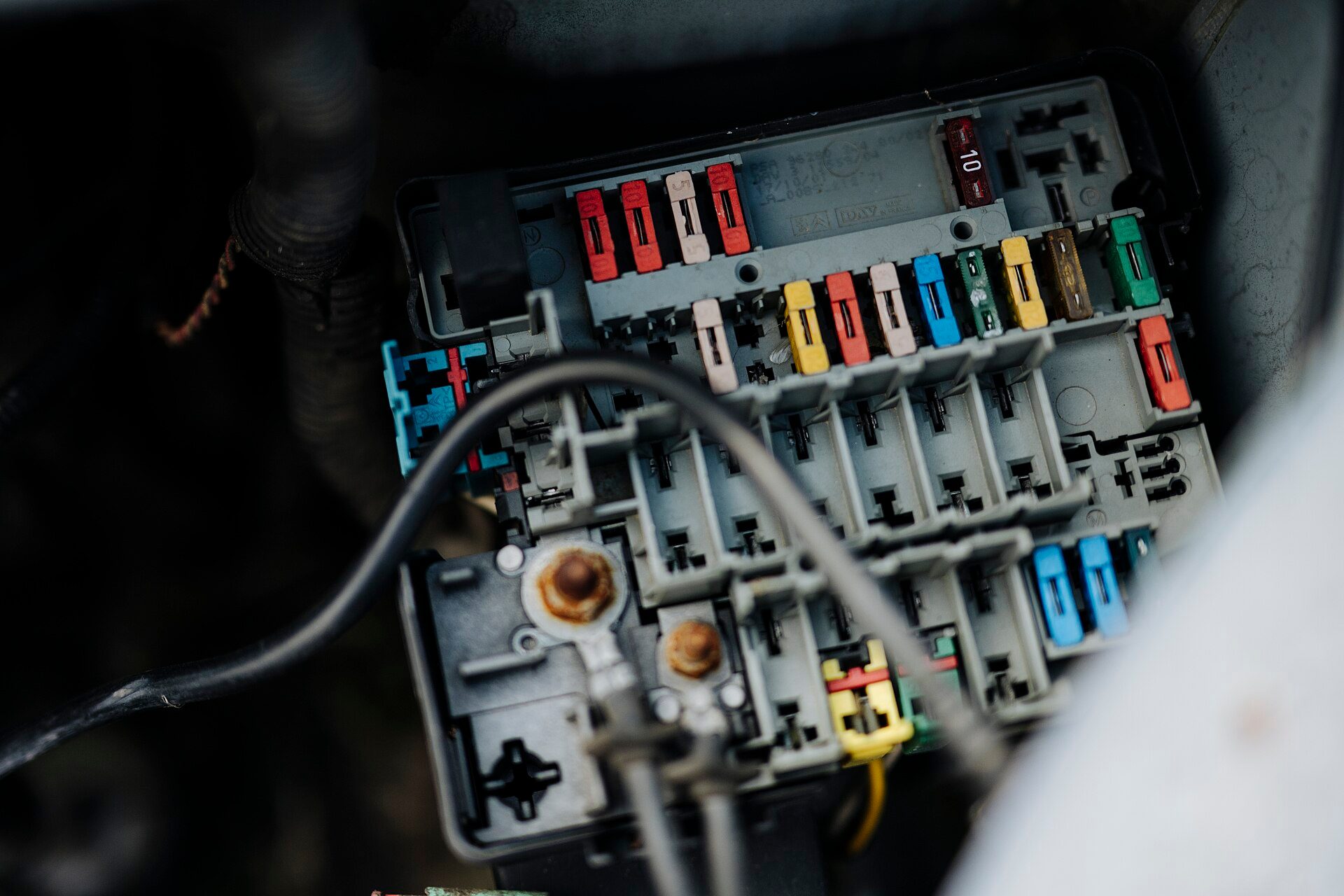
Photo: Shixart1985 / Wikimedia Commons, CC BY 2.0
Fuse-pull procedure
- Leave the clamp meter or multimeter measuring, with the car asleep.
- Pull one fuse at a time, watch the reading, note how much the draw falls, then refit it in the same place before pulling the next.
- If pulling a fuse makes the draw fall sharply (for example from 320 mA to 95 mA), that circuit contains the culprit. Use the diagram to see what it feeds.
- Narrow down within that circuit: unplug each device or disconnect the power lead of any aftermarket accessory.
Pulling a fuse sometimes wakes another module; if so, wait for the car to sleep again before reading. Open the cabin fuse box before you lock the car.
Voltage drop across fuses: no pulling needed
A faster method used by experienced technicians: set the multimeter to DC mV and touch the leads to the two test points exposed on the top of each fuse (Figure 5). A circuit carrying current shows a drop of a few tenths of a mV or more; a circuit with no current shows close to 0. This does not cut power or wake the car. To convert mV into mA you need a voltage-drop table for the fuse type and rating (some tool makers publish them); without one, simply comparing which circuits show a clear drop is enough to narrow things down.
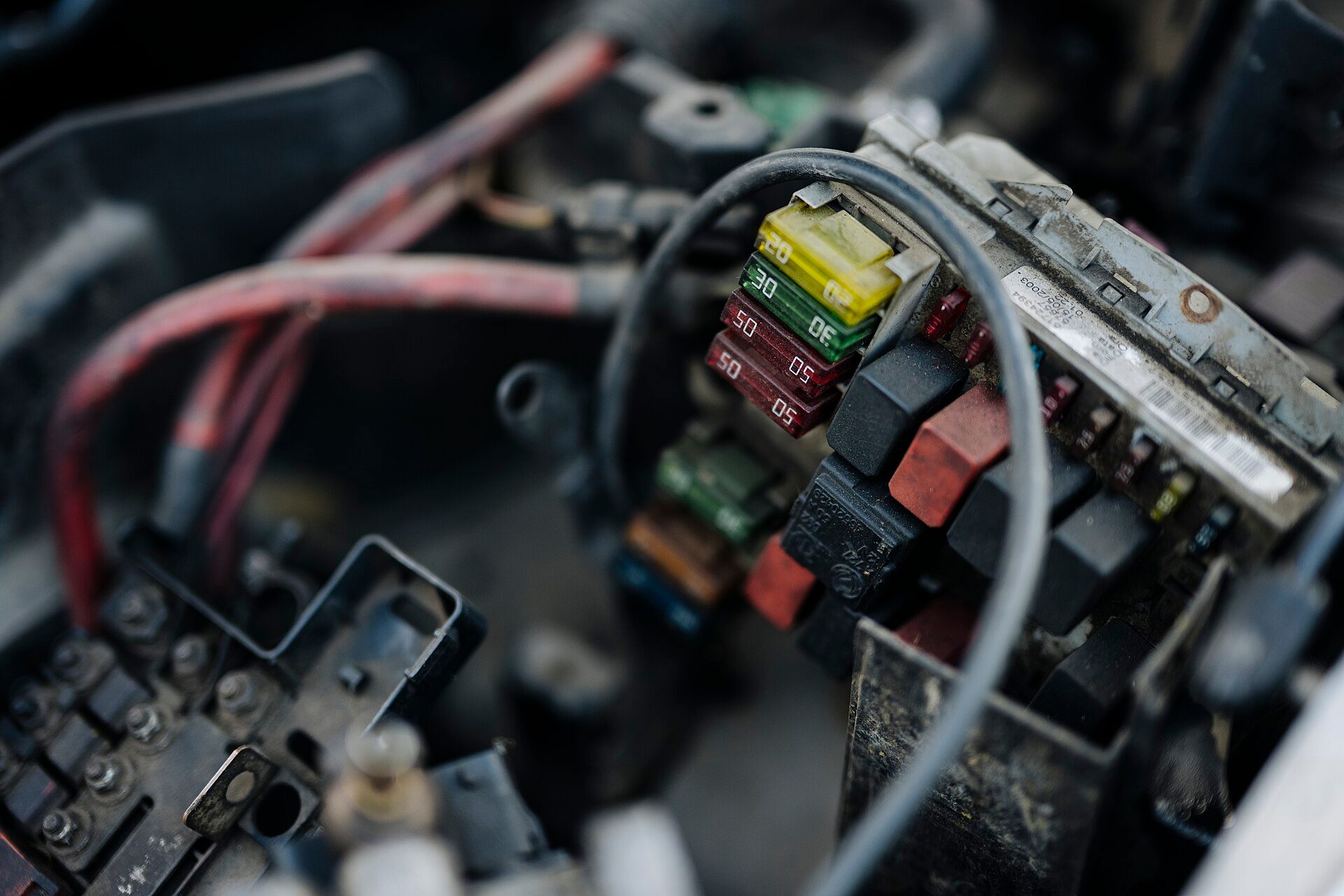
Photo: Shixart1985 / Wikimedia Commons, CC BY 2.0
Reading blade fuses
Most cars use blade fuses (Figure 6), with colours showing the rating under a common convention: for example red 10 A, blue 15 A, yellow 20 A. When refitting, use exactly the rating printed on the fuse and the diagram — never fit a bigger fuse "so it won't blow".

Photo: Illusive255 / Wikimedia Commons, CC BY-SA 4.0
Common causes of battery drain
In Vietnamese workshops, most drain cases involve accessories fitted after the car was bought.
| Culprit | Symptom | How to check | Fix |
|---|---|---|---|
| Dashcam with parking mode | Camera light still on when the car is locked | Unplug the camera, watch the draw fall | Power module with low-voltage cut-off, or move power to ACC |
| Aftermarket tracker or alarm | Draw jumps up regularly when the device sends data | Unplug the device | Choose a device with a sleep mode, rewire to the correct supply |
| Head unit or amplifier wired wrongly | Drain started after an audio or screen upgrade | Check the ACC and permanent feed wires | Rewire the trigger to ACC |
| Module not sleeping | Draw does not fall, no accessories fitted | Scan tool, door, boot and bonnet switches | Repair the switch, update software per the manufacturer |
| Stuck relay, boot or glovebox light staying on | Clicking, parts warm with the car off | Pull the fuse, feel or measure the relay | Replace the relay, adjust the light switch |
| Leaking alternator diode | Drain plus poor charging, alternator slightly warm with the car off | Disconnect the alternator B+ lead, watch the draw fall | Repair or replace the rectifier or alternator |
Dashcams and other accessories
A dashcam in parking mode typically draws from a few tens to a few hundred mA. Many installers tap a permanent feed from the interior light fuse with no low-voltage cut-off. The first question to ask the customer: "Have you had anything fitted recently?"
Worked example: an SUV that goes flat after 3 days
Mr Tuan has a 2019 seven-seat SUV with a 60 Ah battery. Three months ago he had a two-channel dashcam with parking mode and a GPS tracker fitted. Lately, whenever the car sits for a 3-day weekend, it will not start on Monday morning.
Measuring and narrowing down
- Resting voltage after a night parked: 12.1 V. After a full charge the tester says the battery is still good. Charging voltage with the engine running is 14.2 V: the charging system is fine.
- DC clamp meter, 40 minutes after locking: the draw settles at 320 mA — many times the reference level.
- Pull the interior light fuse (where the dashcam was tapped in): the draw falls to 95 mA. So the camera takes 320 − 95 = 225 mA.
- Unplug the tracker: the draw falls to 35 mA. So the tracker takes 95 − 35 = 60 mA. The remaining 35 mA belongs to the car and is within normal limits.
Check the sum: 225 + 60 + 35 = 320 mA, matching the first reading. Each day the car loses 0.32 A × 24 h = 7.68 Ah; over three days about 23 Ah. Because Mr Tuan mostly does short trips, the battery is rarely full, so losing another 23 Ah is enough to fall below cranking level.
Repair plan and quote
Move the dashcam onto a power module with a low-voltage cut-off (set to about 12.2 V) and limit parking mode to 12 hours; set the tracker to its power-saving mode following the maker's instructions. Prices are 2026 reference figures for an independent auto-electrical workshop in Vietnam and vary by area.
| Item | Reference cost |
|---|---|
| Parasitic draw diagnosis (labour) | 400,000 VND |
| Dashcam power module with low-voltage cut-off | 350,000 VND |
| Labour to rewire the camera and set up the tracker | 250,000 VND |
| Total | 1,000,000 VND |
Check the sum: 400 + 350 + 250 = 1,000 thousand VND (about 40 USD). Retest after the repair: the car sleeps at 35 mA. Much cheaper than fitting a new battery that would still go flat.
Safety when working on batteries and fuse boxes
Safety warning: lead-acid batteries can give off explosive hydrogen gas, especially while charging — no smoking and no sparks near the battery. When removing, disconnect the negative terminal first; when refitting, connect the negative last. Take off rings and metal watches; never let a spanner touch the positive post and the body at the same time. Battery acid burns eyes and skin — wear glasses and gloves; if acid gets on you, rinse with plenty of clean water and see a doctor if it reaches your eyes. Do not pull fuses or probe connectors on the airbag system. On hybrid and electric cars, work only on the 12 V system; never touch the orange high-voltage cables or connectors unless you are trained and the system has been isolated following the manufacturer's procedure.
Disconnecting power can lose settings
Disconnecting the battery can erase the radio code and one-touch window settings; some cars need relearning procedures after power is restored. Ask the customer for the radio code first and check the manufacturer's information.
Common mistakes when hunting a drain
Measuring right after locking
Symptom: you see 500 mA to 1 A and conclude there is a big drain. Cause: the modules have not gone to sleep yet. Fix: wait the full sleep time given by the manufacturer and record the draw over time.
Using an AC clamp meter or the wrong range
Symptom: the reading is zero or jumps around. Cause: the clamp meter cannot measure DC, or was not zeroed. Fix: use a DC clamp meter with a zero button, or confirm with a multimeter in series.
Frequently asked questions
How long can a car sit before the battery goes flat?
With a good battery and normal parasitic draw, a car can usually sit for a few weeks. If it will not start after 3–5 days, there is almost certainly a large drain or a weak battery.
Does a dashcam drain the battery?
Yes, if parking mode is on and it is wired to a permanent feed with no low-voltage cut-off. Installed properly, the camera switches itself off before the battery gets too low.
Should I disconnect the battery when leaving the car for a long time?
Disconnecting the negative terminal stops the drain but can lose settings. For several weeks of storage, a maintenance charger suited to the battery type is a better option.
Practice exercises and self-assessment
- Measure resting, cranking and charging voltage on 2 different cars; use the table to estimate state of charge.
- Under a senior technician's supervision, measure parasitic draw on one car using both methods, recording the draw at 0, 10, 20 and 40 minutes.
- Build a fuse-pull table for that car: circuit name, draw before, draw after, difference.
Self-assessment criteria
- Pass: you check the battery and charging before measuring draw; you wait the full sleep time; the readings before and after pulling fuses add up to the total draw.
- Pass: you connect a jumper before lifting the terminal; you refit every fuse in the right place with the right rating.
- Not yet: you crank the engine with a meter in series, pull an airbag fuse, fit a higher-rated fuse, or draw a conclusion from a single reading taken right after locking.
Once you can handle starting, charging and battery drain, you are ready for the next step of the roadmap: Lights, horn, wipers, locks & air conditioning — reading body wiring diagrams and fixing the electrical faults customers meet every day. See the 8-step automotive electrician roadmap.