
The labour law basics an HR and admin officer in Vietnam must know fall into five areas: using the right type of employment contract, applying probation with the right length and pay, keeping working hours and overtime within the limits, granting the full annual leave, and handling resignations with the right notice and final payment. Alongside these comes a duty many beginners overlook: keeping salaries and employees' personal data confidential. This lesson summarises the core rules of the 2019 Labour Code (in force at the time of writing) in plain language, with reference tables and a worked overtime and leave example whose figures add up.
By the end of this lesson, you will be able to:
- Tell indefinite-term and fixed-term contracts apart and know when a contract must become indefinite-term.
- Look up the maximum probation period for a role and work out the minimum probation salary.
- Check whether overtime exceeds the daily, monthly and yearly limits and calculate overtime pay at the statutory rates.
- Work out annual leave for someone who joined mid-year and the notice period when an employee resigns.
- Set six confidentiality rules for payroll and personnel files in a small office.
Just starting out in HR and admin? Basic labour law and data privacy are step 1 of the roadmap, before office records, recruitment, contracts, timekeeping and insurance. See the 8-step HR and admin roadmap to learn in the right order.
Legal note: This lesson summarises principles for vocational learning and is not legal advice. Laws and implementing documents can change; before applying anything to a specific case, check the current text on official Vietnamese government portals or ask the local labour authority or a lawyer.
Why new HR staff learn labour law first
In a small Vietnamese company, the HR and admin person usually drafts contracts, tracks attendance, answers "how many days of leave do I get?" and handles the paperwork when someone leaves. A contract of the wrong type, a month of excessive overtime or a late final payment can lead to complaints, fines after an inspection, or a loss of trust across the whole company.
The core documents to know by name
- The 2019 Labour Code (No. 45/2019/QH14, effective 1 January 2021): the main framework for contracts, probation, working hours, rest, wages, discipline and termination.
- The implementing decree on working conditions and labour relations (Decree 145/2020/ND-CP) and later amendments.
- Personal data protection rules: the Law on Personal Data Protection (passed by the National Assembly in 2025, in force from 1 January 2026) and its current implementing rules; before that, Decree 13/2023/ND-CP applied. Check the latest guidance before writing company policy.
- Your own company's internal rules, pay regulations and collective agreements: these may be more generous to employees than the law, never less.
Types of employment contract and signing them correctly
The 2019 Labour Code has only two types of employment contract: indefinite-term, and fixed-term for up to 36 months. The old "seasonal contract under 12 months" no longer exists as a separate type.
The two contract types
| Contract type | Term | Used when | Note |
|---|---|---|---|
| Indefinite-term | No end date | Long-term roles, established staff | Can still be ended in the situations the law allows |
| Fixed-term | Up to 36 months | First contract, time-limited projects | Can be renewed only once; if the person keeps working after that, the next contract must be indefinite-term (with a few exceptions the law permits) |
When a fixed-term contract expires and the employee keeps working, the parties must sign a new contract within 30 days; if they do not, the old contract becomes indefinite-term. HR should keep a contract tracker and send reminders at least 30–45 days before expiry.
Contract form
Employment contracts are made in writing in two copies, one for each party; contracts concluded electronically as data messages have the same validity as written ones. Contracts under one month can be oral, except in cases where the law requires writing. Changes to salary or position during the term go into a contract annex, never handwritten onto the original.
A different name is still an employment contract
Many companies sign "collaborator contracts" or "piecework contracts" with people who work full time in the office, clock in and receive a monthly salary. Under the law, if the content shows paid work, wages and one party managing, directing and supervising the other, it is treated as an employment contract, with the insurance obligations and other rights that follow. When you see this, flag it to your manager for review.
Probation: maximum length and probation pay
Probation is agreed by both parties, either in the employment contract or in a separate probation contract. Each job can have only one probation period. There is no probation for contracts under one month.
Maximum probation periods
| Role / qualification required | Maximum probation |
|---|---|
| Enterprise manager (as defined in the Law on Enterprises) | 180 days |
| Work requiring a college degree or higher | 60 days |
| Work requiring an intermediate vocational qualification, technical workers, professional staff | 30 days |
| Other work | 6 working days |
Probation pay and ending probation
Probation pay is agreed by the parties but must be at least 85% of the salary for that job. At the end of probation the employer must tell the person the result; if they pass, the employment contract is signed (or continues), if not, it ends. During probation either party may cancel the probation agreement without notice and without compensation.
Common probation mistakes
Two months' probation for a cleaner, a second probation because "we're not sure yet", paying 70% of salary, or announcing the result weeks after probation ended. All four break the law and are common reasons for complaints.
Working hours, overtime and rest
Normal working hours are no more than 8 hours a day and 48 hours a week. If the company sets hours by the week, it is no more than 10 hours a day and still no more than 48 a week; the State encourages a 40-hour week. Figure 1 shows an old card time clock; most offices now use fingerprint or face readers or apps, but the principle of recording clock-in and clock-out times is the same.
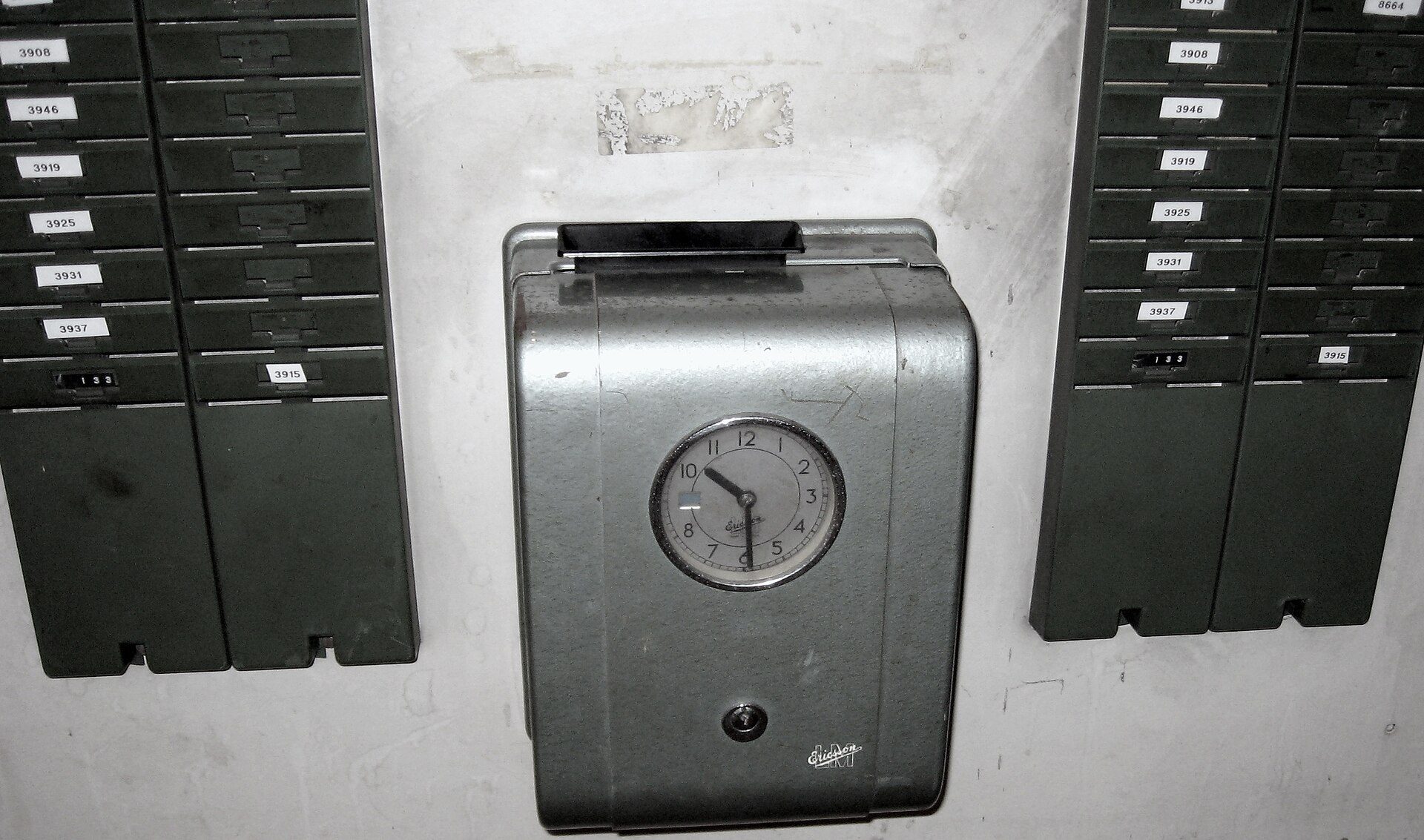
Photo: © 2009 by Tomasz Sienicki [user: tsca , mail: tomasz.sienicki at gmail.com] / Wikimedia Commons, CC BY 3.0
Overtime limits
- The employee must agree.
- Overtime may not exceed 50% of normal hours in a day; with weekly scheduling, normal plus overtime hours may not exceed 12 a day.
- No more than 40 hours in a month.
- No more than 200 hours in a year; certain industries and jobs listed by law may go up to 300 hours a year.
Overtime pay
| When the overtime is worked | At least |
|---|---|
| Normal working days | 150% of the hourly wage |
| Weekly days off | 200% of the hourly wage |
| Public holidays, Tet and paid days off | 300% of the hourly wage (not counting the holiday pay itself for daily-paid workers) |
Night work (10 p.m. to 6 a.m.) is paid at least 30% extra; overtime at night has its own calculation, so look up the implementing rules when you meet it.
Breaks and weekly rest
Anyone working 6 hours or more a day gets a break of at least 30 consecutive minutes (at least 45 minutes for night work). Each week includes at least 24 consecutive hours of rest; if the company cannot arrange weekly rest, it must ensure an average of at least 4 days off a month.
Annual leave, public holidays and personal leave
These are the questions HR gets asked most. Answering correctly from day one avoids arguments at the end of the year.
Annual leave entitlement
- After 12 full months with one employer: 12 working days under normal conditions; 14 days for minors, people with disabilities and those in heavy, hazardous or dangerous jobs; 16 days for especially heavy, hazardous or dangerous jobs.
- Less than 12 months: leave in proportion to the months worked.
- Every 5 full years with the same employer adds 1 day.
- Unused leave is paid out when the employee leaves.
Public holidays and Tet
Employees are off on full pay on the public holidays and Tet days set by law (when issued, the 2019 Labour Code provided 11 days in total). The exact dates each year, any swapped working days and any later amendments follow the official announcement; HR reads that announcement before issuing an internal notice.
Paid personal leave
Own wedding: 3 days; a child's wedding: 1 day; death of a parent, adoptive parent, parent-in-law, spouse or child: 3 days. Other cases can be unpaid leave by agreement. Write this into the internal rules so everyone understands it the same way.
Ending a contract: notice, final pay and documents
Leaving is when disputes most often arise. Keep the cases separate: the employee unilaterally ends the contract, the employer unilaterally ends it (only in the cases the law lists), both sides agree to end it, the contract expires, or dismissal (a disciplinary measure with its own procedure).
Notice when an employee resigns
| Contract type | Minimum notice |
|---|---|
| Indefinite-term | 45 days |
| Fixed-term, 12 to 36 months | 30 days |
| Fixed-term, under 12 months | 3 working days |
Certain special occupations have different periods. The law also lists cases where the employee may leave without notice, for example not being paid in full or on time, being mistreated, or being sexually harassed at work. When the employer ends the contract unilaterally, it needs a reason that falls within the legal grounds and must also give notice.
Final payment and documents
- Within 14 working days of termination, both sides settle everything (remaining salary, unused leave, allowances if any); in some special cases this can be extended, but to no more than 30 days.
- Severance allowance: for someone who has worked regularly for 12 months or more, half a month's salary per year worked, counting the working time minus the time covered by unemployment insurance and any period already compensated.
- Complete the confirmation of social insurance contribution periods and return any original documents the company holds.
Handover record
Make a handover record for assets, documents and accounts; collect access cards and lock email and software accounts on the last day. This is both an admin procedure and a data security step.
Keeping salaries and employee data confidential
HR holds the most sensitive information in the company: salaries, ID card numbers, addresses, bank accounts, health records and disciplinary files. Health and financial data count as sensitive personal data and need stronger protection. One leaked payroll sheet can split a team; one leaked ID card photo can be used by fraudsters to open accounts or take out loans.
Principles for collecting and using data
- Collect only what a clear purpose needs (contracts, insurance, payroll), tell people the purpose and obtain consent as the rules require.
- Only people whose duties require it may see the data; do not give employees' phone numbers or addresses to outsiders without consent.
- When the retention period ends, destroy data securely; never throw whole pages in the bin.
Paper files: locked cabinets and shredders
Keep paper personnel files in a lockable cabinet (Figure 2), with the key held by the person responsible and a log of who borrowed which file and when. ID card copies, misprinted payslips and draft payroll lists go through a shredder (Figure 3), never reused as scrap paper.

Photo: MarkBuckawicki / Wikimedia Commons, CC0

Photo: Raimond Spekking / Wikimedia Commons, CC BY-SA 4.0
Digital files: six rules for a small office
- Keep payroll in a separate folder with access granted by name, never shared through an "anyone with the link" setting.
- Send payslips to each person individually (personal email or HR software), never post the whole sheet in a group chat.
- Password-protect files with sensitive data and send the password through a different channel from the file.
- Do not keep employee data on personal computers or unencrypted USB drives.
- Lock your screen whenever you leave your desk, even for two minutes.
- When an employee leaves, lock their accounts on the last day; when an HR person leaves, hand over every password and access right to the successor.
Worked example: the file of Ms Mai, an admin officer
Ms Mai joined a 25-person trading company in Hai Phong as an admin officer on 1 March 2026, in a role requiring a college degree. Her agreed salary is 10,400,000 VND a month (about US$400). The company's pay regulations use 26 standard working days of 8 hours each (each company sets this in its own regulations; it is used here for illustration).
Probation and probation pay
- A role requiring a college degree: maximum probation 60 days. The company chooses 60 days.
- Minimum probation pay: 85% × 10,400,000 = 8,840,000 VND a month. The company pays exactly 8,840,000 VND, which is valid.
- At the end of probation the company confirms she passed and signs a 24-month fixed-term contract.
Overtime pay for October 2026
Hourly wage: 10,400,000 ÷ 26 ÷ 8 = 50,000 VND per hour. During the month Ms Mai works 10 overtime hours on normal days to prepare a customer conference and 8 hours on a Sunday (the company's weekly day off).
| Overtime type | Hours | Rate | Unit price | Amount |
|---|---|---|---|---|
| Normal days | 10 | 150% | 75,000 VND | 750,000 VND |
| Weekly day off | 8 | 200% | 100,000 VND | 800,000 VND |
| Total | 18 | 1,550,000 VND |
Check: 10 + 8 = 18 hours, below the 40-hour monthly limit. Money: 10 × 75,000 = 750,000; 8 × 100,000 = 800,000; 750,000 + 800,000 = 1,550,000 VND. Overtime on a normal day is capped at 4 hours (50% of 8 hours), so the 10 hours must be spread over at least 3 days; 8 hours on the Sunday stays under 12 hours a day. For tax and insurance on overtime pay, see how to calculate gross and net salary in Vietnam (2026).
Leave for 2026, and if Ms Mai resigns
Probation time counts towards annual leave if the person stays on afterwards. From 1 March to 31 December 2026 is 10 months, so her 2026 leave is 12 × 10 ÷ 12 = 10 days. If she wants to resign in early 2027 while on her 24-month contract (in the 12–36 month group), she must give at least 30 days' notice; the company pays everything within 14 working days of termination, including unused leave days.
Common mistakes of new HR staff
Forgetting contract expiry dates
Sign: an employee is still working months after the contract expired. Cause: no tracker. Fix: keep a contract list with an expiry column, set calendar reminders 45 days ahead and handle renewals as the law requires.
Answering legal questions from memory
Sign: you tell an employee a figure and later have to correct it. Cause: relying on old articles or the old law. Fix: check the document currently in force, note its name and article, and for complicated cases ask your manager or a lawyer.
Sending payroll to the wrong group chat
Sign: the whole company knows everyone's salary within five minutes. Cause: sending the file to a group chat to save time. Fix: send individual payslips only, password-protect them and check the recipient before pressing send; if you send to the wrong place, recall it immediately and inform your manager.
Frequently asked questions
How many types of employment contract are there in Vietnam?
Under the 2019 Labour Code there are two: indefinite-term contracts and fixed-term contracts of up to 36 months. A fixed-term contract can be renewed only once, except in certain cases the law allows.
What is the maximum probation period?
Up to 180 days for enterprise managers, 60 days for work requiring a college degree or higher, 30 days for intermediate vocational, technical and professional staff, and 6 working days for other work. Probation pay must be at least 85% of the job's salary.
How much overtime is allowed per month?
No more than 40 hours a month and 200 hours a year (some industries may go up to 300 hours), and the employee must agree.
How much notice must an employee give?
45 days on an indefinite-term contract, 30 days on a 12–36 month contract and 3 working days on a contract under 12 months; certain special occupations have their own rules.
Can HR show the payroll to another department head?
Only if that person's duties require it and the company's access rules allow it. The default is no; when asked, check with the authorised manager and share only the data that is needed.
Practice tasks and self-assessment
- Build a contract tracker for 5 hypothetical employees: contract type, signing date, expiry date, reminder date.
- Work out the minimum probation pay and maximum probation period for 3 roles: accountant (college degree), security guard, sales department head (not an enterprise manager).
- Calculate overtime pay for an employee earning 13,000,000 VND, 26 working days, 8 hours a day, who works 6 overtime hours on normal days and 4 hours on a public holiday.
- Write six data protection rules for HR at your company (or a hypothetical one) and pin them at your desk.
Self-assessment criteria
- Pass: you classify each contract correctly and record the right date for action at expiry.
- Pass: no probation exceeds the maximum and probation pay is 85% or more.
- Pass: overtime is calculated at the right rates and each line adds up (for the task above: hourly wage 62,500 VND, total 562,500 + 750,000 = 1,312,500 VND).
- Not yet: answering a legal question without noting the source, or sharing salary data with anyone whose duties do not require it.
With the labour law framework and good confidentiality habits in place, move on to the next roadmap step: Office administration & records, where you learn to draft official letters and notices in the correct format, manage the company seal and incoming and outgoing correspondence, buy office supplies and look after company assets.
Keep learning HR and admin: after labour law come office records, recruitment, personnel files, contracts and policies, timekeeping, payroll and social insurance, onboarding and an HR process kit. See the 8-step HR and admin roadmap.