Pre-exercise health screening means a personal trainer asks about and records a client's health on a short form (heart, blood pressure, current medication, old injuries, pregnancy) before the first session, to know who can train straight away, who should train lightly and who needs a doctor's approval first. Two skills go with it and are not optional: first aid for the incidents that happen in gyms, and chest compressions (CPR) when someone's heart stops. This is the first step of the PT career because one session at the wrong level for the wrong person can cause harm that no programme can undo.
By the end of this lesson, you will be able to:
- Use a 10-question screening form with new clients and place them in 3 groups: train normally, train lightly with monitoring, or doctor's approval first.
- Recognise the red flags that mean stopping a session or calling emergency number 115 (Vietnam).
- Give correct first aid for sprains, strains, fainting, low blood sugar, heat illness and cuts in the gym.
- Perform basic adult CPR and use an automated external defibrillator (AED) by following its voice prompts.
- Stay within your professional limits: no diagnosing, no prescribing drugs, no selling supplements in place of medical advice.
Starting out as a PT? Gym safety, health screening and first aid are step 1 of the roadmap, before anatomy, exercise technique and programming. See the 8-step personal trainer roadmap to learn in the right order.
Why must a PT screen clients before the first session?
Among clients who look perfectly healthy are people on blood pressure medication, people who have had ligament surgery, and diabetics who skip breakfast. If you do not ask first, you give them all the same load, and the risk falls on exactly the most vulnerable people.
The real risks in a gym
The most common incidents are soft tissue injuries: an ankle sprain from jumping, a hamstring strain from sprinting, back pain from a badly performed lift. Next come dizziness and fainting from training on an empty stomach, dehydration or standing up too quickly. Rarer but most serious are cardiac events during exertion, usually in people with existing heart disease or several risk factors that they did not know about or did not mention. Screening does not remove every risk, but it tells you whom to watch.
Professional limits: a PT is not a doctor
A PT does not diagnose disease, interpret test results, treat injuries, or prescribe medicine or supplements. Your job is to ask enough questions, record the answers, recognise when a case is beyond you, advise the client to see a doctor and adjust training within safe limits. When a client asks "do you think I have a slipped disc?" or "which pill should I take for my knee?", the right answer is "a doctor needs to examine that, and I will adjust your training to what the doctor advises".
Screening is not the same as fitness assessment
Screening answers "is it safe to start, and at what level?"; fitness assessment (waist, InBody, posture) belongs to step 4. Always screen first: never put a client through an endurance test before you know whether they have heart disease.
What goes into a health screening form?
Many gyms use a form based on the PAR-Q+ (Physical Activity Readiness Questionnaire, widely used in the international fitness industry) or their own version. A good form is short, uses clear yes/no questions and leaves space for details when the client answers "yes". The 10-question form below is a learning template; at work, use the form your gym requires.
Heart and blood pressure questions
- Has a doctor ever told you that you have a heart condition or high blood pressure?
- Do you ever feel chest pain at rest, during daily activities or when you exert yourself?
- In the past 12 months, have you lost your balance from dizziness or fainted?
- Are you taking prescribed medication for a chronic condition (blood pressure, heart, diabetes, asthma...)?
Medical conditions, pregnancy and injury questions
- Do you have diabetes, asthma, epilepsy or another chronic condition?
- Are you pregnant now, or have you given birth in the past 12 months?
- Do you have a bone, joint, back or neck problem that hurts now or gets worse with activity?
- Have you had surgery, a fracture or a ligament injury in the past 12 months?
- Has a doctor said you should only be physically active under medical supervision?
- Is there anything else about your health you want your trainer to know before training?
Add general details (age, current activity level, an emergency contact number) and a line where the client signs to confirm the answers are true and promises to tell the PT if their health changes.
Reading the answers and deciding
The table below is the cautious grouping used in this lesson. It is not a diagnosis; it only helps you decide whether to train now or wait for a doctor's opinion. The gym's rules and the doctor's advice always come first.
| What the form shows | Group | What the PT does |
|---|---|---|
| All answers "no", no symptoms | Train normally | Start at moderate intensity and progress by the programme |
| Chronic condition well controlled, no symptoms (e.g. blood pressure on regular medication) | Train lightly, with monitoring | Low to moderate intensity, no breath-holding, advise the client to ask their doctor about suitable intensity before progressing |
| Current joint or back pain but walking normally | Train lightly, with monitoring | Avoid exercises that increase pain; if pain persists or numbness spreads into the limbs, advise a medical check |
| Chest pain, fainting, unusual breathlessness, or a doctor who said supervised activity only | Doctor's approval first | No training yet; take the client on only with a doctor's opinion |
| Pregnant, recently gave birth, recent surgery | Doctor's approval first | Wait for clearance; refer to a PT trained for special populations if needed |
The first-session screening process, step by step
Screening only works when it is done with every client and kept on record. The process below takes about 15 minutes.
Steps
- Send the form for the client to complete before the first session (paper or online), and ask them to bring their prescription if they are under treatment.
- Go through the form with the client somewhere private and follow up every "yes": what condition, since when, what medication, what the doctor said.
- If the gym has a monitor, measure resting blood pressure and heart rate after the client has sat quietly for about 5 minutes, take 2 readings and record them (Figure 1). These numbers are for reference and tracking only, not for diagnosis.
- Assign a group from the table above; if unsure, choose the more cautious group.
- Explain the decision to the client in plain words, record it and have the client sign.
- At the start of every later session, ask quickly: "Did you sleep well, have you eaten, does anything hurt, has your medication changed?"
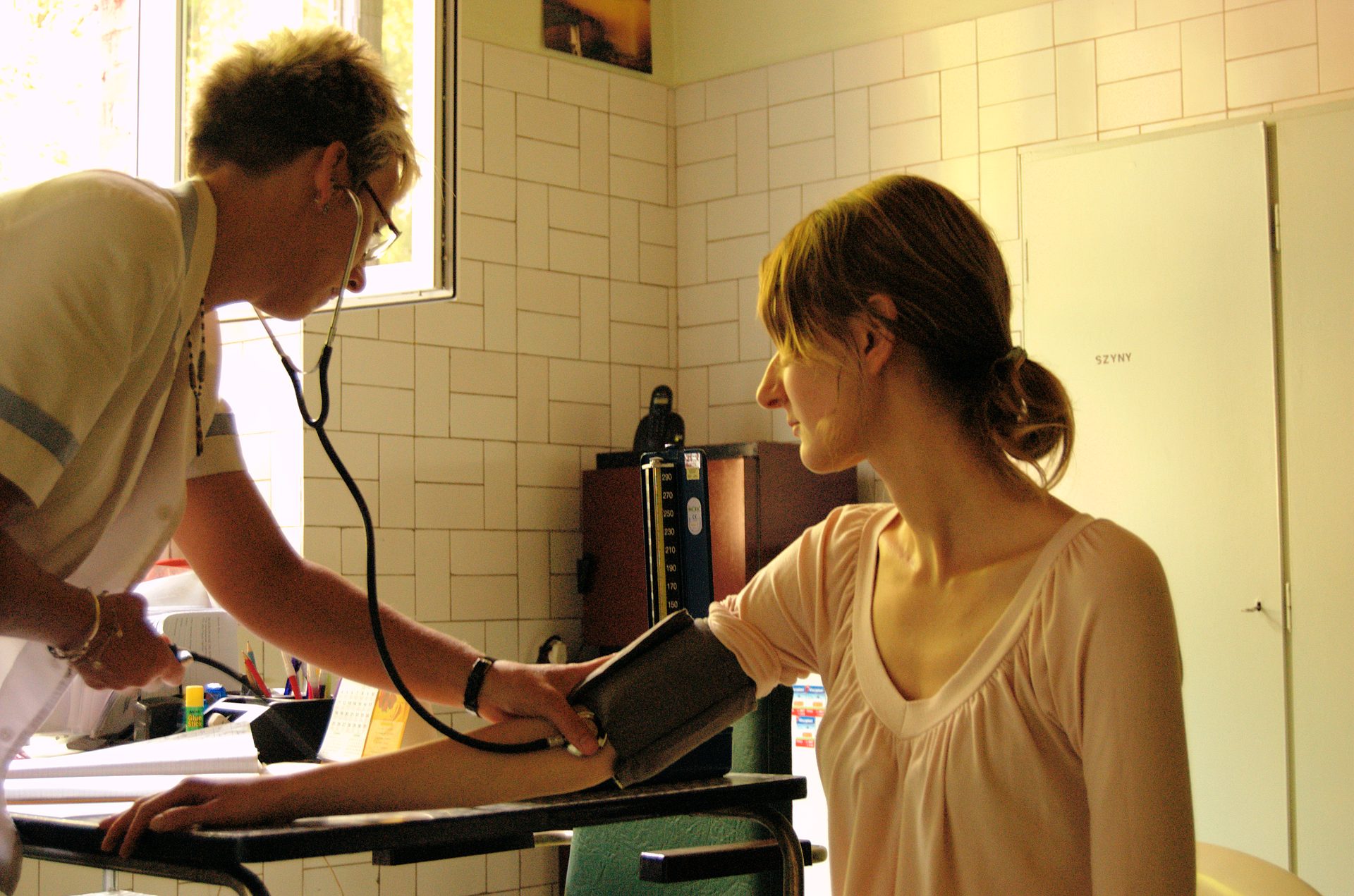
Photo: Kris D from Metropolia Silesia, Upper Silesia ( Oberschlesien ) / Wikimedia Commons, CC BY-SA 2.0
Keeping health records private
Health information is sensitive personal data: only the responsible PT and the manager should see it, paper forms go in a locked cabinet or the gym's system, and they are never photographed into a group chat. Ask your manager how records are stored in line with the rules where you work.
Everyday gym safety
A frayed cable on a pulley machine or a loose weight pin can injure even the fittest person, so checking the gym matters as much as screening clients.
A 10-minute check at the start of a shift
- Floors are dry, with no plates or resistance bands lying in walkways; rubber mats are not lifting at the edges.
- Machine cables are not frayed, selector pins are fully inserted, benches do not wobble, barbell collars are all there.
- The first aid kit is complete and in date; you know where the AED is if the gym has one and its status light shows ready.
- Emergency exits are clear, fire extinguishers are in place (Figure 2), air conditioning and fans work.
- Drinking water is available; you know the duty manager's number and the gym's exact address to give to 115.
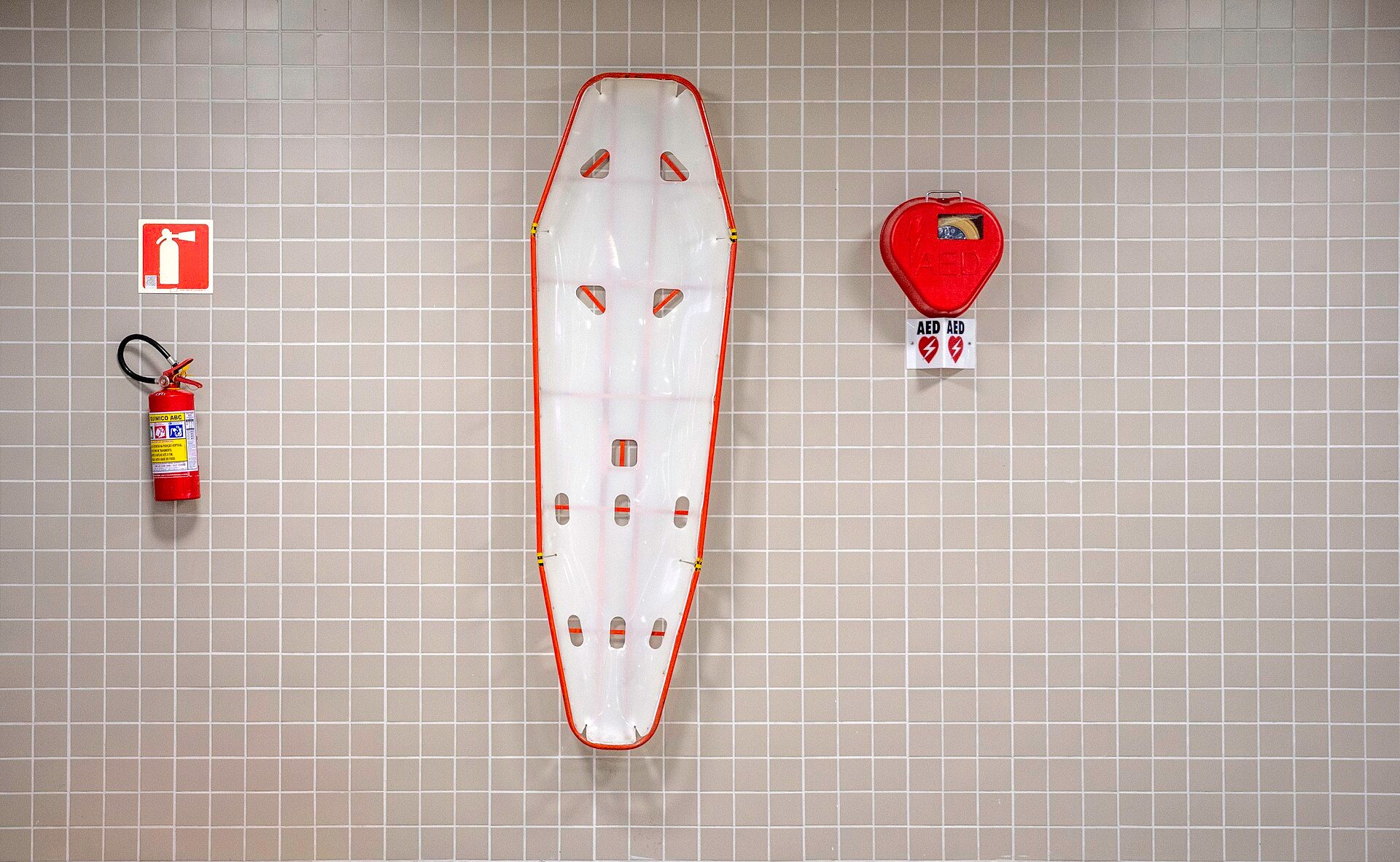
Photo: Wilfredor / Wikimedia Commons, CC BY-SA 4.0
During the session
Always stand where you can see the client, especially in the final set. Spot clients on heavy bench presses and squats, and never use your phone while a client is lifting. Spotting and your responsibilities when selling packages are covered in Personal trainer salary in Vietnam: commission, certificates, 2026.
Heat, humidity and dehydration
Closed gyms in the Vietnamese summer easily cause dehydration and heat illness. Remind clients to sip water, lower the intensity when the room is hot, and postpone the session if the client has just been ill, has a fever or diarrhoea.
First aid for common gym incidents
First aid is initial care, not treatment: the goal is to avoid making things worse and to recognise when to call 115.
Sprains and strains
Stop the exercise immediately and have the client sit or lie down; never "train through it to loosen up". Apply an ice pack wrapped in a towel for about 15–20 minutes, never ice directly on skin; raise the injured limb, and apply a light compression bandage if you have been taught how. Do not massage hard or rub hot balm on a fresh swelling. Severe pain, deformity, a "crack" sound, inability to bear weight or rapidly increasing swelling means a medical check.
Dizziness, fainting and low blood sugar
A dizzy client should lie down at once in a safe spot, legs raised if there is no injury, tight clothing loosened, with fresh air. If they come round quickly and talk normally, let them rest and drink water, and do not resume training that day. A diabetic or fasting client who is shaky, sweaty and slightly confused but can still swallow: give a sugary drink or sweets, rest about 15 minutes, then reassess. Never pour liquid into the mouth of someone who is not fully conscious.
Heat illness, cuts and bleeding
Heat illness: move the client somewhere cool, remove extra clothing, sponge and fan with cool water, give sips if conscious. Confusion, slurred speech, very hot skin or seizures is an emergency: call 115 and keep cooling. A cut from equipment: put on gloves and press directly with clean gauze until bleeding stops; a deep or gaping cut, or bleeding that will not stop, needs medical care.
Quick reference: what to do and when to call 115
| Incident | Signs | Do now | Call 115 when |
|---|---|---|---|
| Sprain or strain | Pain, swelling, bruising | Stop, wrapped ice pack, elevate | Deformity, suspected fracture, severe pain |
| Dizziness, fainting | Pale, sweaty, collapses | Lie down, raise legs, check breathing | Does not come round quickly, fainting with chest pain, head injury |
| Low blood sugar | Shaky, very hungry, sweaty, confused | If able to swallow: fast sugar, rest 15 minutes | Increasing confusion, cannot swallow, seizure |
| Heat illness | Exhausted, cramps, hot skin | Move to shade, cool down, sip water | Confusion, slurred speech, seizure, unconscious |
| Chest pain, breathlessness | Heavy chest pressure, spreading to left arm or jaw, unusual breathlessness | Stop, sit the client down, do not let them go home alone | Call at once; do not wait to see if it passes |
Safety warning: This lesson does not replace a hands-on first aid course and does not replace a doctor. Call emergency number 115 at once if a client has chest pain or pressure, severe breathlessness, fainting without quick recovery, weakness or a drooping face, slurred speech, seizures, a head or neck injury, or a suspected fracture. Do not give clients medication yourself, not even painkillers, and do not recommend supplements to "recover". If a neck injury is suspected, do not move the client unless there is immediate danger.
Basic CPR and the AED: what every PT must know
When someone's heart stops, starting chest compressions immediately and using an AED early (if there is one) clearly improves the chance of survival. Below is a framework to memorise; the real skill only comes from practising on a manikin with an instructor.
Recognising cardiac arrest
The person collapses, does not respond when you shout and tap their shoulders, and is not breathing or only gasps occasionally (gasping is not normal breathing). Check for about 10 seconds and do not waste time looking for a pulse if you have not been trained. Shout for someone to call 115 and bring the AED, naming each person clearly: "You in the blue shirt, call 115; you, get the AED from reception".
Chest compressions
- Lay the person on their back on a firm surface and kneel beside their chest.
- Place the heel of one hand in the centre of the chest (lower half of the breastbone), the other hand on top, arms straight, shoulders above your hands.
- Push about 5–6 cm deep for an adult, at 100–120 compressions per minute, letting the chest rise fully after each push (Figure 3).
- If trained in rescue breaths: 30 compressions, 2 breaths. If not trained or unwilling: continuous compressions without stopping.
- Swap the person compressing about every 2 minutes if help is available, keeping pauses as short as possible.
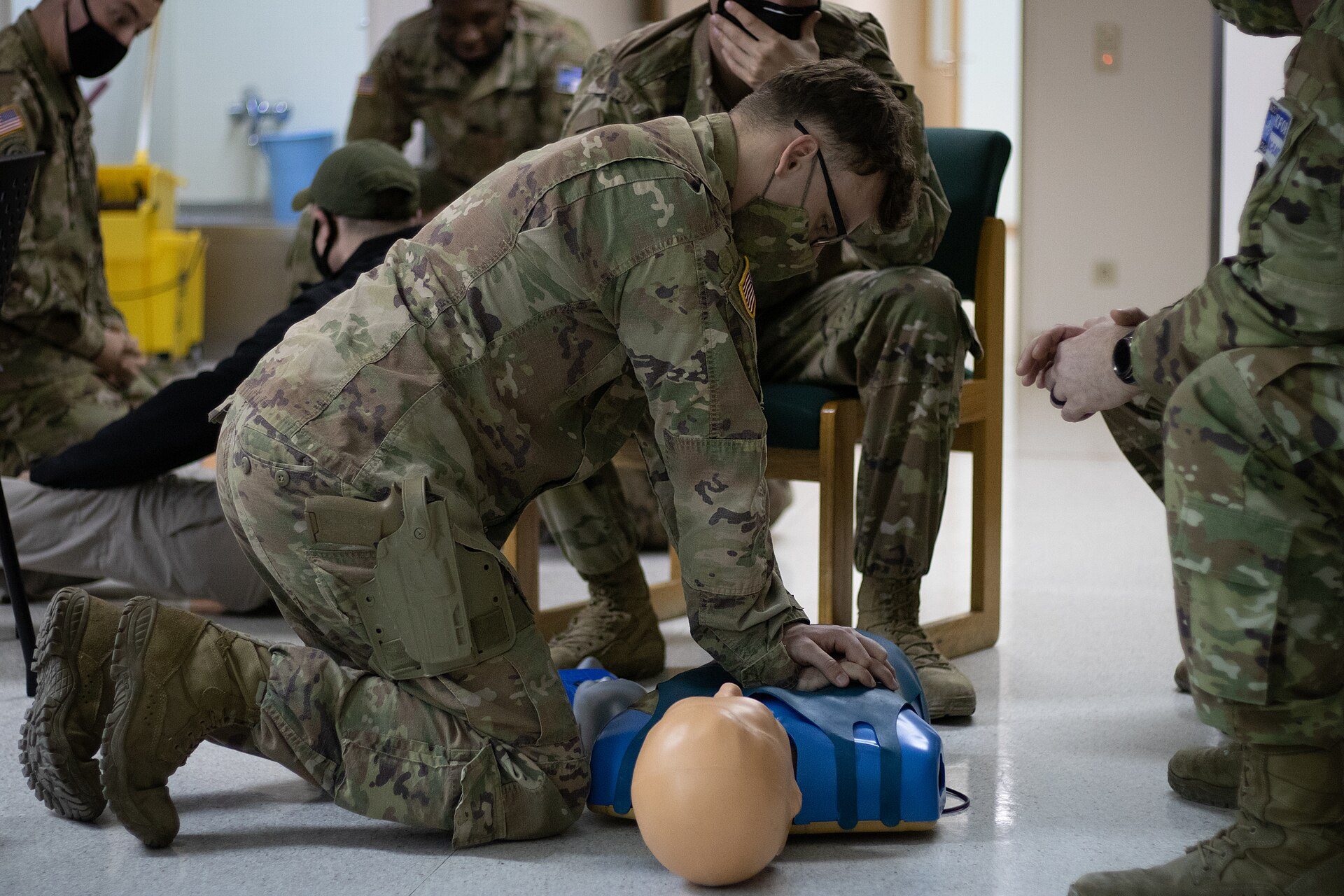
Photo: U.S. Army National Guard photo by Sgt. Zachary Zippe / Wikimedia Commons, Public domain
Using an automated external defibrillator (AED)
An AED is a small device that analyses the heart rhythm and decides whether to deliver a shock; the user simply switches it on and follows the voice prompts (Figure 4). Stick the two pads on the bare chest as shown in the pictures on the pads, make sure nobody touches the person while the machine analyses and shocks, then restart compressions immediately when the machine says so. Not every gym has an AED; if yours does, ask the manager to let you practise on a training unit.
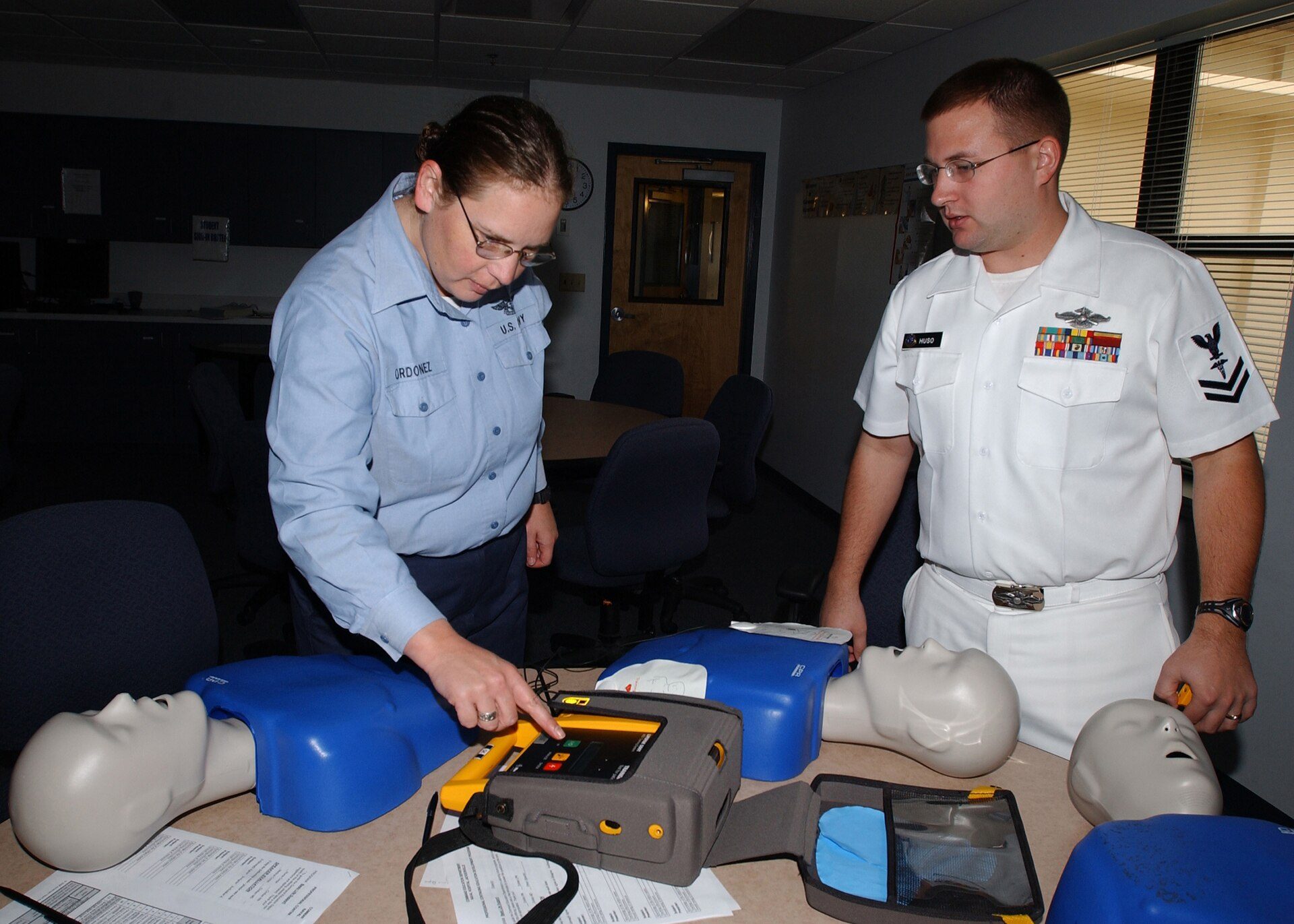
Photo: U.S. Navy photo by Mass Communication Specialist 2nd Class Susan Cornell / Wikimedia Commons, Public domain
Where to learn and how often to refresh
Look for a first aid and CPR course with hands-on manikin practice, run by a hospital or clinic, the local Red Cross or a reputable training provider. Compression skills fade quickly, so retrain within the validity period shown on your certificate.
Worked example: screening Tuan, 52, who wants to lose fat
Tuan is 52, works in an office, is 1.68 m tall, weighs 80 kg and has done almost no exercise for 5 years. He buys a 12-session package to lose belly fat. On the 10-question form, he answers "yes" to 2 questions.
Step 1: read the form and follow up
- Question 4 (prescribed medication): he has taken blood pressure tablets every morning for 3 years, has regular check-ups, no chest pain, no fainting.
- Question 7 (joint pain): his right knee hurts on stairs, he has not seen a doctor, the knee is not swollen and he walks normally.
- The other 8 answers are "no". Resting blood pressure, measured twice after 5 minutes seated: 138/88 and 134/86 mmHg, recorded for tracking.
Step 2: assign a group and decide
By the grouping table, Tuan is "train lightly, with monitoring": blood pressure treated and stable, no symptoms, knee pain but normal walking. The PT explains that the first session will stay at low to moderate intensity (he can still talk), with no breath-holding during lifts, no jumping and no deep squats; he should ask the doctor treating his blood pressure about suitable intensity, and get his knee checked if the pain increases. This is a cautious PT decision, not a medical conclusion.
Step 3: plan the 60-minute first session
| Part | Content | Time |
|---|---|---|
| Screening | Read the form, follow up, sign | 10 minutes |
| Resting blood pressure | Sit quietly, measure twice, record | 5 minutes |
| Warm-up | Easy cycling, joint circles | 10 minutes |
| Main session | Light machine exercises, treadmill walking, no jumping | 25 minutes |
| Cool-down and booking | Gentle stretches, ask how he feels, remind him to ask his doctor | 10 minutes |
| Total | 60 minutes | |
Check: 10 + 5 + 10 + 25 + 10 = 60 minutes. Over the 12 sessions, the PT raises intensity step by step only after Tuan reports that his doctor agrees; on any day he forgets his tablets or feels a headache or dizziness, that session is light walking only or postponed.
Common mistakes new PTs make, and how to avoid them
Skipping the form because the client "looks fit"
Sign: you only ask "any health problems?" out loud and record nothing. Fix: use the form with every client and explain that it is there to design safe training for them personally.
Diagnosing and recommending pills
Sign: telling a client "you probably have a slipped disc" or "take this joint supplement and it will go away". Cause: wanting to look knowledgeable or to sell extra products. Fix: record the symptoms, advise a medical check and only adjust the training. Selling supplements with promises of curing disease crosses professional limits and may break advertising rules.
Practice tasks and self-assessment
- Write your own 10-question screening form (with an emergency contact section and signature), then screen 3 acquaintances of different ages.
- For each person, write the group decision and the reason in 3 sentences.
- Walk around the gym where you train and sketch where the first aid kit, AED (if any), fire extinguishers and exits are.
- Sign up for a first aid and CPR course with hands-on manikin practice.
Self-assessment criteria
- Pass: with all 3 people, every "yes" was followed up and recorded in detail; the group decision matches the table.
- Pass: without notes, you can state 5 signs that mean calling 115 and the compression steps (hand position, depth, rate).
- Pass: you can point to the first aid kit, fire extinguishers and exits within 1 minute.
- Not yet: you skipped the medication question, diagnosed a client yourself, or have never practised compressions on a manikin.
Frequently asked questions
What is the PAR-Q, and must a PT use it?
The PAR-Q (and its expanded version, the PAR-Q+) is a yes/no physical activity readiness questionnaire widely used in the fitness industry for pre-exercise screening. You do not have to use that exact form, but a PT needs a recorded screening form; use the one your gym requires if it has one.
Can people with high blood pressure train in a gym?
Many people with controlled high blood pressure can train and benefit from regular exercise, but the intensity should be advised by their treating doctor. The PT keeps intensity low to moderate, avoids breath-holding during lifts and checks in every session. Anyone not yet diagnosed, with a very high reading or with symptoms should postpone training and see a doctor.
How should a sprain from gym training be handled?
Stop training, apply a towel-wrapped ice pack for 15–20 minutes, raise the limb and avoid putting weight on it. Do not rub hot balm or massage hard on a fresh swelling. Severe pain, deformity, inability to walk, or no improvement after a few days means seeing a doctor.
Does a PT need a first aid and CPR certificate?
Many gyms and PT certification programmes require or prefer trainers with a valid first aid and CPR certificate. Even where it is not required, it is a skill to have before your first client.
Once screening, first aid and CPR are solid, move on to the next step of the roadmap: Anatomy, exercise physiology & training principles, where you learn the major muscles and joints, energy systems and why overtraining injures beginners.
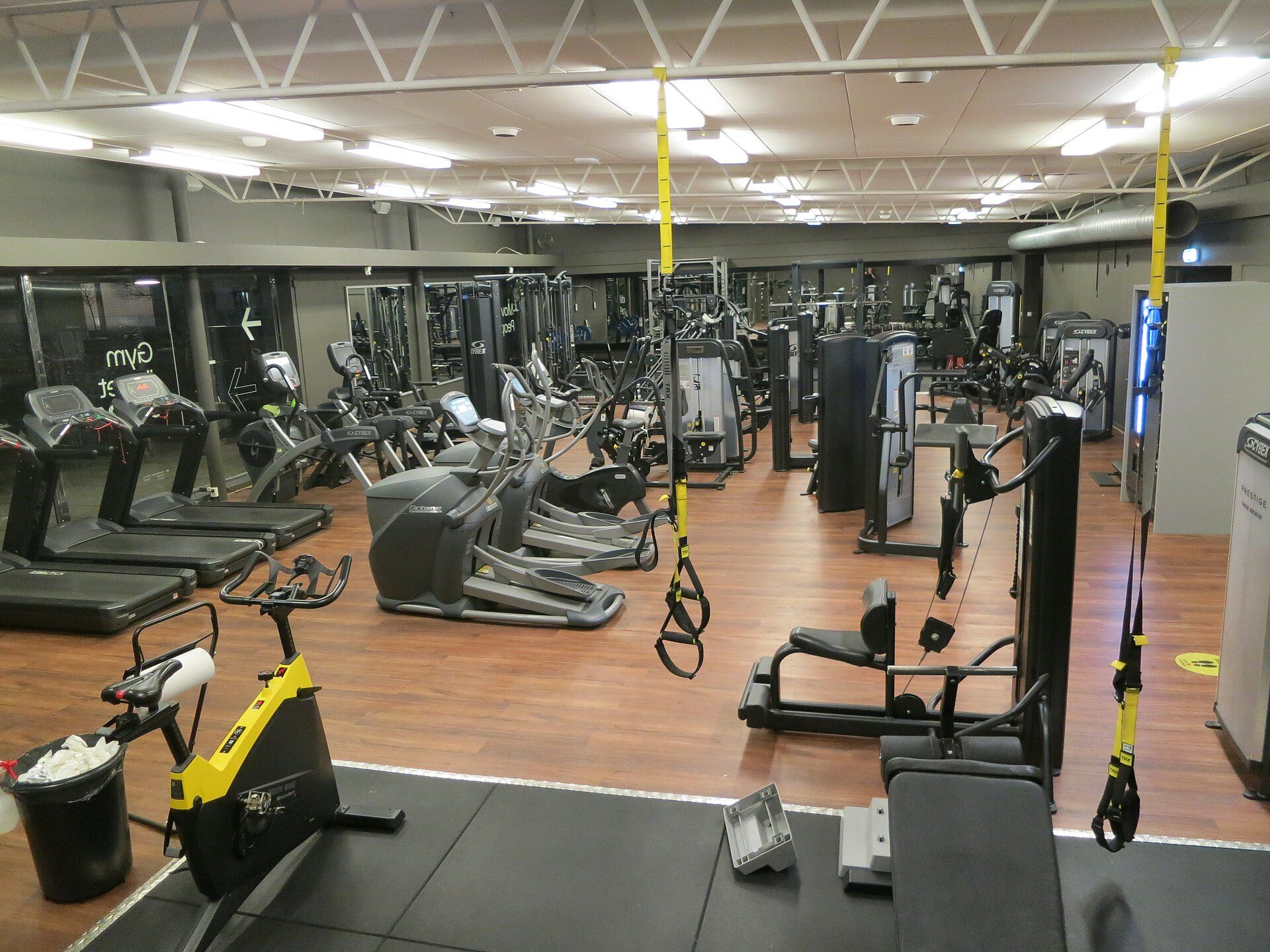
Photo: R. Henrik Nilsson / Wikimedia Commons, CC BY 4.0
Keep learning to be a PT: after safety and first aid come exercise anatomy, squat and deadlift technique, fitness assessment, fat-loss and muscle-gain programming and basic nutrition. See the 8-step personal trainer roadmap.