Software testing is the work of checking whether a software product does what its requirements say and finding defects before users run into them, both by running the product (dynamic testing) and by reviewing documents and code (static testing). The people who do it are called testers or QA; they do not "click around for fun" but work by principles, by test levels and within the development team's process. This lesson is the first step of the tester roadmap: learn the 7 testing principles, see where testing fits in Waterfall and Scrum, and tell apart the 4 test levels and the main test types.
By the end of this lesson, you will be able to:
- Explain in your own words what software testing is, and distinguish an error, a defect (bug) and a failure.
- State the 7 testing principles, each with a real-world example.
- Compare the tester's place in a Waterfall project and in a Scrum sprint.
- Place a testing activity at the right level (unit, integration, system, UAT) and type (functional, non-functional, regression).
- Build a test allocation table for a small feature with figures that add up.
Starting out as a tester? Testing fundamentals and the development process are step 1 of the roadmap, before test case design, Jira bug reports, Postman and automation. See the 8-step software tester roadmap to learn in the right order.
What is software testing, and why is it needed?
Software is written by people, so it always contains mistakes. A "Pay" button that charges the wrong amount, a banking app that shows someone else's balance, a sign-up form that freezes when a name contains Vietnamese diacritics: each such bug costs money, customers or reputation. Testing finds defects early and gives the whole team reliable information about quality, so they can decide whether to release.
Error, defect and failure
- Error (mistake): a human mistake, for example a developer reading "10% off" as "10,000 VND off".
- Defect (bug): the flaw that the mistake leaves in the product, such as the line of code that calculates the discount wrongly.
- Failure: when the system runs and produces a result different from what was expected, such as a customer seeing a 500,000 VND (about US$19) order discounted by only 10,000 VND.
Testers usually see the failure first, then report it so a developer can find and fix the defect. Keeping the three terms apart helps you write precise bug reports in step 3 of the roadmap.
Static and dynamic testing
Dynamic testing means running the software and comparing results with expectations. Static testing means reviewing without running: reading requirements, checking UI designs, reviewing code. One well-timed question while reading requirements ("does the 10% apply to the shipping fee?") can prevent a whole chain of bugs before a single line of code is written.
Tester, QA and QC
In Vietnamese job ads, "tester", "QA" and "QC" are often used interchangeably. Strictly, QC (quality control) focuses on checking the product to find defects, while QA (quality assurance) is broader and improves the process so fewer defects happen. At interviews, read the job description carefully rather than relying on the title.
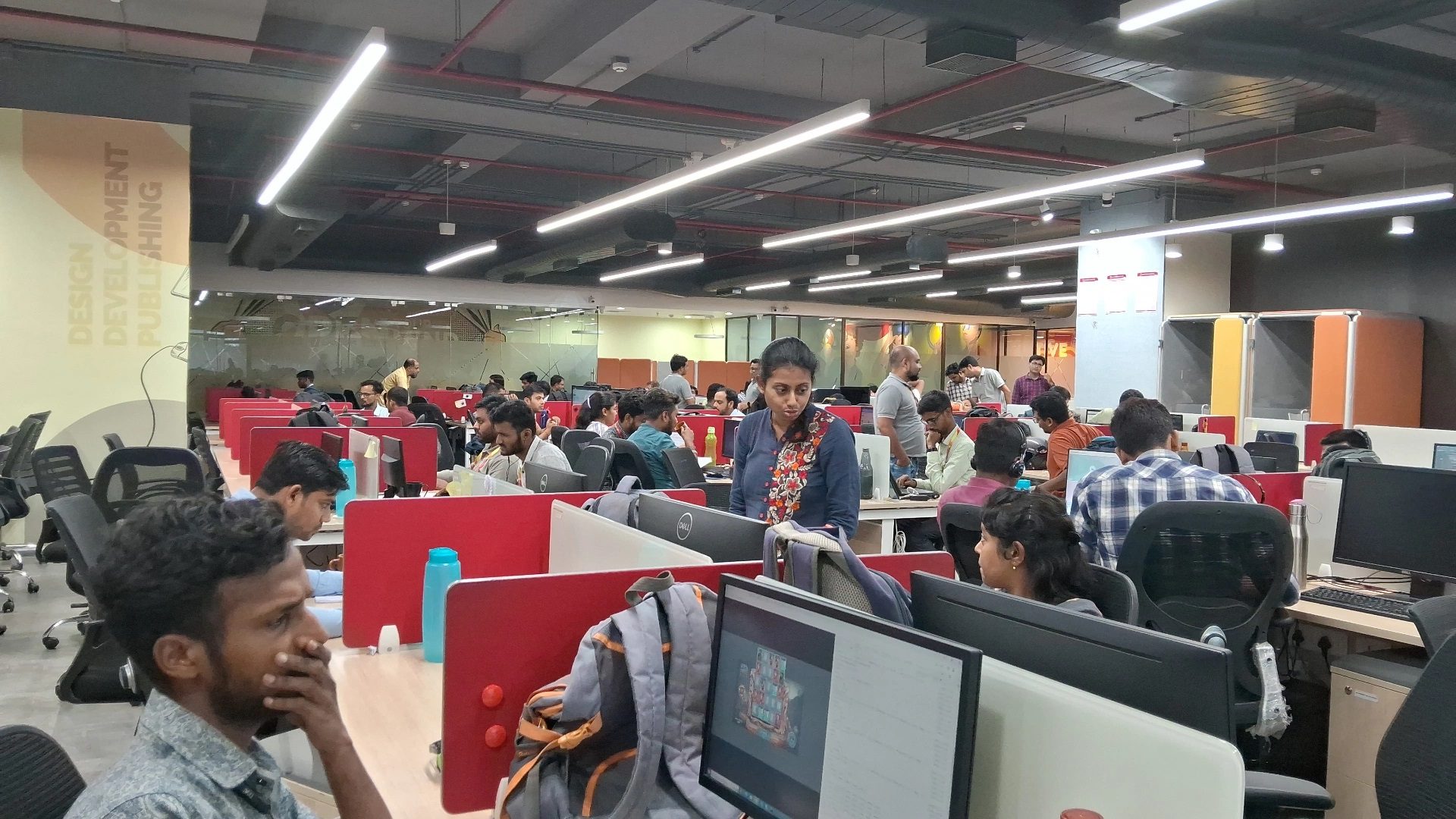
Photo: Red Apple Learning / Wikimedia Commons, CC BY-SA 4.0
The 7 testing principles every tester must know
The seven principles below come from the ISTQB Foundation syllabus, the popular testing certificate you will meet in step 8 of the roadmap. They explain why testers work the way they do.
The 7 principles with examples
| Principle | Meaning | Real-world example |
|---|---|---|
| 1. Testing shows the presence of defects | Testing can prove defects exist, but cannot prove the software is defect-free | Running 200 test cases without a failure does not mean the app has no bugs |
| 2. Exhaustive testing is impossible | You cannot try every combination of data, devices and actions; choose by risk | A quantity field of 1–99 combined with 30 discount codes already gives thousands of combinations |
| 3. Early testing | Start when reading requirements; the later a defect is found, the more it costs to fix | Clarify a vague requirement before coding instead of fixing it after it reaches production |
| 4. Defects cluster together | Most defects tend to sit in a small number of modules | Payment and promotion modules usually have more bugs than the "About us" page |
| 5. Tests wear out | Running the same old tests finds fewer new defects (the pesticide paradox) | Add new test cases regularly as features and data change |
| 6. Testing is context dependent | How you test depends on the kind of product | A banking app needs much deeper security testing than a casual game |
| 7. Absence-of-defects fallacy | Software free of technical bugs still fails if it does not meet users' needs | A food ordering site with no bugs that takes 9 steps to place an order |
Applying the principles day to day
Principles 2 and 4 lead to the most basic practice: risk-based testing, spending your time where defects are likely and costly. Principle 3 means testers join from the requirement reading stage instead of waiting for developers to "finish and throw it over the wall". Principle 7 reminds you to always put yourself in a real user's shoes.
Where does testing fit in the development process?
How a tester works depends on the project's development model. The two you will meet most are Waterfall and Agile, specifically Scrum.
Waterfall and the V-model
Waterfall runs in sequence: requirements, design, coding, testing, deployment, maintenance, each phase finishing before the next begins. Its weakness is that testing piles up at the end and requirement defects are found late. The V-model improves on this by pairing each development phase with a test level and letting testers prepare early.
Agile and Scrum
Scrum splits work into short sprints, usually 1–4 weeks. At the start of a sprint the team picks work from the product backlog in sprint planning; every day there is a short daily stand-up of about 15 minutes (Figure 2); at the end there is a sprint review to demonstrate the product and a retrospective to learn lessons. The tester is a team member who tests within the sprint, and a user story only counts as finished when it meets the Definition of Done, which usually includes being tested.
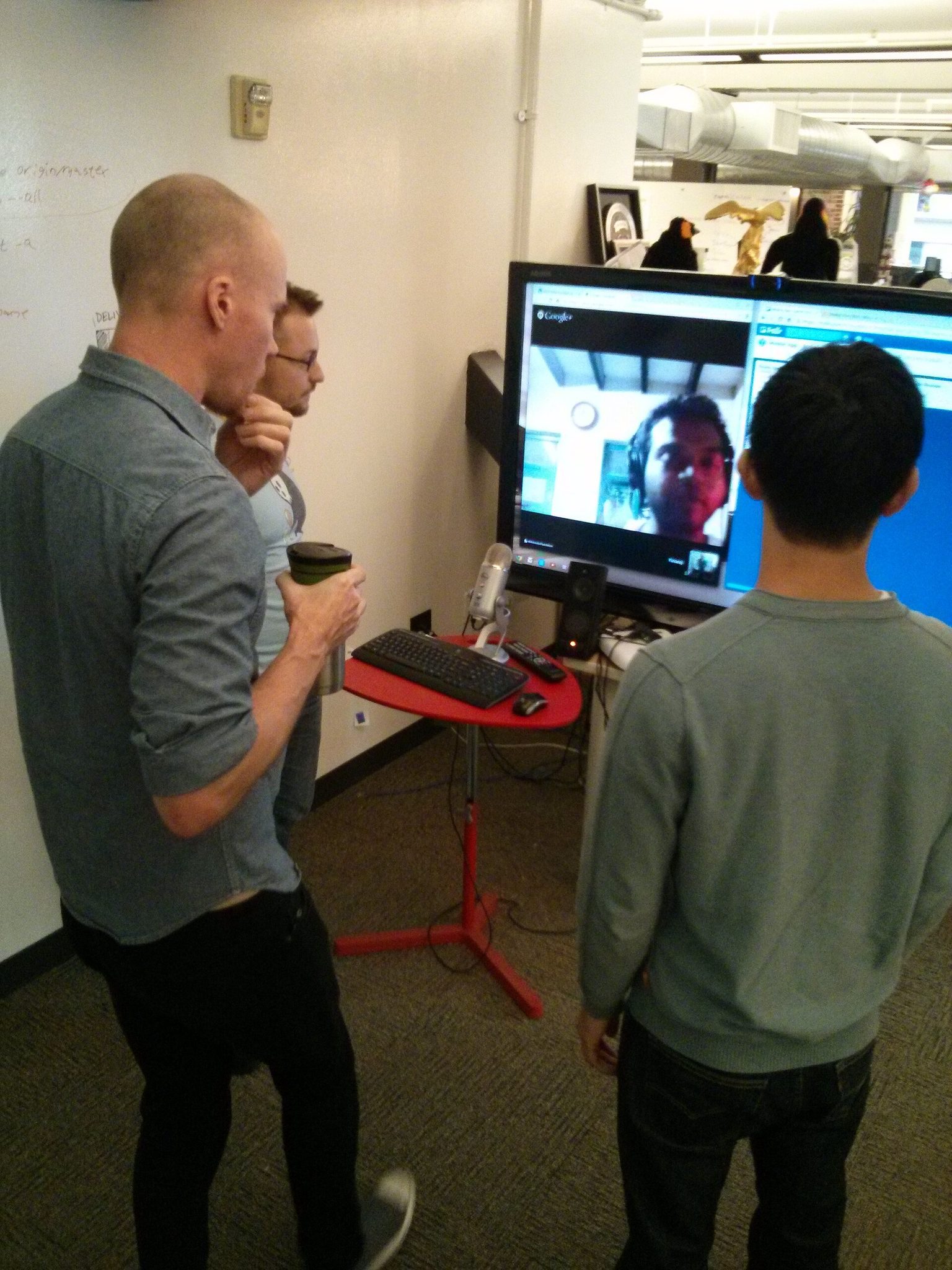
Photo: Awjrichards / Wikimedia Commons, CC BY-SA 3.0
Many teams track work on a board with "To Do – Doing – Done" columns (Figure 3), on a wall with sticky notes or in a tool such as Jira. Testers often add an "In testing" column so cards do not jump straight to "Done" before they have been checked.
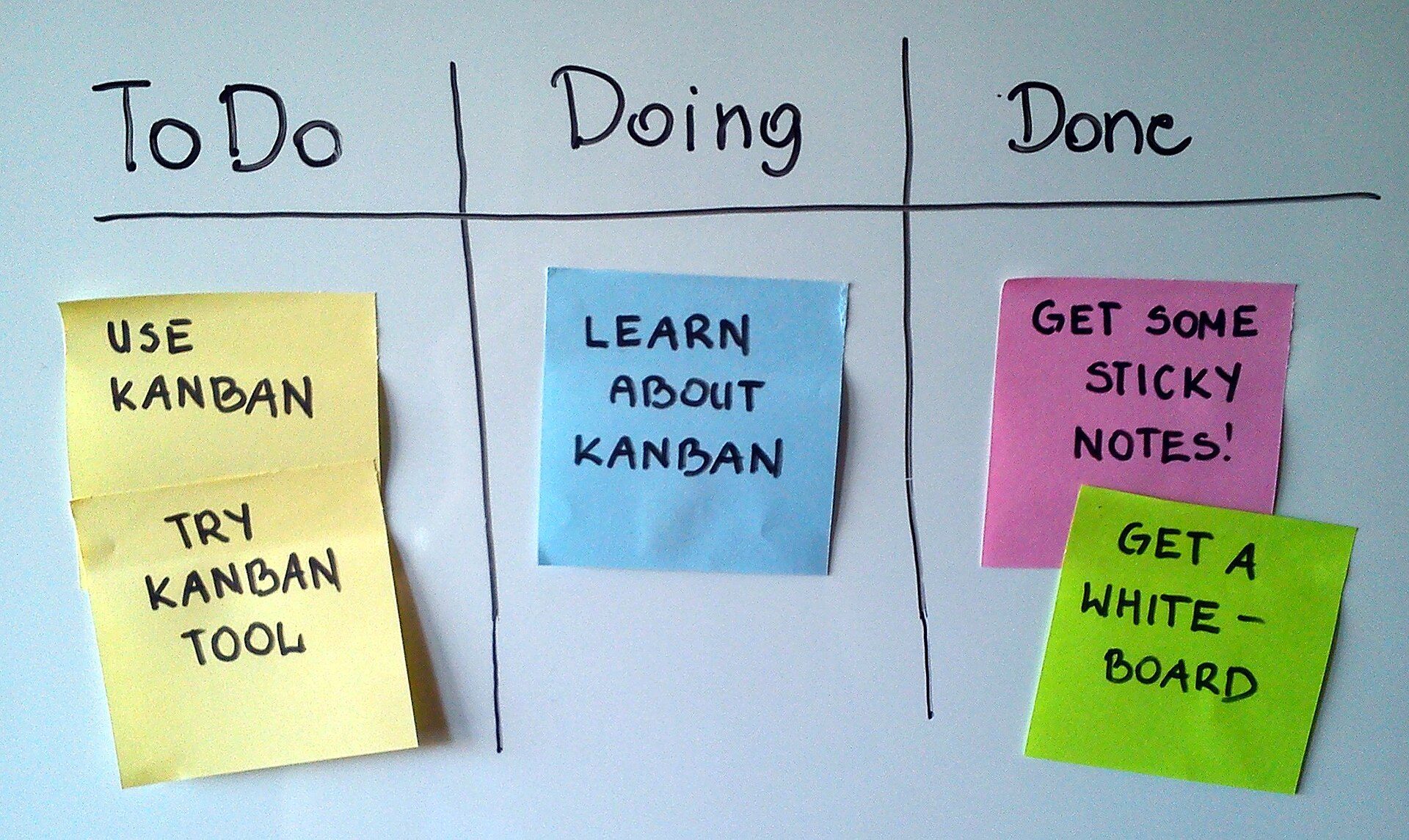
Photo: Jeff.lasovski / Wikimedia Commons, CC BY-SA 3.0
The tester's role compared
| Aspect | Waterfall | Scrum |
|---|---|---|
| When testing happens | A separate phase after coding | Continuously in every sprint |
| Documentation | Full requirement documents and test plan | User stories, acceptance criteria, lean test cases |
| Requirement changes | Hard and costly | Welcomed sprint by sprint |
| Regression testing | One big round before release | Every sprint, increasingly automated |
The software testing life cycle (STLC)
Whatever the model, testing usually goes through these steps: requirement analysis, test planning, test case design, environment and data preparation, execution and bug reporting, retesting, then closure and reporting. Steps 2 and 3 of the roadmap go deep into test case design and bug reporting.
The 4 test levels: unit, integration, system, UAT
A test level answers "which part of the system are we testing, and who tests it". Moving from small to large catches defects where they are cheapest to fix.
The 4 levels at a glance
| Level | What is tested | Usually done by | Example with a login feature |
|---|---|---|---|
| Unit | Individual functions, classes, small components | Developers | The function that checks a password has at least 8 characters returns true or false correctly |
| Integration | Communication between components, services, APIs | Developers and testers | The login screen calls the authentication API and gets the right error code for a wrong password |
| System | The whole system against the requirements | Testers | Log in, lock the account after 5 failed attempts, reset the password by email |
| UAT (user acceptance testing) | Whether the system meets real business needs | Clients, business users | Shop staff log in and run a normal sales shift |
Which levels a new tester works on
Most fresher testers do system testing and support UAT, then learn API testing (integration) in step 4. Unit tests are usually written by developers, but testers should be able to read them to know what is already covered.
Common test types
A test type answers "which aspect are we testing". One level can include several types.
Functional and non-functional
- Functional testing: does the system do the right thing, such as adding to the cart, totalling the bill, sending a confirmation email.
- Performance testing: is it fast, and how many simultaneous users can it handle.
- Security testing: can a user see someone else's data, can passwords leak.
- Usability and compatibility: is it easy to use, does it work correctly across browsers, phones and screen sizes (Figure 4).

Photo: Alejandro Escamilla alejandroescamilla / Wikimedia Commons, CC0
Retesting and regression testing
Retesting (confirmation testing) means running the exact test case that found a defect again after the developer fixes it. Regression testing means re-running existing features to make sure a fix or a new feature has not broken something else. Regression repeats every sprint, so it is often automated, which you will learn in step 5 of the roadmap.
Smoke tests, black box, white box, manual and automated
A smoke test is a quick check of critical functions as soon as a new build arrives; if it fails, the build goes back without deeper testing. Black-box testing is based on requirements without looking at the code; white-box testing is based on code structure. Manual testing is done by a person, automated testing uses scripts; beginners should be solid at manual testing before learning automation.
Worked example: testing a discount code feature in one sprint
A Scrum team of 6 (4 developers, 1 tester, 1 product owner) builds a shop website in 2-week sprints. User story: "As a customer, I want to enter a discount code in my cart to get 10% off orders from 300,000 VND, up to a maximum discount of 50,000 VND."
Step 1: read the requirement and ask early
In sprint planning, the tester asks: does the 10% apply to shipping, how many codes can one order use, what message appears for an expired code. The product owner answers and adds the answers to the acceptance criteria. This is static testing and the "early testing" principle in action.
Step 2: allocate testing by level
| Level | Who | Content | Tests |
|---|---|---|---|
| Unit | Developers | Function for 10% off, 50,000 VND cap, 300,000 VND threshold | 12 |
| Integration | Developers + tester | Cart calls the promotion API and gets the right error code for an expired code | 4 |
| System (functional) | Tester | Valid, invalid and expired codes, order below threshold, large order hitting the cap | 18 |
| System (regression) | Tester | Re-run existing checkout, cart and shipping fee tests | 6 |
| UAT | Product owner | Place 3 trial orders like a real customer | 3 |
| Total | 43 | ||
Step 3: check the numbers and the result
Check: 12 + 4 + 18 + 6 + 3 = 43 tests. Sample calculation: a 300,000 VND order with 10% off = 30,000 VND discount; an 800,000 VND order with 10% off = 80,000 VND, but the cap limits it to 50,000 VND, so the customer pays 750,000 VND. The tester finds 1 defect: an order of exactly 300,000 VND gets no discount because the code uses "greater than" instead of "greater than or equal to". After the fix, the tester retests that case and re-runs the 6 regression tests before moving the card to "Done".
Common mistakes beginners make in testing
Thinking testing means random clicking
Sign: opening an app, clicking around, then reporting "the app is broken". Cause: no test case and no expected result. Fix: always start from the requirement and write down the steps and expected result; even exploratory testing needs a goal and notes.
Waiting for finished code before reading requirements
Sign: discovering vague requirements only at the end of the sprint. Fix: join sprint planning, ask questions while reading user stories and propose measurable acceptance criteria.
Learning tools before understanding the basics
Sign: jumping into Selenium or Playwright without being able to tell regression testing from retesting. Fix: master the concepts, levels, types and manual test cases first; automation only automates what you already know how to test.
Practice tasks and self-assessment
- Rewrite the 7 testing principles in your own words, each with an example from an app you use daily (banking, food delivery, social media).
- Pick the "create account" feature of a website and list a test example at each level: unit, integration, system, UAT.
- For the same feature, write 2 functional test examples, 2 non-functional ones and 1 regression scenario.
- Draw a To Do – Doing – Done board for one week of your own study.
Self-assessment criteria
- Pass: you correctly distinguish error, defect and failure in a concrete example.
- Pass: each level example has the right owner and scope (a unit test does not cover a whole UI flow).
- Pass: you can explain the difference between retesting and regression testing in 2 sentences.
- Not yet: your examples are just "click around and see if it breaks", with no expected result.
Frequently asked questions
What is software testing, and what does a tester do every day?
Testers read requirements, write test cases, run tests, log bugs in tools such as Jira, retest after fixes, run regression and report on quality. In Scrum, testers also attend sprint meetings and help shape acceptance criteria.
Do testers need to know how to code?
Not to start as a manual tester. For API testing, reading logs and automation you will need basic programming; testers with automation skills generally have more opportunities.
Are the 7 testing principles in the ISTQB exam?
Yes, they are a core part of the ISTQB Foundation syllabus. The certificate is not required to get a job but many companies value it; check the syllabus and sample exams on the official ISTQB website.
How long does it take to learn software testing and get a job?
Steady learners usually need a few months to cover the fundamentals, test case design, bug reporting and basic API testing, plus a practice project for the CV. Fresher tester pay in Vietnam is roughly 7–11 million VND a month (about US$270–420; 2026 reference, varies by region and company).
With the fundamentals in place, move on to the next step of the roadmap: Requirement analysis & test case design, where you learn to read user stories and use equivalence partitioning, boundary values and test case writing. You can read ahead in How to write test cases: 9-column template, partitions and boundaries.

Photo: Crew crew / Wikimedia Commons, CC0
Keep learning software testing: after the fundamentals come test case design, bug reporting with Jira, API testing with Postman and SQL, automation with Playwright and a real testing project. See the 8-step software tester roadmap.