
Making a hotel bed properly takes 7 steps in a fixed order: strip the used linen, check the mattress, lay the bottom sheet and fold 45-degree corners, put the duvet in its cover, spread the duvet, case and arrange the pillows, then place the runner and do a final check; an experienced attendant finishes a double bed in about 4 minutes. Beginners often take 8–10 minutes per bed, still leave creased sheets and loose corners, and have back pain after half a shift because they bend at the waist instead of the knees. This lesson walks through every movement the way a floor supervisor coaches a trainee, with a standard timing table and a worked example of the linen needed for a 12-room shift.
By the end of this lesson, you will be able to:
- Lay a flat sheet or a fitted sheet tight, with the centre fold in the middle of the bed, and fold firm 45-degree hotel corners.
- Put a duvet into its cover quickly in 2 ways (inside-out and roll) in about 1 minute.
- Case pillows hygienically and arrange pillows and the runner to the room-category standard.
- Bend at the knees, not the back, when lifting the mattress edge and tucking sheets.
- Work out enough linen for your trolley before a shift and time yourself to get under 4 minutes per double bed.
Learning hotel housekeeping properly? Bed making is step 3 of the roadmap, after chemical and posture safety, the trolley and colour-coded cloths. See the 8-step housekeeping attendant roadmap to learn in the right order.
The hotel bed standard: what guests see
The bed is the first thing guests see when they open the door and where they spend the most hours. A hotel-standard bed does not need to be elaborate, but it must meet 4 points: clean, smooth, balanced and consistent between rooms of the same category (see Figure 1).
The layers of a hotel bed
- Mattress protector: a waterproof or quilted cover over the mattress that keeps it clean for longer.
- Bottom sheet: a flat sheet (which needs folded corners) or a fitted sheet (elastic at the 4 corners). Many hotels use flat sheets because they are easier to launder and press.
- Duvet: a duvet insert inside a duvet cover; some hotels also use a top sheet between the guest and the duvet.
- Pillows: sleeping pillows in white cases, sometimes with decorative cushions.
- Runner: a decorative strip of fabric across the foot of the bed, often in the hotel's brand colour.
Clean, smooth, balanced, consistent
Clean means no hair, no stains, no smell. Smooth means no big creases when you look across the bed at eye level. Balanced means the duvet hangs evenly on both sides and the centre seam of the cover runs down the middle of the bed. Consistent means room 305 and room 512 of the same category look alike: the same number of pillows, the same top fold, the same runner position. Every hotel has its own standard operating procedure (SOP); this lesson teaches the common method, and when you start work you learn that hotel's standard on top.
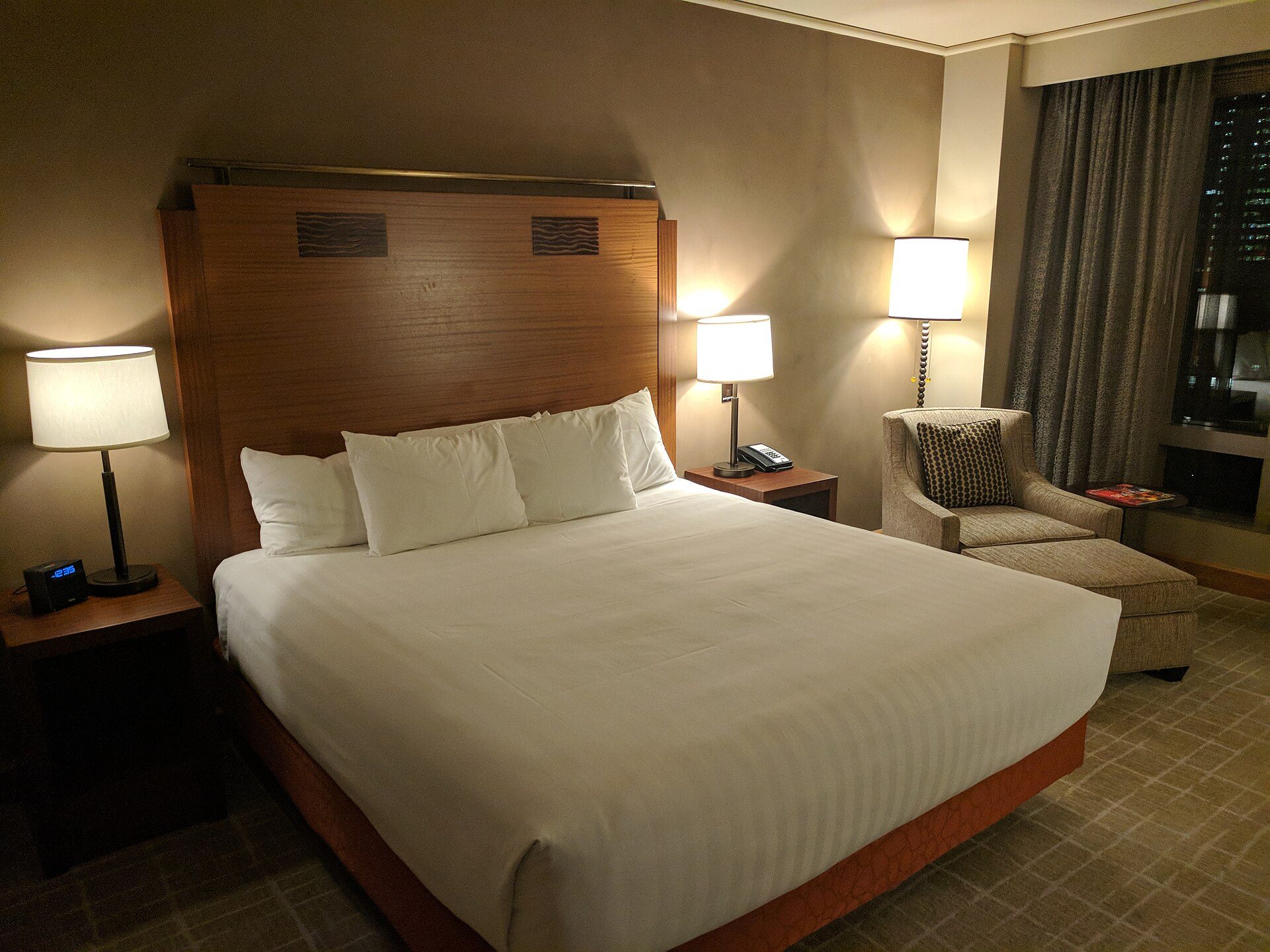
Photo: Kurt Kaiser / Wikimedia Commons, CC0

Common bed sizes
| Bed type | Typical mattress size | Usual number of pillows | Notes |
|---|---|---|---|
| Single (twin) | About 1.0–1.2 × 2.0 m | 1–2 | A twin room has 2 single beds |
| Double, queen | About 1.6 × 2.0 m | 2–4 | Common in 2–3 star hotels |
| King | About 1.8–2.0 × 2.0 m | 4 | Heavy mattress; lift the edge one section at a time |
Actual sizes vary by hotel and supplier; always take the sheet and cover sizes from the housekeeping linen list.
Posture that protects your back
A housekeeping attendant may make 15–20 beds a shift. Bend the wrong way 20 times a day and within a few months your lower back will hurt. Learn posture before speed.
Bend your knees, not your back
When tucking sheets under the mattress or folding corners, lower yourself by bending the knees or kneeling on one knee, keeping your back straight (Figure 2). Never stand with straight legs and fold your back down to the mattress edge. Kneeling on one knee on a knee pad is the posture many people find easiest for corners.
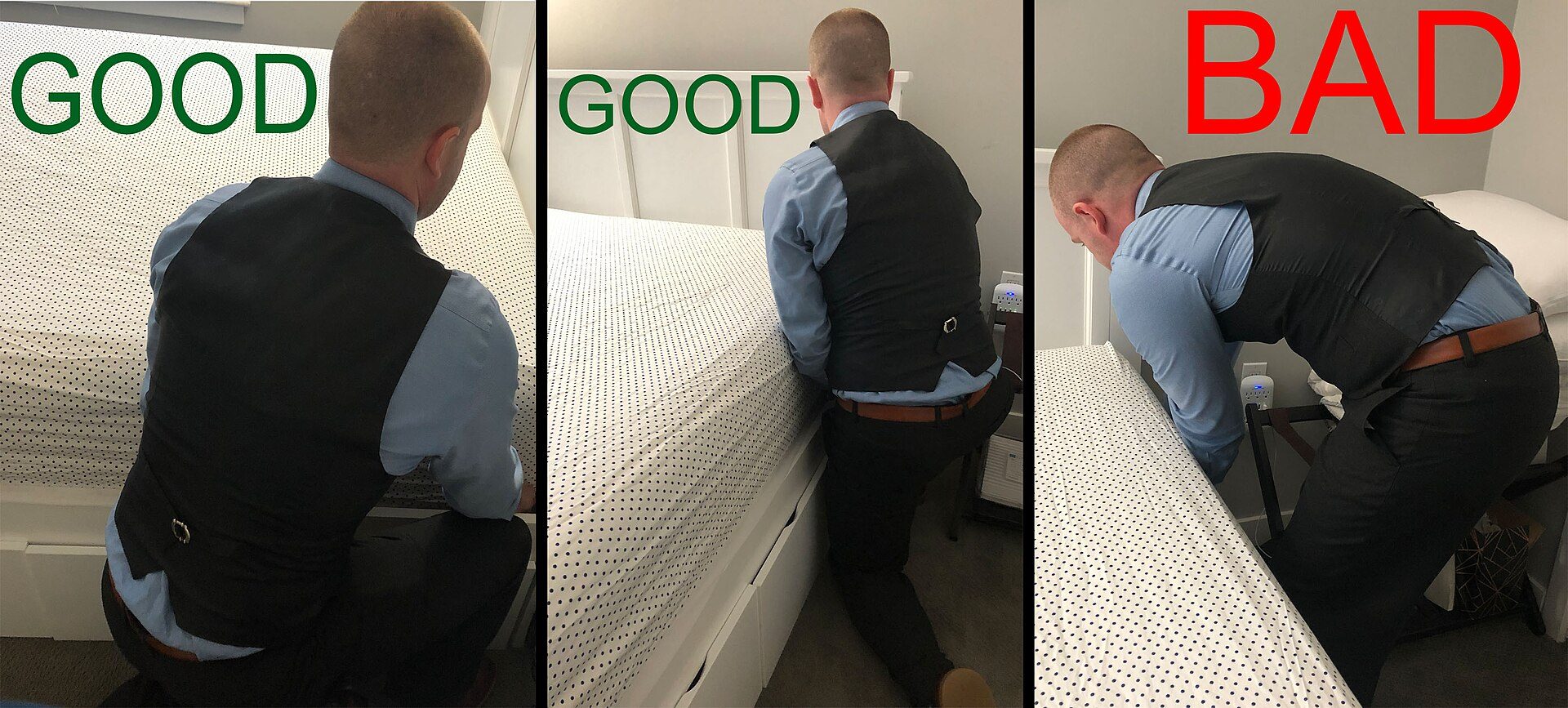
Photo: HarvardOcDoc / Wikimedia Commons, CC BY-SA 4.0

Lifting the mattress edge correctly
- Lift only a section of the mattress edge, just enough to tuck the sheet; never lift the whole mattress.
- Lift with your legs: bend your knees, palms under the edge, stand up slowly.
- Rotating mattresses or handling heavy king mattresses is a two-person job, never alone.
Walk around the bed instead of reaching
Finish one side before moving to the other; never stretch across the bed to pull the far side. If the bed has castors, pull it a few tens of centimetres from the wall to make room to stand, then push it back to the exact spot.
Safety warning: Always wear gloves when stripping used linen, as sheets and pillowcases may carry blood or body fluids. Never shake dirty linen near your face; roll it from the outside in. If you find a needle, razor blade or broken glass in the bedding, stop, do not pick it up with bare hands, and report it to your supervisor to handle by procedure. Never lift or flip a king mattress alone. If back pain lasts or numbness spreads down your leg, see a doctor rather than carrying on.
Preparing linen and stripping the bed
Speed starts with taking everything you need into the room on the first trip. Going back to the trolley for one pillowcase costs 30 seconds.
Linen to take in for one double bed
1 bottom sheet, 1 duvet cover, 4 pillowcases, and a runner if the old one is dirty. Put clean linen on a clean chair or table, never on the floor or on the used bed. On the trolley, clean linen goes in its own shelves, fully separate from the dirty linen bag (Figure 3).
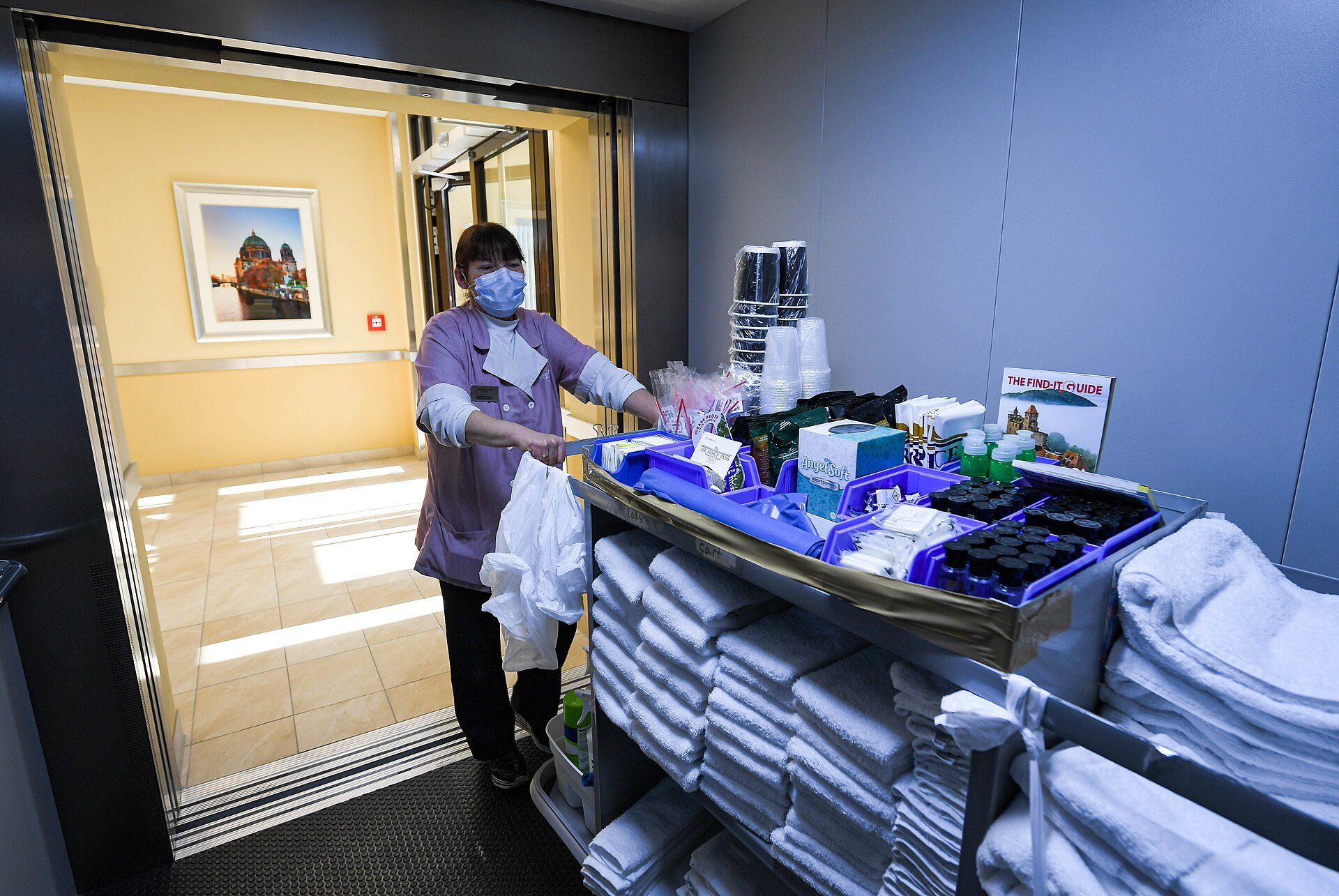
Photo: U.S. Air Force photo by Airman Jared Lovett / Wikimedia Commons, Public domain

Stripping used linen
- Put on gloves. Lift the pillows, remove the cases and check inside for guest items (phones, jewellery, earphones).
- Pull off the duvet, remove the cover and put the insert on a clean chair.
- Strip the bottom sheet from the corners towards the centre, roll it into a bundle and put it straight into the dirty linen bag.
- Guest items left behind: record them and hand them in through the lost-and-found procedure; never keep them.
Checking the mattress and protector
Look at and run your hand over the protector: hair, crumbs, stains. Change a dirty protector; if a stain has gone through to the mattress, tell your supervisor. Pull the protector smooth before laying the sheet, because creases underneath show through on top.
Laying the bottom sheet and folding hotel corners
The bottom sheet decides whether the bed looks smooth. The goal: the centre seam or fold lies exactly in the middle of the mattress, both sides hang evenly and all 4 corners are firm.
Laying a flat sheet
- Standing at the foot or one side of the bed, place the folded sheet in the middle of the mattress with the centre fold along the bed's centre line.
- Open the sheet out to both sides with one light flick, right side up.
- Adjust so the overhang at the head and foot is equal, and the same on both sides.
- Tuck the head end under the mattress first, then pull the sheet tight towards the foot.
Folding a 45-degree (hotel) corner
- At a foot corner, lift the side edge of the sheet about 30–40 cm from the corner and lay it diagonally on top of the mattress to form a triangle, its edge at about 45 degrees.
- Holding the triangle on the mattress, tuck the sheet still hanging at the corner under the mattress.
- Drop the triangle, smooth the edge straight along the mattress side, then tuck in the rest.
- Repeat for the other 3 corners; finish one side before the other, pulling the sheet tight before tucking.
A corner is right when the fold makes a neat diagonal on the mattress side and does not come loose when pulled lightly. This is the hotel corner, also called a hospital or mitred corner.
Using a fitted sheet
Fit the head corner on your side first, then the foot corner on the same side, then go round and fit the far head corner, and finally the last foot corner. The last corner is always the hardest: lift the mattress edge with your legs and do not yank the sheet. Retire fitted sheets whose elastic has gone and no longer grips the mattress.
Fast duvet covers, pillows and the runner
Method 1: inside-out cover
- Turn the duvet cover inside out. Put both hands inside and grab the two closed corners of the cover.
- Through the fabric, grab the two top corners of the duvet insert lying on the bed.
- Lift and shake firmly downwards; the cover turns itself right side out over the insert.
- Lay it on the bed, close the buttons or zip, and smooth the 4 corners of the insert into the 4 corners of the cover.
Method 2: the roll (no shaking)
- Lay the cover flat on the bed inside out, opening at the foot.
- Lay the insert flat on top, corners matching.
- Roll both layers together from the head towards the foot into a tight roll.
- Turn the cover opening over the roll, close it, then unroll back towards the head.
Method 2 suits small rooms, low ceilings or shorter people, with no lifting the arms high to shake. After spreading it, place the top edge of the duvet the distance from the headboard that your hotel specifies (many fold the top edge back), with even overhang on both sides.
Casing and arranging pillows
Never hold a pillow under your chin or hug it against your body to case it; it is unhygienic. Fold the pillow in half lengthwise, slide it into the case, let it spring open to fill the case and pat it plump (Figure 4). Turn the open end of the case towards the centre of the bed or away from the door so the guest does not see it. Sleeping pillows stand against the headboard, decorative cushions in front if used.
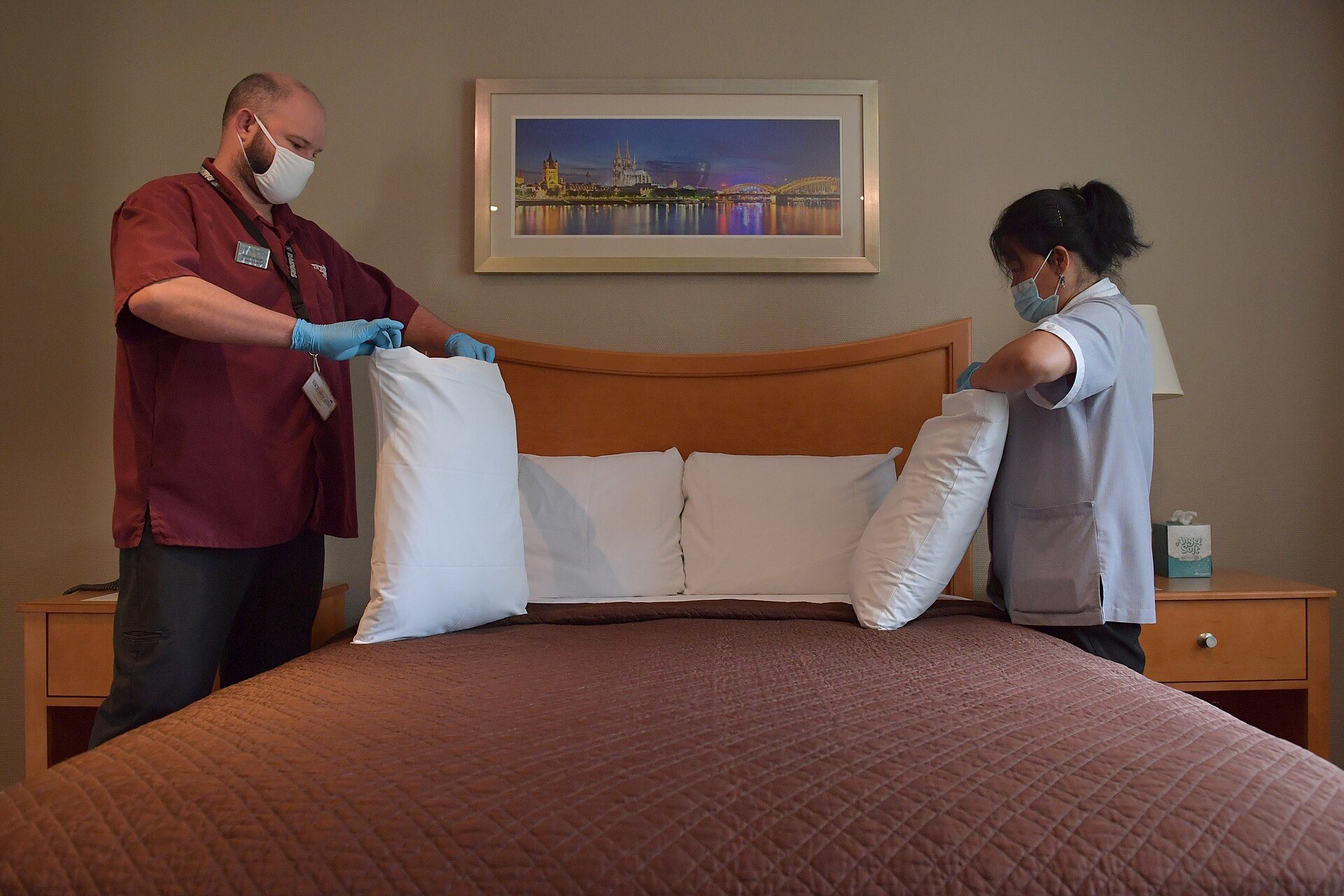
Photo: U.S. Air Force photo by Airman 1st Class John Wright / Wikimedia Commons, Public domain

Runner and final check
Lay the runner across the foot of the bed, balanced on both sides, its edge parallel to the bed's edge. Walk round the bed and bend your knees to look across the surface at eye level for creases, hair and crumbs. Replace torn, worn or stained linen straight away; never leave it for the guest.
Standard timing and a worked example for one shift
Target timing for a double bed
| Step | Target time | Tip to go faster |
|---|---|---|
| Strip used linen | 30 seconds | Pillows first, roll the sheet in one go |
| Check mattress and protector | 15 seconds | Sweep your hand in a Z pattern |
| Bottom sheet + 4 corners | 60 seconds | Finish one side before the other |
| Duvet into cover | 60 seconds | Pick one method and drill it |
| Spread duvet, top fold | 30 seconds | Line up the centre seam first |
| Case 4 pillows, arrange | 30 seconds | Fold the pillow, don't stuff it |
| Runner + final check | 15 seconds | One look across the bed at eye level |
| Total | 240 seconds = 4 minutes |
Check: 30 + 15 + 60 + 60 + 30 + 30 + 15 = 240 seconds. This is the target once the movements are automatic; taking twice as long in your first week is normal. The exact standard is set by each hotel.
Worked example: linen for a 12-departure shift
Hoa is assigned 12 departure (checked-out) rooms on floor 5: 8 double rooms (1 bed, 4 pillows each) and 4 twin rooms (2 single beds each, 2 pillows per bed).
- Bottom sheets: 8 × 1 + 4 × 2 = 8 + 8 = 16.
- Duvet covers: 8 × 1 + 4 × 2 = 16.
- Pillowcases: 8 × 4 + 4 × 2 × 2 = 32 + 16 = 48.
- Spares for torn or stained items: 2 sheets, 2 covers, 4 pillowcases more. The trolley carries 18 sheets, 18 covers and 52 pillowcases.
Bed-making time alone: 8 double beds × 4 minutes = 32 minutes; 8 single beds × 3 minutes = 24 minutes; total 32 + 24 = 56 minutes. The rest of the shift goes on bathrooms, vacuuming, dusting and restocking amenities. If Hoa takes 8 minutes per double bed, the beds alone take 8 × 8 + 24 = 88 minutes, 32 minutes slower.
Common bed-making mistakes and fixes
Creases in the middle of the bed
Sign: ripples across the middle when you look at eye level. Cause: a creased protector underneath, or not pulling the sheet tight after tucking the head end. Fix: smooth the protector first, tuck the head end and pull tight, tuck the foot corners last.
Corners pop out when someone sits
Sign: corners come loose after a few sits. Cause: too little sheet tucked under, the 45-degree triangle not held flat while tucking. Fix: leave enough overhang to tuck deep, and press the triangle on the mattress while tucking the part below.
Twisted cover, lumpy duvet
Sign: one side long, the other short, empty cover corners. Cause: grabbing the wrong insert corners when turning the cover. Fix: before closing the cover, check that all 4 insert corners are in the 4 cover corners and line the centre seam up with the middle of the bed.
Missed hair and stains
Sign: a guest sends a photo of a hair on the pillow with a complaint. Cause: skipping the final look. Fix: always bend your knees and look across the bed once before leaving it; use a lint roller if the hotel provides one.
Frequently asked questions
Are hotel sheet corners hard to fold?
Not if you remember 3 moves: lift the edge into a 45-degree triangle, tuck the hanging part at the corner, drop the triangle and tuck the rest. Practise 20 corners in a row and your hands will remember.
What is the fastest way to put on a duvet cover?
The inside-out-and-shake method is fastest if the room is roomy and you are tall enough. In small rooms or with large duvets the roll method is steadier. Pick one and practise until it takes under a minute.
How should hotel pillows be arranged?
Cases pulled smooth, the open end facing the centre or away from the door, sleeping pillows standing straight against the headboard, decorative cushions in front, and the right number of pillows for the room category.
Is the hotel bed standard the same everywhere?
The general principles are the same: clean, smooth, balanced, consistent. Details such as the number of pillows, the top fold and whether a top sheet is used follow each hotel's SOP. To see how rooms are handed to guests, you can read the lesson on the hotel check-in procedure in the receptionist career.
Is making beds all day bad for your back?
Yes, if you bend at the waist again and again. Bending your knees, kneeling on one knee for corners, lifting the mattress edge with your legs and asking a colleague for heavy mattresses cut the risk a lot. See a doctor if the pain lasts or your leg goes numb.
Practice exercises and self-assessment
- Make 5 double beds in a row, time each one and record the 7 steps from the table.
- Drill 45-degree corners alone: 20 in a row, with someone pulling each one to test it.
- Put a duvet in its cover both ways, 5 times each, and pick the faster method for you.
- Work out the linen for a 10-room shift: 6 double rooms with 4 pillows, 4 twin rooms with 2 beds and 2 pillows per bed.
Self-assessment criteria
- Pass: a double bed in under 5 minutes after your first week, heading for 4; the centre seam straight, no corner coming loose when pulled.
- Pass: not once during the exercises did you stand straight-legged and bend your back to tuck a sheet.
- Pass: the linen exercise gives 14 sheets, 14 duvet covers and 40 pillowcases (before spares).
- Not yet: hair or stains still on the bed at the final check, or clean linen put on the floor.
Once bed making is second nature, move on to the next step of the roadmap: Bathroom cleaning & detail checks, where you learn to work top to bottom and dry to wet and to check for hair and water marks before leaving the room.
Keep learning hotel housekeeping: after bed making come bathroom cleaning, occupied and departure room procedures, public areas and a timed 10-room shift. See the 8-step housekeeping attendant roadmap.