Shrimp pond pH should usually be kept within the commonly used range of 7.5–8.5, and just as important, the difference between early morning and mid-afternoon should not exceed about 0.5 units. To hold it there you test pH twice a day, test alkalinity regularly, and use the right kind of lime or mineral at the right time and dose for the volume of water in the pond. This lesson is written the way a shrimp farm technician coaches a newcomer: why pH swings, how to measure it properly, how to handle low and high pH, and a worked lime calculation for a 2,000 m² pond with figures that add up.
By the end of this lesson, you will be able to:
- State the pH and alkalinity ranges commonly recommended for whiteleg shrimp and black tiger shrimp, and explain why the day-night pH swing matters.
- Test pH at the right times (early morning and early afternoon) with a colour test kit or a calibrated pen meter, and test alkalinity with a drop-count kit.
- Choose the right lime (CaCO3, dolomite, hydrated lime, quicklime CaO) for each situation and work out the dose from pond volume.
- Deal with pH crashes after rain, high afternoon pH from dense algae and large swings after an algae crash.
- Work safely with quicklime, aerator electrics and slippery lined ponds.
Learning shrimp farming properly? Daily water quality management is step 4 of the roadmap, after pond safety, pond preparation and stocking. See the 8-step aquaculture roadmap to learn in the right order.
What is pH, and why are shrimp so sensitive to it?
pH measures how acidic or alkaline water is, on a scale from 0 to 14. pH 7 is neutral, below 7 is acidic and above 7 is alkaline. Each pH unit is a tenfold change in hydrogen ion concentration, so a drop from 8.0 to 7.0 means the water is ten times more acidic, not "a little lower".
How pH affects shrimp
Shrimp breathe through gills and moult regularly, and both depend on pH. Low pH (below about 7) makes gas exchange harder, slows moulting and leaves shells soft for longer. High pH (above about 9) shocks the shrimp, puts them off feed and damages the gills. Figure 1 shows a whiteleg shrimp, the most widely farmed species in Vietnam's coastal provinces today.
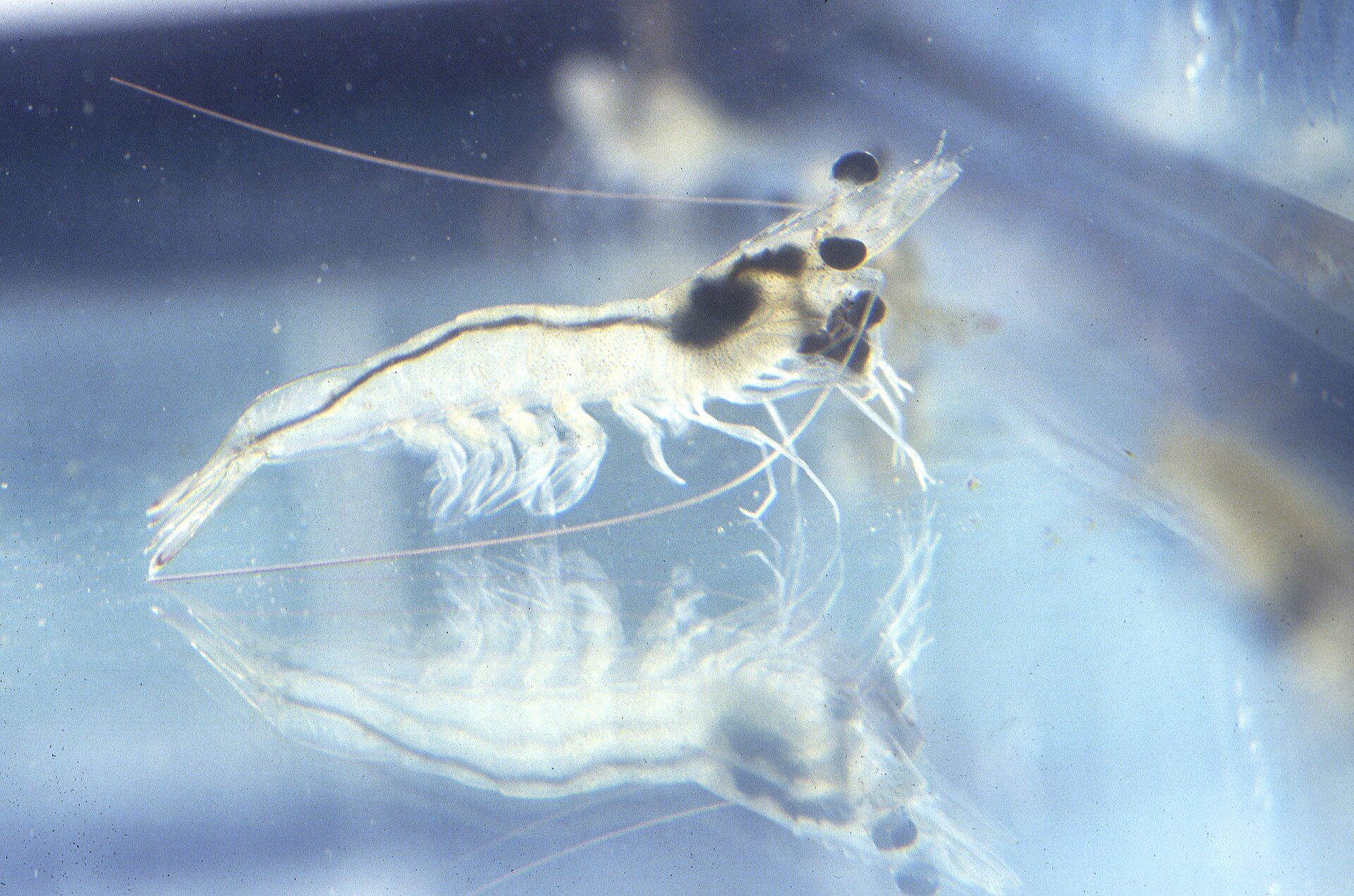
Photo: Không rõ tác giả / Wikimedia Commons, Public domain

pH controls how toxic ammonia and hydrogen sulphide are
Ponds always contain ammonia from uneaten feed and shrimp waste. It exists as NH4+, which is fairly harmless, and NH3, which is highly toxic. The higher the pH, the larger the NH3 share. At around 28–30°C in fresh water, NH3 is roughly 7% of total ammonia at pH 8 but around 40% at pH 9 (slightly lower in brackish water). At the other end, low pH makes hydrogen sulphide (the rotten-egg gas from pond sludge) more toxic.
Alkalinity is the buffer that holds pH steady
Alkalinity (expressed as mg/L CaCO3) measures bicarbonate and carbonate in the water. With enough alkalinity, pH moves only slightly when CO2 rises or falls; with low alkalinity, pH jumps hour by hour. Moulting shrimp take up minerals, so alkalinity falls through the crop. That is why technicians always read pH together with alkalinity.
Commonly recommended pH and alkalinity for shrimp
The figures below are ranges commonly used in brackish-water shrimp farming guidance. The exact targets can differ by species, salinity, farming system (extensive, intensive, high-density lined ponds) and local extension advice, so always check them against your farm's own protocol.
| Parameter | Whiteleg shrimp | Black tiger shrimp | How to read it |
|---|---|---|---|
| pH | 7.5–8.5 | 7.5–8.5 | Below 7 or above 9 is a danger zone; act immediately |
| Morning–afternoon pH swing | ≤ 0.5 | ≤ 0.5 | More than 0.5 means dense algae or low alkalinity |
| Alkalinity (mg/L CaCO3) | 120–180 | 80–120 | Low-salinity ponds usually struggle to hold alkalinity |
| When to test pH | 5–6 a.m. and 2–3 p.m. | The lowest and highest pH of the day | |
| How often to test alkalinity | At least twice a week, daily while correcting | Retest after heavy rain and water exchange | |
Why the swing matters more than one good reading
A pond at pH 7.6 at 5 a.m. and 8.9 at 2 p.m. has a nice "average", but the shrimp go through a 1.3-unit swing every day, with repeated stress, poorer feeding and more disease. A pond at 7.8 in the morning and 8.2 in the afternoon is far more stable.
Signs that shrimp are struggling with pH
- Shrimp gathering at the pond edge or swimming sluggishly near the surface before the sun is strong.
- A sudden drop in appetite, with feed left on the feed trays after the check time.
- Scattered moulting, shells staying soft, gills changing colour.
Why shrimp pond pH swings between day and night
Algae are the main driver. By day, algae photosynthesise and take CO2 out of the water; less CO2 means higher pH, peaking in early afternoon. At night, algae, shrimp and bacteria only respire and release CO2, so pH falls and bottoms out around dawn. A dark green pond (Figure 2) has more algae, so its swing is usually larger than in a pond with lighter water colour.
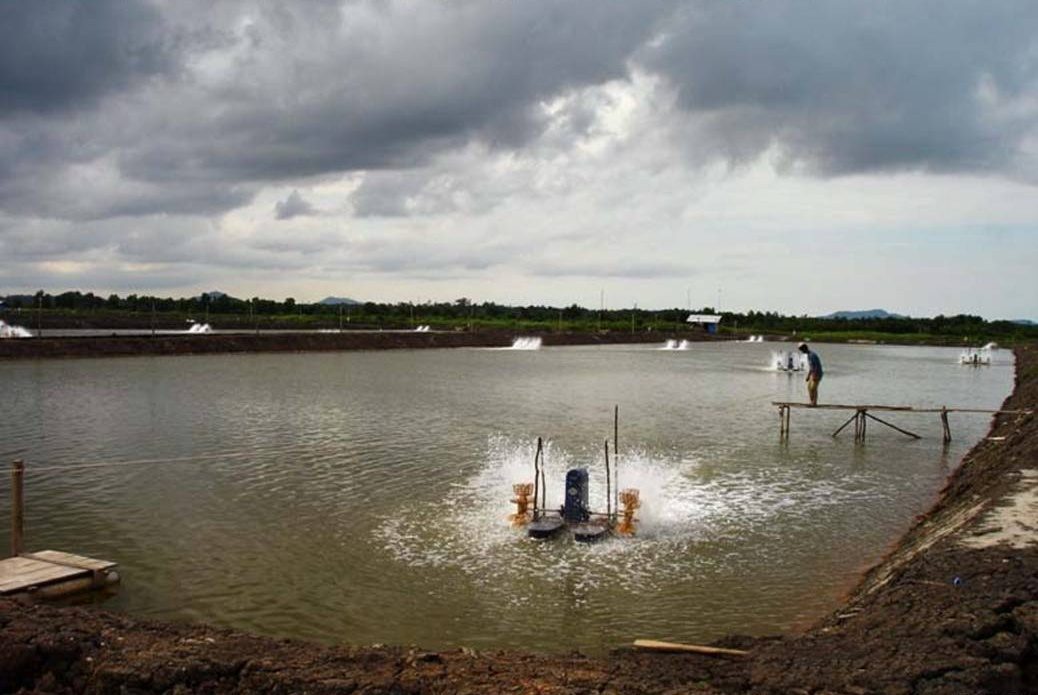
Photo: Herman Gunawan, Bangka, Indonesia. / Wikimedia Commons, CC BY-SA 3.0

Heavy rain makes pH crash
Rainwater is slightly acidic and dilutes the alkalinity of the surface layer. In acid sulphate soil areas, rain also washes acidity from the pond banks into the water, and pH can drop sharply after a single storm. Rainwater is lighter than brackish water and sits on top as a layer; run the aerators to mix it.
An algae crash drops pH and oxygen together
When algae grow too dense and then die off at once, it is called an algae crash. Signs: the water turns from green to clear or murky brown, with foam and a fishy smell. Decaying algae use up oxygen and release CO2, so pH and dissolved oxygen fall together, which is the most dangerous situation at night.
How to measure pond pH and alkalinity properly
A wrong reading is more dangerous than no reading, because you will add lime based on a wrong number. Sample in the right place, test at the right time and check your equipment.
Taking a water sample
- Take water at about 20–30 cm depth, at least 1–2 m from the bank, not right behind an aerator or where chemicals were just applied.
- In large ponds sample 2–3 points and record them separately; big differences mean the water is not well mixed.
- Test immediately at the bank; a sample left in the sun changes pH because the algae keep photosynthesising.
Colour test kits and electronic pen meters
A colour pH test kit is cheap and simple: fill the tube to the mark, add the exact number of reagent drops, shake and compare against the colour chart in natural light. An electronic pH pen (Figure 3) reads to 0.01–0.1, but it must be calibrated with pH 7 and pH 4 or 10 buffer solutions as the maker instructs, usually once a week, and the electrode tip must stay moist in storage solution. Test the same sample with the pen and the kit; if they differ by more than about 0.3, recalibrate or replace the reagent.
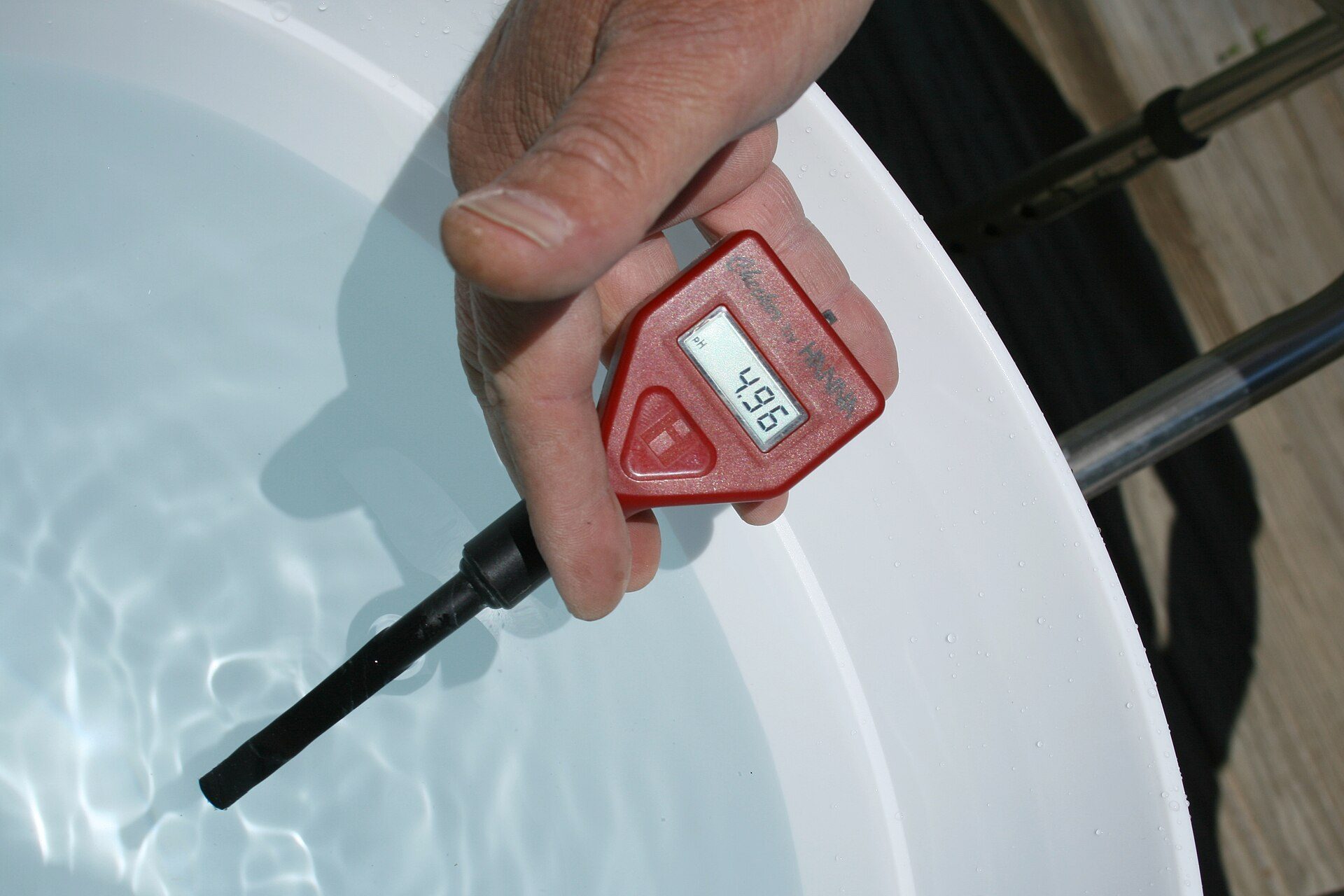
Photo: Ildar Sagdejev ( Specious ) / Wikimedia Commons, CC BY-SA 4.0

Testing alkalinity with a drop-count kit
Alkalinity kits are usually a titration: put the sample in the tube, add the indicator, then add reagent one drop at a time until the colour changes, and multiply the number of drops by the maker's factor to get mg/L CaCO3. Shake after each drop, count carefully and repeat if the result looks odd.
Keep a water quality log
One page per pond: date, time, morning pH, afternoon pH, swing, alkalinity, salinity, water colour, weather, what you applied and how much. The log shows trends before the shrimp show symptoms.
How to raise shrimp pond pH and add alkalinity
Low pH nearly always comes with low alkalinity or follows rain. The rules: raise alkalinity first and pH will settle; use mild lime while shrimp are in the pond; apply at night, around 9–10 p.m., when pH is falling, so you do not push the afternoon peak even higher.
Common limes and minerals
| Product | Main effect | When to use | Notes |
|---|---|---|---|
| Agricultural lime CaCO3 (ground limestone) | Raises alkalinity gently, steadies pH | Stocked ponds, routine treatment, after rain | Mild, dissolves slowly, rarely spikes pH |
| Dolomite CaMg(CO3)2 | Raises alkalinity, adds Ca and Mg | Stocked ponds, low-salinity ponds | Similar to CaCO3 |
| Sodium bicarbonate NaHCO3 | Raises alkalinity fast with little pH rise | Low alkalinity that must come up quickly | Split into several doses, costs more than lime |
| Hydrated lime Ca(OH)2 | Raises pH fast | Low doses when pH crashes, on technical advice | Can spike pH, caustic |
| Quicklime CaO | Raises pH very strongly, disinfects | Mainly pond preparation before stocking | Gets very hot with water, causes burns |
Quicklime (Figure 4) is used when preparing the pond bottom, not something to throw casually into a stocked pond: it heats up on contact with water and turns into hydrated lime, pushing the pH of the water around the spot very high.
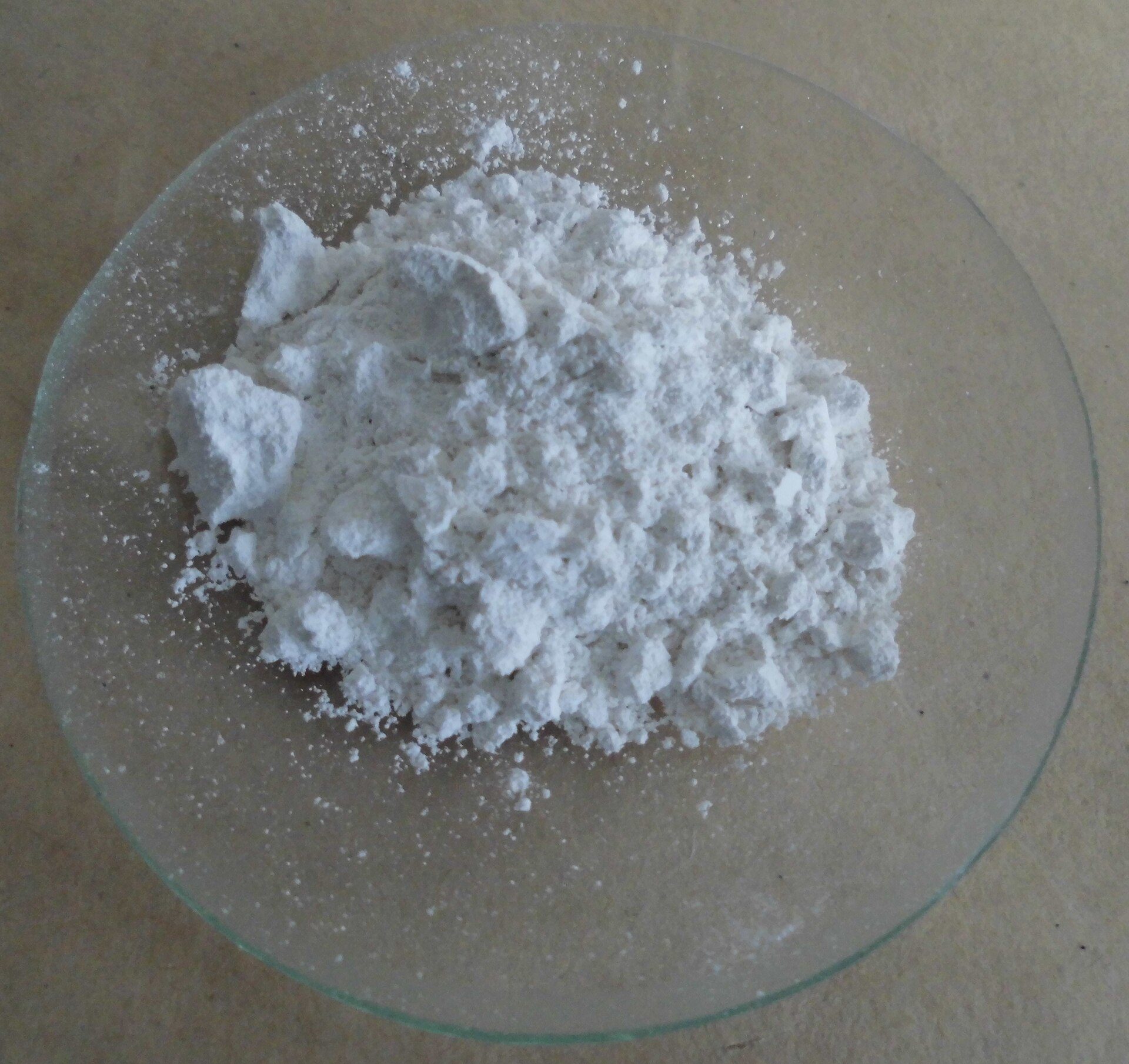
Photo: Leiem / Wikimedia Commons, CC BY-SA 4.0

Dose by volume, not by area
Doses for stocked ponds are usually given in kg per 1,000 m³ of water. Volume = water surface area × average depth. Many protocols use CaCO3 or dolomite at about 10–20 kg per 1,000 m³ per application; for sodium bicarbonate, in theory about 1.68 g of NaHCO3 per m³ raises alkalinity by 1 mg/L. These are reference figures; the real dose depends on your test results and the advice of an extension officer or the product label.
How to spread it evenly
- Dissolve the lime or bicarbonate in pond water in a plastic tub, stir and let the grit settle.
- Switch the aerators on first, then spread evenly along the current around the pond, never dumping it in one spot.
- Retest pH the next morning and afternoon and record the new swing.
How to lower shrimp pond pH when the afternoon reading is too high
Afternoon pH above about 8.5–9 almost always comes from too much algae and too little alkalinity to buffer it. The goal is not "lower pH at any cost" but fewer algae and more buffering.
Thin the algae and exchange water
- Exchange or top up with treated water from the settling pond, about 10–20% depending on conditions and water available.
- Cut overfeeding, because surplus nutrients feed the algae; use the feed trays to set the ration.
- Siphon the bottom or drain sludge from the central drain (lined ponds) to reduce organic matter.
Molasses and probiotics
Many farms use molasses together with a probiotic product: bacteria feed on the sugar, compete with algae for nutrients and release CO2, so afternoon pH eases down. A common dose is about 2–3 kg of molasses per 1,000 m³, but follow your farm protocol and the supplier's instructions. Active bacteria also use oxygen, so keep the aerators running fully, especially at night.
What not to do
- Do not pour in strong acid to lower pH: pH crashes locally and the shrimp go into shock and die.
- Do not apply lime at midday or in the afternoon when pH is already high: it only pushes the peak higher.
- Do not kill algae with one big dose of algaecide: mass die-off causes an algae crash and oxygen depletion.
Safety with lime, electricity and the pond itself
Three common hazards: lime burns, electric shock from aerators, and drowning.
Safety warning: Quicklime CaO and hydrated lime Ca(OH)2 are caustic and burn skin and eyes; CaO gets very hot with water and can boil and spatter. Always wear sealed goggles, rubber gloves, a mask and long sleeves; add lime slowly to plenty of water, never water onto lime; spread with the wind at your back. If lime gets in the eyes, rinse with clean running water for at least 15 minutes and see a doctor immediately. Aerators and blowers must be on residual-current (earth-leakage) breakers, with motor housings earthed and cables kept up off the water; switch off before touching an aerator, clearing debris from the paddles or entering the pond. HDPE-lined ponds are very slippery and hard to climb out of: never go out to the ponds alone at night, keep a ring buoy or rescue rope on the bank, and never enter a pond after drinking alcohol.
Aerators and electricity at the pond
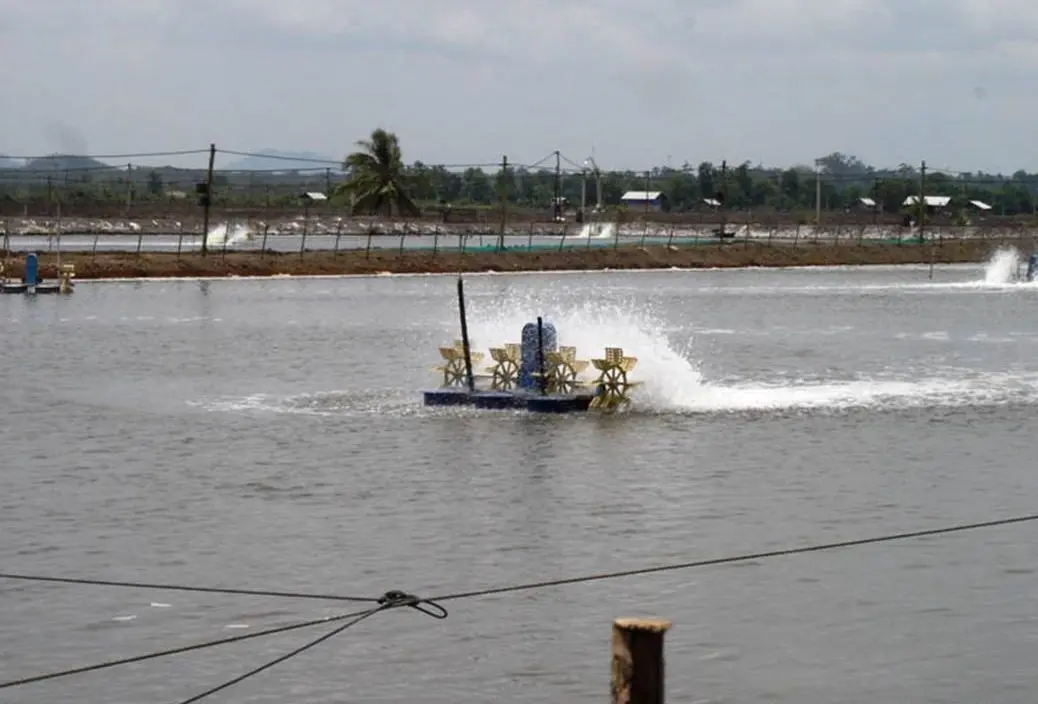
Paddlewheel aerators (Figure 5) run around the clock in the middle and late crop with the motor just above the water, so current leakage is a real risk. Each aerator circuit should have its own residual-current breaker, with the TEST button pressed regularly. If you are unsure how to choose and test this device, read how to wire an RCD at home from the electrician track, and have an experienced electrician wire the farm.
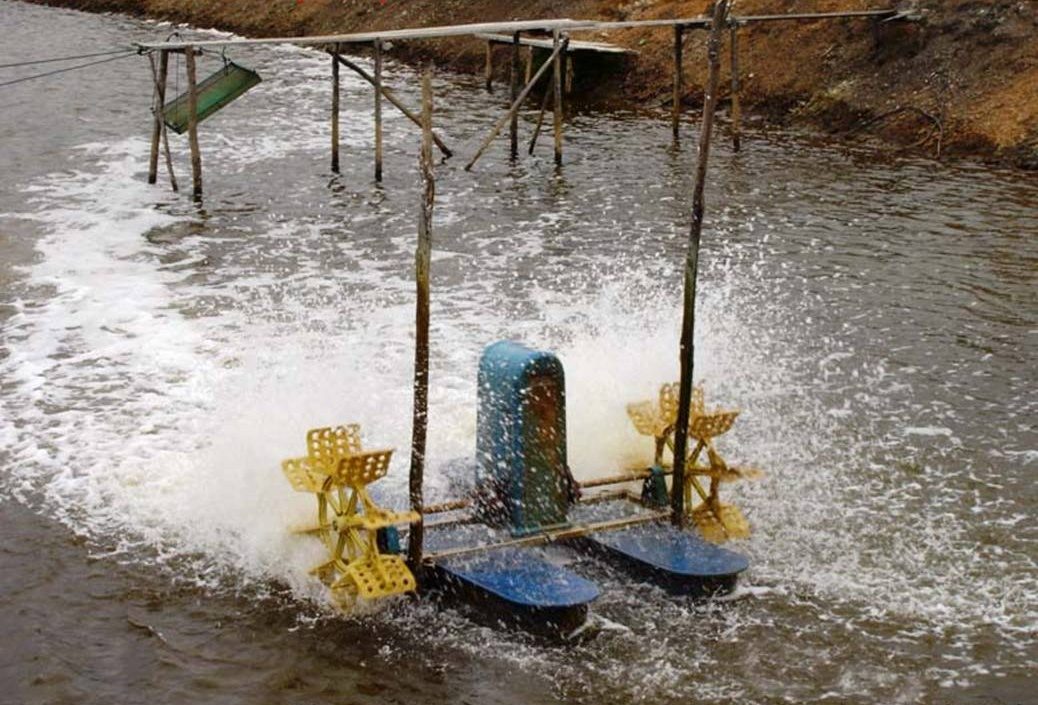
Photo: Herman Gunawan, Bangka, Indonesia. / Wikimedia Commons, CC BY-SA 3.0

Worked example: a 2,000 m² whiteleg shrimp pond with a 0.9 pH swing
This is an illustrative example to practise the calculation; real doses must follow your own pond's test results and technical advice. A lined whiteleg shrimp pond measures 50 × 40 m with an average water depth of 1.4 m, and the shrimp are 45 days into the crop. Three days in a row the readings were: pH about 7.4 at 5 a.m., about 8.3 at 2 p.m., alkalinity 100 mg/L. The water is dark green and there were two afternoon storms.
Step 1: assess
- pH swing: 8.3 − 7.4 = 0.9, above the 0.5 limit.
- Alkalinity 100 mg/L, below the 120–180 mg/L commonly used for whiteleg shrimp.
- Conclusion: low alkalinity is letting pH swing. Target: raise alkalinity to about 120 mg/L and bring the swing to 0.5 or less.
Step 2: volume and doses
- Water surface: 50 × 40 = 2,000 m². Volume: 2,000 × 1.4 = 2,800 m³.
- Night 1, steady the pH with CaCO3 at 15 kg per 1,000 m³: 2.8 × 15 = 42 kg.
- Nights 2 and 3, raise alkalinity by 20 mg/L with sodium bicarbonate, split into two doses of 10 mg/L: 10 × 1.68 = 16.8 g/m³; 16.8 × 2,800 = 47,040 g ≈ 47 kg per night, 94 kg over two nights.
- To stay on the safe side, ignore the alkalinity the CaCO3 adds; retest before night 3 and cut the dose if alkalinity is already on target.
Step 3: materials and cost (2026 reference, varies by region and dealer)
| Item | Needed | Bought × unit price | Amount |
|---|---|---|---|
| CaCO3 lime, 25 kg bag | 42 kg | 2 bags × 80,000 VND | 160,000 VND |
| Sodium bicarbonate NaHCO3, 25 kg bag | 94 kg | 4 bags × 400,000 VND | 1,600,000 VND |
| Total | 1,760,000 VND | ||
Check: 160,000 + 1,600,000 = 1,760,000 VND (about USD 67). Buying 50 kg of CaCO3 leaves 8 kg spare and 100 kg of bicarbonate leaves 6 kg, kept for treatment after rain. A 25 kg bag of CaCO3 usually costs about 60,000–100,000 VND and bicarbonate about 350,000–500,000 VND in Vietnam; ask your local aquaculture supply dealer.
Step 4: follow up
On day 4, retest (illustrative results): alkalinity about 120 mg/L, morning pH 7.7, afternoon pH 8.1, a swing of 8.1 − 7.7 = 0.4, now below 0.5. At the same time, cut the feed by about 10% because the trays showed leftovers, and exchange 15% of the water from the settling pond to thin the algae. Log everything, and keep testing alkalinity twice a week because it will keep falling as the shrimp grow.
Common mistakes in managing shrimp pond pH
Testing only once, at 9–10 a.m.
Sign: the log always shows a "nice" pH yet the shrimp are weak. Cause: at that hour pH is in the middle, so you never see the low or the peak. Fix: test at 5–6 a.m. and 2–3 p.m. and record the swing.
Throwing quicklime into a stocked pond
Sign: shrimp jump and crowd the edges after liming, and pH near the spot shoots up. Cause: CaO is too strong and was dumped in one place. Fix: use CaCO3, dolomite or bicarbonate in stocked ponds and keep CaO for pond preparation; if a technician does call for a strong lime, dilute it, keep the dose low and spread it evenly with the aerators running.
Ignoring alkalinity
Sign: lime goes in again and again but pH still swings. Cause: watching pH only, never testing alkalinity. Fix: test alkalinity, bring it into the recommended range, then reassess pH.
Frequently asked questions
What pH is good for a shrimp pond?
The commonly used range is 7.5–8.5 for both whiteleg and black tiger shrimp, with a morning–afternoon swing of no more than about 0.5. The exact optimum depends on species, salinity and your farm's or local technical protocol.
How big a day-night pH swing needs action?
When the gap between the 5–6 a.m. and 2–3 p.m. readings stays above about 0.5 for several days, test alkalinity and check water colour. Usually you need to add alkalinity and thin the algae.
How do I raise pH quickly after rain?
Run the aerators to mix the rainwater layer, test pH and alkalinity, and apply CaCO3 or dolomite in the evening at a dose based on pond volume. Use hydrated lime only in low doses when pH has crashed and on technical advice. Before the rainy season, spread lime on acid sulphate banks to limit acid run-off.
Does low alkalinity affect moulting?
Yes. Shrimp need minerals from the water to harden their shells after moulting. Long periods of low alkalinity usually go with soft shells and slow growth. Add alkalinity and minerals based on test results, not guesswork.
Practice and self-assessment
- Test pH in one pond (or an algae-rich test tank) at 5–6 a.m. and 2–3 p.m. for 7 days, recording the swing each day.
- Test alkalinity twice in the week with a drop-count kit, running two samples each time to check repeatability.
- Work out the CaCO3 dose at 15 kg per 1,000 m³ and the bicarbonate needed to raise alkalinity by 10 mg/L for a 1,500 m² pond, 1.2 m deep, following the example above.
Self-assessment criteria
- Pass: the log has all 14 pH readings at the right times, a swing column, and notes on weather and water colour.
- Pass: two alkalinity samples taken together differ by no more than one reagent drop.
- Pass: your calculation gives a volume of 1,800 m³, 27 kg of CaCO3 and about 30.2 kg of bicarbonate, clearly marked as an illustrative dose.
- Not yet: testing pH at the wrong times, never testing alkalinity, or spreading lime without goggles and gloves.
Once you can keep pH and alkalinity steady, move on to the next roadmap step: Feeding, feed trays & FCR, where you learn feeding tables by shrimp age, reading feed trays and calculating the feed conversion ratio, which is also how you cut the surplus feed that makes algae grow out of control.
Keep learning aquaculture: after water quality management come feeding and FCR, shrimp and fish disease prevention, following a pond through a full crop, then harvest and sales. See the 8-step aquaculture roadmap.