An e-bike or electric scooter battery is "worn out" when the lead-acid set or lithium pack can no longer hold the capacity it had when new: a full charge gives far fewer kilometres, the gauge drops quickly, and the scooter cuts out on hills or with a heavy load. But "the scooter feels weak" does not always mean the battery is finished — sometimes a single battery or one cell group drags the whole pack down, and sometimes the real fault is the charger or the controller. This lesson shows you how to measure like a shop technician in Vietnam: voltage of each battery and each cell group, a load test, reading the BMS, and only then deciding whether to replace the whole pack, replace cells, or simply rebalance.
By the end of this lesson, you will be able to:
- Explain how lead-acid and lithium batteries wear differently, with typical lifespans and voltage thresholds for each.
- Measure the voltage of every 12V battery and every lithium cell group, and find the weak one within 15 minutes.
- Run a load test to measure real capacity (Ah) and calculate battery health as a percentage of the rated capacity.
- Decide between replacing the whole pack, replacing cells or rebalancing, and quote the customer with clear reasons.
- Teach customers safe charging habits and recognise a battery that must be isolated immediately because of fire risk.
Learning e-scooter repair properly? Lithium packs, BMS boards and cell balancing are step 5 of the roadmap — after battery safety, DC electrics, BLDC motors and controllers. See the 8-step e-bike and e-scooter technician roadmap to learn in the right order.
Lead-acid and lithium: two different ways to wear out
Most e-bikes, budget electric scooters and older models in Vietnam run on sealed lead-acid batteries (locally called "dry batteries"); newer electric scooters and many lightweight e-bikes use lithium packs. The two age differently, so you measure and repair them differently.
Lead-acid: several 12V batteries in series
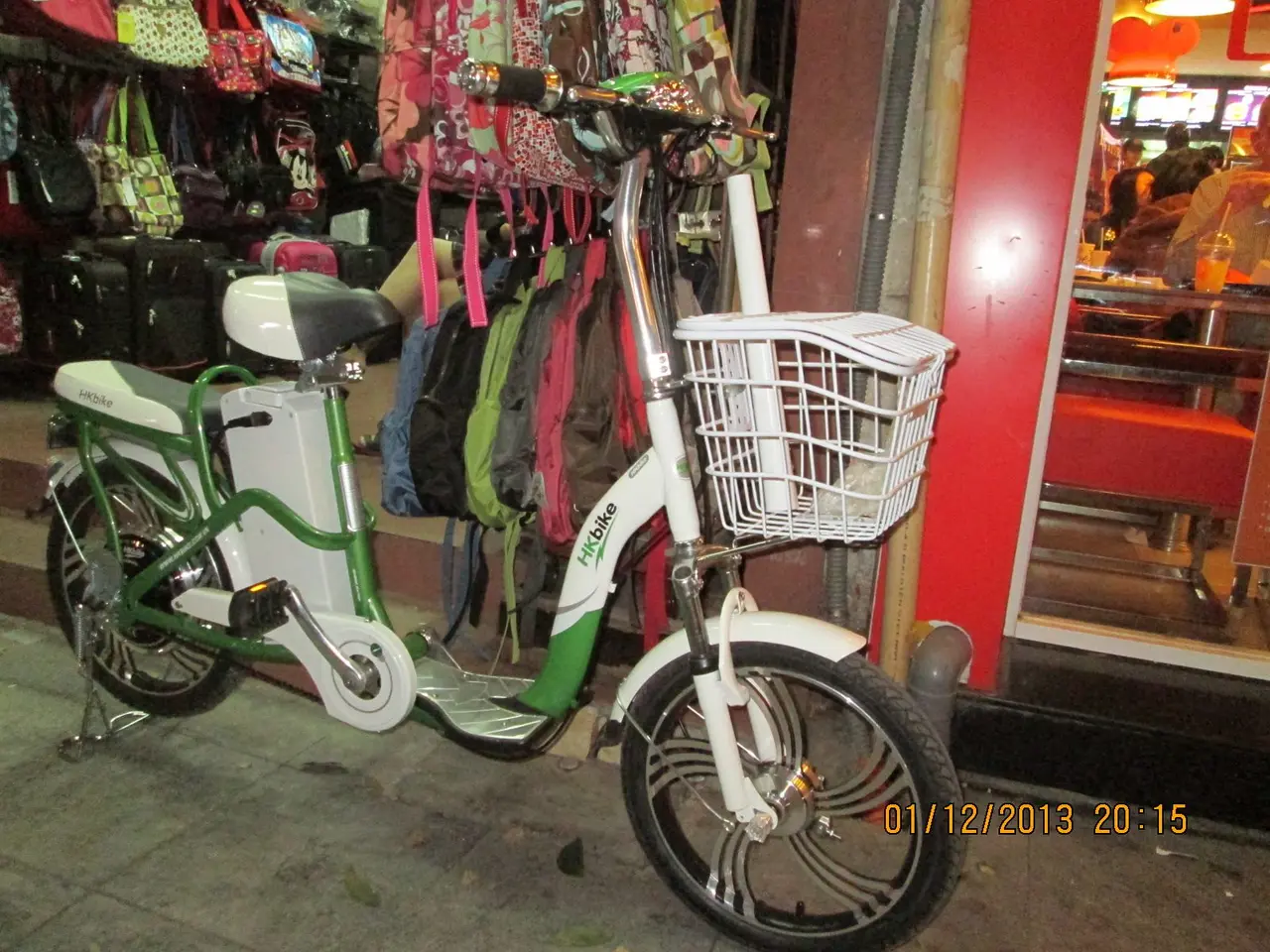
A lead-acid set is several 12V batteries wired in series: 4 for a 48V system, 5 for 60V, 6 for 72V. Typical capacity is 12Ah on e-bikes and 20–23Ah on electric scooters. Lead-acid batteries wear mainly through sulphation: lead sulphate crystals build up on the plates when the battery is often left flat, never fully charged, or stored unused. Figure 1 shows a 24V lead-acid set in a rack on an e-bike, the same kind of battery you will handle every day in the shop.
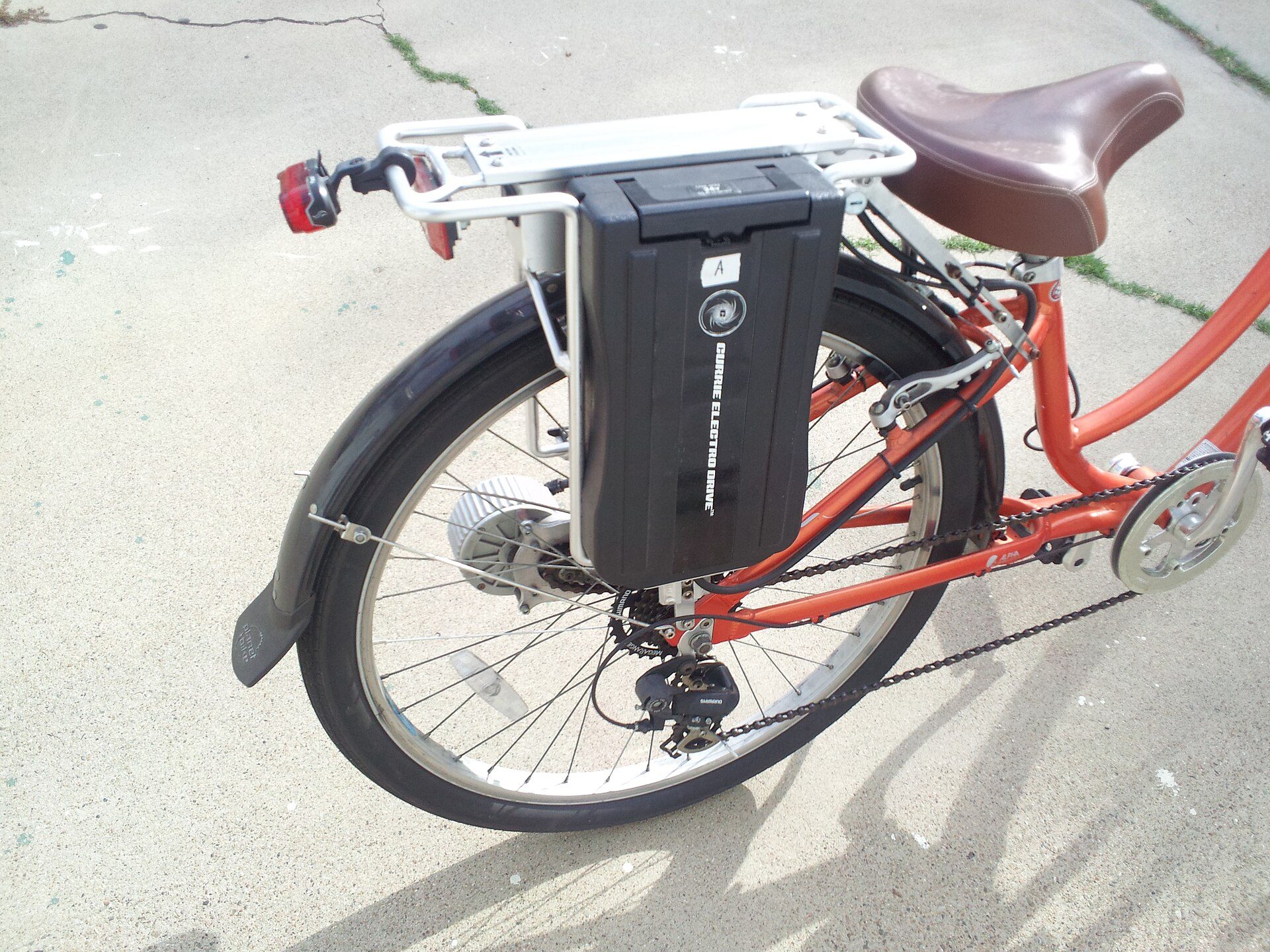
Photo: User:Stanistani / Wikimedia Commons, CC BY-SA 3.0
Lithium: dozens of cells grouped together
A lithium pack is a block of many small cells, cylindrical like 18650 and 21700 (see Figure 2), or pouch and prismatic cells. Cells are joined in parallel into groups to add capacity, and the groups are then wired in series to reach the system voltage. For example, "16S4P" means 16 groups in series, each with 4 cells in parallel. A BMS (battery management system) board monitors the voltage of each group, temperature and current, and cuts the power when something becomes dangerous.
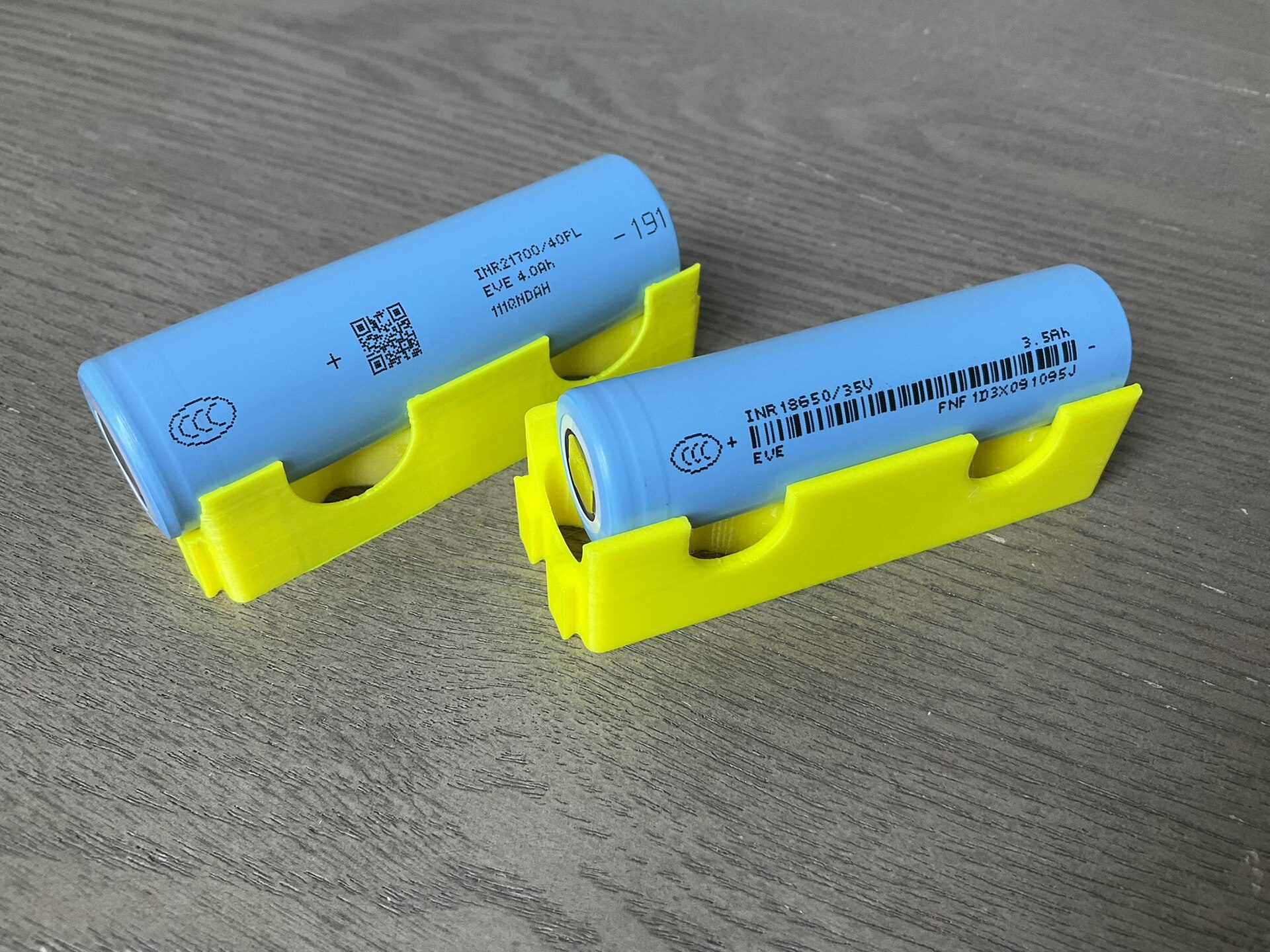
Photo: Sevenethics / Wikimedia Commons, CC0
Lithium cells wear with charge cycles, heat and time: internal resistance rises and capacity falls. Cells do not age evenly — a single weak group is enough for the BMS to cut off the whole pack early, even when every other group is still healthy.
Quick comparison
| Feature | Lead-acid | Lithium NMC | Lithium LFP |
|---|---|---|---|
| Nominal voltage per unit | 12V per battery | 3.6–3.7V per cell | 3.2V per cell |
| Fully charged | about 12.8–13.0V per battery at rest | 4.2V per cell | about 3.6V per cell |
| Empty threshold (do not go below) | about 10.5V per battery under load | about 2.8–3.0V per cell | about 2.5V per cell |
| 48V / 60V / 72V system | 4 / 5 / 6 batteries | 13S / 16S / 20S | 15–16S / 20S / 22–24S |
| Typical lifespan | about 1–2 years, 300–500 cycles | about 2–4 years, 500–1,000 cycles | about 3–6 years, 1,500–3,000 cycles |
| Repair when worn | Replace batteries (usually the whole set) | Replace cell groups or BMS, rebalance, or replace the pack | Same as NMC |
These figures are general conventions; real lifespan depends heavily on charging habits, temperature and load. Always give priority to the battery label and the vehicle maker's documentation.
Signs of a worn e-scooter battery
Customers rarely say "my battery is worn". They describe symptoms, and your job is to turn those symptoms into a hypothesis you can measure.
What customers usually report
- Range has dropped clearly: it used to do 60–70 km, now a full charge gives only 35–40 km.
- The gauge drops fast, then stalls: a battery with high internal resistance sags heavily under load.
- Cuts out on hills or with a heavy load while the gauge still shows 20–40%: usually one cell group has hit its empty threshold and the BMS has cut the power.
- Charges "full" very quickly: it used to take 6–7 hours, now it shows full after 2–3 hours because little capacity is left.
Signs you can see, feel or smell — possibly dangerous
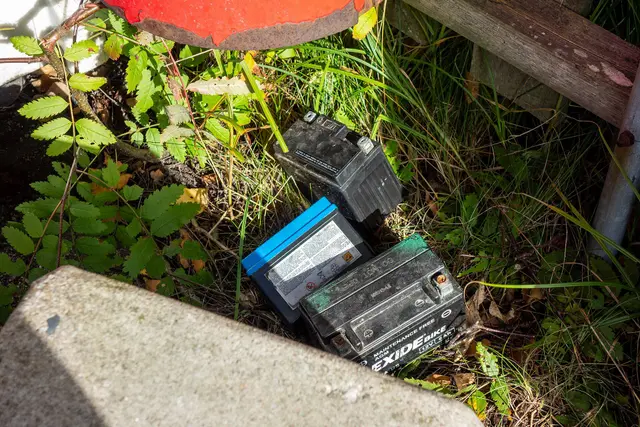
Some signs mean a dangerous battery, not just a worn one: a swollen or cracked case (see Figure 3); abnormal heat; a sharp chemical or burning smell; leaking or crusted terminals on a lead-acid battery. A lithium pack that has been flooded, dropped hard or dented must be treated as a fire risk.
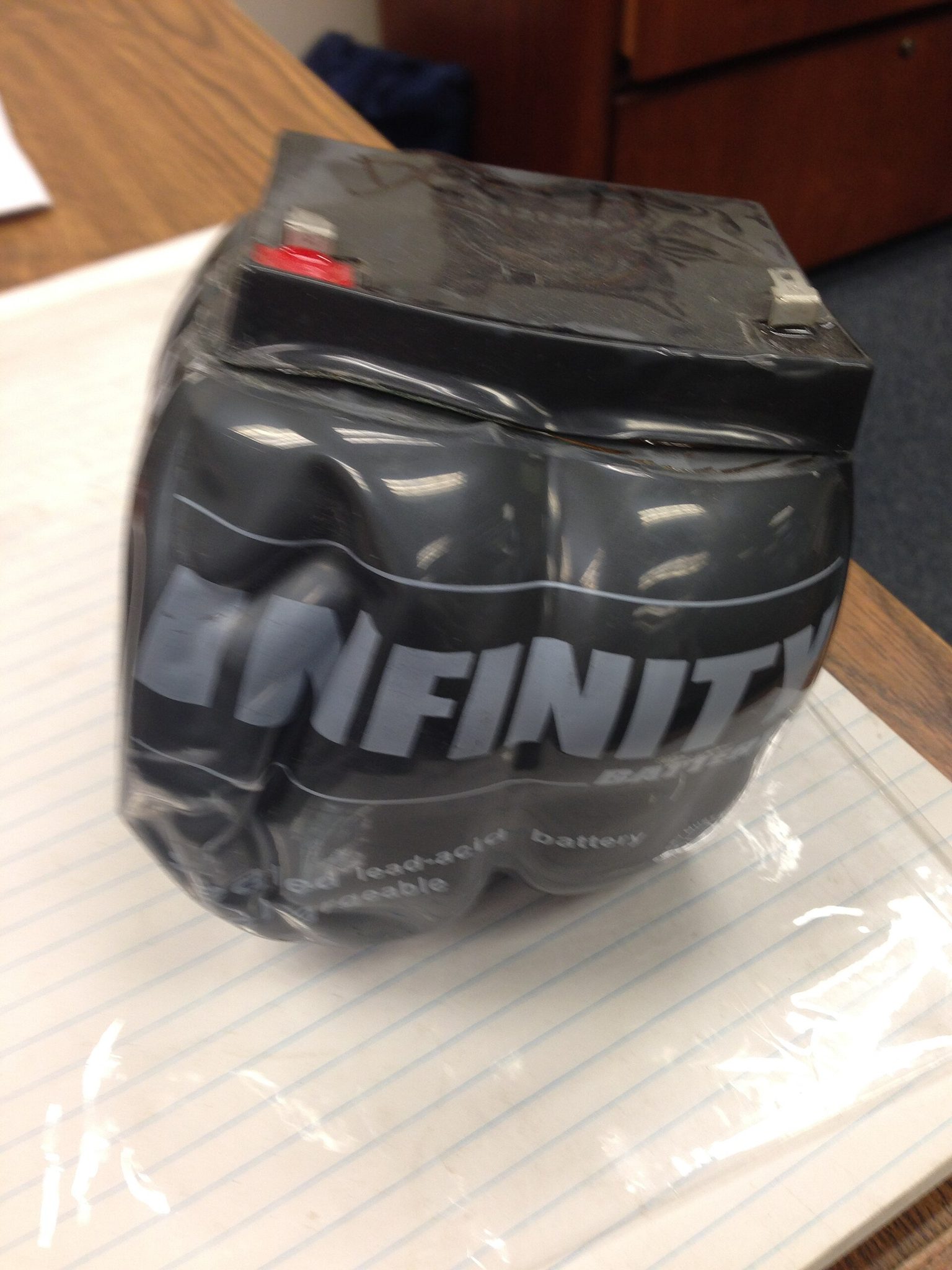
Photo: Artechvideo / Wikimedia Commons, CC BY-SA 4.0
Telling a worn battery from a charger or controller fault
Rule out two faults that are often confused with a worn battery. First, a charger with low output: measure the charger's output voltage with no load and compare it with the pack's full-charge voltage (for example 54.6V for a 13S lithium pack). Second, a loose power connector: measure at the battery terminals and at the controller input while applying throttle; a difference of more than about 1V means a poor contact somewhere along the cable.
The technician's battery testing procedure
The goal is to answer with measurements: what percentage of capacity is left, and is the weakness in one spot or has the whole pack aged.
Tools to prepare
- A multimeter for DC voltage with well-insulated probes.
- A load tester (electronic load with an Ah counter) and, ideally, a cell internal-resistance (IR) meter.
- An app for reading a Bluetooth BMS, or the manufacturer's diagnostic app or tool if your shop has access.
- Insulated gloves, safety glasses, insulated tools, a fire extinguisher and a sand bin for isolating batteries.
Lead-acid: measure each battery, not the whole set
- Fully charge the set with the correct charger, unplug it and let it rest for at least 1–2 hours before measuring.
- Measure the resting voltage of each battery. A healthy battery after a full charge usually reads about 12.8–13.0V. Record the whole set.
- Apply a load: test-ride with a rider on board, climb a gentle slope, or use a load tester on each battery at the recommended current. Measure each battery again under load.
- A battery that drops faster than the others (for example below 11V while the others hold 12V) is weak. A resting difference of more than about 0.3V between batteries after a full charge is also a sign of imbalance.
Example: a 48V set reads 12.9V – 12.8V – 12.1V – 12.8V after a full charge, a total of 50.6V. On a hill, battery 3 falls to 10.2V while the other three hold about 12V — battery 3 has failed and drags the whole set into an early cut-out.
Lithium: measure each cell group and read the BMS
Only open a pack once its warranty has expired and it is not a manufacturer's rental or sealed pack that must not be opened; in those cases, send the customer to the dealer. On a pack you are allowed to open, locate the balance leads (the bundle of thin wires running from each cell group to the BMS board, see Figure 4). Measure each group's voltage at the balance points, in order from group 1 (the negative end) to the last group.
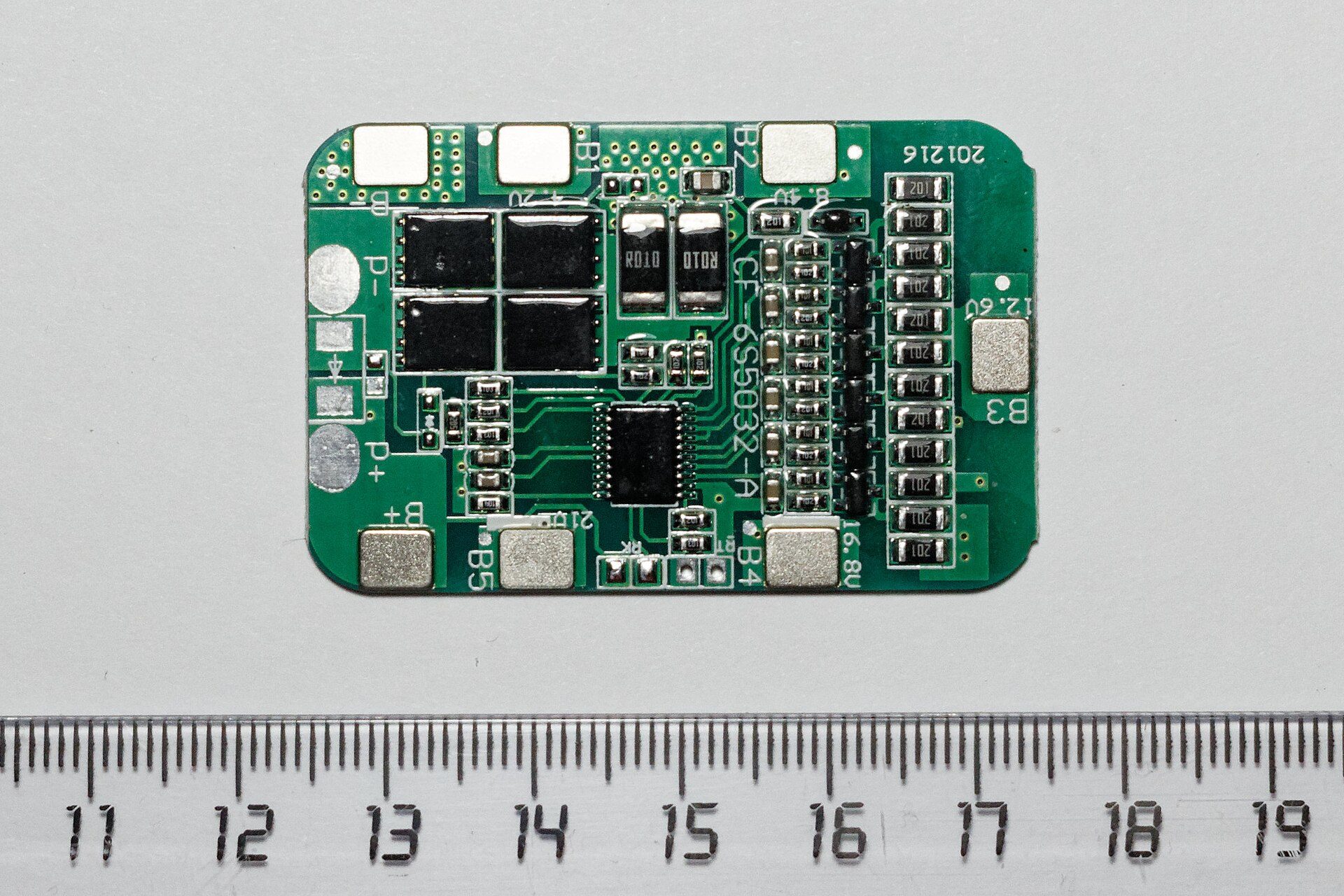
Photo: Retired electrician / Wikimedia Commons, CC0
- After a full charge and 1 hour of rest: healthy NMC groups sit around 4.15–4.2V. A spread between the highest and lowest group of under 0.05V is good; over 0.1V needs watching; over 0.2V almost certainly means a weak group.
- Under load: the weak group drops fastest and reaches the empty threshold first, so the BMS cuts off the whole pack.
- A Bluetooth BMS app shows each group's voltage, temperature and cycle count; use it as a guide, but still confirm with your multimeter.
- Brand-name scooters with an app or diagnostic tool: record fault codes and the battery health percentage on the job sheet, and do not clear codes yourself.
Load test: measure the real capacity
Voltage only tells you whether a battery is full or empty; real capacity must be measured by discharging under load. Fully charge, connect an electronic load at a constant current (for example 10A for a 20Ah pack), discharge down to the empty threshold given in the battery specification, then read the Ah figure on the tester. State of health (SOH) = measured capacity ÷ rated capacity × 100%. A pack below roughly 70–80% is generally considered clearly worn, and the range drops accordingly.
Repair or replace: whole pack, new cells or rebalance?
The decision rests on three factors: the age and cycle count of the pack, the number of weak batteries or groups, and the cost compared with a new pack. A good technician is willing to say "not worth repairing" when a repair would only give the customer a few more months.
Lead-acid
If the set is less than about 6–12 months old and only one battery has failed, you can replace just that battery with one of the same type and capacity. If the set is more than a year old, replace the whole set, because a new battery paired with old ones goes out of balance and wears quickly. Trade the old batteries in at a battery dealer for a discount and proper recycling.
Lithium
- Rebalance only: groups are slightly out of line (about 0.05–0.15V), tested capacity is above 80%, and internal resistance is similar across groups. Balance-charge each group with a balancer, or let the BMS balance over several full charges.
- Replace a cell group: 1–2 groups are clearly weak (capacity and internal resistance clearly worse), the rest test well, and the pack is not too old. Use cells of the same chemistry, size, capacity and internal resistance, joined with a spot welder and nickel strip — never solder directly onto a cell.
- Replace the BMS: the BMS reports wrong values, fails to balance, or has burnt cut-off MOSFETs — while the cells still measure well.
- Replace the whole pack: many weak groups, capacity below about 60–70%, a flooded, swollen or dented pack, or a repair costing more than about 50% of a new pack.
Cells with mismatched capacity or internal resistance in the same pack charge and discharge unevenly: strong groups get overcharged, weak groups get over-discharged, and the risk of overheating rises. That is why you always repeat the load test after a repair.
Worked example: a 60V e-scooter that went from 70 km to 40 km
Mr Tuan is a delivery rider. His electric scooter uses a 60V 20Ah lithium pack (NMC, 16S4P configuration with 5Ah 21700 cells); the pack is 2.5 years old and out of warranty. When new it did about 70 km per charge; now it manages about 40 km and often cuts out on bridge ramps with the gauge still at around 30%. Prices below are 2026 reference figures for Vietnam and vary by region (1,000 VND is roughly 4 US cents, so 100,000 VND is about 4 USD).
Measure and narrow it down
- Charger output: 67.2V with no load, matching 16S × 4.2V = 67.2V. The charger is fine.
- Full charge, 1 hour of rest, total pack voltage: 66.10V.
- Measure all 16 groups: 15 groups at about 4.15V, group 9 at only 3.85V. Check the sum: 15 × 4.15 = 62.25V; 62.25 + 3.85 = 66.10V — it matches the total.
- BMS app: a 0.30V spread, with repeated over-discharge cut-offs logged on group 9.
- Load test at 10A: only 13.2Ah, i.e. 13.2 ÷ 20 = 66% of rated capacity. During the discharge, group 9 hits the empty threshold while the other groups are still at about 3.6–3.7V.
- Internal resistance: the 4 cells of group 9 read about 80–90 mΩ; the other groups about 35–40 mΩ.
Conclusion and quote
One group (4 of 64 cells) has clearly failed and the other 15 groups are consistent. Replace group 9 with 4 new matching cells, balance the whole pack and repeat the load test.
| Item | Reference cost |
|---|---|
| 4 matching 21700 5Ah cells (90,000 VND per cell) | 360,000 VND |
| Labour: open the pack, spot-weld, close the case | 400,000 VND |
| Balancing and repeat load test | 150,000 VND |
| Total | 910,000 VND (about 36 USD) |
After the repair, the load test gives 17.4Ah, i.e. 17.4 ÷ 20 = 87%. Estimated range: 70 km × 0.87 ≈ 61 km. Compared with a new 60V 20Ah pack at about 7–12 million VND, the repair makes sense. But be honest with the customer: the other 15 groups are also 2.5 years old and will keep declining; give a time-limited warranty on the repair (for example 3 months) and book a re-test in about 6 months.
Lithium fire risk and charging safety
A lithium cell that is internally shorted, overcharged, overheated or crushed can go into "thermal runaway": it heats itself, vents flammable gas, ignites violently and spreads to neighbouring cells. Figure 5 shows a single 18650 cell bursting into flame after being struck.

Photo: Tavo Romann / Wikimedia Commons, CC BY 4.0
Safety warning: never charge a battery that is swollen, dented, has been flooded or has just been dropped hard; isolate it outdoors at once, in a metal container or sand bin, away from anything flammable. Do not charge a scooter overnight indoors while everyone is asleep, and never charge it in an escape route, under the stairs or in a shared corridor; choose a ventilated spot with a smoke alarm and a fire extinguisher. Do not use a charger with the wrong voltage, modified "fast chargers", or "upgraded" high-capacity packs of unknown origin. In the shop: work on batteries on an insulated bench, remove metal jewellery, use insulated tools, tape over exposed terminals and never let the two poles touch. If a battery smokes or catches fire: move away, warn everyone and call the fire service (114 in Vietnam); only cut the power or push the scooter outside if it is clearly safe. Lithium battery smoke is highly toxic — do not stand in it.
Where to charge safely
Many rented rooms and Vietnamese tube houses charge scooters on the ground floor (see Figure 6) — risky if that is the only way out. Advise customers to charge during the day when someone is home, keep escape routes clear, use a socket rated for the load, avoid chains of extension leads, and unplug once full.
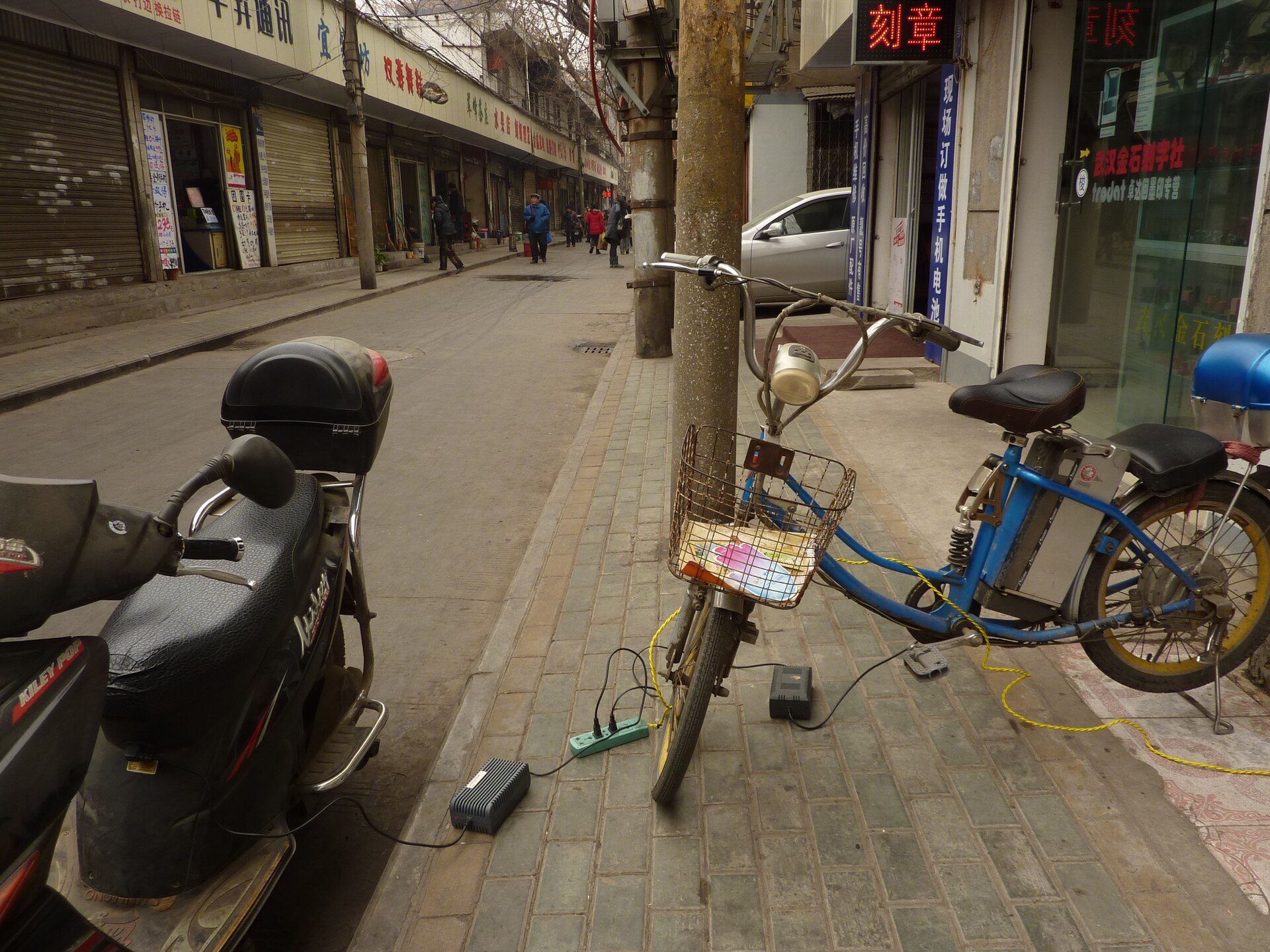
Photo: User:Vmenkov / Wikimedia Commons, CC BY-SA 3.0
Batteries removed in the shop
Tape over the terminals and keep failed lithium packs in a separate area with sand. Return lead-acid batteries to a dealer for trade-in and hand lithium packs to a collection service; never put them in the ordinary rubbish.
Charging habits that make batteries last longer
Give customers this advice when you hand the scooter back, and write it on the handover sheet.
Lead-acid
- Charge after every day of riding, charge fully (until the charger light changes colour), and never leave the scooter flat overnight.
- Do not ride until the scooter cuts out before charging; deep discharge is the fastest route to sulphation.
- If the scooter will not be used for a while: charge fully and top up every 2–4 weeks.
Lithium
- For daily use, stay roughly between 20% and 90%; there is no need to run it flat and charge it full every time.
- After a ride, wait about 30 minutes for the pack to cool before charging; do not charge in strong sun or a hot spot.
- For long storage: keep the pack at about 40–60%, check and top up every month.
- Only use the manufacturer's charger or one with the correct voltage for the battery type (NMC or LFP).
Reference battery replacement prices in 2026
Reference prices for Vietnam in 2026; they vary by region, model and whether parts are genuine or aftermarket, and genuine packs can cost more.
| Item | Reference price |
|---|---|
| Inspection: per-battery or per-group voltages, load test | 100,000–300,000 VND |
| Lead-acid set for a 48V 12Ah e-bike (4 batteries) | 1,200,000–2,200,000 VND |
| Lead-acid set for a 60V 20Ah scooter (5 batteries) | 2,500,000–4,000,000 VND |
| Lead-acid set for a 72V 20–23Ah scooter (6 batteries) | 3,000,000–5,000,000 VND |
| Replace 1 lithium cell group (including labour) | 400,000–1,200,000 VND |
| Replace the BMS board | 300,000–1,200,000 VND |
| New 48V 20Ah lithium pack (aftermarket) | 5,000,000–9,000,000 VND |
| New 60–72V 20–30Ah lithium pack | 7,000,000–15,000,000 VND |
Always include your measurements (voltage of each battery or group, tested capacity) with the quote so the customer understands why you recommend repair or replacement.
Common mistakes new technicians make
Measuring the total voltage and calling the battery good
Symptom: the set reads 52V, you say the battery is fine, and the scooter still cuts out. Cause: the total voltage hides one weak battery or group. Fix: always measure each battery and each group, at rest and under load.
Soldering directly onto lithium cells
Symptom: cells run hot, capacity drops, and sometimes they swell after the repair. Cause: soldering-iron heat damages the cell internally. Fix: use a spot welder and nickel strip of the correct cross-section.
Frequently asked questions
How long does an e-scooter battery last before it wears out?
Lead-acid batteries usually last about 1–2 years; NMC lithium about 2–4 years, and LFP longer. Heavy use, poor charging habits, heat or being left flat for long periods shorten that.
Can a worn lithium battery be restored?
A worn cell cannot be "revived". What can be repaired is replacing weak cell groups, replacing the BMS or rebalancing groups that have drifted apart; how well that works depends on the condition of the remaining groups.
Is it OK to charge an e-scooter overnight?
Avoid charging overnight indoors while everyone is asleep, especially with an old pack, a repaired pack or a non-genuine charger. If you must charge in the evening, do it in a ventilated spot away from escape routes, with a smoke alarm, and unplug when full.
Practice exercises and self-assessment
- Measure and record each battery's voltage in 2 lead-acid sets (one good, one weak), at rest and under load.
- Under a senior technician's supervision, measure the voltage of the 13–16 cell groups in a lithium pack and calculate the largest spread.
- Write a diagnostic sheet for an imaginary job following Mr Tuan's example: measurements, conclusion, options, quote and charging advice.
Self-assessment criteria
- Pass: you find the right weak battery or cell group; the sum of the group readings matches the total voltage (within 0.1V); your SOH calculation is correct.
- Pass: your quote adds up correctly, gives repair-or-replace reasons based on measurements, and includes charging safety advice.
- Not yet: you charge a swollen or flooded battery, solder onto cells, let a metal tool bridge the two poles, or draw conclusions from the total voltage alone.
Once you are confident with lithium packs and BMS boards, you are ready for the next step of the roadmap: Brakes, tyres, suspension & brand diagnostics — servicing the mechanical parts and using manufacturer apps and diagnostic tools within warranty terms. See the 8-step e-bike and e-scooter technician roadmap.