Air layering a branch properly comes down to four jobs: choose a healthy semi-hardwood branch on a disease-free mother tree, remove a ring of bark and scrape the cambium clean, wrap a ball of moist medium with rooting hormone around the wound, then wait for the roots to mature before cutting the layer off and potting it up. Most air layers that fail to root do so because the cambium was not scraped clean and the bark grew back, the medium was too dry or too wet, or the work was done in the wrong season, not because the tree is "difficult". This lesson is written the way an experienced orchard worker coaches an apprentice, with a table of rooting times by tree and a worked example of 50 pomelo layers where materials and cost add up.
By the end of this lesson, you will be able to:
- Choose a suitable mother tree and branch: branch age, diameter, position in the canopy and freedom from disease.
- Ring the bark to the right length, scrape the cambium clean and check the wound before wrapping.
- Mix the medium to the right moisture, use rooting hormone safely according to the label and wrap a tight, sealed ball.
- Estimate rooting time by species, know when to cut the layer off and how to nurse it so it survives.
- Work out materials, labour and the cost per plant for a real layering batch.
Learning fruit tree growing and grafting properly? Bud grafting, cleft grafting and air layering are step 3 of the roadmap, after tool and climbing safety and orchard layout. See the 8-step fruit orchard roadmap to learn in the right order.
What is air layering, and why does the ball grow roots?
Air layering (called "chiet canh" in Vietnam) makes a branch grow roots while it is still on the mother tree, after which it is cut off as a new plant. The layer keeps exactly the variety traits of the mother tree (fruit taste, flesh colour, sweetness) and usually fruits sooner than a seedling, because the branch is already mature.
The principle: block the downward flow of nutrients
Under the bark there are two "pipelines": the xylem in the wood carries water up from the roots to the leaves, while the phloem just beneath the bark carries sugars and growth hormones down from the leaves to the roots. When you remove a ring of bark, water still moves up so the branch does not wilt, but the downward flow is stopped at the upper edge of the ring. That edge swells into callus and, kept moist and dark, produces roots.
What the cambium is and why it must be scraped off
The cambium is a thin, slimy, pale green layer between the bark and the wood that builds new bark and wood. If any is left behind, within 1–2 weeks the bark bridges the ring again, nutrients flow down normally and the ball never roots. This is the number one beginner mistake.
Air layering versus grafting
| Point | Air-layered tree | Tree grafted on a seedling rootstock |
|---|---|---|
| Root system | Fibrous roots, no taproot | Taproot from the rootstock |
| Time to fruit | Early, often 1–2 years after planting | Similarly early, depending on variety |
| Wind and drought tolerance | Weaker, needs staking | Better |
| Plants per mother tree | Few, one per branch | Many, one per bud |
| Best for | Pomelo, orange, lime, guava, lychee, longan, small orchards | Durian, mango, jackfruit, large commercial orchards |
When to air layer and how to choose the branch
Roots form fastest when it is warm, the air is humid and the tree is vigorous, with a recent flush of new growth that has just hardened.
Season
- Southern Vietnam: the start of the rainy season, roughly April to June, is the best time; avoid the height of the dry season because the ball dries out fast.
- Northern Vietnam: spring (roughly February to April) and early autumn (roughly August to September); avoid cold spells, when roots barely grow.
- By tree: layer after harvest once the tree has put out a stable flush, not while it is heavy with fruit or flowering.
Choosing the mother tree
The mother tree must be true to variety, with steady yields for several years and no signs of disease. For pomelo, orange and mandarin, avoid any tree showing citrus greening symptoms: the disease travels with the layer into the new plant and cannot be cured. If you later sell seedlings, you need to be able to show where the mother tree came from; ask your local agriculture office about the current rules on planting material in Vietnam.
Choosing the branch
- Semi-hardwood (woody, bark turned grey-brown, no longer green and soft), usually 1–2 years old.
- About 1–2 cm in diameter where you ring it, between index-finger and thumb thickness.
- In the middle of the canopy, facing the sun, well leaved, straight, free of borers and fungus.
- Layer only about a quarter to a third of the healthy branches on one tree so the mother tree keeps enough leaves to feed itself.
Tools, materials and rooting hormone
Have everything ready before you climb, so you do not have to come down the ladder halfway with an open wound on the branch.
Tools
A thin, very sharp layering or grafting knife (Figure 1), pruning shears, a small pruning saw, 70% alcohol and a cloth to disinfect the blade, an A-frame or three-legged orchard ladder, gloves and a bucket for the medium.
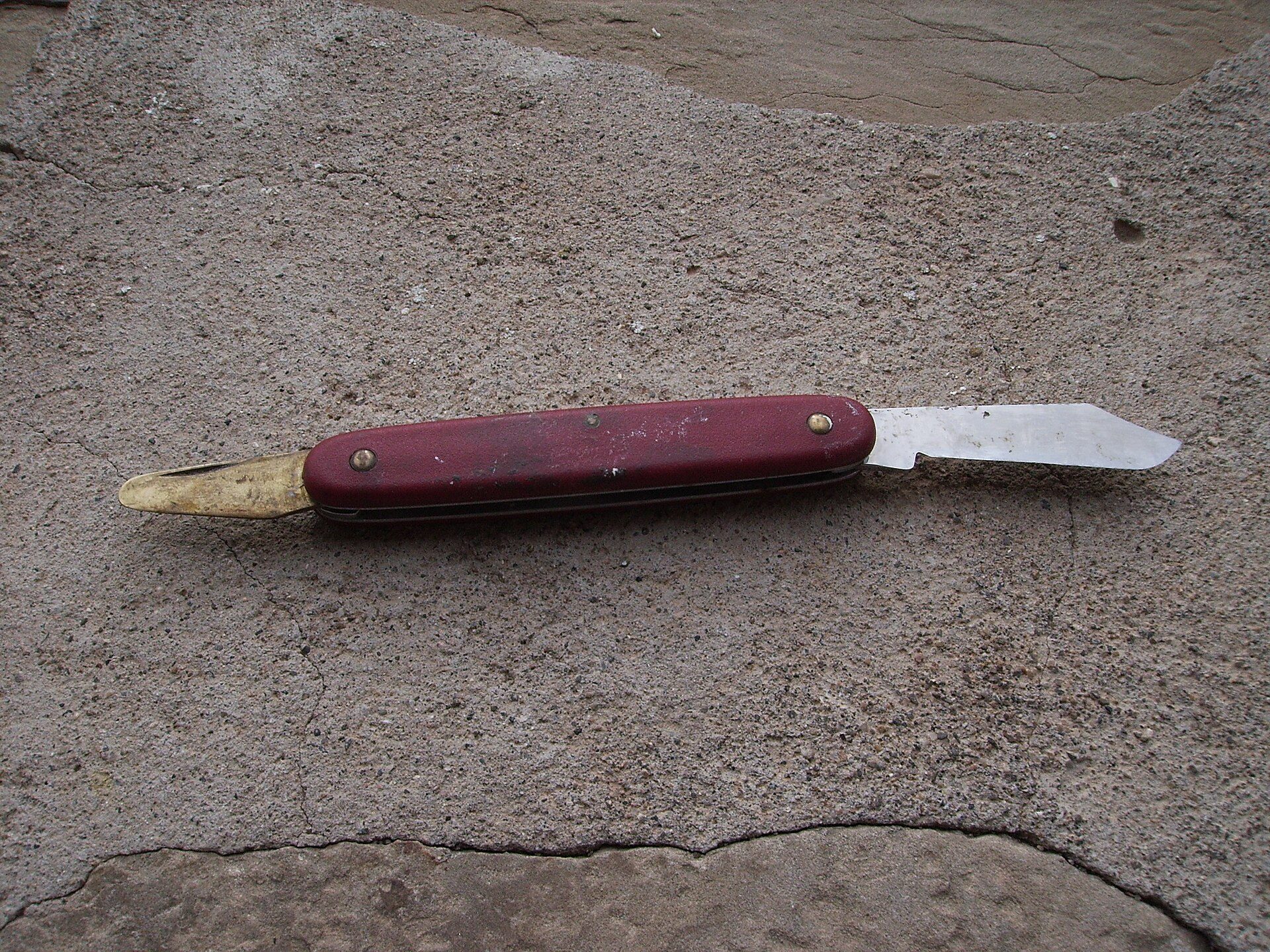
Photo: Victor M. Vicente Selvas / Wikimedia Commons, Public domain

Layering medium
The medium must hold moisture for a long time yet stay airy. A common mix is about 2 parts dried, crumbled pond mud (or loam) to 1 part rotted straw, coconut coir or water hyacinth roots. Many growers use treated coconut coir mixed with a little well-rotted manure. The moisture is right when a squeezed handful feels damp but no water runs between your fingers, and the lump holds together when you open your hand.
Rooting hormone
Rooting products contain auxin-type growth regulators (usually IBA or NAA) as a powder or liquid. Apply only a thin layer to the upper edge of the ring, where the roots will form, at the strength on the label. Too strong a dose can burn the bark and rot the edge of the ring. Easy species such as lime and guava root without hormone, but it helps roots come faster and more evenly on harder species such as lychee and longan.
Plastic film and ties
Clear PE film (so you can see the roots) cut into sheets of about 25 × 30 cm, plus plastic string or banana fibre for tying. Some growers use black film so the roots grow in the dark, then open it slightly to check.
Air layering step by step: from ringing to wrapping
The steps below are for one branch; an experienced worker takes about 5–6 minutes per branch.
Step 1: ring the bark
- Pick a straight, smooth stretch of branch about 10–15 cm above the fork below it.
- Cut the first ring around the branch through the bark to the wood, without cutting into the wood.
- Cut a second ring below it, 1.5–2 times the branch diameter away (usually 2–4 cm).
- Make one vertical cut joining the rings and peel off the whole strip of bark.
Step 2: scrape the cambium clean
Use the back of the knife or the blade at an angle to scrape gently around the exposed wood until it feels dry and rough with no slime left. Check by touch: if it still feels slippery, it is not clean. Many growers leave the ring to dry for about 1–3 days before wrapping so any leftover cambium dies; others scrape very thoroughly and wrap straight away. Pick one method and record it so you can compare rooting rates.
Step 3: apply hormone and wrap
- Apply rooting hormone to about 1 cm of bark just above the ring, at the strength on the label.
- Wrap the film into a tube around the branch and tie the bottom tightly about 3–4 cm below the ring (Figure 2, A–B).
- Fill the tube with medium and press it firm so the ring sits in the middle of a ball about 12–15 cm long and 8–10 cm across (Figure 2, C).
- Tie the top tightly (Figure 2, D). The film must be sealed so rain cannot pool inside and the medium cannot dry out.
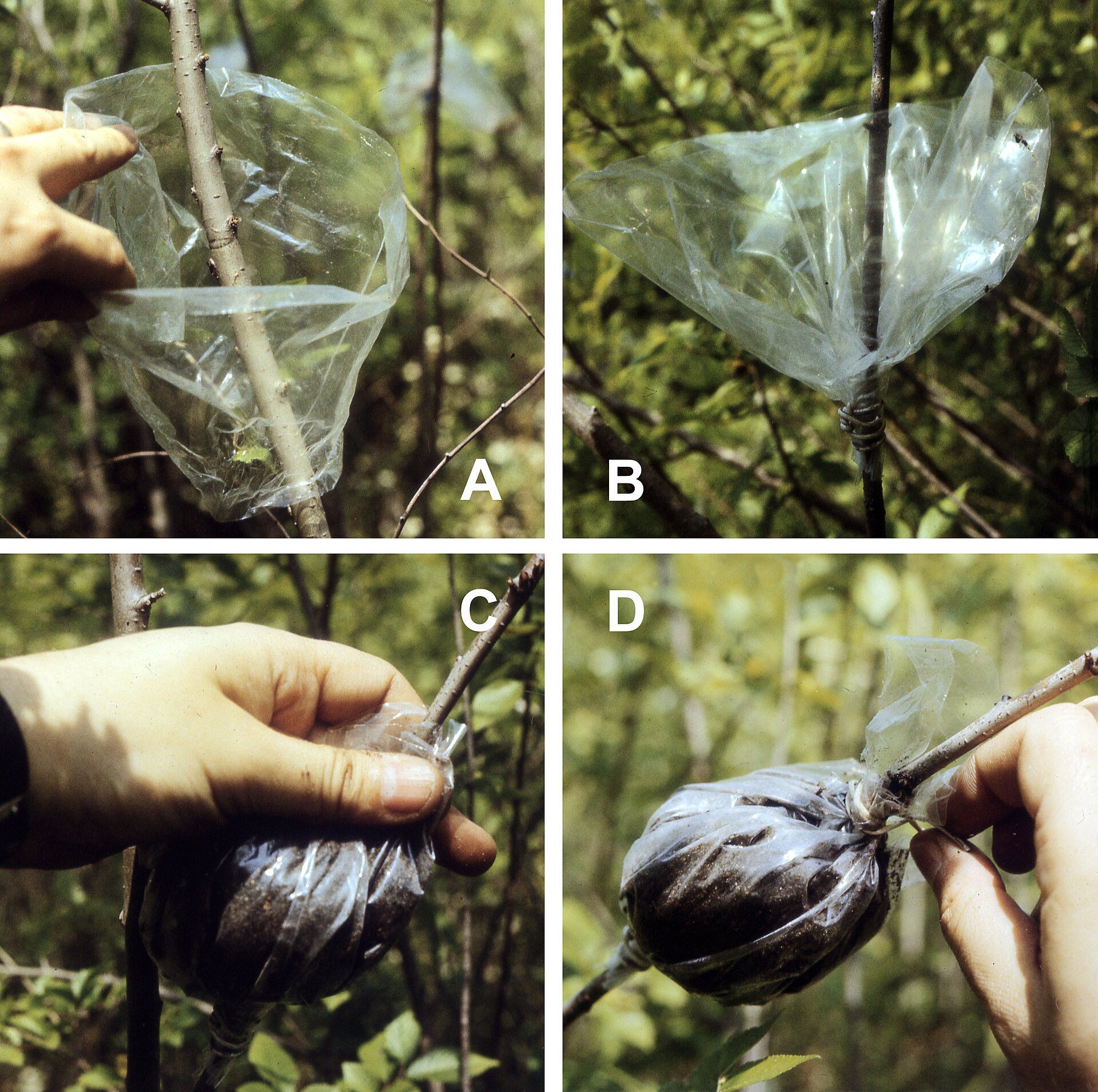
Photo: Mihailo Grbic / Wikimedia Commons, CC BY-SA 3.0 rs

Step 4: label and record
Hang a small tag with the date and whether you used hormone. Record the number of layers on each mother tree so you can track the rooting rate and never cut a ball too early by mistake.
How long do air layers take to root? Table by tree
The times below are typical ranges when layering in season, depending on variety, weather and skill. Hard-to-root species have low success rates and are usually propagated by grafting.
| Tree | Ease | Rooting time (approx.) | Notes |
|---|---|---|---|
| Lime, kumquat | Very easy | 20–30 days | Often fine without hormone |
| Pomelo, orange, mandarin | Easy | 30–45 days | Check the mother tree for citrus greening |
| Guava, rose apple, star fruit | Easy | 30–45 days | Semi-hardwood roots quickly |
| Lychee, longan | Moderate | 35–60 days | Hormone recommended |
| Sapodilla | Hard | 60–120 days | Long wait, check moisture |
| Mango | Hard | 60–90 days | Low success, usually grafted |
| Durian, jackfruit | Rarely used | Not recommended | Propagated mainly by grafting |
Figure 3 shows an air layer on a small lychee tree, wrapped in clear film so the roots can be seen through it.
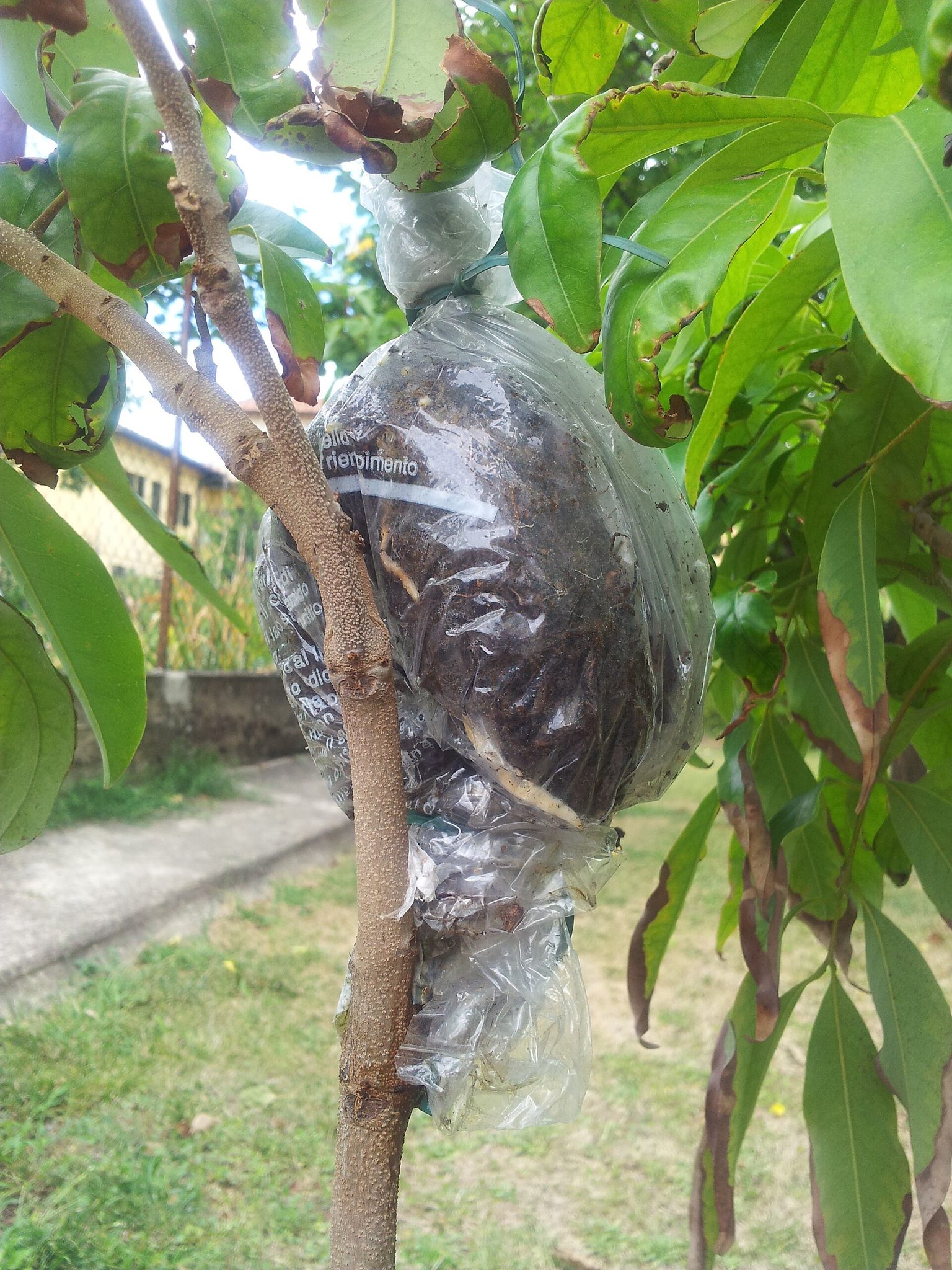
Photo: Iacopo Lorenzini / Wikimedia Commons, CC BY-SA 3.0

Care while you wait for roots
- Look at every ball once a week: torn film, dry medium, ants nesting.
- If a ball has dried (much lighter, medium pale), inject a little water through the film with a syringe and tape the hole.
- Keep watering and feeding the mother tree normally; a vigorous mother tree roots its layers faster.
Cutting and potting up the layer so it survives
Cutting too early, while the roots are still white, young and few, is the main reason layers wilt and die after removal.
When to cut
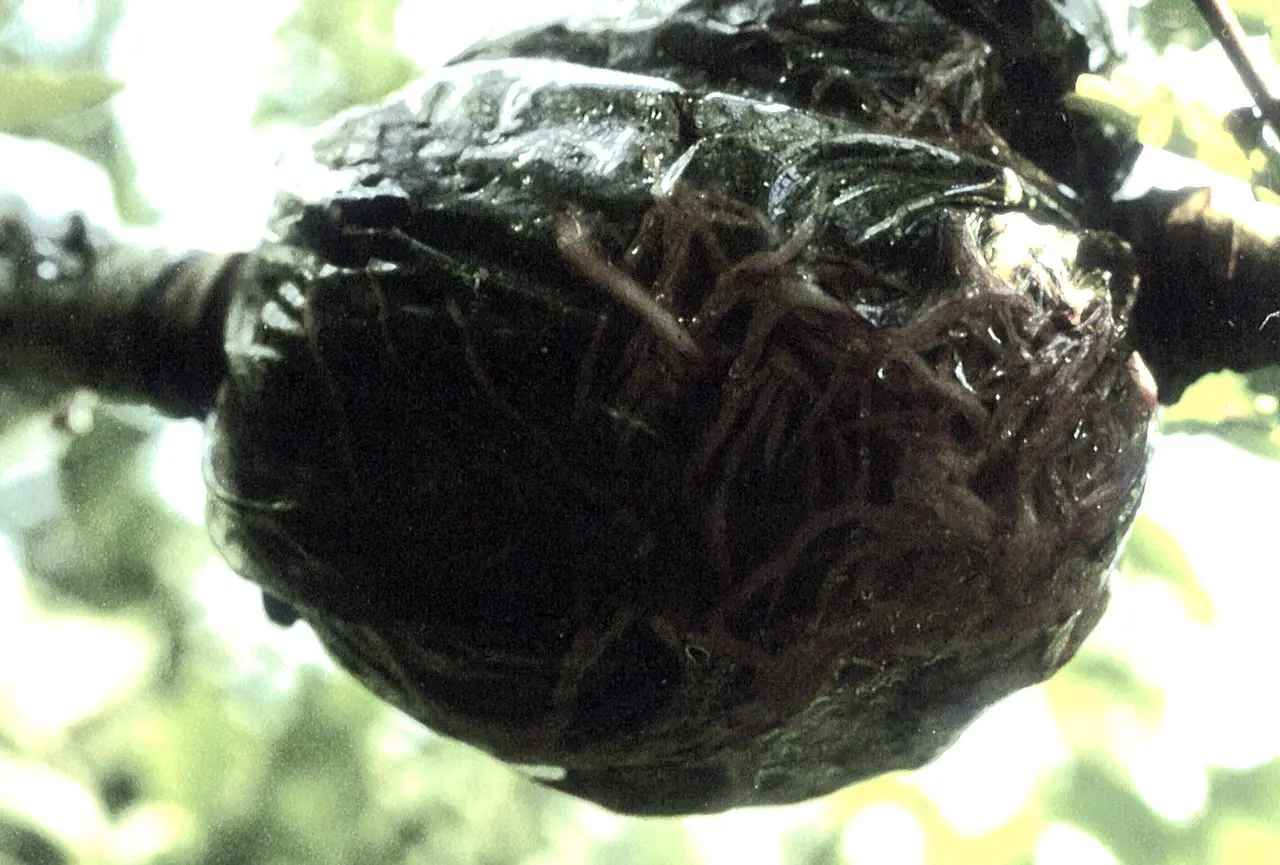
Cut when roots have spread all round the ball, you can see plenty through the film, they have turned from white to cream or light brown and have side roots (Figure 4). This is usually the time in the table plus 1–2 weeks for the roots to mature.
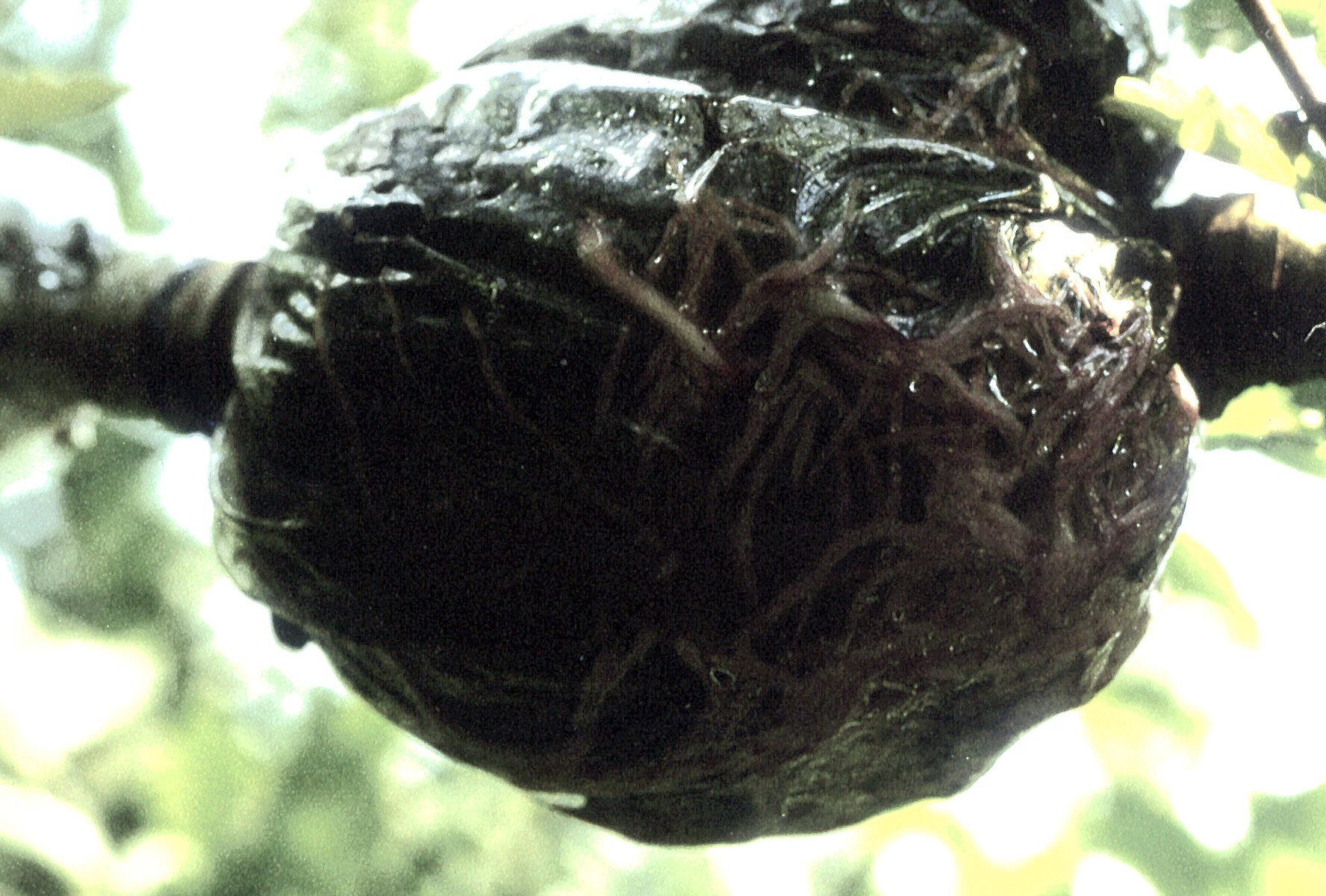
Photo: Mihailo Grbic / Wikimedia Commons, CC BY-SA 3.0 rs

How to cut and pot up
- Cut with a sharp saw or shears just below the ball, about 1–2 cm under it, leaving a clean, uncrushed cut.
- Remove about half to two thirds of the leaves and shorten long side shoots to cut water loss while the root system is small.
- Peel the film off gently, keeping the ball of medium intact (Figure 5 shows the roots around the ring after the medium was removed, for observation only; do not strip it when potting).
- Set the ball in a nursery bag of loose soil, firm it lightly, water well and stake the stem so it cannot rock.
- Keep it in shade or under shade net and water daily for about 3–4 weeks, until new shoots appear, before planting it in the orchard.
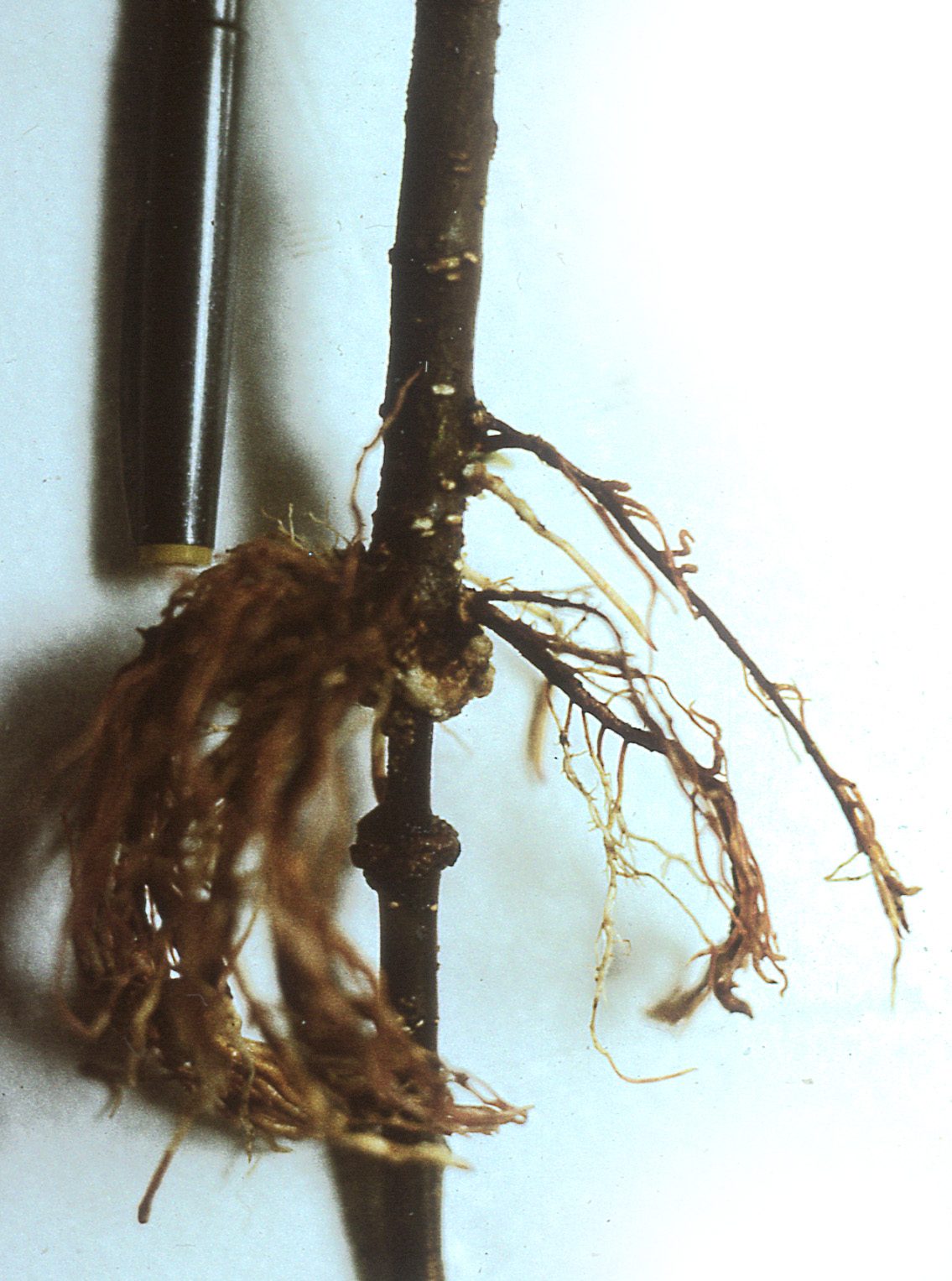
Photo: Không rõ tác giả / Wikimedia Commons, CC BY-SA 3.0 rs

Planting out
Air layers have no taproot, so stake them at planting, especially in windy areas. Digging the planting hole, base fertiliser and watering young trees are covered in detail in the next roadmap step.
Safety when air layering
Air layering sounds gentle but has three real hazards: cuts from a very sharp knife, falls from trees or ladders, and contact with rooting chemicals.
Safety warning: Always cut away from your body, hold the branch above the line of the cut and never cut towards your fingers; fold the blade or sheath it when moving and climbing. Use an A-frame or three-legged orchard ladder on firm ground with someone holding it, and never stand on the top step; do not climb onto thin branches or branches made brittle by rain; on trees taller than about 2 m, wear a safety harness tied to a main limb. Keep clear of power lines running through the canopy. Rooting hormone is a chemical: read the label before use, wear gloves, do not eat, drink or smoke while handling it, wash your hands with soap afterwards and store it away from children and food. If it gets in your eyes, rinse with clean water for several minutes and see a doctor. Check for ants and bees nesting in the canopy before you climb.
Disinfect the knife
Wipe the blade with 70% alcohol when moving to another mother tree so you do not carry fungal disease from tree to tree through the cuts.
Working outdoors
Wear a hat, drink enough water and avoid climbing in harsh midday sun or when there is thunder and lightning.
Worked example: air layering 50 green-skin pomelo branches
A five-year-old green-skin pomelo orchard; the owner wants seedlings to fill gaps. Ten healthy mother trees with no signs of citrus greening are chosen, five branches each, for a total of 10 × 5 = 50 layers, done at the start of the rainy season. Survival rates and prices are illustrative.
Materials and labour
- Film: one 25 × 30 cm sheet per ball, 50 sheets; buying 1 kg of film leaves plenty spare.
- Medium: about 1 litre per ball, 50 litres, plus 10% for waste makes 55 litres; pond mud is free on the farm, plus 2 bags of treated coconut coir.
- Labour: about 6 minutes per branch, 50 × 6 = 300 minutes = 5 hours, so one hired day.
- Expected rooting rate 80%: 50 × 0.8 = 40 layers. Expected survival after potting 90%: 40 × 0.9 = 36 plants.
Cost table (2026 reference, varies by region)
| Item | Quantity × unit price | Amount |
|---|---|---|
| Treated coconut coir | 2 bags × 50,000 VND | 100,000 VND |
| Clear PE film | 1 kg × 60,000 VND | 60,000 VND |
| Tying string | 2 rolls × 10,000 VND | 20,000 VND |
| Rooting hormone | 1 sachet × 30,000 VND | 30,000 VND |
| Nursery bags | 40 bags × 1,000 VND | 40,000 VND |
| Layering labour | 1 day × 300,000 VND | 300,000 VND |
| Total | 550,000 VND | |
Check: 100,000 + 60,000 + 20,000 + 30,000 + 40,000 + 300,000 = 550,000 VND (about USD 21). Cost per surviving plant: 550,000 ÷ 36 ≈ 15,300 VND. Air-layered pomelo seedlings bought in Vietnam usually cost about 30,000–80,000 VND each depending on variety, size and seller (2026 reference), so layering your own is cheaper, provided the mother trees are disease-free.
Timeline
Day 1: ring and wrap. Around days 35–45: roots fill the ball. Around day 50: cut and pot up (a few extra days for roots to mature). Nurse in bags for 3–4 weeks, then plant out around days 75–80.
Common air layering mistakes and fixes
No roots, bark has grown back
Sign: after 1–2 months the bark has bridged the ring. Cause: cambium not scraped clean, ring too short. Fix: make the ring 1.5–2 times the branch diameter and scrape until the wood feels dry and rough.
Ring edge rots black
Sign: the ring turns black and smells, the branch above wilts. Cause: medium too wet, film open so rain pools inside, hormone too strong. Fix: squeeze the medium to the right moisture, seal both ends tightly, dilute hormone as the label says.
Ball dries out, roots form and die
Sign: through the film you see dry roots and pale medium. Cause: layering in the dry season, torn film, ball too small. Fix: layer in season, make the ball big enough, check weekly and add water when needed.
Plant wilts after cutting
Sign: a few days after cutting, leaves droop and drop. Cause: cut while roots were young, leaves not reduced, left in the sun. Fix: wait for mature roots, remove half to two thirds of the leaves, nurse in shade and water regularly.
Frequently asked questions
What is the best season for air layering?
In southern Vietnam, the start of the rainy season (roughly April to June); in the north, spring (roughly February to April) and early autumn. Avoid the harsh dry season and cold spells.
Do I have to use rooting hormone?
Not for easy species such as lime, guava and pomelo, but it helps roots form faster and more evenly, especially on lychee, longan and sapodilla. Use only clearly labelled products at the stated strength, and wear gloves.
How long does an air layer take to root?
Citrus and guava usually take about 30–45 days, lychee and longan about 35–60 days, and mango and sapodilla much longer. Always look at the actual roots before cutting rather than following a fixed calendar.
Can I air layer mango?
Yes, but rooting success is low and the layered tree has a weak root system, so commercial mango orchards normally use grafted trees. If you want to try, choose semi-hardwood branches, use hormone and expect a longer wait.
How many branches can I layer on one pomelo tree?
It depends on the tree's age and vigour. The rule is to take only about a quarter to a third of the healthy branches so the mother tree is not weakened and still fruits the next season.
Practice and self-assessment
- Air layer 10 branches on an easy species (lime, guava or pomelo): 5 with hormone and 5 without, dated and tagged.
- Check weekly and record the day you first see roots through the film and the day you cut each layer.
- Work out the cost and cost per surviving plant for your batch, using the table above as a template.
Self-assessment criteria
- Pass: rings are 1.5–2 times the branch diameter and the wood is dry and rough with no slime.
- Pass: at least 7 of 10 balls root and none rot at the ring.
- Pass: at least 80% of potted layers survive 4 weeks in the nursery.
- Not yet: climbing without someone holding the ladder, handling hormone without gloves, or cutting layers while the roots are still white and young.
Once you have healthy layered plants, move on to the next roadmap step: Planting, irrigation & fertilising, where you learn to dig the planting hole, apply base fertiliser, plant without burying the root collar and set a watering and feeding schedule for young trees.
Keep learning fruit tree growing: after propagation come planting, watering and fertilising, pruning and canopy shaping, flower induction and pest control. See the 8-step fruit orchard roadmap.