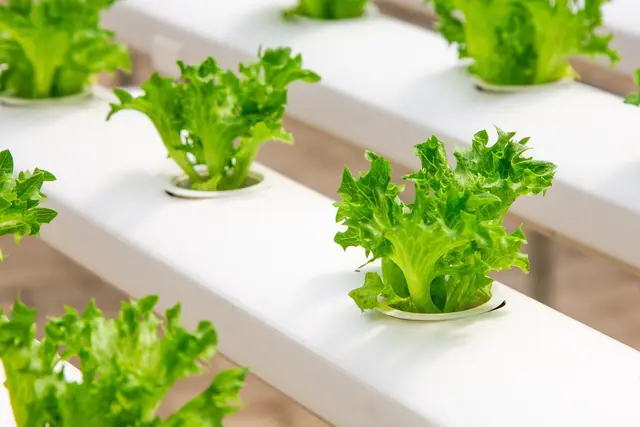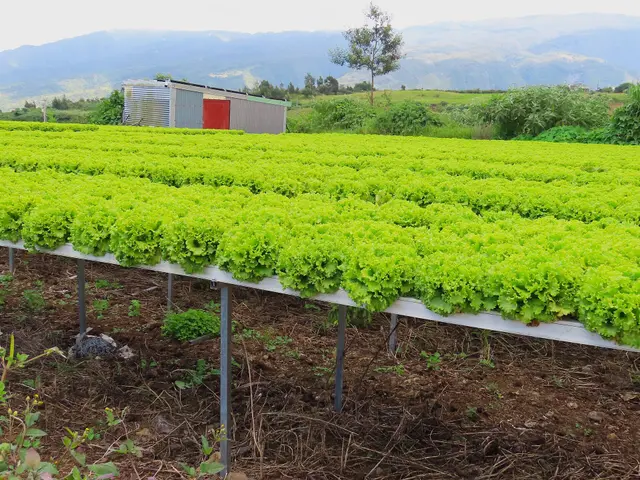
The most common hydroponic systems today come in four types: NFT (a thin film of nutrient solution flowing through channels), DWC (roots hanging in a deep, aerated tank), recirculating systems (solution pumped up, over the roots and back to the tank) and drip irrigation on coco-coir substrate. Leafy greens such as lettuce and Asian greens suit NFT or DWC; melons, tomatoes and cucumbers are large, long-lived plants that suit drip on substrate. The right choice also depends on budget, space, location and who will buy your produce, while the greenhouse is the "coat" that keeps rain and insects off the whole system. This lesson helps you read a hydroponic rig and a greenhouse, and draft a rough investment plan before you spend any money.
By the end of this lesson, you will be able to:
- Explain how NFT, DWC, recirculating and substrate drip systems work, with the strengths and weaknesses of each.
- Choose a hydroponic system to match the crop (leafy greens, melons, tomatoes), the space and the budget.
- Name the parts of a greenhouse: frame, PE film, insect net, roof vents and double doors.
- Check an NFT rig or a newly built greenhouse against a checklist before accepting it from the builder.
- Draw up a rough budget for a 360 m² greenhouse with two options, with figures that add up.
Learning hydroponic growing properly? Choosing a hydroponic system and greenhouse is step 2 of the 8-step roadmap, right after electrical, water and chemical safety and before sowing and mixing nutrients. See the 8-step hydroponic and greenhouse grower roadmap.
What is a hydroponic system and what parts does it have?
Hydroponics means growing plants without soil: roots either sit directly in a nutrient solution or anchor in an inert substrate (coco coir, carbonised rice husk, rockwool) that is watered with the solution. Either way, the root zone needs enough water, nutrients and oxygen.
The main parts
Almost every system has a reservoir (with a dark lid so algae struggle to grow), a pump and pipework, somewhere for the roots (channels, gullies, tanks or grow bags), net cups or foam rafts to hold the plants, and EC and pH meters plus a thermometer. DWC adds an air pump.
Recirculating versus open systems
A recirculating (closed) system returns the solution to the reservoir for reuse: it saves water and fertiliser, but if one plant gets a root disease the pathogen travels through the whole system. An open system (common with drip on substrate) lets the surplus drain away: it uses more solution, but disease does not spread along the water flow.
Root oxygen is a matter of life and death
Roots short of oxygen turn brown, slimy and rot within days, especially when the solution is warm. NFT leaves part of the roots in the air, DWC bubbles air continuously, and substrate holds air in its pores between waterings. When you compare systems, always ask: if the power fails, how long do the roots keep water and oxygen?
Comparing NFT, DWC, recirculating and coco-coir drip systems
There is no single "best" system for everyone; read how each one works, then check the summary table at the end of this section.
NFT: a thin film of solution in channels
NFT (nutrient film technique) sends a very thin layer of solution, only a few millimetres deep, continuously along the bottom of slightly sloping pipes or channels, typically around 1–3%, and back to the reservoir. Roots sit partly in the film and partly in the air, so they get enough oxygen. Each channel usually needs a flow of about 1–2 litres per minute and should not be much longer than 12–15 m, because the solution gets warmer and poorer in oxygen towards the end.
Strengths: light, uses little solution, can be stacked in tiers, suits rooftops and leafy greens. Weaknesses: a power cut, blocked pipe or failed pump dries the roots very quickly, and at noon in hot weather plants can wilt in less than an hour; the pipes also heat up fast in the sun, so you need shade netting or a greenhouse.
DWC: roots in a deep tank under floating rafts
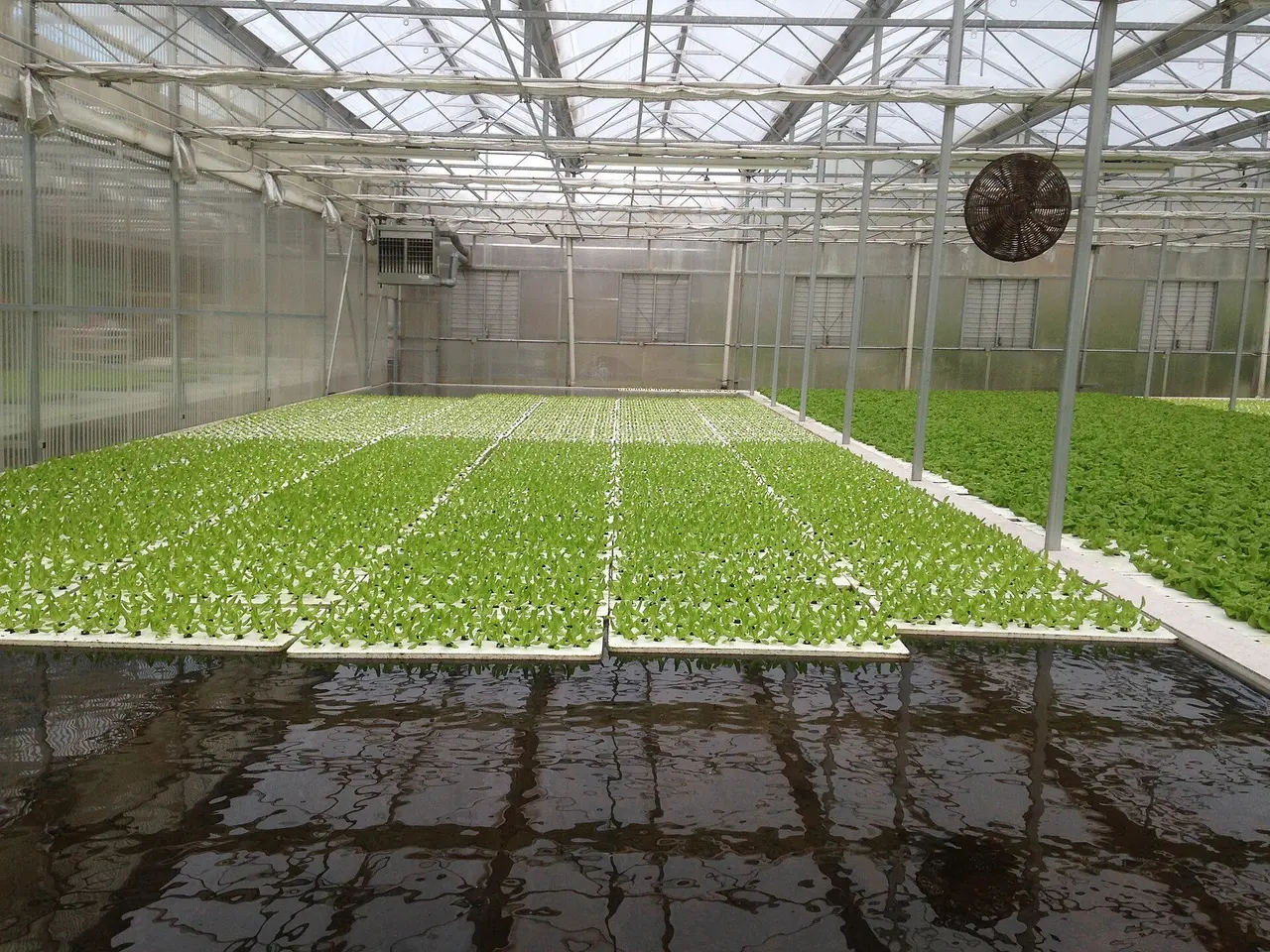
DWC (deep water culture) uses a waterproof tank roughly 20–30 cm deep filled with solution, with drilled foam rafts floating on top to hold the net cups (Figure 1). Because the roots are fully submerged, an air pump must push air through air stones or diffuser tubes on the tank floor. The home version is a foam box with no pump and no aeration (the "Kratky" or static method), suitable only for a few boxes of short-cycle greens.
Strengths: the large water volume makes EC, pH and temperature change slowly, and the roots still have water for a few hours during a power cut. Weaknesses: it uses a lot of solution and the tanks are heavy (1 m² at 25 cm deep holds about 250 litres, roughly 250 kg), so it needs a solid floor and should not go on a rooftop until an engineer has checked the slab. As the solution warms up, dissolved oxygen falls and root rot becomes more likely.
Recirculating systems: deeper flow channels and ebb and flow
In Vietnam, a "recirculating hydroponic rig" usually means channels or pipes where solution is pumped up, flows past the roots and drains back to the reservoir. NFT is one type; others include channels that hold a layer a few centimetres deep (DFT, deep flow technique), which keeps roots wet longer than NFT during a power cut, and ebb and flow, where trays are flooded on a timer and then drained back to the reservoir.
When you read a quote, ask for the water depth, the slope, how many litres of reservoir serve how many plant holes, and whether there is a drain valve and a filter screen. Every recirculating system also needs a between-crop cleaning and disinfection routine, as covered in the lesson on cleaning a hydroponic system, plus electrical and chemical safety.
Drip irrigation on coco-coir substrate
Plants grow in bags, pots or slabs of substrate (usually coco coir, sometimes mixed with carbonised rice husk), and solution is pumped through drip lines with one emitter per plant, in several short pulses a day depending on sunlight (Figure 2). Each irrigation should push some water out of the bottom of the bag, typically around 15–30%, to flush out salts that build up in the substrate. This is the main system for melons, tomatoes, cucumbers and sweet peppers in greenhouses.
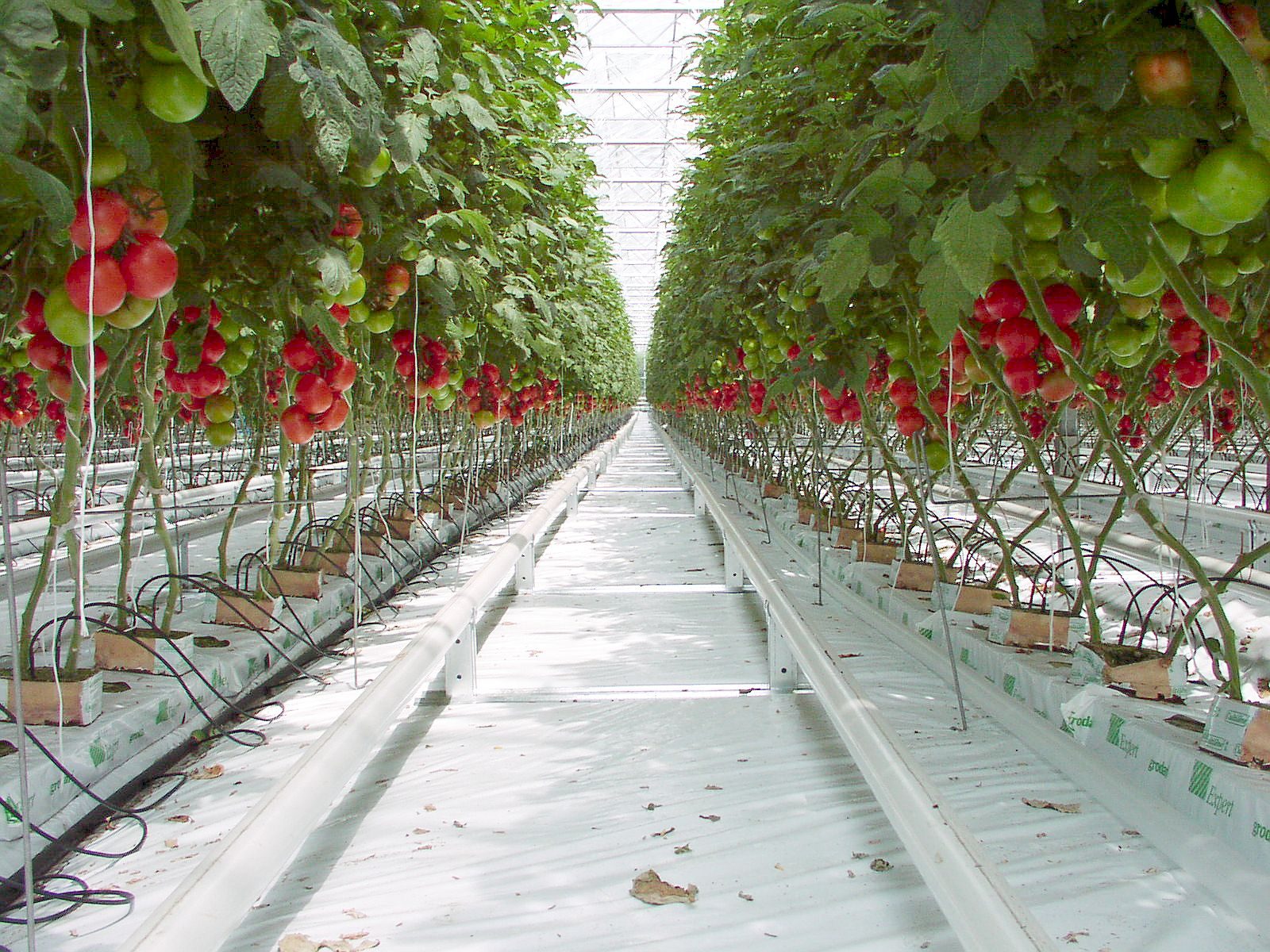
Photo: Goldlocki / Wikimedia Commons, CC BY-SA 3.0
Raw coco coir contains tannins and salts, so use pre-treated coir or soak and rinse it several times until the run-off has a low EC. Strengths: the substrate holds moisture, so plants survive a few hours without power. Weaknesses: emitters clog easily, so a filter is essential; the drainage water must be collected or treated, not dumped straight into canals or ditches.
Quick comparison of the four systems
| System | How it works | Best crops | During a power cut | Watch out for |
|---|---|---|---|---|
| NFT | Thin film of solution flows down sloping channels back to the tank | Lettuce, Asian greens, herbs | Roots dry fast, highest risk | Light, stackable; pipes heat up in the sun |
| DWC | Roots in a deep tank under floating rafts, with aeration | Lettuce, Asian greens, water spinach | Water lasts a few hours but oxygen runs down | Heavy, uses a lot of solution; needs a solid floor |
| Deep flow, ebb and flow | Solution pumped up, held in a layer or flooded on a timer, then returned | Leafy greens, herbs | Better than NFT, depends on water depth | Ask for depth, slope and tank volume |
| Drip on substrate | Pulsed watering through emitters, surplus drains out | Melons, tomatoes, cucumbers, sweet peppers | Substrate stays moist for a few hours | Clogged emitters; treating coir and drainage water |
Greenhouse structure: frame, PE film and insect net
In Vietnam a "nha mang" (film greenhouse) is a framed structure with a roof of clear plastic film (PE film) and walls of insect net. The roof keeps rain off and reduces leaf diseases spread by splashing water, the net keeps out caterpillars, thrips and aphids, and the vents let hot air escape (Figure 3). A net house is different: net on both roof and walls, cheaper but no rain protection.
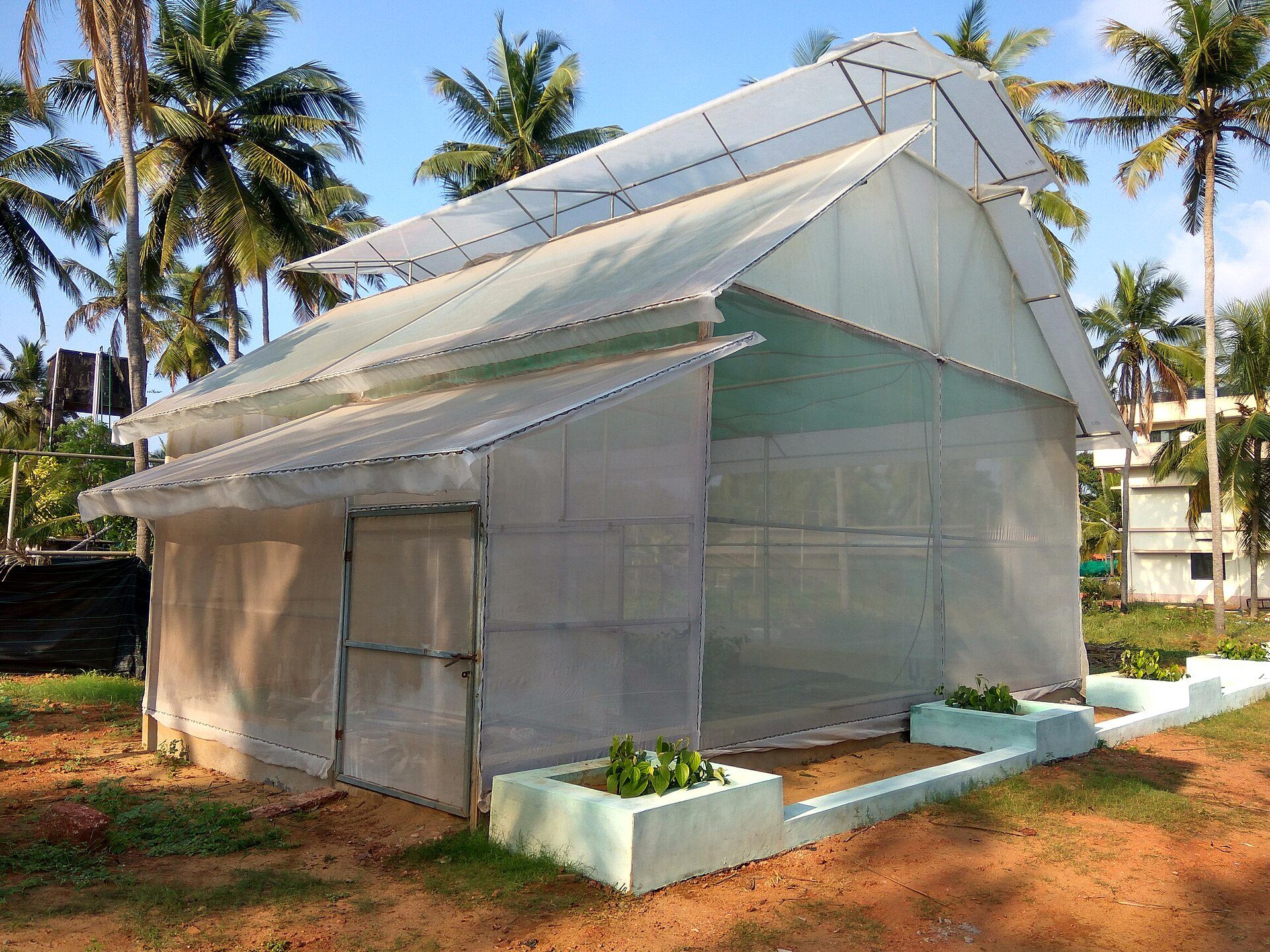
Photo: Al Jo Zeb / Wikimedia Commons, CC BY-SA 4.0
Frame: galvanised steel, height and foundations
Most greenhouse frames are galvanised steel (round tube for the arches, box section for posts and beams), bolted together, with the posts set in concrete footings. Bamboo or timber frames are cheaper but wear out fast and can collapse in storms. Multi-span greenhouses joined side by side have gutters between the spans to carry away rainwater.
In the hot lowlands, the lower the house, the hotter it gets, because hot air collects under the ridge; the house needs enough height and roof vents. Let the builder work out post height, arch spacing and footings for the wind and storm conditions in your area, and never cut steel to save money.
PE roofing film
Agricultural PE film is polyethylene with UV-stabilising additives; better grades also diffuse light (softer, more even light and less leaf scorch) and are anti-drip (condensation runs to the edges instead of dripping onto leaves). The film is held in steel profiles with zigzag spring wire and pulled tight so the wind cannot flap and tear it. It usually lasts a few years depending on thickness, UV additives and exposure; yellowed, brittle, cloudy film is due for replacement.
Insect net and double doors
Net is rated in "mesh" (threads per inch): the higher the mesh, the smaller the holes, which stops tiny insects such as thrips and whiteflies but blocks more air, so the house runs hotter. Growers usually weigh something in the 32–50 mesh range depending on the main pests and how much ventilation they need; ask suppliers and nearby growers. The entrance should have double doors (an airlock): close the outer door before opening the inner one. One hole at the bottom of the net can undo the whole house, so check the net every week.
Greenhouse parts and what to check
| Part | Common materials | What to check at handover |
|---|---|---|
| Footings, posts | Concrete, galvanised box steel | Posts straight, bases firm, no rust at welds |
| Arches, beams, bracing | Galvanised round tube | Diagonal bracing in gable ends, bolts tight |
| Roof | UV-stabilised, light-diffusing PE film | Film taut, no wrinkles or tears, profiles sealed |
| Walls | Insect net | No gaps at the base, edges sealed in profiles |
| Ventilation | Roof vents, roll-up sides | Open and close properly, vents covered with net |
| Drainage | Gutters, perimeter ditch | No water flowing in during heavy rain, no pooling at posts |
Safety warning when building and covering a greenhouse: Covering a roof with film is work at height and catches the wind like a sail: a large sheet hit by a gust can pull a person off a ladder or frame. Only fit film on a calm day with enough people holding it, wear a helmet and a safety harness when working at height, and use a sturdy ladder. Never climb the frame in rain or thunderstorms. If you build near power lines, ask the local power company about safe clearances. Pumps, lights and fans must be on an earth-leakage breaker (step 1).
Greenhouses in Vietnam: location, orientation and permits
Greenhouses are concentrated in highland areas such as Lam Dong, and are also found around Hanoi, Ho Chi Minh City and in many lowland provinces. Climates differ, so one design does not suit everywhere (Figure 4).
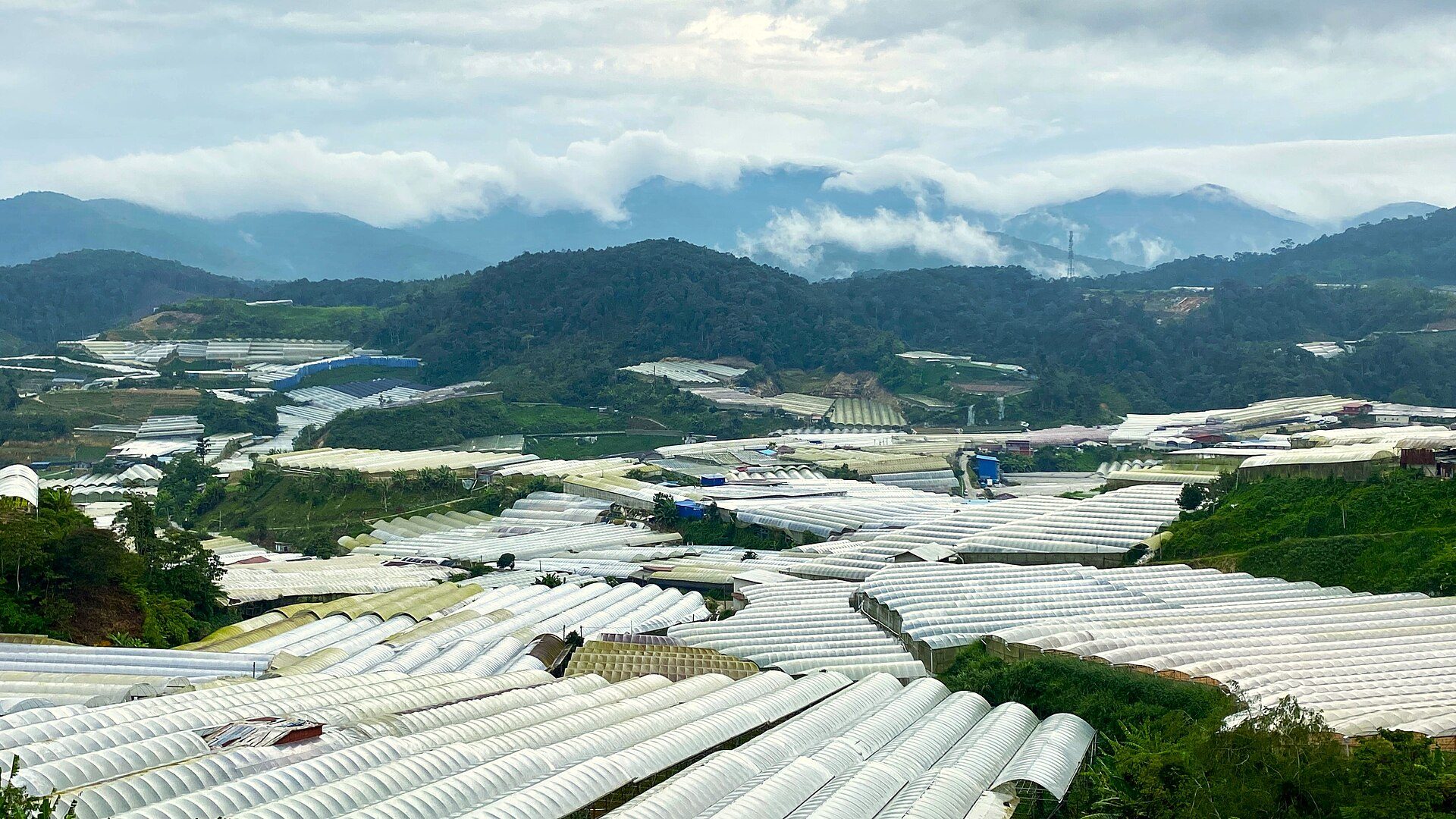
Photo: Slleong / Wikimedia Commons, CC0
Choosing the site
Pick high, flood-free ground with clean water and reliable power, plenty of sun, away from livestock pens and rubbish tips (sources of insects and disease), with vehicle access and as close to your buyers as possible, because leafy greens wilt quickly.
Orientation and ventilation
Have the builder set the orientation and vents for the prevailing winds and storm winds in your area, so heat escapes well without rain blowing in; lay out benches and rows so plants get even light and one row does not shade the next. Controlling temperature and humidity with fans, shade nets and misting comes in step 5.
Land and permits
In Vietnam, rules on structures for crop production on agricultural land, how permanent they may be and whether you must notify or apply for a permit can differ over time and between localities. Before building, ask the commune or ward People's Committee where the land is and check the current regulations; on rented land, state in the contract who may build and who removes the structure when the lease ends. This lesson is not legal advice.
Choosing a system by crop, budget and space
Three questions decide it: what you will grow, who will buy it, and how much money and space you have.
Leafy greens: NFT or DWC
Lettuce, Asian greens and herbs have small roots and are harvested after roughly 1–1.5 months per batch depending on the crop and season, so sales roll over steadily. NFT suits tight spaces, rooftops and multi-tier racks; DWC suits flat ground and growers who want a system that copes better with power cuts. Beginners usually start with NFT because it is easy to buy and to expand one rack at a time.
Melons and tomatoes: drip on substrate in a greenhouse
Melons and tomatoes are climbing plants that grow several metres tall, live for months and need room for their roots. They are grown in coco-coir bags with stems trained up strings hung from the greenhouse beams (Figure 5), one drip emitter per plant. A melon crop usually takes about 2.5–3 months and tomatoes longer, so income arrives per crop rather than steadily as with greens. Climbing crops need a tall house and a frame strong enough to carry the plants and fruit.
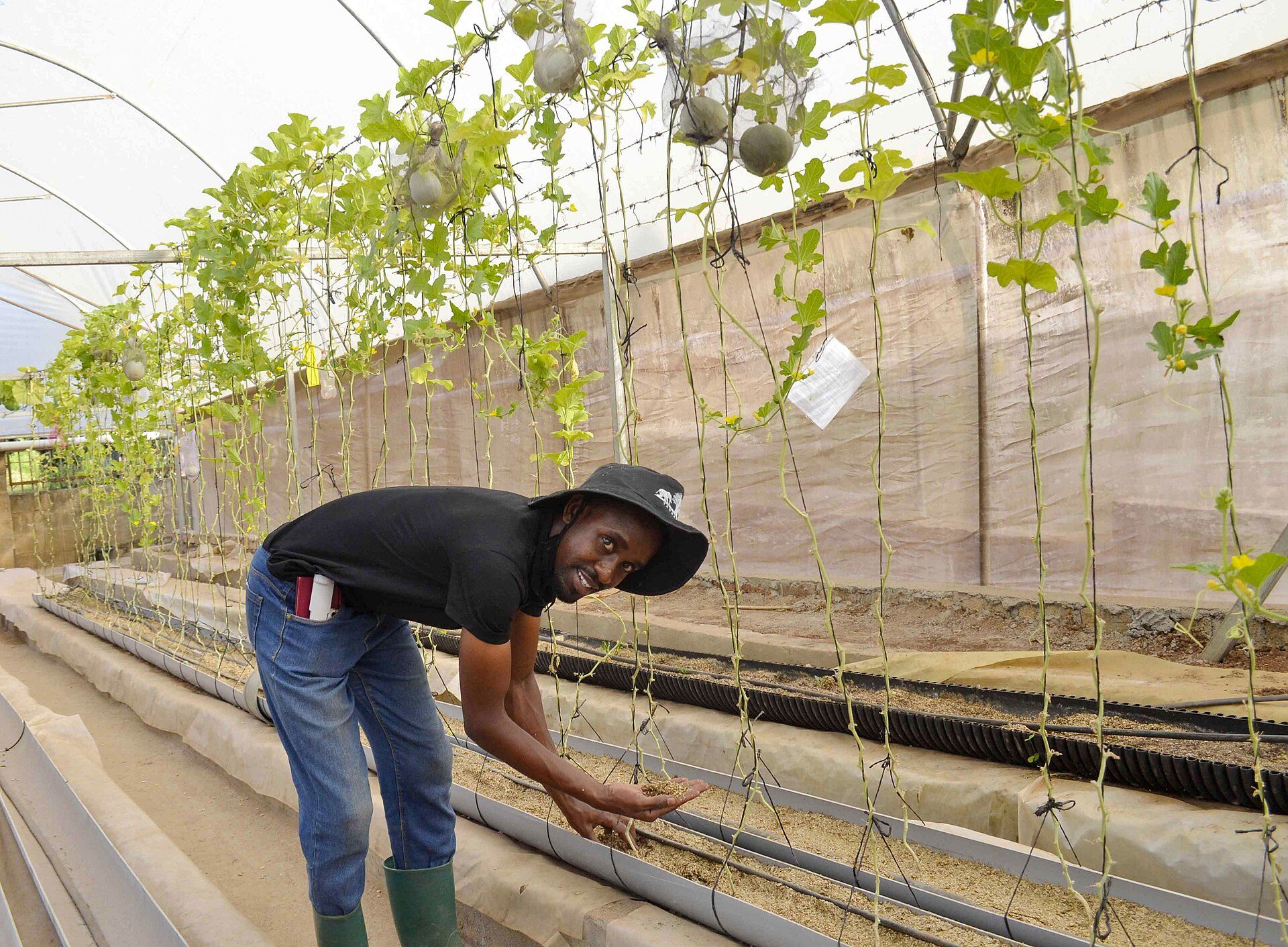
Photo: Emmanuel Ssekaggo / Wikimedia Commons, CC BY-SA 4.0
Reference costs (2026, vary by region)
| Item | Reference range | Notes |
|---|---|---|
| Net house, light steel frame | 120,000–250,000 VND/m² | Keeps insects out, no rain cover |
| Greenhouse, galvanised steel, PE roof, net walls | 250,000–450,000 VND/m² | Depends on height, roof vents, footings |
| Greenhouse with automated climate control | From about 600,000 VND/m² upwards | Fans, shade screens, misting, controller |
| Complete NFT rig (rack, channels, tank, pump) | 25,000–50,000 VND per plant hole | Depends on pipe material and tiers |
| Drip system for substrate | Tens of millions of VND for a few hundred plants | Tank, pump, filter, pipes, emitters, timer |
These are ranges for estimating, not quotes. Get detailed quotes from at least three builders and compare item by item (steel thickness, film type, net mesh, footings), not just the total.
Worked example: a 360 m² greenhouse on a 250 million VND budget
Ms Hanh has a 12 m × 30 m plot (360 m²) on the edge of Ho Chi Minh City and 250 million VND of her own money (about 10,000 USD, at roughly 40 USD per million VND), and wants to supply a few clean-vegetable shops she knows. She compares two options: A is NFT leafy greens, B is drip-irrigated melons. Prices in the example are assumptions within the reference ranges above.
Shared cost: the greenhouse
A galvanised steel greenhouse with a PE roof and net walls, assumed at 320,000 VND/m². Greenhouse cost: 360 m² × 320,000 VND = 115,200,000 VND. Both options also set aside 15,000,000 VND for EC and pH meters, a spare tank, a UPS or battery backup for the pump and small supplies.
Option A: NFT leafy greens
In phase 1 she installs only 120 m² of rack surface, leaving room for a nursery, walkways and later expansion. At about 25 plant holes per m² of rack, that gives 120 × 25 = 3,000 holes. A complete NFT rig at an assumed 30,000 VND per hole: 3,000 × 30,000 VND = 90,000,000 VND.
Option B: drip-irrigated melons on substrate
She plans 600 melon plants (actual spacing depends on the variety; ask the seed supplier). Treated coco coir and grow bags: 600 × 15,000 VND = 9,000,000 VND. Drip system with tank, pump, filter, pipes, emitters and timer: 25,000,000 VND. Strings, hooks and supports: 6,000,000 VND. Growing system total: 9,000,000 + 25,000,000 + 6,000,000 = 40,000,000 VND.
Summary table and decision
| Item | Option A: NFT leafy greens | Option B: drip melons |
|---|---|---|
| Greenhouse 360 m² | 115,200,000 VND | 115,200,000 VND |
| Growing system | 90,000,000 VND | 40,000,000 VND |
| Meters, backup | 15,000,000 VND | 15,000,000 VND |
| Total initial investment | 220,200,000 VND | 170,200,000 VND |
| Left as working capital (from 250 million) | 29,800,000 VND | 79,800,000 VND |
Option B costs 50,000,000 VND less up front but demands more skill (pruning, pollination, supporting fruit) and income arrives per crop. Option A costs more but sales roll over, which fits regular deliveries to shops. She already has buyers for greens and has never grown melons, so she chooses A and keeps 29,800,000 VND for seed, nutrients, net cups and the first few months of electricity.
Common mistakes when choosing a system and building a greenhouse
Buying the cheapest rig without asking for specifications
Signs: thin pipes, a wobbly rack, uneven flow, dry ends of channels. Cause: slope, flow rate and channel length were never specified when ordering. Fix: get the specifications written into the quote and run the rig with water before paying in full.
A low, closed, stifling greenhouse
Signs: at noon it is much hotter inside than outside, greens wilt, roots turn brown. Cause: low house, no roof vents, net too fine. Fix: ask detailed questions about ventilation before building; in an existing house add shade netting and fans (step 5).
Torn net and no double door
Signs: thrips and aphids still appear. Cause: gaps at the base of the net, a single direct door, unrepaired tears. Fix: build a double-door airlock, check the net weekly and patch tears at once.
Frequently asked questions
Which hydroponic system should a beginner choose?
For leafy greens, beginners usually start with a small NFT rack or a few DWC tanks because they are easy to buy and the roots are easy to watch. If your area has frequent power cuts, DWC or deep flow channels are safer than NFT; whichever you choose, have backup power for the pump.
How much does a vegetable greenhouse cost?
As a 2026 reference, a galvanised steel greenhouse with a PE roof and net walls is typically about 250,000–450,000 VND/m², not including the growing system, depending on region and materials. Net houses are cheaper; houses with automated climate control cost much more.
What is a recirculating hydroponic system and how does it differ from NFT?
Recirculating means the solution flows past the roots and returns to the tank for reuse. NFT is one recirculating type with a very thin film; other recirculating rigs hold a deeper layer of water or flood and drain on a timer.
Should melons be grown hydroponically or on substrate?
Most greenhouse melon growers use drip irrigation on coco coir, because the plants are large and long-lived, need anchorage for their roots, and irrigation is easy to adjust by growth stage. Melons on NFT are less common and harder for beginners.
Practice exercise and self-assessment
Exercise
- Visit a hydroponic farm or greenhouse near you and note: system type, crop, how roots get oxygen, frame type, roof, wall net and double door.
- Use the greenhouse parts table above to mark each row "pass" or "not yet" for the house you visited.
- Redo the budget table for a 10 m × 24 m plot with a greenhouse at 300,000 VND/m², an NFT rig on 80 m² of rack surface, 25 holes per m², 30,000 VND per hole and 12,000,000 VND of contingency.
Self-assessment criteria
- Pass: you can explain in your own words why NFT is risky in a power cut while DWC and substrate last longer.
- Pass: your sums match: house 240 m² × 300,000 VND = 72,000,000 VND; rig 80 × 25 = 2,000 holes × 30,000 VND = 60,000,000 VND; total 72,000,000 + 60,000,000 + 12,000,000 = 144,000,000 VND.
- Pass: you can point out at least 3 things to fix in the greenhouse you visited (gaps in the net, no double door, torn film, poor ventilation...).
- Not yet: you chose a system on price alone without thinking about buyers, or put heavy water tanks on a rooftop without checking the slab.
Once you have chosen a system and understand the greenhouse that will house it, move on to the next step of the roadmap: Sowing & transplanting into the system, where you learn to sow in sponge cubes and coir plugs and move strong seedlings into net cups without leggy growth or root rot. Later, in step 4, you will learn how to mix hydroponic nutrient solution A and B to the right EC and pH for the system you chose.
Keep learning hydroponic growing: after choosing a system and greenhouse come sowing, mixing nutrients and measuring EC and pH, greenhouse climate, pest control and running an NFT system for a full cycle. See the 8-step hydroponic and greenhouse grower roadmap.