Destination knowledge for a tour guide in Vietnam comes in 5 layers for every place you take guests: history, geography, people and culture, food, and festivals, plus practical details such as the best season, opening hours and site rules. The most durable way to learn it is not to memorise commentary scripts from the internet, but to build your own fact notebook in which every piece of information carries its source and the date you checked it, then update it after every tour. This lesson walks through 4 popular routes (Hanoi - Ninh Binh - Ha Long, the central heritage coast, the Mekong Delta, the Central Highlands) and how to build that notebook, with a worked example for a 3-day, 2-night tour.
By the end of this lesson, you will be able to:
- List the 5 layers of knowledge you need for a destination and check which layer you are still missing.
- State the main heritage and history milestones of 4 popular routes, with a source to check against.
- Tell apart historical records, official figures and legends, and present each to guests with the right level of certainty.
- Build a notebook of fact cards, each with a source, a date checked and a reliability level.
- Plan the study hours and number of fact cards needed for a specific tour, with figures that add up.
Learning to be a tour guide? Destination knowledge is step 2 of the roadmap, after the guide licence and professional ethics, and before commentary skills. See the 8-step tour guide roadmap to learn in the right order.
What does destination knowledge cover?
In step 1 (Tour guide licence in Vietnam: 3 card types, requirements, application) you saw that the professional exam includes Vietnamese culture, history and geography. This step goes beyond the exam: you need enough knowledge to answer guests on the spot, without inventing anything and without reading from paper.
Five layers for every destination
- History: when the place took shape, which dynasties, people and events it is linked to, and when it was listed as a monument or heritage site.
- Geography: terrain, climate, rainy and dry seasons, rivers and mountains, and why the landscape looks different from elsewhere.
- People and culture: ethnic groups, religions and beliefs, traditional crafts, house architecture.
- Food: signature dishes, where the ingredients come from, how locals eat them, and dishes to flag for guests with allergies or vegetarian diets.
- Festivals and events: which month (lunar or solar calendar) the big festivals fall in, and how they affect a tour (crowds, traffic, room prices).
A sixth layer: practical details that change fastest
Opening hours, ticket prices, dress codes, boat routes and parking change from year to year, sometimes by season. Do not memorise this layer; check it before every tour with the site management or your company's operations team.
Learn wide first, then deep for the tour you are given
A beginner cannot know all 34 provinces and cities. Learn the 4 best-selling routes to the level of "I can talk for 5 minutes about each main stop", then go deep on the route you are assigned, to the level of "I can answer the guest's second and third question".
Hanoi - Ninh Binh - Ha Long
This is the best-selling route in the north. The three stops form one continuous story: the old capital of Hoa Lu, the capital of Thang Long, then limestone rising from the sea.
Hanoi: a thousand years of Thang Long
In 1010, Emperor Ly Thai To moved the capital from Hoa Lu to Dai La and named it Thang Long; Hanoi celebrated its 1,000th anniversary in 2010. The Central Sector of the Imperial Citadel of Thang Long was inscribed as a UNESCO World Heritage Site in 2010. The Temple of Literature (Van Mieu) was built in 1070 and the Imperial Academy (Quoc Tu Giam) in 1076. Inside stand 82 doctoral stelae carved with the names of laureates of the royal examinations from 1442 to 1779 (see Figure 1): a primary source, more reliable than any rewritten article online.
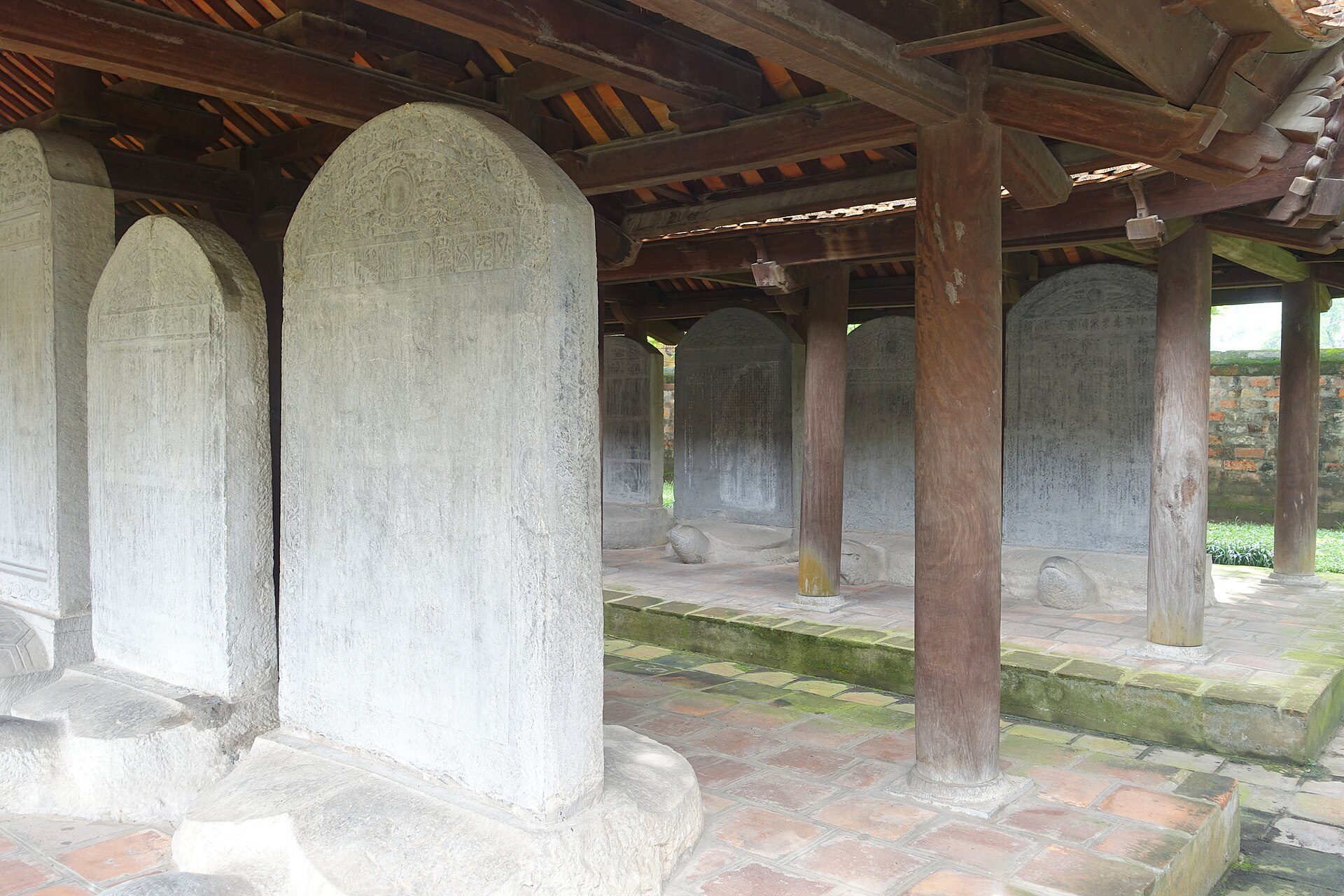
Photo: Daderot / Wikimedia Commons, CC0
Hanoi dishes guests ask about: pho, bun cha, cha ca, banh cuon, egg coffee. Festivals near Hanoi worth knowing: the Perfume Pagoda festival opens on the 6th day of the first lunar month and runs for several weeks; the Giong Festival at Phu Dong and Soc temples was inscribed by UNESCO in 2010.
Ninh Binh: Hoa Lu and Trang An
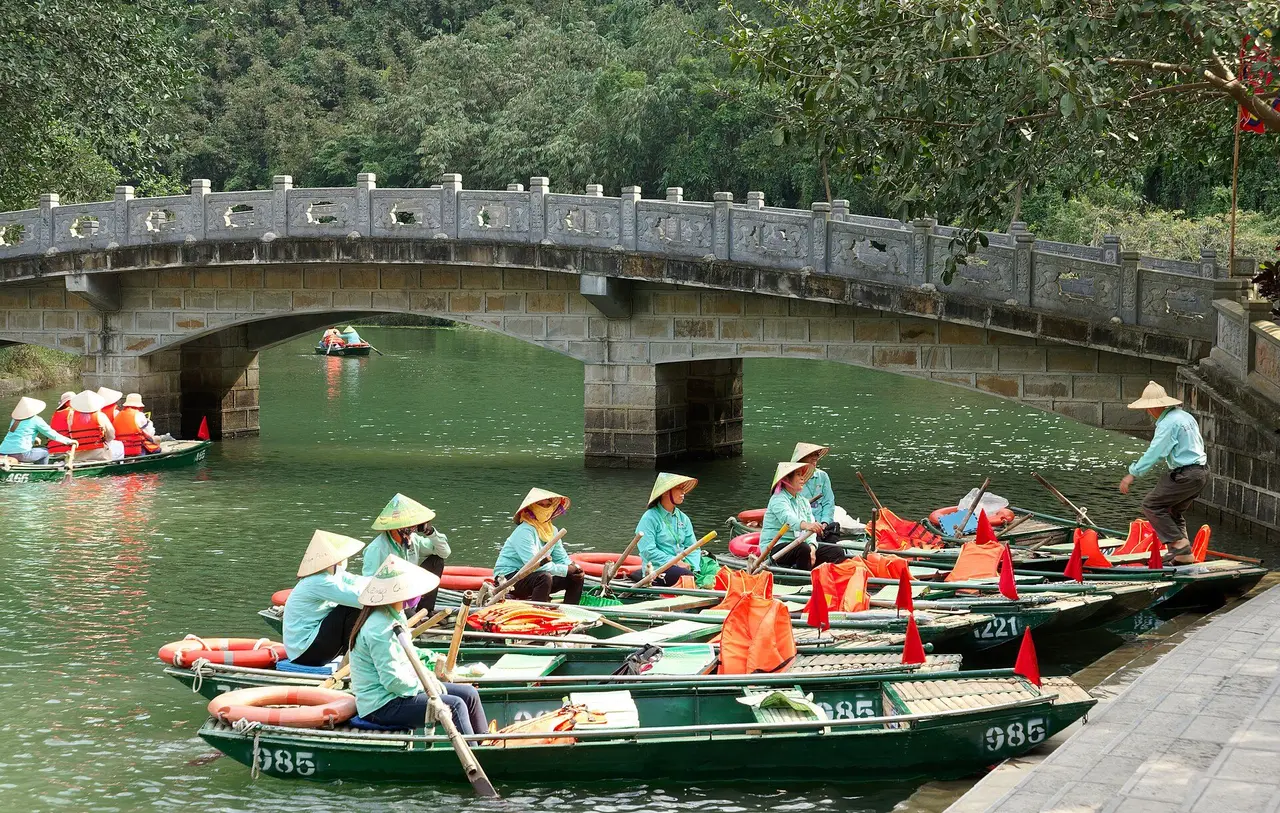
Hoa Lu was the capital of the Dinh and Early Le dynasties (from 968) before the move to Thang Long. The Trang An Landscape Complex was inscribed by UNESCO in 2014 as Vietnam's first mixed (cultural and natural) World Heritage Site. Highlights for commentary: tower karst, water caves you row through, traces of prehistoric people in the caves, and the lives of the boat rowers. Food: mountain goat, crispy rice (com chay).
Ha Long: limestone on the sea
Ha Long Bay was inscribed by UNESCO in 1994 for its aesthetic value, with its geological value added in 2000; in 2023 the site was extended as "Ha Long Bay - Cat Ba Archipelago". Guests often ask how many islands there are (Figure 2): Vietnamese sources usually say 1,969, while UNESCO's description of Ha Long Bay says about 1,600 islands and islets. The figures differ because of the area covered and the counting method, so a safe answer is "close to 2,000 islands and islets, depending on how you count", with a source if the guest wants detail. Food: squid cakes (cha muc) and seafood.
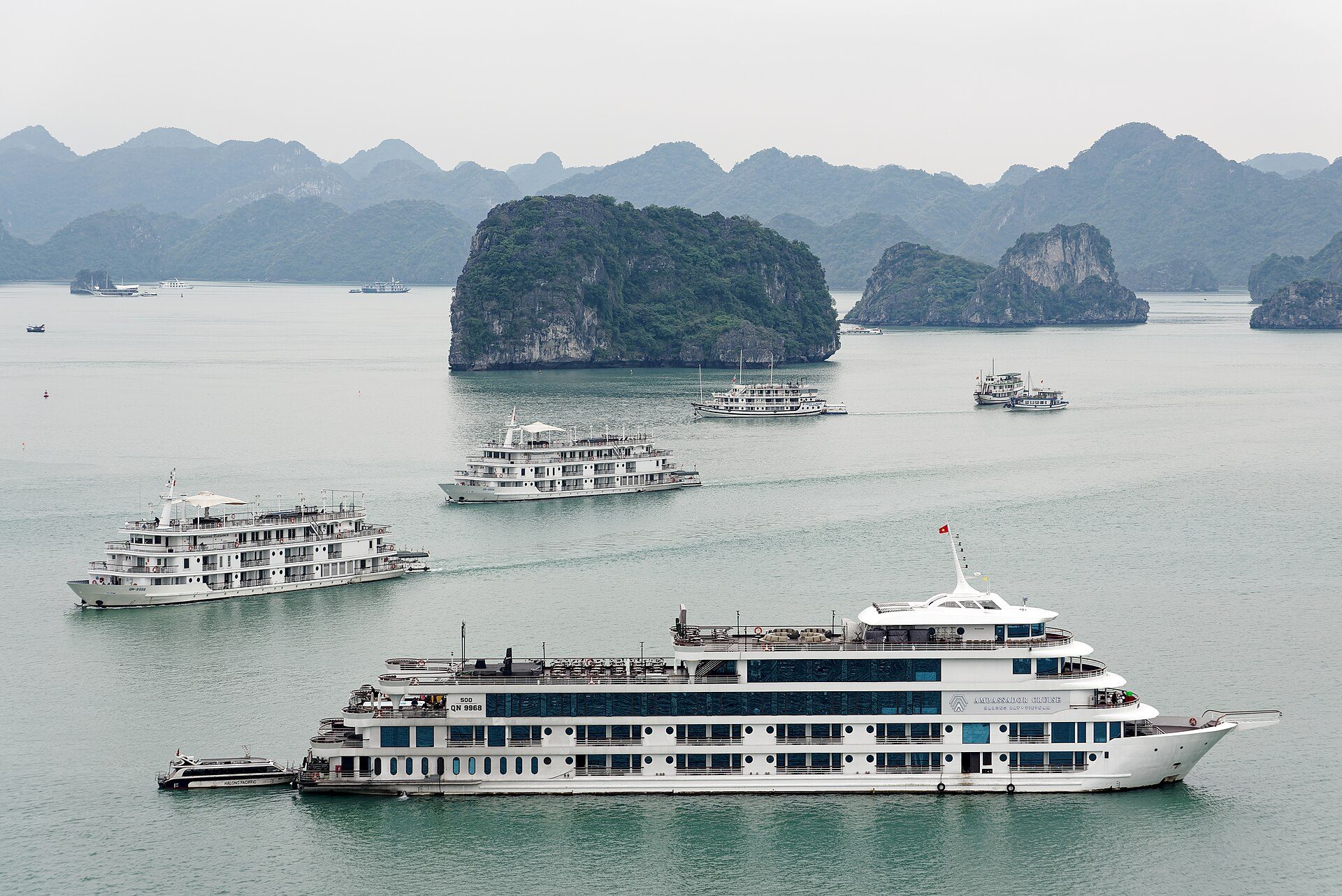
Photo: Jakub Hałun / Wikimedia Commons, CC BY 4.0
The central heritage coast: Hue, Hoi An, My Son, Phong Nha
Central Vietnam has the most World Heritage Sites along a single route; guests here usually love history and ask deeper questions.
Hue: capital of the Nguyen dynasty
Hue was the capital of the Nguyen dynasty from 1802 to 1945. The Complex of Hue Monuments was inscribed by UNESCO in 1993 as Vietnam's first World Heritage Site. Nha nhac, Vietnamese court music, was recognised by UNESCO in 2003. Food: bun bo Hue, com hen (rice with baby clams), banh beo and other small rice cakes; royal cuisine makes a good story for international guests. Since 2025 Hue has been a centrally governed city, so stop calling it "Thua Thien Hue province".
Hoi An and My Son
Hoi An Ancient Town and the My Son Sanctuary were both inscribed in 1999. UNESCO describes Hoi An as a trading port active from the 15th to the 19th century, where Vietnamese, Chinese, Japanese and Western influences met. The Japanese Covered Bridge (Chua Cau, Figure 3) is the town's symbol; its construction date is given differently in different sources, so in commentary say "according to tradition, Japanese merchants built it around the late 16th or early 17th century". My Son is a complex of Cham temple towers. Food: cao lau, mi Quang, chicken rice.
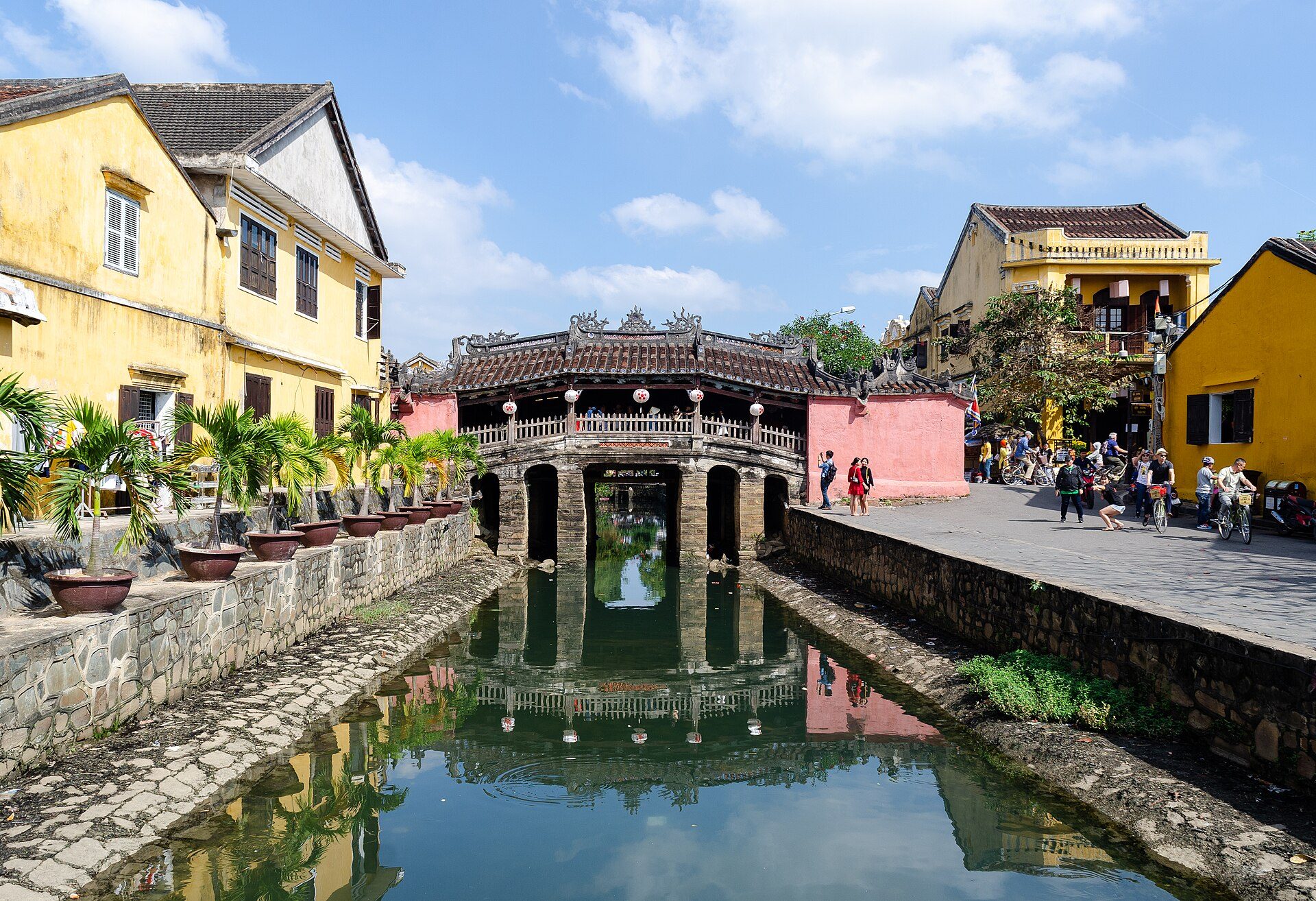
Photo: Steffen Schmitz ( more photos ) / Wikimedia Commons, CC BY-SA 4.0
Phong Nha - Ke Bang and the storm season
Phong Nha - Ke Bang National Park was inscribed in 2003 and extended in 2015, and is best known for its limestone caves. Central Vietnam's rain and storm season usually runs from about September to December; cave and boat tours may be postponed, so keep backup plans in your notebook.
The Mekong Delta: floating markets, orchards and don ca tai tu
Guests come to the Mekong Delta to slow down: small boats, fruit eaten in the orchard, traditional music. Knowledge here is more about rivers and daily life than monuments.
Geography: why "Cuu Long", the Nine Dragons
In Vietnam the Mekong splits into the Tien and Hau rivers and reaches the sea through several mouths; the name Cuu Long (Nine Dragons) refers to nine river mouths. Many sources today note that some mouths have silted up or been closed by structures, so tell it as "there used to be nine mouths" and check the current number before stating it. The flood season usually runs from about August to November and the main fruit season from about May to August; both vary by year.
Floating markets and river life
Cai Rang floating market in Can Tho is the best-known stop (Figure 4). Details guests enjoy: the pole (cay beo) hoisted on each boat with a sample of what it sells, and trading that starts at first light. Watch and ask the sellers yourself to stay current, because floating markets shrink as roads improve.
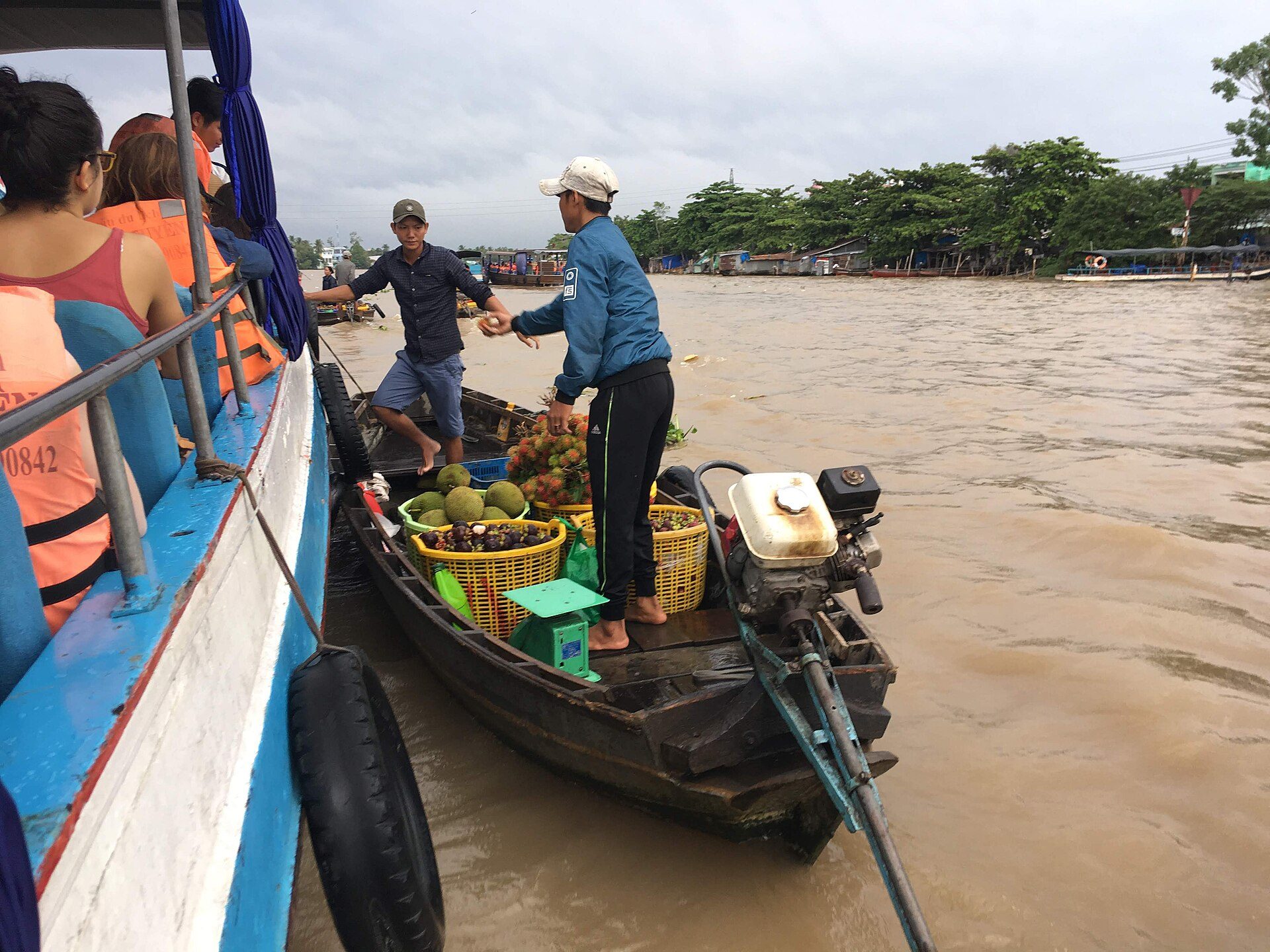
Photo: Christophe95 / Wikimedia Commons, CC BY-SA 4.0
Culture, festivals and food
The art of don ca tai tu music and song of southern Vietnam was inscribed by UNESCO in 2013; the Festival of Ba Chua Xu Goddess at Sam Mountain (An Giang) was inscribed in 2024. The Khmer community celebrates Ok Om Bok with ngo boat races around the full moon of the 10th lunar month. Food: snakehead fish grilled in straw, banh xeo, fermented fish hotpot (lau mam), hu tieu noodles. Since 2025 Can Tho has absorbed Soc Trang and Hau Giang, so update place names in your notebook.
The Central Highlands: basalt plateaus and gong culture
The Central Highlands attract guests interested in ethnic cultures, coffee and nature, but it is also the easiest route to get wrong if you rely on generic material.
Geography and economy
The Central Highlands are red basalt plateaus suited to coffee, pepper and rubber. The climate has a clear rainy season, usually about May to October, and a dry season from about November to April. Da Lat sits on the Lang Biang (Lam Vien) plateau and stays cool all year, very different from Buon Ma Thuot. After the 2025 reorganisation some Highland provinces merged with coastal ones (for example Kon Tum into Quang Ngai, Phu Yen into Dak Lak), so "going to the Highlands" no longer matches provincial borders.
Gongs and communal houses
The Space of Gong Culture in the Central Highlands was proclaimed by UNESCO in 2005 (Figure 5). Gongs belong to life-cycle and farming rituals such as the new rice celebration, not just stage shows. The rong communal house is the community hall of several northern Highland peoples such as the Ba Na and Xo Dang. The indigenous peoples include many groups (Ede, Gia Rai, Ba Na, M'nong, Co Ho and others), each with its own customs, so avoid lumping them together.
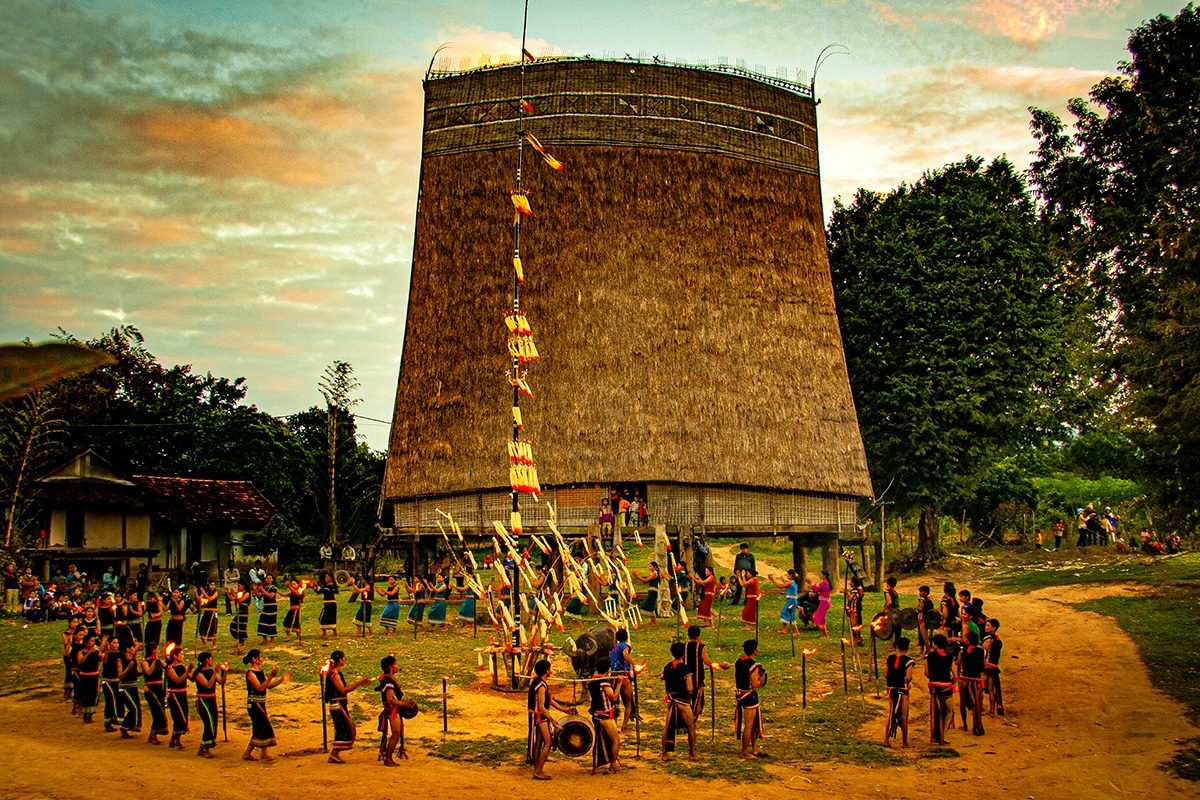
Photo: (C) Cục Du lịch Quốc gia Việt Nam / Wikimedia Commons, CC BY 4.0
Behaviour when bringing guests into villages
Ask the local guide before entering a house or photographing people or sacred objects; do not touch gongs or ritual poles. Food: bamboo-tube rice (com lam), grilled chicken, rice wine drunk through straws (remind guests to drink in moderation).
Safety and cultural respect: before boat trips, caves, mountain passes or tours in the storm season, check the official weather forecast and ask operations for a backup plan; never push a group out when there is a warning. At temples, pagodas and villages, remind guests to dress modestly, ask before taking photos and never climb on monuments. Group safety in detail comes in the step "Group safety & basic first aid".
Quick summary of the 4 routes
Copy this table into your notebook as a frame, then add to it. UNESCO years follow UNESCO's heritage lists; seasons and dishes are general patterns and may vary by year.
| Route | Heritage, key dates | Geography, seasons to watch | Signature food | Festivals, culture |
|---|---|---|---|---|
| Hanoi - Ninh Binh - Ha Long | Thang Long 1010; Imperial Citadel 2010; Trang An 2014; Ha Long 1994, 2000, extended 2023 | Delta and limestone karst; cold, humid winters; boats may be suspended in bad weather | Pho, bun cha, goat, crispy rice, squid cakes | Perfume Pagoda festival, Giong Festival (2010) |
| Central heritage coast | Hue 1993; court music 2003; Hoi An, My Son 1999; Phong Nha 2003 | Narrow coastal strip; storms about September-December | Bun bo Hue, com hen, cao lau, mi Quang | Royal court culture, Cham culture |
| Mekong Delta | Don ca tai tu 2013; Ba Chua Xu festival 2024 | Tien and Hau rivers; flood season about August-November | Grilled snakehead, banh xeo, lau mam | Khmer Ok Om Bok, ngo boat races |
| Central Highlands | Gong culture 2005 | Basalt plateaus; rains about May-October | Bamboo-tube rice, grilled chicken, coffee | New rice festival, rong houses |
How to build a fact notebook from reliable sources
A fact notebook is a long-term asset: done right from the start, each new tour only adds to it. Paper or phone notes both work, as long as you can find a card in 10 seconds.
Rank your sources by reliability
| Level | Source type | Examples | How to use it in commentary |
|---|---|---|---|
| A | Primary, official | UNESCO heritage pages and files; site management boards; signage at the site; stone inscriptions | State as fact; give the source if asked |
| B | Scholarly, museum | History books, provincial gazetteers, researchers' books; museum displays | State as fact; say "according to..." for disputed details |
| C | Press, travel sites | Online newspapers, tourism authority pages, travel guides | Check against A or B before using any number |
| D | Legends, anecdotes | Folk tales, what local people tell you | Always open with "legend has it" or "locals say" |
Two easy level-A sources for heritage routes are UNESCO's World Heritage list and its intangible heritage lists (UNESCO's Viet Nam page for intangible heritage). The Vietnam National Authority of Tourism site (vietnamtourism.gov.vn) is useful for events; important numbers should still be checked against the original source.
A sample fact card
Each card is one 3-5 minute story, enough to tell on the coach or at the site. A sample card for Trang An:
- Topic: Trang An is a mixed heritage site.
- Key point: inscribed by UNESCO in 2014 for both cultural value (prehistoric traces, the Hoa Lu capital) and natural value (limestone karst, water caves).
- Source: UNESCO World Heritage list (level A), with the date checked.
- Line for guests: open with what guests can see, then give the year and the title.
- Questions guests ask: "What does mixed mean?", "Does Vietnam have other mixed sites?" (answer after checking the latest list).
Update place names after the 2025 provincial reorganisation
Since 1 July 2025 Vietnam has had 34 provincial-level units. Many place names in older material have changed: Ninh Binh now includes the former Ha Nam and Nam Dinh, Quang Nam merged into Da Nang, Kien Giang merged into An Giang. For every stop in your notebook, write both the new administrative name and the old familiar one, and check the province's or city's official portal before telling guests.
Worked example: preparing for a 3-day, 2-night Hanoi - Ninh Binh - Ha Long tour
Situation: your company assigns you a group of 25 domestic guests on a 3-day, 2-night tour, departing in 10 days. Driving times in the itinerary: day 1 Hanoi to Ninh Binh about 2 hours, day 2 Ninh Binh to Ha Long about 3 hours, day 3 Ha Long back to Hanoi about 3 hours. Actual times depend on traffic and stops.
Step 1: work out how much content you need
Assumption for this example: on the coach you give about 15 minutes of commentary per hour of driving and let guests rest the rest of the time. Total driving is 2 + 3 + 3 = 8 hours, so you need 8 x 15 = 120 minutes of coach content. At about 5 minutes per card, that is 120 / 5 = 24 cards. On-site commentary uses separate cards per stop, counted in the table below.
Step 2: split cards and study hours
| Task | Coach cards | Prep hours |
|---|---|---|
| Hanoi (Thang Long, Temple of Literature, food) | 6 | 4 |
| Ninh Binh (Hoa Lu, Trang An, the boat rowers' lives) | 8 | 5 |
| Ha Long (geology, island count, fishing villages, seafood) | 8 | 5 |
| Festivals and weather on tour dates | 2 | 1 |
| On-site cards (Temple of Literature, Trang An, a cave in the bay) | 0 | 2 |
| Cross-checking sources, adding dates checked | 0 | 3 |
| Total | 24 | 20 |
Check the sums: cards 6 + 8 + 8 + 2 = 24, matching 120 minutes. Prep hours 4 + 5 + 5 + 1 + 2 + 3 = 20 hours. Over the 10 days left that is 2 hours a day, manageable even if you are studying or working.
Step 3: self-check before departure
Every card has a source and a date checked; numbers guests are likely to ask about (inscription years, island count, the year the capital moved) are checked against 2 sources; opening hours and site rules were confirmed with operations in the week of departure.
Common mistakes when learning destination knowledge
Copying sample commentary from the internet
Sign: you speak fluently but freeze at the guest's follow-up question. Cause: you memorised someone else's words. Fix: break each sample into cards, check them against level A or B sources, and rewrite them in your own words.
Telling legends as facts
Sign: an international guest asks "is there evidence?" and you are stuck. Cause: no reliability label. Fix: legends are still worth telling, because they are culture too, but open with "legend has it" and keep them apart from the historical record.
Using outdated numbers and place names
Sign: you say "Quang Nam province" or "Thua Thien Hue province" as if current, or quote last year's ticket price. Cause: your notebook has no dates checked. Fix: add a date to every card that contains a number and review cards older than 12 months before each peak season.
Frequently asked questions
What should a tour guide learn first?
Start with the outline of Vietnamese history by major dynasty and the UNESCO heritage milestones, because they are the backbone of most cultural tours. Then go deep on the route you are about to lead, using the 5 layers: history, geography, culture, food, festivals.
Where can I find reliable commentary material?
Prefer UNESCO pages, site management boards, museums and scholarly books; use newspapers and travel guides for ideas, then check them. Signage at the site is also a good source: photograph it and note the date.
Do I need to know the culture of all 34 provinces and cities?
No. Know the 4 popular routes broadly, then go deep on the route you are assigned; your notebook grows with every route you lead.
What if a guest asks something I do not know?
Say honestly that you are not sure, write the question down and promise an answer after you check. That question becomes a new card in your notebook.
Practice exercise and self-assessment
- Make 10 fact cards for one of the 4 routes above, each with topic, key point, source, date checked and reliability level.
- Find one number that two sources give differently (such as the island count in Ha Long Bay) and write how you will answer guests.
- Build a cards-and-prep-hours table for a 2-day, 1-night tour following the worked example, with the sums checked.
Self-assessment criteria
- Pass: 10/10 cards have a source and a date checked; at least 4 cards use level A or B sources.
- Pass: every legend is labelled "legend has it"; administrative names reflect the 2025 reorganisation.
- Pass: the prep-hours table adds up and matches the minutes of content.
- Not yet: cards without sources, paragraphs copied from other sites, or a number you cannot trace.
With your notebook in place, move on to the next step of the roadmap: Commentary on the bus & at sites, where you turn each fact card into a story with a clear opening, body and close, use the microphone at the right pace, and adapt content for children, seniors and international guests.
Keep learning to be a tour guide: after destination knowledge come commentary, running the group, safety and first aid, incident handling, then a real tour. See the 8-step tour guide roadmap.