The engineered boards a furniture carpenter in Vietnam uses every day fall into four groups: melamine-faced particleboard (called MFC in Vietnamese workshops), MDF (including a green-core moisture-resistant grade), high-density fibreboard (HDF) and plywood; solid wood is used for worktops, trims and handles. Melamine board suits carcasses in dry areas, MDF suits doors that need routing and painting, plywood or green-core MDF suits the sink area, and HDF suits back panels and drawer bottoms. The wrong board, hinge or runner is the most common reason kitchen cabinets swell at the base, doors sag and drawers stick after a few months.
By the end of this lesson, you will be able to:
- Look at a board edge and correctly name melamine board, MDF, green-core MDF, HDF and plywood.
- Choose boards and surfaces (melamine, laminate, acrylic, veneer) for sink units, base units, wall units and wardrobes.
- Tell full overlay, half overlay and inset hinges apart; roller, ball-bearing and undermount runners; and the main lift stay types.
- Understand, at a general level, what the E0, E1, E2 and CARB P2 emission labels mean.
- Draw up a hardware and screw list for a kitchen, with totals that add up.
Learning furniture carpentry properly? Materials and hardware are the second step of the roadmap, after table saw safety and before reading drawings and cutting lists. See the 8-step furniture carpenter roadmap to learn in the right order.
What is engineered wood and why do workshops use so much of it?
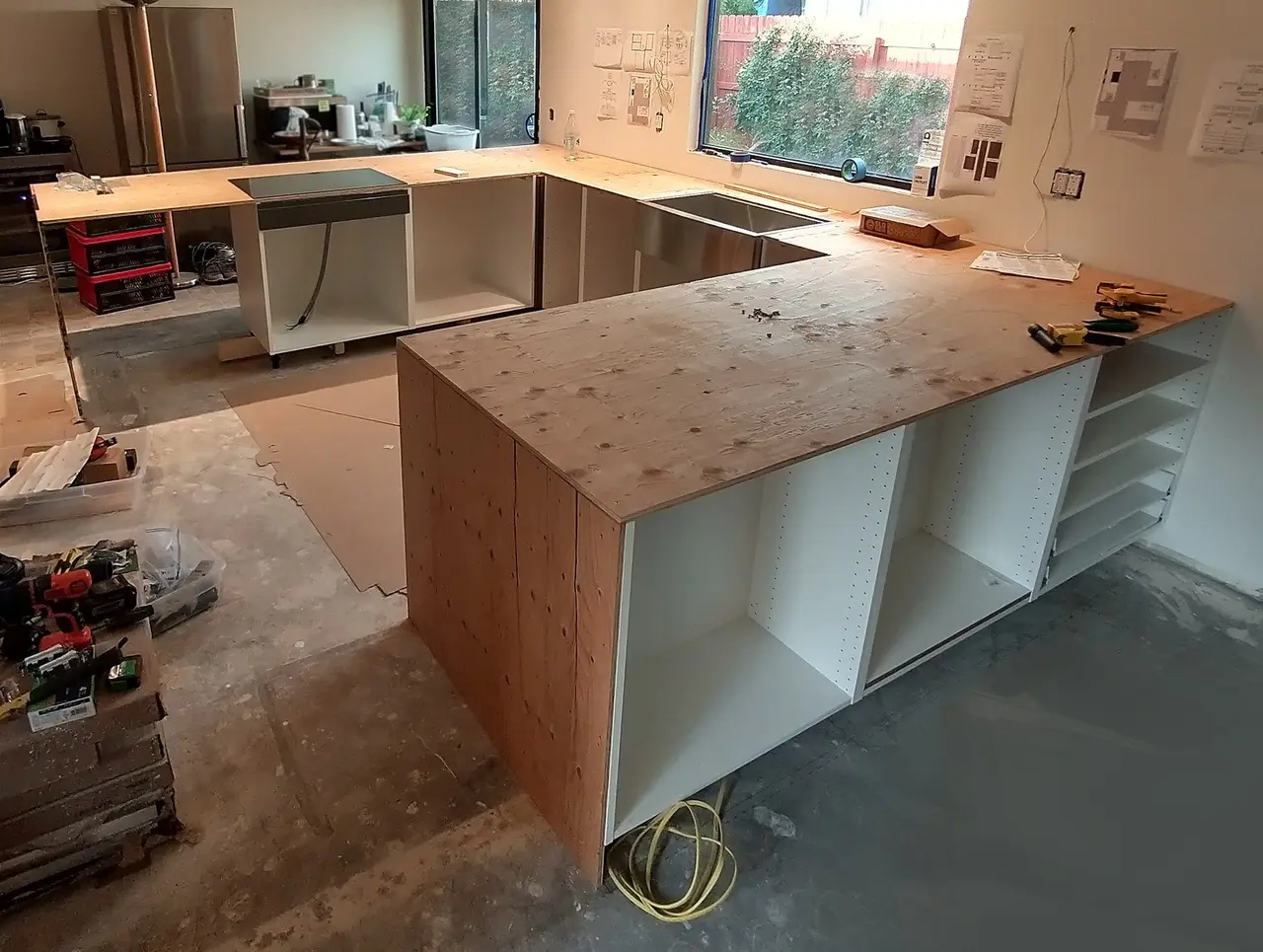
Engineered wood is board made from wood that has been chipped, ground into fibres or peeled into thin sheets, then mixed or coated with glue and hot-pressed. Most kitchens and wardrobes in Vietnamese apartments today have engineered-board carcasses; Figure 1 shows a familiar scene: white-faced carcasses with plywood laid on top before the stone worktop goes on.
Strengths and weaknesses compared with solid wood
Engineered boards are flat, warp little and come in a standard 1220 × 2440 mm sheet (carcasses are usually 17–18 mm thick), so they can be cut to a layout; melamine board already has its finish, so you cut, edge band and assemble. On the other hand, boards hate water at open edges, hold screws in their edges less well than solid wood, and the glue in them emits formaldehyde at different levels. Cutting dust is very fine; review the lesson on table saw safety and wood dust.
How much a carpenter needs to know
Drawings often say things like "17 mm moisture-resistant melamine carcass, acrylic doors, 5 mm HDF back, soft-close full overlay hinges, 450 undermount runners". You must understand every word to cut the right thickness, drill in the right place, and speak up when a material does not suit its location, for example standard melamine board under a sink.
Telling melamine board, MDF, HDF and plywood apart
Board faces are often the same colour and easy to confuse; the fastest way is to look at the cut edge.
Melamine board (MFC): faced particleboard
Melamine board is particleboard faced with melamine paper on both sides. The edge shows chips of mixed size, finer on the outer layers than in the middle (Figure 2). It is cheap, comes in many colours and is quick to work, so it is the most common carcass material. Weaknesses: the chip core soaks up water at open edges, it cannot be routed into profiles, and screws hold poorly in its edges. The moisture-resistant grade copes with humidity better but still cannot survive soaking.
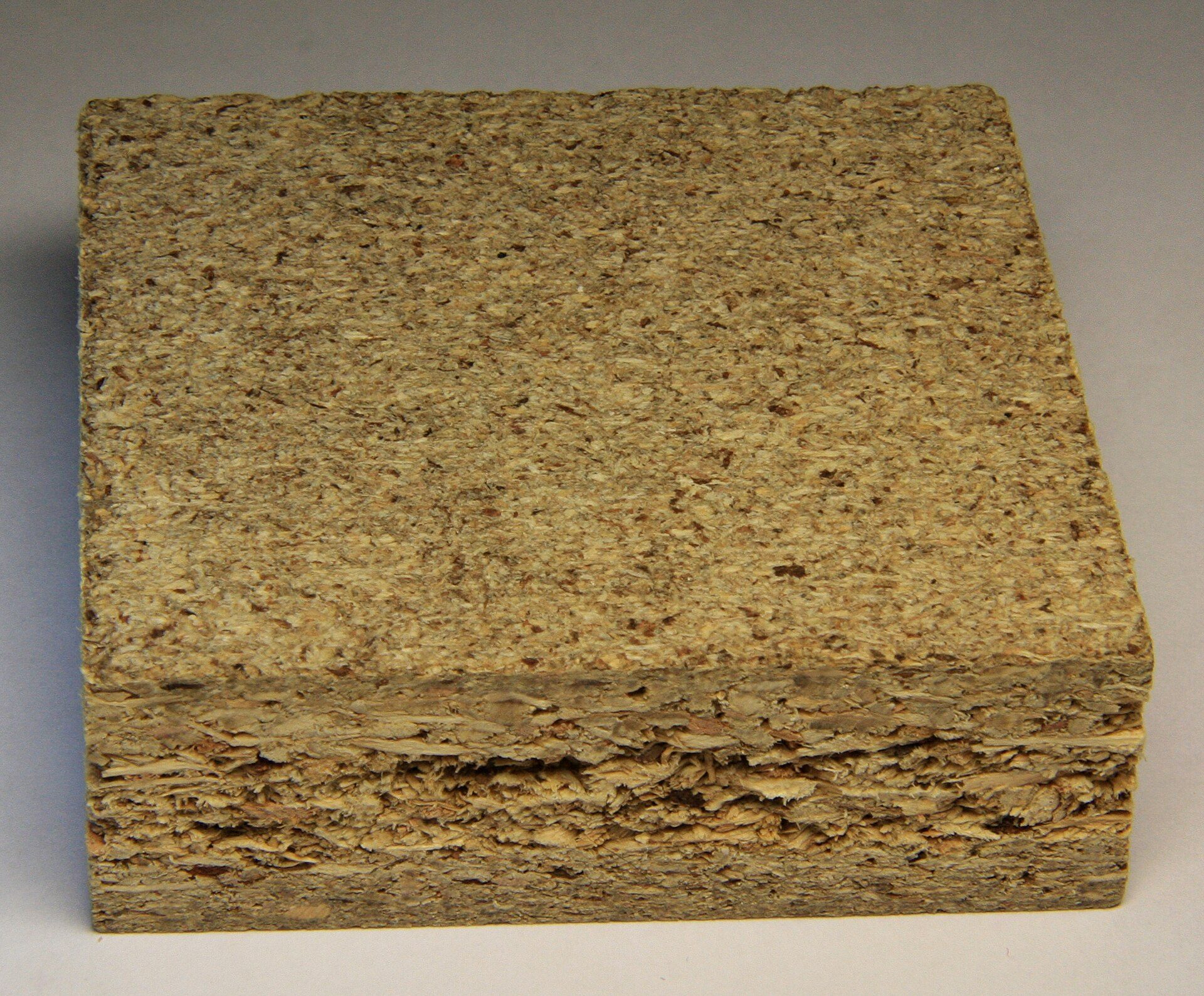
Photo: D-Kuru / Wikimedia Commons, CC BY-SA 3.0 at
MDF, green-core MDF and HDF
MDF is made from wood fibres mixed with glue and pressed; its edge is smooth and evenly light brown (Figure 3). Because it is uniform, MDF routes, curves and paints well and is used for painted doors and acrylic-faced doors. Green-core MDF has a moisture-resistant additive and is dyed green so you can recognise it; "moisture resistant" means it copes better with humid air and occasional splashes, not that it can be soaked. HDF is made like MDF but pressed much denser: heavy, hard, with a darker edge; thin sheets of about 3–5 mm are used for back panels and drawer bottoms.
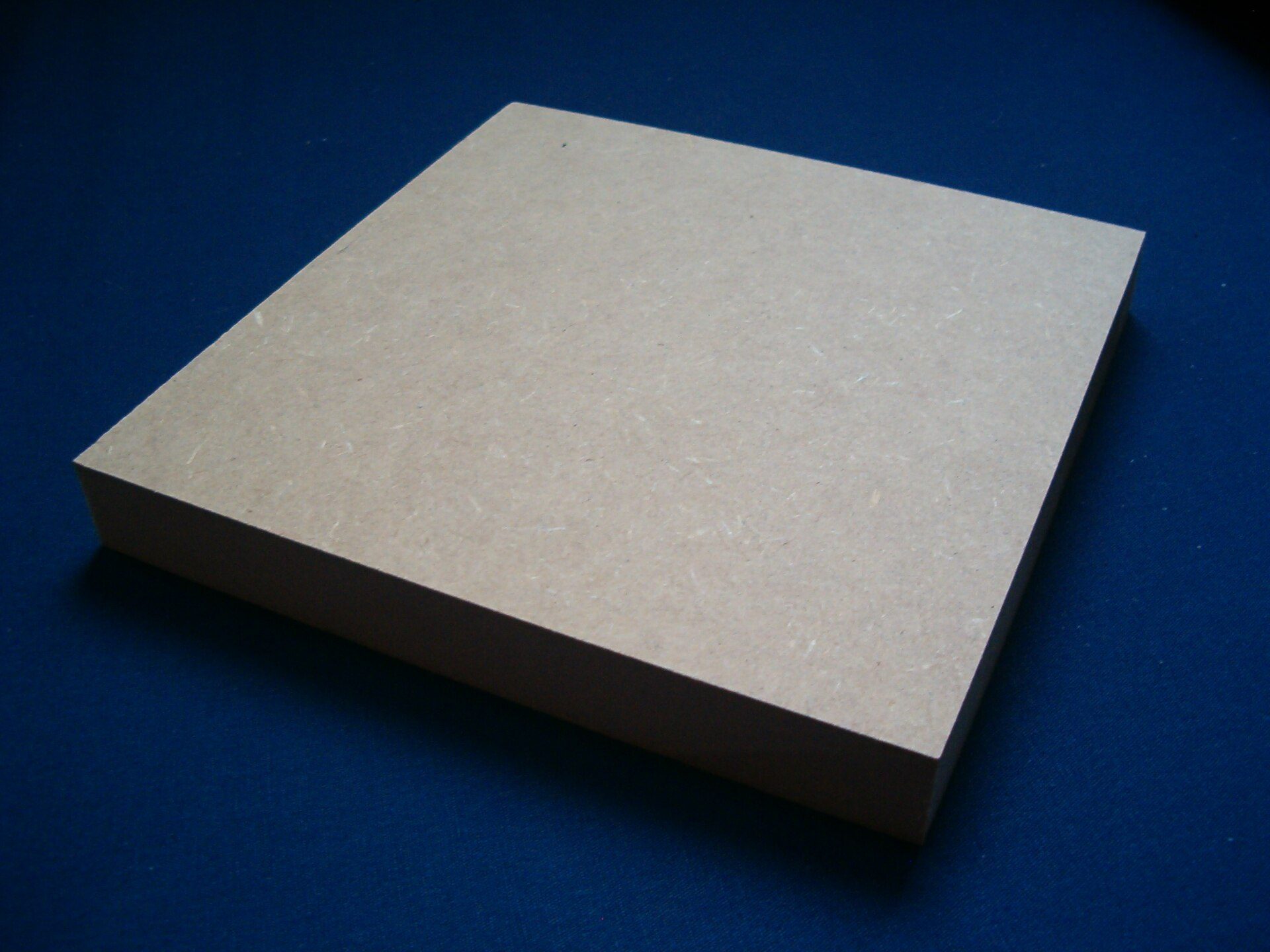
Photo: Joern Allmers at de.wikipedia / Wikimedia Commons, Public domain
Plywood: layered board
Plywood is made of thin peeled wood veneers glued together, each layer with its grain at right angles to the one before, usually in an odd number of layers (Figure 4). The cross grain makes plywood strong, good at holding screws even in its edges and better than particleboard in damp conditions; it suits sink units, bathroom cabinets and the layer under stone worktops. Weaknesses: it costs more than melamine board and its face may have knots, so it usually needs a surface finish.
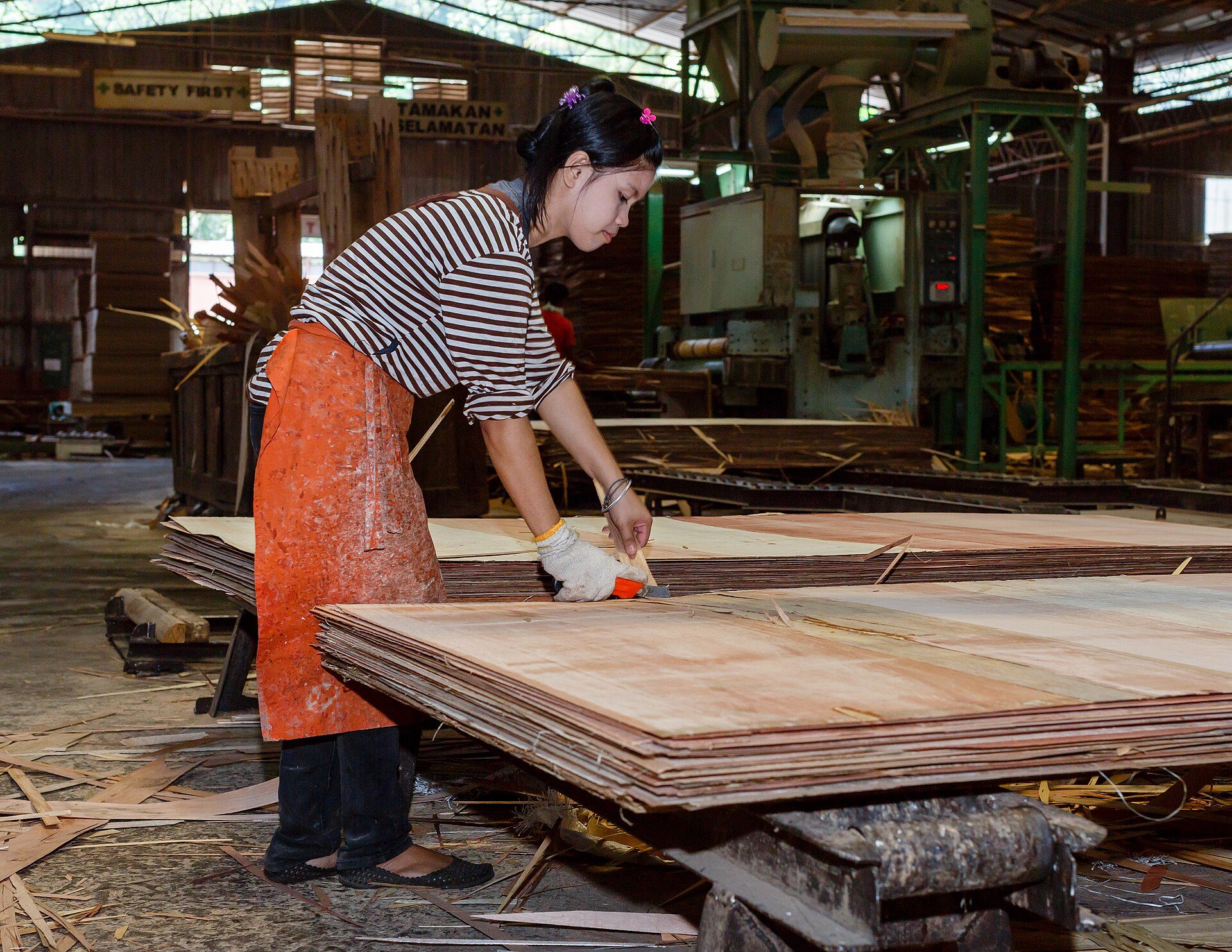
Photo: CEphoto, Uwe Aranas / Wikimedia Commons, CC BY-SA 3.0
Quick comparison table
| Board | What the edge looks like | Strength | Weakness | Used for |
|---|---|---|---|---|
| Melamine board (standard, moisture resistant) | Coarse chips, finer outer layers | Cheap, many colours | Hates water at edges | Carcasses in dry areas, wall units, wardrobes |
| MDF | Smooth, light brown | Routes and paints well | Heavy, hates water | Painted and acrylic doors |
| Green-core MDF | Smooth, green core | More moisture resistant than MDF | Costs more | Sink area, kitchen doors |
| HDF | Smooth, dark, very dense | Hard, impact resistant | Heavy | Back panels, drawer bottoms |
| Plywood | Stripes of layers | Holds screws well | Costs more | Sink units, bathrooms |
A 17–18 mm sheet of 1220 × 2440 mm has a volume of about 0.05 m³; with the typical density of 600–800 kg/m³ for particleboard and MDF, each sheet weighs about 30–40 kg, so always carry it with two people.
Solid wood in fitted furniture
In apartments, solid wood rarely makes up whole carcasses, but you still meet it in worktops, handles, trims, door frames and cabinet legs.
Common types
Finger-jointed rubberwood (small strips joined into panels) is used for worktops and shelves; pine is light with many knots; oak, ash and walnut have attractive grain, are hard, are usually imported and often appear as veneer. When a client wants precious domestic timber, check the paperwork on the wood's legal origin under the current regulations.
Moisture and movement
Solid wood swells when it takes up moisture and shrinks when it dries, mainly across the grain. Wood for furniture is usually dried to a moisture content of about 8–12% depending on where it will be used; if the workshop has a moisture meter, measure before cutting. Fix solid wood tops through slotted holes or sliding brackets so the wood can move, never rigidly.
Surfaces: melamine, laminate, acrylic, veneer
The core board decides moisture resistance; the surface decides scratch and heat resistance, gloss and price.
Melamine and laminate
Melamine is coloured or woodgrain paper soaked in resin and hot-pressed onto the board; it is cheap, comes in many colours and resists everyday scratches, but it is thin and a dull blade chips it easily. Laminate (HPL) is thicker, made of many layers of paper pressed at high pressure and glued onto the core; it resists scratches, heat and knocks better and suits kitchen doors and worktops. When you glue laminate, also glue a balancing sheet on the back so the door does not bow.
Acrylic and veneer
Acrylic is a high-gloss or matt plastic sheet bonded to MDF, with deep colour and easy cleaning; high-gloss acrylic shows scratches and fingerprints, so keep the protective film on until installation is finished. Veneer is a thin slice of real wood glued onto MDF or plywood and then sanded and finished like solid wood; it gives real grain for less than solid timber, but heavy sanding can break through to the core.
| Surface | Scratch resistance | Heat resistance | Relative price | Good for |
|---|---|---|---|---|
| Melamine | Fair | Medium | Low | Carcasses, wardrobes |
| Laminate | Good | Good | Medium | Kitchen doors, worktops |
| Acrylic | Medium | Medium | Medium to high | Modern kitchen doors |
| Veneer + finish | Depends on finish | Depends on finish | Medium to high | Units and panels needing real wood grain |
Formaldehyde and the E0, E1, E2 and CARB P2 labels
The glue in boards can emit formaldehyde, a pungent gas that stings the eyes and irritates the airways. Clients with small children or allergies will ask about it, so you need to answer at the right level.
Understanding the labels in general terms
E0, E1 and E2 are emission classes in the European classification: E0 is lower than E1, and E2 is higher than E1; boards for furniture today are commonly labelled E1 or E0. CARB P2 is a level set by the California Air Resources Board (USA), and boards that meet it are generally low-emission. Each system has its own test method, so the labels cannot be converted mechanically into one another.
What a carpenter should do
Do not promise "this board is not toxic". Ask the supplier for the emission certificate for the batch, state the board type clearly in your quote, and seal the hidden edges too. After installation, advise the client to ventilate for a few days; households with asthma or severe allergies should ask a doctor when to move in.
Hardware: hinges, drawer runners, lift stays
At this step you learn to name and choose hardware; drilling, fitting and adjusting it is step 5 of the roadmap.
Concealed cup hinges
Almost all modern cabinet hinges are cup hinges: a round cup bored into the door (35 mm is by far the most common size) and an arm joined to a mounting plate screwed to the cabinet side (Figure 5). There are three types by door position:
- Full overlay: the door covers the whole side edge; the arm is almost straight.
- Half overlay: two doors share a middle panel and each covers half its edge; the arm is slightly cranked.
- Inset: the door sits inside the carcass; the arm is strongly cranked.
Soft-close hinges have a built-in hydraulic damper so the door closes gently. Mounting plates come in clip-on or slide-on and keyhole versions. The number of hinges rises with door height and weight: kitchen doors under about 900 mm tall usually take 2, near-ceiling wardrobe doors usually 4–5; always check the manufacturer's table.
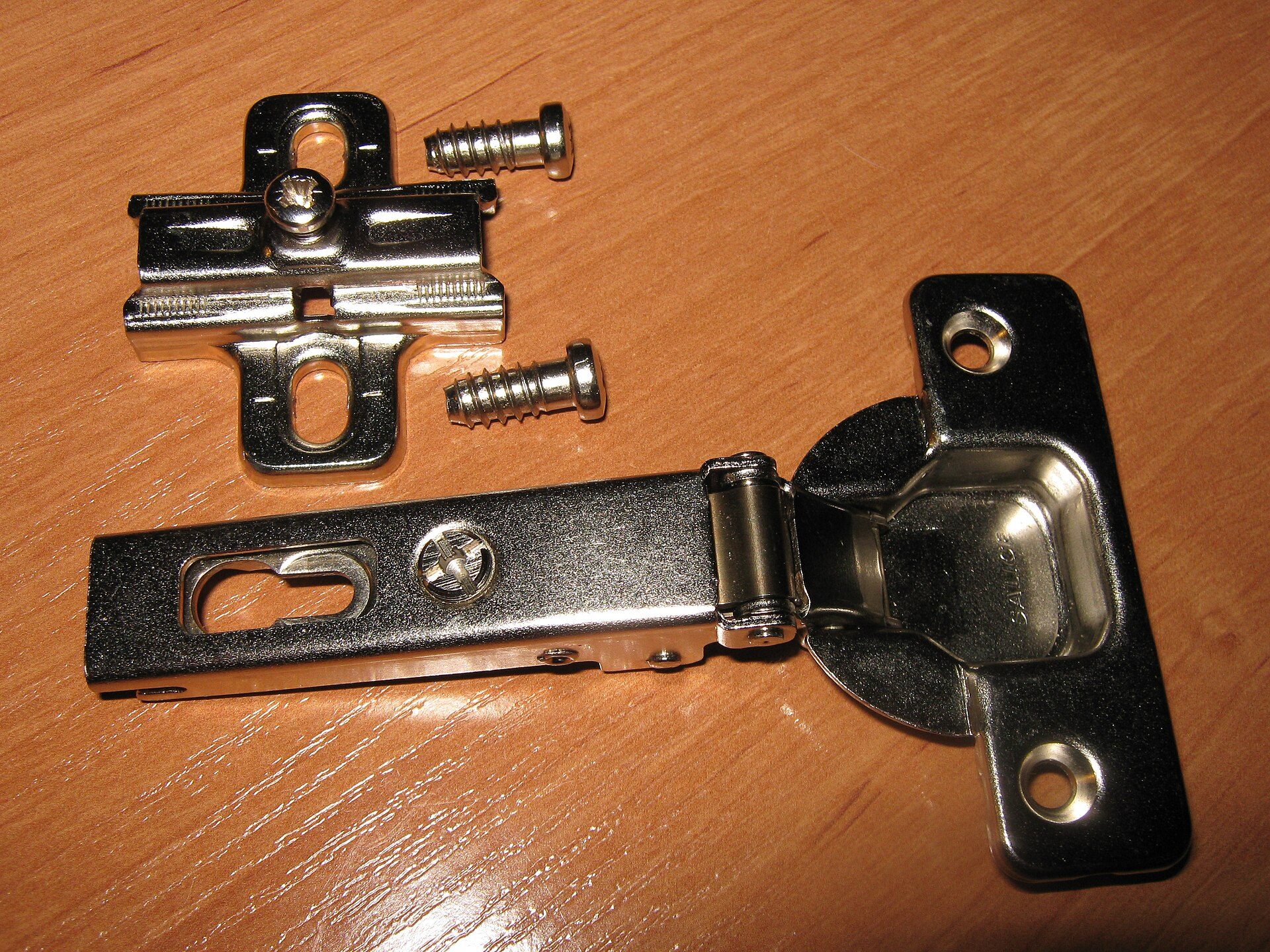
Photo: Hefugo / Wikimedia Commons, CC0
Drawer runners
Roller runners (Figure 6) are the cheapest: painted steel rails with plastic wheels running in a channel, fitted to the bottom edges of the drawer; they usually open only about three quarters of the way and carry light loads. Ball-bearing runners fit on the sides of the drawer, open fully and carry more; the drawer must be narrower than the opening by exactly the clearance the manufacturer specifies on each side (usually about 12.5–13 mm). Undermount runners are hidden under the drawer bottom, usually soft-close, and look best; the drawer must be built exactly to the runner model's catalogue. Runner length is chosen from the inside depth of the cabinet, usually in 50 mm steps.
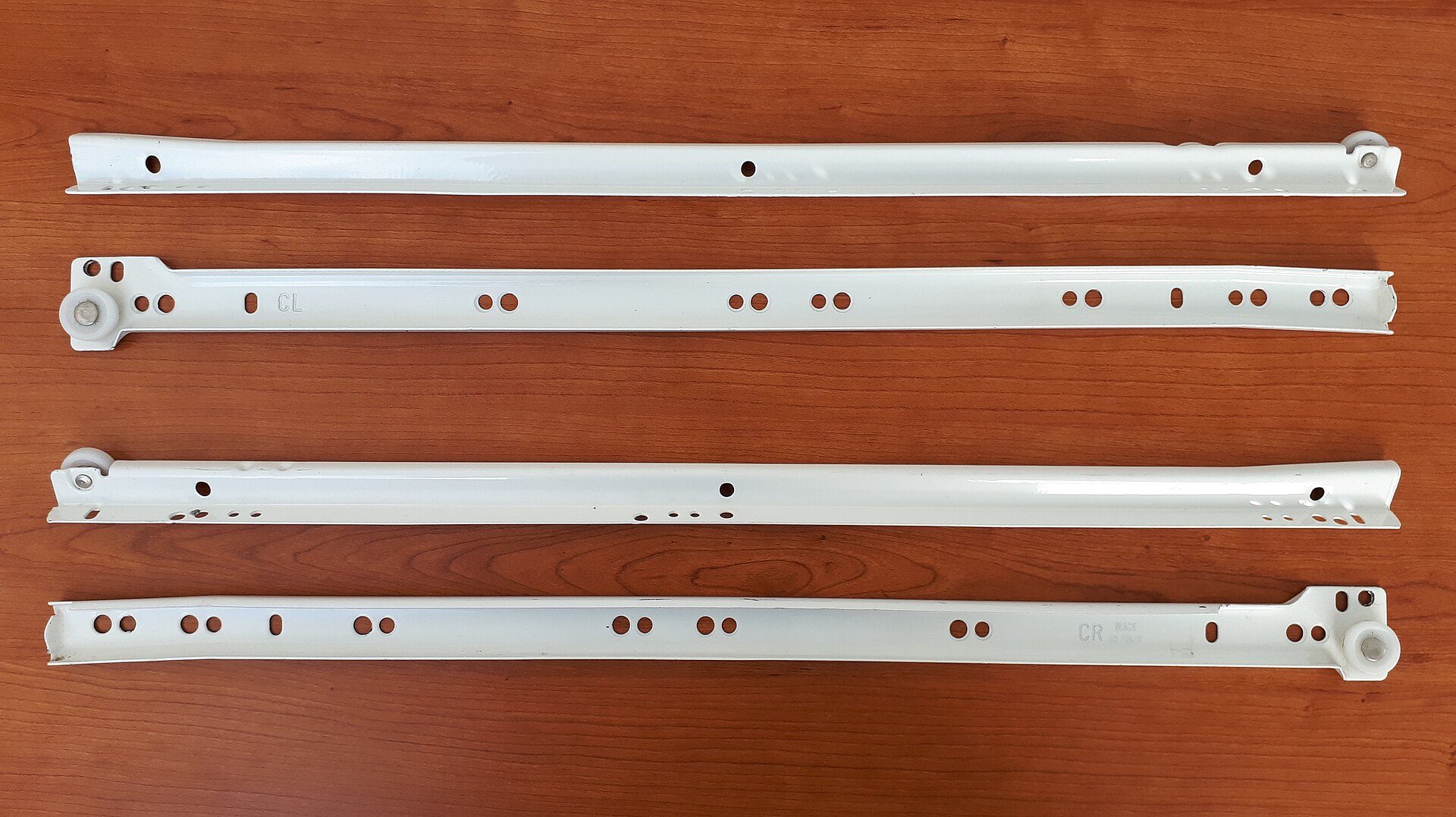
Photo: Fructibus / Wikimedia Commons, CC0
Lift stays for wall units
Gas struts are cheap and hold a lift-up door open, but the force must match the door weight. Soft-close lift-up stays stop at several angles and are common above cooker hoods. Bi-fold and parallel lift stays suit high units with no room for a swinging door. Manufacturers usually publish a table by door height and weight.
Screws, dowels and the 32 mm system
A screw that is too long breaks through the face, the wrong type does not hold, and the wrong position means hardware does not line up with its holes.
Hardware screws and assembly screws
Screws for hinges and runners are commonly about 3.5–4 × 15–16 mm; a screw going into the face of a board must not be longer than the board is thick. Euro screws, with a thick shank of about 5–6 mm, go into pre-drilled 5 mm holes and hold better than small screws in particleboard. Carcass assembly screws are around 4 × 35–40 mm, driven through the side into the edge of the other panel; always pilot drill so the edge does not split.
Cam locks, dowels and the 32 mm system
A cam lock has a cam housing bored into the face of one panel and a bolt screwed into the edge of the other; turning the cam pulls the panels tight, and it can be taken apart and reassembled many times. Wooden dowels (usually 8 mm) locate the panels and take shear loads. Most European hardware follows the 32 mm system: a row of 5 mm holes 32 mm apart, with its centre line 37 mm from the front edge of the side panel; hinge plates, runners and shelf pins all line up with this row.
Choosing materials by cabinet zone
Upgrade the core where it is damp and heavily loaded; upgrade the surface and hardware where clients touch most; use standard materials in hidden dry areas to keep the price down.
Suggestion table
| Zone | Carcass | Doors | Suggested hardware |
|---|---|---|---|
| Sink unit | Plywood or green-core MDF | Green-core MDF with laminate or acrylic | Rust-resistant soft-close hinges |
| Other base units | 17 mm moisture-resistant melamine board | Laminate, acrylic or melamine | Undermount or ball-bearing runners for drawers |
| Kitchen wall units | 17 mm moisture-resistant melamine board | Same as base doors | Lift stays for lift-up doors |
| Wardrobes | 17–18 mm melamine board | Melamine or veneer | Soft-close hinges, ball-bearing runners |
Spell it out in the quote
State the core, thickness, surface, emission label and hardware type for each item. "Melamine board kitchen" is too vague; "17 mm moisture-resistant melamine board, soft-close hinges, soft-close undermount runners" helps the client understand why prices differ and avoids disputes at handover.
Worked example: a 2.2 m straight kitchen
The 2200 mm base run has an 800 mm sink unit (2 doors), a 600 mm drawer unit (3 drawers) and an 800 mm unit under the hob (2 doors). The wall run has an 800 mm unit (2 doors), a 600 mm unit above the hood (1 lift-up door) and an 800 mm unit (2 doors). Check: 800 + 600 + 800 = 2200 mm for both runs. Base doors are about 715 mm tall, wall doors about 700 mm.
Step 1: choose materials
Sink unit: 18 mm plywood carcass. All other units: 17 mm moisture-resistant melamine board carcasses. All doors in green-core MDF with matching laminate; backs in 5 mm HDF. Boards labelled E1 or lower, with batch paperwork from the supplier.
Step 2: count the hardware
| Unit | Doors / drawers | Soft-close hinges | Undermount runners (pairs) | Lift stays (sets) |
|---|---|---|---|---|
| Sink unit 800 | 2 doors | 4 | 0 | 0 |
| Drawer unit 600 | 3 drawers | 0 | 3 | 0 |
| Hob unit 800 | 2 doors | 4 | 0 | 0 |
| Wall unit 800 (left) | 2 doors | 4 | 0 | 0 |
| Wall unit 600 above hood | 1 lift-up door | 0 | 0 | 1 |
| Wall unit 800 (right) | 2 doors | 4 | 0 | 0 |
| Total | 8 swing doors, 1 lift-up door, 3 drawers | 16 | 3 | 1 |
Check: 8 swing doors × 2 hinges = 16, matching 4 + 4 + 4 + 4 = 16. Doors under 900 mm tall normally need 2 hinges, but still check the manufacturer's table.
Step 3: count the screws
- Hinges: 2 screws for the cup + 2 for the plate = 4 screws; 16 × 4 = 64 screws.
- Undermount runners: assume 4 screws per rail into the cabinet side; 3 pairs = 6 rails; 6 × 4 = 24 screws.
- Lift stay: 2 sides × 4 screws = 8 screws (depends on the model).
- Total: 64 + 24 + 8 = 96 screws; buy about 15% extra: 96 × 1.15 ≈ 110 screws.
Assembly screws, dowels and cam locks are counted after the cutting list is made, because they depend on the number of panels in each unit.
Common mistakes when choosing materials and hardware
These three mistakes are the ones seen most often on real jobs.
Sink unit base swells after a few months
Sign: the base and the bottom of the sides become rough, swollen and the face peels. Cause: standard melamine board, open edges around pipe holes, a slowly dripping trap. Prevention: plywood or green-core MDF, fully sealed edges, waterproof sealant around cut-outs, a plastic liner on the base.
Sagging doors, loose hinges
Sign: the door drops over time and the gaps become uneven. Cause: small screws in particleboard removed and refitted many times, too few hinges for a tall door. Prevention: Euro screws in holes drilled on the 32 mm system and enough hinges; if a hole is stripped, glue in a wooden dowel and re-drill.
Sticking drawers or screws breaking through doors
Sticking drawers usually come from ignoring ball-bearing runner clearance or building to the wrong undermount runner dimensions; fix the runner model before making the cutting list. Screw tips break through the door face when the screw is longer than the remaining board thickness; measure the door first and pick a shorter screw.
Safety when handling boards and hardware: a 17–18 mm sheet weighs about 30–40 kg; always carry it with two people and keep your back straight. Cutting and sanding MDF, HDF and particleboard creates very fine dust: extract at the machine and wear a fine-dust mask and goggles. Gas struts contain compressed gas: do not puncture or burn them when disposing of them. Freshly cut laminate and acrylic edges are very sharp; wear gloves when carrying sheets but take them off at the saw. If stinging eyes or breathing trouble persist when working with new boards, get fresh air and see a doctor.
Frequently asked questions
What is the difference between MDF and melamine board?
MDF is fibreboard with a smooth edge that routes and paints well; melamine board is faced particleboard, cheap and quick to work. Carcasses in dry areas usually use melamine board, while painted or acrylic doors usually use MDF.
Is moisture-resistant MDF waterproof?
No. Green-core MDF copes with humidity and splashes better than standard MDF but still swells if soaked for long; you still need to seal edges and fix leaks.
Is plywood better than melamine board for kitchens?
Plywood holds screws and resists moisture better and is ideal for sink units. Moisture-resistant melamine board is still adequate and cheaper for wall units and dry areas; many workshops combine both.
Ball-bearing or undermount runners?
Ball-bearing runners are cheaper and the drawer is simpler to build. Undermount runners look better and run more quietly but the drawer must match the runner catalogue; mid-range kitchens and above often use soft-close undermount runners.
Is E0 board safer than E1?
E0 is a lower formaldehyde emission class than E1 in the same classification. Ask for the batch certificate to be sure, and still ventilate after installation.
Practice exercise and self-assessment
Visit a board supplier or a workshop near you and do three things:
- Look at the edges of 6 samples (standard melamine board, moisture-resistant melamine board, MDF, green-core MDF, HDF, plywood), write down each name without reading the label, then compare.
- Hold a cup hinge and point out the cup, arm and mounting plate; say whether it is full overlay, half overlay or inset, and whether it is soft-close.
- For a straight kitchen you know, make a materials-by-zone table and a count of hinges, runners, lift stays and screws, as in the worked example.
Self-assessment criteria
- Pass: you name at least 5 of the 6 boards correctly and tell the 3 hinge overlay types apart.
- Pass: no standard melamine board in the sink unit; the hardware table adds up and includes spares.
- Not yet: you say "moisture-resistant MDF is waterproof", choose screws longer than the door thickness, or count hinges without counting doors.
Once you are confident with materials and hardware, move on to the next roadmap step: Reading drawings & panel cutting lists. There you will use the board thickness, edge banding and runner clearances from this lesson to work out the size of every panel, just as the lesson on standard kitchen cabinet dimensions breaks a base unit down into a cutting list.
Keep learning furniture carpentry: after materials come reading drawings and cutting lists, cutting and edge banding, fitting hinges and runners, installing kitchens and wardrobes on site, and a full L-shaped kitchen project. See the 8-step furniture carpenter roadmap.