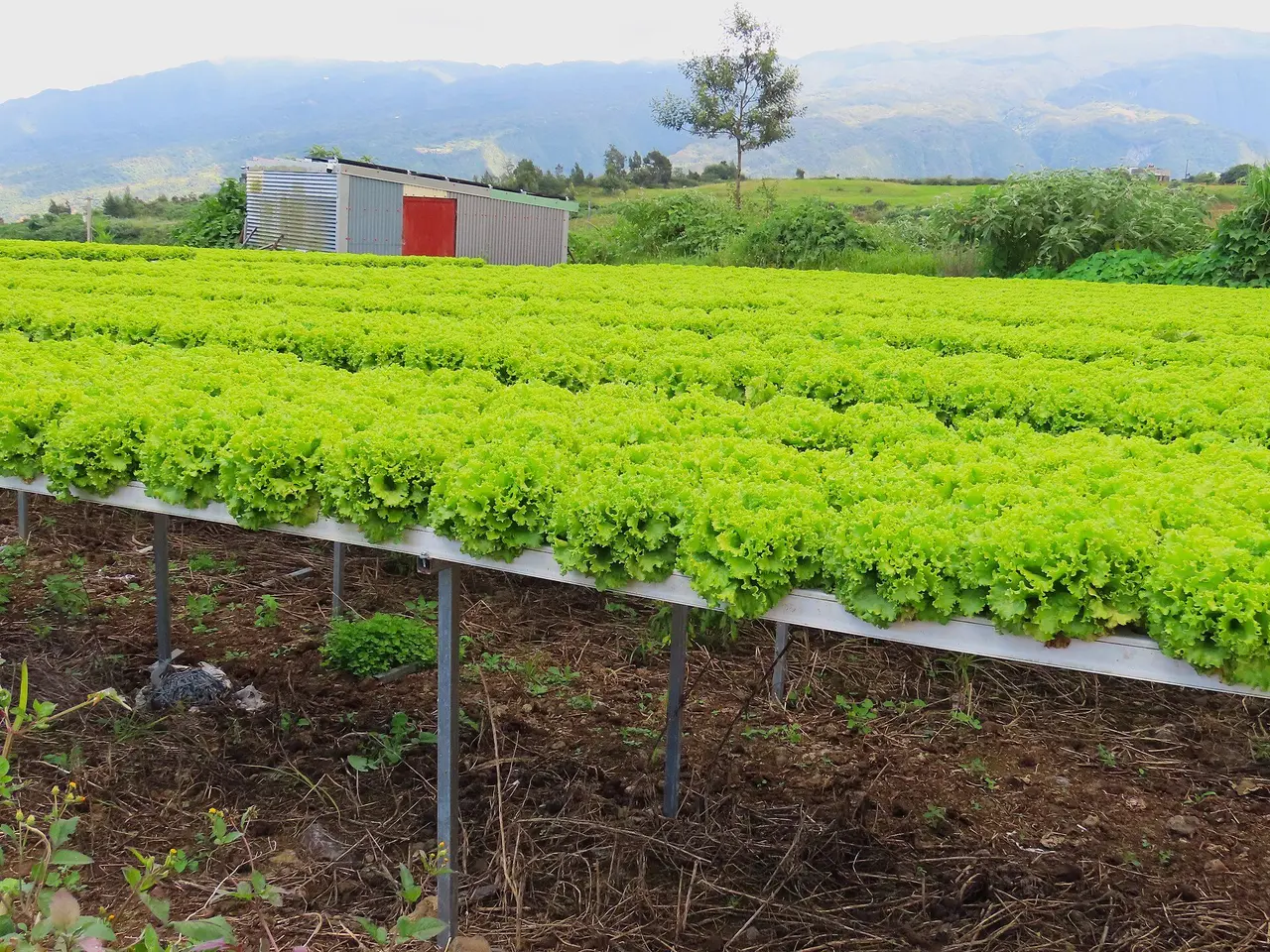
To mix a hydroponic nutrient solution properly: fill the tank with clean water first, measure the water's EC and pH, add part A and stir well, then add part B (never mix concentrated A and B together), measure EC again until it reaches the level for your crop (leafy greens usually about 1.0–1.8 mS/cm), and finally adjust pH to about 5.5–6.5, ideally 5.8–6.2. Most problems with hydroponic greens, such as yellow leaves, stunted plants and root rot, come from EC or pH being off, from meters that were never calibrated or from solution left too long without changing, not from the seed variety. This lesson walks you through each step the way a farm technician coaches a newcomer, with a worked example for a 100-litre tank whose numbers add up from start to finish.
By the end of this lesson, you will be able to:
- Explain what EC and pH are and why hydroponic greens must be kept within set ranges.
- Calibrate EC and pH meters and take readings correctly.
- Mix A and B parts for a tank or reservoir from the label dose and adjust EC to target.
- Lower or raise pH safely, in small measured steps, with records.
- Monitor daily, top up water, add nutrients and know when to change the solution.
Learning hydroponic growing properly? Mixing nutrients and measuring EC and pH is step 4 of the roadmap, after electrical, water and chemical safety, hydroponic systems and sowing. See the 8-step hydroponic and greenhouse grower roadmap to learn in the right order.
What are nutrient solution, EC and pH?
In hydroponics the roots have no soil to draw minerals from, so every nutrient has to be dissolved in the water. A hydroponic nutrient solution is water containing macronutrient salts (nitrogen, phosphorus, potassium, calcium, magnesium, sulphur) and micronutrients (iron, manganese, zinc, copper, boron, molybdenum) in the proportions plants need.
EC: how concentrated the nutrients are
EC (electrical conductivity) tells you how much dissolved salt is in the water, usually in mS/cm. The more minerals, the better the water conducts and the higher the EC. Too low and the greens go hungry, pale and slow; too high and roots struggle to take up water, leaf edges burn and the greens turn bitter and fibrous. Some meters show TDS in ppm: EC 1.4 mS/cm is about 700 ppm on a meter using a 0.5 factor, or about 980 ppm on a 0.7 factor, so when reading guides you need to know which factor your meter uses. It is best to work in EC directly.
pH: which nutrients the roots can take up
pH measures how acidic or alkaline the solution is, on a scale from 0 to 14 with 7 as neutral. At about pH 5.5–6.5 most minerals are in a form roots can absorb. Above about 6.5–7, iron and manganese become hard to absorb and young leaves turn yellow even with enough nutrients; below 5.5, roots can be harmed and calcium and magnesium uptake suffers. That is why greens can yellow even when EC is right: the fault is the pH.
Why nutrients come in two parts, A and B
Liquid hydroponic nutrients are usually sold as two bottles: A contains calcium (calcium nitrate) and often iron; B contains sulphates and phosphates (potassium, magnesium). Mix the two concentrates together and the calcium reacts with sulphate and phosphate to form an insoluble white precipitate that plants cannot use and that clogs pipes. Once diluted in a large tank of water the two parts can coexist, so the rule is: A into the water, stir well, then B.
EC and pH levels for common hydroponic crops
Each crop and growth stage needs a different EC. Seedlings just moved into the system need a lower EC than plants close to harvest. The table below shows commonly used reference ranges; when growing for real, also read the nutrient maker's and seed supplier's guidance, then fine-tune based on how plants respond on your farm.
Reference table
| Crop | Reference EC (mS/cm) | Reference pH | Notes |
|---|---|---|---|
| Lettuce (all types) | 0.8–1.4 | 5.8–6.2 | Low end for young plants; keep EC lower in hot weather |
| Leafy brassicas (choy sum, mustard greens) | 1.2–2.0 | 5.8–6.5 | Too high an EC burns leaf edges |
| Water spinach (rau muong) | 1.0–1.6 | 5.8–6.5 | Fast growing, drinks a lot, top up often |
| Basil and herbs | 1.0–1.6 | 5.8–6.5 | Too high an EC gives small, tough leaves |
| Cucumber (for comparison) | 1.7–2.5 | 5.8–6.2 | Fruiting crops need a higher EC than leafy greens |
| Tomato (for comparison) | 2.0–3.5 | 5.8–6.5 | Highest EC at the fruiting stage |
Adjusting for the weather
In hot sunny weather plants transpire heavily and drink water faster than they take up minerals, so the EC in the tank creeps up. Keep your target at the low end of the range then. In cool, overcast weather you can use the higher end.
Solution temperature
The warmer the water, the less dissolved oxygen it holds and the more easily roots rot. In a Vietnamese summer, solution in a tank left in the sun can go above 30°C. Shade the tank, paint or wrap it in a light colour, keep it in the shade and try to hold the solution below about 28°C (Figure 1).
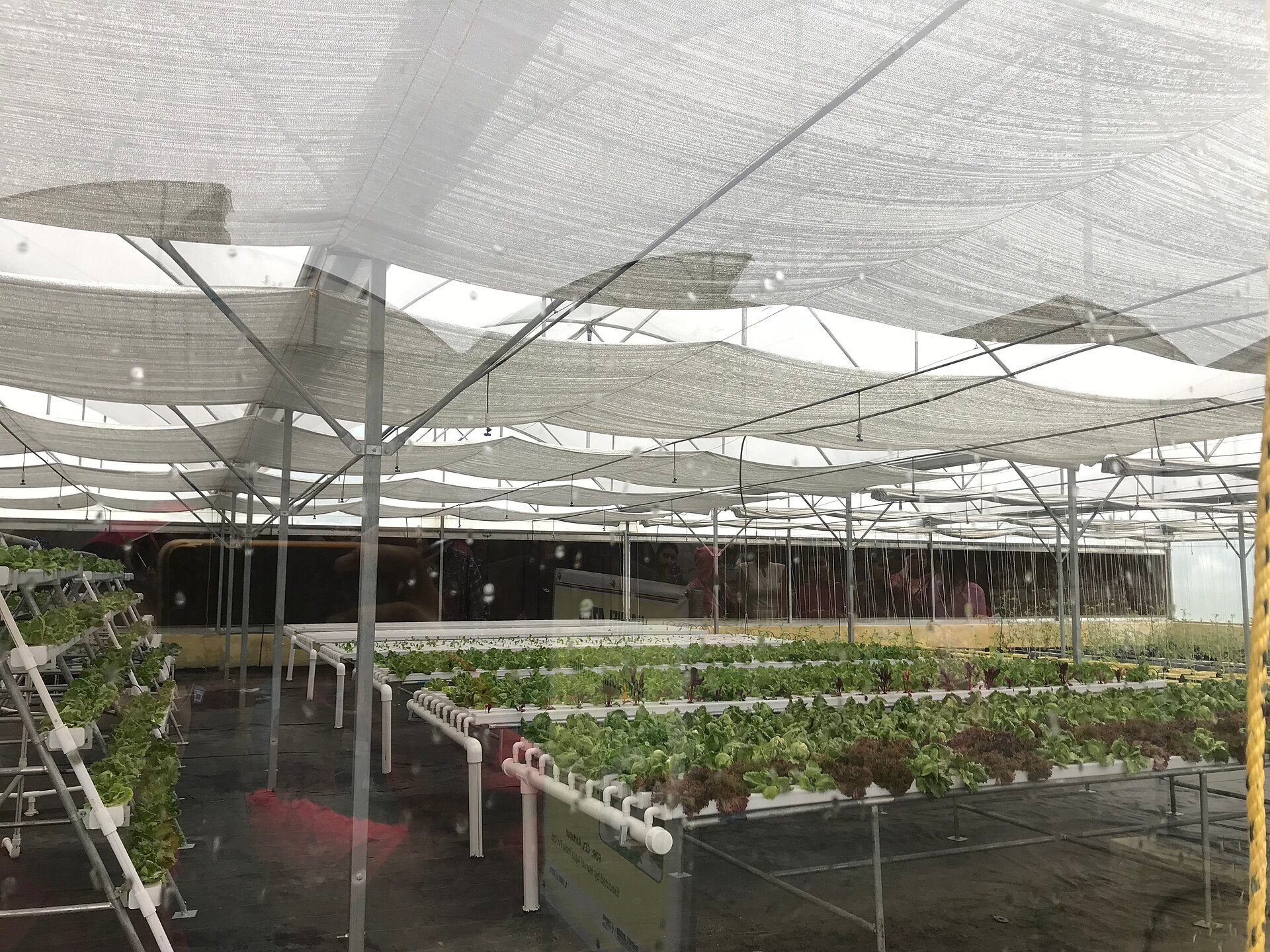
Photo: Just2blabber / Wikimedia Commons, CC0

Tools and meter calibration
Your nutrient mix is only as accurate as your instruments. A pH meter reading 0.3 units out is enough to ruin a crop without you knowing why.
Tools you need
- An EC meter and a pH meter (or a combined meter), and calibration solutions (Figure 2).
- A measuring cylinder or jug marked in ml, and 10–50 ml plastic syringes for small doses.
- A clean plastic stirring rod or a circulation pump to mix thoroughly.
- Nutrient parts A and B; pH adjusters (pH down, pH up) sold for hydroponics.
- Chemical-resistant gloves, safety glasses and a notebook or log sheet.
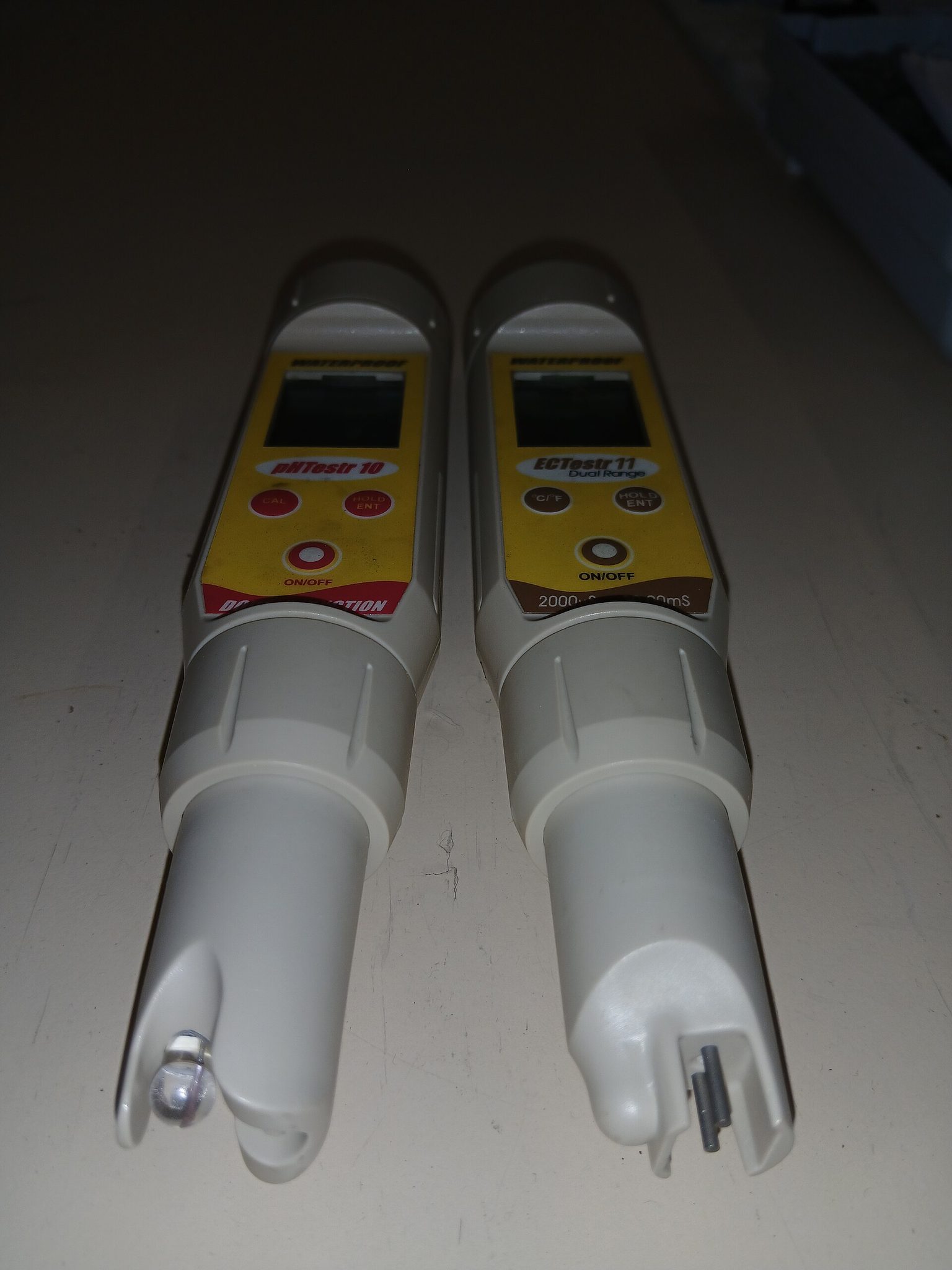
Photo: Rotkaeppchen68 / Wikimedia Commons, CC0

Calibrating the pH meter
- Rinse the probe with clean water (ideally distilled) and shake it gently dry.
- Dip it into pH 7.00 buffer, wait for a stable reading and adjust as the meter's instructions say.
- Rinse, dip into pH 4.01 buffer (or as your meter requires) and adjust a second time.
- Recalibrate regularly (many growers do it weekly or whenever readings look odd); keep the pH probe moist in storage solution and never let it dry out.
Calibrating the EC meter
Use the common 1.413 mS/cm (1,413 µS/cm) standard. Dip the probe, wait for a stable reading and set it to the standard value. Most pens compensate automatically to 25°C; still, measure only after the solution is well mixed and its temperature is stable. Indicative 2026 prices in Vietnam: a pH pen costs about VND 150,000–600,000 (roughly USD 6–24), an EC pen about VND 100,000–500,000, and better combined meters cost more, depending on model and seller.
Mixing A and B nutrient solution step by step
Follow the order below exactly and record the readings after each step. The habit of logging helps you find the cause whenever the greens have problems.
Step 1: prepare the source water
- Use clean water: mains water, filtered well water, clean rainwater or RO water.
- Measure the source water's EC and pH before mixing. High-EC (hard, mineral-rich) water adds to the final EC; water above about 0.5 mS/cm is worth filtering or blending with softer water.
- Well water with iron, alum or a fishy smell must be treated before use in hydroponics.
Step 2: add part A and stir
Read the dose on the product label (ml of A per litre of water). Multiply by the litres in the tank to get the amount of A. Pour A into the tank and stir or run the circulation pump for 2–3 minutes until evenly mixed.
Step 3: add part B, stir, measure EC
Measure part B (usually the same amount as A if the label says 1:1) with a separate or freshly rinsed measure, pour it in and stir for another 2–3 minutes. Measure EC. If it is low, add A then B in equal small amounts; if it is high, add clean water.
Step 4: adjust pH last
Adjust pH only once EC is right, because adding nutrients shifts the pH. Measure pH; if it is above target add pH down, if below add pH up. Each time add a small measured amount, stir, wait a few minutes and measure again. Do not pour in a lot at once to save time: pH does not change in a straight line and it is easy to overshoot.
Chemical and electrical safety warning: pH down is usually an acid (ready-diluted phosphoric or nitric acid) and pH up is usually an alkali (potassium hydroxide); both corrode skin and eyes. Always wear chemical-resistant gloves and glasses when measuring them; add acid to water, never water to concentrated acid; if it touches your skin rinse at once with plenty of clean water, and if it splashes into your eyes rinse continuously for at least 15 minutes and see a doctor. Never mix concentrated A and B together, never store chemicals in drinking bottles, keep them away from children and food, and read each product's safety label. Submersible pumps and air pumps run on mains power next to water: the supply must have residual current protection (an RCD or earth-leakage breaker), sockets must be high, dry and covered, and cables must never sit in water; always unplug the pump before putting your hand into the tank.
Worked example: mixing a 100-litre tank for lettuce
A small farm in Da Lat grows lettuce on an NFT pipe system with a 100-litre tank. The plants went into the system a week ago; the target is EC 1.4 mS/cm and pH 6.0. The label on the A and B nutrient set says: 2.5 ml A + 2.5 ml B per litre of water, raising EC by about 1.1 mS/cm above the source water. These figures are for practice; in real work, use the dose and EC rise stated on the product you buy.
Steps 1–3: mix and adjust EC
- Fill the tank with 100 litres of water. Source water reads EC 0.2 mS/cm, pH 7.4.
- Label dose of A: 100 × 2.5 = 250 ml. Add 250 ml of A and stir for 3 minutes.
- Dose of B: 250 ml. Add it and stir for 3 minutes. Expected EC: 0.2 + 1.1 = 1.3 mS/cm. Measured: 1.3.
- Still short by 1.4 − 1.3 = 0.1 mS/cm. Extra needed per part: 250 × 0.1 ÷ 1.1 ≈ 23 ml. Add 23 ml of A, stir, then 23 ml of B, stir. Measure again: 1.4 mS/cm, on target.
Step 4: adjust pH
- After mixing, pH reads 6.7 (above the 6.0 target).
- Put on gloves and glasses. Measure 5 ml of pH down with a syringe, add it, stir, wait 5 minutes and measure: 6.4.
- Add a second 5 ml: 6.2. Add a third 5 ml: 6.0, on target. Total used: 5 + 5 + 5 = 15 ml.
Batch log
| Step | Added | EC after (mS/cm) | pH after |
|---|---|---|---|
| 100 litres of source water | - | 0.2 | 7.4 |
| A + B at label dose | 250 ml A + 250 ml B | 1.3 | - |
| Top-up | 23 ml A + 23 ml B | 1.4 | 6.7 |
| pH down, 3 doses | 3 × 5 ml = 15 ml | 1.4 | 6.0 |
Total nutrients used: A = 250 + 23 = 273 ml, B = 273 ml, 546 ml in all for 100 litres. With 1-litre bottles of A and B, each bottle mixes 1,000 ÷ 273 ≈ 3.7 batches, that is 3 full tanks like this with some left over for mid-cycle top-ups.
Four days later: topping up and readjusting
The water level has dropped to 85 litres and EC reads 1.6 mS/cm, because the plants drank water faster than they took up minerals. Add 15 litres of clean water to bring it back to 100 litres. Estimated EC after topping up: 1.6 × 85 ÷ 100 = 1.36, measured at about 1.4, on target, so no extra A or B is needed. Check pH again and adjust if needed. If EC is below target after topping up, add A then B in small amounts as in step 3.
Daily monitoring, and how often to change the solution
The solution never stands still: plants take up water and minerals every day at different rates, so EC, pH and the water level keep changing.
A suggested checking routine
- Daily: measure EC, pH and solution temperature, check the water level, that the pump runs steadily and that no pipe leaks.
- When the level drops: top up with clean water first, stir, then measure EC to decide whether nutrients are needed.
- Weekly: recalibrate the meters (or as the meter instructions say) and check the roots of a few plants (Figure 3).
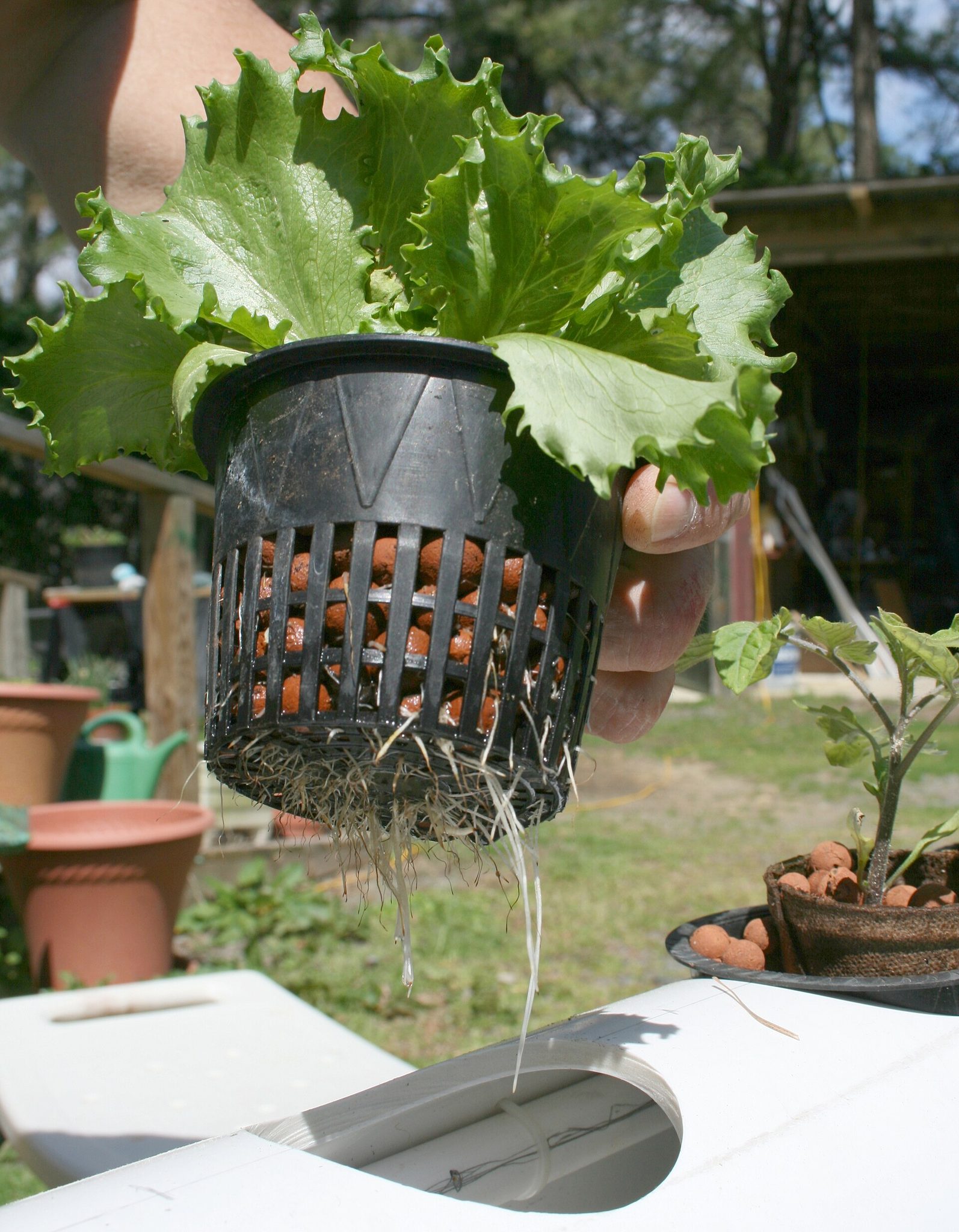
Photo: Ildar Sagdejev ( Specious ) / Wikimedia Commons, CC BY-SA 4.0

When to change the whole solution
After many top-ups and additions, the balance of nutrients in the tank drifts because plants take up some elements faster than others, even if EC still looks right. Common grower practice: change the whole solution in small tanks after about 1–2 weeks, in large well-monitored reservoirs after about 2–3 weeks, or sooner once the total water added roughly equals the tank volume. Change it immediately if the solution turns cloudy, smells, grows a lot of algae or pH swings and will not hold.
Changing the solution properly
- Unplug the pump and drain the old solution.
- Scrub the tank, clean the pump filter and flush the pipes with clean water.
- Mix a new batch with the 4-step process, restart the pump and check the flow in every pipe.
Old solution still contains nutrients: you can use it to water soil-grown plants in the garden, but do not pour large amounts into ponds or canals.
Common mixing mistakes and how to fix them
Young leaves turn yellow even though EC is right
Sign: young leaves yellow while the veins stay green. Common cause: pH too high (above 6.5–7), making iron hard to absorb. Fix: calibrate the meter, measure pH again, bring it down to about 5.8–6.2 and watch for a few days.
Burnt leaf edges, bitter and fibrous greens
Sign: dry brown leaf margins and tough greens. Cause: EC too high, especially on hot days or after forgetting to top up. Fix: add clean water to bring EC back to target, and keep EC lower in the hot season.
White sediment in the tank, clogged pipes
Sign: a white powdery layer on the tank floor and blocked pipe inlets. Cause: pouring A and B into a small amount of water at the same time, or mixing them concentrated in one jug. Fix: change the solution, use two separate measures, and always add A to the water and stir before adding B.
Brown, slimy roots and plants wilting at midday
Sign: roots turn brown and smell, plants wilt in the sun. Cause: warm, oxygen-poor solution, a dirty tank, solution left too long. Fix: shade the tank, increase aeration or flow, change the solution and clean the system (Figure 4).
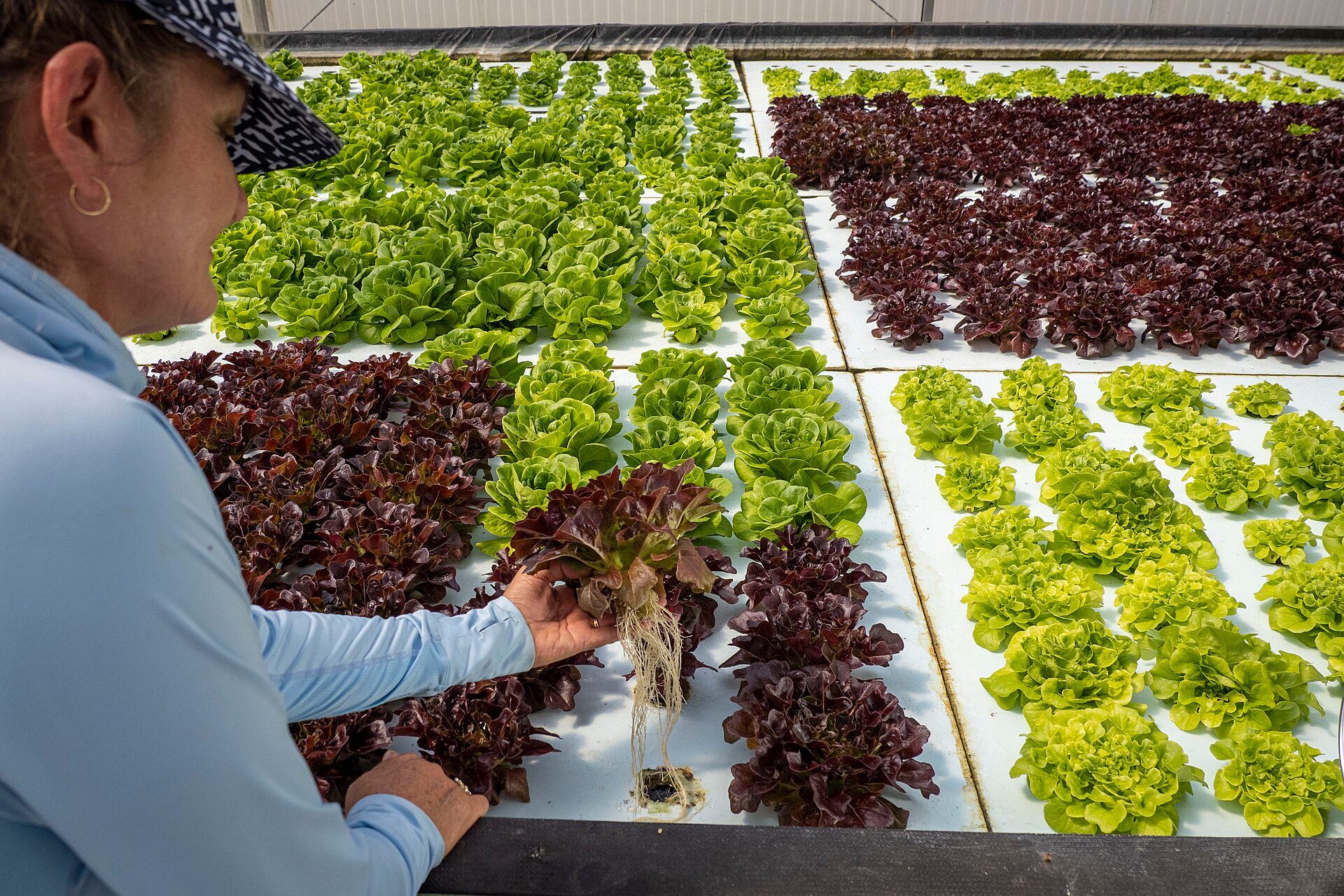
Photo: Preston Keres/USDA/FPAC / Wikimedia Commons, Public domain

Frequently asked questions
What EC and pH do hydroponic leafy greens need?
Most leafy greens use EC of about 1.0–1.8 mS/cm (lettuce lower, about 0.8–1.4) and pH of about 5.5–6.5, ideally 5.8–6.2. Adjust for variety, growth stage and weather.
Do A and B have to be mixed 1:1?
Follow the product label. Most two-part sets use equal amounts of A and B, but some differ. What matters is never mixing A and B while concentrated.
What should I use to adjust pH? Can I use vinegar or lime juice?
Use pH down and pH up made for hydroponics, because they are stable and easy to dose. Vinegar or lime juice may drop pH briefly and then let it swing, and add organic matter that fouls the tank; they are not recommended for production farms.
How often should I change hydroponic solution?
Common practice is about every 1–2 weeks for small tanks and 2–3 weeks for large, well-monitored reservoirs, or when the water added has nearly equalled the tank volume. Change sooner if the solution is cloudy, smells or pH will not hold.
Can I mix by the label without an EC meter?
Mixing by the label works for a small home garden, but you will not know the real EC as the plants drink and the tank concentrates. On a production farm, EC and pH meters are essential tools.
Practice tasks and self-assessment
- Calibrate a pH meter with two buffers and an EC meter with the 1.413 mS/cm standard; record the readings before and after calibration.
- Mix a 20-litre tank using the label of the product you have, targeting EC 1.2 and pH 6.0; keep a batch log like the example.
- Monitor that tank for 7 days: each day record EC, pH, temperature, water level, water added and nutrients added.
Self-assessment criteria
- Pass: after calibration the meters read the standard solutions within the tolerance stated on the meter.
- Pass: the batch is within ±0.1 mS/cm EC and ±0.2 pH of target, and the totals of A, B and acid add up in the log.
- Pass: you always wear gloves and glasses when measuring acid and unplug the pump before putting your hand in the tank.
- Not yet: mixing A and B in one jug, adjusting pH before EC, or not logging readings.
Once you can mix solution confidently, move on to the next step of the roadmap: Greenhouse climate, irrigation & automation, where you learn to manage temperature and humidity and time pumps and aeration so the solution stays cool and well oxygenated.
Keep learning hydroponic growing: after mixing nutrients come greenhouse climate, pest control, running an NFT system for a full cycle and finding buyers. See the 8-step hydroponic and greenhouse grower roadmap.