Calculating calories for weight loss takes three steps: estimate the energy your body uses at rest (BMR) with the Mifflin-St Jeor equation, multiply it by an activity factor to get total daily energy expenditure (TDEE), then eat a moderate amount below TDEE, usually about 300–500 kcal a day, to lose weight gradually. The result is only an estimated starting point, not an exact truth; a nutrition coach adjusts it over a few weeks based on the client's weight, waist and how they feel. This lesson walks through each step with a worked example whose numbers add up, shows how to translate the target into Vietnamese meals, and sets out the limits of the job: people with chronic illness, pregnancy, eating disorders or under 18 need a medical professional, not a formula.
By the end of this lesson, you will be able to:
- Calculate BMR with the Mifflin-St Jeor equation for men and women without sign or unit errors.
- Choose the right activity factor and calculate TDEE for a specific client.
- Set a safe calorie deficit and estimate the weekly rate of weight loss.
- Split a calorie target into protein, fat and carbohydrate and turn it into a Vietnamese meal plan whose totals match.
- Recognise clients who must be referred to a doctor or clinical dietitian.
Learning nutrition coaching properly? Calculating energy needs and goals is step 4 of the roadmap, after scope of practice, nutrients and reading food labels. See the 8-step nutrition coaching roadmap to learn in the right order.
What are calories, BMR and TDEE?
A calorie (strictly a kilocalorie, kcal) measures the energy in food and the energy the body uses. Body weight follows energy balance: take in more than you use and you gain, take in less and you lose. That sounds simple, but both sides can only be estimated, so a coach must understand where every number comes from.
BMR: energy at rest
BMR (basal metabolic rate) is the energy the body needs to stay alive at complete rest: heartbeat, breathing, body temperature, brain and organ function. For most people who are not very active, BMR makes up the largest share of daily energy use.
What is TDEE?
TDEE (total daily energy expenditure) is all the energy used in a day: BMR, movement (walking, work, exercise) and the energy needed to digest food. The most common shortcut is BMR multiplied by an activity factor. TDEE is the intake that maintains weight; to lose weight, eat below TDEE.
Energy from protein, fat and carbohydrate
- Protein: about 4 kcal per gram.
- Carbohydrate: about 4 kcal per gram.
- Fat: about 9 kcal per gram, more than double.
- Alcohol: about 7 kcal per gram of alcohol, often forgotten.
That is why fried food, oily dishes and rich sauces push total calories up quickly even when the portion looks small.
The Mifflin-St Jeor BMR equation
The Mifflin-St Jeor equation was published in 1990 and is now one of the most widely used equations for estimating BMR in adults. It uses weight (kg), height (cm), age (years) and sex.
The equation for men and women
- Men: BMR = 10 × weight (kg) + 6.25 × height (cm) − 5 × age + 5
- Women: BMR = 10 × weight (kg) + 6.25 × height (cm) − 5 × age − 161
Watch the final constant: men add 5, women subtract 161. This is the most common beginner error. Weigh in the morning, after using the toilet, before eating, on the same scale each time (Figure 1).
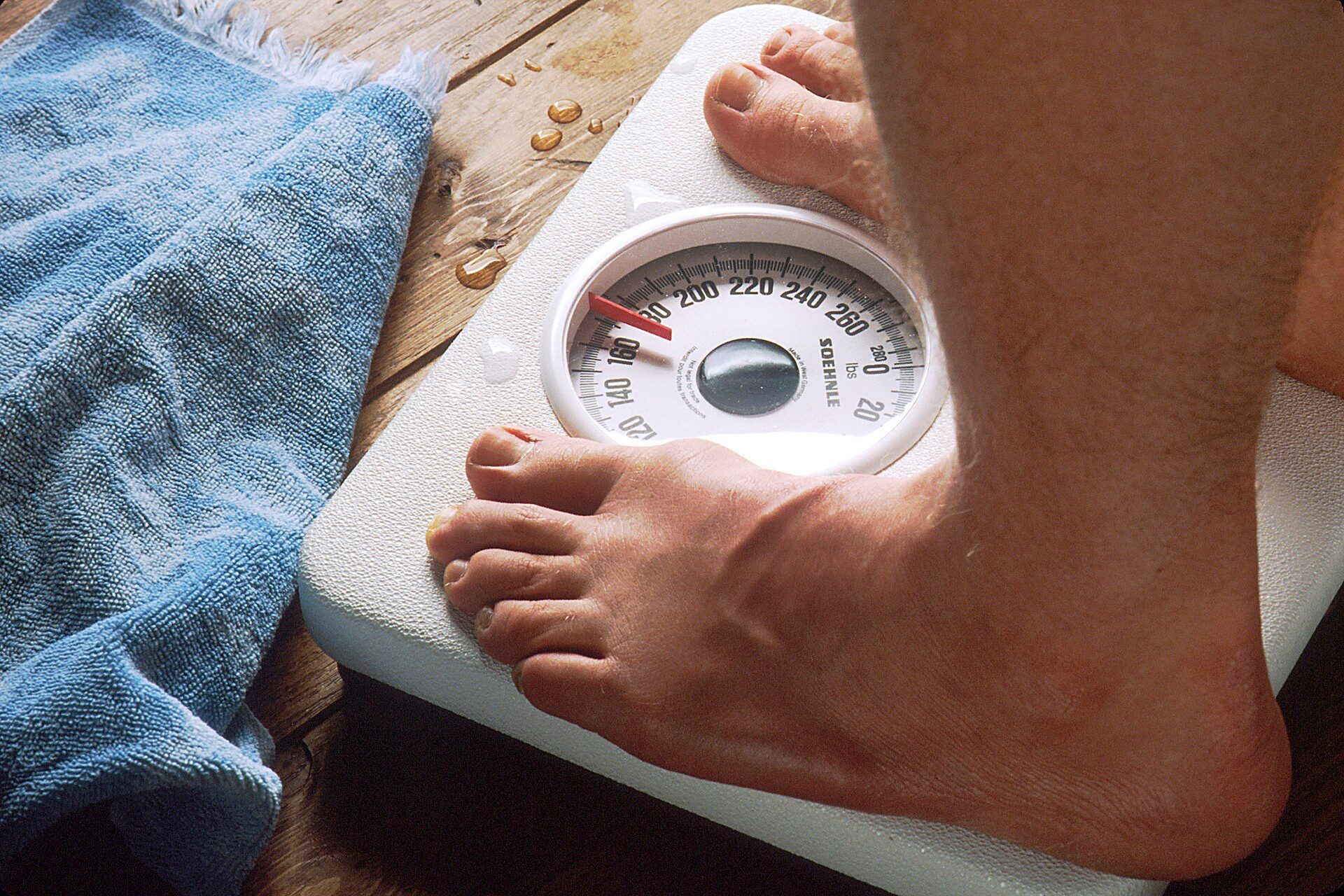
Photo: Bill Branson, National Cancer Institute / Wikimedia Commons, Public domain

Limits of the equation
The equation gives a population average; it does not measure an individual's body. Very muscular people usually have a higher real BMR than calculated; older adults, people with thyroid conditions or on certain medicines can differ substantially. So the result is only a starting point; tracking actual weight for 2–4 weeks shows whether the intake is right.
Activity factors for TDEE
| Activity level | Description | Factor to multiply BMR |
|---|---|---|
| Sedentary | Desk job, almost no exercise | 1.2 |
| Lightly active | Light exercise or walking 1–3 times a week | 1.375 |
| Moderately active | Moderate exercise 3–5 times a week | 1.55 |
| Very active | Hard exercise 6–7 times a week | 1.725 |
| Extra active | Heavy manual work or training twice a day | 1.9 |
Clients tend to rate their activity higher than it really is. When torn between two levels, choose the lower one and adjust based on results.
How big a calorie deficit is safe?
The calorie deficit is the gap between TDEE and intake. A moderate deficit lets fat come off steadily while leaving enough energy for work, exercise and keeping muscle. Too large a deficit usually leads to fatigue, hunger, muscle loss, rebound eating and giving up.
Typical ranges for healthy adults
- A deficit of about 300–500 kcal a day, or about 15–20% of TDEE, is a common starting point.
- A commonly recommended rate of loss is about 0.5–1 kg a week; beginners should aim for the lower end.
- Rough estimate: a deficit of about 7,700 kcal corresponds to 1 kg of fat. In practice, scale weight also swings with water, salt and the menstrual cycle.
- Many nutrition guidelines advise not to go below about 1,200 kcal a day for women and 1,500 kcal a day for men without medical supervision.
Why not cut harder
Eating too little leaves people short of protein and micronutrients, loses muscle as well as fat, and can cause dizziness, hair loss and menstrual problems, and clients quit within weeks. "Lose 5 kg in a week" plans mostly remove water, and the weight comes back fast.
When to adjust intake
Track the weekly average weight and the waist. If the weekly average does not move after 2–3 weeks on target, reduce by about 100–200 kcal a day or add activity. If loss stays faster than 1 kg a week, increase intake.
When not to calculate alone: refer to a medical professional
A nutrition coach only supports healthy adults. Coaches do not diagnose disease, prescribe, recommend weight-loss drugs or supplements in place of medicine, or replace a doctor's advice.
Must be referred to a doctor or clinical dietitian
- People with chronic conditions: diabetes, kidney or liver disease, heart disease, high blood pressure, thyroid disease, gout.
- People on medicines that affect blood sugar or weight, or who need a special diet.
- Women who are pregnant or breastfeeding.
- People with, or suspected of, an eating disorder (prolonged fasting, bingeing then vomiting, extreme fear of weight gain), or a history of one.
- Anyone under 18: energy needs for growth differ from adults; a paediatrician or dietitian is needed.
- Older adults with multiple conditions, and people with a very low or very high BMI.
Signs that need a doctor straight away
Rapid unexplained weight loss, exhaustion, dizziness, fainting, an unusually fast heartbeat, missed periods, thirst with frequent urination: advise the client to see a doctor and pause the weight-loss programme until they have medical advice.
Safety note: Calorie equations are for healthy adults and give estimates only. Do not apply them to people with chronic illness, pregnancy, breastfeeding, eating disorders or under 18 without a doctor or clinical dietitian involved. Never advise fasting, eating below the minimum, weight-loss pills, diuretics or "rapid slimming" products. If a client faints, has chest pain or trouble breathing, call emergency services (115 in Vietnam).
Worked example: calorie target for a client
Client: Ms Hoa, 30, female, 158 cm, 60 kg, office worker, brisk walks 3 times a week. Health form: no chronic illness, not pregnant or breastfeeding, no history of eating disorders. Goal: gradual fat loss without harsh dieting.
Step 1: calculate BMR
- 10 × 60 = 600
- 6.25 × 158 = 987.5
- 5 × 30 = 150
- BMR = 600 + 987.5 − 150 − 161 = 1,276.5 kcal a day
Step 2: calculate TDEE and the target
- Walking 3 times a week: lightly active, factor 1.375.
- TDEE = 1,276.5 × 1.375 ≈ 1,755 kcal a day.
- Deficit of 400 kcal a day: target = 1,755 − 400 = 1,355 kcal a day (still above BMR and above 1,200 kcal).
- Weekly deficit: 400 × 7 = 2,800 kcal, roughly 2,800 ÷ 7,700 ≈ 0.36 kg a week.
Step 3: split protein, fat and carbohydrate
| Nutrient | Grams a day | Conversion | kcal |
|---|---|---|---|
| Protein | 90 g (1.5 g/kg) | 90 × 4 | 360 |
| Fat | 45 g | 45 × 9 | 405 |
| Carbohydrate | 147.5 g | 147.5 × 4 | 590 |
| Total | 1,355 | ||
Check: 360 + 405 + 590 = 1,355 kcal, matching the target. Carbohydrate is the remainder: 1,355 − 360 − 405 = 590 kcal, divided by 4 gives 147.5 g.
Quick comparison: a male client
Mr Nam, 35, 170 cm, 75 kg, gym 4 times a week (factor 1.55). BMR = 750 + 1,062.5 − 175 + 5 = 1,642.5 kcal. TDEE = 1,642.5 × 1.55 ≈ 2,546 kcal. With a 500 kcal deficit the target is about 2,046 kcal a day, a weekly deficit of 3,500 kcal, roughly 0.45 kg a week.
Counting calories in Vietnamese food
Vietnamese dishes are harder to count than packaged food: there is no label, every stall cooks differently, and the amount of oil, fatty broth and noodles varies. Coaches use reference ranges, then teach clients to estimate portions with bowls, spoons and palms.
Reference calories for familiar dishes
| Dish and portion | Estimated energy (kcal) | Notes |
|---|---|---|
| Steamed white rice, 1 medium bowl, about 150 g cooked | 190–200 | A heaped bowl can be half as much again |
| Beef pho, 1 medium bowl | 400–550 | Large bowls, extra fatty broth or fried dough sticks add a lot |
| Banh mi with meat, 1 roll | 400–550 | Depends on butter, pate and meat |
| Bun cha (grilled pork with noodles), 1 serving | 500–700 | Fatty grilled pork, sweetened dipping sauce |
| Com tam (broken rice with pork chop), 1 plate | 600–850 | Scallion oil and sweet fish sauce add more |
| Boiled chicken breast, 100 g | about 165 | Skin removed |
| Boiled egg, 1 | 70–80 | More when fried in oil |
| Bubble milk tea, 1 cup about 500 ml | 300–500 | Mostly sugar and tapioca pearls |
These are reference estimates that vary with recipe and portion. Calorie-counting apps often have large errors for Vietnamese dishes because their data comes from many sources; use them to see trends, not as exact figures.

Photo: Codename5281 / Wikimedia Commons, CC BY-SA 3.0

Estimating portions without a scale
- A medium bowl of rice (Figure 3) is the easiest unit: ask clients to always serve with the same bowl at home.
- Meat and fish: a piece the size of the palm (without fingers) and about one finger joint thick is usually about 80–100 g.
- Oil: 1 tablespoon of cooking oil is about 120 kcal and easily "slips into" stir-fries and fried dishes.
- Boiled greens and vegetable soup: low in calories, ideally about half of each plate.

Photo: Douglas Perkins / Wikimedia Commons, CC0

A one-day menu of about 1,355 kcal for Ms Hoa
| Meal | Food | Estimated kcal |
|---|---|---|
| Breakfast | Small bowl of rare beef pho, fewer noodles, no fatty broth | 400 |
| Lunch | 1 bowl of rice (195) + braised fish 100 g (170) + boiled water spinach (40) + gourd soup (30) | 435 |
| Snack | 1 pot of unsweetened yoghurt (60) + 1 small apple (70) | 130 |
| Dinner | 1 bowl of rice (195) + boiled chicken breast 100 g (165) + boiled greens (30) | 390 |
| Total | 1,355 | |
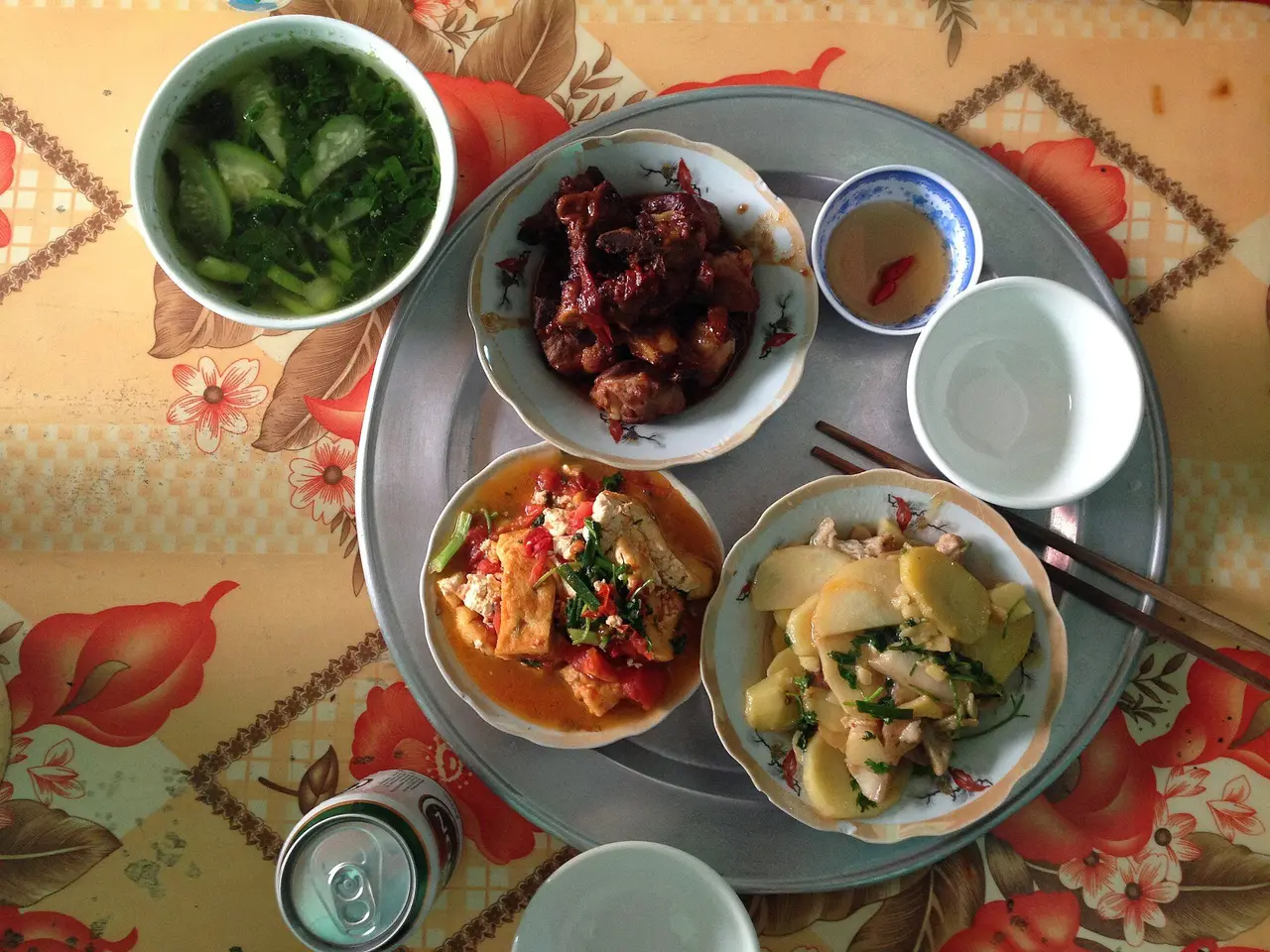
Check: lunch 195 + 170 + 40 + 30 = 435; snack 60 + 70 = 130; dinner 195 + 165 + 30 = 390; whole day 400 + 435 + 130 + 390 = 1,355 kcal. A Vietnamese family meal like Figure 4 still works; it just needs sensible portions of rice, protein dishes and vegetables. Fresh greens from the market (Figure 5) are a cheap, low-calorie source of fibre.
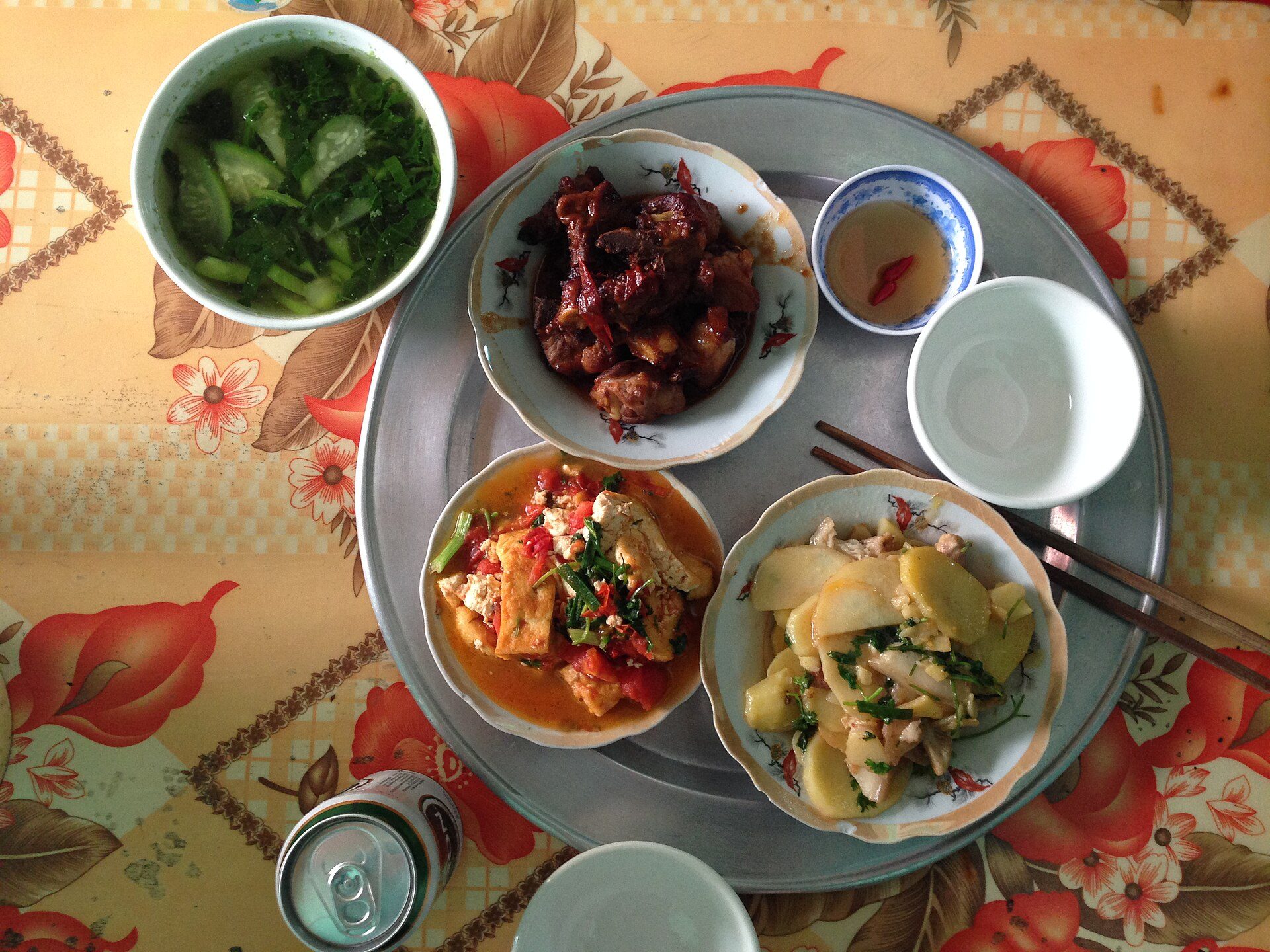
Photo: Hoangkid / Wikimedia Commons, CC BY-SA 4.0


Photo: Takeaway / Wikimedia Commons, CC BY-SA 3.0

Common mistakes when calculating calories for weight loss
Using the wrong equation for men and women
Sign: an unusually high BMR for a female client. Cause: adding 5 instead of subtracting 161. Fix: always write the client's sex at the top of the calculation and recheck the last line.
Choosing too high an activity factor
Sign: no weight change after 3 weeks on target. Cause: counting a 30-minute walk as "very active". Fix: pick the lower level when unsure and adjust to real results.
Forgetting drinks and cooking oil
Sign: a food diary showing "exactly 1,300 kcal" but no change on the scale. Cause: leaving out milk tea, condensed-milk coffee, soft drinks, frying oil and dipping sauces. Fix: log drinks too, ask how food is cooked and add the oil.
Cutting too deep to go faster
Sign: the client wants to eat 800–900 kcal a day. Fix: explain the risks, keep a moderate deficit, and if the client still wants very low intake, advise them to see a doctor.
Frequently asked questions
What is TDEE and how is it different from BMR?
BMR is the energy used at complete rest. TDEE is total energy used across the day, including BMR, activity and digestion, usually calculated as BMR times an activity factor.
Is the Mifflin-St Jeor BMR equation accurate?
It is a widely used estimate for adults, but it still has errors for individuals. Use it as a starting point, then adjust using actual weight over 2–4 weeks.
How big a calorie deficit is safe?
For healthy adults, a common range is about 300–500 kcal a day, losing about 0.5–1 kg a week. People with illness, pregnancy or under 18 need a doctor or clinical dietitian to set targets.
How do I count calories in Vietnamese food when eating out?
Use reference ranges, choose smaller bowls or plates, go easy on fatty broth, scallion oil and fried food, and track the weight trend rather than chasing exact calorie counts.
Do I have to count calories forever?
No. A few weeks of counting teaches clients to judge portions. After that, many people maintain through habits: a fixed rice bowl, half a plate of vegetables, fewer sweet drinks.
Practice and self-assessment
- Calculate BMR, TDEE and a calorie target for yourself and a healthy adult relative, writing out every step.
- Split the target into protein, fat and carbohydrate using the table format above and check the total.
- Build a one-day Vietnamese menu that matches the target within ±50 kcal.
- Write 5 health screening questions that tell you when to refer a client to a doctor.
Self-assessment criteria
- Pass: BMR uses the correct constant by sex (+5 for men, −161 for women), with kg and cm.
- Pass: the target is not below BMR and the deficit is within 300–500 kcal a day.
- Pass: protein, fat and carbohydrate totals and the menu total match the target.
- Not yet: applying the equation to someone under 18, pregnant or with a chronic illness without referring them to a medical professional.
With energy needs calculated, move on to the next step of the roadmap: Budget Vietnamese meal plans, where you turn calorie targets into a 7-day plan built from rice, pho, rice noodles, fish, tofu and vegetables that fits the client's budget.
Keep learning nutrition coaching: after energy calculations come Vietnamese meal planning, habit coaching, progress tracking and coaching real clients. See the 8-step nutrition coaching roadmap.