Infection control when caring for older people rests on four daily habits: washing your hands at the right moments, putting gloves on and taking them off correctly whenever you may touch waste or body fluids, wearing a mask when you or the older person has respiratory symptoms, and handling soiled items and dirty surfaces separately from clean ones. Alongside these come the limits of the job: a carer does not give injections or drips, does not change or stop medicines, and does not diagnose illness; you only help the person take medicines exactly as prescribed and tell the family or health staff when something is wrong. This is the first lesson for newcomers to the trade in Vietnam, based on common guidance from the World Health Organization (WHO), Vietnam's Ministry of Health and bodies such as the CDC (USA) and NHS (UK); it does not replace the advice of the doctor or nurse looking after the person.
By the end of this lesson, you will be able to:
- Wash your hands in 6 steps and remember the moments in a care day when handwashing is mandatory.
- Put on and take off gloves and a mask in the right order so you do not contaminate your own hands.
- Handle soiled pads, bedpans and stained linen, and wipe surfaces from clean to dirty.
- Tell apart what a carer may and may not do with medicines, injections, drips and tubes.
- Work out a month's supply of gloves, masks and disinfectant for a bedbound person, with figures that add up.
Just starting out in elderly care? Hygiene, infection control and role limits are step 1, the foundation for personal care, mobility, nutrition and monitoring vital signs. See the 8-step elderly care roadmap to learn in the right order.
Why older people catch infections easily
With age the immune system responds more slowly, the skin becomes thin and tears easily, and many older people live with conditions such as diabetes, lung disease or heart failure. A cold that a young adult shrugs off can turn into pneumonia in an 80-year-old. People who are bedbound, wear incontinence pads, have a urinary catheter or a pressure sore have even more "entry points" for bacteria.
Common infections in older people cared for at home
- Pneumonia: often after flu, or from food or drink going down the wrong way when eating lying down.
- Urinary tract infections: linked to intimate hygiene, wet pads left too long, drinking too little, catheters.
- Skin and wound infections: dirty skin tears or pressure sores, carers' unwashed hands.
- Infectious diarrhoea: spread by hands after pad changes, or by food left out too long.
Signs of infection in older people are often vague
An older person may not run a high fever, but simply become drowsier, confused, stop eating, seem exhausted, pass urine differently or fall. Your job is not to guess the illness but to notice that the person is "not themselves today", write it down and tell the family or health staff early.
Handwashing: the single most important measure
According to WHO guidance, a proper handwash with soap takes about 40–60 seconds: wet your hands, lather the palms, backs, between the fingers, thumbs, fingertips and under the nails, then rinse and dry with your own towel or a paper towel. Alcohol hand rub (Figure 1) is for when your hands are not visibly dirty; rub for about 20–30 seconds until dry.
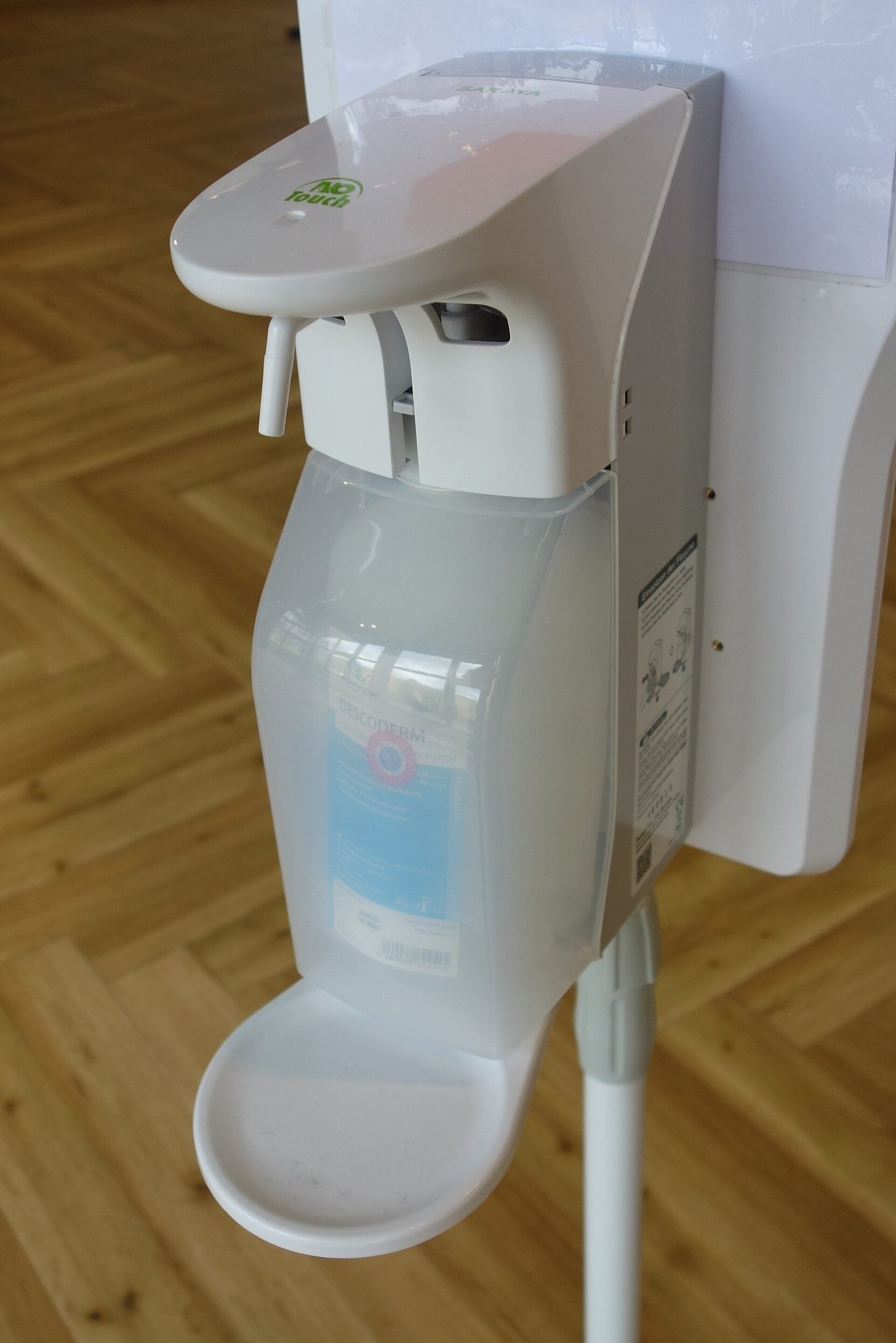
Photo: Enter / Wikimedia Commons, CC BY 4.0
When you must wash your hands
| Moment | Reason | Soap or alcohol rub |
|---|---|---|
| On arrival, before touching the person | Hands carry germs from outside | Soap |
| Before preparing food, feeding or handing out medicines | Hands touch things that go into the mouth | Soap |
| Before caring for skin tears, sores or the mouth | Contact with areas that infect easily | Soap or alcohol rub |
| After changing pads, emptying a bedpan, touching urine, stool, sputum or vomit | Waste carries large numbers of bacteria | Soap is mandatory, even if you wore gloves |
| After taking off gloves | Gloves can tear, and hands get soiled during removal | Soap or alcohol rub |
| After touching the bed, wheelchair or nearby items, and before going home | So you do not carry germs to other people | Soap or alcohol rub |
Nails and work clothes
Keep nails short, with no polish or false nails, and take off rings and your watch while working. Wear a uniform or a dedicated set of clothes and tie your hair back. Use a disposable plastic apron, or a washable one changed daily, for splash-prone tasks such as bathing and pad changes.
Gloves and masks: when to wear them and how to take them off
Gloves protect both you and the person when you may touch blood, urine, stool, sputum, vomit or broken skin. They are not meant to be worn all day: one pair used for several tasks just carries bacteria from dirty areas to clean ones.
When you need gloves
- Changing pads, intimate hygiene, emptying a bedpan, cleaning up waste.
- Mouth care, or gently clearing sputum from the mouth as a nurse has shown you.
- Touching skin tears, sores or dressings.
- Washing or collecting linen soiled with waste; cleaning up vomit or blood.
- When you have a scratch on your hand (cover it with a plaster before gloving).
Putting on and taking off gloves in the right order
- Wash and dry your hands and choose the right glove size; loose gloves slip and tight ones tear (Figure 2).
- Pull the gloves over your wrists; if you wear an apron, put the apron on first and gloves last.
- Remove gloves as soon as a dirty task is finished; never touch your phone, door handles or your face with dirty gloves on.
- To remove: with one gloved hand, pinch the outside of the other glove at the wrist, peel it off inside out and hold it in the gloved palm.
- Slide two bare fingers inside the cuff of the remaining glove, peel it off inside out over the first glove and drop both in the bin bag.
- Wash or rub your hands straight away.

Photo: Nenad Stojkovic / Wikimedia Commons, CC BY 2.0
Masks
Wear a medical mask when you have a cough or runny nose, when the person is coughing, producing sputum or has a fever, when cleaning up vomit, and whenever a doctor or care facility requires it. The mask must cover nose and mouth, with the metal strip pressed to the bridge of your nose; do not pull it down to your chin to talk, and change it when damp or dirty. Remove it by the ear loops without touching the front, put it in a lidded bin and wash your hands.
Handling soiled items, waste and cleaning surfaces
The basic rule: dirty items travel one route and clean items another, and the two never meet. Never shake out dirty towels or sheets in the room; it spreads dust and bacteria into the air.
Soiled pads, bedpans and spittoons
- Adult pads: roll the soiled side inwards, put in a bag, tie it shut and drop it in a pedal bin with a lid; empty the bin at least daily.
- Bedpans and commode pots: empty into the toilet, flush, scrub with a dedicated brush and leave to drain; never wash them in the bathroom basin or kitchen sink.
- Spittoons and sputum cups: empty, wash and soak in disinfectant as the product label instructs.
Linen soiled with waste
Wear gloves, scrape solid waste into the toilet, roll the soiled linen inwards and put it into a separate basin or bag. Wash it separately from other people's clothes, in hot water if the fabric allows, and dry it completely. Change bedding on schedule and immediately when wet or soiled.
Wiping surfaces and mixing disinfectant
Wipe from clean to dirty and from top to bottom: bed head, grab rails, meal table, phone and light switches first; bed frame, commode chair and floor last. Keep separate cloths for the toilet area. With chlorine bleach products (common in Vietnam as "javel" or chloramine), dilute exactly as the label says; many health guidelines use a weaker solution for ordinary surfaces and a stronger one for spills of blood or waste. Mix a fresh batch once a day, keep it covered and write the date on it.
Safety warning: Never mix chlorine bleach with acids (acidic toilet cleaners), ammonia or other cleaners: the mixture gives off toxic gas that can choke and burn the airways. Wear rubber gloves, open windows when using cleaning chemicals, and keep chemicals out of reach of people with memory problems. If you are pricked by the person's needle or razor, let the wound bleed freely, wash it with soap under running water, tell the family and see a doctor immediately for advice.
Role limits: medicines, injections and what belongs to health staff
Families trust their carer and often ask you to "just do" medical tasks as well. Knowing the boundaries keeps the person safe and keeps you from being held responsible for work beyond your training.
What you may and may not do
| Task | The carer may | The carer must not |
|---|---|---|
| Oral medicines | Hand over medicines already sorted by the family or pharmacist according to the prescription, on time, and record it | Add, reduce, swap or stop medicines; buy medicines on someone's recommendation |
| Injections and drips | Watch the drip site and report swelling, redness or a drip that has stopped | Inject, insert a drip needle, change the drip rate, remove the needle |
| Urinary catheters and feeding tubes | Keep tubes unkinked, the urine bag below the bladder, and report problems | Insert, remove or replace tubes |
| Wounds and sores | Keep them clean and dry, reposition the person, report spreading redness, pus or smell | Debride, apply medicines on your own, apply leaves |
| Blood pressure and blood sugar | Measure the way you were shown, record, report readings outside the doctor's limits | Draw conclusions about illness, adjust medicines based on the numbers |
| New symptoms | Note the time, describe them, tell the family, call 115 in an emergency | Diagnose, or suggest "taking something for now" from someone else's medicines |
Helping with prescribed medicines safely
- Check the person's name, medicine, dose and time on the pill organiser against the doctor's prescription (Figure 3).
- Wash your hands, hand over the pills with a glass of water and have the person sit upright to avoid choking.
- Stay until the pills are swallowed; never leave them on the table "for later".
- Never crush or split tablets without asking a pharmacist or doctor: some slow-release medicines must not be crushed.
- Record the time, whether the medicine was taken or refused, and any vomiting. If a dose is refused or missed, tell the family; never give a double dose to catch up.
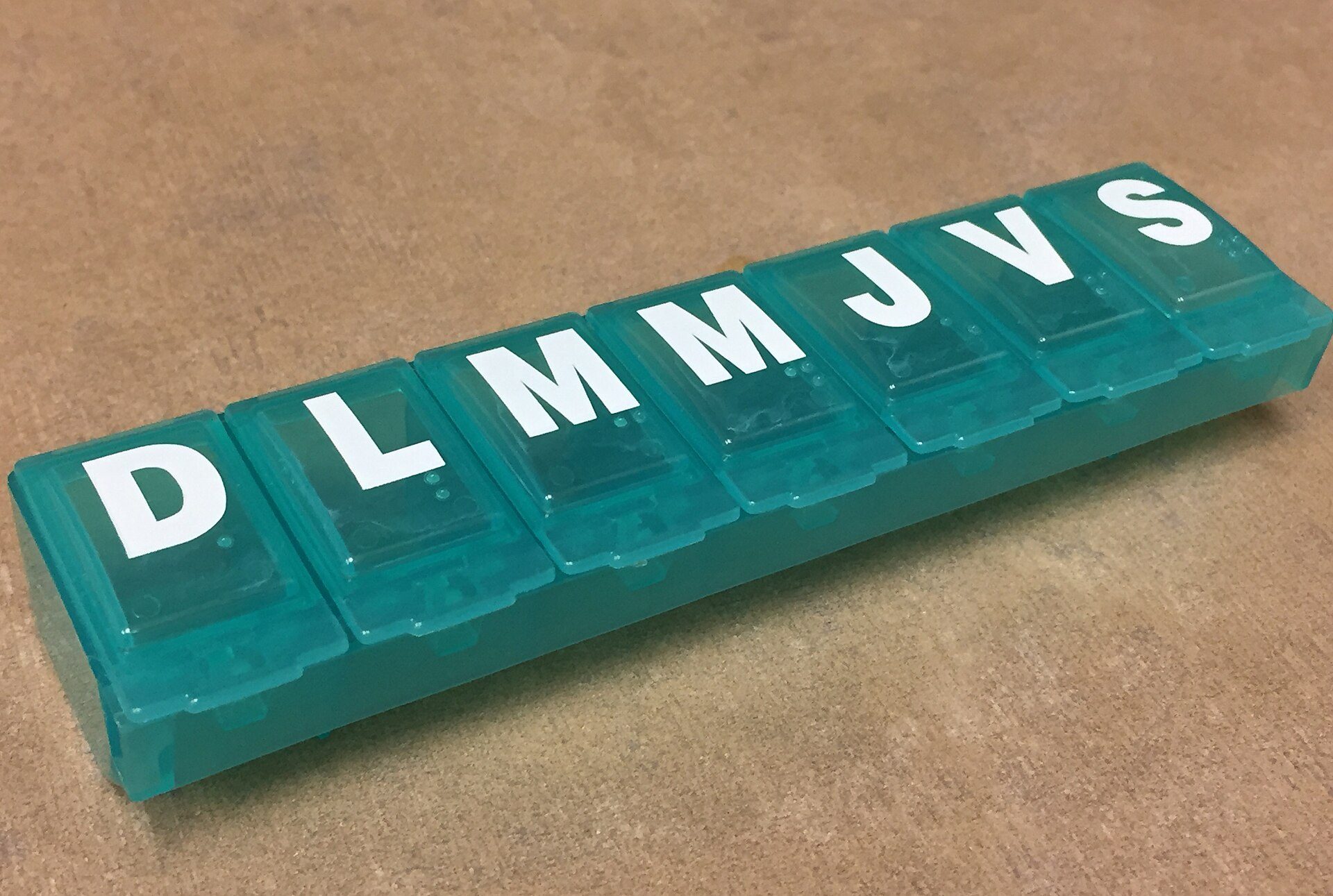
Photo: NIAID / Wikimedia Commons, CC BY 2.0
When to tell the family, and when to call 115
Tell the family the same day if the person has a fever, a worsening cough, cloudy sputum, burning on passing urine, cloudy or smelly urine, diarrhoea, stops eating, is drowsier than usual, or a sore shows spreading redness. Call 115 (Vietnam's emergency number) at once for difficulty breathing, blue lips, chest pain, a drooping face, sudden weakness on one side, sudden difficulty speaking, a seizure, a fall with a head knock, or if the person cannot be woken.
When you are the one who is ill
Before each shift, ask yourself: do I have a fever, cough, sore throat, diarrhoea, vomiting, or an infected cut on my hand? If so, tell the family before your shift so they can arrange cover. With fever, diarrhoea, vomiting, flu or a diagnosed infectious disease you should stay home. With a mild cold and no fever, and only if the family agrees, wear a mask throughout the shift, wash your hands more often and avoid getting close to the person's face.
Vaccinations for carers
Ask a doctor or vaccination centre which vaccines suit people who work closely with older adults, such as the seasonal flu vaccine. Many families and care homes ask about this when hiring.
Worked example: one month of infection-control supplies for an 85-year-old bedbound woman
An 85-year-old woman with diabetes is bedbound after a fracture and wears adult pads. You work the day shift and the family covers nights. In your shift you change pads 5 times, give mouth care twice and empty the bedpan and clean up waste twice. Calculate for 30 days.
Step 1: pairs of gloves
- Per day: 5 pad changes + 2 mouth care + 2 waste clean-ups = 9 pairs.
- Per month: 9 × 30 = 270 pairs.
- A box of 100 gloves = 50 pairs: 270 ÷ 50 = 5.4 boxes, so buy 6 boxes (30 spare pairs for unplanned changes).
Step 2: supplies and cost (2026 reference prices, varying by area and product)
| Item | Quantity × unit price | Amount |
|---|---|---|
| Medical gloves, box of 100 (usually 90,000–150,000 VND) | 6 boxes × 120,000 VND | 720,000 VND |
| Medical masks, box of 50 (usually 40,000–80,000 VND) | 1 box × 60,000 VND | 60,000 VND |
| Alcohol hand rub, 500 ml bottle | 2 bottles × 80,000 VND | 160,000 VND |
| Chlorine bleach, 1 litre bottle | 2 bottles × 30,000 VND | 60,000 VND |
| Bin bags, roll | 3 rolls × 25,000 VND | 75,000 VND |
| Total | 1,075,000 VND | |
Check: 720,000 + 60,000 + 160,000 + 60,000 + 75,000 = 1,075,000 VND a month (about USD 41), or roughly 1,075,000 ÷ 30 ≈ 35,800 VND a day. Masks are counted at 1 a day for an ordinary shift; if you or the person has respiratory symptoms you will need more. Give this list to the family to buy in advance and mark items running low, so you never have to "make do" with one pair of gloves for several tasks.
Common mistakes and how to fix them
One pair of gloves for many tasks
Signs: after a pad change you keep the same gloves on to serve rice, adjust the pillow or use your phone. Consequence: bacteria travel from waste to the person's mouth and shared objects. Fix: one pair per dirty task, take them off at once, wash your hands, then do the clean task.
Washing bedpans or cloth pads in the kitchen sink
Signs: the kitchen and the toilet area share basins and brushes. Fix: set up clean and dirty zones; bedpans and soiled linen are handled only in the bathroom with their own tools.
Giving medicines someone recommended "while you're at it"
Signs: a visitor brings tonics or herbal medicine and you give them straight away. Consequence: drug interactions, low blood sugar, low blood pressure. Fix: only give what is on the prescription; record anything new and tell the family to ask the doctor.
Frequently asked questions
Do I need gloves to bathe an older person at home?
Yes when cleaning the intimate area, broken skin, or anywhere you may touch waste. For the face, arms and legs with intact skin, gloves are not essential, but wash your hands before and after. Change gloves when moving from a dirty area to a clean one.
Can a carer give insulin injections?
As a general rule of the job, injections are for health staff, or for the patient or relatives trained by a doctor. If the family wants your help, a doctor or nurse must train you and assign the task clearly; until then, do not do it yourself.
Can alcohol hand rub replace washing with soap?
Only when your hands are not visibly dirty. After pad changes, emptying a bedpan, cleaning up vomit, or when the person has diarrhoea, you must wash with soap and water.
If a dose is missed, should the person take it later?
Do not decide yourself. Note the time of the missed dose and tell the family to ask the doctor or pharmacist; never give a double dose at the next time.
Practice tasks and self-assessment
- Wash your hands in 6 steps and time yourself to reach 40–60 seconds.
- Put on gloves, smear a little lotion on the outside, take them off in the correct order and check whether any lotion is on your bare hands.
- Sketch the person's home and mark the clean zone, dirty zone, lidded bins and hand rub points.
- Work out a month's supplies for a person with 6 pad changes, 2 mouth care sessions and 1 waste clean-up per shift, using the table above.
Self-assessment criteria
- Pass: no lotion on your bare hands after removing gloves; handwashing lasts long enough and misses no finger gaps.
- Pass: you can name at least 5 things you must not do with medicines, injections, drips or tubes, and 5 signs that mean calling 115.
- Pass: your supplies table adds up and includes a spare margin.
- Not yet: one pair of gloves for many tasks, mixing cleaning chemicals, or giving medicines not on the prescription.
Photo: agilemktg1 / Wikimedia Commons, Public domain
Once hygiene and role limits are second nature, move on to the next roadmap step: Understanding older people and respectful communication, where you learn about the physical and emotional changes of ageing and how to protect the person's dignity. When you reach the hands-on steps, also read fall prevention for older people and preventing pressure sores in bedbound people.
Keep learning elderly care: after hygiene and role limits come respectful communication, personal care, mobility and fall prevention, nutrition and monitoring vital signs. See the 8-step elderly care roadmap.