If an elevator gets stuck, the people inside only need to do three things: stay calm, press the alarm or intercom button to reach building management, and wait for trained people to arrive; never prise the doors open or climb out. Getting people out is the job of a trained elevator technician: isolate the power and lock it out and tag it (LOTO), locate the car, release the brake in a controlled way to bring the car level with a floor, and only then open the doors. Most accidents during trapped-passenger rescues happen because untrained people open a landing door while the car is between floors, not because the elevator falls.
By the end of this lesson, you will be able to:
- Guide trapped passengers over the intercom with five short sentences in the right order.
- Carry out, under an instructor's supervision, the 9-step power-failure rescue procedure including LOTO.
- Work out the load difference between car and counterweight to know whether the car will go up or down when the brake is released.
- Recognise situations where you must not rescue on your own and must call your supervisor, the manufacturer or 114.
- Write a rescue report and read fault codes to find the cause before putting the elevator back into service.
Learning to be an elevator technician properly? Trapped-passenger rescue and fault codes is step 6, after hoistway safety, elevator components, control circuits, landing doors and routine maintenance. See the 8-step elevator technician roadmap to learn in the right order.
Stuck in an elevator: what should you do?
This part is for passengers, and it is also what a technician must be able to say over the phone. A traction elevator car hangs from several steel ropes, has a machine brake, and has safety gear that clamps onto the rails if it overspeeds, so a free fall is extremely rare. The car is not airtight either; you will not run out of air while waiting.
Five things to do
- Breathe slowly and reassure the people with you, especially children and older people.
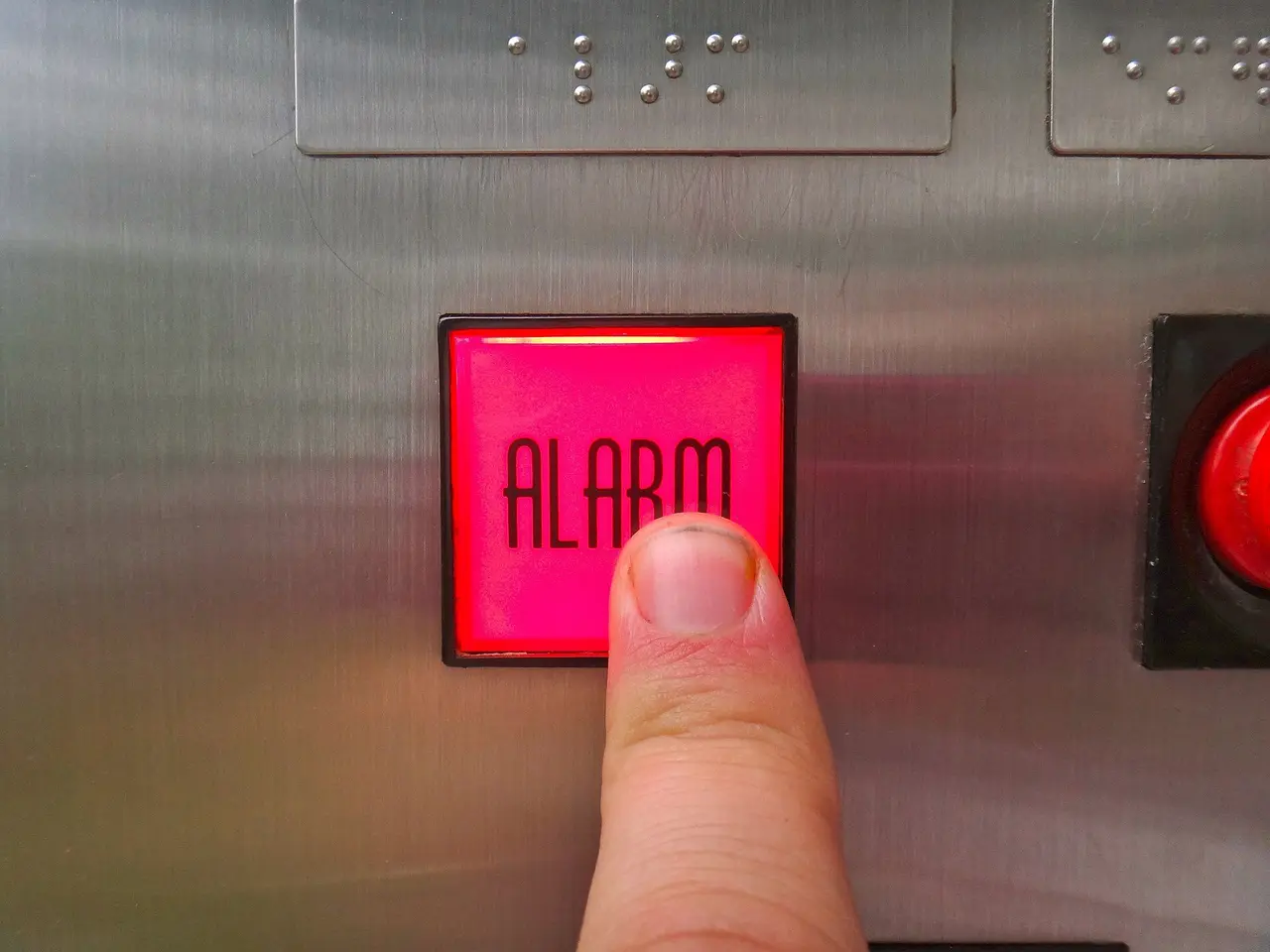
- Press and hold the alarm button (Figure 1) or the intercom button; say which building, which elevator, how many people, and whether anyone feels unwell.
- If your phone has signal, call the hotline posted in the car or building security.
- Press the door-open button once; if the door does not open, stop pressing buttons at random.
- Sit or stand away from the doors and wait for trained help.
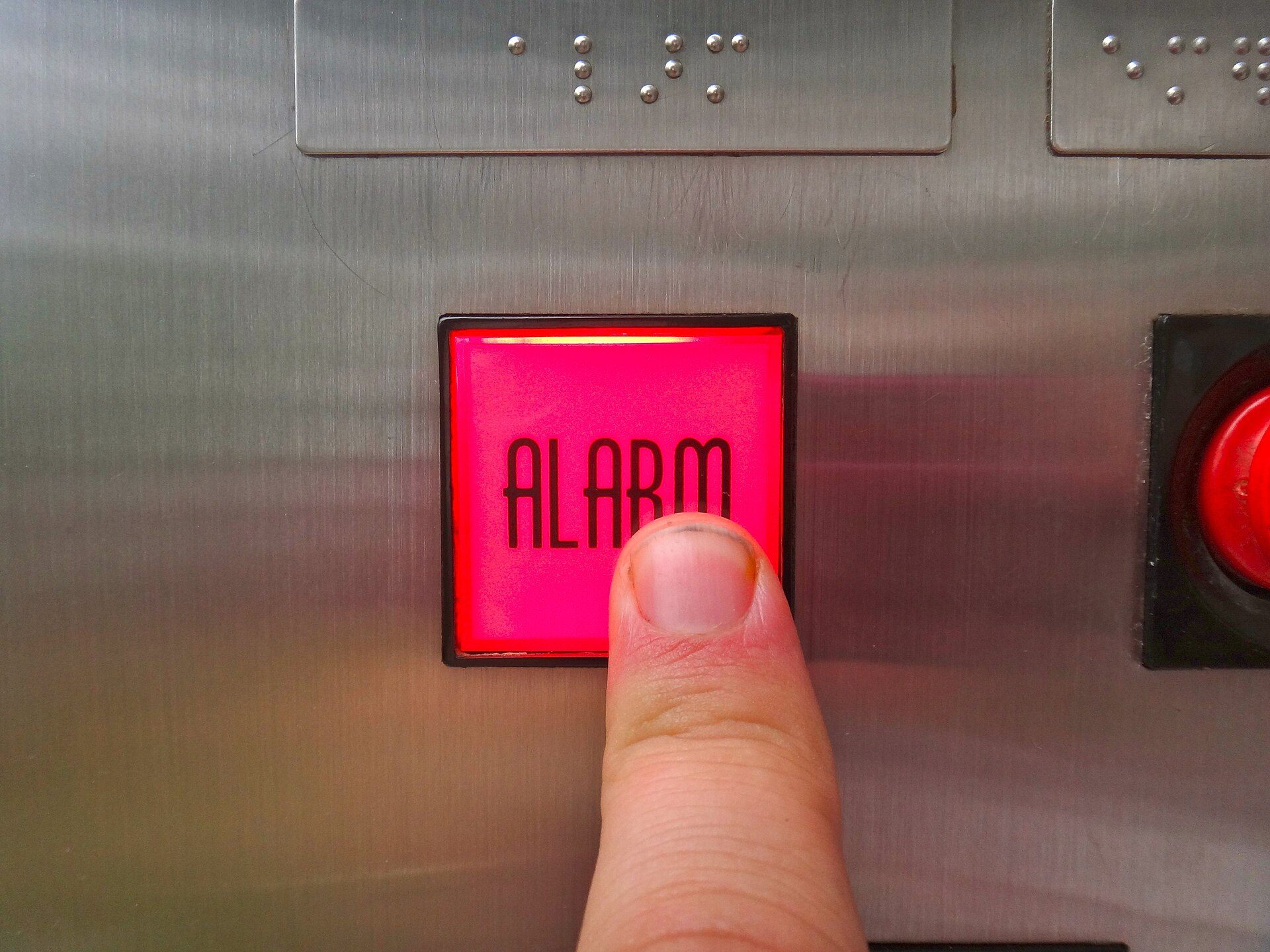
Photo: Dieselducy, Andrew R / Wikimedia Commons, CC BY-SA 3.0
Things you must never do
- Do not use hands, keys or knives to force the car doors: if the car is between floors, behind the door may be the open hoistway.
- Do not climb onto the car roof through the emergency hatch.
- Do not jump or rock the car to "get it going".
- People outside must not open a landing door with a found key or a crowbar.
When to call 114 or 115 straight away
In Vietnam, call 114 (fire and rescue) if you cannot reach building management or the maintenance company, if there is smoke or fire, or if you have waited a long time with nobody coming. Call 115 (ambulance) if someone faints, has chest pain, difficulty breathing or a seizure, or a pregnant woman has abdominal pain. Call for medical help at the same time; do not wait for the rescue to finish.
Why elevators get stuck: common causes
A technician needs the cause because both the rescue method and what you do afterwards depend on it. Most stops are caused by an open safety circuit, not a major failure.
Mains power failure
The most common cause. An elevator with an automatic rescue device (ARD) uses its battery to take the car to the nearest floor and open the doors; if the ARD has failed, its battery is weak or there is none, the car stops where it is and the brake closes to hold it.
Open safety circuit
The series safety chain includes landing door contacts, door locks, the car-top and pit stop switches, the slack rope switch and the overspeed governor. One open contact stops the elevator. The most frequent culprit is a dusty or misaligned landing door lock contact, often after someone kicks the door, or debris jammed in the door track.
Drive, controller or safety gear faults
The drive may report overcurrent, overvoltage or encoder faults; the controller may report a floor-positioning error. More serious is when the safety gear has clamped the rails after an overspeed: the car is mechanically locked and releasing the machine brake will not move it. Fault codes differ between makers, so always use the documentation for the exact brand and controller generation.
Trapped-passenger rescue procedure during a power cut
The procedure below is a general framework for a traction elevator with a machine room. Each maker and model has its own rescue instructions, usually posted in the machine room or rescue panel; always follow those and your company's rules.
Safety warning: Only people trained in elevator rescue and assigned by their company may release the brake and open landing doors. Always work in pairs with radio or phone contact. Isolate the main supply and lock out and tag out (LOTO) before releasing the brake, so that returning power cannot start the elevator. Never force doors, and never open a landing door until the car is level within the door zone given by the maker. Never bridge the safety circuit to run the elevator. Anyone standing at an open landing door needs a barrier and must keep clear of the hoistway edge. If there is fire, smoke, injury or someone has fainted, call 114 and 115 immediately; do not wait.
Nine rescue steps
- Receive the call and reassure: talk to the passengers over the intercom, ask how many people and how they are, tell them when you expect to arrive. Tell them to stand away from the doors and not to open them.
- Assign roles: one person in the machine room (brake operator), one at the landing (observer who opens the door). Building security cordons off the landing.
- Locate the car: check the controller display, the floor-level marks on the hoist ropes in the machine room, or ask the passengers which floor number they can see.
- Isolate and LOTO: switch off the elevator's main supply, lock it and tag it "Rescue in progress, do not switch on". Verify with a meter.
- Check landing doors: all landing doors closed and locked, nobody in the hoistway or on the car roof.
- Warn the passengers: "The car will move slowly and may jolt a little; please stand still."
- Release the brake under control: use the manual brake release lever as the maker instructs, in short bursts, watching the speed and the rope marks; when the car reaches the levelling zone, let the brake close.
- Open the doors and bring people out: the landing observer confirms the car is level, opens the landing door with the proper key, opens the car door and helps each person out, warning them about any small step.
- Secure and record: close the landing door, check it is locked, keep the elevator out of service with a sign, write the report and inform building management.
Machine-room-less (MRL) elevators
The machine sits inside the hoistway, so rescue is done from the controller and rescue panel next to the top landing door. There is usually an electric brake release button powered by the panel's battery, or a cable-operated release lever. The panel shows a light or display when the car is in the levelling zone. Never enter the hoistway to work the brake.
What the brake and machine look like
In a machine-room elevator, the brake sits next to the traction sheave (Figure 2). Without power, springs press the brake shoes onto the drum; the manual release lever pulls them apart while you hold it. Let go and the brake closes again, which is why you release in short bursts.
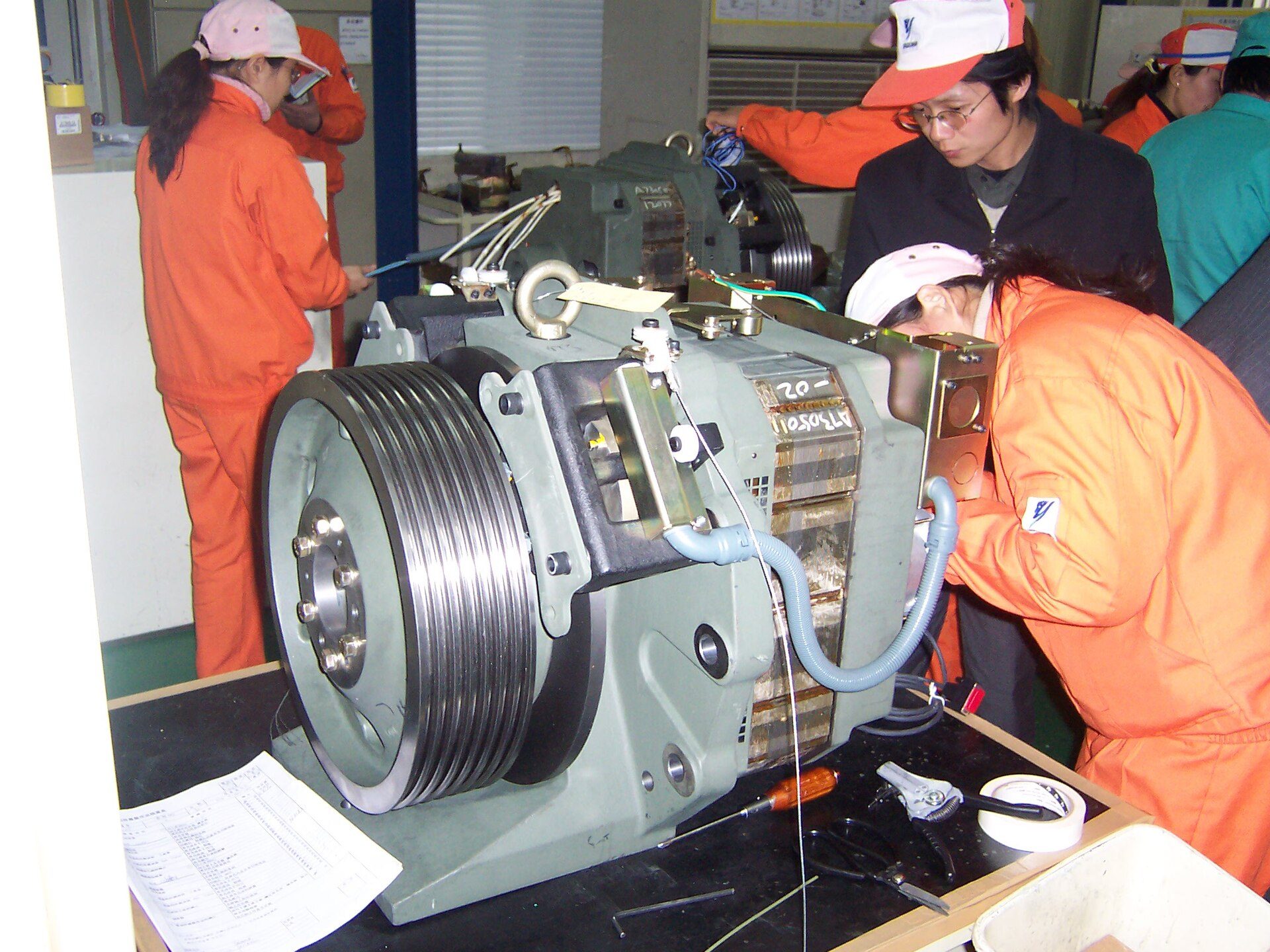
Photo: Krotz / Wikimedia Commons, Public domain
Will the car go up or down when you release the brake?
This is where trainees most often go wrong. The car and the counterweight hang at the two ends of the ropes like two weights over a pulley. Release the brake and the heavier side goes down, the lighter side goes up. You do not choose the direction; you only choose the nearest floor in the direction the elevator moves by itself.
How heavy is the counterweight?
The counterweight usually equals the empty car weight plus about 40–50% of the rated load (the balance factor, found in the elevator's documentation). That way, with the car about half full, both sides are nearly balanced and the motor works lightly.
Load and direction table
| Load in the car vs. balance load | Heavier side | Car when brake released | Notes |
|---|---|---|---|
| Few people, much lighter | Counterweight | Goes up | Usually moves easily; use short bursts so it does not run fast |
| Close to balance load | Nearly balanced | Hardly moves | Use the hand-winding wheel or the maker's method |
| Many people, heavier | Car | Goes down | Watch the rope marks closely; a heavy car speeds up quickly |
| Safety gear has clamped the rails | Not applicable | Does not move | Do not handle alone; call your supervisor or the maker |
Floor-level marks on the ropes
During maintenance, many companies paint marks on the hoist ropes at the point that matches the car being level at each floor, as seen from the machine room. During a rescue, the brake operator watches the mark pass a reference point to know the car has reached the levelling zone. If the marks are faded or missing, rely on the landing observer and the levelling light on the controller, and note it in the report so the team repaints them.
Worked example: rescuing 3 people stuck between floors 7 and 8 in a power cut
A 15-storey apartment block loses mains power at 21:05, and the building generator does not supply elevator no. 2. It is a traction elevator with a machine room and no ARD. Three people are stuck between floors 7 and 8. The maintenance company's on-call team is 2 technicians.
Step 1: work out which way the car will move
- Elevator data: empty car 800 kg, rated load 1,000 kg, balance factor 0.45.
- Counterweight: 800 + 0.45 × 1,000 = 800 + 450 = 1,250 kg.
- Loaded car: 3 people at about 200 kg plus the 800 kg car = 1,000 kg.
- Difference: 1,250 − 1,000 = 250 kg; the counterweight is heavier, so on brake release the car goes up, to floor 8.
Step 2: timeline
| Task | Who | Time |
|---|---|---|
| Security answers the alarm, talks on the intercom, calls the maintenance company, reassures | Security, technician by phone | 3 min |
| On-call team travels to the building | 2 technicians | 22 min |
| Locate car, isolate, LOTO, check landing doors | 2 technicians | 6 min |
| Warn passengers, release the brake in 3 bursts to bring the car up to floor 8 | Machine room operator | 4 min |
| Open landing door at floor 8 and the car door, bring 3 people out | Landing observer | 3 min |
| Check on passengers, close doors, secure the elevator, write the report | Whole team | 7 min |
| Total time from the alarm | 45 min | |
Check: 3 + 22 + 6 + 4 + 3 + 7 = 45 minutes. The hands-on work at the building is only 6 + 4 + 3 = 13 minutes; most of the time is travel. That is why the first minute on the phone matters so much: people who know help is coming will not try to force the doors.
Step 3: after the rescue
Power returns at 22:10. The team does not restart the elevator straight away but checks: stored fault codes, the battery and ARD circuit (if an upgrade is in the contract), a test run in inspection mode from the car roof (Figure 3), and a few empty test trips before handing the elevator back to building management.
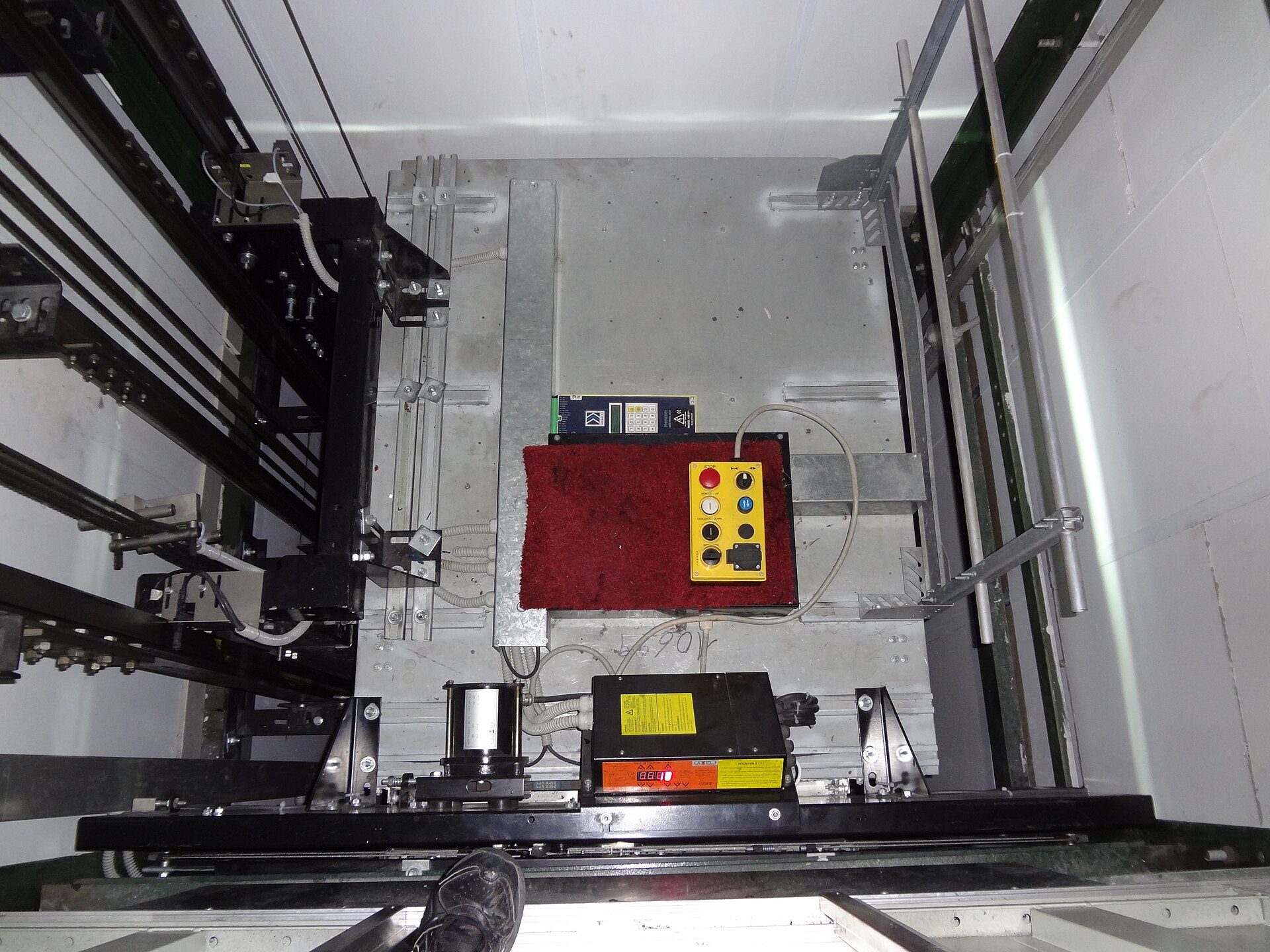
Photo: Harrihealey02 / Wikimedia Commons, CC BY-SA 3.0
When not to rescue on your own and to call for support
A good technician knows when to stop. The cases below are beyond the normal brake-release procedure.
Situations where you must stop
- The safety gear has operated and the car is clamped on the rails.
- Ropes, sheave or brake show signs of mechanical damage: strange noise, burning smell, a rope off its groove.
- The car is far from a floor and cannot be moved safely by releasing the brake.
- There is fire, smoke or water entering the hoistway.
- You have not been trained on this model, or you do not have the maker's rescue instructions.
Who to call
Your team leader or on-call engineer, the elevator maker's technical line, and 114 when lives are at risk or there is a fire. Fire and rescue services have their own procedures and equipment; when they arrive, give them the car position, the power status and the landing door keys.
Never pull people through a gap
When the car is far from floor level, the gap between the car floor and the landing floor is where a person can fall into the hoistway. Do not help people jump down or pull them up through it. Bring the car level first, or wait for the maker's and rescue services' plan.
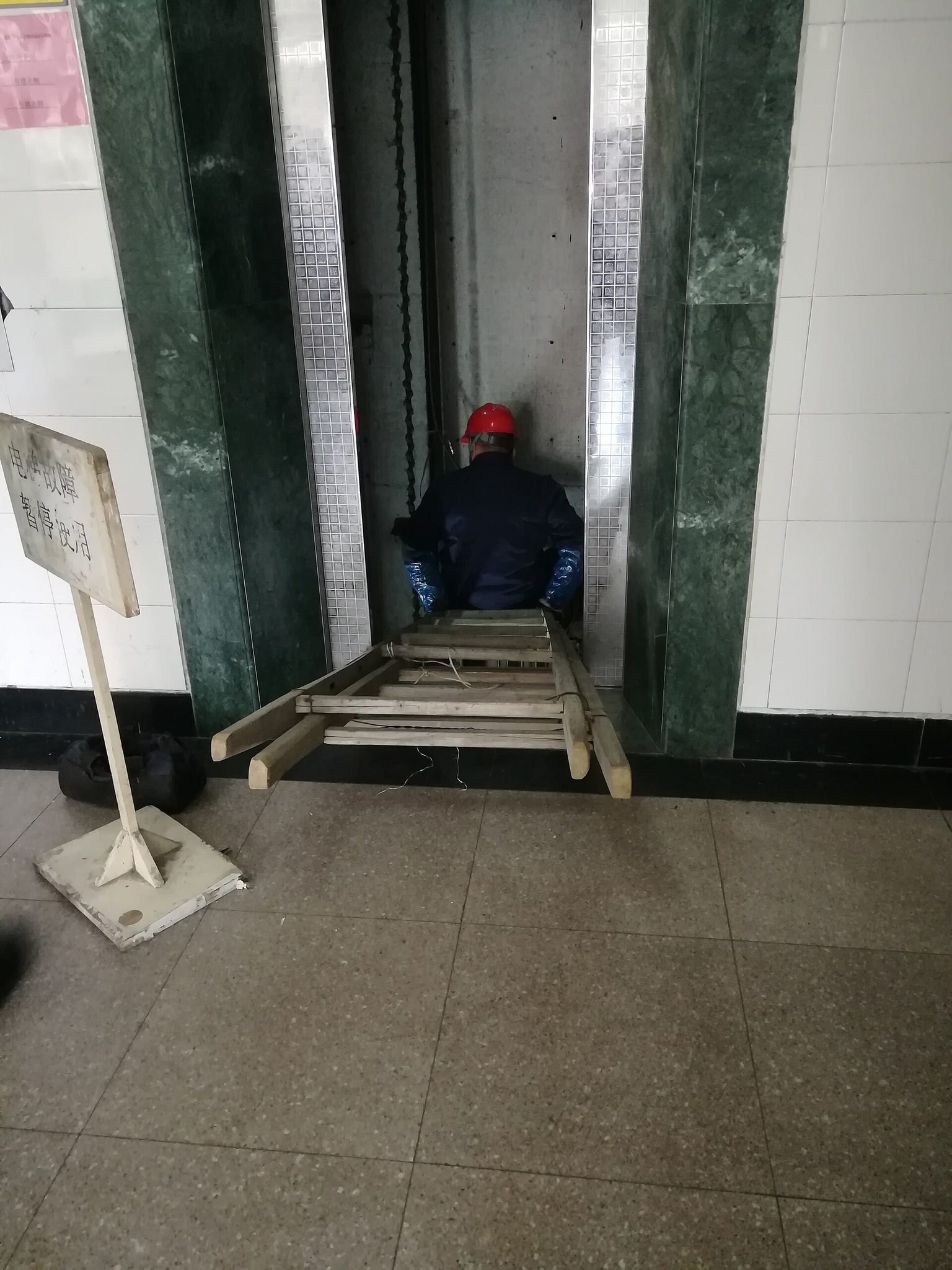
Photo: Leiem / Wikimedia Commons, CC BY-SA 4.0
Rescue reports and fault codes
Every rescue is an incident that must be recorded. The report helps find the root cause and protects you if there is a complaint.
What the report records
- Time of the call, time of arrival, time people were brought out.
- Number of people, their condition, whether 114 or 115 was called.
- Car position, power status, whether there is an ARD and whether it worked.
- Fault codes read from the controller, probable cause, work done.
- Whether the elevator is out of service or back in use, and who approved it.
Reading fault codes properly
Each maker (Mitsubishi, Fuji, Otis, Schindler and others) and each controller generation has its own fault code list. Record the whole fault history, not just the last code: a power-cut stop is often preceded by phase loss or undervoltage codes. Door faults repeating through the week mean the landing door lock contacts need cleaning and adjustment.
Do not restart until the cause is clear
Building management usually wants the elevator running immediately. If you have not found why it stopped, or you suspect the brake, safety gear or ropes, keep it out of service and inform your team leader. A second entrapment on the same day damages trust far more than a few hours of downtime.
Frequently asked questions
What if I am stuck in an elevator and my phone has no signal?
Press and hold the alarm button, use the intercom, knock on the wall and shout so people outside can hear. Stay calm and do not force the doors; there is still air in the car.
How long does a power-cut elevator rescue take?
Hands-on work usually takes only about 10–20 minutes for a trained team. The total time depends mostly on how long the maintenance team takes to arrive and the response time in the building's maintenance contract.
Is releasing the brake for a rescue dangerous?
Yes, if the power has not been isolated, if the brake is held open too long and the car runs fast, or if the person is untrained. That is why only trained and assigned technicians do it, always in pairs and following the maker's instructions.
Can building staff rescue trapped passengers themselves?
Only if they have been trained in rescue for that specific elevator and assigned the task. Untrained security staff should communicate, reassure, call the maintenance company and call 114 or 115 when needed.
If the elevator has an ARD, do we still need a rescue procedure?
Yes. The ARD can fail, its battery can be weak, or the elevator may stop for a reason other than a power cut. Checking the ARD is part of routine maintenance.
Practice exercises and self-assessment
- Write a five-sentence intercom script for trapped passengers and read it aloud to a classmate.
- Under an instructor's supervision, rehearse the 9-step procedure on a training elevator with LOTO and two people.
- Work out the direction for an elevator with a 900 kg empty car, 1,350 kg rated load, balance factor 0.5, and 8 people weighing about 560 kg.
- Write a sample rescue report for the worked example above.
Self-assessment criteria
- Pass: your script covers: we have your call, help is coming, stand away from the doors, do not open them, we will warn you before the car moves.
- Pass: your calculation gives a counterweight of 900 + 675 = 1,575 kg, a loaded car of 1,460 kg, the counterweight heavier by 115 kg, so the car goes up.
- Pass: your rehearsal never skips LOTO and never opens a landing door before the car is level.
- Not yet: you release the brake without isolating power, work alone, or open a door with the car between floors.
Once you can rescue safely, the next step of the roadmap is Join an install crew & hand over a home lift: you will understand an elevator from setting the rails and hanging the counterweight to test runs and preparing the inspection dossier.
Keep learning the elevator technician trade: after rescue and fault codes come installing and handing over a home lift, safety training and trade certificates. See the 8-step elevator technician roadmap.