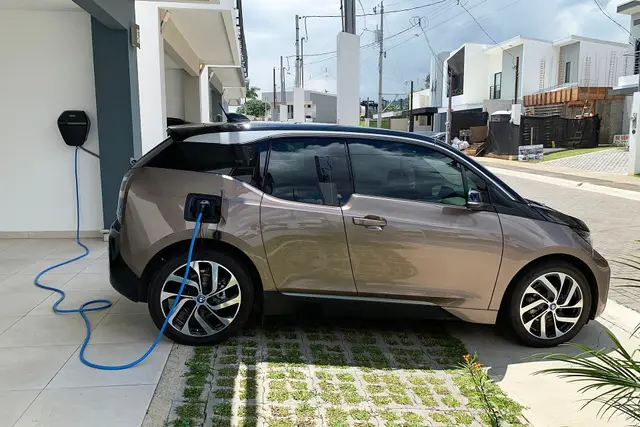
Electric vehicle high-voltage safety is the set of rules that lets a technician work on a car with a 400–800 V DC battery without electric shock or arc burns: only trained people touch the high-voltage system, rated insulated gloves are always worn and checked before use, the work area is fenced off and signed, and the car is isolated exactly as the manufacturer's documentation says: switch off, disconnect the 12 V battery, remove the service plug, wait for the capacitors to discharge and verify there is no voltage before touching any orange cable. These voltages can kill, and unlike 220 V household power, this is direct current from a battery pack that cannot be "switched off at the mains". This is the first lesson a trainee EV technician must read, before opening a single cover.
By the end of this lesson, you will be able to:
- Explain why 400–800 V DC is far more dangerous than 12 V, and recognise high-voltage components by their orange cables and warning labels.
- Choose the right class of insulated gloves, insulated tools and meter, and check gloves before every use.
- Prepare a high-voltage work area: barriers, signs, lock-out and tag-out, rescue hook and a second person.
- Carry out an 8-step isolation procedure and verify zero voltage using the test-measure-test principle.
- Know what to do if someone is electrocuted or a high-voltage battery starts smoking, and know the limits of your role.
Just starting out in EV repair? High-voltage safety and isolation are step 1 of the roadmap, before vehicle architecture, batteries, BMS or motors. See the 8-step EV technician roadmap to learn in the right order.
Why EV high voltage is dangerous
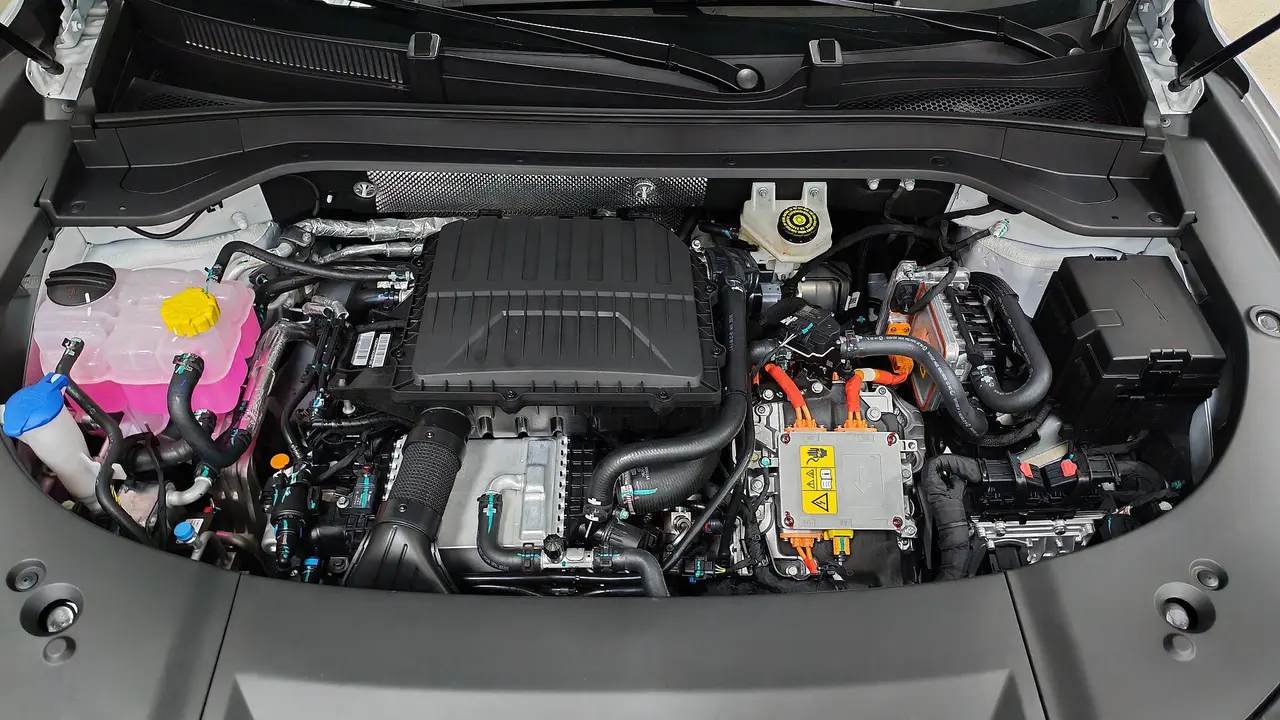
A petrol car only has a 12 V system; touching both battery terminals is barely noticeable. Battery electric vehicles (BEVs) and many hybrids add a high-voltage system: battery, inverter, electric motor, electric A/C compressor, on-board charger and heater, linked by orange cables (Figure 1). Most current EV batteries run at about 400 V, and some models use about 800 V.
A simple calculation
By Ohm's law, the current through a person equals voltage divided by body resistance. Body resistance varies a lot and drops with wet or sweaty hands; take about 1,000 Ω as an example. At 12 V: 12 ÷ 1,000 = 0.012 A, or 12 mA, usually just a tingle. At 400 V: 400 ÷ 1,000 = 0.4 A, or 400 mA, far above the few tens of mA that can already cause heart fibrillation or cardiac arrest. At 800 V the current doubles again.
Direct current and arcs
- No zero crossing: alternating current reverses constantly; direct current flows one way, and hand muscles can lock onto a conductor.
- The battery is always live: even with the car off and the main contactors open, the battery pack still holds full voltage inside. There is no "main switch" that empties it.
- Capacitors hold charge: inverters and converters have large capacitors that keep dangerous voltage for a while after the battery is disconnected.
- Arc flash: a metal tool shorting two high-voltage points can create an arc, causing severe burns and spraying molten metal into the eyes.
What counts as "high voltage" in a car
Widely used international vehicle safety standards treat DC circuits above 60 V as hazardous voltage that needs touch protection. That is why hybrids, with lower pack voltages than full EVs, must still be treated as high-voltage vehicles. The exact thresholds and procedures always follow the repair documentation for the vehicle you are working on.
Who is allowed to work on the high-voltage system
EV service workshops split work into levels: people who only work near EVs (washing, tyres, brake servicing), people authorised to isolate the high-voltage system, and people authorised to repair inside the battery. Each level needs its own training from the manufacturer or the workshop.
What a trainee may do
- Work that does not touch high-voltage components, under the supervision of a certified technician.
- Help prepare the area, check PPE and fill in the isolation sheet.
- Never remove the service plug, disconnect orange cables or open a battery cover yourself, even if you "have watched it done many times".
Certification and regulations
In Vietnam, electrical work requires occupational safety training, and EV makers run their own high-voltage training and authorisation for workshop technicians. Course names, certification levels and validity periods differ by maker and by the regulations in force. Ask your workshop and the manufacturer, and check current occupational safety rules, before taking on high-voltage work; this lesson does not replace formal training.
PPE and tools for high-voltage work
Personal protective equipment (PPE) and insulated tools are the last line of defence. They only work when they are rated for the voltage and in good condition.
| Equipment | Main requirement | Check before use |
|---|---|---|
| Rubber insulating gloves | Class equal to or above system voltage (class 0, up to 1,000 V AC / 1,500 V DC, is common) | Test date, inflate to find holes, look for cracks or hardening |
| Leather protector gloves | Worn over the rubber gloves against cuts and punctures | No tears, no oil, no metal particles |
| Safety glasses or face shield | Splash protection; arc-rated type preferred when measuring or unplugging | No cracks or scratches blocking vision |
| Insulated tools | Marked 1,000 V insulated, insulation continuous to near the working tip | No cracks, chips or exposed metal |
| Voltage meter | CAT III 1,000 V or higher, or as the manufacturer requires, shrouded probes | Proved on a known source before and after measuring |
| Insulating mat, insulated rescue hook | At the work area, within reach | Clean, dry, undamaged |
Checking insulated gloves before every use
- Read the label or stamp: correct voltage class and within the periodic test interval set by the maker and workshop.
- Roll the cuff to trap air and squeeze so the glove inflates; listen and feel for leaks.
- Inspect closely under a light: pinholes, cracks, cuts, bulges, hardening, oil or chemical contamination.
- If there is any defect: tag the glove as faulty and remove it from use; never "make do".
- Store gloves in their own bag, out of sunlight, without folds, away from oil and sharp objects.
How insulated tools differ from ordinary tools
Insulated tools have plastic insulation running from the handle to near the working tip, leaving only minimal metal exposed (Figure 2). An ordinary screwdriver has a plastic handle but a fully exposed steel shaft, which shorts the moment it touches two high-voltage points. Never wrap tape around an ordinary tool to "turn it into" an insulated one.

Photo: Dmitry G / Wikimedia Commons, CC BY-SA 3.0
Meters: not a cheap general-purpose one
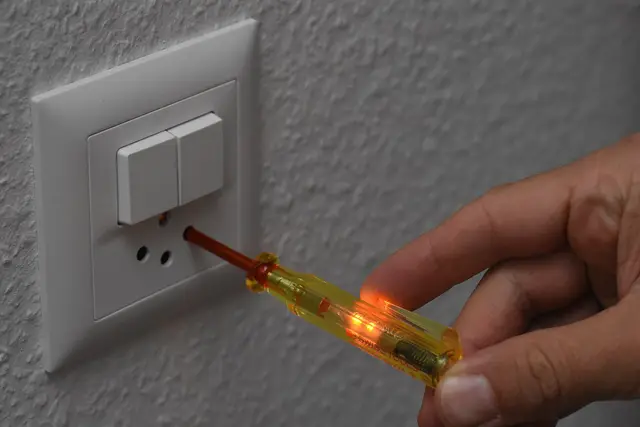
A cheap general-purpose multimeter (Figure 3) is useful for learning to measure 12 V, but not for verifying high voltage. In an arc or voltage spike, an under-rated meter can explode in your hand. Use a meter with the right category rating, shrouded probes and undamaged leads, and always prove the meter on a known source before and after measuring.
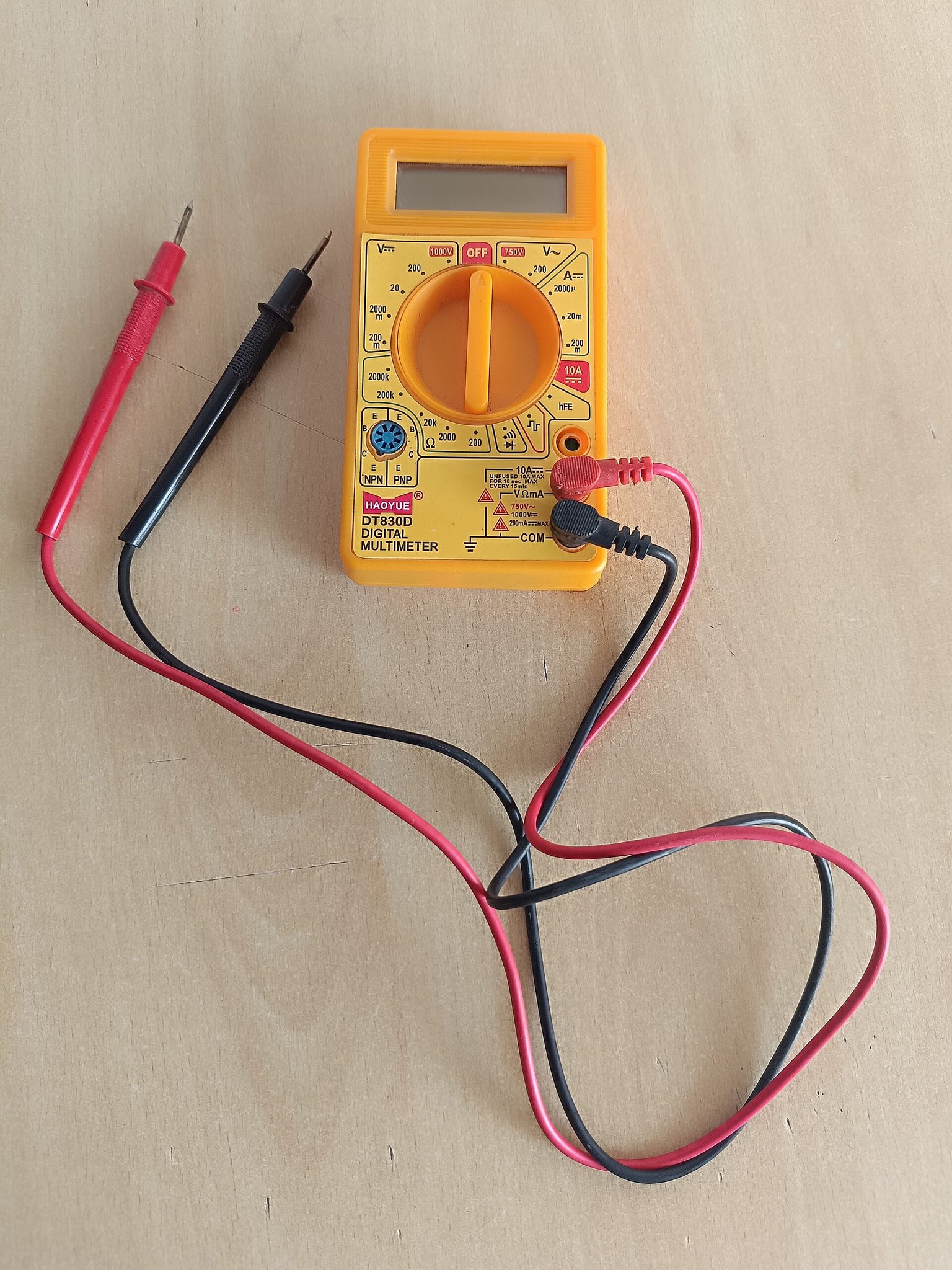
Photo: K.Venkataramana / Wikimedia Commons, CC0
Preparing the high-voltage work area
Before isolation, the area around the car must be marked so nobody touches the car by accident or re-energises it.
Barriers and signs
- A barrier around the car, at least an arm's length from the body, with a single entry point.
- A high-voltage warning sign (Figure 4) and a "Vehicle isolated for high-voltage work, do not touch" sign with the responsible person's name.
- A dry floor with no water or oil, and an insulating mat where the technician stands.
- The insulated rescue hook and a fire extinguisher outside the barrier, within reach.
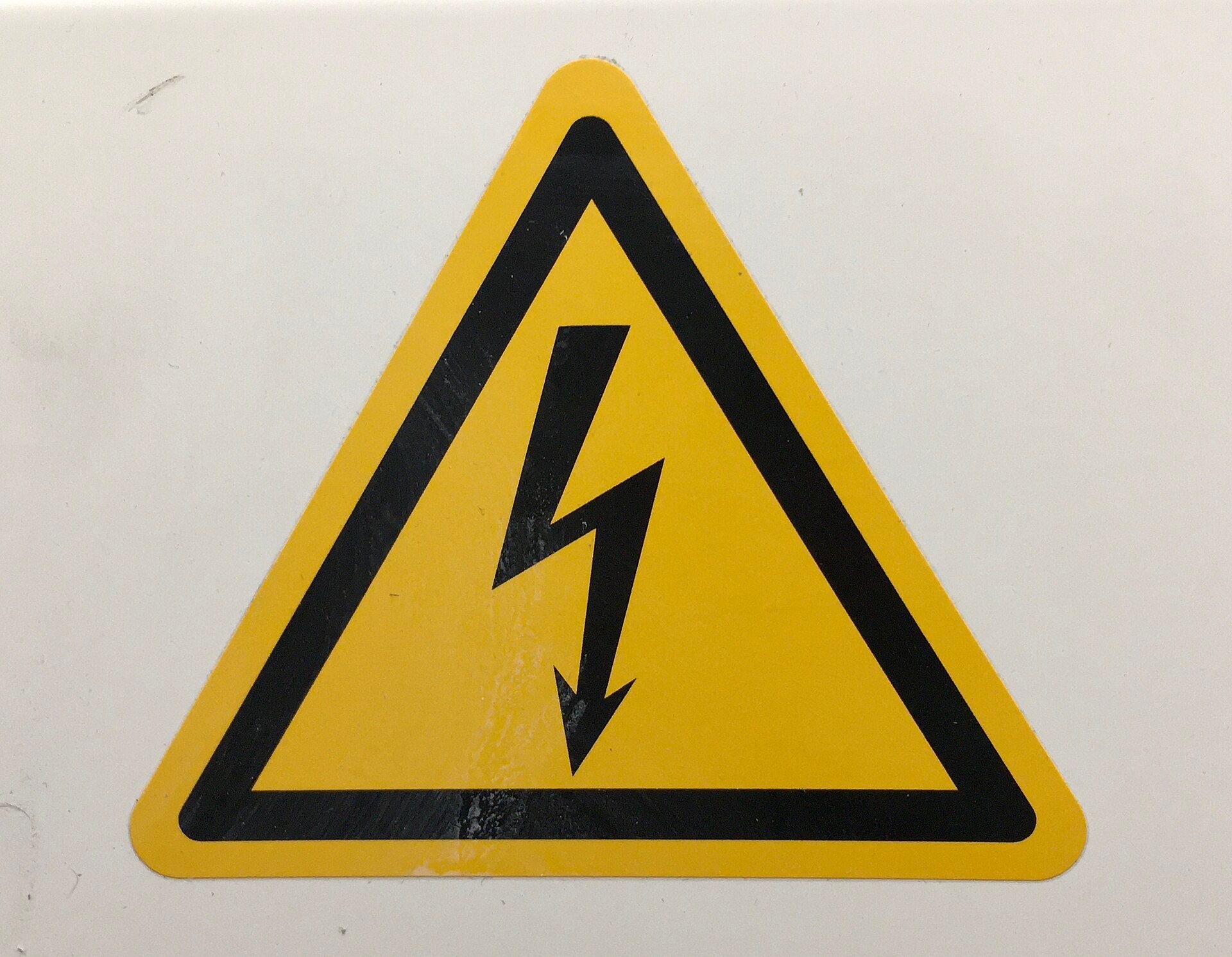
Photo: Pittigrilli / Wikimedia Commons, CC BY 4.0
Lock-out, tag-out and a second person
Once removed, the service plug goes into a locked box or pouch, with the key kept by the person doing the work and a tag showing name and time. The car key (card or smart key) is stored as far from the car as the maker requires. During high-voltage work, a second person trained in rescue should stand outside the barrier.
The 8-step isolation procedure and verifying zero voltage
The order below is a general framework to help you understand the logic. Every maker and model has its own service plug location, waiting time, measuring points and voltage threshold. Always open the correct repair documentation for the car before starting, and follow it wherever it differs.
Isolation steps
- Read the maker's documentation: service plug and HV fuse location, capacitor discharge time, measuring points, safe threshold.
- Inspect the car: battery damage, coolant leaks, odd smells, flood history. If anything looks wrong, stop and report to the person in charge.
- Switch off and unplug: put the car fully off, remove the charging cable, store the key away from the car.
- Disconnect the 12 V battery as the maker instructs (usually the negative terminal), so the high-voltage main contactors cannot close again.
- Put on checked PPE, remove the service plug (or HV fuse or maintenance disconnect) per the documentation, and lock it away.
- Wait for capacitor discharge for the time the maker specifies, usually a few minutes up to about 10 minutes; never shorten it.
- Verify zero voltage using test-measure-test, described below.
- Complete the isolation sheet and hang the tag: time, technician, readings, signature. Only then disconnect the high-voltage connectors that need work.
The test-measure-test principle
- Test: prove the meter on a known voltage source (a 12 V battery or a dedicated proving unit) to be sure it reads correctly.
- Measure: at the points the maker specifies, measure HV positive to HV negative, HV positive to chassis, and HV negative to chassis. All three must be below the safe threshold in the maker's documentation.
- Test again: prove the meter on the known source again. If it no longer reads correctly, the "0 V" you just measured cannot be trusted; measure again with another meter.
Re-energising after the repair
Reverse the process under control: check every high-voltage connector is fully seated and covers are refitted, no tools are left in the compartment; remove the tag, refit the service plug, reconnect 12 V, switch on and read fault codes with a diagnostic tool. Only the person who isolated the car (or someone it was formally handed over to, with a signature) may re-energise it.
Safety warning: 400–800 V DC can kill instantly. Do not touch orange cables, connectors or components with high-voltage labels until the car is isolated and verified. Do not wear rings, watches or metal chains while working. If someone is being electrocuted: do not touch them with bare hands; cut the power if you can do so safely or pull them clear with an insulated rescue hook, call an ambulance (115 in Vietnam) and give first aid if trained. If a high-voltage battery smokes, hisses, gives off a sweet acrid smell or gets unusually hot: stop work, evacuate the area, call the fire service (114 in Vietnam) and notify the maker; never open the battery to put it out yourself.
Worked example: isolation time and the cost of a high-voltage PPE kit
A small service workshop is getting ready to take EVs and has one high-voltage bay. You are asked to cost a minimum PPE and tool kit, and to work out isolation time so labour can be quoted to customers.
Time for one isolation (assuming the maker requires a 10-minute discharge wait)
| Task | Time |
|---|---|
| Barrier, signs, mat, rescue hook | 5 minutes |
| Check gloves, eye protection, meter | 5 minutes |
| Switch off, unplug charger, disconnect 12 V | 5 minutes |
| Remove service plug, lock it away | 5 minutes |
| Capacitor discharge wait | 10 minutes |
| Test-measure-test, fill in sheet | 10 minutes |
| Hang tag, hand over to the repairer | 5 minutes |
| Total | 45 minutes |
Check: 5 + 5 + 5 + 5 + 10 + 10 + 5 = 45 minutes. Re-energising and checking for faults usually adds about 15–20 minutes, so a job that needs isolation cannot be priced like the same job on a petrol car.
PPE and tool budget (2026 reference prices in Vietnam, varying by brand and supplier)
| Item | Quantity × unit price | Cost |
|---|---|---|
| Class 0 insulating gloves | 1 pair × 1,500,000 VND | 1,500,000 VND |
| Leather protector gloves | 1 pair × 300,000 VND | 300,000 VND |
| Arc-rated face shield | 1 × 800,000 VND | 800,000 VND |
| 1,000 V insulated tool set | 1 set × 4,500,000 VND | 4,500,000 VND |
| CAT III 1,000 V meter | 1 × 3,500,000 VND | 3,500,000 VND |
| Insulating mat | 1 × 1,200,000 VND | 1,200,000 VND |
| Insulated rescue hook | 1 × 1,500,000 VND | 1,500,000 VND |
| Barriers and signs | 1 set × 600,000 VND | 600,000 VND |
| Lock box, padlock, isolation tags | 1 set × 400,000 VND | 400,000 VND |
| Total | 14,300,000 VND | |
Check: 1,500,000 + 300,000 + 800,000 + 4,500,000 + 3,500,000 + 1,200,000 + 1,500,000 + 600,000 + 400,000 = 14,300,000 VND (about 550 USD). Insulating gloves must be retested and replaced on a schedule, so budget for that every year.
Common mistakes when working near high voltage
"The car is off, so there's no power"
Sign: unplugging an orange connector right after switching off. Cause: thinking like a petrol-car mechanic. Fix: the battery is always live and capacitors hold charge; treat the system as safe only after isolation and verification.
Skipping the glove check
Sign: gloves go straight from the box onto the hands. Cause: rushing, assuming new gloves are fine. Fix: inflate and inspect every time, even new gloves, and record the test date.
Measuring with an under-rated meter and no proving
Sign: the display shows 0 V but the meter has a blown fuse or is on the wrong range. Cause: skipping the known-source check. Fix: always test-measure-test with a properly rated meter.
Leaving the service plug on the roof
Sign: someone else picks it up and refits it while you are working. Cause: no lock box, no tag. Fix: the service plug always goes into a locked box, with the key kept by the person doing the work.
Frequently asked questions
What voltage does an electric car use?
Most current battery electric cars use packs of about 400 V, some about 800 V; hybrids have lower-voltage packs but still in the hazardous range. Every car also has a 12 V system for lights, screens and controls. The exact figure is in each vehicle's technical documentation.
Can you get a shock washing an EV or driving in the rain?
EVs are designed to be watertight and monitor their insulation, so washing and driving in rain are as normal as with a petrol car. The real danger is when the high-voltage system is opened for repair, or after deep flooding or a crash damages the battery; then a qualified technician must inspect it.
How long do insulating gloves last?
Gloves must be visually checked and inflated before every use, and retested periodically on the schedule set by the maker and workshop. Damaged gloves or gloves past their test date are replaced, never used "just this once".
Can a petrol-car mechanic teach themselves EV repair?
Automotive basics help a lot, but the high-voltage part must be learned through formal training from a manufacturer or recognised provider, with hands-on practice and assessment. Reading articles and watching videos cannot replace that.
Practice tasks and self-assessment
- On an EV or hybrid (observe only, do not touch), point out the components with orange cables and high-voltage labels, and write down their names.
- Check a pair of insulating gloves with the 5 steps and record the result of each.
- Read the repair documentation for one model, write out its isolation procedure and note where it differs from the 8-step framework.
- Practise test-measure-test on a 12 V battery with a properly rated meter, and record all three readings.
Self-assessment criteria
- Pass: you can list the 8 steps in the right order and explain why the discharge wait matters.
- Pass: you find a faulty glove by inflating and inspecting it, without skipping any step.
- Pass: you can explain what to do if someone is electrocuted and if a battery smokes.
- Not yet: you touch an orange cable before isolation, measure without proving the meter, or leave the service plug outside the lock box.
Once high-voltage safety is second nature, move on to the next roadmap step: BEV, HEV and PHEV architecture, where you learn how battery, inverter, motor and charger connect in each type of vehicle. If you are curious about home charging early on, see Installing a home EV charger: 7 kW wallbox, cable, RCD and costs.
Keep learning EV repair: after high-voltage safety come vehicle architecture, batteries and BMS, motors and inverters, AC and DC charging, 12 V and thermal systems, software diagnostics and a workshop placement. See the 8-step EV technician roadmap.