Safe solar installation rests on three rules: treat panels as always live, because they generate electricity whenever there is light; never unplug a DC connector while the string is carrying current, because DC arcs are very hard to extinguish; and never step onto a roof until your harness is clipped to a solid anchor or there is a temporary guardrail at the roof edge. A finished system must also have its frames and rails earthed and surge protection devices (SPDs) on both the DC and AC sides; without them, a nearby lightning strike can be enough to burn out the inverter. Read this lesson carefully before you touch your first panel.
By the end of this lesson, you will be able to:
- Explain why the DC from a solar array is more dangerous than it looks and work out the open-circuit voltage of a string.
- Follow a safe isolation sequence: switch off the inverter, open the isolators, confirm zero current, and only then unplug MC4 connectors.
- Prepare and check fall protection: full-body harness, lifeline, anchor points, temporary guardrails and ladders.
- Identify the earthing and lightning protection parts of a rooftop system and check whether an SPD is still working.
- Use a 10-point checklist before going on the roof to decide whether to carry on or stop work.
Just starting out as a solar installer? DC safety, roof work and lightning protection are step 1 of the 8-step roadmap, before system principles and roof surveys. See the solar PV installer roadmap to know what comes after this lesson.
Why is DC from solar panels dangerous?
Beginners often think a panel is only a few tens of volts, so there is nothing to fear. It is true that a 550 Wp panel has an open-circuit voltage (Voc) of about 49-50 V. But panels are wired in series into strings and the voltages add up: a 10-panel string is already close to 500 V DC, and factory systems run strings of 1,000-1,500 V DC.
A panel has no off switch
A socket at home goes dead when you switch off the breaker. A panel is different: as long as there is light, the cells produce voltage, even on a cloudy day, at dawn or under site floodlights. The open-circuit voltage reaches almost its full value even in weak sunlight; only the current falls with light intensity. Opening the DC isolator or switching off the inverter only stops current flowing to the cabinet; the cable from the array to the isolator still carries full voltage.
DC arcs are harder to quench than AC
50 Hz alternating current changes direction and passes through 0 V a hundred times a second, so the spark when you pull a plug usually dies by itself. Direct current never passes through 0 V: if you pull a connector while the string is carrying current, the spark (an arc) can keep burning and stretch between the contacts at very high temperature, melting the connector and burning hands and eyes. That is why DC isolators have dedicated arc chutes (Figure 1) and why ordinary AC breakers must not be used on DC circuits.
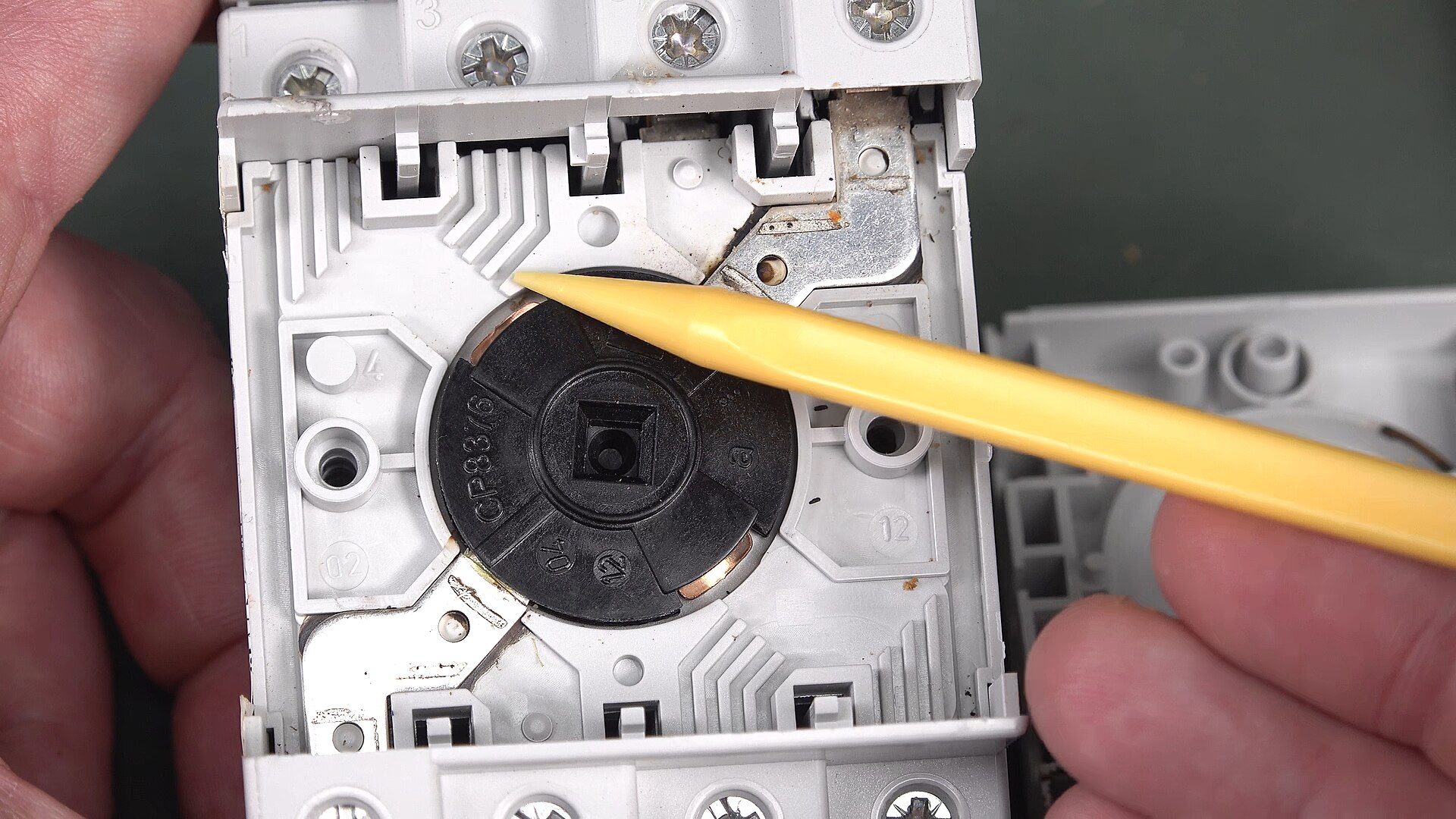
Photo: Binarysequence / Wikimedia Commons, CC0
The danger threshold
Under IEC electrical safety standards, smooth DC above about 120 V is beyond the extra-low voltage band. Home strings are almost always far above this. A string's short-circuit current (Isc) is only about 13-18 A, but that is enough to kill and to sustain an arc. A cable with damaged insulation touching an aluminium frame can also make the whole frame live.
The main hazards of rooftop solar installation
The table sums up the hazards to keep in mind when you plan a job; the following sections go through each group.
| Hazard | Typical situation | Consequence | Main control |
|---|---|---|---|
| Falling from the roof edge | Stepping back while carrying a panel, no guardrail at the edge | Serious injury, death | Temporary guardrail or harness clipped to a lifeline |
| Falling through the roof | Stepping on skylights, fibre cement sheets, thin metal between purlins | Fall through the roof | Walk only on the purlin screw lines, use boards, cover skylights |
| DC electric shock | Touching string cable ends, damaged cable touching the frame | Shock, reflex fall | Treat the array as live, insulated gloves, measure before touching |
| DC arc | Unplugging MC4 connectors while the string carries current | Burns, melted connectors, eye injury | Isolate in the right order, confirm zero current before unplugging |
| Lightning, overvoltage | Working in a thunderstorm, no earthing or SPDs | Shock, burnt inverter | Stop work at thunder, earth the frames, fit SPDs on both sides |
| Heat, sunstroke | Metal roof at midday | Dizziness, loss of balance | Start early, rest in shade, drink water, heat-resistant gloves |
The first two hazards have nothing to do with electricity but often cause the worst accidents. An electric shock on a roof is doubly dangerous because the reflex jerk can throw you off balance.
Working on metal roofs: harness, temporary guardrails, ladders
Most rooftop systems in Vietnam go on corrugated metal roofs: pitched, slippery with dew, scorching in strong sun, and often with translucent skylight sheets between the metal sheets.
Collective protection first, personal equipment second
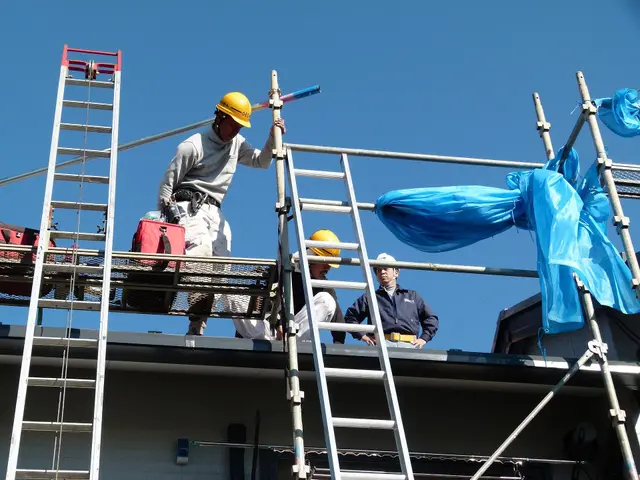
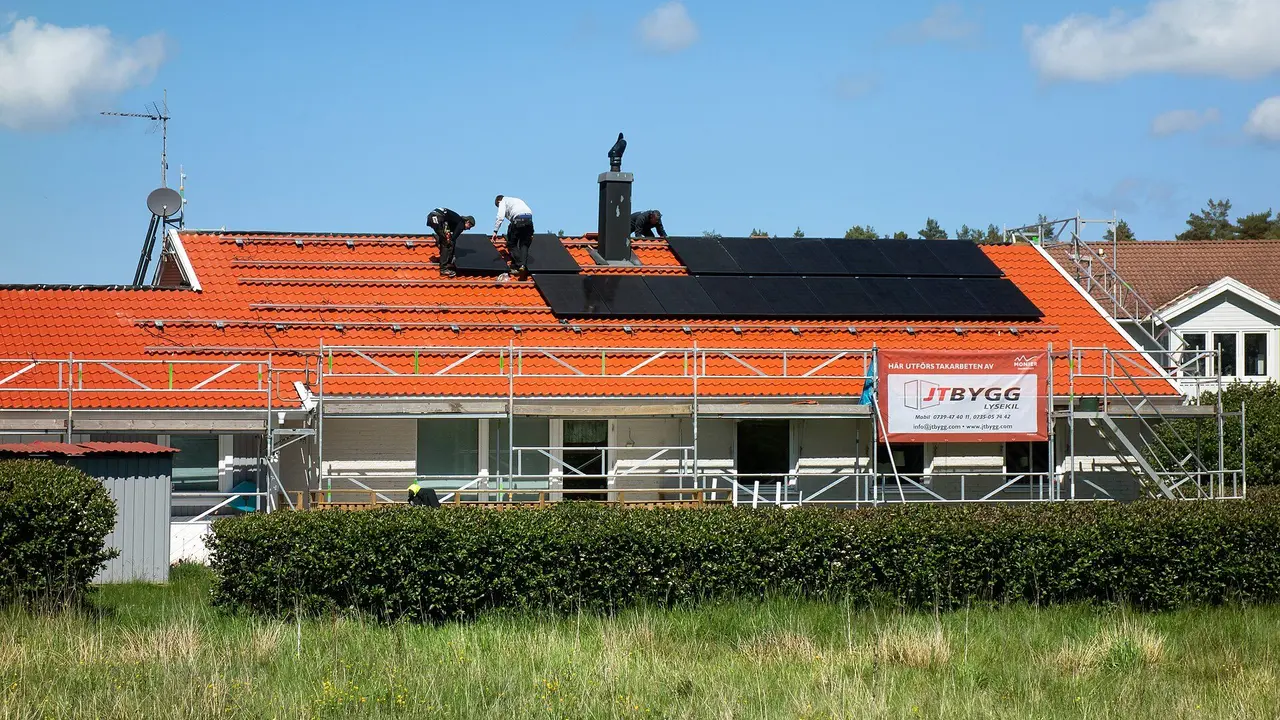
The priority is to stop people falling in the first place (temporary guardrails, scaffolding at the edge, covering holes), and only then personal equipment that catches a person who has already fallen. In Figure 2 the scaffold has a guardrail along the whole roof edge: anyone who slips is stopped at the rail. On large roofs crews often run a lifeline along the ridge so installers can clip on and move along the roof without unclipping.
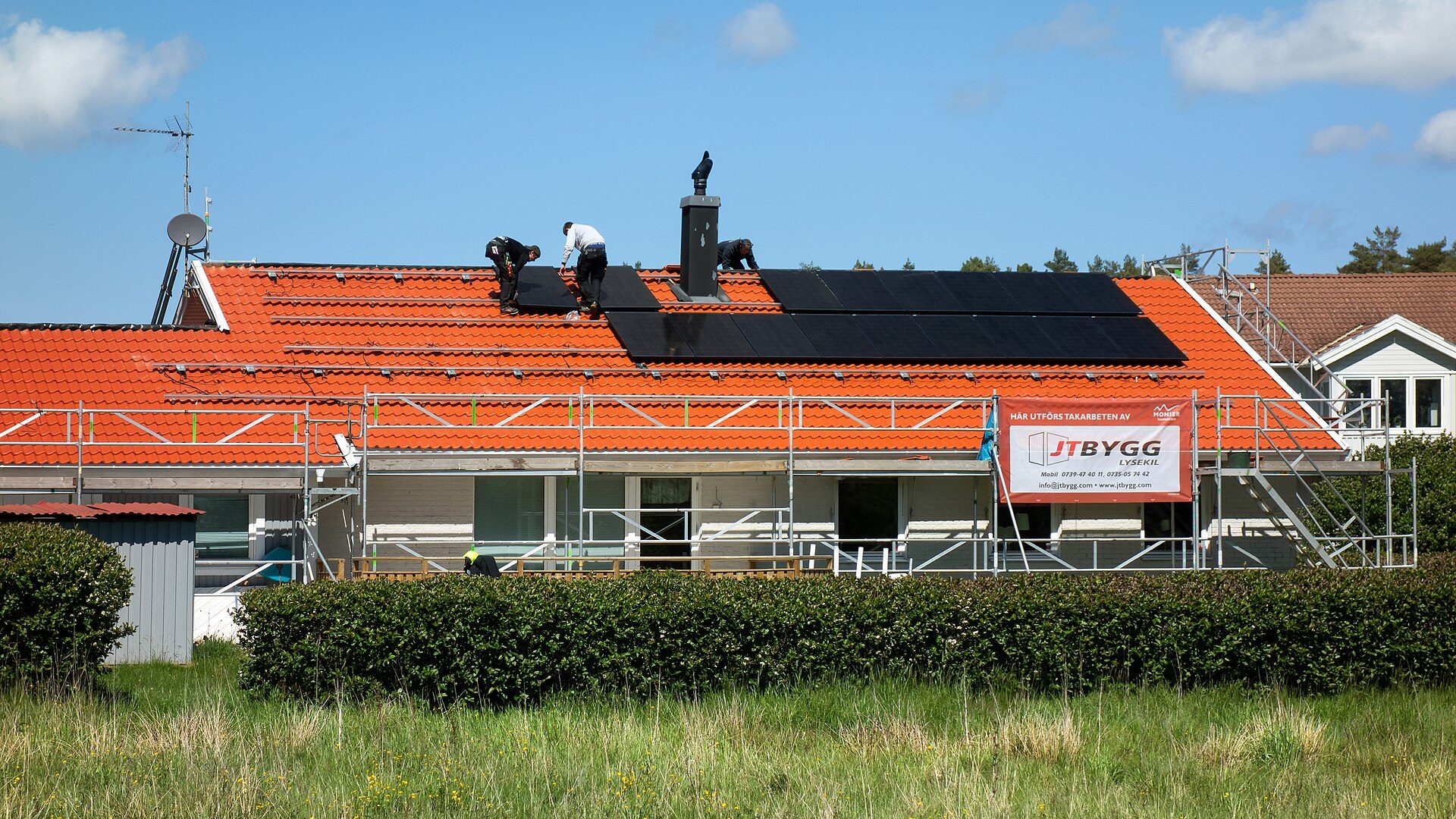
Photo: W.carter / Wikimedia Commons, CC0
Full-body harness and anchor points
- Use a full-body harness (shoulder straps, leg straps, back D-ring), not a simple waist belt. The lanyard should have a shock absorber, ideally a twin-hook type so one hook is always attached while you move between anchors.
- Anchors must be load-bearing: beams, steel trusses, purpose-made anchors fixed into the structure, or a properly tensioned lifeline. Never clip onto aluminium rails, water pipes, gutters, antenna masts or flimsy railings.
- Check before every shift: stitching not frayed, self-closing hooks working, shock absorber not deployed. A harness that has stopped a real fall must be replaced.
Walking on metal roofs and skylights
Step only on the screw lines, because the screws go into the purlins below; between purlins the thin sheet can sag, dent and tear. Skylight sheets (clear plastic) and fibre cement sheets cannot take a person's weight: cover them with boards, mark them or fence them off before you start. In Figure 3 the technician crouches low, keeping his centre of gravity close to the metal roof while he works. Wear soft, non-slip soles, and wait for morning dew to dry.
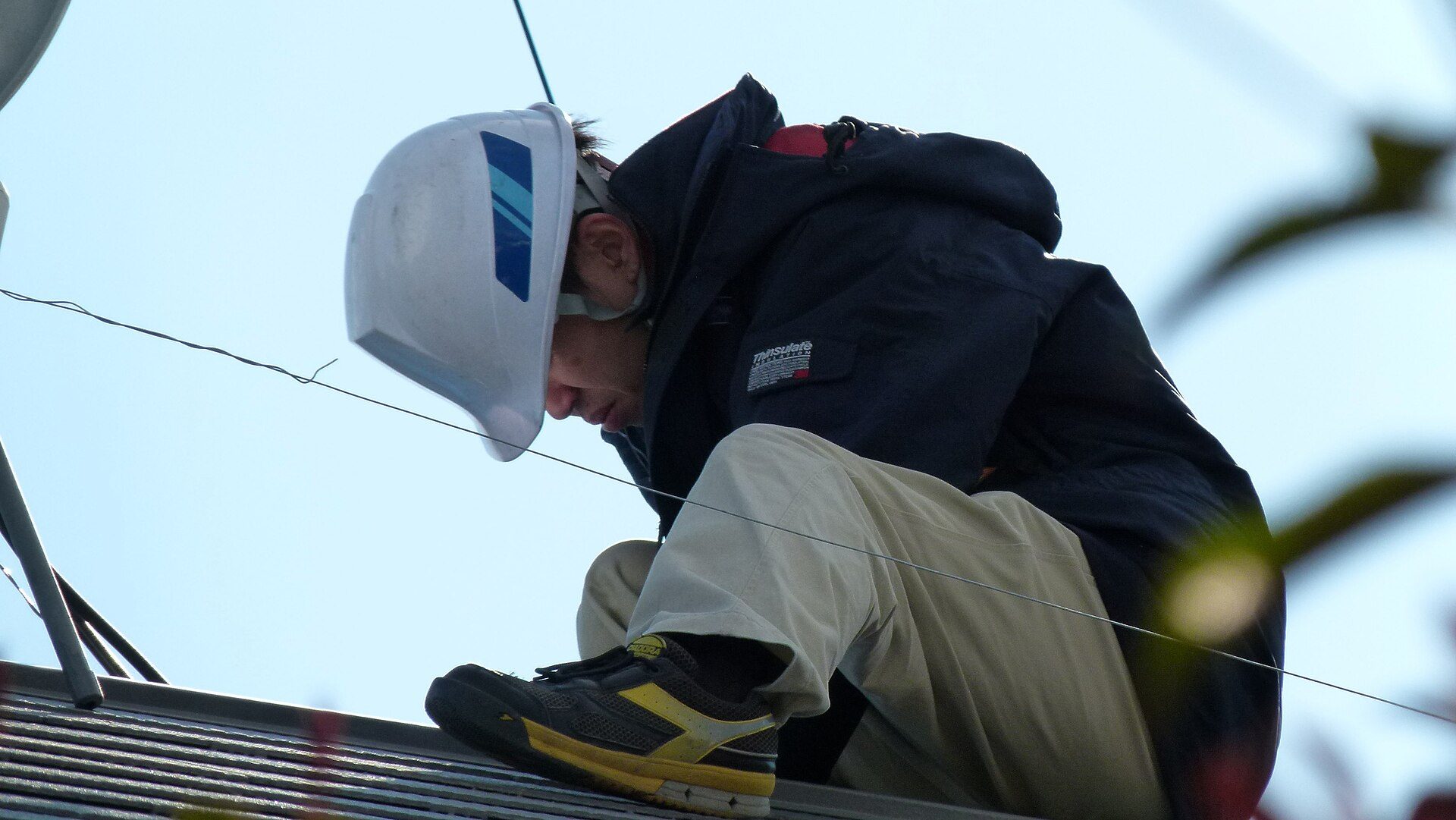
Photo: CoCreatr from Yokohama, Japan / Wikimedia Commons, CC BY-SA 2.0
Ladders and lifting materials
Set the ladder at about 75 degrees (the foot about a quarter of the height out from the wall), extend it about 1 m above the roof edge and tie it off; always keep three points of contact while climbing. A panel weighs about 25-32 kg and catches wind like a sail: never carry one up a ladder, haul it up on a rope or with a hoist, and stop moving panels in strong wind.
Isolating and measuring DC safely
You will need to isolate a system for final connection, repairs, inverter replacement or fault finding. The rule: break the current with a device designed to switch under load, confirm by measuring, and only then unplug connectors. Never the other way round.
The 6-step isolation sequence
- Switch off the inverter as the manufacturer instructs, or open the AC breaker on the grid side so the inverter stops exporting.
- Open the DC isolator or DC breaker for each string in the DC box.
- Use a DC clamp meter on each string cable to confirm the current is zero or near zero.
- Hang a "Work in progress, do not switch on" sign and lock the box if possible.
- Wearing insulated gloves, unplug the MC4 connectors with the proper release tool, never by yanking them.
- Measure and note the voltage at the cable end you just unplugged: a few hundred volts is normal, and it reminds you that the array is still live.
MC4 connectors and covering panels
MC4 connectors (Figure 4) have differently shaped positive and negative halves, a weather seal and locking latches. Release them with a tool that squeezes the latches, without twisting the cable, and cap unplugged ends against water. Covering panels with an opaque tarp reduces the current, but you must still treat them as live, because one gust lifting a corner brings the string voltage back.
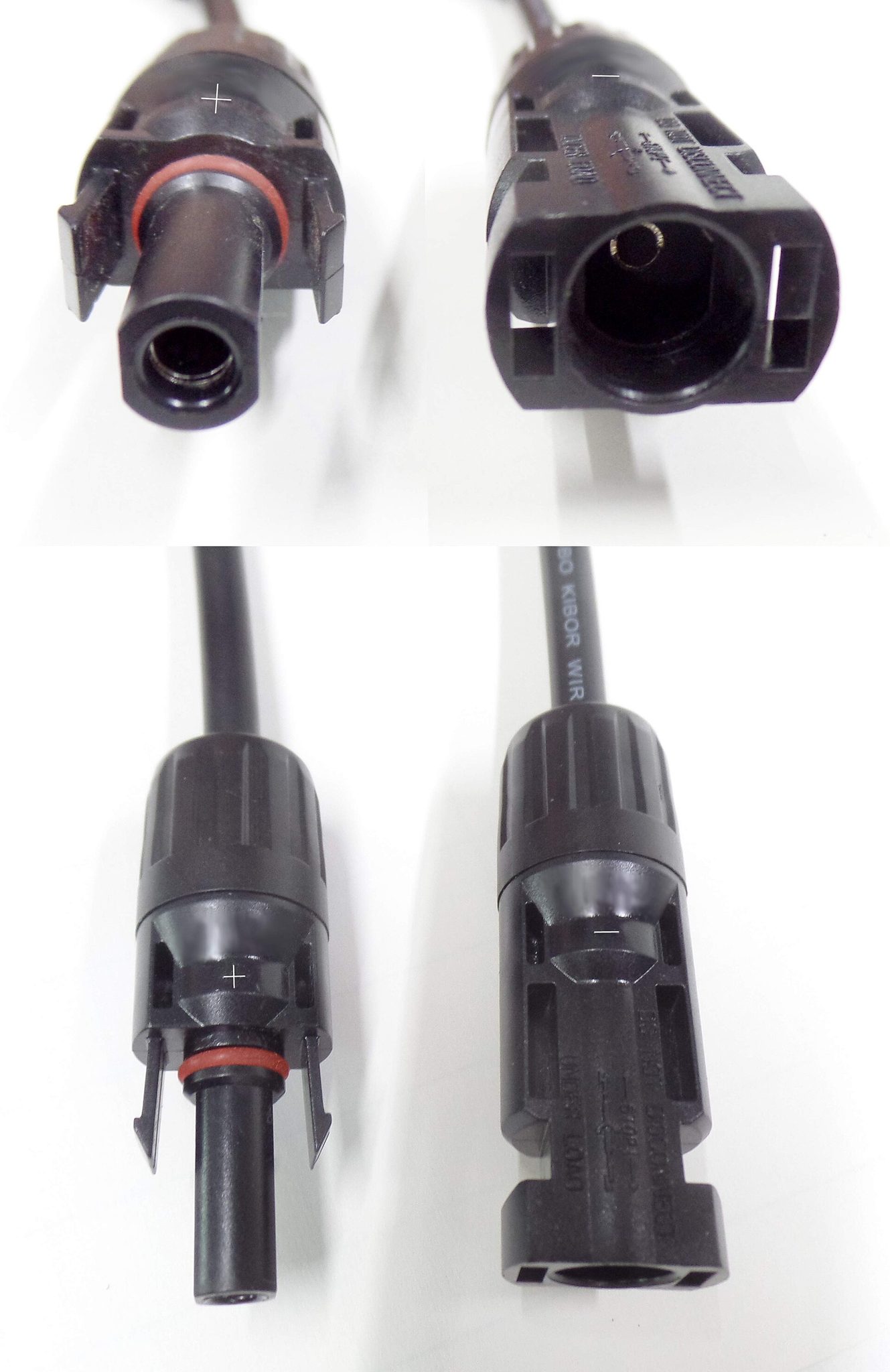
Photo: Orion Lawlor / Wikimedia Commons, CC0
Earthing and lightning protection for solar systems
The array is the largest metal object on the roof. A direct strike or a nearby strike can both send an overvoltage surge along the cables into the inverter and the house, so earthing and lightning protection are a mandatory part of the system.
Earthing frames and rails
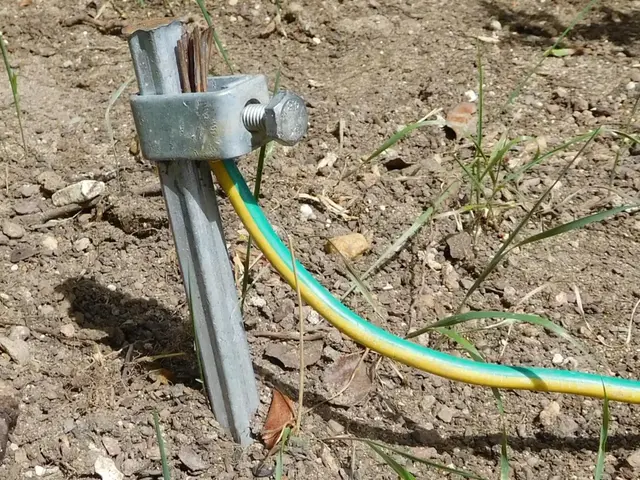
Panel frames, aluminium rails, cabinet enclosures and the inverter case are bonded together with copper conductors or purpose-made earthing clips, then connected to earth rods in the ground. The aim: if a damaged cable touches a frame, fault current flows to earth and the protection devices or the inverter detect the fault, instead of leaving a live frame waiting for someone to touch it. Earth resistance must meet the design documents and the client's requirements and is measured with an earth resistance tester at commissioning.
Direct lightning protection
If the building already has lightning rods (Figure 5), the array must sit within their zone of protection and keep its distance from, or be bonded to, the down conductors as the lightning protection designer specifies. Never move rods or down conductors yourself to make room for panels; if the drawings do not match what you see on site, report it at once.
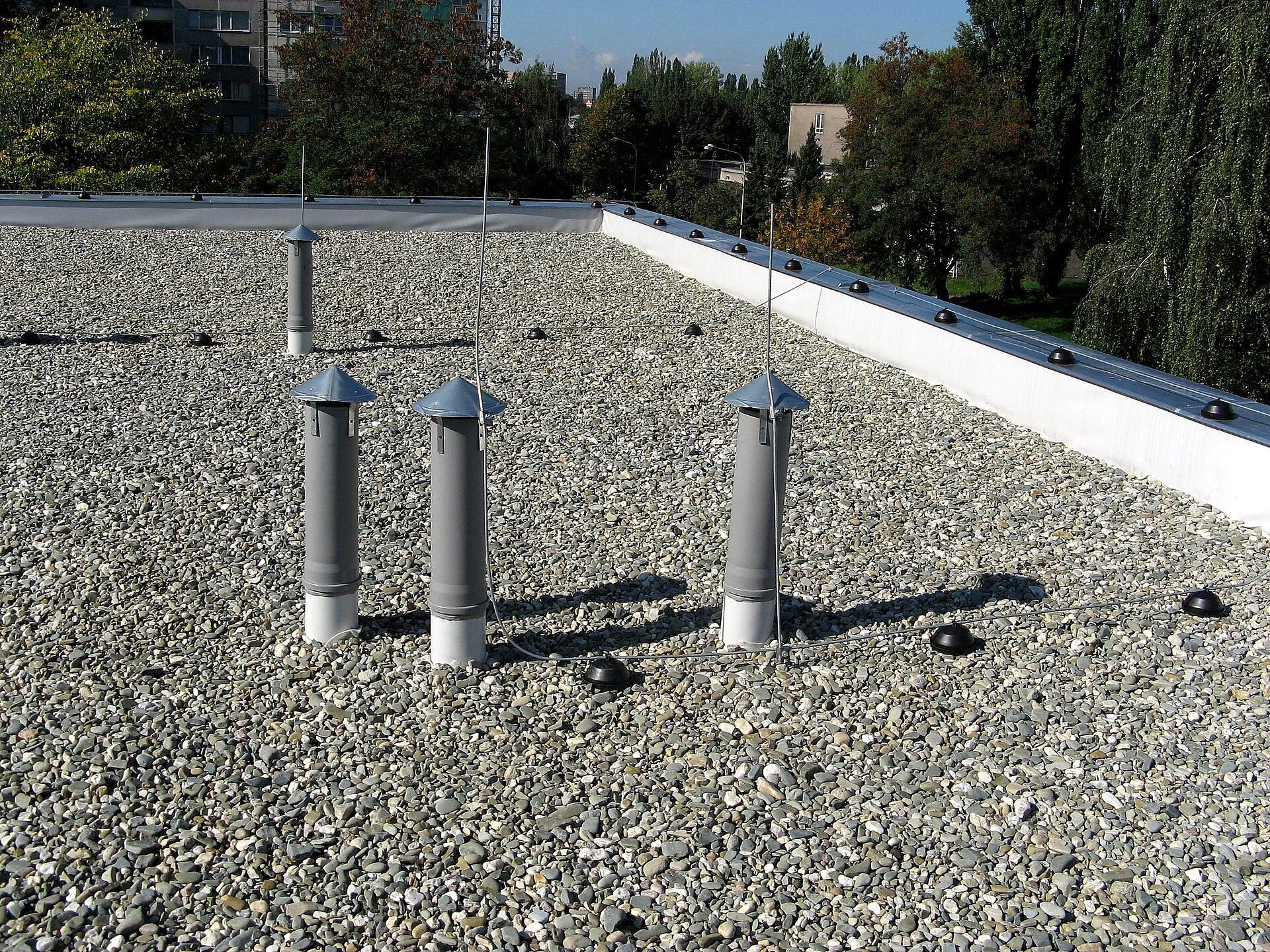
Photo: Paolo Neo / Wikimedia Commons, Public domain
Surge protection devices (SPDs)
An SPD diverts overvoltage surges to earth before they reach the inverter. Rooftop systems usually have a DC SPD in the DC box near the inverter and an AC SPD in the AC box. A DC SPD must have an operating voltage higher than the highest open-circuit voltage of the string; the AC SPD is rated for the 220 V grid. Many SPDs have a status window: green means it is still good, red means it has failed and must be replaced. A wall-mounted DC box like the one in Figure 6 is where you will find each string's fuses, DC breakers and SPDs.
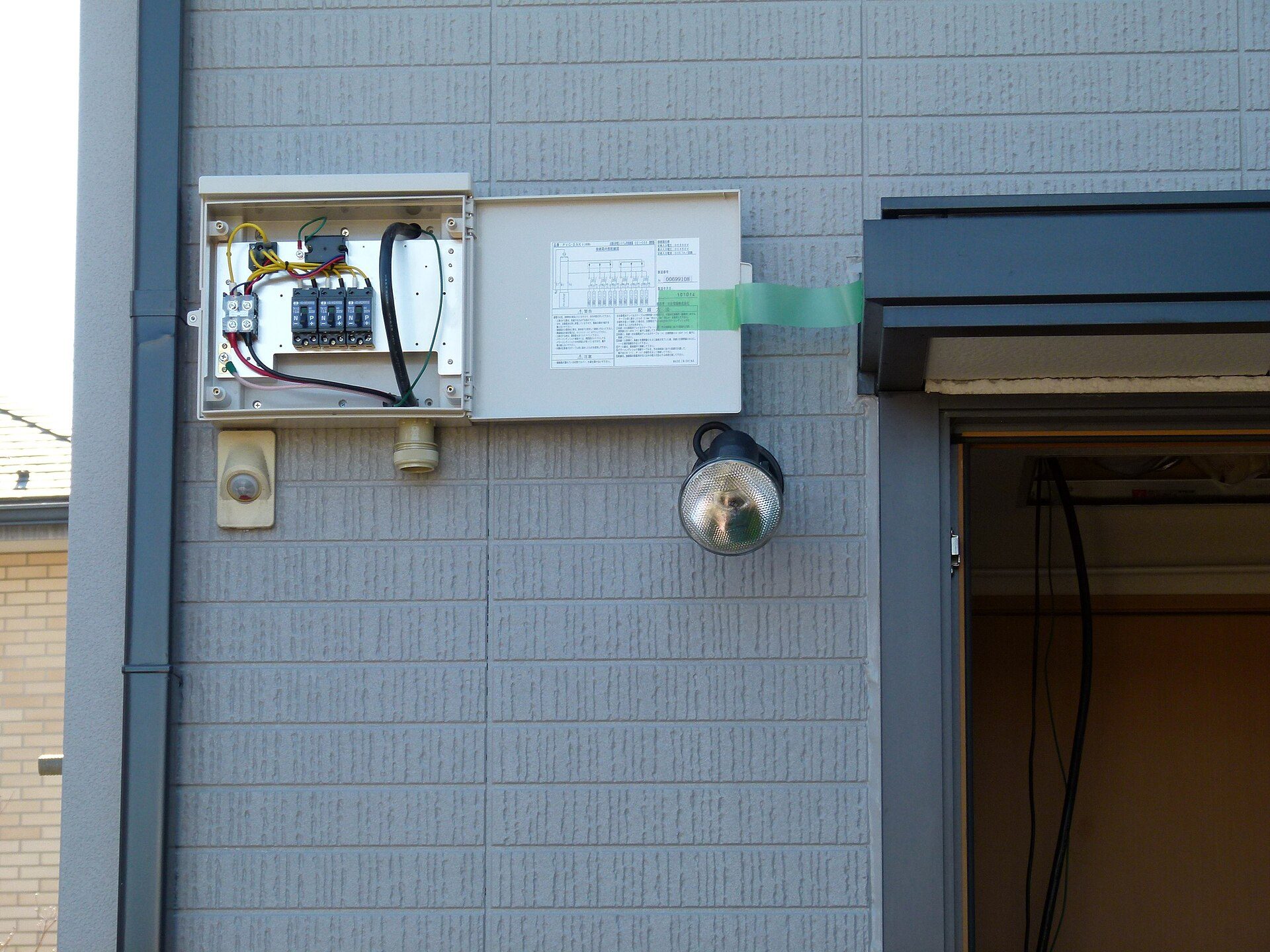
Photo: cocreatr / Wikimedia Commons, CC BY-SA 2.0
For the detailed layout of the DC box, AC box and inverter, see grid-tied solar wiring diagram: DC box, AC box and inverter. At this step you only need to recognise each device and understand why it is there.
Safety warning: Do not go on the roof in rain, strong wind, while it is still wet with dew or when there is thunder and lightning; at the first thunder, leave the roof and wait at least 30 minutes after the last thunder before going back. Never unplug an MC4 connector or open a DC box before the current has been broken and confirmed by measurement. If you see broken panel glass, cables with damaged insulation, scorched connectors or signs that a frame is live, do not touch anything, fence off the area and report to the technical lead. AC connection to the house board and the grid must be done by a skilled electrician with the power off. Always work in pairs at least, with one person on the ground watching who knows the emergency number (115 in Vietnam). Beginners should only work on roofs under direct supervision.
Protective equipment and safety tools for installers
Installation companies usually issue protective equipment; if you take on home systems yourself, you must buy and check your own.
Meters and insulated tools
Your multimeter needs a DC range of at least 1,000 V and a CAT III 1000 V safety rating printed on the case; your clamp meter must measure DC current (many cheap ones only read AC). Add insulated 1000 V screwdrivers and pliers and an MC4 release tool. Test your meter on a known source before measuring a system, and throw out tools with cracked insulation. Your hard hat needs a chin strap, because when you bend over on a roof, the hat falls off.
Cost of a personal kit (2026 reference, varies by brand and region)
| Item | Price range | Price used in the total |
|---|---|---|
| Full-body harness, twin-hook shock-absorbing lanyard | 400,000-900,000 VND | 650,000 VND |
| Hard hat with chin strap | 80,000-200,000 VND | 120,000 VND |
| Non-slip shoes with insulating soles | 300,000-700,000 VND | 450,000 VND |
| Low-voltage insulating gloves + leather over-gloves | 400,000-900,000 VND | 600,000 VND |
| Safety glasses | 30,000-100,000 VND | 60,000 VND |
| CAT III 1000 V multimeter | 500,000-1,500,000 VND | 900,000 VND |
| DC clamp meter | 800,000-2,000,000 VND | 1,200,000 VND |
| Total | 3,980,000 VND | |
Check: 650,000 + 120,000 + 450,000 + 600,000 + 60,000 + 900,000 + 1,200,000 = 3,980,000 VND (about US$155); the whole kit falls in the range 2,510,000-6,300,000 VND. Do not buy fall protection or meters of unknown origin.
Worked example: safety checks before connecting a 5.5 kWp system
A three-person crew arrives to finish a 5.5 kWp system on the metal roof of a three-storey townhouse in Ho Chi Minh City. The array is 10 panels of 550 Wp in one string; the panel label shows Voc = 49.6 V, Isc = 14 A and a voltage temperature coefficient of -0.27%/°C. Today the crew must connect the string to the inverter.
Step 1: work out the string voltage so you know what you are facing
- Array power: 10 × 550 = 5,500 Wp = 5.5 kWp.
- Open-circuit voltage at standard 25°C: 10 × 49.6 = 496 V DC.
- On a cool early morning the panels are about 15°C, 10°C below standard: voltage rises 10 × 0.27% = 2.7%. Voc per panel: 49.6 × 1.027 ≈ 50.94 V; for the string: 10 × 50.94 = 509.4 V DC.
- Conclusion: about 500 V DC, more than four times the 120 V threshold. Treat it as dangerous from the moment the second panel is connected.
Step 2: prepare the roof and the people
Forecast: sunny morning, possible afternoon storms, so the crew goes up at 7 a.m. A lifeline runs along the ridge, anchored to two steel trusses. Two people work on the roof while one stays on the ground holding the ladder and watching. The skylight in the corner of the roof is covered with boards.
Step 3: connect and measure
- Check that the DC breaker in the box is open and the inverter is not energised.
- Connect the MC4s between panels one by one, positive to negative, listening for the latch to click.
- Measure Voc across the string ends in the DC box before they go into the breaker: the reading is 505 V, inside the 496-509.4 V range worked out earlier, with the right polarity. A reading 50-100 V below the calculation means a faulty or reversed panel; 0 V means the string is still open; find the cause before closing.
- Close the DC breaker, then start the inverter in the manufacturer's order; the clamp meter shows a string current of about 10 A at 9 a.m., reasonable for sun that is not yet strong.
Time on the roof: 7:00 to 10:30, that is 3 hours 30 minutes, with two water breaks; the crew leaves before the midday heat and the afternoon storms.
Common beginner safety mistakes
Believing that opening the breaker kills the power
Sign: unplugging string cables straight after switching off the inverter, without measuring. Cause: habits from AC wiring at home. Fix: memorise "light means live", always confirm zero current before unplugging and measure voltage after.
Clipping the harness to an aluminium rail
Sign: an installer clips onto a rail because it is handy. Cause: no proper anchor, or reluctance to move the hook. Fix: prepare anchors and a lifeline before installation day; rails are held by a few screws into the metal sheet and cannot take the shock load of a fall.
Skipping earthing because "the house already has lightning protection"
Sign: frames and rails with no earth conductor. Cause: thinking the lightning rod is enough. Fix: a rod only intercepts direct strikes; the frames must still be earthed and the system still needs SPDs against surges carried along the cables.
10-point checklist before going on the roof
A single "no" means stop and fix it before carrying on.
- No rain, storms or strong wind forecast during the shift; the roof is dry.
- At least two people, with a clear role for the person watching from the ground.
- Anchor points or a lifeline prepared and checked.
- Harness, hard hat, shoes and gloves checked and undamaged.
- A temporary guardrail at the edge, or a plan to stay clipped on the whole time.
- Skylights, fibre cement sheets and holes covered or marked.
- Ladder tied off and extending about 1 m above the edge.
- You know where the inverter and the DC and AC breakers are, and their current state.
- Multimeter and DC clamp meter have charged batteries and were tested on a known source.
- Drinking water, a first aid kit and the emergency number at hand.
Before advising customers you should also know roughly what a system costs and how payback works; see 5 kW solar system cost in Vietnam. The safety rules in this lesson also apply to routine maintenance; see cleaning solar panels safely.
Frequently asked questions
Can solar panels give you an electric shock?
Yes. A single panel at about 40-50 V DC is not very dangerous, but a string of panels in series reaches several hundred volts DC, enough for a dangerous shock. Panels are live whenever there is light, even with the inverter off.
What is a DC arc, and why is it more dangerous than AC?
An arc is an electric spark that keeps burning in the air when a circuit carrying current is broken. DC does not pass through 0 V the way AC does, so the arc does not die out easily and can cause burns and fires. That is why current must only be broken with the correct DC switching device.
Does a rooftop solar system need lightning protection?
It needs earthed frames, rails and enclosures, and SPDs on the DC and AC sides. Whether extra lightning rods are needed depends on the building and is decided by the lightning protection designer; if the house already has rods, the array must sit within their zone of protection.
Do solar installers need a safety certificate?
Companies usually require installers to be trained in electrical safety and working at height under the occupational safety rules in force in Vietnam. Ask the employer directly and check the current rules with the labour authorities; step 8 of the roadmap covers this in more detail.
Practice tasks and self-assessment
- Read the label of any panel (a photo online or a real one) and work out the Voc of strings of 8, 10 and 12 panels at 25°C and at 15°C.
- Rewrite the 6-step isolation sequence in your own words and save it on your phone.
- Survey a metal roof you know (observe only, from the ground or a safe rooftop terrace) and note possible anchor points, skylights and dangerous edges.
Self-assessment criteria
- Pass: you work out string Voc correctly, with temperature correction, and the multiplication matches the panel label.
- Pass: you can state the order of breaking the current, measuring and unplugging without looking at notes.
- Pass: you can point out at least two places not to step on and one valid anchor on the roof you surveyed.
- Not yet: you still think opening the breaker makes the array dead, or plan to clip your harness to an aluminium rail.
Once you are solid on safety, move on to the next roadmap step: Grid-tied, off-grid & hybrid systems, where you learn how panels, inverters and batteries work and how to read Voc, Isc and Vmp on a panel label.
Keep learning solar installation: after safety come system principles, roof surveys, mounting rails and panels, string wiring and inverters, battery storage and maintenance. See the solar PV installer roadmap.