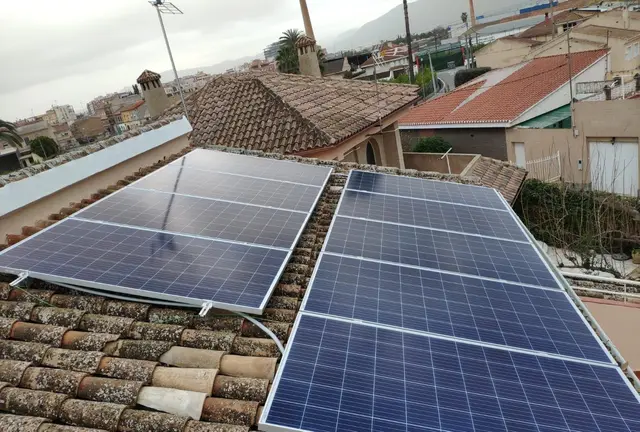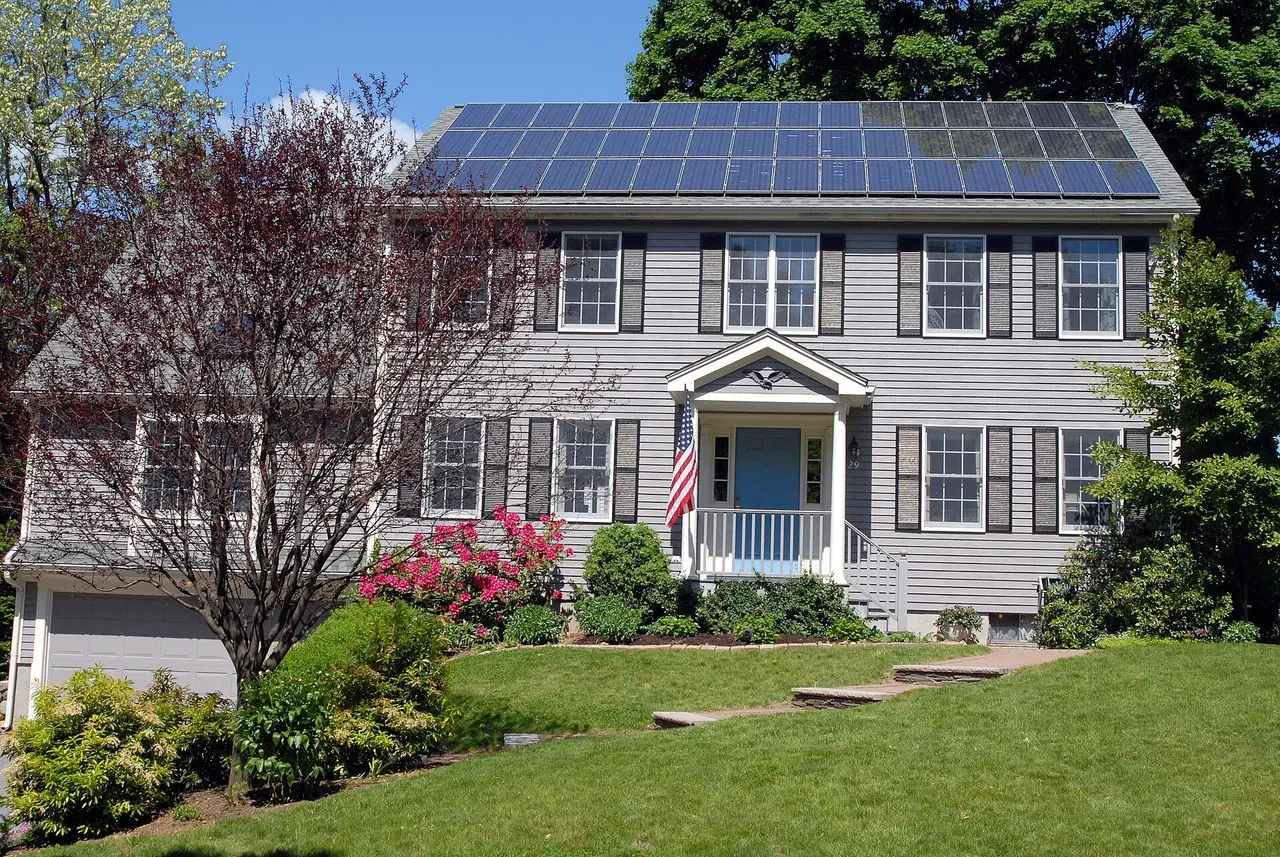
A 5 kW grid-tied rooftop solar system for a Vietnamese household costs roughly 40–65 million VND fully installed in 2026 (reference only; it varies by region, panel and inverter choice); adding battery storage to make it a hybrid system brings it to around 70–110 million VND depending on battery size. A 5.5 kWp system like the example in this lesson produces about 500–700 kWh a month depending on the region, and payback usually falls between 4 and 6 years if the family uses plenty of electricity during the day. This lesson shows you — the technician doing the site survey — how to break down every cost item and calculate yield and payback so you can give the homeowner a transparent quote.
By the end of this lesson, you will be able to:
- Break the cost of a 5 kWp system into 5 items — panels, inverter, mounting, cabling and boxes, labour — with a total that matches every line.
- Compare grid-tied and hybrid (battery) systems on price and benefit, and know when to recommend each.
- Estimate monthly kWh output from peak sun hours in northern and southern Vietnam.
- Calculate payback from the power bill and the self-consumption ratio, and explain it to the customer.
- Work out the roof area needed and spot an unsuitable roof before quoting.
Want to survey, quote and install rooftop systems? Roof survey and system sizing is step 3 of the roadmap — after DC safety and the principles of grid-tied and hybrid systems. See the 8-step solar PV installer roadmap.
What does a 5 kW solar system include?
When a customer says "5 kW", they usually mean an inverter rated at 5 kW; the panel array is often slightly larger, around 5–6 kWp (kilowatt-peak — panel output under standard test conditions). The example in this lesson uses 10 panels of 550 Wp = 5.5 kWp feeding a 5 kW single-phase inverter, the familiar layout on a home roof shown in Figure 1.
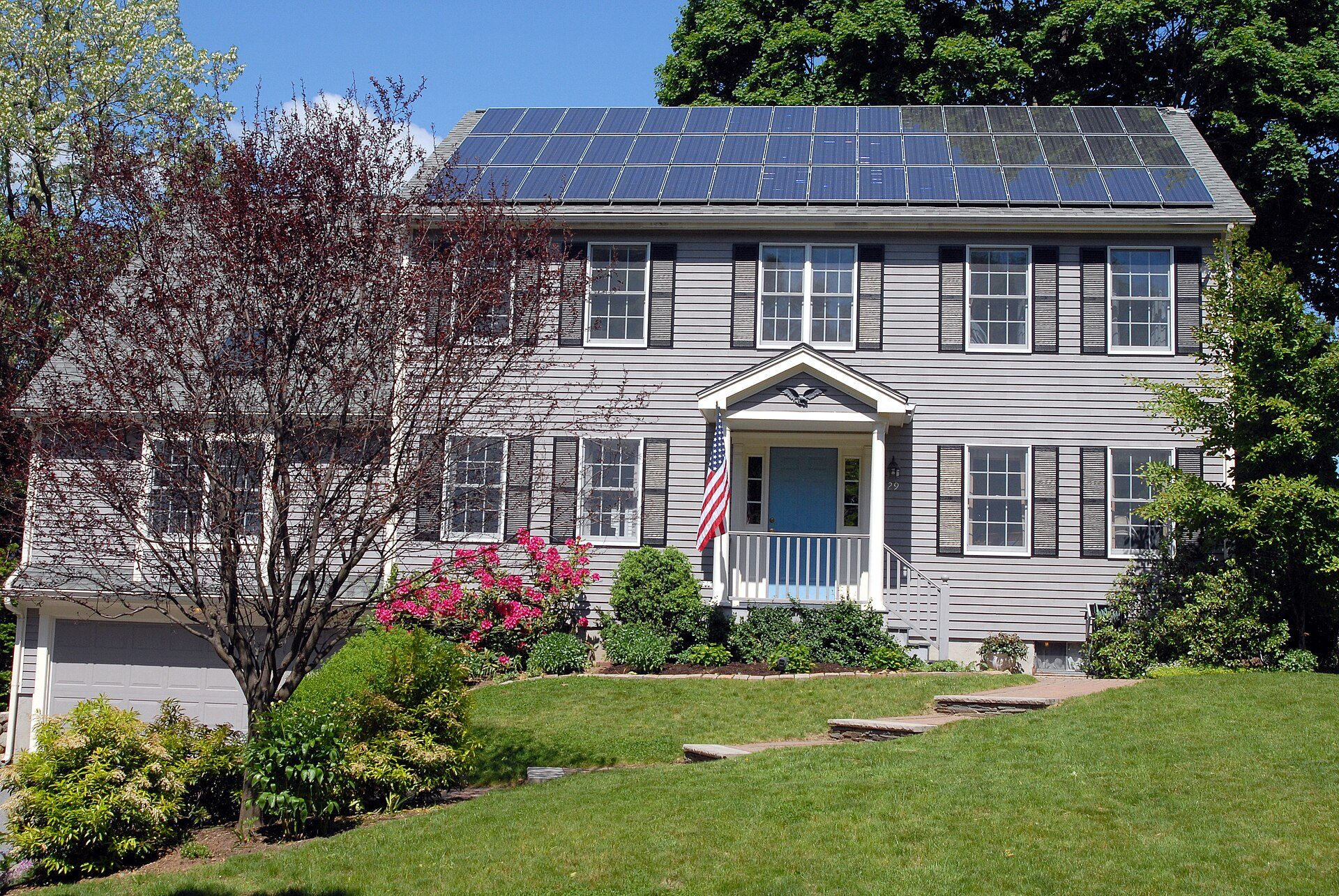
Photo: Gray Watson User:E090 / Wikimedia Commons, CC BY-SA 3.0
Main components
- Panels: usually mono PERC or TOPCon, 540–620 Wp each.
- Inverter: converts the panels' direct current (DC) into 220 V alternating current (AC), the household standard in Vietnam. A grid-tied inverter only runs when the grid is live; a hybrid inverter adds a battery port and backup output.
- Mounting: aluminium rails, metal-roof clamps or L-feet, mid and end clamps.
- Cabling and boxes: solar DC cable, MC4 connectors, a DC box (fuses, DC breaker, surge protection), an AC box (MCB/RCBO, surge protection) and earthing.
- Labour: survey, transport, installation, wiring, monitoring setup and commissioning.
The detailed wiring of the DC box, AC box and inverter is covered in the lesson grid-tied solar wiring diagram in the residential electrician track.
Grid-tied or hybrid?
A grid-tied system is cheaper and pays back faster, but when the grid goes down the inverter shuts off automatically — the house stays dark even in bright sun. A hybrid system adds a battery: it charges at midday, discharges in the evening, and keeps priority loads running during a power cut. The battery adds a lot of cost, so it only pays off if the home often loses power, uses most of its electricity in the evening, or cannot sell surplus power.
Cost breakdown for a 5 kW solar installation
The table below is a worked estimate for a 5.5 kWp grid-tied, single-phase system on a metal roof of a 2–3 storey house with roof access. Unit prices are 2026 references that vary by region, brand and purchase date (1 USD is roughly 26,000 VND, so 1 million VND is about 38 USD); use them to learn the breakdown method, not as a fixed quote.
| Item | Details | Amount (VND) | Share |
|---|---|---|---|
| Panels | 10 panels 550 Wp × 2,000,000 VND | 20,000,000 | 40% |
| 5 kW grid-tied inverter | Single-phase, 2 MPPTs, Wi-Fi monitoring | 15,000,000 | 30% |
| Mounting, rails, clamps | Rails, metal-roof clamps, mid and end clamps, sealant | 4,000,000 | 8% |
| Cabling, boxes, earthing | DC cable, MC4, DC box, AC box, surge protection, earth rod | 5,000,000 | 10% |
| Labour, transport | 2 installers × 1.5 days, lifting panels, commissioning | 6,000,000 | 12% |
| Total | About 9.1 million VND per kWp | 50,000,000 (about 1,900 USD) | 100% |
Check: 20 + 15 + 4 + 5 + 6 = 50 million; 50,000,000 ÷ 5.5 kWp ≈ 9.1 million per kWp. Shares: 40 + 30 + 8 + 10 + 12 = 100%.
Why do quotes vary so much?
- Panels and inverter: about 70% of the total; major brands with long warranties cost more than lesser-known ones.
- Roof type: metal roofs are easiest; tiled roofs need tile hooks, and flat concrete roofs need raised frames that can cost 2–3 times as much.
- Cable route: an inverter far from the house's distribution board means long conduit runs through several floors.
- Scope of the package: whether earthing, surge protection, paperwork with the power company, monitoring and first-year maintenance are included.
What does labour cover?
Labour is more than "bolting panels on the roof". It includes the survey, lifting panels safely (Figure 2), fixing the frame and sealing every screw hole, wiring the strings, measuring each string's open-circuit voltage before plugging it into the inverter, fitting the boxes, setting up monitoring and handing over. Suspiciously cheap quotes usually cut corners on waterproofing, earthing or the protective devices in the boxes.
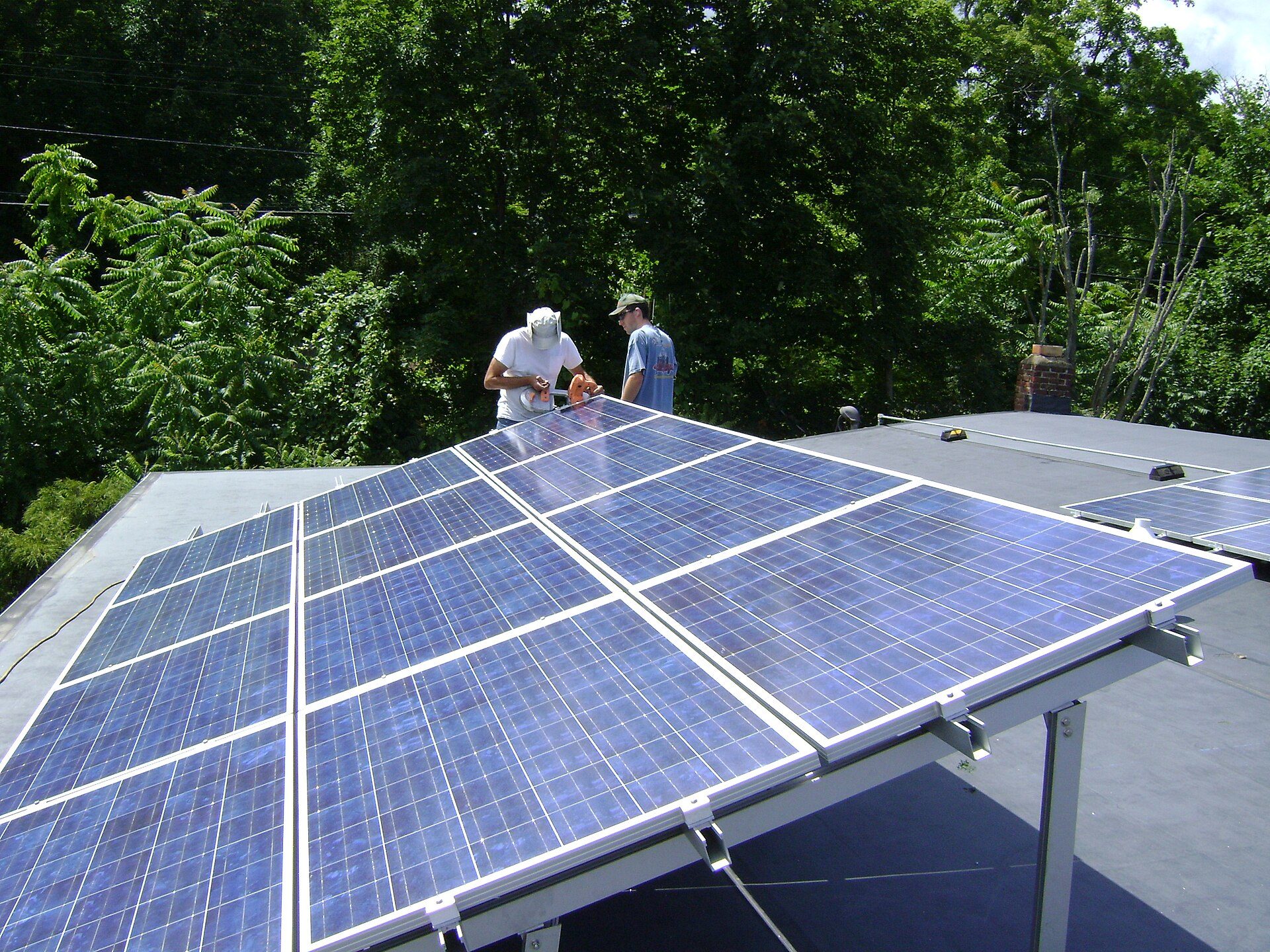
Photo: Lucas Braun / Wikimedia Commons, CC BY-SA 3.0
How much more does a hybrid system with battery cost?
Keep the same 5.5 kWp array, swap the grid-tied inverter for a 5 kW hybrid inverter, and add a 5 kWh lithium iron phosphate (LFP) battery. LFP is more thermally stable than other lithium chemistries, and manufacturers typically quote several thousand charge cycles.
| Item | Grid-tied (VND) | Hybrid + 5 kWh battery (VND) |
|---|---|---|
| Panels 5.5 kWp | 20,000,000 | 20,000,000 |
| 5 kW inverter | 15,000,000 | 25,000,000 |
| Mounting, rails, clamps | 4,000,000 | 4,000,000 |
| Cabling, boxes, earthing | 5,000,000 | 6,000,000 |
| Labour, transport | 6,000,000 | 7,000,000 |
| LFP battery 5 kWh | — | 20,000,000 |
| Total | 50,000,000 | 82,000,000 |
Check the hybrid column: 20 + 25 + 4 + 6 + 7 + 20 = 82 million. The difference of 32 million is almost two-thirds of the price of a whole grid-tied system. Battery storage costs roughly 3–5 million VND per kWh in 2026 depending on brand and warranty; for 10 kWh, add accordingly.
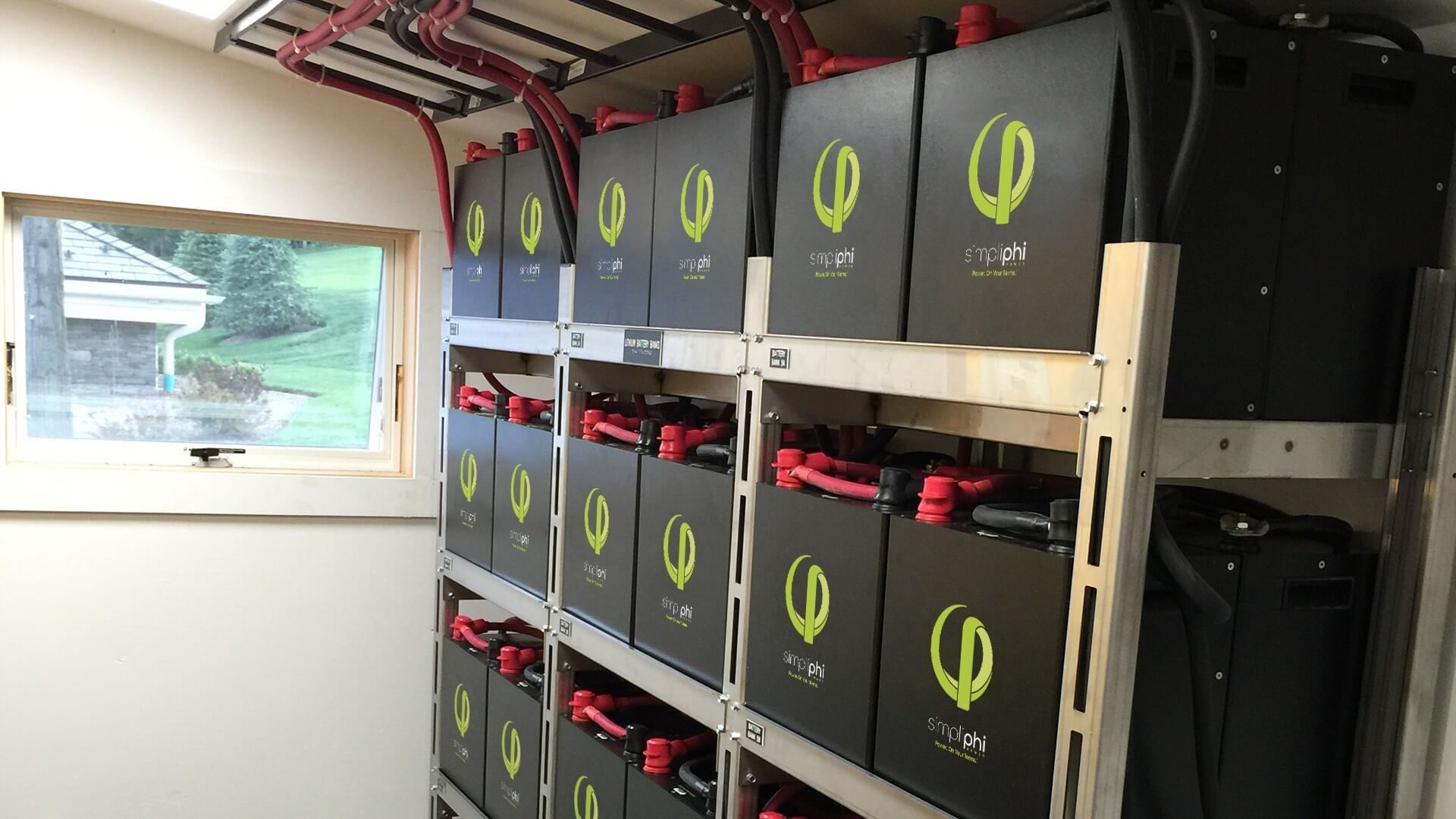
Photo: U.S. Department of Energy from United States / Wikimedia Commons, Public domain
When to recommend a hybrid system
- Areas with frequent power cuts, or homes with a medicine fridge, cameras or pumps that must keep running.
- Families out at work all day who use electricity mainly in the evening.
- Surplus power exported to the grid is not paid for or is capped, so storing it for later use is worth more.
On the other hand, if someone is home in the daytime running air conditioning or an induction hob at midday, and power cuts are rare, a grid-tied system usually makes more sense. A battery can be added later if a hybrid inverter is chosen from the start.
Monthly output of a 5 kW system in northern and southern Vietnam
Output depends on peak sun hours (the number of hours per day if the sun shone at standard intensity) and overall system efficiency (losses from heat, dust, cabling and the inverter). A quick estimate:
Daily output (kWh) = array size (kWp) × peak sun hours × system efficiency (about 0.8)
The South and South Central Coast have steady sun all year, like the factory rooftops covered in panels in Dong Thap province shown in Figure 4. The North has a grey, drizzly winter, so output in January–March is clearly lower, some months only half of summer.
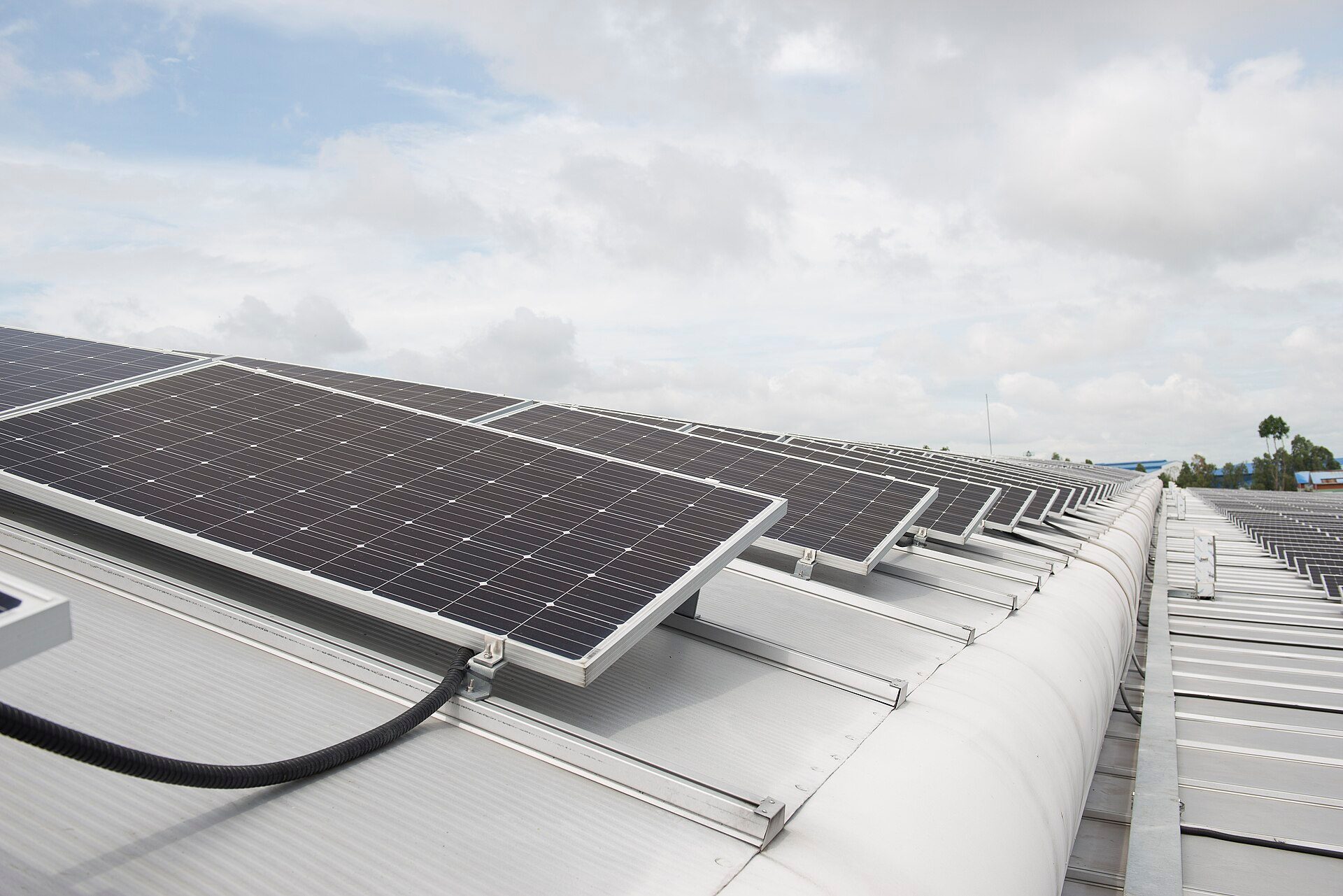
Photo: USAID Vietnam / Wikimedia Commons, Public domain
| Region | Peak sun hours (annual average, reference) | Daily output, 5.5 kWp | Monthly output (30 days) |
|---|---|---|---|
| Northern Vietnam | about 3.5–4.5 h, example uses 4 | 5.5 × 4 × 0.8 = 17.6 kWh | about 528 kWh |
| Southern Vietnam | about 4.5–5.5 h, example uses 5 | 5.5 × 5 × 0.8 = 22 kWh | about 660 kWh |
These are annual averages for quoting; sunny months can be higher and rainy months lower. During the survey, use the inverter maker's design software or irradiance data for the exact location to get a closer figure, and always mark it as an "estimate" on the quote.
Roof direction, tilt and shading
In Vietnam, a south-facing roof gives the highest output; east or west loses about 10–15%; north-facing roofs in the North lose a lot and should be avoided. A tilt of about 10–20 degrees works well, catching the sun while letting rain wash off dust. Shade from a water tank, an aerial mast or a taller house next door can drag down a whole string even if it covers only a few panels — note shading at 9:00, 12:00 and 15:00 during the survey.
Roof area needed for 5 kW
A 550 Wp panel measures roughly 2.28 × 1.13 m, about 2.6 m² per panel. 10 panels take 10 × 2.6 = 26 m². Add gaps between rows, a maintenance walkway and clearance from the roof edge, and you need about 30–35 m² of clear roof — a quick rule of about 6–7 m² per kWp. A typical 4 × 15 m townhouse roof (60 m²) is usually enough unless a water tank or stair housing takes up space.
Worked example: payback for a townhouse in Ho Chi Minh City
Ms Mai lives in Ho Chi Minh City, uses about 900 kWh a month, has someone at home during the day and runs air conditioning at midday. You propose the 5.5 kWp grid-tied system at 50 million VND from the table above. Worked assumptions (2026 references; replace with real figures for each home):
- Output: 660 kWh per month (southern Vietnam, table above).
- Self-consumption: 60% — the share of solar power used immediately in the home; nothing is counted for exported surplus.
- Electricity price saved: an average of 2,800 VND/kWh (solar replaces the higher tiers of Vietnam's tiered residential tariff).
- Maintenance and panel cleaning: 1,000,000 VND per year.
The calculation
- Self-consumed power per month: 660 × 60% = 396 kWh.
- Savings per month: 396 × 2,800 = 1,108,800 VND.
- Savings per year: 1,108,800 × 12 = 13,305,600 VND.
- Less maintenance: 13,305,600 − 1,000,000 = 12,305,600 VND per year.
- Payback: 50,000,000 ÷ 12,305,600 ≈ 4.1 years.
Ms Mai's grid purchases fall from about 900 kWh to about 900 − 396 = 504 kWh a month.
Comparing the options
| Option | Investment (VND) | Monthly output | Self-used | Net savings/year (VND) | Payback |
|---|---|---|---|---|---|
| Grid-tied, Ho Chi Minh City | 50,000,000 | 660 kWh | 60% = 396 kWh | 12,305,600 | ≈ 4.1 years |
| Grid-tied, Hanoi | 50,000,000 | 528 kWh | 60% ≈ 317 kWh | 9,644,480 | ≈ 5.2 years |
| Hybrid 5 kWh, Ho Chi Minh City | 82,000,000 | 660 kWh | 90% = 594 kWh | 18,958,400 | ≈ 4.3 years |
The other two rows are calculated the same way. Hanoi: 528 × 60% = 316.8 kWh × 2,800 = 887,040 VND/month × 12 = 10,644,480 − 1,000,000 = 9,644,480 VND; 50,000,000 ÷ 9,644,480 ≈ 5.2 years. Hybrid: 660 × 90% = 594 kWh × 2,800 = 1,663,200 VND/month × 12 = 19,958,400 − 1,000,000 = 18,958,400 VND; 82,000,000 ÷ 18,958,400 ≈ 4.3 years.
The hybrid saves more each year but pays back slightly more slowly, and the battery may need replacing after about 10 years depending on cycling. Its biggest value is power during grid outages. Tell the customer plainly that the inverter may also need repair or replacement within the panels' 20–25 year life.
Selling power and self-consumption: stick to the principles
Vietnam's rooftop solar policy has changed several times. The current direction encourages self-generation for self-consumption: power produced is mainly for use on site. Whether surplus can be exported to the grid, whether it is paid for, at what price, with what cap and with what paperwork all depend on the regulations in force at the time.
What the technician should do when advising
- Never promise "profit from selling power" or a specific buy-back price without checking the current rules.
- Advise the homeowner to ask the local power company before installing: notification or registration procedures, meter requirements, and whether zero-export (anti-backflow) control is required.
- Base payback mainly on the self-consumed share, as in the example above — any payment for exported surplus is only a bonus.
- Also check building and fire-safety rules for the roof, especially for boarding houses, workshops or homes in areas with special regulations.
The home's meter may need to be changed to a bidirectional type if power is exported (Figure 5). That is decided and carried out by the power company, not by the installer.
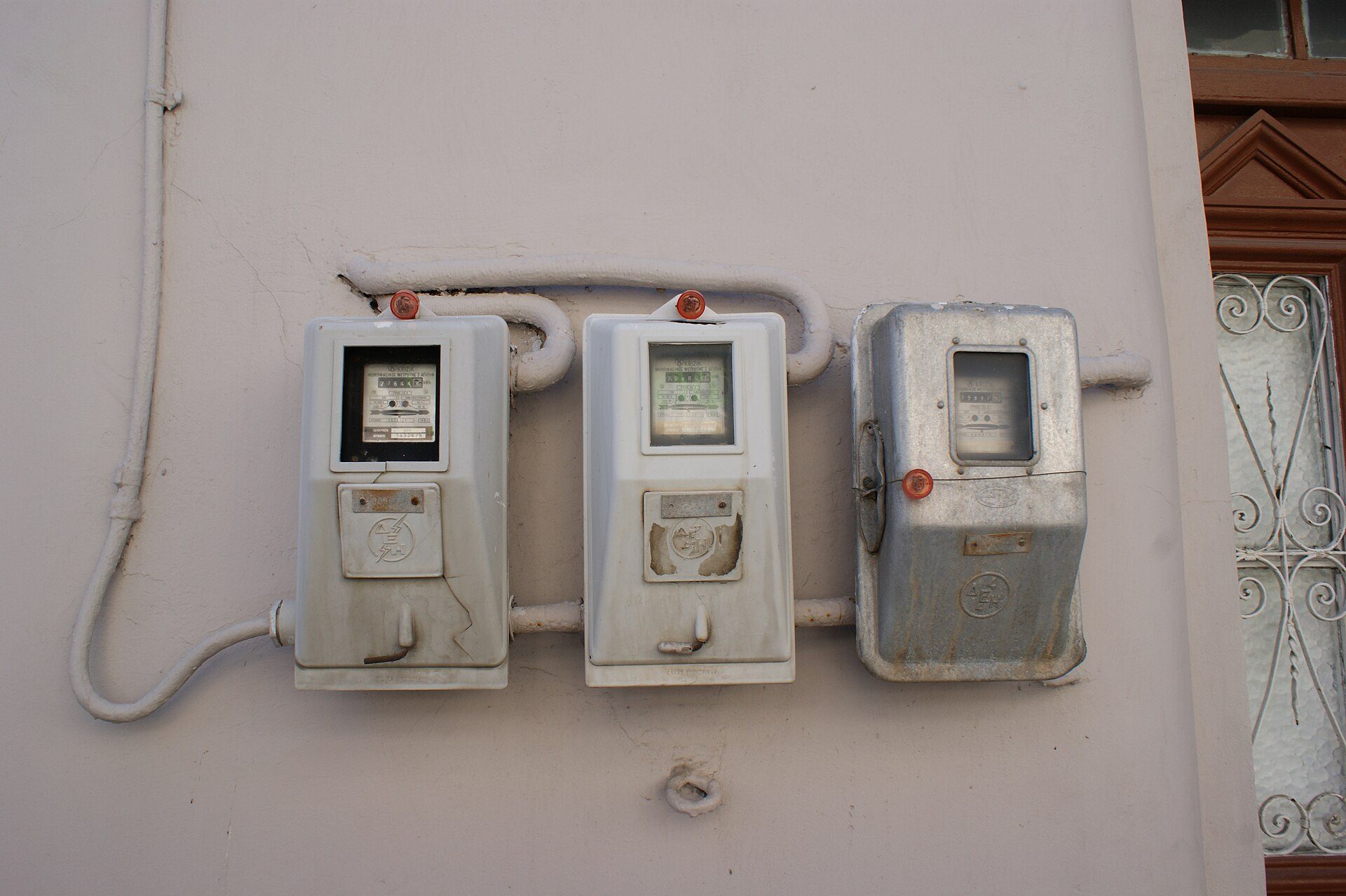
Photo: Asurnipal / Wikimedia Commons, CC BY-SA 4.0
Inverter and warranties
In the quote, state the warranty for each item: panels usually carry separate product and performance warranties; the inverter warranty is usually shorter; installation workmanship and waterproofing are guaranteed by the installer. Mount the inverter on a ventilated wall out of direct sun and driving rain, as in Figure 6.
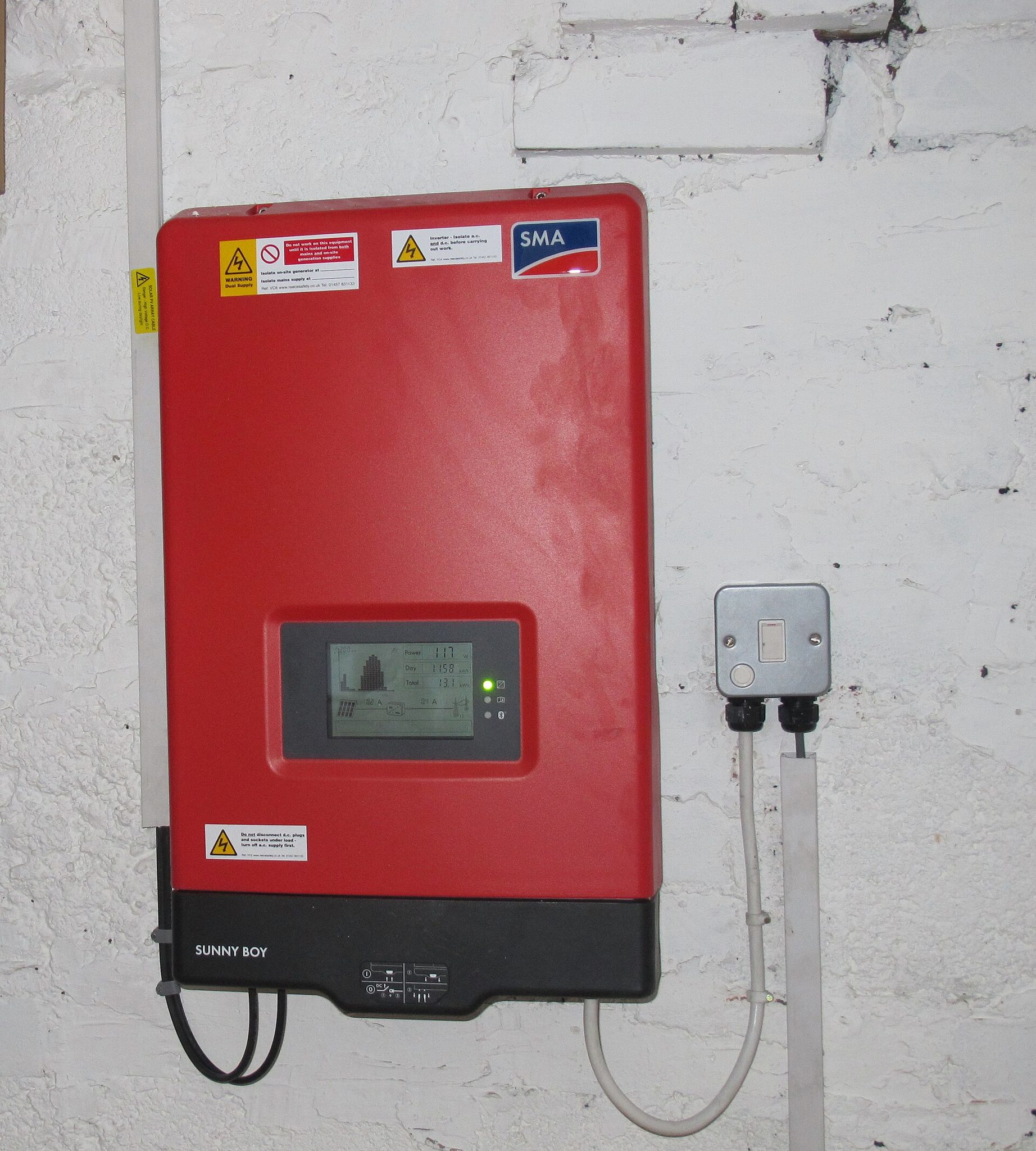
Photo: David Hawgood / Wikimedia Commons, CC BY-SA 2.0
DC electrical safety and working on the roof
Safety warning: solar panels produce electricity whenever there is light — there is no "off switch" on the roof. A string of 10 panels can reach several hundred volts DC, and a DC arc does not extinguish itself easily, causing fires and burns. Never unplug an MC4 connector while the string is under load; switch off the inverter and open the DC breaker first, and test with a meter of a suitable measurement category. On the roof, wear a harness anchored to a solid point and non-slip shoes, never climb onto a wet metal roof or during thunderstorms, and never step on a panel. Only people trained in electrical safety and working at height should do the wiring.
Safety checks during the survey, before quoting
- Check the purlins and how corroded an old metal roof is: a weak roof must be reinforced, and the cost added to the quote.
- How the panels get onto the roof: stair access, a crane or rope hauling; any medium-voltage lines close to the house.
- Location of the distribution board and existing earthing; an old board with no earth needs a new earthing system.
Hidden costs to mention
Removing and refitting panels when the roof is repaired, regular panel cleaning and an inverter replacement mid-life are costs customers often forget. State clearly in the quote what is and is not included.
Common quoting mistakes for 5 kW systems
Quoting the inverter rating as the array size
Symptom: a customer receives a "5 kW system" with only 8 small panels. Cause: the quote never stated the array's kWp. Fix: always write number of panels × Wp = kWp, with the inverter rating listed separately.
Promising output based on the sunniest month
Symptom: the customer complains about low output in the rainy season. Cause: April–May output multiplied by 12. Fix: use annual averages as in the table above and state that output varies by season.
Calculating payback on 100% of output
Symptom: "2–3 year payback" that turns out much longer. Cause: counting exported surplus as savings. Fix: use the realistic self-consumption ratio based on daytime usage habits.
Frequently asked questions
How many kWh does a 5 kW solar system produce per month?
Roughly 500–550 kWh a month on average in northern Vietnam and 650–700 kWh in the South for a 5.5 kWp array on a well-oriented, unshaded roof. Rainy months and the northern winter are noticeably lower.
Can a 5 kW system run an air conditioner?
Yes, if the air conditioner runs during the day while the sun is out. A grid-tied system draws extra from the grid when needed; on a hybrid system, running air conditioning in the evening drains the battery quickly, so size the battery accordingly.
Does a grid-tied system work during a power cut?
No. A grid-tied inverter shuts down when the grid fails, to protect line workers repairing the network. To have power during outages you need a hybrid inverter with a battery or a backup output.
Do I need permission before installing?
The procedure depends on the regulations in force and on whether power is exported to the grid. The safe approach is to ask the local power company and check the current rules before installing.
How long do solar panels last?
Manufacturers usually give a performance warranty of about 25 years or more, with output declining gradually each year. Inverters and batteries have shorter lives and should be planned for replacement.
Practice exercises and self-assessment
- Take 3 months of power bills from your home or someone you know and estimate the share of daytime use.
- Build a cost breakdown for a 6 kWp system (11 panels of 550 Wp) using unit prices you collect from 2 suppliers.
- Calculate monthly output and payback with the formulas in this lesson for your own province.
- Measure a roof, sketch the panel layout and mark shading at 9:00, 12:00 and 15:00.
Self-assessment criteria
- Pass: the cost table has all 5 items and the total adds up; the array kWp and inverter kW are stated separately.
- Pass: output and payback use the correct formulas and the self-consumption ratio, not 100% of output.
- Not yet: promising a specific power buy-back price, skipping the roof structure check, or leaving out DC and working-at-height safety.
Once the quote is accepted, move on to the next step of the roadmap: Mounting rails & panels — fixing metal-roof clamps, sealing screw holes and torquing clamps correctly. See the 8-step solar PV installer roadmap.