Clean solar panels when sunny-day output drops by about 5–10% compared with just after the last wash, or when you can see bird droppings, leaves or a thick layer of dust on the glass; for a typical town house in Vietnam that usually means 2–4 washes a year, mostly in the dry season. Wash in the early morning or late afternoon with clean, low-mineral water, a long-handled soft brush and microfibre cloths; never use a high-pressure washer, stiff brushes or harsh chemicals. This lesson gives the procedure a maintenance technician follows, with warnings about DC electricity and working on roofs, and a worked example that checks whether a wash is worth the money.
By the end of this lesson, you will be able to:
- Read production data in the monitoring app to decide when cleaning is needed, rather than washing by feel.
- Choose the right tools, water and permitted cleaners so you do not scratch the glass or void the panel warranty.
- Plan roof safety: anchor points, ladder, weather and the places you must never step on.
- Clean an array with an 8-step procedure while checking for cracked glass, hot spots, cables and clamps.
- Turn lost output into money so you can advise customers on a sensible cleaning frequency.
Learning solar installation properly? Cleaning and maintenance belong to the step "Battery storage, monitoring and maintenance" in the roadmap. See the 8-step solar installer roadmap to learn from DC safety through to complete home systems.
Why do dirty panels produce less?
A solar panel turns the light passing through its glass into electricity. Dust, smoke, pollen and bird droppings block some of that light. Even dust lowers output gradually; dense local dirt is more dangerous.
Even dust versus local dirt
Dust spread evenly across a panel means every cell gets a little less light, and output falls in proportion to the dust layer. Bird droppings, dry leaves or mud covering a few cells are different: a shaded cell stops producing and restricts the current of the whole string. Panels have bypass diodes that route current around a shaded cell group, but that group's output is lost, and a cell shaded for a long time can heat up into a hot spot that damages the panel.
Typical losses in Vietnam
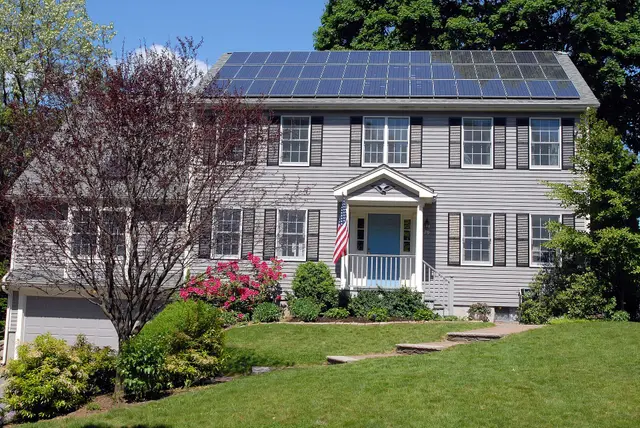
In the rainy season, rain washes off some dust from panels tilted at about 10 degrees or more. In the dry season (roughly December to April in the south, the dry winter in the north) dust builds up. Roofs near main roads, building sites, industrial parks, sawmills, brick kilns or rice-drying fields get dirty much faster. Dust losses can range from a few percent to more than 10% depending on location and how long it has been since rain; the real figure must be measured from that system's own data, as Figure 1 illustrates.
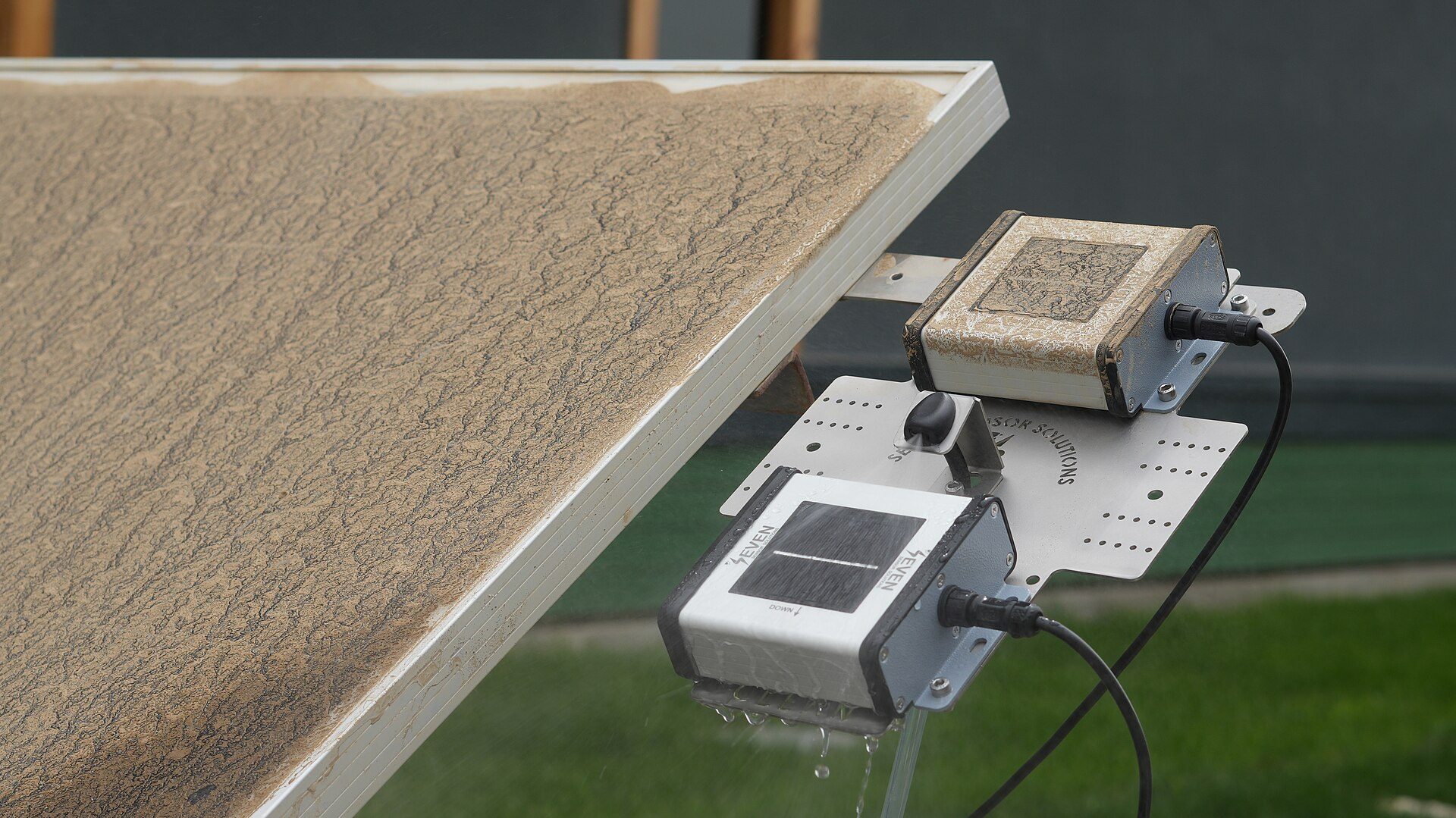
Photo: SerkanEmr / Wikimedia Commons, CC BY-SA 4.0
Low-tilt panels get dirty faster
Panels laid almost flat (below about 5–10 degrees) hold rainwater at the bottom edge of the frame, and dust settles into a muddy strip along it. When surveying a new job, this is one reason to choose a suitable tilt; during maintenance, it is the area to clean most carefully.
When do panels need cleaning?
Washing too often wastes labour and adds roof risk; washing too rarely loses output. The professional approach is data plus observation.
Reading production in the monitoring app
- Right after each wash, record output (kWh) on 3–5 consecutive clear sunny days and take the average as your baseline.
- Each month, average the 3–5 most recent clear days and compare with the baseline.
- A drop of about 5–10% or more in similar weather, with no new shading and no inverter alarms, most likely means dirt.
- A sudden drop, or one string falling much more than the others, points to a technical fault (connector, fuse, failed panel), not dust. Check for faults before washing.
Compare within the same season: July and March output differ because of sun angle, cloud and temperature, not dust.
Reference cleaning frequency
| Surroundings | Reference frequency | Notes |
|---|---|---|
| Residential, low dust, tilt ≥ 10 degrees | Twice a year (start and middle of the dry season) | Usually not needed in the rainy season |
| Town house on a main road or near building sites | 3–4 times a year | Check the app monthly |
| Near industrial parks, workshops, kilns, fields | Every 1–2 months in the dry season | Oily dust and soot need more careful wiping |
| Coastal | 3–4 times a year | Salt film; also check frames and clamps for corrosion |
| Bird droppings, falling leaves | Spot-clean when seen | Local dirt causes hot spots |
Visible signs
Besides the data, ask customers to call you when they see caked bird droppings, leaves on the panels, thick mud along the bottom edge, or after nearby construction, field burning or dusty rain. These cases should be handled early even if the next wash is not due.
Tools, water and cleaners: what to use, what to avoid
Panel glass has a very thin anti-reflective coating. Scratch or etch it and the output loss is permanent, and you may void the warranty. Always read the cleaning section of the panel maker's installation manual first; the table below gives general rules.
| Item | Use | Do not use |
|---|---|---|
| Brushes, cloths | Long-handled soft brush, soft sponge, microfibre cloth, rubber squeegee | Stiff brushes, scouring pads, sandpaper, scrapers |
| Water | Clean, low-mineral water (filtered mains, demineralised) | Hard or iron-rich well water left to dry, which leaves spots |
| Cleaners | Only if the maker allows: diluted neutral solution, then rinse well | Acids, strong alkalis, solvents, fuel, abrasive cleaners |
| Water pressure | Ordinary hose, low pressure | High-pressure washers (unless the maker's manual specifically allows them) |
| Temperature | Wash when panels are cool: early morning, late afternoon | Cold water on hot glass at midday |
Why not wash at midday
At midday the panel surface can be far hotter than the air. Cool water on hot glass causes a sudden temperature difference that stresses the glass. The water also evaporates at once and leaves mineral marks. On top of that, technicians risk heat stroke and burnt hands on the aluminium frames.
The kit for one cleaning job
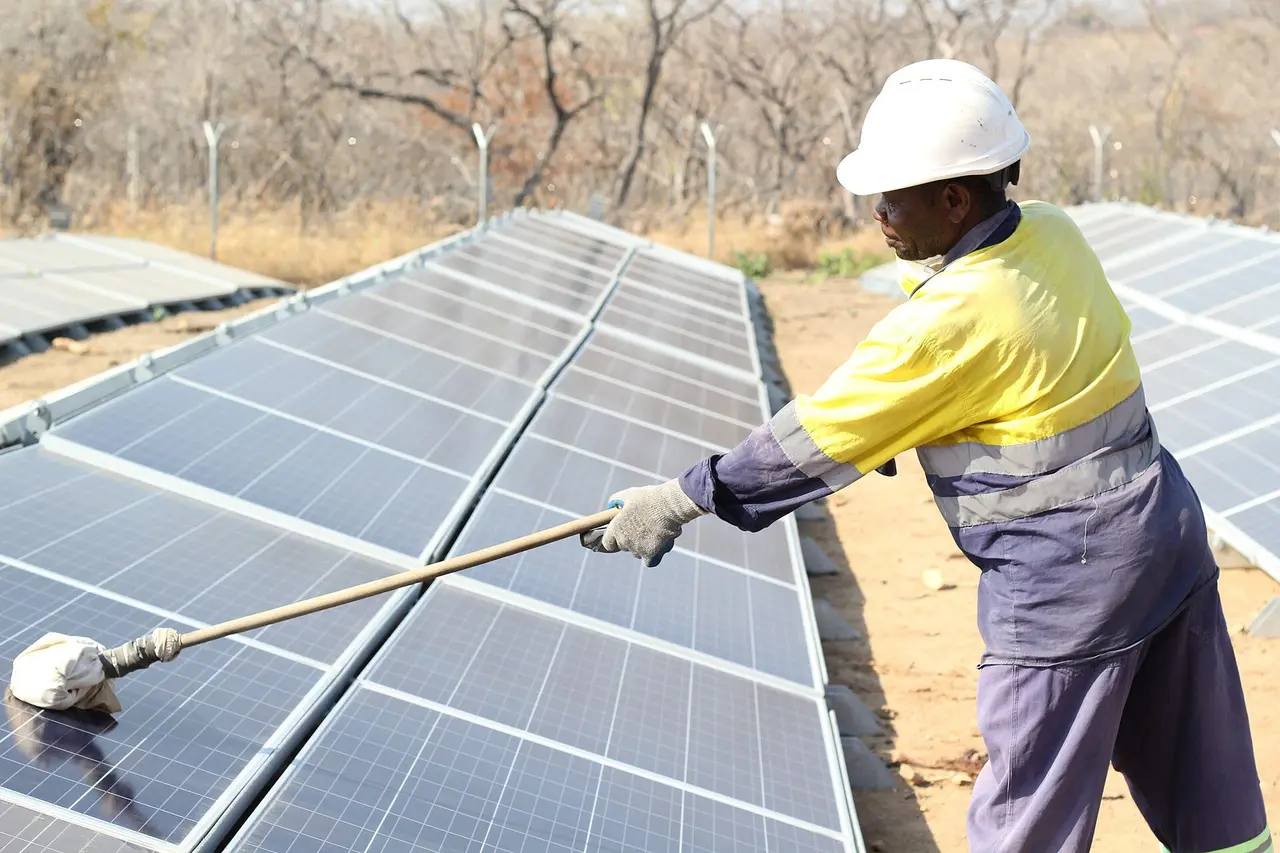
Extendable pole with a soft brush head and a sponge head (Figure 2), clean bucket, microfibre cloths, rubber squeegee, hose with a shut-off nozzle, torch, phone for before-and-after photos, gloves, soft non-slip shoes, helmet, full-body harness and lanyard, and sunglasses against glare.
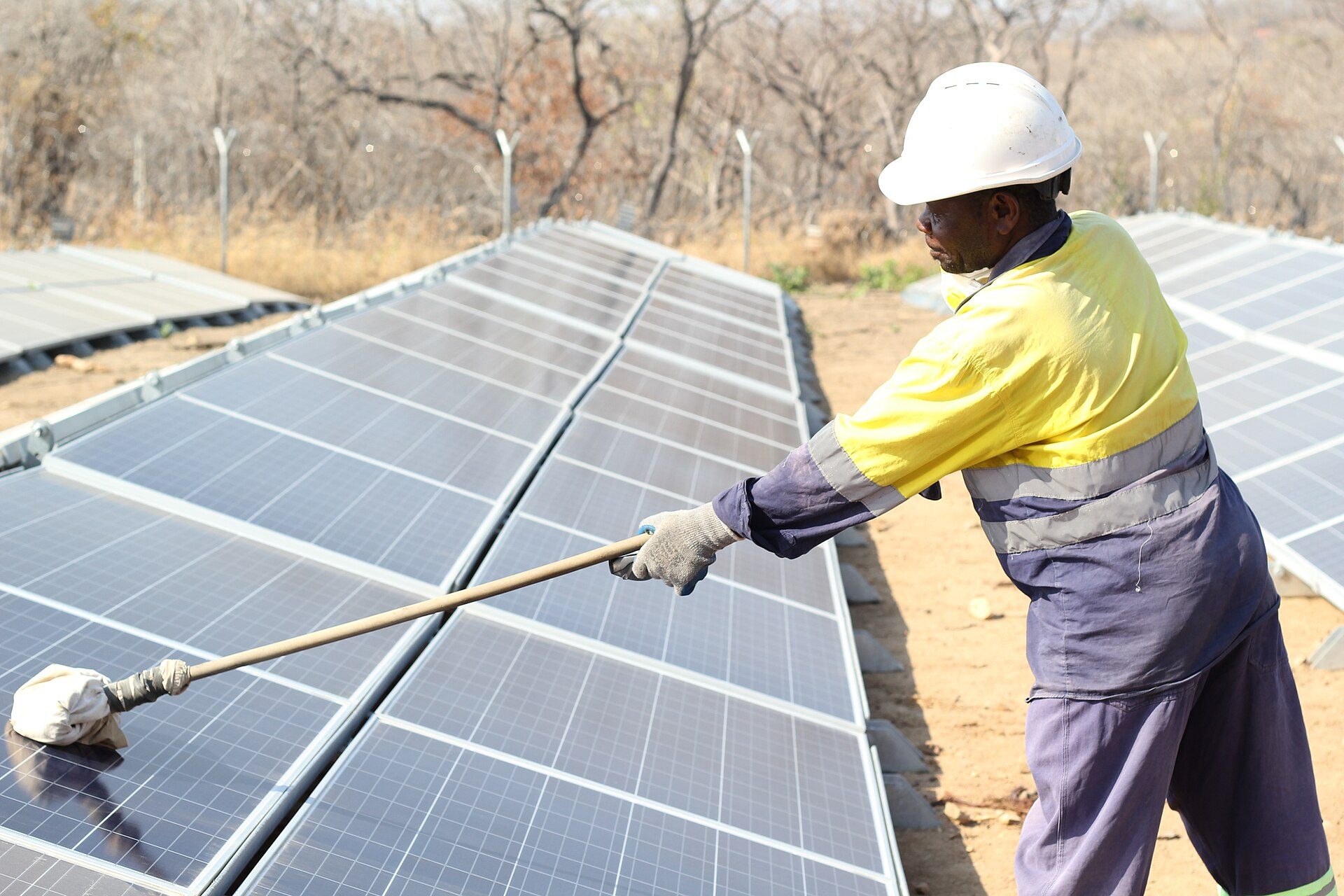
Photo: Deo photographer / Wikimedia Commons, CC BY-SA 4.0
DC safety and working on roofs
Cleaning panels sounds simple, but it combines the two biggest hazards of the trade: high-voltage direct current and working at height. Read this section carefully before you go up.
Safety warning: Panels generate electricity whenever there is light, even after the inverter is off and the isolators are open. A string on a house can reach several hundred volts DC, enough to kill. Before any water touches the array, inspect it: if you see broken glass, a bent frame, damaged cable insulation or scorched connectors, do not wash or touch it; leave the area and call a qualified technician to isolate the system properly. Never spray water directly at junction boxes, connectors, switchboards or the inverter. On the roof: always wear a full-body harness clipped to a sound anchor point; do not go up in rain, strong wind or thunderstorms; wet metal roofing is very slippery; never step on fibre-cement sheets, skylights or the panels themselves. Work in pairs at least, with one person below holding the ladder and watching.
Should the system be switched off first?
Follow the inverter maker's and installer's instructions. Many companies require switching off the inverter, then opening the AC isolator and the DC isolator before washing, to reduce risk if there is hidden damage. You need to know where each switching device is; see how DC and AC boxes are laid out in grid-tied solar wiring diagram: DC box, AC box and inverter. Remember that opening an isolator only stops current; the panels still carry voltage in sunlight.
Ladder, anchor points and walkways
Stand the ladder on firm ground with its top about 1 m above the roof edge and tie it off; keep three points of contact when climbing. The harness must clip to a load-bearing structure (a beam or a purpose-made anchor), not to aluminium rails, pipes or flimsy railings. Figure 3 shows a technician in a full-body harness working beside an array on a town-house roof.
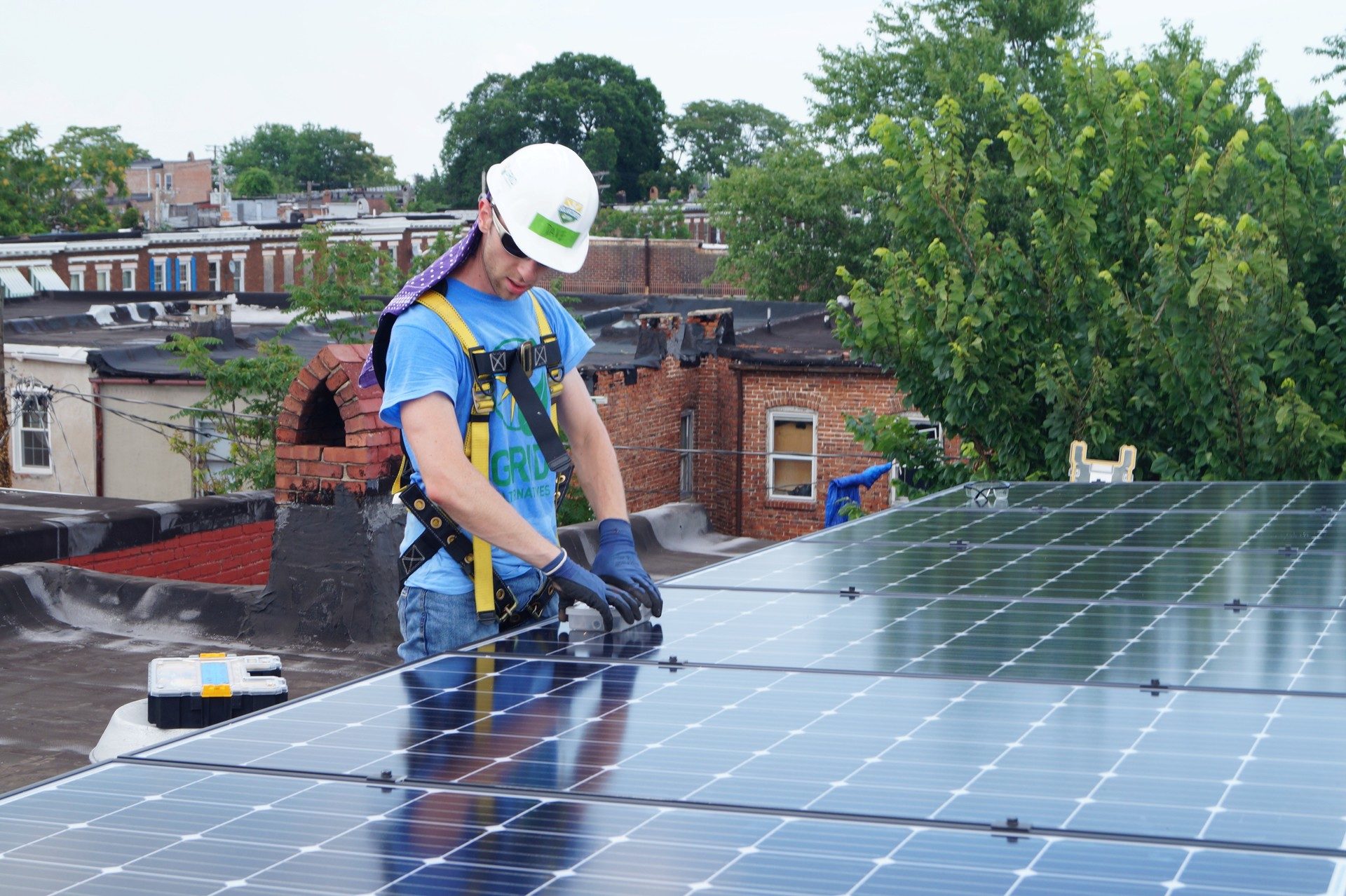
Photo: Photo by Kirsten Rumsey. – U.S. Department of Energy from United States / Wikimedia Commons, Public domain
Who should not do it themselves
Customers often ask whether they can wash the panels themselves. If the array is on a roof terrace with railings, the panels are low and there is a tap nearby, someone at home can gently hose them from a safe walkway. Pitched roofs, metal roofs, and houses of two storeys or more without a terrace should be left to a crew with harnesses and experience.
An 8-step procedure for cleaning a rooftop array
This procedure is for 5–10 kWp home systems washed with clean water and a soft brush.
- Choose time and weather: early morning or late afternoon, dry, light wind, no storms forecast.
- Record the before state: screenshot recent output in the app and photograph the array from several angles.
- Get onto the roof safely: set up and tie off the ladder, clip on, and haul tools up on a rope rather than carrying them while climbing.
- Inspect before any water: cracked glass, burn marks, loose cables, loose panel clamps, nests or leaves under the panels. If there is damage, stop and tell the customer.
- Switch off per company procedure (if applicable) and note the order you used.
- Wet and wipe: spray low-pressure water from the top down, leave a few minutes for dust to soften, brush gently from the top edge to the bottom edge; soak bird droppings longer and wipe with a sponge, never pry them off.
- Rinse and squeegee: rinse with clean water and squeegee or wipe with microfibre so no water lines remain along the frame (Figure 4).
- Restart and hand over: switch back on in reverse order, check the inverter runs normally, take after photos, fill in the record and arrange to compare output over the next 3–5 sunny days.
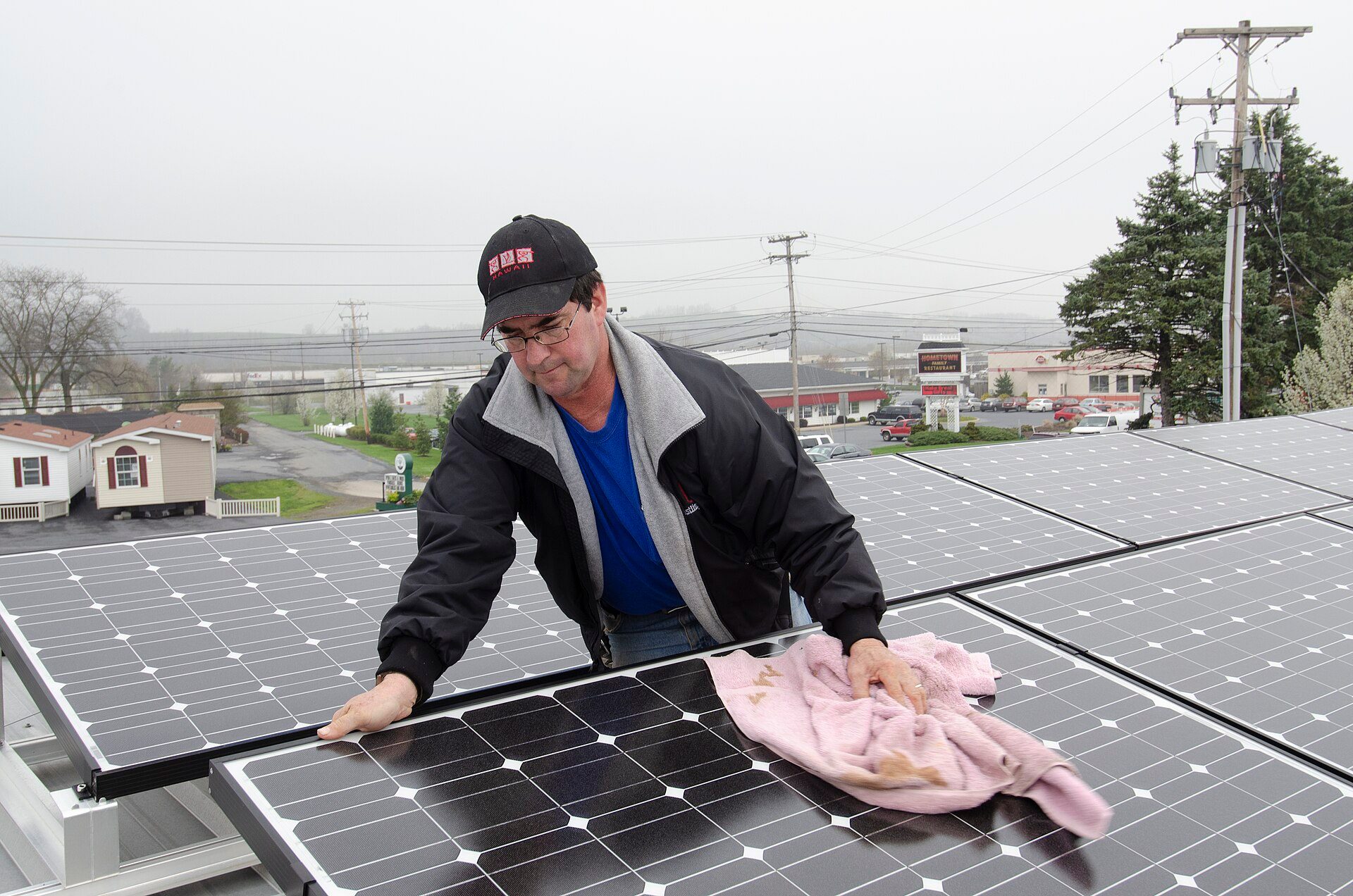
Photo: U.S. Department of Agriculture / Wikimedia Commons, Public domain
Technical checks while cleaning
Every trip onto the roof is a free inspection. Record: panels with cracks, discoloration or "snail trails" (thin brown lines across cells); loose clamps and rail bolts; cables rubbing on metal roofing edges; new tree growth causing shade. If you have a thermal camera, take images while the system is running to find hot spots.
Time for a 10-panel system
Ladder, harness and tools up: 20 minutes. Pre-inspection: 10 minutes. Wetting, brushing, bird droppings: 30 minutes. Rinse and squeegee: 15 minutes. Restart, photos, record: 10 minutes. Total: 20 + 10 + 30 + 15 + 10 = 85 minutes for two people.
Worked example: is a wash worth it for a 5.5 kWp system near an industrial park?
Mr Tam's house in Bien Hoa (Dong Nai) is about 1 km from an industrial park and has a 5.5 kWp system of ten 550 W panels on a metal roof tilted about 12 degrees. It is the middle of the dry season with no significant rain for 3 months. He asks whether to call someone to clean it.
Step 1: compare output with the baseline
- Baseline after the last wash (average of 5 clear days): 23.0 kWh per day.
- Now (average of the 5 most recent clear days): 20.7 kWh per day.
- Drop: 23.0 − 20.7 = 2.3 kWh per day, or 2.3 ÷ 23.0 = 10%.
- No app alarms, all strings dropped evenly, no new shading: most likely dust.
Step 2: convert to money
- Monthly loss: 2.3 × 30 = 69 kWh.
- Electricity saved valued at 2,800 VND per kWh (reference, depends on each household's tariff tier): 69 × 2,800 = 193,200 VND per month (about 7.5 USD).
Step 3: cleaning cost and decision (2026 reference, varies by area)
| Item | Quantity × unit price | Total |
|---|---|---|
| Panel cleaning labour | 10 panels × 40,000 VND | 400,000 VND |
| Call-out fee | 1 × 100,000 VND | 100,000 VND |
| Total for one wash | 500,000 VND | |
Residential cleaning in Vietnam costs roughly 20,000–50,000 VND per panel in 2026, and many companies charge a package of 300,000–800,000 VND for systems under 10 kWp, depending on area, roof height and how dirty it is. Payback for one wash: 500,000 ÷ 193,200 ≈ 2.6 months. With 2–3 months of dry season left in Bien Hoa and a roof near an industrial park that will keep getting dirty, the advice is to wash now, then set a new baseline. If output only rises to about 21 kWh instead of 23 kWh after washing, look for other causes such as panel degradation or a string fault.
Common mistakes when cleaning panels
Using a high-pressure washer
Sign: water gets into the frame edge, seals are pushed out, junction boxes get damp, and the inverter later reports an insulation fault. Cause: a strong jet at close range. Avoid it: use a low-pressure hose; only use a pressure washer when the maker's manual allows it, at the stated pressure and distance.
Scrubbing with stiff brushes, scraping droppings
Sign: hazy scratches visible when you look across the glass. Cause: sand in the dust dragged across the surface, or a scraper. Avoid it: wet thoroughly so dust floats off first, soak droppings and wipe with a soft sponge.
Washing at midday or with mineral-rich well water
Sign: white spots all over the glass once dry. Cause: fast evaporation leaving minerals behind. Avoid it: wash when cool, use low-mineral water and squeegee dry straight away.
Walking on the panels
Sign: a few weeks later one panel underperforms, and close inspection finds micro-cracks. Cause: stepping or kneeling on panels to reach inner rows. Avoid it: use an extension pole from the walkway; on new installs, leave maintenance walkways between rows.
Frequently asked questions
How often should solar panels be cleaned?
Most town houses in residential areas need about 2–4 washes a year, mostly in the dry season. Roofs near main roads or industrial parks may need one every 1–2 months in the dry season. The surest method is comparing sunny-day output in the app with the baseline after the last wash.
Can I clean solar panels with dish soap?
Only use a cleaner if the panel maker's manual allows it, usually a very dilute neutral solution followed by a thorough rinse. Many dish soaps contain foaming agents and fragrances that leave a film which attracts dust. For normal dust, clean water and a soft brush are enough.
Does rain clean solar panels by itself?
Rain washes light dust off well-tilted panels, but not dried bird droppings, oily soot or the mud strip at the bottom edge. Light rain after a long dry spell can even turn dust into sticky mud.
Does washing panels void the warranty?
Not if you follow the maker's instructions. Using tools, chemicals or water pressure the maker forbids, or cracking glass by stepping on panels, can void it. Read the cleaning section in the installation manual for the exact panel model.
Is a panel-cleaning robot worth it for a home?
Robots and automatic spray systems suit solar farms and factory roofs of hundreds of kWp. For a 5–10 kWp system the investment is usually far higher than a few paid washes a year.
Practice and self-assessment
- Take 30 days of output data from a real system (or sample data), pick 5 clear days, calculate the baseline and the percentage drop.
- Write a roof safety checklist for a three-storey town house with a metal roof: ladder, anchor points, walkways, weather, helper.
- Work out the cost and payback of one wash for an 8-panel system losing 1.5 kWh per day, at 2,800 VND per kWh, 40,000 VND per panel labour and a 100,000 VND call-out.
- Clean an array under a lead technician's supervision, with before and after photos and an inspection record.
Self-assessment criteria
- Pass: your decision to wash is based on a measured percentage drop, and you can tell dust from a technical fault.
- Pass: you only use permitted tools, water and cleaners, and never step on a panel.
- Pass: your harness stays clipped to a load-bearing anchor the whole time you are on the roof.
- Not yet: washing at midday, using a pressure washer without the maker's guidance, or touching a panel with broken glass or exposed cable.
To advise customers fully you also need to know how much the system generates and how it pays back; see 5 kW solar system cost in Vietnam: price breakdown and payback. Once maintenance is solid, move on to the next roadmap step: Installing a complete 5–10 kWp home system, where you do everything from roof survey to handover yourself and design maintenance walkways in from the start.
Keep learning solar installation: after maintenance come a complete 5–10 kWp project, electrical safety certification, quoting and finding projects. See the 8-step solar installer roadmap.