What a gypsum ceiling costs in Vietnam depends mostly on the type of ceiling: in 2026 a suspended grid ceiling is typically about 130,000–220,000 VND/m², a flush (concealed-frame) ceiling about 160,000–260,000 VND/m² and a stepped ceiling about 190,000–350,000 VND/m², materials and labour included but painting excluded (2026 reference, varies by region). When two crews quote the same room several million dong apart, it is usually not because one is overcharging. They measured the area differently, priced different frames and boards, or one included skim coating, cove lighting slots and downlight holes while the other did not. This lesson teaches you to read a price table, measure a ceiling properly and build a living room quote whose lines add up.
By the end of this lesson, you will be able to:
- Read and explain a price table for grid, flush and stepped ceilings to a homeowner as min–max ranges.
- Work out ceiling area from drawings or site measurements, including stepped upstands, cove slots and light holes.
- Separate material, labour and finishing costs so two quotes can be compared fairly.
- Build a living room quote where quantity × unit rate = amount and the total adds up.
- Check your own workmanship before handover: flatness, level and crack-free joints.
Learning drywall and ceilings properly? Take-off and quoting is step 8, the last step of the roadmap, after safety, materials, grid ceilings, flush and stepped ceilings, partitions, joint finishing and a real project. See the 8-step drywall and ceiling installer roadmap to learn in the right order.
How much does a gypsum ceiling cost in 2026: reference prices
In Vietnam, gypsum ceilings are usually priced per m² of floor plan, "all-in" for the frame, boards, screws, accessories and installation labour. Painting is usually a separate line. The table below shows the ranges you will meet when asking interior fit-out crews in the big cities; provinces may be cheaper, and high-rise jobs with difficult access may cost more.
Price per m² by ceiling type (all-in, excluding painting)
| Ceiling type | 2026 reference (VND/m²) | Typical use | Notes |
|---|---|---|---|
| Suspended grid ceiling (60 × 60 cm tiles, exposed grid) | 130,000–220,000 | Offices, shops, corridors, storerooms | Vinyl-faced or mineral fibre tiles cost more than plain ones |
| Flush ceiling, standard board | 160,000–260,000 | Bedrooms, apartment living rooms | Heavier, better-galvanised frames sit in the upper half |
| Stepped flush ceiling, 1–2 levels | 190,000–350,000 | Living rooms, lobbies, altar rooms | Upstands and cove slots are often charged extra |
| Flush ceiling, moisture-resistant board | Add 20,000–50,000 to standard board | Bathrooms, covered balconies, kitchens | Moisture resistant does not mean it survives direct leaks |
All figures are 2026 references that vary by region, frame and board type, and job size. They are not fixed prices, and you should never promise a homeowner a number before seeing the site.
Price of skim coating and painting the ceiling
After the boards are fixed and the joints taped, the ceiling still needs skim coating, primer and topcoat. This is usually quoted separately at about 35,000–70,000 VND/m² (2026 reference), depending on the number of coats, the paint and who supplies it. Some crews fold painting into the ceiling price so it looks "all-in"; others leave it out so the ceiling price looks cheap. The first question when comparing two quotes is: does it include painting?
Grid, flush and stepped ceilings compared
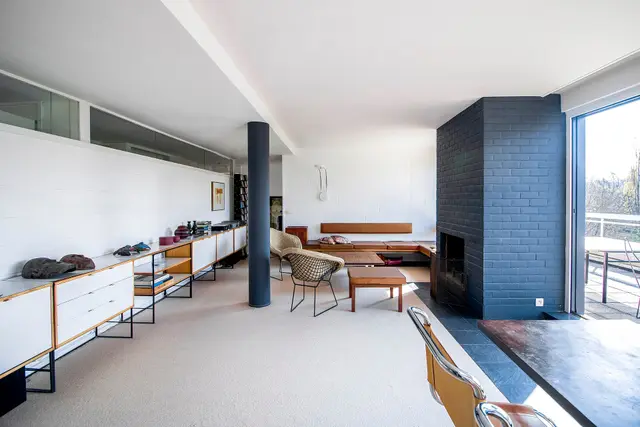
- Suspended grid ceiling (Figure 1): exposed T-bar grid, tiles drop in and lift out for electrical or air-conditioning access. Quick to fit, almost no finishing, so it is the cheapest.
- Flush ceiling: the frame is hidden above, boards are screwed to it and joints are taped and skimmed flat. The surface reads as one piece, like a concrete soffit.
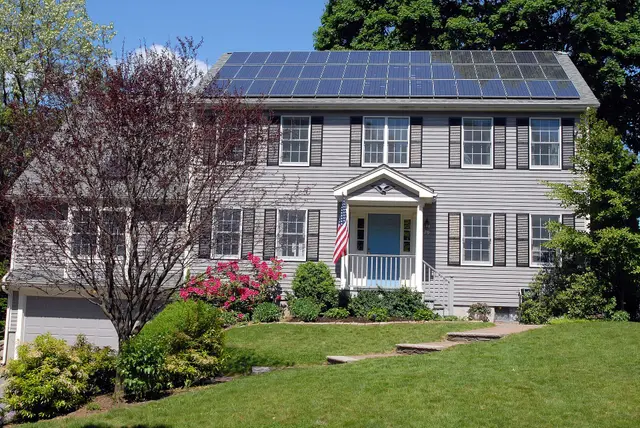
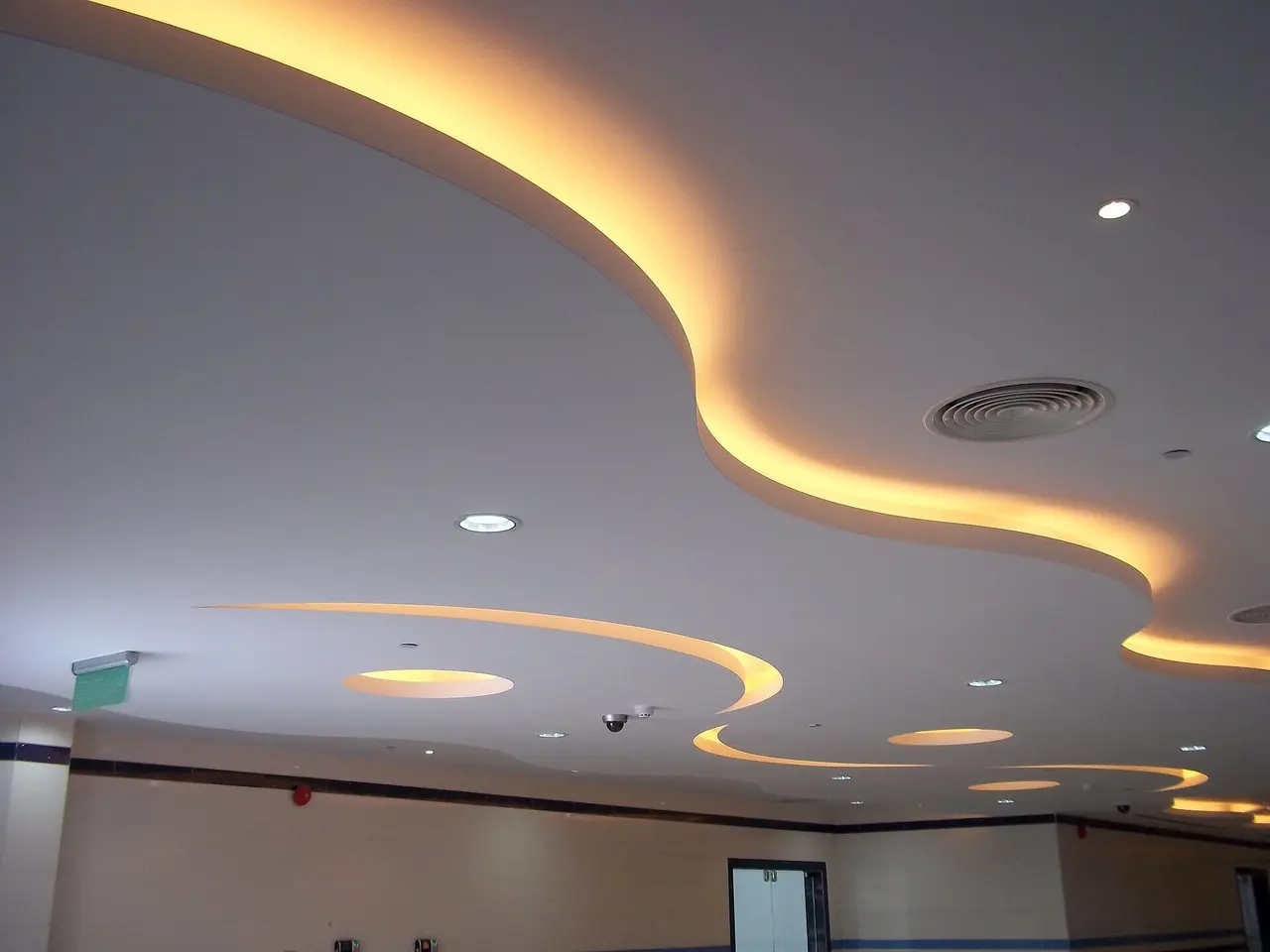
- Stepped ceiling (Figure 4): a flush ceiling at several levels, often with cove lighting slots. Many corners, upstands and finishing hours, so it is the most expensive.
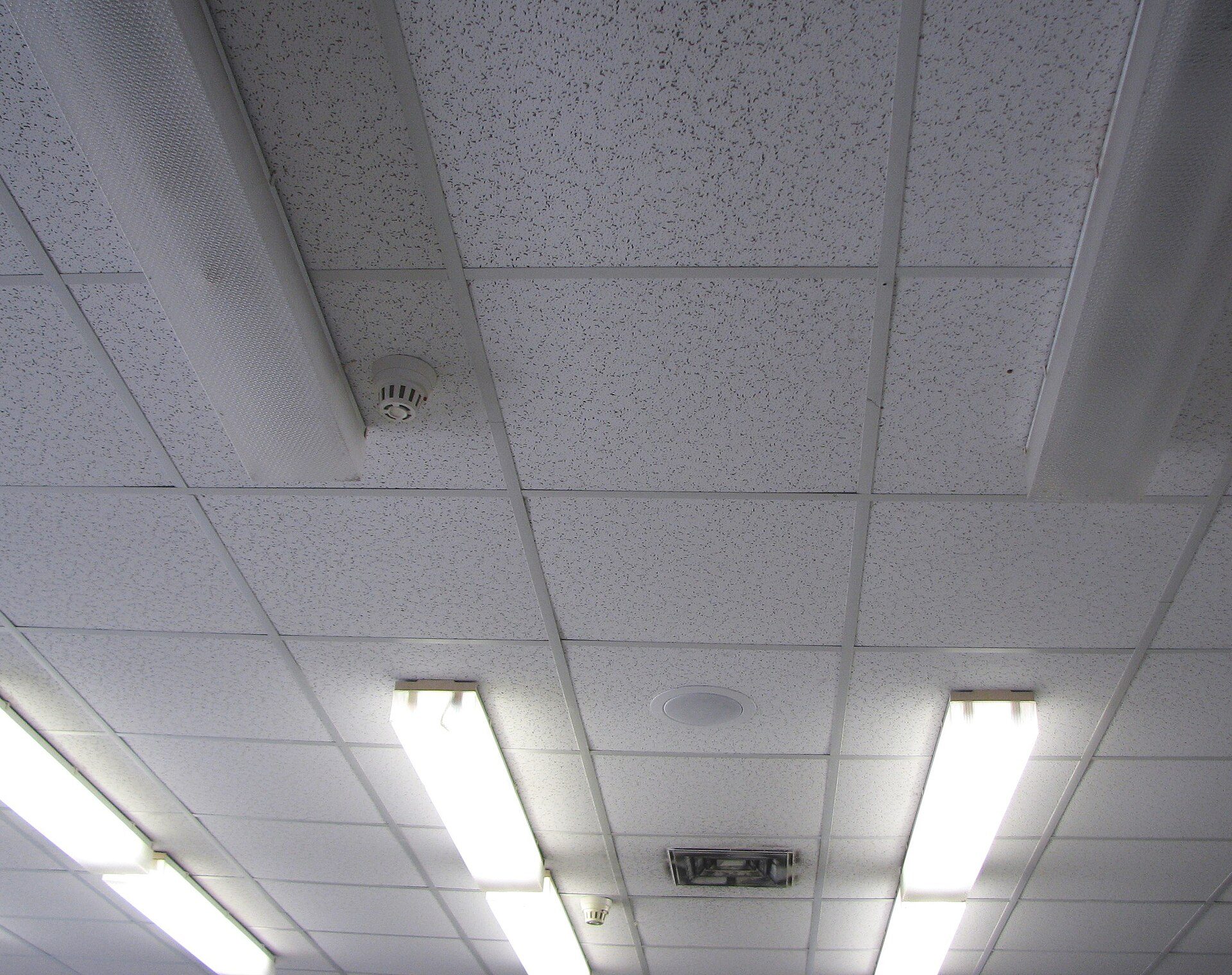
Photo: Adamantios / Wikimedia Commons, CC BY-SA 3.0
Why gypsum ceiling prices vary so much
Homeowners compare quotes by a single VND/m² figure. A good installer can explain where that figure comes from, using four groups of factors.
Frame and boards
The frame carries the load and decides whether the ceiling sags or the joints crack after a few hot and cold seasons. Thicker sections with better galvanising cost more. Ceiling boards are commonly about 9 mm thick; moisture-resistant and fire-rated boards cost more than standard ones. A quote should state the frame type, board type and thickness rather than just "grade 1 gypsum". Do not promise quality by naming a brand; write the specifications and let the homeowner choose.
How hard the job is
- Ceiling height: above roughly 3.5 m you need scaffolding, and that takes time to erect and strike.
- Levels and curves: two steps, curved cuts and round light coffers take several times the labour of a flat ceiling.
- Access: a high-rise apartment with no goods lift means carrying boards up by hand, which raises transport cost.
- Electrical and air-conditioning coordination: ducts and cassette units need access panels and extra framing.
Small areas and fixed costs
A 4 m² bathroom still needs one delivery, one scaffold set-up and one visit. Many crews therefore set a minimum charge per job or use a higher rate for small areas. State this in the quote so the homeowner is not surprised.
Work that comes with the ceiling
Cove slots, downlight holes, access panels, cornices, painting, removing an old ceiling and taking away debris: each is a line of money. An unusually cheap quote is often a quote with missing lines, which then turn into extras halfway through the job.
How to calculate gypsum ceiling area
The usual method is to measure the ceiling area by floor plan (room length × width), add the vertical upstands of a stepped ceiling if any, and price cove slots and light holes separately by the metre or by the piece. Above all, write the method in the quote, because every crew has its own habits.
Flat and grid ceilings
Measure room length and width at ceiling height, finished wall to finished wall. A 5.0 × 4.0 m room has a 20 m² ceiling. For an L-shaped room, split it into two rectangles and add them. Small light holes and vents are usually not deducted, because cutting them costs more labour than the board saved.
Stepped ceilings: add the upstand area
A stepped coffer has vertical faces where boards are cut and fixed to vertical framing. The common method: upstand area = coffer perimeter × step height. For a 4.0 × 2.5 m coffer stepped 0.15 m, the perimeter is 2 × (4.0 + 2.5) = 13 m and the upstand area is 13 × 0.15 = 1.95 m². Some crews do not charge upstands and raise the stepped-ceiling rate instead; both are fine if written down.
Cove slots, light holes and access panels
- Cove lighting slots (LED strip slots around the coffer): priced per linear metre.
- Downlight holes: priced per hole, or free if there are few; state who supplies and who wires the lights.
- Access panels: priced per piece, commonly 45 × 45 cm or 60 × 60 cm.
Taking off quantities from drawings
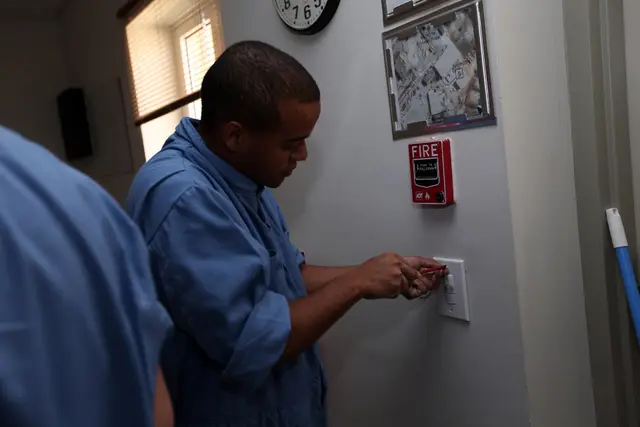
With a reflected ceiling plan, read dimensions from the grid lines and the levels marked on the drawing, mark each coffer and cove slot with a coloured pen, then make a table: room, dimensions, area, metres of slot, number of light holes. Always re-measure on site and fix the ceiling level (Figure 2) before confirming quantities, because real walls are often a few centimetres off the drawing and beams need extra work.
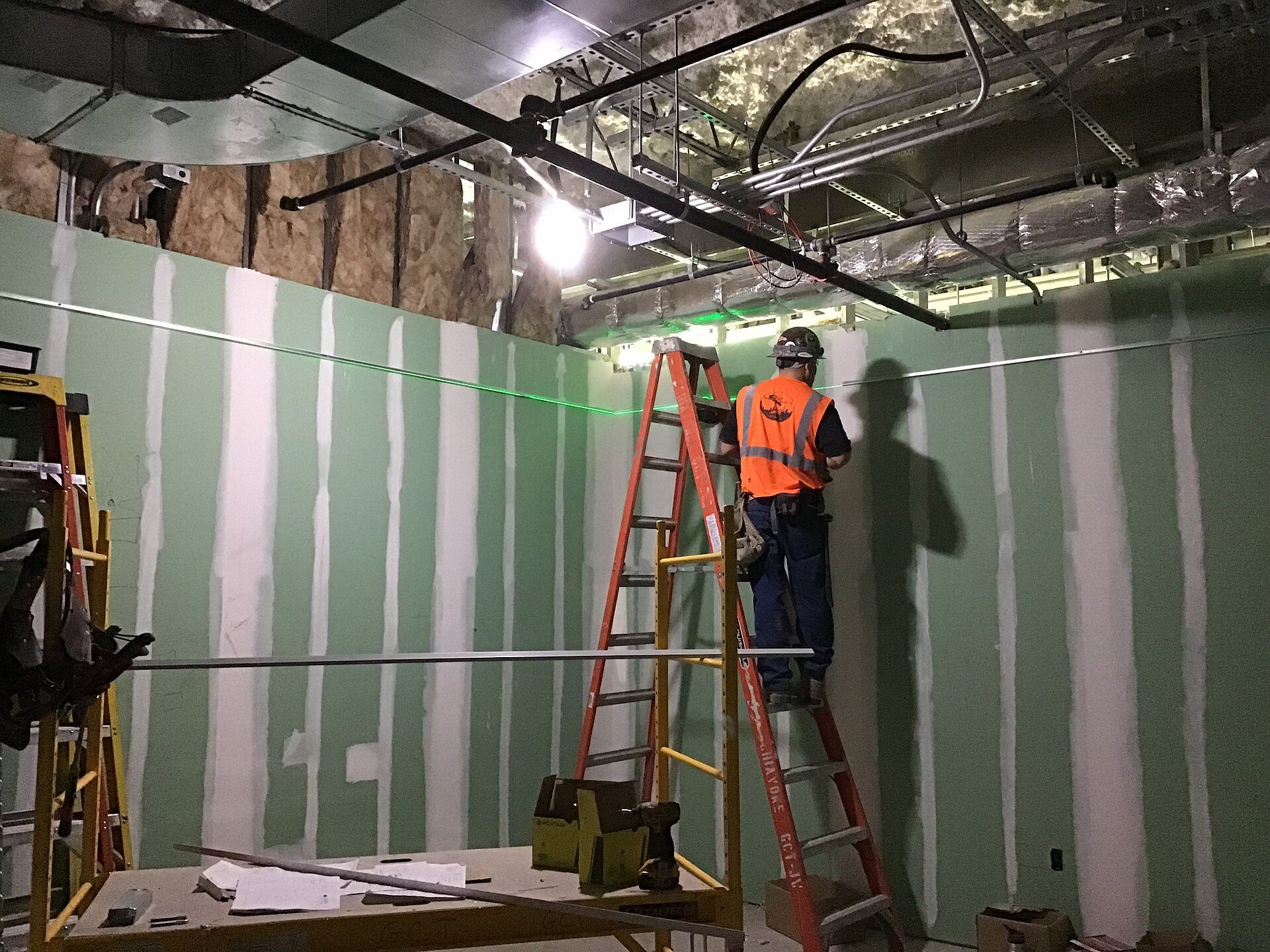
Photo: MTA Capital Construction Mega Projects / Wikimedia Commons, CC BY 2.0
Labour-only prices for gypsum ceilings
Many installers take labour-only contracts while the homeowner or the fit-out company supplies materials. You need to know labour rates so you do not quote below the real cost of your own time.
Reference labour rates
| Item | Unit | 2026 reference labour (VND) |
|---|---|---|
| Install grid ceiling | m² | 35,000–60,000 |
| Install flush ceiling | m² | 55,000–90,000 |
| Install stepped flush ceiling | m² | 75,000–130,000 |
| Cove lighting slot | linear metre | 30,000–70,000 |
| Skim coat and paint (labour) | m² | 20,000–40,000 |
| Remove old ceiling | m² | 15,000–35,000 |
Installers in big cities with a full crew and proper tools usually sit in the upper half of the range (2026 reference, varies by region, height and difficulty).
Per m² or day rate
A per-m² contract is clear and easy to compare, and suits rooms from about 15 m² up. A day rate suits small repairs: replacing a few grid tiles, patching holes, fitting an access panel; agree the number of people and hours in advance.
Work out your own cost before quoting
Use your crew's real output. For example, two installers might frame and board about 20–30 m² of flat ceiling a day at a 3 m height. Divide the two people's daily wages by the area completed to get your labour cost per m². Your quoted rate must be higher than that to cover days off, tool wear, fuel and the risk of rework.
Safety when surveying and installing ceilings
A site survey still means climbing ladders to measure, opening service hatches and looking at the cables above. The quote must include scaffolding and protective equipment; never cut them to make the price look cheaper.
Safety warning: For work at height use scaffolding with a working platform and guardrails, or an A-frame ladder locked open on both sides; never stand on the top step, a paint bucket or a plastic chair. High ceilings and multi-level scaffolds need a helper below and a safety harness where required. Before cutting downlight holes or driving screws near cables hidden above the ceiling, switch off the circuit for the area and ask where the cables run; do not connect wiring yourself unless you are qualified. Wear goggles when drilling concrete for hangers and when screwing overhead, and a fine-dust mask when cutting boards and sanding. Gypsum boards are large and heavy: two people carry each board, never one person up a scaffold.
Write risks into the quote
If the old ceiling shows leaks, cracked concrete beams or tangled old wiring, state in the quote that this is outside your scope and must be fixed first by an electrician or a waterproofing contractor.
Hangers and load-bearing framing
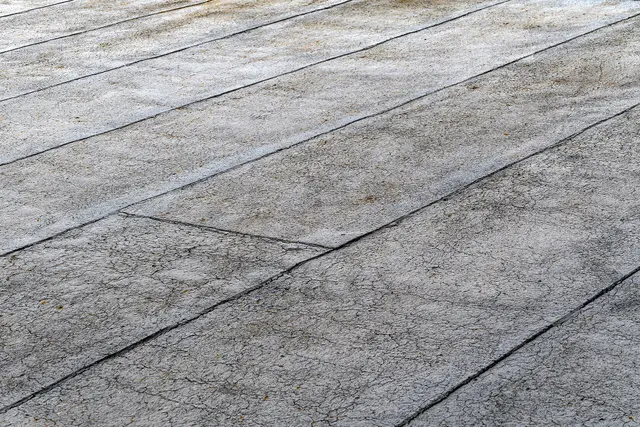
The ceiling frame hangs from the concrete slab on threaded rods and anchors (Figure 3). Hanger, main channel and furring channel spacing must follow the instructions for the frame system you use. Heavy chandeliers and ceiling fans must not hang from the gypsum frame; they must be fixed directly to the concrete slab. Write this down if the homeowner plans a chandelier.
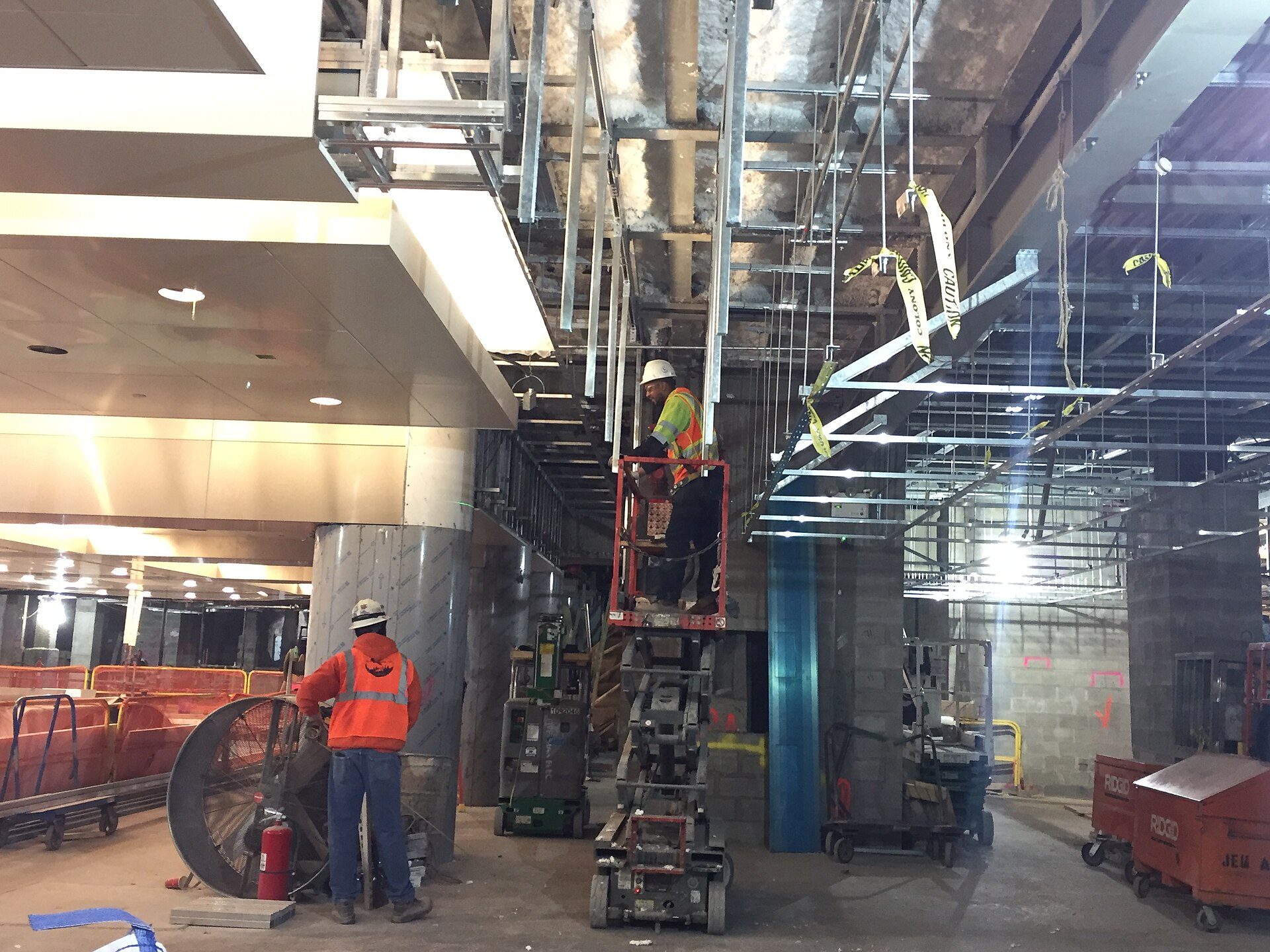
Photo: MTA Capital Construction Mega Projects / Wikimedia Commons, CC BY 2.0
Worked example: quoting a stepped ceiling for a 6.0 × 4.5 m living room
An apartment living room of 6.0 × 4.5 m, with a 3.1 m concrete soffit lowered to a 2.8 m ceiling. The homeowner wants a one-step flush ceiling: a lower border around the room, a central 4.0 × 2.5 m coffer raised 0.15 m, a cove lighting slot around the coffer and 10 downlights. There is a goods lift and no old ceiling to remove.
Step 1: take off the quantities
- Ceiling area by floor plan: 6.0 × 4.5 = 27 m².
- Upstand: coffer perimeter 2 × (4.0 + 2.5) = 13 m; area 13 × 0.15 = 1.95 m².
- Cove slot: around the coffer, 13 linear metres.
- Downlight holes: 10.
- Area to skim and paint: 27 + 1.95 = 28.95 m².
Step 2: estimate the number of boards
A common board size is 1.22 × 2.44 m, about 2.98 m² per board. The area to board is 28.95 m²; add about 10% cutting waste: 28.95 × 1.1 = 31.85 m². Boards: 31.85 ÷ 2.98 ≈ 10.7, rounded up to 11 boards. Frame, hangers, screws and mesh tape follow the take-off rates of the chosen frame system; here they are included in the all-in rate.
Step 3: the quote (2026 reference, varies by region)
| Item | Quantity × unit rate | Amount (VND) |
|---|---|---|
| Stepped flush ceiling, frame + standard 9 mm board, all-in | 27 m² × 220,000 | 5,940,000 |
| Upstand charged extra | 1.95 m² × 220,000 | 429,000 |
| Cove lighting slot (LED strip not included) | 13 m × 60,000 | 780,000 |
| Cut downlight holes (lights and wiring not included) | 10 holes × 15,000 | 150,000 |
| Two skim coats, one primer coat, two topcoats | 28.95 m² × 50,000 | 1,447,500 |
| Transport, protection, clean-up | Lump sum | 300,000 |
| Total | 9,046,500 | |
Check the sum: 5,940,000 + 429,000 = 6,369,000; + 780,000 = 7,149,000; + 150,000 = 7,299,000; + 1,447,500 = 8,746,500; + 300,000 = 9,046,500 VND (about USD 350). Per m² of floor plan: 9,046,500 ÷ 27 ≈ 335,000 VND/m², inside the range for a stepped ceiling plus painting. When the homeowner asks "why more than 220,000 per m²?", point to each line: upstand, cove slot, light holes, painting.
Step 4: schedule and payment
Two installers finish this room in about 4 days: day 1 set out levels, drill hangers and build the frame; day 2 board the ceiling, upstands and cove slot; day 3 tape joints and apply the first skim coat; day 4 second skim coat, sanding and primer (the topcoat may run into day 5 depending on drying time). Split payment by milestones: a material advance, after boarding, and after final inspection.
Writing the quote and checking your work before handover
A good quote is one the homeowner can read without asking "what does this include?", and it is your evidence if there is a dispute.
What a quote must contain
- Site details, survey date and who surveyed.
- Quantity × rate table, stating how area is measured (by floor plan, upstands charged or not).
- Material specifications: frame type, board type, thickness, moisture resistant or not.
- Exclusions: lights, LED strip, wiring, waterproofing repairs, special paint colours.
- Schedule, payment milestones, warranty period and warranty conditions.
Check your workmanship before handover
Before inviting the homeowner to inspect, check for yourself:
- Flatness: hold a 2 m aluminium straightedge against the ceiling in several directions; the largest gap should be only a few millimetres, and a raking light should show no ripples at the joints.
- Level: measure floor to ceiling at the corners and the centre with a laser or tape; differences must be within what you agreed.
- Joints: no cracks, no visible tape, no visible screw heads; stepped corners straight and crisp.
- Light holes and cove slots: in the positions on the drawing, clean cut edges, even slot width.
Skim coating and painting
Skim coating a gypsum ceiling follows the same rules as skimming a wall: thin coats, full drying, sanding, raking-light checks. To revise this part, see the house painter lesson how to skim coat walls in two smooth coats (in Vietnamese).
Common quoting mistakes
Quoting per m² without stating how it is measured
Sign: at payment time the homeowner measures 27 m² while the installer charges 31 m² including upstands and cove slots. Cause: the quote only said "stepped ceiling 220,000 VND/m²". Fix: always include a quantity table and state how each part is measured from the start.
Forgetting fixed costs
Sign: you lose money on small rooms. Cause: multiplying the rate by a small area without transport, scaffolding and clean-up. Fix: add a transport and clean-up line, or set a minimum charge.
Promising quality by brand name
Sign: the quote names a board brand, a different product arrives, and the homeowner stops trusting you. Cause: writing out of habit. Fix: state specifications (board thickness and type, frame section thickness); if the homeowner specifies a brand, write the exact product they chose and show it before fitting.
Frequently asked questions
What does a gypsum ceiling cost per m² in 2026?
As a 2026 reference that varies by region: grid ceilings about 130,000–220,000 VND/m², flush ceilings about 160,000–260,000 VND/m², stepped ceilings about 190,000–350,000 VND/m², usually excluding painting (about 35,000–70,000 VND/m²). A firm price needs a site survey.
Why do flush, grid and stepped ceilings cost so differently?
Grid ceilings go up fast with almost no finishing. Flush ceilings need taping, skimming and painting. Stepped ceilings add upstands, corners and cove slots, so they take the most labour. The difference is mainly labour, not only materials.
Do you deduct light holes when calculating ceiling area?
Usually not for light holes and small vents, because cutting them costs as much as the board saved. Large openings such as a light well or stair void are deducted. What matters is writing the method in the quote.
What are labour-only rates for gypsum ceilings?
As a 2026 reference that varies by region: grid ceilings about 35,000–60,000 VND/m², flush ceilings about 55,000–90,000 VND/m², stepped ceilings about 75,000–130,000 VND/m². Work out your cost from your crew's real output before quoting.
Practice tasks and self-assessment
- Measure a real bedroom (or use 3.6 × 4.0 m), calculate the flush ceiling area and write an all-in quote with painting and transport lines.
- Add a 2.4 × 2.0 m coffer stepped 0.12 m with a cove slot; calculate the upstand area and slot length and re-quote.
- Take two real quotes (yours and another crew's) and split them line by line to see where they differ.
Self-assessment criteria
- Pass: every line is quantity × rate = amount, and the total matches when you add it by hand.
- Pass: the quote states the measuring method, material specifications and exclusions.
- Pass: you can explain why the effective rate per m² is higher than the ceiling rate.
- Not yet: a single VND/m² figure only, painting or cove slots missing, or a wrong total.
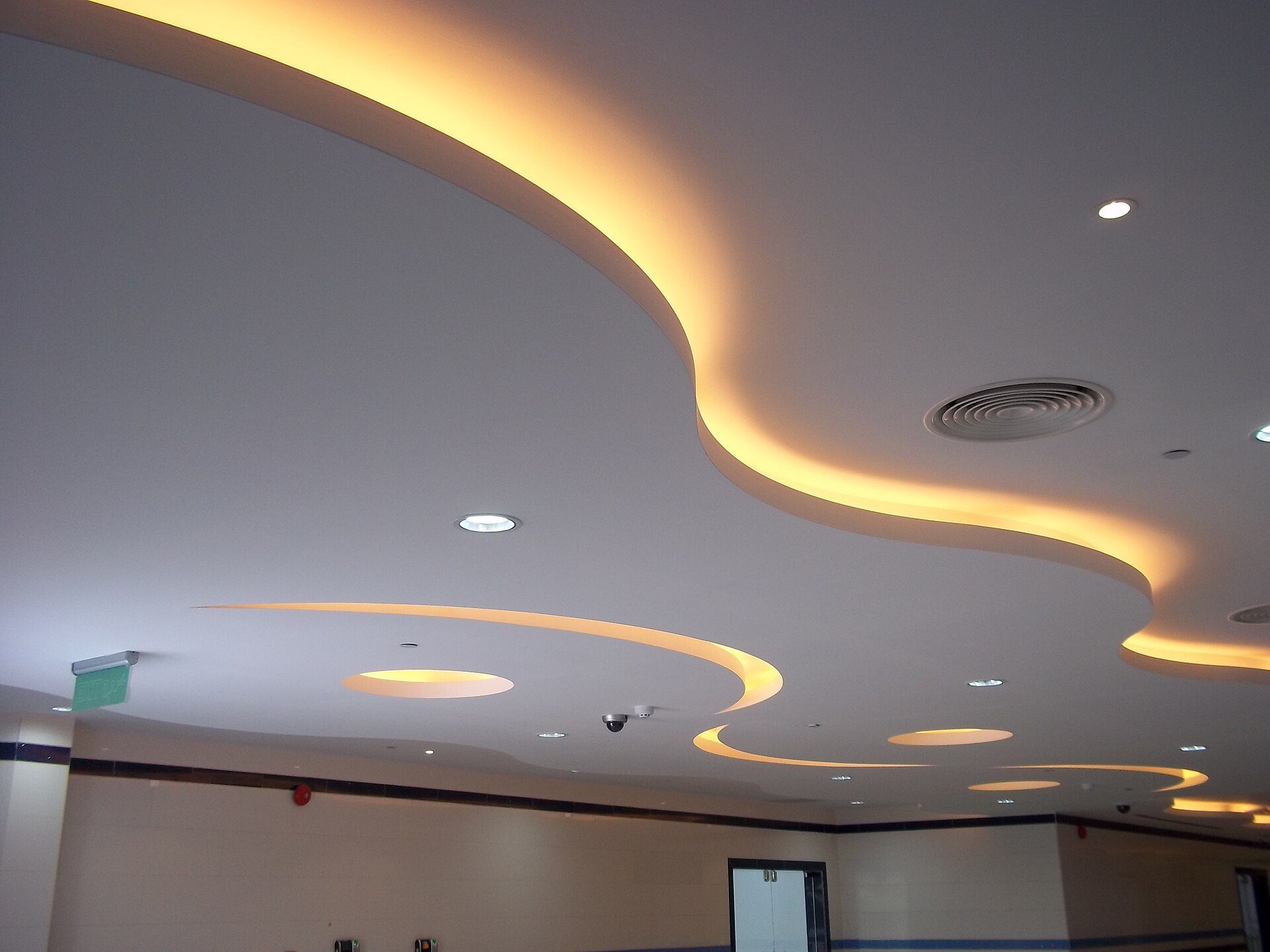
Photo: Suhail sartaj ahmed shaikh / Wikimedia Commons, CC0
This is the final roadmap step, Skills test, take-off & quoting. To revise, run a small project like step 7 again (a stepped living room ceiling and a bedroom partition), this time doing your own take-off and quote, then compare it with the real cost once the job is finished. After a few jobs you will have your own take-off rates and output figures, which is the basis for subcontracting through fit-out companies or starting your own crew.
Revise the whole drywall trade: from scaffold safety, framing, grid ceilings, flush and stepped ceilings and acoustic partitions to crack-free joint finishing and quoting. See the 8-step drywall and ceiling installer roadmap.