Taking an event brief properly means meeting the client for 60–90 minutes, working through a fixed questionnaire in 6 groups (goals and decision makers, date and venue, guest count, budget, style, customs and ceremonies), writing meeting notes at the table, and sending the client a written confirmation within 24 hours. Most disputes between planners and a couple's families do not start on the wedding day; they start with the "I thought we already said that" moments of the first meeting. This lesson teaches a structured way to consult wedding clients in Vietnam, with a worked example of a southern bride and a northern groom where the guest numbers and the budget add up.
By the end of this lesson, you will be able to:
- Prepare and lead a 60–90 minute client meeting using a 6-group questionnaire without missing information.
- Turn the number of invitations into expected guests and a table count, including spare tables.
- Ask about the budget without making the client uncomfortable, and check whether it matches the table count.
- Record regional wedding customs and identify who in the family decides each ceremony.
- Write meeting notes and a confirmation message listing what is agreed, what is still open, who answers and by when.
Learning to plan events? This is step 2 of the 8-step roadmap: after the workflow and safety comes the brief, then budgets, decor, suppliers and run sheets. See the 8-step event and wedding planner roadmap.
What an event brief is and why it must be thorough
A brief is the set of requirements the client hands you: what kind of event, for how many people, where, when, for how much money and in what style. In the lesson on the 7-stage event planning process, taking the brief is the first stage, and every later stage depends on it.
The brief is the assignment for the whole project
Quotes, decor concepts, supplier lists and the run-of-show are all built from the brief. Get one number wrong, for example 25 tables when the family has invited 400 guests, and the quote is wrong, the hall is wrong, and you are the one who has to explain. A vague brief also causes arguments at final settlement (each side remembers it differently) and rework when parents object close to the date. So a briefing meeting is a data-gathering session with notes, not a social chat.
Who needs to be at the meeting
At a Vietnamese wedding, the person who pays, the person who decides and the people who give opinions are often different. Ask directly: "Apart from the two of you, who approves the date, the ceremonies and the budget?" If the parents decide the ceremonies, arrange a short extra meeting or a phone call to confirm with them.
Preparing for the client meeting
A good meeting starts with a screening call and the right kit.
Five screening questions by phone or message
- Type of event: wedding reception, engagement ceremony, or both?
- Planned date (solar calendar, and lunar calendar if the family chooses an auspicious day); fixed or still flexible?
- Area, and has a venue been chosen?
- Estimated number of guests?
- Rough budget for the services they want to hire?
These five questions tell you whether you can take the job (date already booked, area too far, budget far too low) before you spend a whole session on a meeting.
What to bring
- The printed questionnaire (next section), a notebook and pen, or a tablet with a notes template.
- A photo portfolio of past events grouped by budget level, and your team's availability in wedding season.
- Reference price ranges per item for rough answers, but no firm quote at the meeting itself.
Choosing the place and length
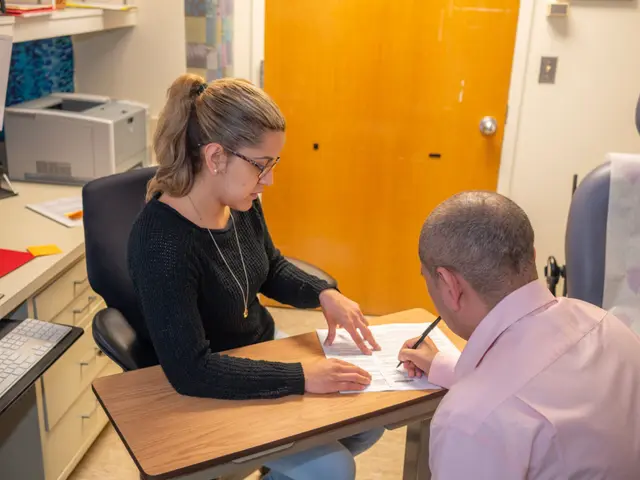
Meet somewhere quiet with a table big enough for paper and where you can hear clearly: an office, a quiet cafe, or the wedding venue the client is considering so you can see the hall at the same time (Figure 1). Plan 60–90 minutes; beyond 2 hours clients get tired and decide in a hurry. Tell them in advance that you will take notes and send back a summary.
The briefing questionnaire: 6 groups of information
The table below is the backbone of the consultation. Go through groups 1 to 6 in order; anything the client cannot answer yet is marked "open", and you never guess on their behalf.
| Group | Main questions | Why you need it |
|---|---|---|
| 1. Goals and decision makers | What matters most to you and your families about this event? Who approves the date, ceremonies and budget? | Know spending priorities and whom to confirm with |
| 2. Date, time, venue | Solar and lunar date, ceremony time, guest arrival time; is the venue booked; is there a backup date? | Hold supplier dates, plan setup time |
| 3. Guest count | How many invitations per side? How many children, elderly guests, guests from far away needing accommodation? | Work out tables, special seating, transport |
| 4. Budget | Total budget for hired services? Who pays for what? What is the maximum increase? | Avoid proposals beyond what they can spend |
| 5. Style | Three words for the mood you want? Favourite colours? Anything you absolutely do not want? | Steer the concept, rule out wrong options |
| 6. Customs, ceremonies, religion | Is there an engagement ceremony, an ancestral altar ceremony, a church or pagoda ceremony? Where are both families from? Any vegetarians or food taboos? | Get ceremonies, menu and offerings right |
Turning guest numbers into tables
Clients usually give the number of invitations, not the number of people who will come. Ask separately for the groom's side, the bride's side and shared friends, then ask the family to estimate the attendance rate from earlier weddings in their extended family. This rate varies with region, day of the week and travel distance, so record it clearly as "the family's estimate". From there, work out expected guests, divide by the number of seats per table the venue uses, and add spare tables.
Asking about the budget without awkwardness
Many clients hesitate to name a figure because they fear being "quoted by the size of their wallet". Three ways to make it easier:
- Offer three levels to choose from: "economical", "moderate", "premium", each with a few photos of real events you have worked on.
- Ask where they have already enquired and what the venue quoted per table; that figure shows you their spending range.
- Ask exactly what the budget covers: the banquet, the wedding dress, rings, make-up? Two sides meaning different things by "budget" is a very common source of disputes.
Asking about style with pictures and "no-go" items
You do not need a moodboard yet, only a direction. Show 10–15 photos and ask the couple to pick 3 they like and 3 they dislike. "What do you not want?" often gives more precise information, for example "no purple, because Mum considers it unlucky".
Open questions, follow-up questions and summaries
Each group goes in three beats: an open question ("How do you picture the party?"), a follow-up ("Does 'cosy' mean candlelight or a small hall?"), then a summary ("So I have about 35 tables, cream and white, is that right?"). The summary is when the client corrects you, right there at the table.
Regional wedding customs in Vietnam: what to ask
Wedding customs differ by region, by family line and by religion; two families from the same province may do things differently. The planner's rule: know the common patterns so you ask the right questions, but always check with the family and never impose "this is how we do it back home".
The engagement ceremony: gift boxes, trays and bearers
The engagement ceremony (an hoi in the north, often called dam hoi or le dinh hon in the south) is when the groom's family brings gifts to the bride's family. The gifts are carried in boxes or on trays covered with red cloth by a team of young men and women (Figure 2). Ask: how many boxes or trays and what goes in them; an odd or even number (many northern families prefer odd numbers, many southern families even numbers, but every family is different); who arranges the bearers; and whether the bride's side returns part of the gifts (lai qua).
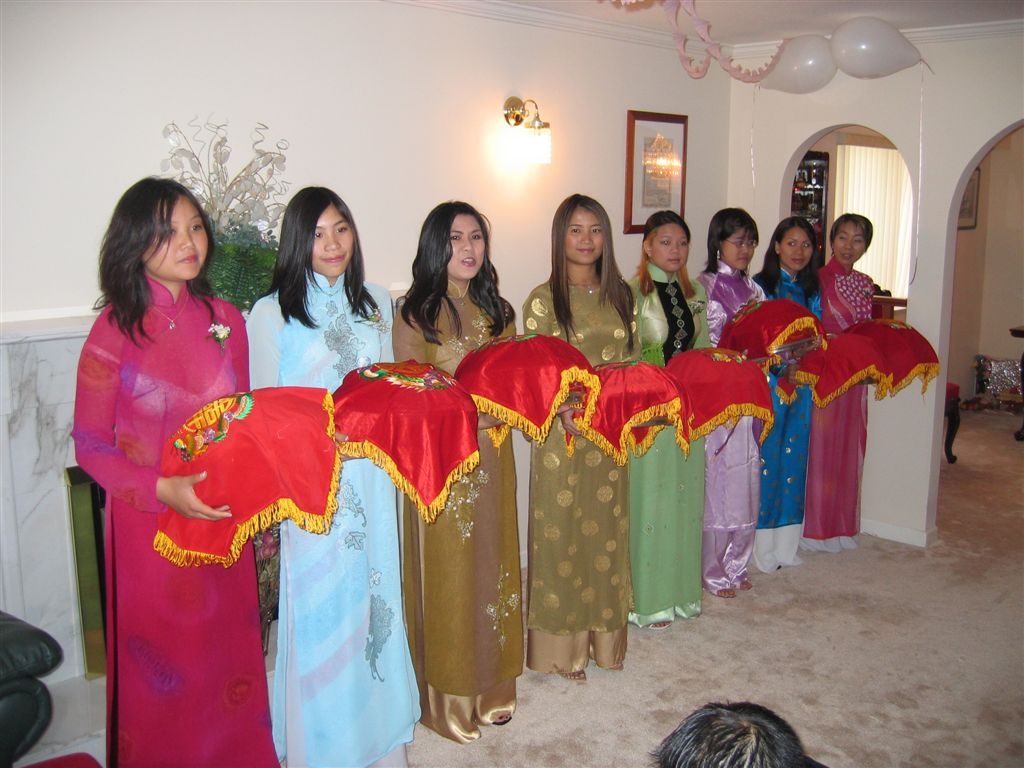
Photo: Jame Healy / Wikimedia Commons, CC BY-SA 2.0
The north: proposal visit, engagement, feast and the hour to collect the bride
Many northern families still keep the full sequence of a proposal visit (dam ngo), the engagement and the wedding. In the countryside, the engagement usually comes with a feast for relatives (Figure 3); gift boxes may be traditional lacquerware or boxes rented from a wedding service (Figure 4). Ask which hour the elders have chosen for collecting the bride, because it sets when the wedding car leaves, when the setup crew must finish and when photos are taken.
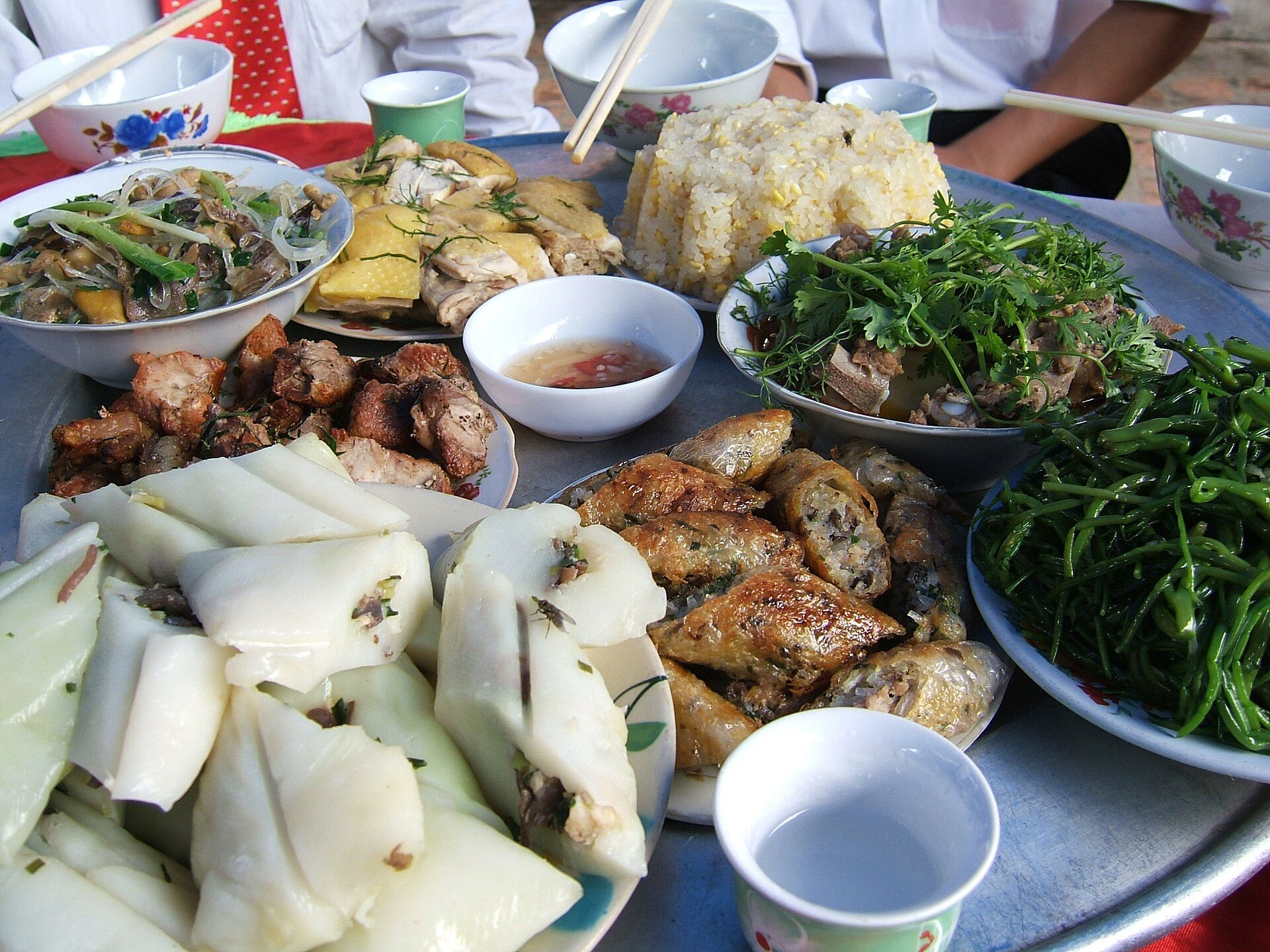
Photo: Viethavvh at Vietnamese Wikipedia / Wikimedia Commons, Public domain
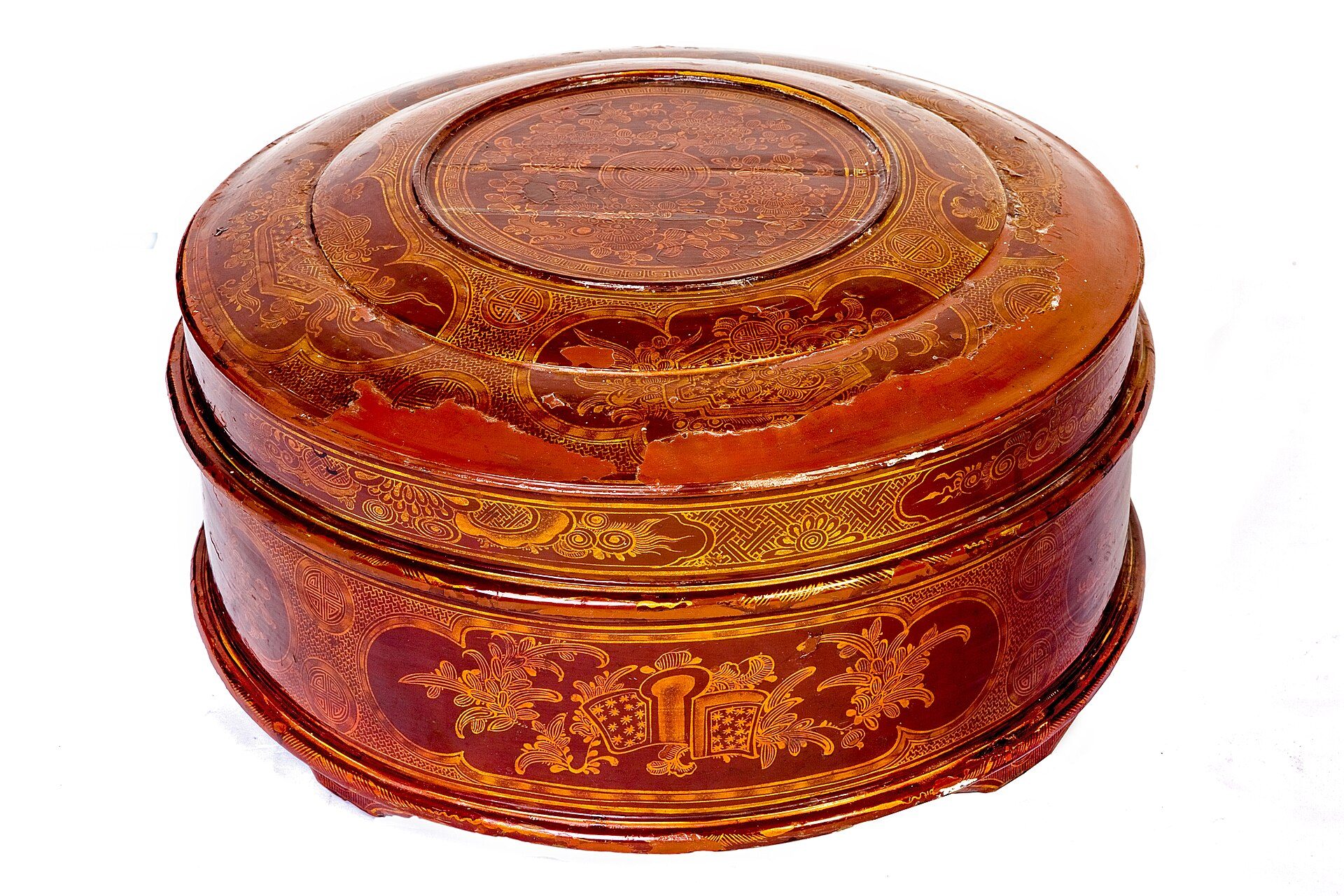
Photo: Vietnamese Women's Museum / Wikimedia Commons, CC BY-SA 3.0
The centre and the south: formality, combined ceremonies and restaurant receptions
In central Vietnam, many families value the ancestral altar ceremony and traditional ao dai wedding clothes; some want the couple in ao dai and headdress for the ceremony, changing into a wedding gown for the reception (Figure 5). In the south, many families collect the bride in the morning and hold a restaurant reception in the evening, and some combine the engagement and the wedding on one day for guests travelling from afar. Ask: how many ceremonies, where, whether there are outfit changes, and whether the two families hold separate or joint receptions.
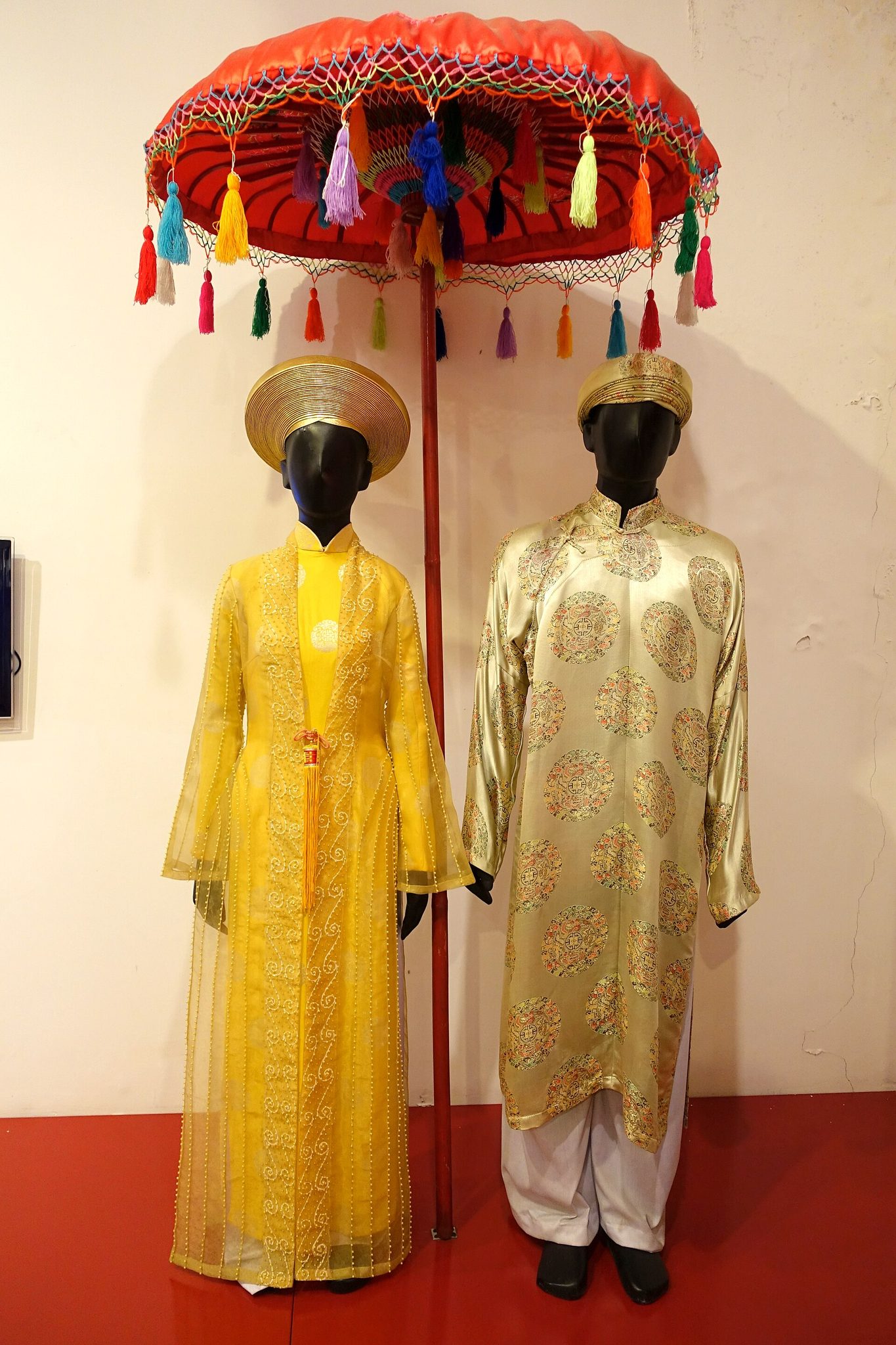
Photo: Daderot / Wikimedia Commons, CC0
Families from different regions or religions
When the two families come from different regions, do not take sides: write down what each side wants, mark the differences as "open points" and let the two families agree. Catholic families hold the wedding Mass at church according to the parish schedule; Buddhist families may hold a ceremony at a pagoda. Religious ceremony times are usually fixed, so ask before setting the hour to collect the bride and the reception time.
Writing meeting notes
Meeting notes record what was said and what was agreed. Write them during the meeting or within a few hours, while details are fresh.
A one-page structure
- General information: date, time and place of the meeting, who attended and their roles (decision maker, payer, adviser).
- Agreed: date, time, venue, guest count, budget, style and ceremonies agreed.
- Open: for each point, who answers and by when.
- Special requests: guests with disabilities, elderly guests, dietary needs, absolute no-go items.
- Next actions: who does what and by when (for example, you send a rough estimate within 3 days).
Record the client's exact words where it matters
For figures and taboos, quote the client word for word: "320 million maximum", "Mum does not like chrysanthemums". Do not paraphrase; always write units (tables, seats per table, VND).
Recordings and personal data
If you want to record the meeting, ask first and record only with the client's consent. Phone numbers, addresses and guest lists are personal data: use them only for organising the event, store them behind a password, and do not post them in group chats with suppliers unless necessary.
Note: Vietnam has rules on personal data protection, and they can change. This lesson only sets out working principles and is not legal advice; if you set up a company or hold a lot of client data, check the current regulations or ask a qualified legal professional.
Confirming the brief in writing
The notes are your record; the confirmation is when the client reads and agrees. The brief is only final once the client replies that they agree.
Send within 24 hours, on the client's channel
Send it by email or Zalo (the messaging app most Vietnamese clients use) with a PDF attached, to the decision makers as well as your contact person. Put a version number in the file name, for example "Brief-wedding-Minh-Lan-v1". Ask for a clear one-line reply such as "Brief v1 agreed".
Sample confirmation message
"Hello Minh and Lan. Here is the brief from this afternoon's meeting (version v1, attached). Agreed: evening reception on 20 December in Hall A at restaurant X, about 36 tables, a services budget of 300 million VND, cream and white colours. Open: the number of gift trays for the engagement (both mothers to answer by 25 November), and whether to add a photo corner outside the hall (you to answer by 22 November). Please reply 'Brief v1 agreed' or note what needs changing; I will then send a rough estimate within 3 days."
When the client changes their mind: version numbers
Clients changing their minds is normal. Each time, update the brief to v2, v3, note the date and the changes at the top, and send it again for confirmation. A confirmed brief does not replace a contract; it is the basis for the estimate and the contract in the next step. How much weight messages and emails carry in a dispute depends on the case; if a real dispute arises, ask a qualified legal professional.
Worked example: a brief for a southern bride and a northern groom
Scenario: Minh (from Nam Dinh in the north) and Lan (from Can Tho in the south) both live in Ho Chi Minh City. They want the engagement at Lan's family home and the reception at a restaurant in Ho Chi Minh City. You meet the couple and Lan's mother at the restaurant they are considering. The names and the restaurant are invented for practice.
Step 1: from invitations to tables
- Invitations: groom's side 150 + bride's side 170 + shared friends 80 = 400 invited guests.
- The family expects about 85% to attend, based on Lan's brother's wedding last year: 400 × 85% = 340 expected guests.
- The restaurant seats 10 per table: 340 ÷ 10 = 34 tables.
- Add 2 spare tables: 34 + 2 = 36 tables. Whether unused spare tables are charged is a question for the restaurant at the quoting stage.
Step 2: does the budget fit?
The family says the services budget is 300 million VND (about US$11,500 at roughly 26,000 VND per US dollar), including the banquet but not the dress, rings or engagement gifts. The restaurant has verbally told them 5.5 million VND per table including drinks (the client's figure, not an official quote). You do a quick check at the table:
| Item | Calculation | Amount |
|---|---|---|
| Banquet, 36 tables | 36 × 5.5 million | 198 million |
| Contingency, 10% of total budget | 300 million × 10% | 30 million |
| Left for decor, photos, MC, sound, wedding car, invitations | 300 − 198 − 30 | 72 million |
| Total | 300 million | |
Check: 198 + 30 + 72 = 300 million VND. The couple wants an all-fresh-flower arch and two-camera video; rather than declaring "not enough", you add an open point: if the services group exceeds 72 million, will the family raise the budget or switch to silk flowers?
Step 3: notes and open points
| Item | Agreed | Open (who answers, deadline) |
|---|---|---|
| Date and time | Evening reception 20 December; engagement on the morning of 30 November | Hour to collect the bride (both sets of parents, by 25 November) |
| Guests | 400 invited, 340 expected, 36 tables | Number of children needing their own seats (Lan, by 22 November) |
| Budget | 300 million for services, banquet included | Maximum increase if exceeded (Minh, by 22 November) |
| Style | Cream and white, warm lighting, no purple | Fresh or silk flowers (depends on the estimate) |
| Customs | Engagement at the bride's home, gifts partly returned | Odd or even number of trays (both mothers, by 25 November) |
The number of trays is where the two home regions may differ, so you name both mothers as the people to answer. The same day you send the confirmation message shown above, receive "Brief v1 agreed", and only then start the estimate.
Common mistakes when consulting wedding clients
Talking only to the couple
Sign: close to the date, the parents ask to change the ceremony time or the menu. Cause: nobody asked who decides the ceremonies. Fix: always include the decision-maker question in group 1 and send the confirmation to that person too.
Accepting a budget of "whatever you think"
Sign: after the quote, the client says "too expensive". Cause: no budget frame. Fix: offer three levels with real photos, or ask what the venue quoted to infer their range.
Making verbal promises at the meeting
Sign: the client says "you told me that price" or "you said you would hold the date for me". Cause: wanting to close quickly. Fix: give only reference price ranges, state that a date is held only with a contract and deposit, and write that in the notes.
Frequently asked questions
What is an event brief?
An event brief is the client's set of requirements: goals, date, venue, guest count, budget, style and ceremonies. Every later step depends on it, so the client should confirm it in writing.
What goes into a wedding consultation questionnaire?
At least 6 groups: goals and decision makers; date and venue; guest count; budget; style and no-go items; customs, ceremonies, religion and dietary needs.
Do you really need meeting notes with a client?
Yes, even with repeat clients. Notes show what is agreed, what is open, who answers and by when; the confirmation keeps both sides remembering the same thing. They do not replace a contract but they are the basis for writing one.
How do wedding customs differ across Vietnam's regions?
In the number of ceremonies, the number of gift boxes or trays, the order of rituals, the hour to collect the bride and how the reception is held. Common patterns only tell you what to ask; the details always follow each family.
Practice and self-assessment
- Write your own 6-group briefing questionnaire with at least 3 questions per group, printed on one A4 page.
- Ask a friend to play an engaged client (bride and groom from different regions), lead a 60-minute meeting and take notes using the 5-part structure.
- Work out expected guests, tables and a budget check as in the example, then send a v1 confirmation message within 24 hours.
Self-assessment criteria
- Pass: the notes have all 5 parts; every open point has a person and a deadline.
- Pass: invitations, expected guests, tables and budget figures all add up.
- Pass: the notes name who decides the ceremonies and list at least one absolute no-go item.
- Not yet: the brief has only the number of invitations and no table count; or the confirmation goes out after 2 days; or you decided a customs question on the family's behalf.
With a brief confirmed by the client, move on to the next step of the roadmap: Budgets, quotes & contracts, where the brief becomes an itemised estimate with a 10% contingency and clauses on deposits, cancellation and changes. Read ahead: wedding reception costs in Vietnam: prices by item and a 30-table budget.
Keep learning event planning: after the brief come budgets and quotes, concept and decor, supplier management, run sheets and running a small event yourself. See the 8-step event and wedding planner roadmap.