The right way to calculate ingredients for a Vietnamese feast ("co") is to start from the menu, write down raw quantities for one tray ("mam", usually 6 people in northern Vietnam), multiply by the number of trays, add about 5% as a buffer, then split the result into shopping lists by supplier and by purchase day. Running out mid-feast or ending up with ten kilos of surplus meat usually comes from estimating by eye, forgetting trimming losses, and not separating what can be bought in advance from what must be bought on the morning of cooking. This lesson is written the way a head feast cook coaches an assistant: a quantity sheet for one 6-person tray, a worked example of shopping for 20 trays with totals that add up, how to cost a tray, and the food safety rules for cooking in bulk.
By the end of this lesson, you will be able to:
- Build a raw-quantity sheet for one 6-person tray of a northern Vietnamese feast menu.
- Scale quantities to 10, 20 or 50 trays, with a buffer and trimming losses.
- Split shopping lists by product group and schedule, knowing what to buy early and what to buy on the morning of cooking.
- Cost a tray including ingredients, labour and fuel, and quote a profitable price.
- Keep food samples and hold food hot or cold correctly when cooking in bulk.
Learning feast and banquet cooking properly? Quantities and shopping are step 3 of the roadmap, after bulk food safety and food samples, and feast menus by region and occasion. See the 8-step banquet and feast cook roadmap to learn in the right order.
Why calculate quantities instead of estimating by eye?
Cooking for a family, if you run short you cook more, and leftovers go in the fridge. A 20-tray feast is different: guests sit down at the same time, dishes go out together, and there is no time to run to the market midway. Too much means lost money and waste; one missing dish means losing face with the host on one of the most important days of their life (see a wedding tray in Figure 1).
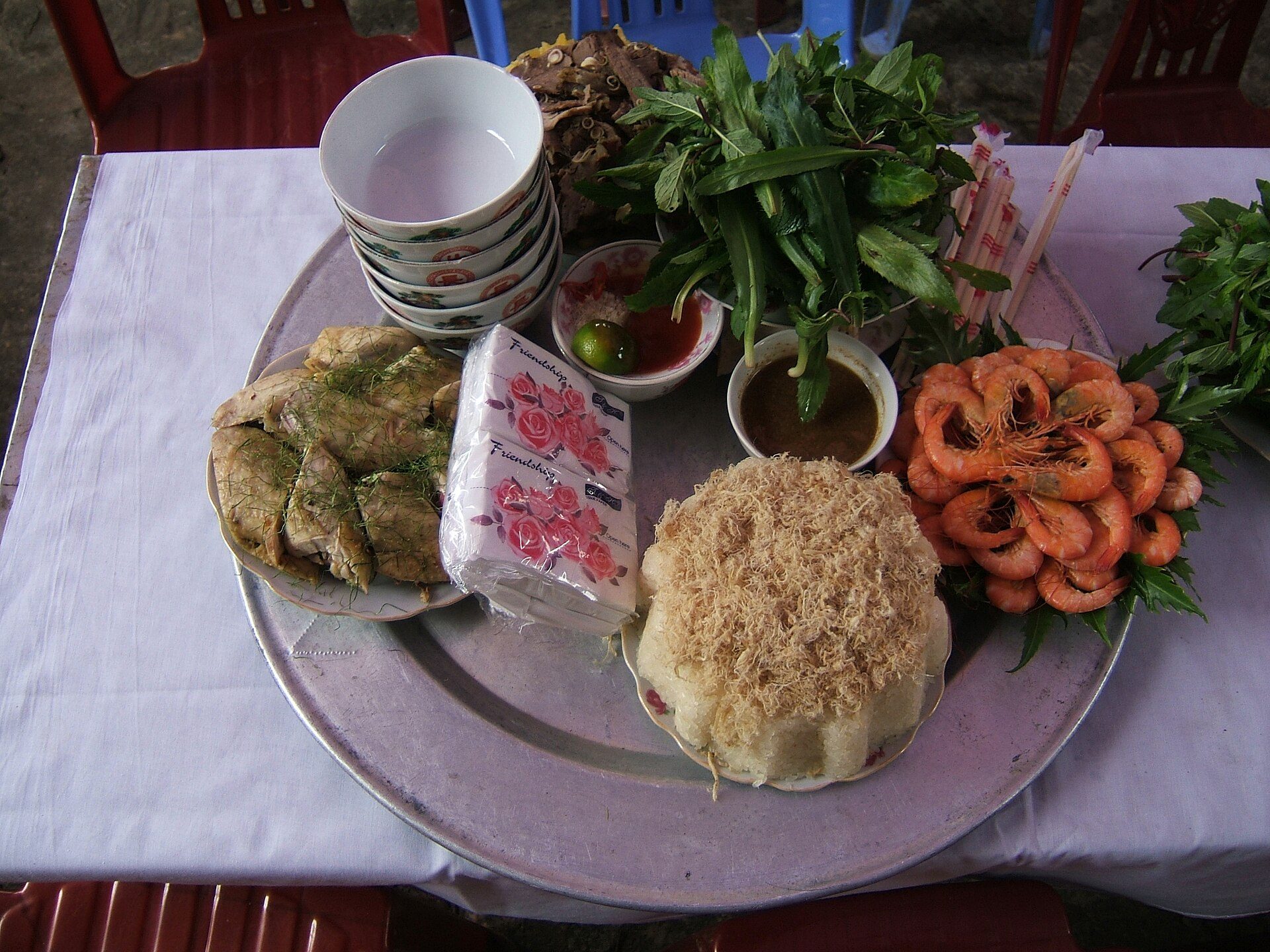
Photo: Viethavvh / Wikimedia Commons, CC BY-SA 4.0
Three numbers drive every calculation
- People per tray: usually 6 in the north; many places in central and southern Vietnam seat 8–10 per table. Ask the host, never assume.
- Confirmed number of trays: hosts usually give you the number of invited guests; convert to trays and ask whether they want spares.
- Raw quantity per dish: calculated by purchase weight (whole chicken, prawns in shell), not cooked weight.
Trimming and cooking losses
A whole free-range chicken, once boiled and chopped, loses bones, head and feet, so the edible part weighs much less than the raw bird. Peeled prawns, trimmed greens and meat with fat removed all lose weight too. That is why quantity sheets are always written in raw weight, and experienced head cooks note the loss rate for each regular supplier.
How much buffer is enough
Many feast teams keep a buffer of about 5% of ingredients, or cook one extra tray for every 20. The buffer covers extra guests, spilled dishes or the serving team's meal. Too much buffer pushes up the price; none at all risks running short.
A northern feast menu and quantities for one 6-person tray
Traditional northern feasts are often described as "four bowls, six plates": bowls of soup and broth dishes, and plates of savoury dishes, sticky rice, pork roll and chicken. Menus are more flexible today, but some dishes remain almost compulsory: boiled chicken, gio lua (Vietnamese pork roll), sticky rice, fried spring rolls and soup (see Figure 2).
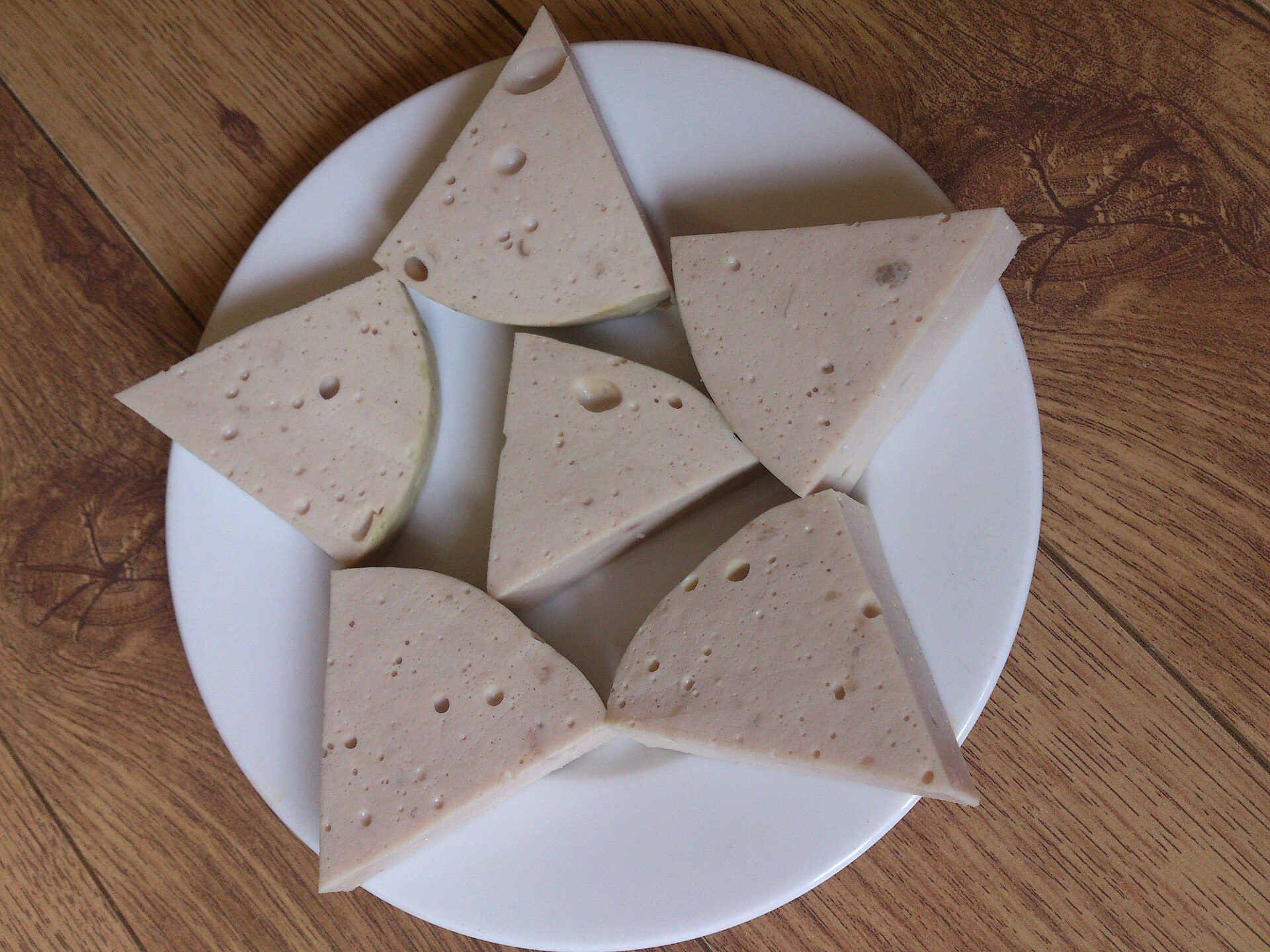
Photo: Viethavvh / Wikimedia Commons, CC BY-SA 4.0
Sample 10-dish wedding menu
- Boiled free-range chicken with lime leaves.
- Gio lua pork roll.
- Fried spring rolls (nem ran).
- Beef stir-fried with garlic chives and celery.
- Prawns, dry-fried or steamed.
- Mixed soup with puffed pork skin (canh bong).
- Gac fruit sticky rice (xoi gac).
- Stir-fried greens and fresh herbs.
- Steamed rice.
- Fresh fruit for dessert.
Raw quantities for one 6-person tray
| Dish | Main ingredient (raw) | One 6-person tray | Per person |
|---|---|---|---|
| Boiled chicken | Cleaned whole free-range chicken | 1.0 kg (half a 2 kg bird) | ≈ 167 g with bone |
| Pork roll | Finished gio lua | 0.3 kg | 50 g |
| Spring rolls | Minced pork shoulder + other fillings | 0.25 kg meat, 12 rolls | 2 rolls |
| Beef stir-fry | Beef | 0.3 kg | 50 g |
| Prawns | Prawns in shell | 0.4 kg | ≈ 67 g |
| Pork skin soup | Puffed pork skin, raw pork paste, vegetables | About 0.6 kg in total | 1 small bowl |
| Gac sticky rice | Glutinous rice (gac fruit per batch) | 0.5 kg | ≈ 83 g rice |
| Greens | Stir-fry greens, fresh herbs, chives | 0.6 kg | 100 g |
| Rice | Ordinary rice | 0.3 kg | 50 g rice |
| Dessert | Seasonal fruit | 0.6 kg | 100 g |
These are reference quantities for a rural or peri-urban northern wedding with moderate appetites. City feasts usually have more dishes with less of each; feasts with many young men need more rice, sticky rice and meat. Always ask the host about the guests.
Variations by occasion and region
Northern death-anniversary and Tet feasts often add banh chung (square sticky rice cake), pork roll and bamboo shoot soup (Figure 3); central and southern feasts have hotpot, salads, grilled dishes and larger tables. The method is exactly the same: quantities for one table, times the number of tables, plus a buffer. Regional menus in detail are step 2 of the roadmap.
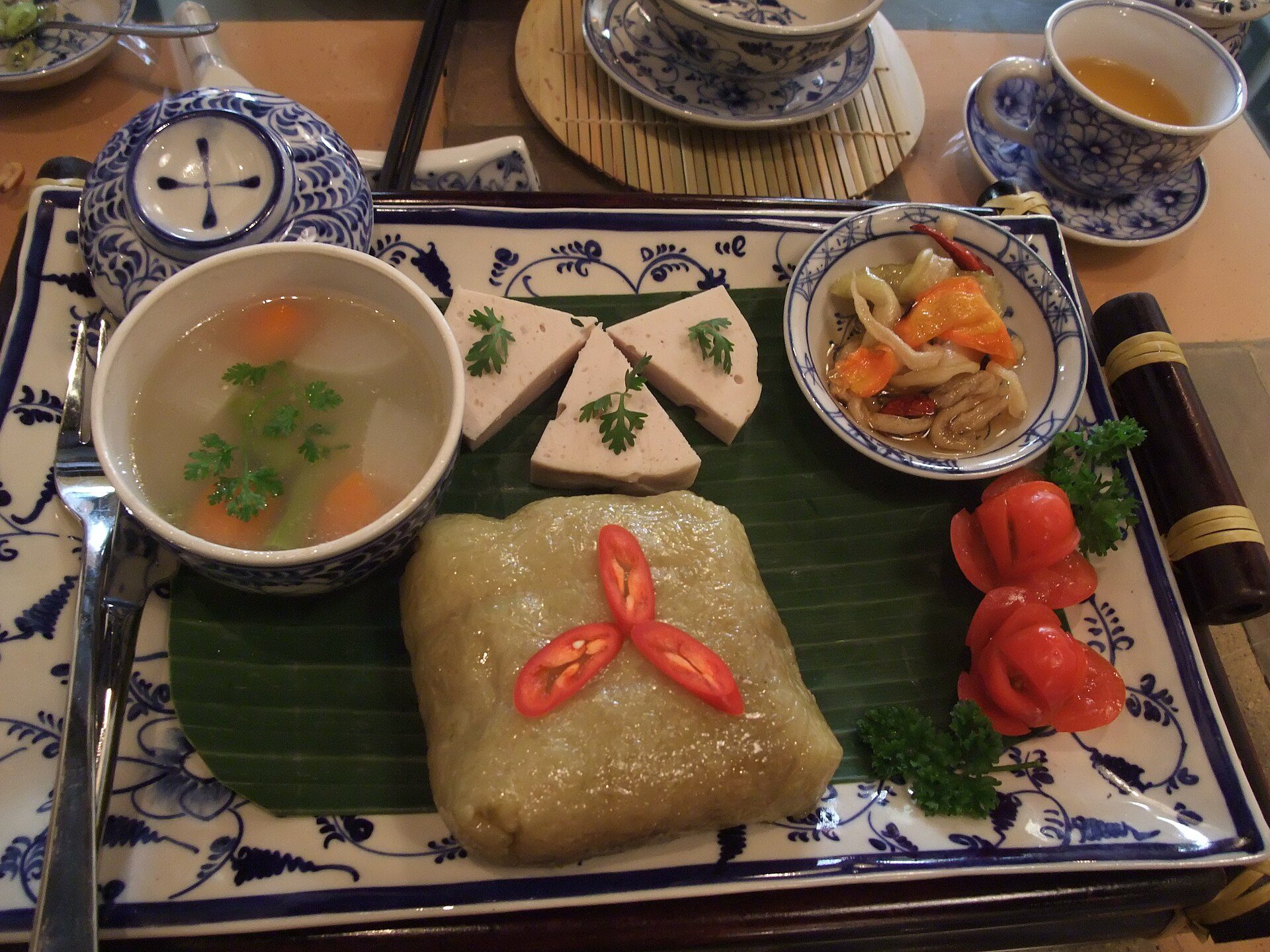
Photo: Yun Huang Yong / Wikimedia Commons, CC BY 2.0
Worked example: shopping for a 20-tray feast
A wedding on the outskirts of Hanoi: 120 guests at 20 trays of 6, with the 10-dish menu above. Ingredient prices are 2026 references and vary by area, season and supplier. Multiply one tray's quantities by 20 to get the shopping list below.
| Ingredient | 1 tray | 20 trays | Unit price | Amount |
|---|---|---|---|---|
| Cleaned free-range chicken | 1.0 kg | 20 kg | 130,000 VND/kg | 2,600,000 VND |
| Gio lua pork roll | 0.3 kg | 6 kg | 180,000 VND/kg | 1,080,000 VND |
| Minced pork shoulder (spring rolls) | 0.25 kg | 5 kg | 120,000 VND/kg | 600,000 VND |
| Spring roll extras (rice paper, glass noodles, wood ear, egg, carrot) | 1 set | 20 sets | 25,000 VND/set | 500,000 VND |
| Beef | 0.3 kg | 6 kg | 280,000 VND/kg | 1,680,000 VND |
| Prawns | 0.4 kg | 8 kg | 250,000 VND/kg | 2,000,000 VND |
| Pork skin soup ingredients | 1 set | 20 sets | 40,000 VND/set | 800,000 VND |
| Glutinous rice | 0.5 kg | 10 kg | 35,000 VND/kg | 350,000 VND |
| Gac fruit | 0.25 fruit | 5 fruits | 40,000 VND/fruit | 200,000 VND |
| Assorted greens | 0.6 kg | 12 kg | 25,000 VND/kg | 300,000 VND |
| Ordinary rice | 0.3 kg | 6 kg | 20,000 VND/kg | 120,000 VND |
| Dessert fruit | 0.6 kg | 12 kg | 40,000 VND/kg | 480,000 VND |
| Seasoning, oil, dipping sauce, onions, lime leaves | 1 set | 20 sets | 30,000 VND/set | 600,000 VND |
| Total ingredients for 20 trays | 11,310,000 VND (~USD 435) | |||
Checking the addition
2,600,000 + 1,080,000 + 600,000 + 500,000 + 1,680,000 + 2,000,000 + 800,000 + 350,000 + 200,000 + 300,000 + 120,000 + 480,000 + 600,000 = 11,310,000 VND. Divided by 20 trays: 11,310,000 ÷ 20 = 565,500 VND of ingredients per tray. Adding a 5% buffer: 11,310,000 × 5% = 565,500 VND, exactly one tray, for a total of 11,875,500 VND.
Splitting the shopping list by schedule
- 2–3 days before: glutinous and ordinary rice, dry extras (rice paper, glass noodles, wood ear, puffed pork skin), seasoning, oil, gac fruit.
- 1 day before: order the pork roll, order chicken and beef from a slaughterhouse or butcher with clear origins; book an early-morning delivery.
- Morning of cooking: receive chicken, beef, minced pork, prawns, greens and fruit; check everything on delivery (Figure 4).
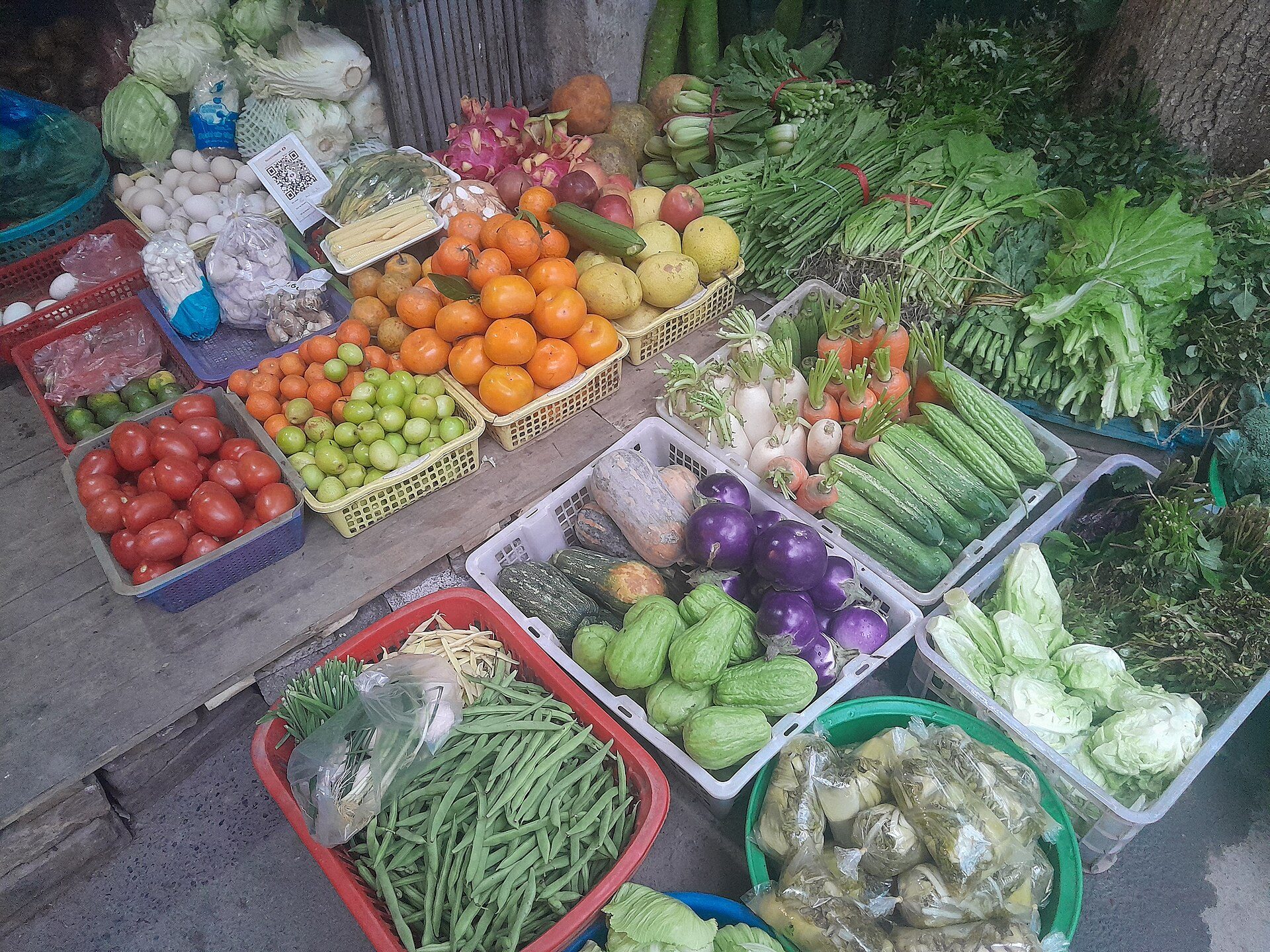
Photo: Huy Vinh 299G / Wikimedia Commons, CC BY-SA 4.0
Checking goods on delivery
Weigh each item against the list and write down the actual weight. Meat should be fresh-coloured, springy, not slimy, with no off smell; prawns fresh with glossy shells; greens not bruised or wilted. Reject anything that fails and order a replacement straight away, rather than "making do" because it is already paid for.
Costing a tray and quoting
Ingredients are only part of the cost. To quote a profitable price, add labour, fuel and other costs, then divide by the number of trays.
| Cost item | Calculation | Amount |
|---|---|---|
| Ingredients for 20 trays | From the shopping list | 11,310,000 VND |
| 5% buffer | 11,310,000 × 5% | 565,500 VND |
| Labour | 4 people × 500,000 VND | 2,000,000 VND |
| Gas, charcoal | Flat rate per event | 600,000 VND |
| Total cost | 14,475,500 VND | |
Cost per tray and the quote
Cost per tray: 14,475,500 ÷ 20 = 723,775 VND. If you quote the host 900,000 VND per tray, revenue for 20 trays is 18,000,000 VND and gross profit is 18,000,000 − 14,475,500 = 3,524,500 VND, about 19.6% of revenue. That margin still has to cover wear on pots and equipment, transport and risk, so it is not net profit.
Reference price range
Feast tray prices in 2026 are typically around 800,000–1,800,000 VND per tray depending on menu, area and whether crockery, tables and service are included, excluding drinks. State clearly in the quote what is and is not included; detailed tray pricing is step 8 of the roadmap.
When market prices move
Meat, prawn and vegetable prices change with the season and around Tet. For orders booked weeks ahead, note in the quote that the price may be adjusted if key ingredients rise beyond a level both sides agree on, or lock in suppliers and prices early.
Food safety when cooking feasts in bulk
Feast cooking means large quantities, long holding times and many guests, exactly the conditions behind mass food poisoning. Perfect quantities mean nothing if the food is not safe.
Safety warning: cooked food left at room temperature too long is a common cause of mass food poisoning. Hold hot cooked dishes above about 60°C, keep fresh ingredients and cold dishes below about 5°C, and do not leave cooked food at ambient temperature for more than 2 hours before eating. Use separate boards, knives and trays for raw and cooked food. Industrial gas burners, big pots of boiling water and frying oil: set burners on firm ground away from flammables, keep a fire extinguisher, shut the gas valve when finished; two people carry a large pot along a clear path. If several guests have stomach pain, vomiting or diarrhoea after the feast, take them to a medical facility, call 115 (Vietnam's ambulance number) for serious cases, and inform the local health authority.
Keeping food samples
Food samples help identify the cause if something goes wrong. Under the Ministry of Health's current guidance on food sampling, the usual practice is to keep a sample of each dish (often about 100 g for solid dishes and 150 ml for liquid ones) in a clean lidded container labelled with dish name, sampling time and the person who took it, refrigerated at about 2–8°C for at least 24 hours. Check the current regulations and local requirements, as rules can be updated.
Practical hot and cold holding at a feast
- Meat and prawns delivered early: keep in an ice box or chiller if not prepared straight away.
- Boiled chicken and pork roll: cool in an airy place under a food cover, chop and plate close to serving time.
- Soups and hot dishes: keep on a low flame and ladle into bowls only when ready to carry out.
- Leftovers from guests' trays: never combine them to serve another tray.
Cook hygiene
Cooks wash hands after touching raw food, wear aprons and tie back or cover hair; anyone with diarrhoea, fever or an open wound on the hands does not handle ready-to-eat food. This is covered in step 1 of the roadmap, repeated here because it is easy to skip on a busy feast day.
Common mistakes when calculating feast ingredients
Counting invitations instead of actual guests
Sign: several trays left over, or not enough when guests bring family. Cause: no final tray count. Fix: confirm the number of trays 2–3 days ahead and agree in writing how extra trays will be charged.
Forgetting trimming losses
Sign: you bought the full weight, yet the chopped chicken plate still looks thin. Cause: quantities written as cooked weight but bought as raw weight. Fix: always write quantity sheets in raw weight, with loss rates noted for each item.
Buying everything in one trip
Sign: wilted greens and tired prawns by cooking time. Cause: buying fresh goods the afternoon before without enough cold storage. Fix: split the shopping list by schedule and take fresh goods on the morning of cooking.
Quoting on ingredients only
Sign: after the feast you realise you worked for free. Cause: forgetting labour, fuel and buffer. Fix: use a full cost sheet as in the example before dividing by trays.
Frequently asked questions
How much food is needed for one 6-person feast tray?
For the 10-dish menu in the example: about 1 kg whole chicken, 0.3 kg pork roll, 0.25 kg meat for spring rolls, 0.3 kg beef, 0.4 kg prawns, 0.5 kg glutinous rice, 0.3 kg ordinary rice, 0.6 kg greens and 0.6 kg fruit, plus soup ingredients and seasoning. Adjust for the guests and the number of dishes.
How much does shopping for a 20-tray feast cost?
In the example above, ingredients come to about 11,310,000 VND, or 11,875,500 VND with a 5% buffer; real costs depend on area, season and menu.
What dishes are on a typical northern Vietnamese feast menu?
Usually boiled chicken, gio lua pork roll, fried spring rolls, sticky rice, pork skin or bamboo shoot soup, a stir-fry, prawns or fish, greens and dessert. Tet and anniversary feasts often add banh chung.
How do I cost a feast tray so it makes a profit?
Add ingredients, buffer, labour, fuel and other costs, divide by the number of trays to get the cost per tray, then quote enough above that to cover equipment wear, risk and management time.
Is keeping food samples compulsory for feasts?
For collective kitchens and large-scale catering in Vietnam, keeping samples is required under health-sector guidance; check the current rules and local requirements. Wherever you cook, keeping samples is a habit worth having at every feast.
Practice exercises and self-assessment
- Build a one-tray, 6-person quantity sheet for an 8-dish anniversary menu from your home region.
- Scale it to 35 trays, add a 5% buffer, and split the shopping list into 3 stages: 2–3 days before, 1 day before, morning of cooking.
- Get real prices from a nearby market and work out ingredients, labour, fuel and the cost per tray.
- Write a one-page food sampling procedure: containers, labels, sample size, storage place, holding time.
Self-assessment criteria
- Pass: the quantity sheet is in raw weight, covers every dish and has a per-person column.
- Pass: multiplication, addition and cost per tray match across all tables.
- Pass: the shopping list correctly separates dry goods bought early from fresh goods taken on the morning.
- Not yet: no buffer, a quote based on ingredients only, or no plan for food samples and cold holding.
With ingredients calculated, move on to the next step of the roadmap: Cooking in big pots: boiling, steaming, frying and braising in bulk, where you learn to boil 20 chickens evenly, steam ten kilos of sticky rice and fry hundreds of spring rolls without burning them.
Keep learning feast cooking: after quantities come big-pot cooking, field kitchens and industrial gas, hot holding and synchronised service, and a full 20-tray feast project. See the 8-step banquet and feast cook roadmap.