
Office administration work in a Vietnamese company covers three areas: drafting and managing documents (official letters, decisions, notices), keeping the company seal and the incoming and outgoing mail logs, and running the office logistics such as stationery, assets, meeting rooms and business trips. In small and mid-sized companies one HR and admin officer usually handles all three, so working from a process makes the job calm, while working from memory means fighting fires every day. This lesson walks through each task with log templates and a business-trip budget whose numbers add up.
By the end of this lesson, you will be able to:
- Name the 9 main format elements of a Vietnamese administrative document and place each one correctly on the page.
- Draft an official letter, a decision and a notice with numbers and reference codes that never clash.
- Keep complete incoming and outgoing mail logs and find any document in under 2 minutes.
- Apply the company seal in the right position and set seal-keeping rules for a small company.
- Prepare a stationery order within budget, an asset register and a business-trip budget.
Learning HR and admin work? Office administration and records is step 2 of the roadmap, after basic labour law and before recruitment, employee records and contracts, and timekeeping. See the 8-step HR and admin roadmap to learn in the right order.
Legal note: This lesson summarises principles for vocational learning in Vietnam and is not legal advice. Rules on records, seals and invoices can change; before applying them, check the current text on official government portals, your company's internal rules, or ask your accountant or a lawyer.
What office administration work involves
The admin officer is the hub that keeps paperwork, supplies and schedules flowing. When you do it well nobody notices; when you lose a letter or double-book a meeting room, the whole company notices. Most of the job is recording things correctly, completely and in a way you can look up later (see Figure 1).
The three main areas
| Area | Typical tasks | Tools |
|---|---|---|
| Documents and records | Draft, get signed, log incoming and outgoing mail, file | Word, templates, logs in Excel or Google Sheets |
| Company seal | Keep the seal, stamp in the right place, log when it leaves the office | Locked cabinet, seal usage log |
| Logistics | Stationery, assets, meeting rooms, tickets and hotels for trips | Budget sheet, asset register, shared calendar |
Two fixed points in the day
Start of the day: receive the mail, log incoming documents and pass them to whoever handles them. End of the day: dispatch signed documents, lock the seal away and file the originals. The middle of the day goes on drafting, preparing meetings, purchasing and booking travel.
Administrative document format: the 9 required elements
"Format" (the Vietnamese term is "the thuc") means the required elements of a document and how they are laid out. For state agencies, state organisations and state-owned enterprises, the format of administrative documents follows Decree 30/2020/ND-CP on clerical work (Appendix I). Private companies are not required to follow it, but many adopt it as their in-house standard because partners, banks and government offices are used to it.
Table of the 9 main elements
| Element | Position | Example |
|---|---|---|
| 1. National title and motto | Top right | "Socialist Republic of Vietnam / Independence - Freedom - Happiness" (in Vietnamese) |
| 2. Name of the issuing organisation | Top left | ABC JOINT STOCK COMPANY |
| 3. Number and reference code | Under the organisation name | No. 42/QD-ABC |
| 4. Place and date of issue | Under the national title, in italics | Ha Noi, 01 December 2026 (written as "day 01 month 12 year 2026") |
| 5. Document type and subject line | Centred; letters put the "V/v" (Re:) line under the number | DECISION / On sending staff on a business trip |
| 6. Body | Main text | Legal bases, articles, paragraphs |
| 7. Title, name and signature of the signer | Bottom right | DIRECTOR, signature, full name |
| 8. Seal or digital signature | Over the signature | Red seal, or a digital signature for electronic documents |
| 9. Recipients | Bottom left | As in Article 3; Filed: Records, HR |
Optional elements are added when needed: appendices, confidentiality and urgency marks, the drafter's code and number of copies, and the address and email. Set paper size A4, Times New Roman and the margins once as a template; how to do this in Word is covered in the lesson Professional Word documents from the office IT career.
Numbers, reference codes and dates
The document number is the sequence number registered with the records desk, starting at 01 on 1 January and ending on 31 December each year. The reference code joins the abbreviation of the document type and the company: "QD-ABC" for a decision (quyet dinh), "TB-ABC" for a notice (thong bao). Official letters have no type name, so they use the company and drafting department, for example "15/ABC-HCNS". Days below 10 and the months January and February take a leading zero: "day 05 month 02 year 2026". Each number goes to one document only; if a document is cancelled, mark it "cancelled" in the log and never reuse the number.
Signing on behalf
- KT. (signing for): a deputy signs for the head, "KT. DIRECTOR / DEPUTY DIRECTOR".
- TM. (on behalf of): the head signs on behalf of a collective body such as the board.
- TL. and TUQ. (by order, by authorisation): a department head signs when delegated by internal rules or a power of attorney.
New staff often forget the "KT." line when a deputy director signs, so ask who will sign before printing the signing copy.
How to draft letters, decisions and notices
These three types make up most of the drafting work. Once you know each skeleton, you only fill in the content.
Official letters: dealing with outsiders
Use them to request, reply or invite partners, banks and government offices. Skeleton: the "V/v ..." (Re:) line; "To: ..."; three paragraphs (reason, request or answer, contact person); signature and seal; recipients. One letter should cover one matter so the receiver can route it to the right person.
Decisions: assignments, appointments, rewards
Type name "DECISION", the subject line "On ...", then the issuing authority ("DIRECTOR OF ABC JOINT STOCK COMPANY"). The legal bases cite the company charter, relevant internal rules and the department's proposal. Article 1 states what is decided and for whom; Article 2 covers entitlements, costs and duration; Article 3 names who carries it out and when it takes effect. Recipients: "As in Article 3; Filed: Records, ...".
Notices and the signing workflow
Internal notices (holiday schedules, changes to working hours, health check dates) stay short: what, for whom, from when, who to ask. Even if a notice only goes on the board or a group chat, give it a number and file a copy so you can later prove when the company announced it. Signing workflow:
- Draft from the template; check the 9 elements and spelling yourself.
- The department head checks the content and initials it.
- Take a number from the outgoing log and fill in the number and date.
- Print enough copies and present them to the authorised signer.
- Seal, dispatch, log and file the original.
Incoming and outgoing mail logs and filing
The mail log is the company's memory: when someone asks "what day did we receive that letter?", you answer from the log. A three-tier tray separating new arrivals, items in progress and items waiting to be filed keeps your desk from turning into a pile (see Figure 2).
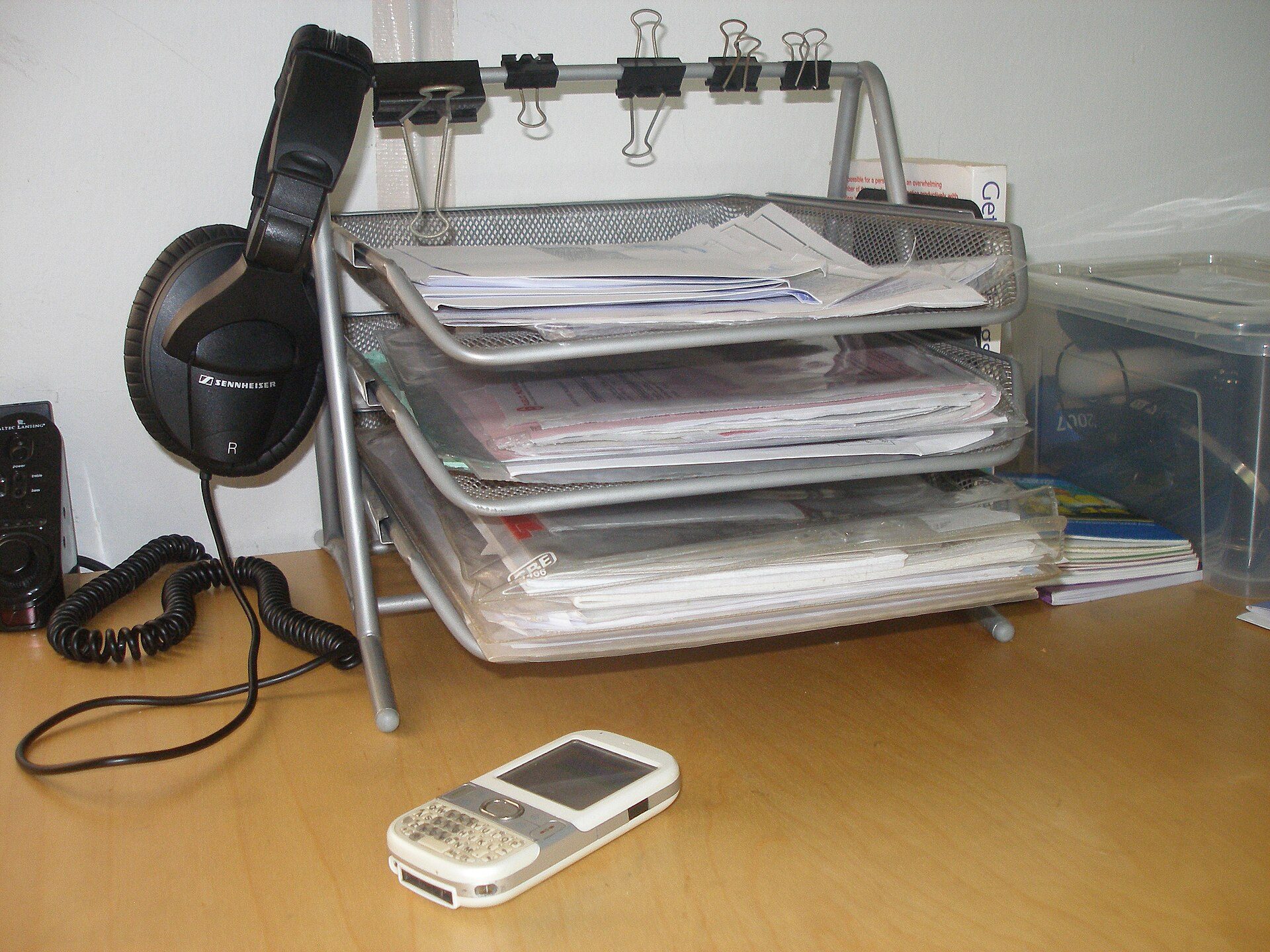
Photo: Khairil Yusof / Wikimedia Commons, CC BY 2.0
Handling incoming and outgoing documents
- Receive and check the envelope; anything marked "personal" or "confidential" goes to the addressee unopened.
- Stamp it "RECEIVED" (the Vietnamese stamp reads "DEN") with the incoming number and date; a rotating date stamp makes this quick (see Figure 3).
- Log it, get the manager's instructions, pass it to the handler who signs for it, and track the reply deadline.
- Outgoing: check format and signature before sealing, log it, send by post or by email with a scan, and keep the tracking number.
- The original with wet signature and seal stays with the records desk; one copy goes to the drafting department's file.
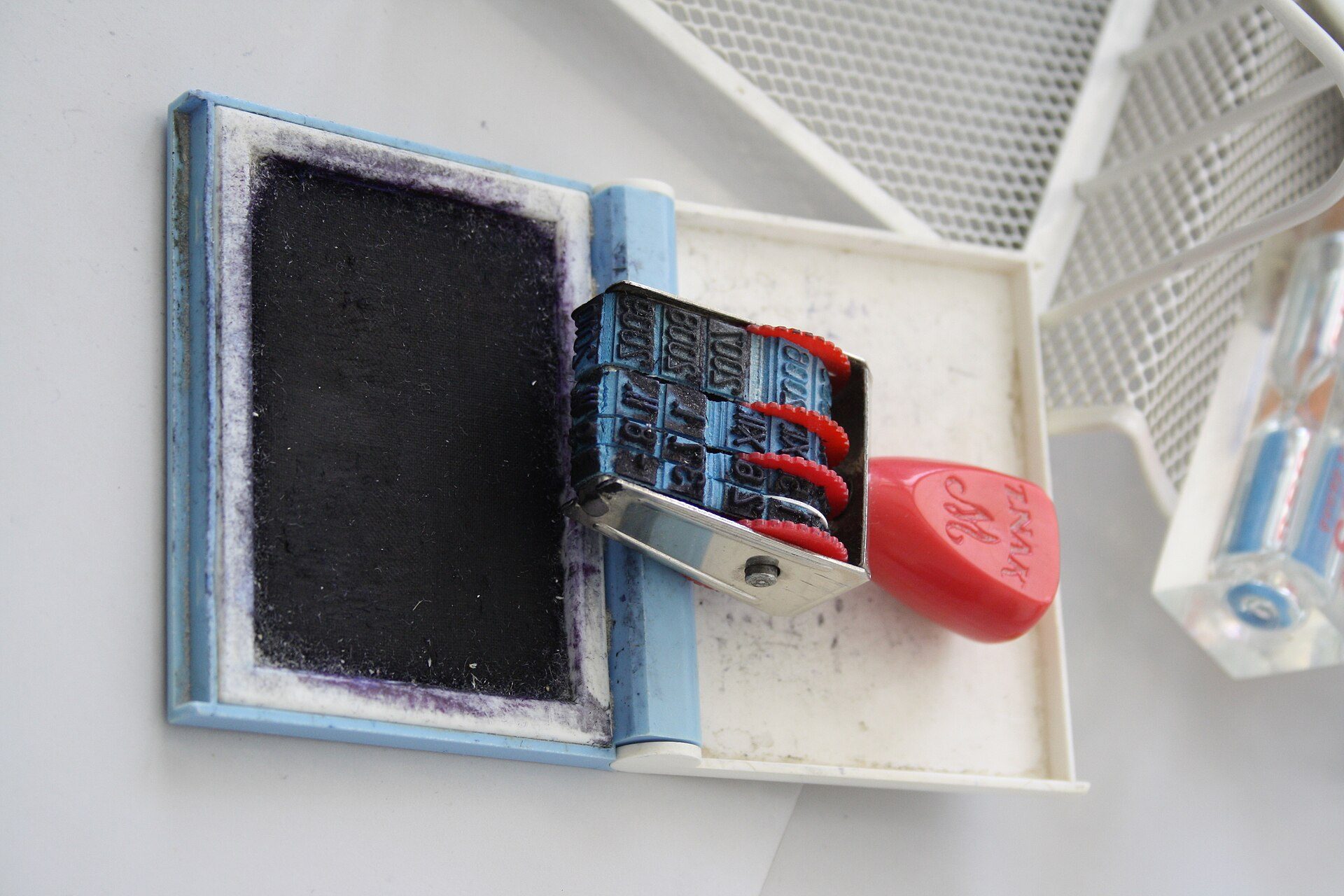
Photo: Jiří Sedláček (Frettie) / Wikimedia Commons, CC BY 3.0
Log template in Excel or Google Sheets
| Column | Incoming log | Outgoing log |
|---|---|---|
| Number, date | Incoming number, date received | Number issued, date of issue |
| Reference code | The sender's | The company's |
| From / to | Sending organisation | Recipients |
| Subject | Short summary | Short summary |
| Handler / signer | Handler, reply deadline | Signer, drafting department |
| Notes | Answered by document no. ... | Tracking number, link to the scan |
Lock editing so only the records officer can add rows and everyone else can only view. Name scans by date and number, for example "2026-12-01_42-QD-ABC.pdf".
Building files and archiving
At the end of each month, group documents about the same matter into one file ("Office lease 2026", "HR decisions 2026"), add a contents list, put it in a labelled box and shelve it by year (see Figure 4). How long each type of record must be kept depends on sector rules and company policy; if unsure, ask the chief accountant before destroying anything.

Photo: The National Archives (United Kingdom) / Wikimedia Commons, CC BY 3.0
Managing the company seal properly
In Vietnam the red company seal confirms that a document comes from the company. A lost seal, or a seal stamped on blank paper, can bind the company to something nobody approved.
Relevant legislation
Enterprises established under the Law on Enterprises 2020 decide for themselves the type, number, form and content of their seals, and manage and keep them under their charter or internal rules. Seals of state agencies and certain other organisations are governed by Decree 99/2016/ND-CP on the management and use of seals. When you have a new seal made or change its design, check the current regulations or ask a lawyer or the accountant.
Stamping in the right place
- Seal over the signature: straight, clear, the right way up, covering about one third of the signature on its left side, in red ink.
- Hanging seal: on the first page, overlapping part of the company name or appendix title.
- Overlapping (edge) seal: on the right edge of a multi-page document, covering part of each sheet; under the guidance in Decree 30/2020/ND-CP, each such stamp covers at most 5 sheets.
Six seal-keeping rules for a small company
- Keep the seal in a locked cabinet; only the person assigned in writing by the director holds the key.
- Only stamp documents already signed by the authorised person.
- Taking the seal out of the office needs the director's approval and an entry in the sign-out log.
- Log seal use for papers that do not go through the outgoing mail log, such as delivery notes.
- If the seal is worn or blurred, tell the director; never have one made on your own.
- If the seal goes missing, tell the director at once so it is handled under current rules.
Warning: Never pre-stamp blank paper "for the boss to sign later", never lend the seal overnight, and never send photos of the seal and the director's signature in a group chat. With the paper shredder, keep long hair, ties and lanyards away from the feed slot; unplug it before clearing a jam and never put fingers into the cutting slot. Boxes of A4 paper are heavy: bend your knees and keep your back straight when lifting, or split them into single reams.
Stationery, assets and meeting rooms
Logistics looks minor but costs money and easily slips out of control. Three tools keep it tidy: a stationery budget, an asset register and a shared meeting-room calendar.
Stationery budget
The budget is the maximum monthly spend approved by the director. At the start of the month, collect requests from each department, compare them with stock and place one order with a regular supplier to get a good price and a proper invoice. A cupboard without labels or a stock log soon looks like Figure 5: nobody knows what is running out and what was over-ordered.
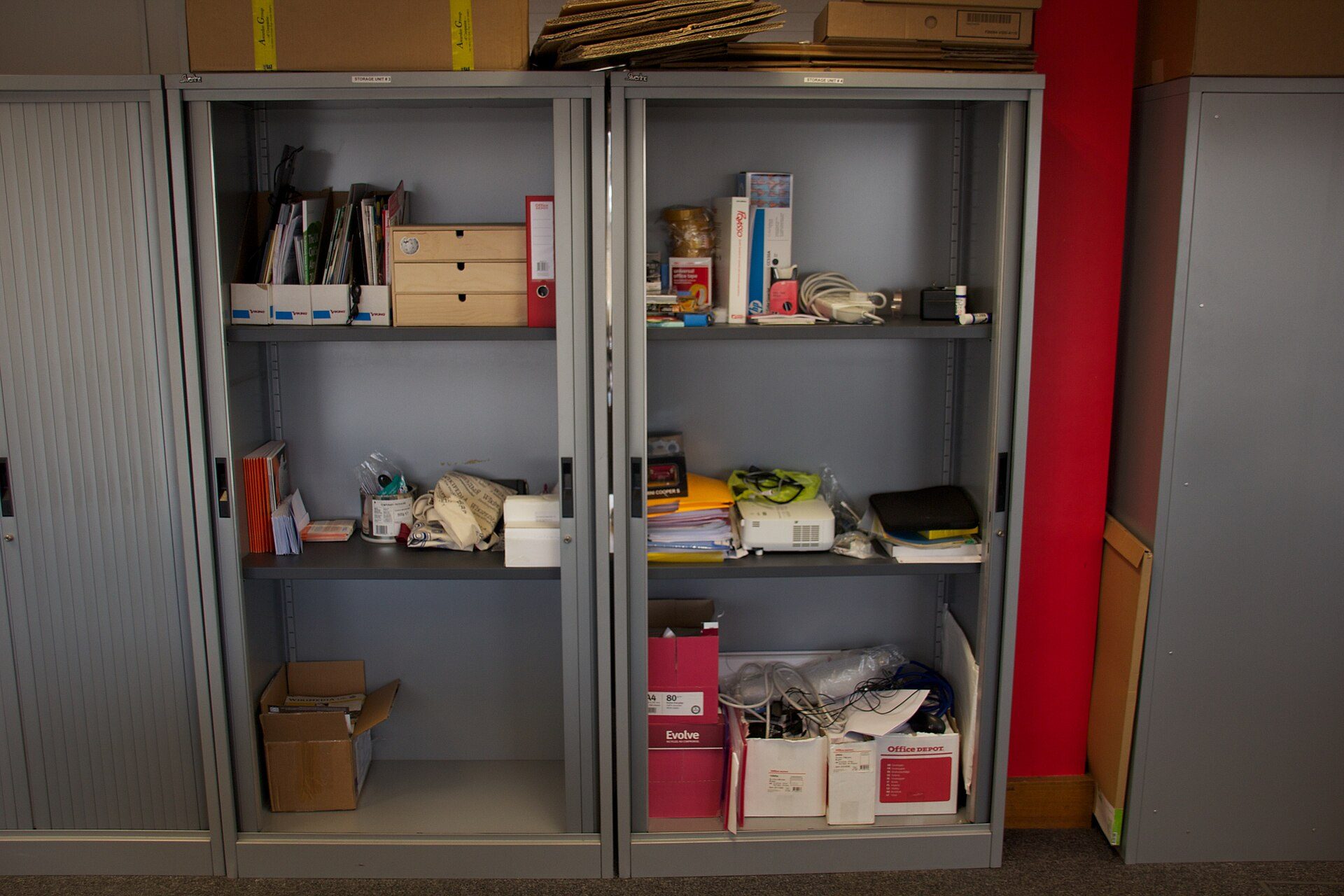
Photo: Photograph by Mike Peel ( www.mikepeel.net ). / Wikimedia Commons, CC BY-SA 4.0
Asset register
Every asset (computer, printer, desk, air conditioner) gets a code label on the back, such as "ABC-MT-007". The register records code, name, purchase date, price, current user and condition. Hand assets to new staff and take them back from leavers with a handover record signed by both sides, and count everything with the accountant at least once a year. Depreciation is the accountant's job; yours is to keep the register matching reality.
Booking meeting rooms without clashes
Give each room a shared calendar (Google Calendar or Outlook) where people book themselves, noting headcount and equipment. Fifteen minutes before a meeting, check the projector, markers, water and air conditioning (see Figure 6). Afterwards wipe the board: notes left behind can leak business plans or salary figures.

Photo: Luis Argerich from Buenos Aires, Argentina / Wikimedia Commons, CC BY 2.0
Tickets, hotels and business-trip paperwork
Arranging a business trip is not just buying a ticket; it is a chain: the trip decision, budget and cash advance, bookings, then collecting the documents for settlement.
Pre-trip checklist
- Signed decision sending the staff: who, where, when and why.
- Budget based on the company's travel expense policy, and a cash advance request sent to accounting.
- Tickets booked in the exact name on the ID document; a hotel close to the work site.
- Send travellers the booking codes, flight times, hotel address and a contact number.
Documents for settlement
Ask for electronic VAT invoices showing the company's exact name, tax code and address, and keep e-tickets and boarding passes. The accountant decides the exact set of documents required: ask for the list once and pin it next to your desk.
Worked example: Hanh's first week of December
Hanh is the HR and admin officer at ABC Joint Stock Company in Ha Noi, with 30 staff. This week she sends 2 people to Da Nang for 2 days and 1 night and orders December's stationery. Prices are 2026 references in Vietnam and vary by region and booking time.
The trip decision
The outgoing log shows 41 decisions issued so far in 2026, so the new one is No. 42/QD-ABC, dated 01 December 2026, subject "On sending staff on a business trip". Article 1 sends Tung (technical) and Vy (sales) to Da Nang on 3 and 4 December 2026; Article 2 applies the travel expense policy; Article 3 assigns the two travellers and accounting to carry it out. A deputy director signs, so the title line reads "KT. DIRECTOR / DEPUTY DIRECTOR".
Budget and settlement
| Item | Calculation | Budget (VND) | Actual (VND) |
|---|---|---|---|
| Return flights | 2 people × 2,800,000 | 5,600,000 | 5,600,000 |
| Hotel | 2 rooms × 1 night × 850,000 | 1,700,000 | 1,700,000 |
| Local transport | Budget 4 rides × 150,000; actual 3 rides × 160,000 | 600,000 | 480,000 |
| Daily allowance | 2 people × 2 days × 200,000 | 800,000 | 800,000 |
| Total | 8,700,000 | 8,580,000 |
Check: 5,600,000 + 1,700,000 + 600,000 + 800,000 = 8,700,000 VND (about USD 330); actual 5,600,000 + 1,700,000 + 480,000 + 800,000 = 8,580,000 VND. Tung took a 9,000,000 VND advance and returns 9,000,000 − 8,580,000 = 420,000 VND.
December stationery order
| Item | Quantity × unit price | Amount (VND) |
|---|---|---|
| A4 paper | 10 reams × 75,000 | 750,000 |
| Ballpoint pens | 2 boxes × 60,000 | 120,000 |
| 7 cm lever arch files | 6 × 45,000 | 270,000 |
| Printer cartridge | 1 × 350,000 | 350,000 |
| Staples, clips, tape, notebooks | 1 pack | 160,000 |
| Total | 1,650,000 |
Check: 750,000 + 120,000 + 270,000 + 350,000 + 160,000 = 1,650,000 VND. The monthly budget is 1,800,000 VND, leaving 150,000 VND in reserve. When the goods arrive, Hanh checks them against the invoice and logs them into stock before signing.
Common beginner mistakes
Duplicate document numbers
Sign: two decisions with the same number. Cause: two people issuing numbers, or a number taken but not logged. Fix: one person issues numbers and logs them immediately; if a wrong document has gone out, ask management to issue a correcting or replacement document rather than editing by hand.
Old letters that cannot be found
Sign: half a day searching cabinets. Cause: not logged, left too long in the tray. Fix: log on the day, scan to PDF named by number and date, build files at month end.
Trip invoices in the wrong company name
Sign: accounting rejects the hotel invoice. Cause: no invoicing details sent when booking. Fix: keep the company name, tax code, address and invoice email as a ready-to-paste snippet for every booking.
Frequently asked questions
Do I need a specific degree for office administration work?
Many companies hire people with vocational, college or university training in office management, administration or business, but solid Word and Excel skills, care and discretion matter more. A portfolio of documents you have drafted often convinces more than a certificate.
Is the Decree 30 format mandatory for private companies?
Decree 30/2020/ND-CP applies to state agencies, state organisations and state-owned enterprises. A private company can set its own format in internal rules, but following the decree makes documents look professional and easier for others to accept.
What is the difference between an official letter and a notice?
An official letter has no type name, deals with one matter for one or a few recipients and carries a "V/v" (Re:) line. A notice has the type name "NOTICE" and informs many people at once, usually internally.
Who may keep the company seal?
The person assigned in writing by the director or under the company's seal rules, usually the records or admin officer, who is responsible for stamping correctly and logging whenever the seal leaves the office.
Practice and self-assessment
- Draft a decision sending 2 people on a trip, as in the example, with all 9 elements and the "KT. DIRECTOR" line.
- Draft an official letter asking the landlord to extend the office lease, and a Tet holiday notice.
- Build incoming and outgoing logs in Google Sheets from the template and enter 10 sample rows.
- Budget a trip for 3 people to Ho Chi Minh City for 3 days and 2 nights, with a check-sum line.
Self-assessment criteria
- Pass: the decision has all 9 elements, a number like "42/QD-ABC", a correctly written date and "Filed: Records" among the recipients.
- Pass: the letter has a "V/v" line, covers one matter and names a contact person.
- Pass: you find any log row with a filter in under 2 minutes, and the trip budget adds up.
- Not yet: a missing number or reference code, the wrong signer title, or sealing before signing.
With documents, the seal and logistics under control, move on to the next roadmap step: Recruitment from job description to offer, where you write job descriptions, post ads, screen CVs, schedule interviews and send offer letters. An offer letter is also a document that needs a number and a log entry, just as you learned here. To review contracts, probation and employee data privacy, see Vietnam labour law basics for HR.
Keep learning HR and admin: after records come recruitment, employee records, contracts and workplace rules, timekeeping, payroll and social insurance, onboarding, then a project building an HR process kit for a 30-person company. See the 8-step HR and admin roadmap.