Accounting source documents are the paper or electronic records that prove a transaction really happened: cash receipts, payment vouchers, goods received and goods issued notes, contracts, bank transfer orders and e-invoices. A small business accountant in Vietnam has to do four things with them: prepare internal documents correctly, issue and check e-invoices, look up purchase invoices on the tax authority portal, and decide whether a wrong invoice should be adjusted or replaced. This lesson is for people who already know debits and credits from step 1, and includes a worked example of a shipment that arrived with a wrong invoice.
By the end of this lesson, you will be able to:
- List the document set needed for cash receipts, payments, stock in, stock out and purchases.
- Prepare receipts, payment vouchers and stock notes with complete content, no erasures and continuous numbering.
- Issue a sales e-invoice in 7 steps and check it yourself before signing.
- Look up purchase invoices on the tax authority portal and reconcile the monthly list of purchase invoices.
- Choose between an adjustment invoice and a replacement invoice, and calculate the adjustment amount correctly.
Learning small business accounting? Source documents and e-invoices are step 2 of the roadmap, right after accounting principles. See the 8-step small business accountant roadmap to learn in the right order.
What are source documents, and why no document means no entry?
Every debit and credit entry must stand on a document. Without one, a number in the ledger is only the accountant's word; when the tax office or the director asks "where did this come from?", you have nothing to show.
In a small company, documents arrive from everywhere: invoices by email, receiving notes from the storekeeper, cash collected by sales staff, bank statements. Your first job is to route them into one flow: a "to process" tray, a "checked" tray and a "posted" tray (Figure 1). It is simple, and it stops you from posting twice or missing something.
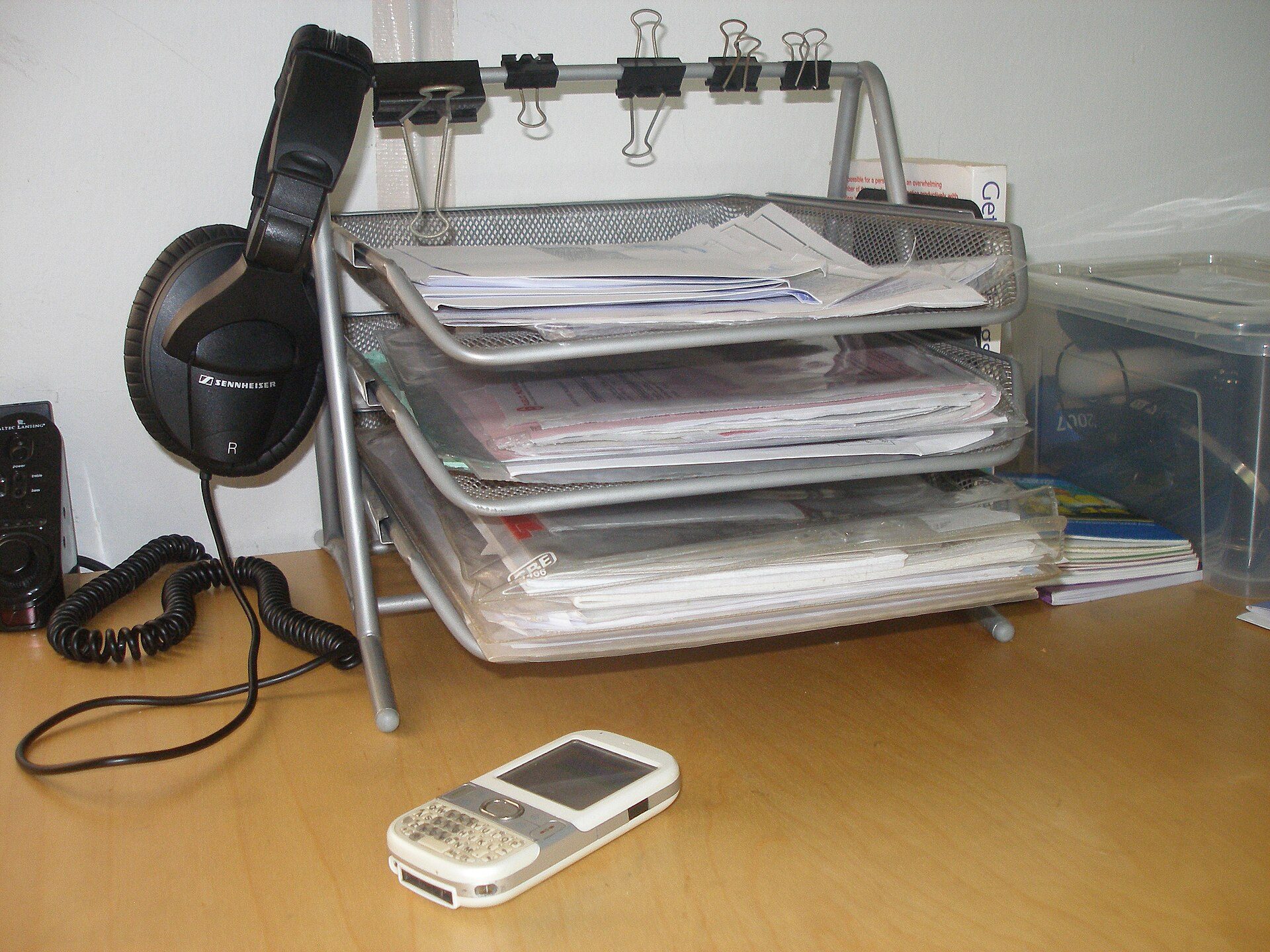
Photo: Khairil Yusof / Wikimedia Commons, CC BY 2.0
Minimum content of a document
- Document name and number (for example "Payment voucher PC-0098").
- Date; name and address of the issuing and receiving parties.
- What the transaction is: what was bought, sold or paid for.
- Quantity, unit price and amount in figures; the total also written in words.
- Signatures and full names of the preparer, the approver and other people involved.
External and internal documents
External documents are issued by other parties: supplier invoices, bank debit and credit advices. Internal documents are prepared by the company: cash receipts, payment vouchers, stock notes, payment requests. External documents carry more weight as evidence, so every large payment should have at least one external document attached.
Common documents in a small business
Who signs and what to attach
| Document | Used when | Signed by | Attach |
|---|---|---|---|
| Cash receipt (phieu thu) | Cash comes into the till | Approver, payer, cashier | Sales invoice, contract |
| Payment voucher (phieu chi) | Cash is paid out | Director, recipient, cashier | Payment request, invoice |
| Goods received note | Goods enter the warehouse | Storekeeper, deliverer | Delivery record, invoice |
| Goods issued note | Goods leave the warehouse | Storekeeper, receiver | Order, sales invoice |
| Contract, purchase order | Larger purchases or sales | Representatives of both sides | Quotation, appendices |
| Transfer order, bank advice | Payments through the bank | Account holder | Invoice, contract |
| E-invoice | Selling goods or services | Seller's digital signature | Original XML file |
The "three matches" rule
A transaction rarely has only one document. Buying a shipment usually needs a purchase order, a goods received note, an invoice and a bank transfer order. Remember the three matches: quantity matches across order, received note and invoice; unit price matches between contract and invoice; amount matches between invoice and payment document.
Preparing cash receipts, payment vouchers and stock notes
Cash receipts and payment vouchers
Number them continuously for the year (PT-0001, PT-0002 and so on) with no gaps. The amount in figures and in words must agree. The cashier only takes in or pays out money against an approved voucher, and counts the cash at the end of the day against the cash book (Figure 2). If you make a mistake, never erase or overwrite: cross the voucher out, mark it "Void", keep it, and issue a new one with the next number.
Photo: HuangWending18072009 / Wikimedia Commons, CC0
Goods received and goods issued notes
A goods received note records the quantity actually received, not the number copied from the invoice. Missing or damaged goods go on a delivery record signed by the deliverer. Units must match the item master (carton, bottle or crate), or your stock will be off when you enter it in software in step 3. A goods issued note states the reason (sale, internal use, return to supplier, damage), because each reason is booked differently (Figure 3).
Photo: Shixart1985 / Wikimedia Commons, CC BY 2.0
Contracts: which clauses does the accountant read?
Accountants do not draft contracts, but they must read them before paying (Figure 4): whether the price includes VAT; quantity and units; delivery or acceptance date; payment terms; invoicing details (company name, tax code, address, email for invoices).
Photo: Blogtrepreneur / Wikimedia Commons, CC BY 2.0
E-invoices: issuing a sales invoice step by step
In Vietnam, an e-invoice is created, digitally signed, sent and stored as electronic data through invoicing software the business has registered with the tax authority. Once you know how to issue one, you can check the ones others issue to you.
With or without a tax authority code, and reading the series
An invoice with a code receives a code from the tax authority before it goes to the buyer; an invoice without a code is sent by the seller, who transmits the data to the tax authority. Example: form number 1 and series C26TAA. The 1 means a value added tax invoice; C means it carries a tax authority code (K means no code); 26 is the year 2026; T is the type of invoice the business registered with the tax authority; AA is set by the seller. This structure follows the current rules and may be amended, so check the latest regulation when you see an unfamiliar series.
The 7-step process
- Receive an approved order or goods issued note, with the buyer's invoicing details.
- Look up the buyer's tax code, registered name and address.
- Enter the items: name, unit, quantity, unit price, discounts.
- Choose the correct VAT rate; rates can change with policy from period to period.
- Preview the draft and re-add goods value, tax, total and the amount in words.
- Sign and issue; for coded invoices, wait until the code is granted.
- Send to the customer and save the XML file in the month folder.
As a general principle, invoice goods when ownership or the right to use them passes to the buyer, and services when they are completed or when payment is collected in advance, depending on the case. There are many special cases, so check the current invoicing rules for your company's line of business.
A 60-second check before signing
Once signed, any error has to be fixed with an adjustment or replacement invoice. Re-read four things: the buyer's tax code, quantity against the goods issued note, the VAT rate, and the total in words.
Looking up purchase invoices on the tax authority portal
The lesson Monthly accounting tasks for a small business already lists 6 checks for a purchase invoice. Here you learn how to look one up for real, and how to check a whole month at once.
Looking up a single invoice
The tax authority's e-invoice portal (currently hoadondientu.gdt.gov.vn; if the address changes, go through the official tax sector website) lets you look up any invoice. You usually enter the seller's tax code, the series, the invoice number and the amount. Read three things: whether the invoice exists and matches the file you received; its status (normal, replaced, adjusted or cancelled); and whether the tax authority code matches the one printed on the invoice. Also check the seller's tax code status: a seller who has stopped operating is a signal to stop, not post the invoice, and tell your chief accountant.
Reconciling the monthly purchase list
Log in to the portal with the company account, download the list of invoices sellers issued to your tax code, and compare it with the invoices you received:
- On the portal but not in your books: a lost email or a colleague forgot to hand it in. Find it now.
- In your books but not on the portal: possibly a typo in the number or an invalid invoice. Check each one again.
- In both, with different status: the invoice was replaced and you still hold the old version.
The XML file is the original invoice
An e-invoice is an XML file with a digital signature; the PDF is only a readable rendering. Keep both, and if a supplier only sends a PDF, ask for the XML. Many accounting packages import XML directly, which you will do in step 3.
A wrong invoice: adjust or replace?
The short answer: it depends on what is wrong. Below is the common approach under Vietnam's current rules on invoices and documents. These rules have been amended several times, so before handling a specific case, read the latest regulation or ask your tax office.
Wrong buyer name or address, correct tax code
If only the buyer's name or address is wrong, and the tax code and everything else are correct, the seller usually only needs to notify the buyer of the error, without reissuing the invoice. The buyer keeps that notice with the invoice.
Wrong tax code, quantity, price, VAT rate or amount
| Criterion | Adjustment invoice | Replacement invoice |
|---|---|---|
| Nature | Records only the increase or decrease | Reissues the whole invoice with correct figures |
| Original invoice | Still valid; original plus adjustment gives the right figure | No longer valid, status "replaced" |
| Note on the new invoice | "Adjusts invoice" + form, series, number and date of the original | "Replaces invoice" + form, series, number and date of the original |
| Typically used when | The original was already declared in an earlier period; only part is wrong | Found early in the same period; several errors |
General sequence
- The side that finds the error tells the other by email or letter: which invoice, what is wrong, the correct figures.
- Both sides agree how to fix it; in many cases the rules require a written agreement stating the error, and it is worth having one even when not required.
- The seller issues the adjustment or replacement invoice, selects the right original, signs and sends it.
- The buyer checks the portal again: the original has changed status and the new invoice is valid. File the whole set together.
An invoice not yet sent to the buyer, or a transaction cancelled entirely, is handled differently; use the matching function in your invoicing software and check the current regulation.
Legal note: this lesson explains principles and does not replace the law. Vietnam's rules on invoices and documents change fairly often; deadlines, notice forms and penalties must be checked in the current regulation on the tax authority's official site or with your tax officer. Never edit an invoice file yourself or treat it as corrected before the seller agrees.
Worked example: Hoa Mai's shipment with a wrong invoice
Hoa Mai Trading Co., Ltd. (fictional) sells drinks to restaurants. On 3 November 2026 it orders 200 cartons of bottled water from supplier Suoi Xanh at 85,000 VND per carton before VAT. The example uses 10% VAT to keep the maths simple; in practice, check the rate that applies.
The right figures and the error
Correct figures: goods 200 × 85,000 = 17,000,000; VAT 1,700,000; total 18,700,000 VND (about US$710). On 5 November the storekeeper counts all 200 cartons and writes goods received note NK-0412. Invoice no. 125 arrives by email showing 210 cartons: 17,850,000 + 1,785,000 = 19,635,000 VND. The three matches reveal 10 extra cartons, or 935,000 VND (850,000 goods + 85,000 VAT). The portal shows invoice 125 is valid and carries Hoa Mai's tax code, so this is a data-entry error by the seller. The accountant does not post or pay it, and emails the supplier a photo of the received note.
Choosing the fix
- Downward adjustment: an invoice for −850,000 goods, −85,000 VAT, total −935,000; with the original: 19,635,000 − 935,000 = 18,700,000.
- Replacement: a new invoice for 200 cartons, 18,700,000, marked "replaces invoice no. 125".
The error was caught within the month and neither side had declared it, so both signed an agreement and chose replacement. On 6 November invoice no. 131 arrives and the portal shows invoice 125 as "replaced". Hoa Mai transfers 18,700,000 and pays 400,000 in cash for a truck (payment voucher PC-0098 with the haulier's invoice).
The complete document set
| Date | Document | Content | Amount (VND) |
|---|---|---|---|
| 3 Nov | Purchase order DH-27 | 200 cartons, before VAT | 17,000,000 |
| 5 Nov | Received note NK-0412 | 200 cartons actually received | — |
| 5 Nov | Invoice 125 (replaced) | 210 cartons, kept as evidence | 19,635,000 |
| 6 Nov | Agreement + invoice 131 | Replaces invoice 125 | 18,700,000 |
| 6 Nov | Transfer order + bank debit advice | Payment to Suoi Xanh | 18,700,000 |
| 6 Nov | Payment voucher PC-0098 | Truck hire | 400,000 |
Total actually paid for the shipment: 18,700,000 + 400,000 = 19,100,000 VND. Invoice 125 stays in the file but is not added in. Entries from invoice 131: Debit 156 (goods) 17,000,000, Debit 133 (deductible VAT) 1,700,000, Credit 331 (payables) 18,700,000; on payment: Debit 331 / Credit 112 18,700,000. Entering these in software is step 3.
Filing paper and electronic documents
Good filing means you can find anything in a few minutes, whether for a tax inspection or a balance reconciliation (see How to reconcile receivables and payables).
Electronic folders
- Folder tree:
Year / Month / Purchases | Sales | Bank | Stock | Cash. - File name:
2026-11-06_HD131_SuoiXanh_18700000.xml, with a PDF of the same name. - Replaced invoices get the suffix
_bi-thay-the("replaced") so nobody uses them by mistake.
Paper files and retention
File paper by transaction: the order, received note, printed invoice and transfer order for one shipment stay together, bound by month, clearly labelled and kept in a locked cabinet (Figure 5). Accounting documents must be kept for many years, with periods depending on the type under Vietnam's Accounting Law and current guidance; check carefully before destroying anything. For electronic data, follow the 3-2-1 rule: 3 copies, on 2 kinds of device, 1 kept outside the office.
Photo: MarkBuckawicki / Wikimedia Commons, CC0
Common mistakes new accountants make
Keeping only the PDF, losing the XML
Sign: the software cannot import the invoice, or the tax office asks for the original data. Cause: only the viewing copy was saved from email. Fix: ask the seller for the XML or download it from the portal; use one shared mailbox for invoices.
Erasing or overwriting vouchers
Sign: an amount corrected in a different pen. Cause: reluctance to write a new voucher. Fix: void the wrong one, keep it, issue a new one and have it signed again.
Posting first, checking later
Sign: at quarter end you find purchase invoices that were replaced, or sellers that stopped operating. Cause: posting as soon as the email arrives. Fix: check status before posting and reconcile the portal list at the start of every month.
Frequently asked questions
What is the difference between an adjustment invoice and a replacement invoice?
An adjustment invoice records only the difference and the original stays valid; a replacement invoice reissues everything and voids the original. Both must lead to the same final correct figure.
Does an e-invoice with the wrong company name have to be reissued?
If only the name or address is wrong and the tax code is right, the seller usually only needs to notify the buyer. A wrong tax code requires an adjustment or replacement. Check the current rules first.
Must cash receipts and payment vouchers follow a fixed template?
For small and medium businesses in Vietnam, many document templates in the current accounting regime are for guidance only; companies may design their own as long as the minimum content is there. Invoices follow separate invoicing rules.
Do electronic documents need to be printed for filing?
The original e-invoice is the XML file; electronic storage is enough if it stays readable and backed up. Printouts are just for convenience in paper files.
Practice exercise and self-assessment
Exercises
- Prepare a payment voucher with all minimum content for 1,250,000 VND of office supplies.
- An order is for 150 cartons × 120,000 VND (before VAT, assume 10% VAT), but the invoice shows 160 cartons. Calculate the correct total, the total on the wrong invoice, and the downward adjustment amount.
- Look up 3 e-invoices you have (electricity, internet, a purchase) on the tax authority portal and note each status.
Self-assessment criteria
- Pass: the voucher has all minimum content, and the figures and words agree.
- Pass: correct total 19,800,000; wrong invoice 21,120,000; downward adjustment 1,320,000 VND (1,200,000 + 120,000).
- Not yet: a replaced invoice is counted as an expense, or only PDFs are kept without XML.
With documents complete, correct and neatly filed, move on to the next step of the roadmap: Bookkeeping in accounting software, where you set up master data, import the XML files you saved and turn Hoa Mai's document set into ledger entries.
Keep learning small business accounting: after documents and invoices come bookkeeping in software, tax filing, payroll and financial statements. See the 8-step small business accountant roadmap.