The 7-step sales process is: prospecting, preparing and approaching, discovering needs, presenting a solution, handling concerns, closing and after-sales care. New sales staff often jump straight into making calls, but they do not yet know the product, do not know what competitors charge and are not sure how much discount they may give, so they either fumble or make promises just to get through the call. This is the first lesson of the roadmap: learn the shape of the process, study the product and pricing policy the right way, and keep the professional ethics that make customers trust you for years.
By the end of this lesson, you will be able to:
- Name the 7 steps of the sales process, with the goal and the output of each step.
- Write a one-page "product card" and test yourself with the 20 questions customers ask most.
- Build a comparison table against 2–3 main competitors using verifiable data, without badmouthing anyone.
- Work out a quotation whose discount stays within your authority and check the gross profit.
- Recognise unethical and illegal behaviour: false promises, trading customer data, taking kickbacks.
New to sales? This is step 1 of the roadmap, before prospecting, calling, consulting and closing. See the sales executive roadmap to learn in the right order.
What a sales process is and why beginners must know it
A sales process is the repeatable chain of steps a salesperson goes through to turn a stranger into a customer, and then into a returning customer. Each step has its own goal and an "output" that tells you whether you can move on. Knowing the process tells you where you stand with every customer, instead of calling whoever comes to mind.
Selling is a chain of tasks, not a single call
A stationery order for a 50-person company may need 1 call, 1 quotation, 2 follow-up messages and 1 sample delivery. Good salespeople rarely talk better than others; they complete every step and do not drop customers halfway. What you promise a customer is what your company must deliver, so you need to understand the product and your own limits first.
Selling to consumers (B2C) and to businesses (B2B) differ in length
- B2C (business to consumer): quick decisions, usually by one person, a cycle of minutes to days. Examples: phones, courses, personal insurance.
- B2B (business to business): several people involved (users, budget approvers, accountants), quotations, contracts and invoices needed; a cycle of weeks to months.
The 7 steps of the sales process
The table summarises the goal and output of each step. Companies name them differently, but the order is almost always the same.
| Step | Goal | Main tasks | Output needed to move on |
|---|---|---|---|
| 1. Prospecting | A list of people who may need the product | Referrals, groups, events, past customers | A list with names, likely needs and a legitimate way to contact them |
| 2. Preparing and approaching | The customer agrees to talk | Research the customer, open with a call or message | A meeting or a proper conversation |
| 3. Discovering needs | Understand the real problem | Ask questions, listen, take notes | Needs, budget, decision-maker and deadline written down |
| 4. Presenting a solution | Show the product solves that problem | Demo, samples, quotation | The customer understands the solution and has a quote |
| 5. Handling concerns | Remove worries about price, quality, risk | Ask back, answer with evidence | No major concern left unanswered |
| 6. Closing | The customer decides | A clear proposal, agreed terms | An order, a contract or a clear "no" |
| 7. After-sales care | Satisfied, repeat and referring customers | Track delivery, help with use, check in | The product works for them; repeat orders or referrals |
Steps 1–2: finding and approaching customers
Prospecting is a daily task, not a one-off. For beginners the best sources are usually the company's past customers and referrals, because they already have a reason to listen. Before contacting someone, spend 5 minutes on what they do and what they use now; building and scoring lead lists is covered in step 2 of the roadmap.
Steps 3–4: understand the need before presenting
The most common mistake is talking about the product before understanding the customer. Ask what problem they have, how much it costs them and who decides. When you present, mention only the features tied to the problem they just described. Customers do not need all 30 features; they need the 3 that help them.
Steps 5–6: handling concerns and closing
"Too expensive" or "let me think about it" is normal, not failure. Ask back to find the real worry, answer with evidence, then ask the customer to decide. Specific techniques are in the lesson how to close a sale without pressure; at this stage just remember: never close with a promise your company cannot keep.

Photo: RebeccaChurt / Wikimedia Commons, CC BY-SA 3.0
Step 7: after-sales care is where long-term income comes from
Winning a new customer takes far more effort than keeping an existing one. After delivery, call to check they received everything and that it works (see Figure 1 and Figure 4). Note when they will need to buy again, for example water filter cartridges after 6 months or printer ink after 2 months. Well-served customers refer you to others, bringing you back to step 1 at almost no cost.
Learning the product until you can answer without notes
If a customer hears "let me check and get back to you" three times in a row, they lose trust. In your first week, the most important job is learning the product, not making as many calls as possible. Many companies run product training sessions (Figure 2); come with a notebook and a list of questions.
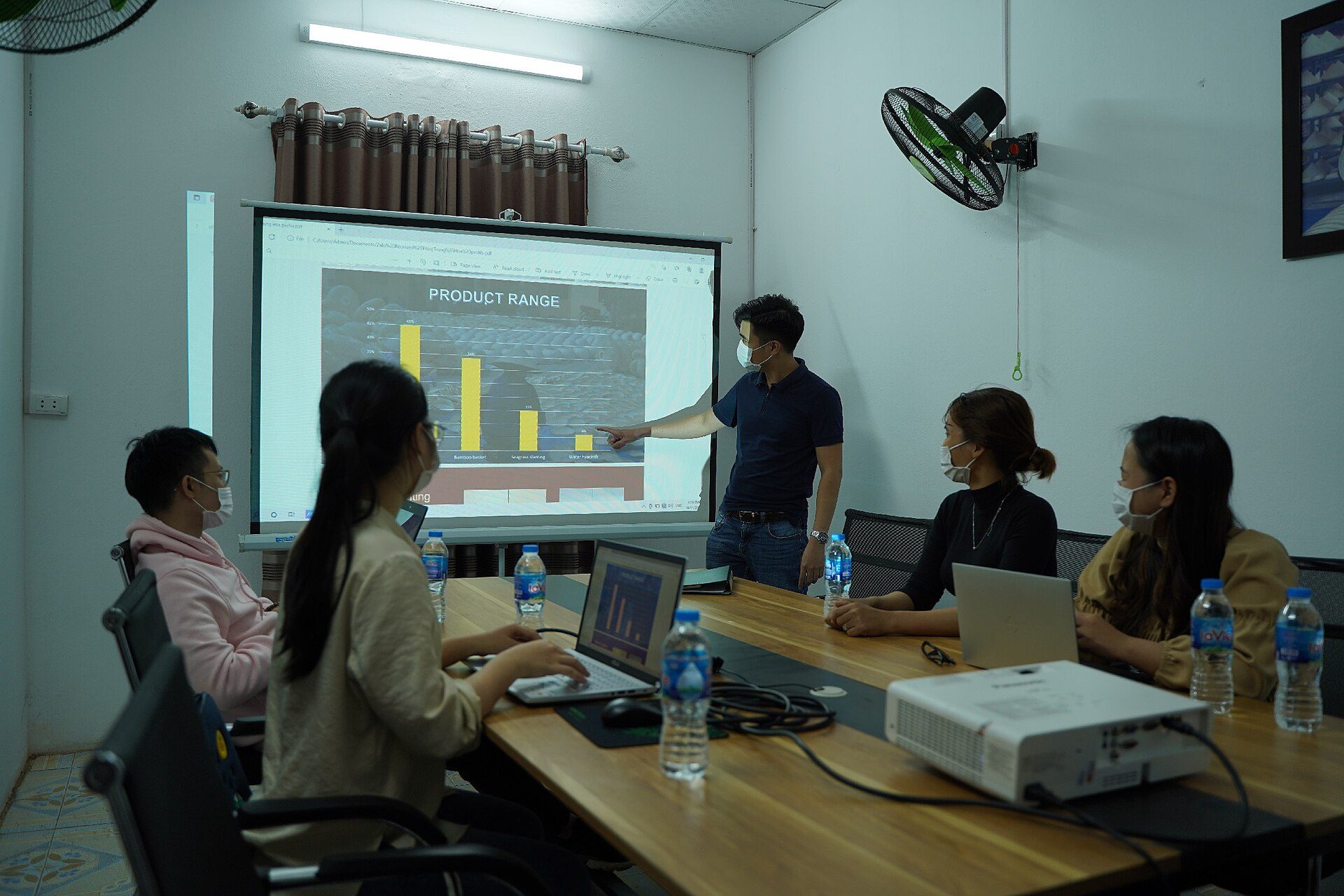
Photo: Maytretrunghoa / Wikimedia Commons, CC BY-SA 4.0
The one-page product card
For each main product, write one page with 8 items:
- Product name, code and versions.
- Who it is for (typical customer).
- What problem it solves, and how.
- The three most important specs or benefits, with verifiable figures.
- List price, packages and extra charges (delivery, installation, maintenance).
- Warranty and returns: exact conditions and time limits.
- What the product cannot do, or who it does not suit.
- Frequent customer questions with answers confirmed by your team leader.
Item 7 is often skipped, but it keeps you from mis-selling and avoids complaints.
A 5-day learning plan
- Day 1: read the product material, try or handle the real product, write the card for the best-seller.
- Day 2: learn the price list, discount policy, warranty, ordering and delivery process.
- Day 3: sit in on colleagues' calls or consultations and note what customers ask.
- Day 4: research 2–3 main competitors and build a comparison table.
- Day 5: ask your team leader to role-play a customer and fire 20 questions; relearn anything you got wrong.
Testing yourself with 20 common questions
Collect real questions from past customers and colleagues: price and how fees are calculated, how it differs from cheaper goods, who repairs it, how long delivery takes, whether there is a VAT invoice. You pass when you answer at least 18 of 20 correctly without notes.
Understanding competitors and pricing policy
Customers almost always compare. If you do not know what competitors sell and for how much, "the other company is 2 million cheaper" will catch you off guard. Understanding competitors is not about badmouthing them; it is about knowing where your product is strong or weak and which customers it suits better.
An honest competitor comparison
Use public sources: websites, catalogues, published price lists, genuine user reviews. Record the source and date, because prices change often. Each row compares one criterion customers care about: price, warranty, delivery time, after-sales service, strengths, weaknesses. If a competitor is genuinely better on a point, write it down; you need to know in order to pick the right customers.
Reading your company's pricing policy
- List price: the published price; always tell the customer clearly whether it includes value added tax (VAT).
- Volume or customer discounts: how much off for larger orders, how dealers differ from retail customers.
- Promotions: dates, conditions, and whether they stack with discounts.
- Pricing authority: how much you may discount on your own and which levels need a team leader or director.
- Payment terms: prepayment, how many days of credit, and who approves credit.
Never badmouth competitors
When a customer mentions a competitor, acknowledge their strengths, then explain your difference with data. For example: "Yes, their unit is cheaper. Ours costs more, but a technician comes to replace the cartridges on site, so you never have to do it yourself." Badmouthing or inventing facts about competitors makes customers suspicious of you and may breach competition rules.
Professional ethics and legal limits for salespeople
Sales targets push beginners toward tough choices: promising extra to get a yes, buying a phone list to save time, accepting a "thank you" payment from a buyer acting for their company. These may win one order, but they lose customers and jobs, and can lead to legal liability.
Legal and ethical warning: Never buy, sell, request or share lists of customer information (names, phone numbers, addresses, health or financial details) without the data subject's consent. Vietnam has dedicated rules on personal data protection; violations can be fined and serious cases can lead to criminal liability. Do not promise anything that is not in the contract, do not guarantee profits or results, and never take or give kickbacks. When unsure whether something is allowed, ask your team leader or legal department first, and read the current regulations on official government portals.
No false promises
False promises usually start small: "we can probably deliver in 2 days", "this model lasts 10 years without breaking". When the promise fails, the customer complains or returns the goods, and colleagues in the warehouse and technical team pay for it. Only promise what is in official documents or has been confirmed. If you are unsure, say so: "I will check with the warehouse and call you back before 3 pm today."
Customer data: use it only for what the customer agreed to
- Contact customers only through details they gave you, the company's existing customers, or business contact information published for that purpose.
- If a customer does not want marketing calls or messages, record it and stop contacting them.
- Never photograph or send the company's customer list outside, even when you change jobs.
- Do not keep customer information on a personal phone or in chat groups the company has not approved.
Gifts, commissions and kickbacks
Sometimes a buyer suggests inflating the invoice and splitting the difference. This is fraud that harms both companies: refuse and tell your team leader. Gifts to customers must follow company policy and be recorded.
When to advise a customer not to buy
If the product does not solve the customer's problem, or they are about to buy a bigger package than they need, say so and suggest the smaller one. You lose an order today but gain someone who trusts you.
Personal safety when meeting customers
Meet unfamiliar customers in public places such as cafes or company offices, and tell a colleague or your team leader about the appointment. Do not carry large amounts of cash and never collect payment outside the company's process. If you ride a motorbike all day, wear a fastened helmet and do not take calls while riding.
Photo: Ethan Muehlstein / Wikimedia Commons, CC BY-SA 4.0
Worked example: a quotation within your discount authority
You sell for a water purifier distributor. A 40-person office needs 2 purifiers for 2 floors plus 2 spare cartridge sets, and says: "Give me 15% off and I'll take them now." The prices below are assumptions for practice and include VAT. For scale, 20,000,000 VND is roughly 760 USD.
Data from company policy
- Water purifier: selling price 8,500,000 VND per unit, cost 6,000,000 VND per unit.
- Cartridge set: selling price 1,200,000 VND per set, cost 700,000 VND per set.
- Installation: 300,000 VND per point, actual cost 150,000 VND per point.
- Authority: staff may give up to 5% off the unit price on their own; above 5% up to 10% needs the team leader; above 10% needs the director.
Working out the quote
| Item | Quantity × unit price | Amount | Cost |
|---|---|---|---|
| Water purifier | 2 × 8,500,000 VND | 17,000,000 VND | 12,000,000 VND |
| Spare cartridge set | 2 × 1,200,000 VND | 2,400,000 VND | 1,400,000 VND |
| Installation | 2 × 300,000 VND | 600,000 VND | 300,000 VND |
| Total before discount | 20,000,000 VND | 13,700,000 VND | |
| 5% discount on purifiers | 17,000,000 × 5% | −850,000 VND | |
| Quoted total | 19,150,000 VND |
Check: 17,000,000 + 2,400,000 + 600,000 = 20,000,000 VND; 20,000,000 − 850,000 = 19,150,000 VND. Gross profit: 19,150,000 − 13,700,000 = 5,450,000 VND, about 28.5% of revenue.
Why not give 15% straight away
15% off the total is 20,000,000 × 15% = 3,000,000 VND, so the customer pays 17,000,000 VND. Gross profit drops to 17,000,000 − 13,700,000 = 3,300,000 VND, 2,150,000 VND less than above, and the discount exceeds your authority and needs the director. Instead of a bigger discount, offer one more cartridge set: the customer receives 1,200,000 VND of value, the company spends only the 700,000 VND cost, and gross profit stays at 5,450,000 − 700,000 = 4,750,000 VND.
A sample reply to the customer
"The discount I can give is 5% on the purifiers, which brings the total to 19,150,000 VND including VAT and installation on both floors. If you confirm this week, I can add one more spare cartridge set, enough for the first change on both units. I can't approve 15% myself; if you need it I'll take it to the director, but I can't promise the outcome." The answer is honest, states your authority and promises nothing that has not been approved.
Common mistakes of new sales executives
Calling before knowing the product
Sign: repeatedly saying "let me check", customers replying "just send me the brochure". Cause: skipping the product-learning week. Fix: finish the product card and the 20-question test before calling real customers.
Discounting beyond your authority
Sign: accounting rejects the quote and your team leader has to call the customer to apologise. Cause: not reading the pricing policy, wanting a quick close. Fix: know your discount limit, offer extras or better terms instead of price cuts, and get approval before quoting.
Forgetting customers after delivery
Sign: no repeat orders, poor reviews. Cause: treating the sale as finished at closing. Fix: schedule follow-up calls after 3 days, after 1 month and before the customer needs to reorder (Figure 4).

Photo: Shixart1985 / Wikimedia Commons, CC BY 2.0
Frequently asked questions
How many steps does the sales process have?
The most common version has 7: prospecting, approaching, discovering needs, presenting a solution, handling concerns, closing and after-sales care. Some materials merge them into 5 or split them into 9, but the core is the same.
How does a B2B sales process differ from B2C?
B2B involves several decision-makers, needs quotations, contracts and invoices, and usually takes weeks to months. B2C is faster and usually decided by one person. Both go through the same steps.
How long should a beginner study the product before calling customers?
It depends on product complexity, usually a few days to a few weeks. A practical milestone: you answer at least 18 of 20 common questions without notes and know the pricing policy and warranty.
Does sales ethics reduce sales?
You may lose a few orders in the short term, but customers who trust you buy again and refer others. Mis-selling and false promises lead to complaints, returns, a damaged reputation, and possibly discipline or fines.
Practice and self-assessment
- Write a one-page product card with all 8 items for the product you will sell (or a familiar one such as a water purifier or an internet package).
- Build a comparison table against 2 competitors, with the source and date in every cell.
- Redo the quotation example for 3 purifiers, 3 cartridge sets and 3 installation points, 5% off the purifiers; work out the quoted total and gross profit.
- Write a sample reply for when a customer asks for more discount than you are allowed to give.
Self-assessment criteria
- Pass: you list the 7 steps in order with the output of each.
- Pass: you answer at least 18 of 20 common questions without notes.
- Pass: the 3-unit quote comes to 28,725,000 VND with a gross profit of 8,175,000 VND (cost 20,550,000 VND).
- Not yet: you promise a discount or delivery date that has not been confirmed, or use a customer list of unknown origin.
Once you know the process, the product and your limits, move on to the next step of the roadmap: Customer profile & prospecting, where you learn to define target customers, find leads through referrals, groups and events, and build a scored priority list.
Keep learning sales: after the sales process come prospecting, cold calls, consulting, handling objections and closing. See the sales executive roadmap.