A spa therapist's salary in Vietnam in 2026 (reference figures, varying by region) is typically around 4–7 million VND a month as a trainee, 7–15 million as a therapist, 12–20 million at the advanced level and 15–30 million as a manager in Hanoi and Ho Chi Minh City (HCMC); in the provinces it is roughly a quarter to a third lower. For orientation, 1 million VND is about 40 US dollars, so a therapist on 12 million VND earns roughly 480 USD a month. What you actually take home depends heavily on how the spa calculates session pay and commission, not just the base pay in the job advert. Many newcomers see "salary 15 million" in an advert and then receive 5 million in their first month — this lesson helps you read a pay structure correctly before you accept a job.
By the end of this lesson, you will be able to:
- Split a spa therapist's income into its parts: base pay, session pay, product and package commission, plus tips and allowances.
- Calculate a monthly salary from a spa's own pay policy, including insurance deductions, to within 0.1 million VND.
- Compare income across the 4 career levels, between Hanoi, HCMC, tourist cities and the provinces, and between hotel spas and small spas.
- Spot 5 warning signs in job adverts and contracts before you sign.
- Plan how to raise your income at each level through concrete skills, not through pushy selling.
Where to start? If you have not entered the trade yet, the course Spa Therapist Level 1 – Trainee teaches safety, hygiene and foundation techniques — exactly what spas check when they take on trainees. The path continues with Level 2 – Therapist, Level 3 – Advanced Therapist and Level 4 – Spa Manager.
What makes up a spa therapist's income?
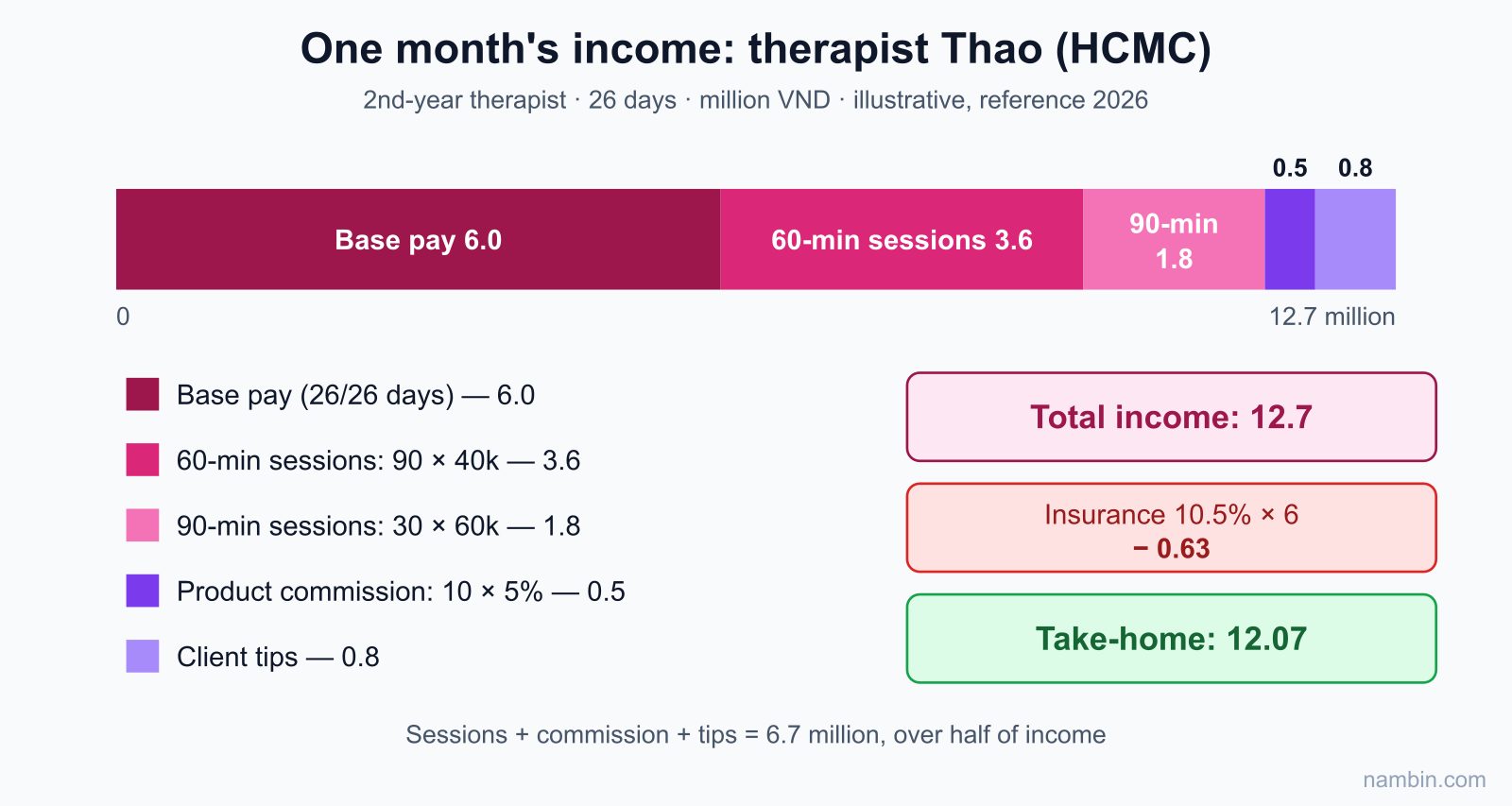
Most spas in Vietnam pay according to the formula base pay + session pay + commission + tips and allowances. The fixed part gives you a floor; the variable part rewards skill and client numbers. That is why two therapists with the same title at the same spa can earn 3–5 million VND apart each month. Figure 1 shows how a real pay slip is built from these parts.
Base pay
This is the fixed monthly amount, calculated on the number of working days (usually 26). It is also usually the amount on which the spa pays social insurance if you have a labour contract. Base pay for a therapist in a big city is roughly 5–7 million VND; trainees get less, managers much more. When comparing two employers, do not look only at base pay: a place with high base pay may pay low session rates.
Session pay ("tour")
In Vietnamese spas a "tour" is one complete service for one client, for example one 60-minute body massage. For each session you receive either a fixed amount or a percentage of the service price. For a therapist, session pay is often 30–50% of total income, so the number of sessions per day explains most of the difference between a busy month and a quiet one.
Product and package commission
When a client buys cosmetics or a multi-session package after your consultation, the spa pays a commission as a percentage of the sale, typically 3–8%. This is the part most easily misunderstood: commission only lasts when your advice matches the client's real skin needs and the health information on their record (see the lesson on client consultation and health forms). Pressuring clients to buy loses you regular clients — and with them, the session pay of the following months.
Tips, allowances and service charge
Tips vary widely: a budget spa may bring a few hundred thousand VND a month, a resort with international guests several million. Common allowances include lunch, parking, attendance and overtime after closing. Hotels and resorts often add a service charge shared among staff each month.
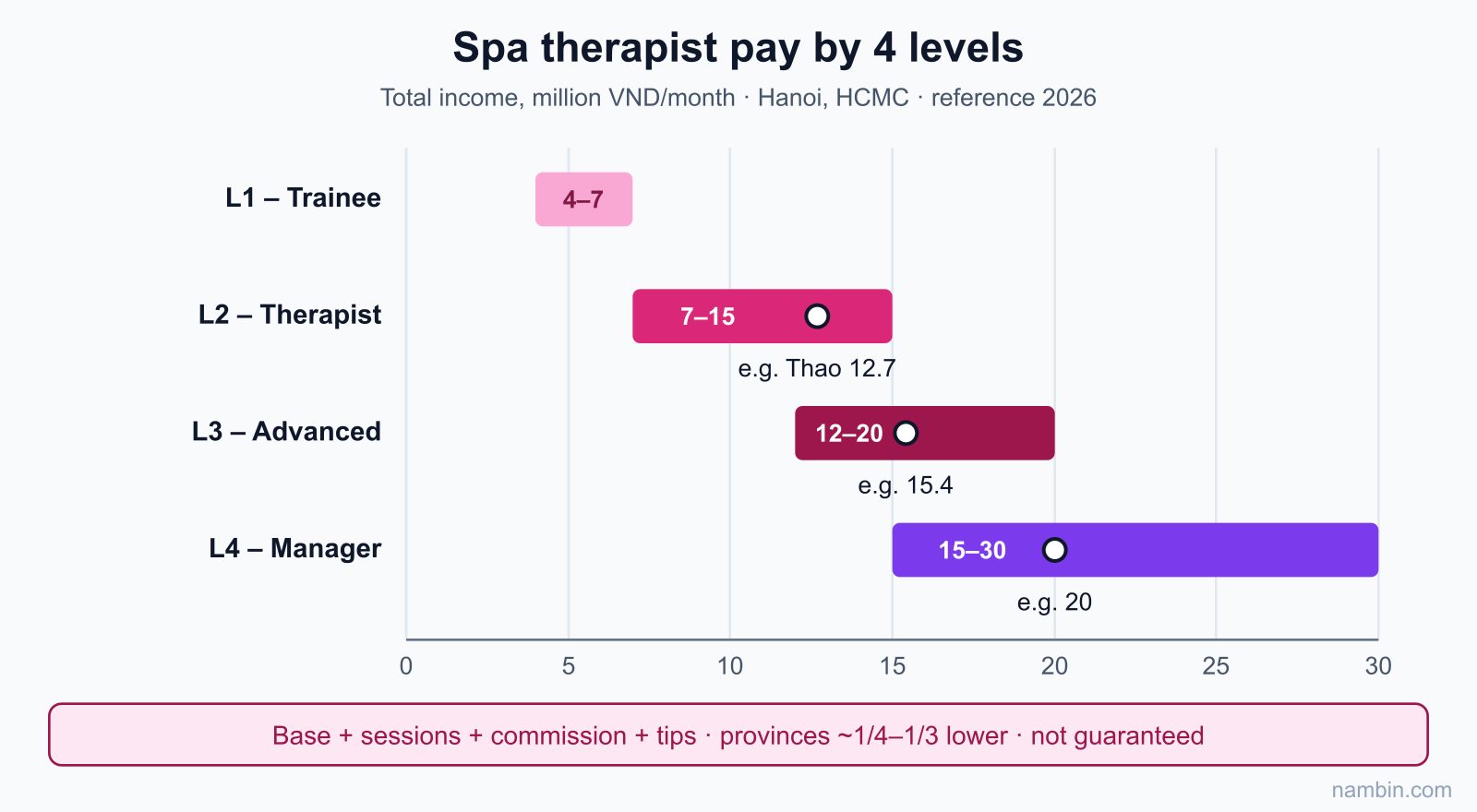
Spa therapist pay by 4 levels (reference 2026)
The table below follows the 4 levels of the NAMBIN career path and applies to small and medium spas in Hanoi and HCMC. These are reference ranges for 2026 that vary by region and employer; they are not guaranteed amounts or official statistics. Each row shows base pay, session pay, commission and total separately so you can compare them with job adverts.
| Level | Base pay (million VND/month) | Session pay | Commission | Total income (million VND/month) |
|---|---|---|---|---|
| Level 1 – Trainee (0–6 months) | 3–5 (allowance or trainee wage) | 20–30 thousand per session, few sessions | 0–3% on products | 4–7 |
| Level 2 – Therapist (6 months – 2 years) | 5–7 | 30–60 thousand per 60-minute session | 3–5% on products and packages | 7–15 |
| Level 3 – Advanced therapist | 6–9 | 50–100 thousand per advanced session | 5–8% on treatment packages | 12–20 |
| Level 4 – Manager, head of spa | 10–15 | few or no sessions | 1–3% of spa revenue or KPI bonus | 15–30 |
Level 1 – Trainee: a floor plus board and lodging
At this level you mostly assist, clean rooms and perform simple sessions under the supervision of a therapist. Many spas pay a trainee allowance of 3–5 million VND, and some provide meals and accommodation. Example: a trainee at a spa in a small town receives a 3.5 million allowance + 40 sessions × 25 thousand = 1 million + 0.3 million in tips, a total of 4.8 million VND, and lives in the spa's dormitory. It is not much, but the goal of level 1 is skill and correct hygiene habits.
Level 2 – Therapist: sessions decide income
Once you can perform a complete body treatment and a basic facial on your own, you take clients independently. From here, sessions per day (usually 3–6) and the client return rate are the two numbers that move income from 7 to 15 million. A detailed worked example follows in the next section.
Level 3 – Advanced therapist: harder services, higher session rates
Advanced therapists operate spa devices, deliver multi-session courses and serve special clients (pregnant women, older people) strictly within the scope of the trade. Services cost more, so session pay is higher. Example: base pay 7 million + 70 advanced sessions × 80 thousand = 5.6 million + package commission 30 million × 6% = 1.8 million + tips 1 million, a total of 15.4 million VND.
Level 4 – Manager: bonus tied to the whole spa
Managers rarely do sessions; their income is linked to the revenue, staff and quality of the whole spa. Example: base pay 12 million + a 2% bonus on monthly revenue of 400 million = 8 million, a total of 20 million VND. When revenue falls, the bonus falls too; a good manager is one who keeps revenue steady.
How is spa session pay calculated?
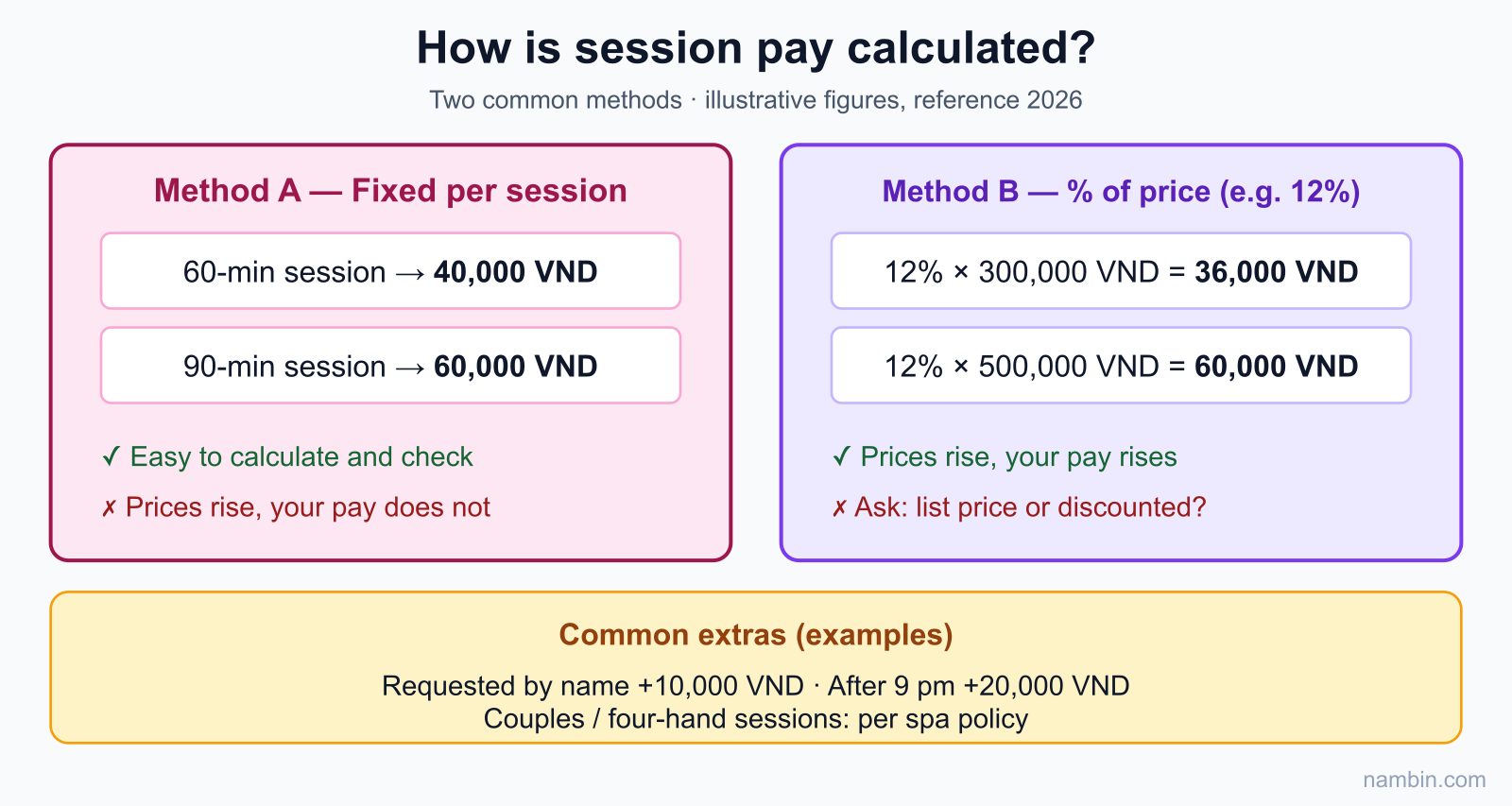
This is the question newcomers most often forget to ask at interviews, even though it decides almost half their income. There are two common methods plus a few extras, as shown in Figure 3. Ask for the session pay table in writing, or a photo of the policy, before you accept a job.
Method A: a fixed amount per session length
The spa sets a fixed amount for each type of session, for example 40 thousand VND for 60 minutes and 60 thousand for 90 minutes. Advantage: easy to calculate and check. Disadvantage: when the spa raises its prices, your session pay does not rise automatically.
Method B: a percentage of the service price
The spa pays a share of what the client pays, typically 10–15%. At 12%, a 300 thousand session gives you 36 thousand and a 500 thousand session gives you 60 thousand. Ask whether the percentage is calculated on the list price or the discounted price — in promotion months, the discounted basis lowers your pay.
Extras: requested by name, overtime, couples sessions
Many spas add a bonus when a client specifically asks for you (for example +10 thousand per session), for sessions after closing time (for example +20 thousand), or for couples and four-hand sessions. Being requested by name is the clearest measure of skill — keep your own monthly count.
Worked example: therapist Thao's monthly pay
Thao is a second-year therapist at a spa in a central district of HCMC and works the full 26 days. The policy (illustrative): base pay 6 million VND with insurance paid on that base; 40 thousand per 60-minute session, 60 thousand per 90-minute session; 5% product commission.
| Item | Calculation | Amount (million VND) |
|---|---|---|
| Base pay | 26/26 days | 6.00 |
| 60-minute sessions | 90 sessions × 40 thousand | 3.60 |
| 90-minute sessions | 30 sessions × 60 thousand | 1.80 |
| Product commission | 10 million × 5% | 0.50 |
| Tips | given by clients, monthly total | 0.80 |
| Total income | 6 + 3.6 + 1.8 + 0.5 + 0.8 | 12.70 |
| Insurance deduction (employee share) | 10.5% × 6 million | − 0.63 |
| Take-home pay | 12.70 − 0.63 | 12.07 |
Thao did 120 sessions in 26 days, about 4.6 a day on average. The 10.5% is the employee's share of statutory insurance in Vietnam (social insurance 8%, health insurance 1.5%, unemployment insurance 1%) on the insured salary. At this income level, after family deductions, she usually does not yet owe personal income tax; if you earn much more, ask the spa's accountant how it is calculated under current rules.
How does pay differ between Hanoi, HCMC and the provinces?
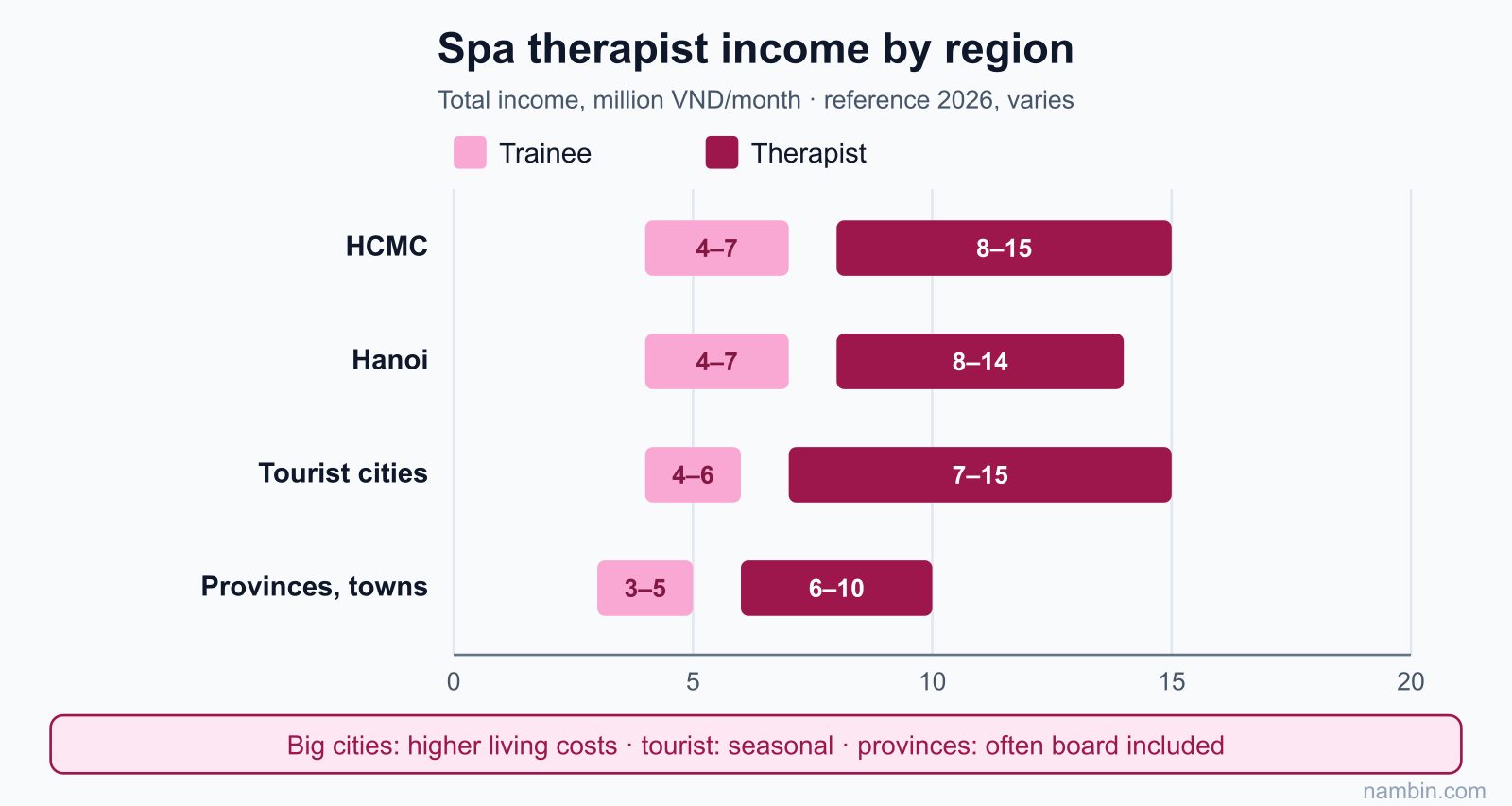
Location affects both service prices and client numbers, so it directly affects session pay. The table and Figure 4 give reference ranges for 2026 for the two levels newcomers care about most; individual employers may fall outside them.
| Region | Trainee | Therapist | Notes |
|---|---|---|---|
| HCMC | 4–7 | 8–15 | Many spas, high prices, busy weekends |
| Hanoi | 4–7 | 8–14 | Similar to HCMC; body treatments rise in winter |
| Tourist cities (Da Nang, Nha Trang, Phu Quoc…) | 4–6 | 7–15 | Seasonal; resorts add tips and service charge |
| Provinces, small towns | 3–5 | 6–10 | Fewer clients, low living costs, often board included |
HCMC and Hanoi: higher pay, higher costs
Session prices in the two big cities are higher, so session pay is higher. But rent, transport and food can take 4–6 million VND a month. When comparing, calculate how much you can save, not just total income.
Tourist cities: seasonal income
In peak season, resort therapists can be fully booked and tips are good; in low season session pay drops sharply. Save during the busy months and ask whether the spa keeps paying base pay in the quiet season.
Provinces and small towns: lower pay, loyal clients
Income is roughly a quarter to a third lower than in big cities, but living costs are lower and many places provide meals and lodging. Provincial clients are more loyal: a skilled therapist can build a stable base of regulars faster than in the city.
Hotel spa, resort or small spa: which to choose?
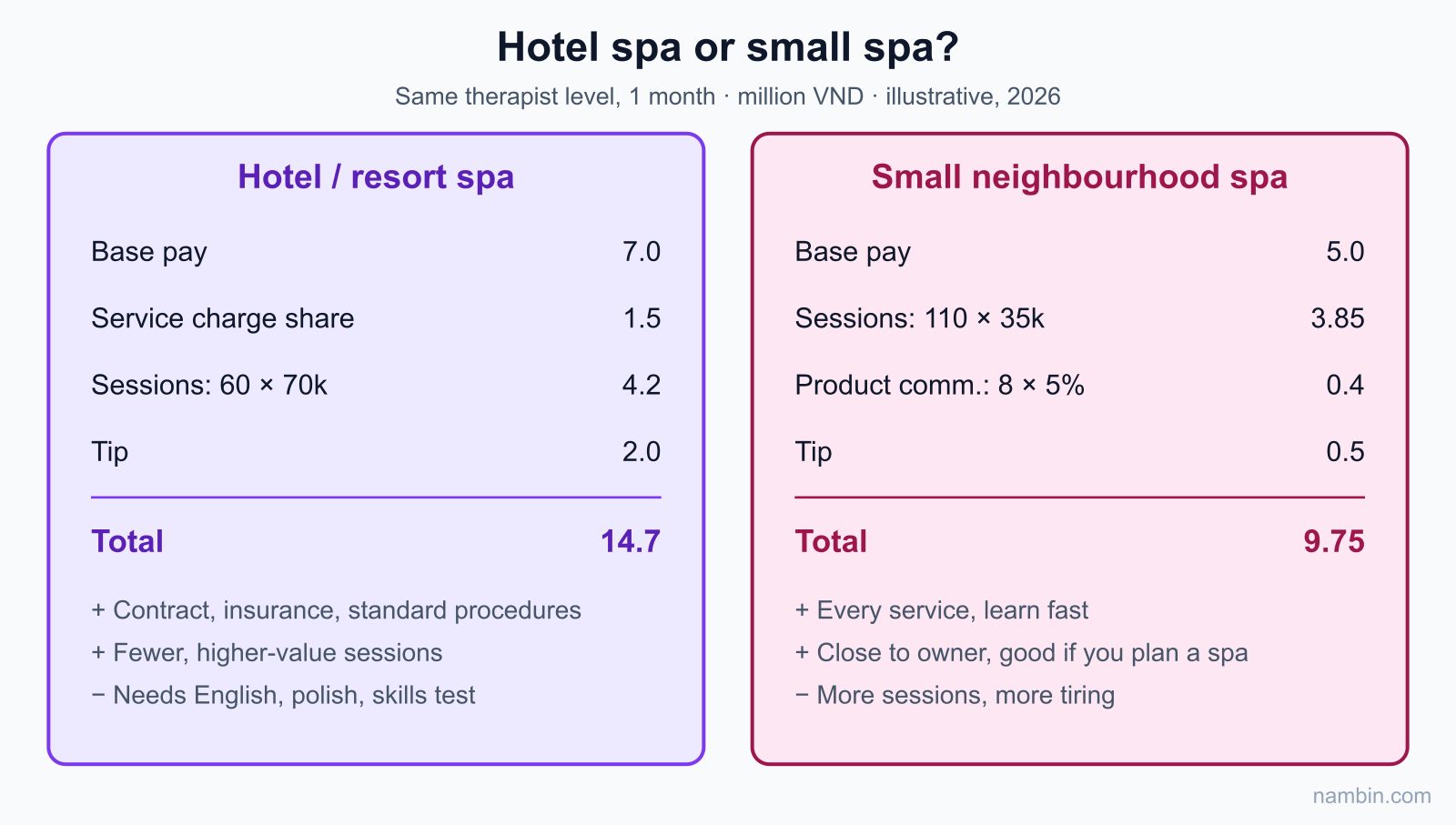
With the same skills, different workplaces produce very different income structures. Figure 5 compares two therapists with illustrative figures: one in a 4–5 star hotel spa, one in a small neighbourhood spa.
Hotel and resort spas
Example: base pay 7 million + service charge share 1.5 million + 60 sessions × 70 thousand = 4.2 million + tips 2 million, a total of 14.7 million VND. Fewer sessions, each worth more, with a contract, insurance and standard procedures. In return you need conversational English, a professional appearance and manner, and you usually face a strict practical skills test.
Small and family spas
Example: base pay 5 million + 110 sessions × 35 thousand = 3.85 million + product commission 8 million × 5% = 0.4 million + tips 0.5 million, a total of 9.75 million VND. More sessions means more tiring work, but you do every type of service, learn fast and work close to the owner — a good fit if you plan to open your own spa one day.
Spa chains and beauty clinics
Chains usually have clear pay grades, in-house training and a path to shift leader. Some set high sales targets; ask exactly which part of your income depends on selling packages, and whether the work stays within the spa trade or crosses into medical services that need a separate licence.
Deductions and risks to know before accepting a job
The income in a job advert is often the "highest possible" figure. Before accepting, ask clearly about the deductions and binding terms below; a reputable employer will answer clearly and in writing.
Insurance and the labour contract
With a labour contract you pay the employee share of insurance (10.5%, as in Thao's example) and gain sickness, maternity and unemployment benefits. A spa with no contract gives slightly higher take-home pay, but you lose those rights. Many people in the spa trade are women of child-bearing age, so maternity benefits are well worth weighing.
Training fees, commitments and withheld pay
Some places train you for free but require a 12–24 month commitment, with a training-fee refund if you leave early; some withhold part of the first month's pay. That is not necessarily wrong, but the refund amount, period and calculation must be written into the contract. Never hand over original identity documents for an employer to keep.
Fines, pay deductions and targets
Ask in advance: how much is deducted for lateness, whether a client complaint cancels your session pay, what happens if you break something, and whether missing a package sales target reduces base pay. Write down the answers and compare them with your first pay slip.
Warning: Be careful with adverts such as "spa staff wanted, no experience, 20–30 million salary", especially if you must pay a fee first, the interview is somewhere with no sign, or you are expected to work privately with clients in closed rooms outside the service menu. These are signs of training-fee scams or disguised work. Never agree to perform invasive services (injections, deep microneedling, cosmetic tattooing, medical lasers) for "high pay" when you are not trained and the premises are not licensed — the risk to the client is real, and legal liability can fall on the person who performed the procedure.
How to raise your income at each level
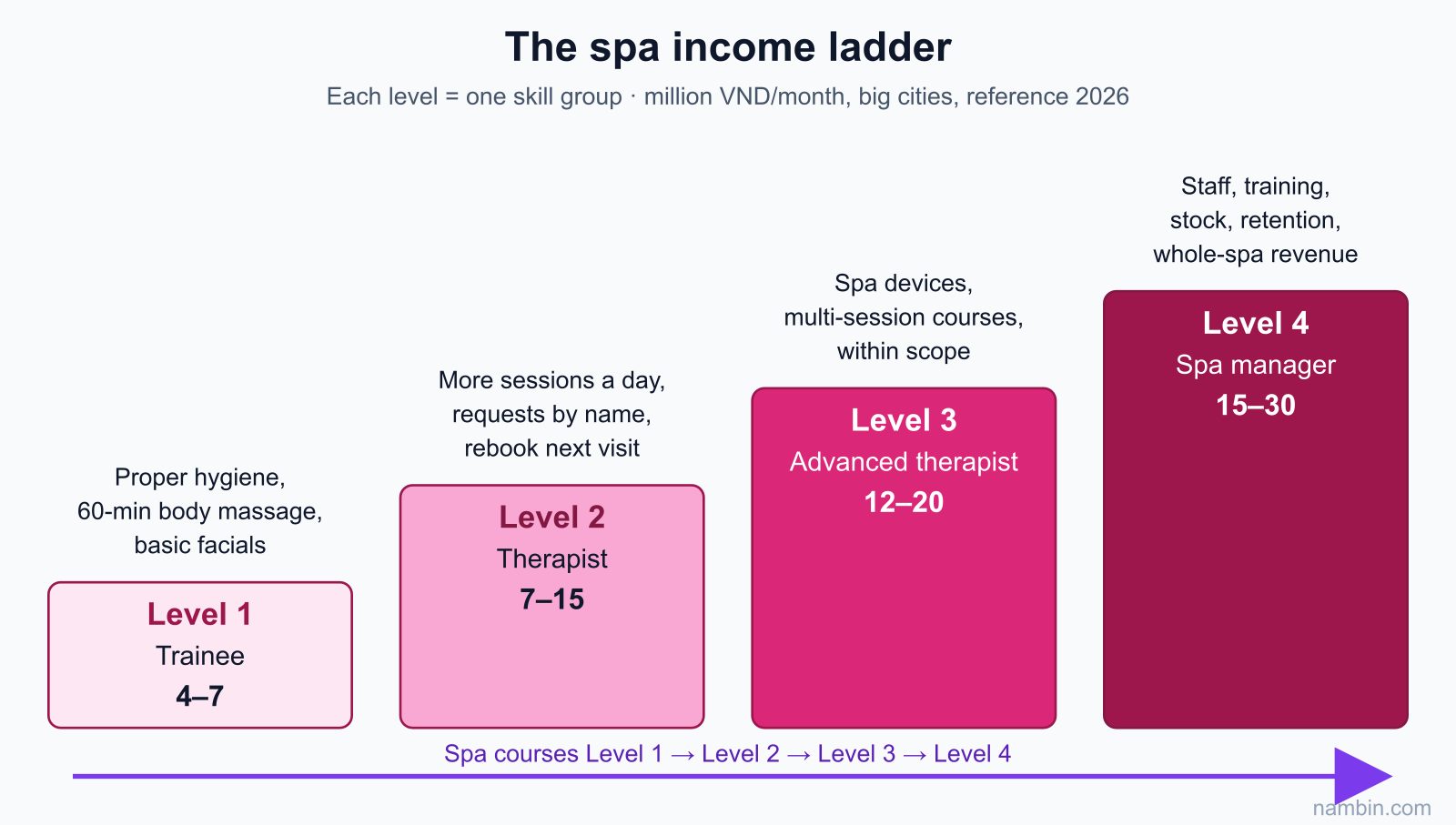
Income grows sustainably when you move up through concrete skills that someone can confirm. Figure 6 summarises what to work on at each level; the lesson on spa certificates and career path covers certificates and skills portfolios in more detail.
From trainee to therapist: do it right, do it efficiently
Goal for the first 6 months: perform a complete 60-minute body massage and a basic facial correctly, on time, with no hygiene complaints. Ask a senior therapist or manager to assess your skills regularly. The course Spa Level 1 – Trainee helps shorten this stage.
As a therapist: more sessions and more name requests
Level 2 income grows with the number of sessions and the return rate. The three most effective habits: keep client notes (pressure, sore areas, preferences), book the next visit at the end of each session, and finish on time so you can take more clients per shift. Delivering a complete treatment from welcome to farewell (see the lesson on delivering a full spa treatment) is the foundation of regular clients. The course Spa Level 2 – Therapist goes deeper into body massage, skin care and consultation.
Advanced therapist: higher-priced services, within scope
Learn spa devices, multi-session courses and care for special clients — services with higher session pay. The essential condition is knowing the boundary with medical aesthetics so that you refuse at the right moment. The course Spa Level 3 – Advanced Therapist teaches exactly this skill group.
Manager: from hands-on skill to operations
Managers are paid for the results of the whole spa: staff rotas, training newcomers, stock control, client retention and regulatory compliance. Start by acting as shift leader, mentoring trainees and reading revenue reports. The course Spa Level 4 – Manager & Spa Owner covers opening a spa legally, operations and finance.
Frequently asked questions
How much does a new spa employee earn?
For reference in 2026, trainees in big cities earn about 4–7 million VND a month and in the provinces about 3–5 million, sometimes with board and lodging. After about 6 months, as a therapist, income usually rises to 7–15 million depending on sessions and region.
Is a spa therapist's income stable?
Base pay is stable; session pay and commission vary with season and client numbers — the gap between busy and quiet months can be 20–40%. A base of regular clients who book ahead is the best way to keep income steady.
How should session pay be calculated?
Either a fixed amount per session type (for example 40 thousand VND for 60 minutes) or a percentage of the service price (typically 10–15%). Ask whether it is based on the list or discounted price, whether there are extras for name requests and overtime, and get the policy in writing.
Do hotel spa therapists earn more than those in independent spas?
Usually more in base pay, service charge and tips, with fewer sessions but higher demands on language and professional manner. Small spas give more sessions and a wider range of services. In Figure 5 the example is 14.7 million versus 9.75 million VND, but that is only an illustration.
Practice exercises and self-assessment
Exercises
- Calculate a therapist's monthly pay: base pay 5.5 million (insurance on 5.5 million), 100 sixty-minute sessions × 35 thousand, 20 ninety-minute sessions × 55 thousand, product sales of 6 million at 4% commission, tips 0.4 million. Calculate total income and take-home pay.
- Change the method: if the spa pays 12% of the price, with 60-minute sessions at 300 thousand and 90-minute sessions at 450 thousand, what is the therapist's monthly session pay from exercise 1? Which method is better?
- Pick 2 real spa therapist job adverts in your area. Build a comparison table: base pay, session pay, commission, insurance, commitment, working hours. Mark the missing information you need to ask about.
- Write a 12-month plan to raise your income: current level, skills to learn, monthly indicators (sessions, name requests, return rate).
Self-assessment criteria (pass / not yet)
- Exercise 1 passes when you get: sessions 100 × 35 thousand = 3.5 million; 20 × 55 thousand = 1.1 million; commission 6 million × 4% = 0.24 million; total 5.5 + 3.5 + 1.1 + 0.24 + 0.4 = 10.74 million; insurance 10.5% × 5.5 ≈ 0.58 million; take-home ≈ 10.16 million. An error above 0.1 million does not pass.
- Exercise 2 passes when you get: 100 × 36 thousand = 3.6 million; 20 × 54 thousand = 1.08 million; total session pay 4.68 million, slightly above the fixed method (4.6 million) by 0.08 million — and you note that if it is calculated on discounted prices the result may reverse.
- Exercise 3 passes when the table has all 6 columns and at least 3 questions to clarify before signing.
- Exercise 4 passes when each quarter has at least one new skill and one measurable number, not a vague "work harder".
Roadmap step — Spa certificates & career development: continue with the certificates lesson in the same step to build your skills portfolio. Beginners should start from step 1, "Skin, body and hygiene foundations".
Next step: To earn a good trainee income and become a therapist sooner, start with the course Spa Therapist Level 1 – Trainee. Then continue with Level 2 – Therapist, Level 3 – Advanced Therapist and Level 4 – Spa Manager — each level is one income step in the table above.