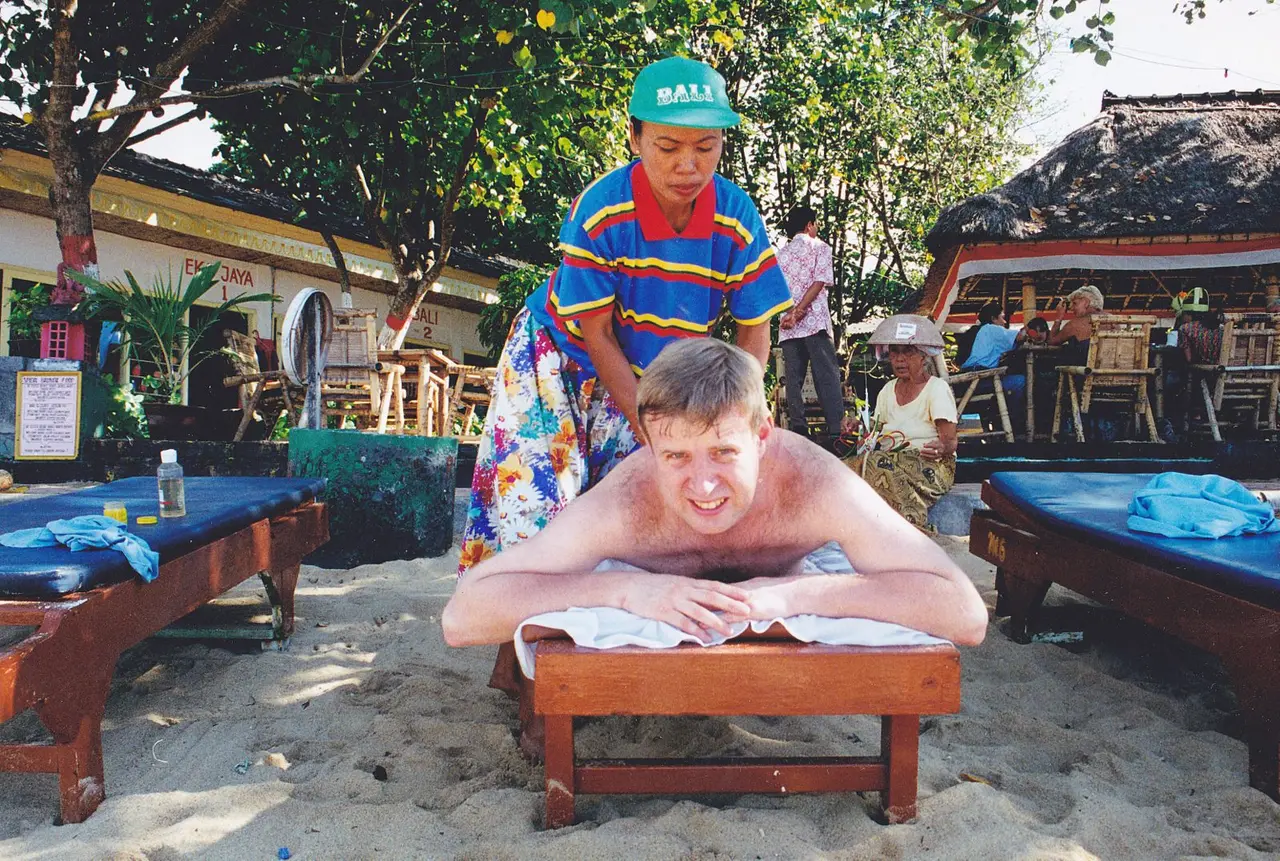
Musculoskeletal anatomy for massage is the knowledge that tells a massage therapist which muscle their hands are on, which bone lies underneath and where blood vessels and nerves sit close to the surface so that firm pressure must be avoided. At trainee level you need about 19 muscle groups of the neck, shoulders, back, hips and legs, 10 bony landmarks you can feel, and 8 endangerment sites: the front of the neck, the hollow above the collarbone, the armpit, the inner elbow, the spine, the kidney area, the groin and the back of the knee. Finally, you need to tell ordinary muscle ache from pain caused by illness, so you know when to stop and advise the client to see a doctor.
By the end of this lesson, you will be able to:
- Find and name 10 major bony landmarks on a real person, from the 7th neck vertebra to the ankle bones.
- Point out the location and fibre direction of the 19 neck, shoulder, back, hip and leg muscle groups therapists work on most.
- List all 8 endangerment sites, say what lies underneath each one and how to work safely around it.
- Tell muscle ache from pain with warning signs using 6 questions, and know when to stop a session and when to call an ambulance (115 in Vietnam).
- Draw a "body map" for a 60-minute session: areas to work, muscle groups, areas to avoid and time for each part.
Learning massage therapy properly? Muscle and bone anatomy is step 2 of the roadmap, after hygiene, contraindications and legal limits, and before pressure and Swedish massage. See the 8-step massage therapist roadmap to learn in the right order.
Why do massage therapists need anatomy?
Massage means working with muscles, tendons and soft tissue. If you do not know where a muscle lies, you tend to press wherever the client points, often onto bone or a nerve. Anatomy is not for diagnosing illness; it is for working in the right place, with the right pressure, safely.
Know where you are pressing, and where you must not
When a client says "my shoulder blade aches", you should think straight away: middle trapezius, rhomboids or levator scapulae, each with its own attachments and fibre direction (see Figure 1). On the other hand, some areas have blood vessels and nerves close to the surface with no thick layer of muscle on top; pressing deeply there causes numbness, sharp pain, bruising or worse. Step 1 tells you when not to massage; step 2 tells you where not to press hard.
How much is enough
A massage therapist does not need to memorise Latin names like a medical student. You need to name the main muscle groups, feel the bony landmarks on a real person, and know the endangerment sites and warning signs. Knowing the English names is a plus when you work at a resort with international guests.
The skeleton and main joints: landmarks for your hands
Muscles attach to bones, so once you can feel a bony landmark you know where the muscle is (see Figure 2).
The spine: 7, 12, 5 and the spinous processes
The adult spine has 7 neck (cervical) vertebrae, 12 thoracic vertebrae, 5 lumbar vertebrae, the sacrum and the coccyx. The spinous process at the back of each vertebra feels like a row of small bumps down the middle of the back; when the client bends their head forward, the most prominent bump at the base of the neck is usually the 7th cervical vertebra. The spinal cord runs inside the spinal canal, with nerve roots leaving on each side.
Shoulder blade, collarbone, ribs and pelvis
The shoulder blade (scapula) is a triangular plate lying on the upper back, with the spine of the scapula running across it and the acromion at the tip of the shoulder; the collarbone runs across the front. There are 12 pairs of ribs; pairs 11 and 12 are short and do not join the breastbone at the front, so they are called floating ribs, and they sit right over the kidney area. The iliac crest is the curved rim of bone you feel when you put your hands on your hips.
Leg bones, knees and ankles
The greater trochanter, on the outer upper end of the thigh bone, can be felt at the side of the hip. The knee joint is formed by the thigh bone, the shin bone and the kneecap in front. The shin bone (tibia) can be felt along the whole front of the lower leg, right under the skin; the inner ankle bone belongs to the tibia and the outer ankle bone to the fibula.
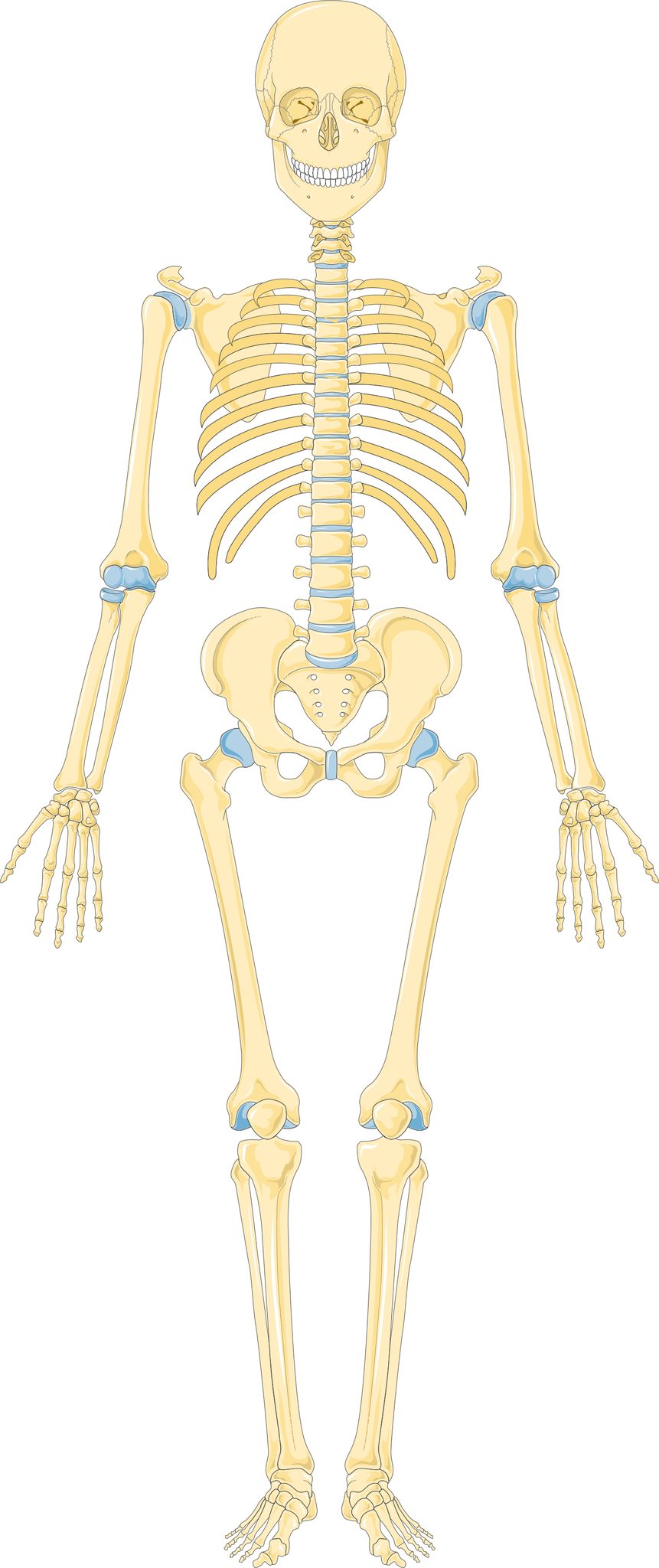
Photo: Laboratoires Servier / Wikimedia Commons, CC BY-SA 3.0
| Landmark | How to find it | What it is for |
|---|---|---|
| Base of the skull | Slide up from the neck until you meet bone | Find the suboccipital muscles; gentle work only |
| Spinous process of C7 | Client bends head forward; most prominent bump at the base of the neck | Reference point for counting vertebrae |
| Spine of the scapula | Bony ridge across the shoulder blade | Separate the muscles above and below it |
| Inner border of the scapula | Client places the back of the hand on the back | Find the rhomboids |
| Acromion | Highest bony point at the tip of the shoulder | End point of the upper trapezius |
| 12th rib | Follow the lower rib edge round to the back | Border of the kidney area |
| Iliac crest | Hands on hips | Attachment of quadratus lumborum and gluteal muscles |
| Greater trochanter | Bony bump at the side of the hip | Locate the gluteal muscles and the sciatic nerve path |
| Kneecap | Front of the knee | Do not press on it; work the quadriceps above |
| Inner and outer ankle bones | Two bumps either side of the ankle | Work around them, never on top |
Neck, shoulder and back muscle groups
This is where office workers complain most. Match the names below with Figure 3; stroking and kneading along the direction of the muscle fibres usually feels better.
Neck: sternocleidomastoid, scalenes, suboccipitals, levator scapulae
- Sternocleidomastoid: runs diagonally down each side of the neck, from behind the ear to the breastbone and collarbone. Only a light pinch, never deep pressure.
- Scalenes: on the side of the neck, behind the sternocleidomastoid; the nerves to the arm pass between them.
- Suboccipitals: small muscles just under the base of the skull, often tight in people who look down at their phones a lot.
- Levator scapulae: from the upper neck vertebrae down to the upper corner of the shoulder blade; tight spots are often at that corner.
Shoulder and shoulder blade: trapezius, rhomboids, deltoid, rotator cuff
- Trapezius: a large muscle covering the back of the neck and upper back, with upper (neck to shoulder), middle and lower parts. The upper part is the classic "stiff shoulders" spot.
- Rhomboids: under the trapezius, between the inner border of the shoulder blade and the spine.
- Deltoid: wraps round the top of the shoulder like a cap.
- Rotator cuff: four small muscles holding the shoulder joint; supraspinatus, infraspinatus and teres minor can be felt on the back of the shoulder blade.
Back: latissimus dorsi, erector spinae, quadratus lumborum
- Latissimus dorsi: the largest back muscle, running from the lower back up to the armpit, forming the back edge of the armpit.
- Erector spinae: two thick bands running along both sides of the spine, fibres running vertically. This is where you work "either side of the spine", about 1–2 finger widths from the midline.
- Quadratus lumborum: deep in the lower back between the 12th rib and the iliac crest; often tight in people who sit for long hours or carry loads on one side.
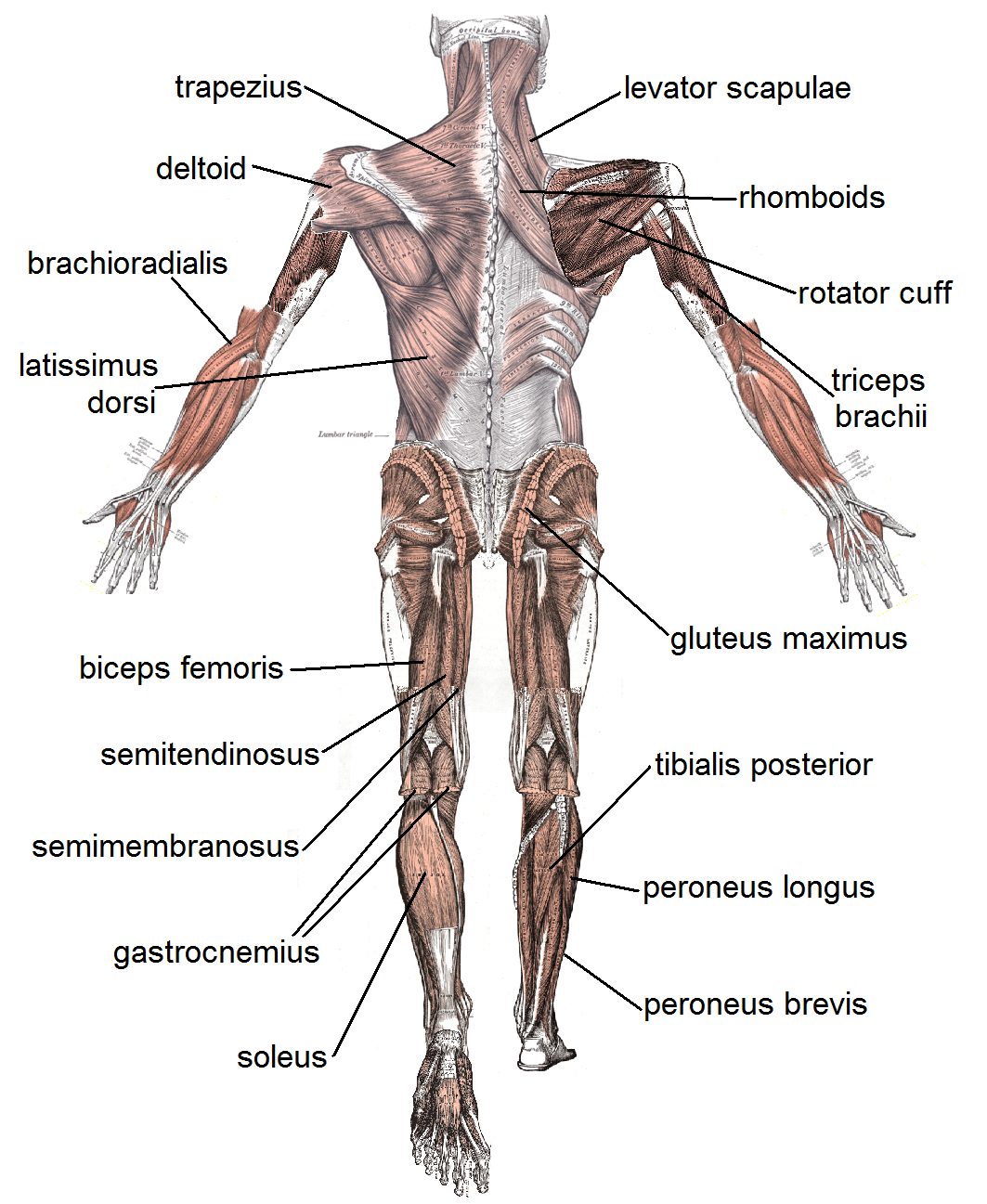
Photo: Mikael Häggström . When using this image in external works, it may be cited as: Häggström, Mikael (2014). " Medical gallery of Mikael Häggström 2014 ". WikiJournal of Medicine 1 (2). DOI : 10.15347/wj / Wikimedia Commons, Public domain
Hip and leg muscle groups
The legs take up nearly half of a full-body session and contain several endangerment sites; see also Figure 4.
Hips: gluteus maximus, gluteus medius, piriformis
The gluteus maximus is thick and tolerates fairly firm pressure. The gluteus medius sits higher and further out, between the iliac crest and the greater trochanter, and is often tight in people who stand for long hours. The piriformis lies deep, running from the sacrum to the greater trochanter; the sciatic nerve usually passes just below it. Do not lean hard with your elbow in the middle of the buttock for a long time; if the client feels numbness running down the leg, move your hand.
Thigh: quadriceps, hamstrings, adductors
- Quadriceps (front): converge on the patellar tendon; work from above the knee upwards, never pressing on the kneecap.
- Hamstrings (biceps femoris, semitendinosus, semimembranosus): from the sitting bone down to below the knee, often tight in people who sit a lot or run.
- Adductors (inner thigh): a sensitive area near the groin; work only the lower half, keep draping secure and ask the client first.
Lower leg and foot
The calf is made up of the gastrocnemius (superficial) and the soleus (deep), which join into the Achilles tendon. On the front, the tibialis anterior lies just outside the edge of the shin bone; do not press on the shin bone itself.
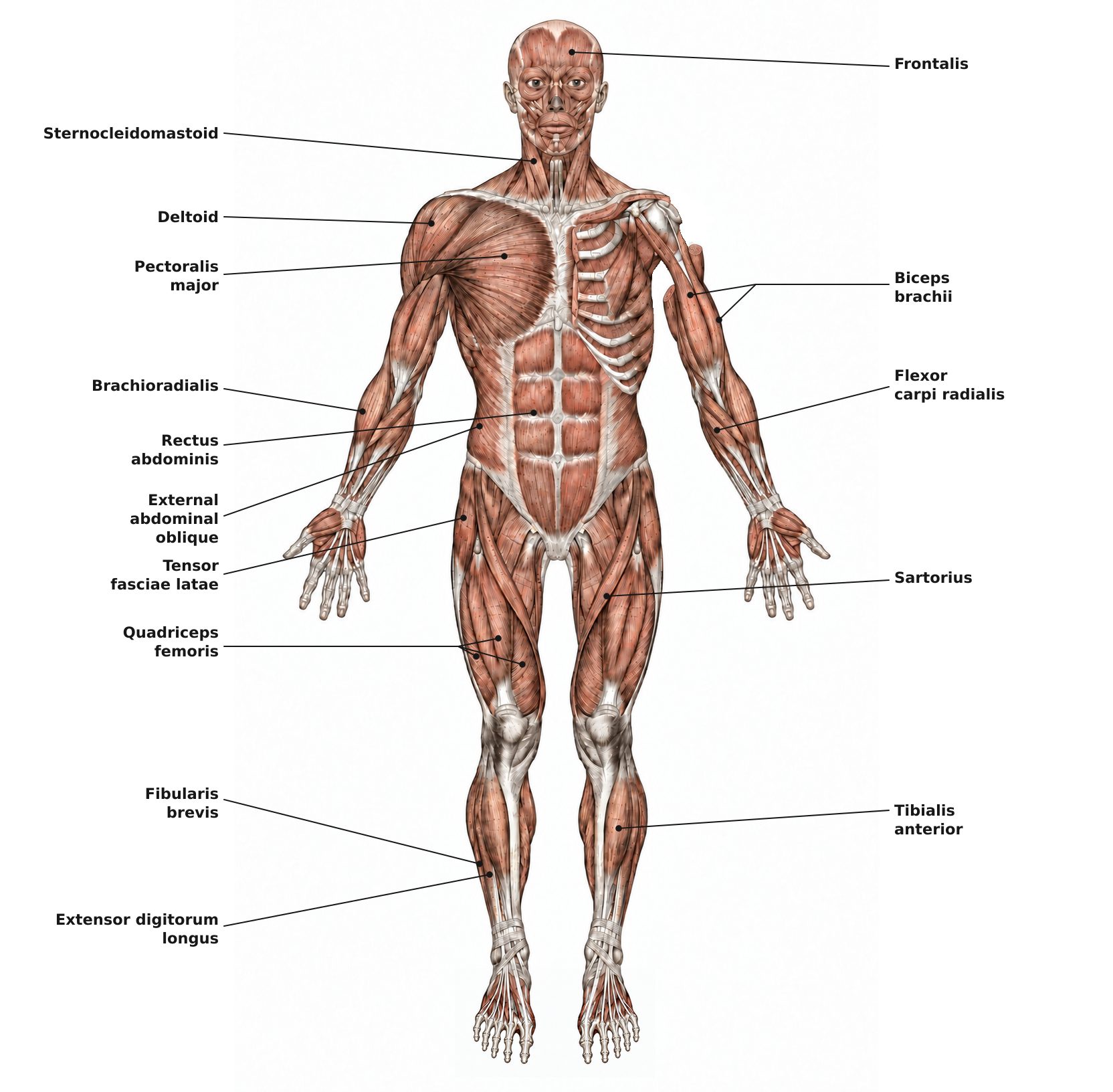
Photo: Mikael Häggström . When using this image in external works, it may be cited as: Häggström, Mikael (2014). " Medical gallery of Mikael Häggström 2014 ". WikiJournal of Medicine 1 (2). DOI : 10.15347/wj / Wikimedia Commons, Public domain
Areas to avoid in massage: 8 endangerment sites
Endangerment sites are places where blood vessels, nerves, lymph nodes or organs lie close to the surface with little muscle covering them, or where a small bony process is easily injured. There you only stroke lightly or skip the area: no deep pressure, no elbows. The general rule: if you feel a pulse under your fingers, move to the side; if the client reports "tingling" or "it shoots down", you are touching a nerve. The neck is covered in detail in the lesson on neck and shoulder massage; below is the whole-body picture.
Safety warning: Firm pressure on the front of the neck can slow the heart, drop blood pressure and cause fainting; deep pressure in the armpit, groin or back of the knee can compress blood vessels and nerves. Never crack or twist the neck or back suddenly: that is spinal manipulation, outside a massage therapist's scope. If the client feels spreading numbness, electric-shock pain, dizziness or nausea, stop at once, let them lie and rest, and note it on the form; if it does not pass within a few minutes, or they are short of breath or have chest pain, call an ambulance (115 in Vietnam).
Front of the neck, above the collarbone, the armpit
Inside the sternocleidomastoid lie the carotid artery, the windpipe and the thyroid. The hollow above the collarbone carries the brachial plexus (the nerves to the arm) and blood vessels, which then pass through the armpit (along with many lymph nodes) and down the inner upper arm. Work only at the edges of the armpit. At the inner elbow, the ulnar nerve lies against the bone (the "funny bone" that tingles down to the little finger): just glide over it.
Spine, xiphoid process and kidney area
Do not press straight onto the spinous processes: it hurts and there is no muscle there to release. At the lower end of the breastbone is the xiphoid process, small and pointed; do not press hard on it. The kidneys lie on either side of the spine, from about the 12th rib down into the lower back, only partly covered by the floating ribs: no hard tapping, no deep pressure. Figure 5 shows why the neck and spine are sensitive: blood vessels and nerve roots run right next to the vertebrae.
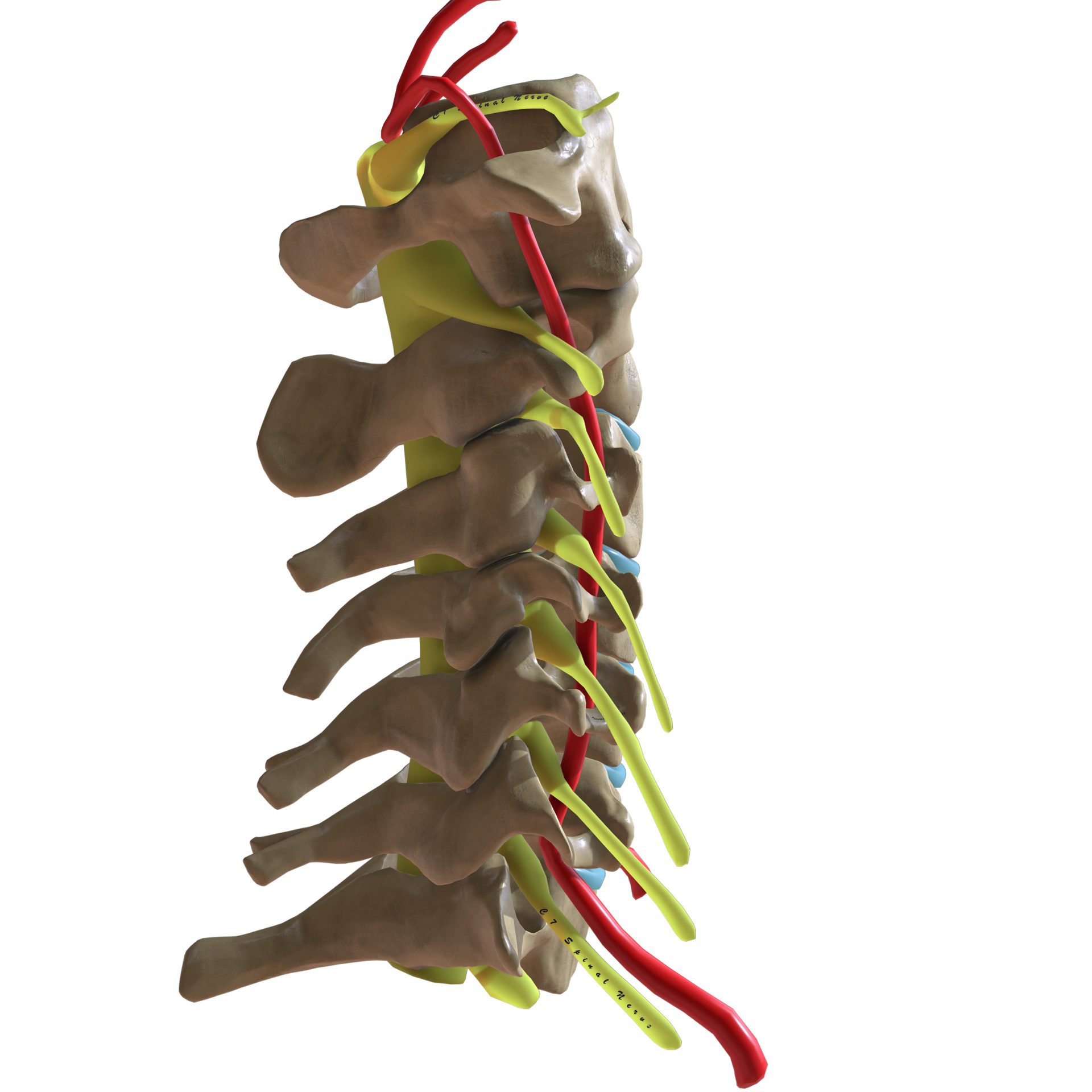
Photo: DrJanaOfficial / Wikimedia Commons, CC BY-SA 4.0
Groin, back of the knee and head of the fibula
The groin has the femoral artery, vein and nerve and lymph nodes close to the surface. The back of the knee (popliteal fossa) holds the popliteal vessels and the tibial nerve, covered only by fat and skin. Just below the knee on the outside, the common fibular nerve wraps around the head of the fibula, right under the skin. In all three places: stroke lightly as you pass, never press or knead.
| Site | What lies underneath | Safe approach |
|---|---|---|
| Front of the neck | Carotid artery, windpipe, thyroid | Very light strokes or skip |
| Above the collarbone | Brachial plexus, blood vessels | Never hook fingers into the hollow |
| Armpit, inner upper arm | Axillary artery, nerves, lymph nodes | Work the edges, not the centre |
| Inner elbow | Ulnar nerve against the bone | Glide over only |
| Spine, xiphoid process | Bony processes, spinal cord inside | Pressure either side, never on bone |
| Kidney area | Kidneys, floating ribs | No tapping, no deep pressure |
| Groin | Femoral vessels and nerve, lymph nodes | Do not work; keep draped |
| Back of knee, head of fibula | Popliteal vessels, tibial and fibular nerves | Light strokes when passing |
How is muscle ache different from pain caused by illness?
Most clients come in with muscle aches, but some pain is a sign of illness, and massage can delay a visit to the doctor. Massage therapists do not diagnose; your job is to notice something unusual, stop and advise the client to see a doctor. The full list is in the lesson on massage contraindications.
What ordinary muscle ache looks like
A dull, tired, tight ache in one muscle area; worse when holding a posture for long, better with rest, gentle movement and warmth. You can feel a tight band of muscle, and pressing on it feels "just right" to the client. Soreness after hard exercise usually starts within about a day, peaks on days 1–3 and then eases on its own.
Warning signs: stop and advise a doctor's visit
- Pain that does not ease with rest, pain at night, or pain that keeps getting worse.
- Pain with fever, unexplained weight loss, or a history of cancer.
- Numbness, weakness in an arm or leg, pain shooting down the arm or leg like an electric shock.
- Pain after a fall, accident or hard blow.
- A hot, swollen, red joint; a calf that is swollen, warm and painful on one side.
- A sudden severe headache, or a stiff neck with fever.
Pain felt in one place, problem in another
Some pain is "referred": the problem is in an internal organ but the pain is felt in the back or shoulder. Examples: heart problems can cause chest pain spreading to the left arm, jaw or between the shoulder blades; gallbladder problems can cause pain spreading to the right shoulder; kidney problems can cause flank pain with fever or painful urination. Massage will not make this kind of pain go away.
Call an ambulance (115 in Vietnam) straight away if: the client has crushing chest pain, shortness of breath, cold sweats; sudden weakness or numbness on one side, a drooping mouth, slurred speech; fainting; or back pain with numbness around the anus and groin and inability to pass urine or loss of bladder control. While waiting, keep the client in a comfortable position and do not continue the massage.
How to talk to the client
Never say "you have a slipped disc" or "you have heart disease". Say instead: "You describe pain going down your leg with numbness; that is not something I can treat with massage. Please see a doctor first, and once they say it is fine, I will give you a relaxation massage."
Worked example: a body map for a 60-minute session with an office worker
The stroke sequence comes in step 4; here we only choose areas, muscle groups and areas to avoid.
Intake and body map
The client is a 38-year-old woman, an accountant who sits at a computer about 9 hours a day. She reports aching in the right neck and shoulder and in the lower back at the end of the day; a dull ache that eases over the weekend, no numbness, no fever, no injury. The form shows no contraindications; she has mild varicose veins on the inside of her left lower leg. The map: focus on the upper trapezius, levator scapulae and rhomboids on the right, the erector spinae and quadratus lumborum; avoid the hollow above the collarbone, the kidney area, the back of the knee and the varicose section.
Time allocation
| Part | Time | Main muscle groups | Avoid |
|---|---|---|---|
| Intake, client points to sore areas, agree on pressure | 5 min | Client points with their hand | Note the varicose veins |
| Back (face down) | 15 min | Erector spinae, latissimus dorsi, quadratus lumborum | Spinous processes, kidney area |
| Neck and shoulders (face down) | 12 min | Trapezius, rhomboids, levator scapulae | Hollow above the collarbone |
| Back of both legs | 12 min | Gluteus medius, hamstrings, calves | Back of knee, varicose veins |
| Front of both legs (face up) | 8 min | Quadriceps, tibialis anterior | Groin, kneecap, shin bone |
| Both arms | 5 min | Deltoid, forearm | Armpit, inner elbow |
| Finish, ask for feedback, complete the form | 3 min | Light full-body strokes | None |
Total: 5 + 15 + 12 + 12 + 8 + 5 + 3 = 60 minutes. The focus areas (back plus neck and shoulders) take 15 + 12 = 27 minutes, nearly half the session, matching what the client complained about. When she reports "a bit of tingling down my arm" while you work near the hollow above the collarbone, you move your hand back towards the trapezius and the tingling stops at once.
When a second client shows different signs
On the same shift, a 52-year-old man asks for a back massage for lower back pain lasting 3 weeks. On further questioning: the pain is worse at night, he has lost about 4 kg without dieting, and sometimes feels numbness on the outside of his left lower leg. Three warning signs at once: you do not massage his back, you explain gently, advise him to see a doctor and record it clearly on the form.
Common mistakes when learning anatomy
Pressing where the client points without thinking what is underneath
The client points to the armpit or the back of the knee and you knead hard right away. Cause: you only remember strokes. Fix: before applying pressure, ask yourself "which muscle is this, and is it one of the 8 endangerment sites?"; if it is, work the muscles around it.
Pressing on bone instead of muscle
The client winces when you press down the middle of the back, the front of the shin or the kneecap. Cause: you did not feel for the landmarks first. Fix: find the spinous processes, shin bone and kneecap, then put your pressure into the muscle on either side.
Practice exercises and self-assessment
Exercise 1: feel the landmarks and point out the endangerment sites
Work with a fellow trainee (wearing a thin shirt, with consent). Find the 10 landmarks in the table, about 1 minute each, naming the landmark and the nearby muscle group. Then point to the 8 endangerment sites without looking at your notes and say what lies underneath.
Exercise 2: 6 questions to tell pain apart
With a pretend client, ask: how long has it hurt, what kind of pain is it, does rest help, does it hurt at night, any numbness, weakness or fever, any recent fall or accident? Write down the answers and decide whether to go ahead, adapt or advise a doctor's visit.
Self-assessment criteria
- Pass: find at least 9 of 10 landmarks correctly within 10 minutes; point out all 8 endangerment sites; ask all 6 questions and make a reasoned decision.
- Not yet: more than 1 landmark wrong, forgetting the back of the knee, groin or armpit, or still planning to massage a client with spreading numbness, night pain or fever.
Frequently asked questions
Which areas should you avoid in massage?
The front of the neck, the hollow above the collarbone, the armpit and inner upper arm, the inner elbow, the spine and xiphoid process, the kidney area, the groin, the back of the knee and the head of the fibula. There you only stroke lightly or skip the area.
Can you massage over the spine?
Light strokes over it are fine, but never press or knead directly on the spinous processes; put the pressure into the erector spinae either side. Do not crack or twist the spine: that is manipulation, outside a massage therapist's scope.
How can you tell if back pain is muscle ache or illness?
Muscle ache is dull, eases with rest and relates to posture or lifting. Pain with leg numbness or weakness, night pain, fever, weight loss, after an accident or with bladder problems needs a doctor. Therapists do not diagnose; they notice, stop and advise the client to see a doctor.
Can you massage someone with varicose veins?
You can work other areas, but never press or stroke firmly over the bulging section. If a leg is swollen, warm, red and painful on one side, do not massage the leg and advise the client to see a doctor straight away.
With a map of muscles, bones and areas to avoid in your head, move on to the next step of the roadmap: Therapist posture, pressure & massage oils, where you learn to use your body weight instead of your wrists to apply the right pressure to the muscle groups you have just learned, and to choose oils that are safe for the client.
Keep learning massage therapy: after anatomy come pressure, Swedish massage, acupressure and deep tissue massage. See the 8-step massage therapist roadmap.