An air conditioner that is not cooling usually has one of three groups of causes: wrong settings or a room with too much heat load; a dirty unit (filters, indoor coil, outdoor unit); or a fault that needs a technician, such as low refrigerant, a failed capacitor, or a faulty sensor or board. Roughly half of the "not cooling" calls in summer can be solved in 5–15 minutes without spending anything. This lesson helps you check things in the same order a technician does, know when to stop and call a professional, and — if you are learning the trade — know how to diagnose the fault for a customer.
By the end of this lesson, you will be able to:
- Name the 9 causes of an air conditioner not cooling, split into those an owner can fix and those that need a technician.
- Carry out the 5-minute check: remote control, filters, outdoor unit, air temperature difference.
- Calculate the BTU capacity a room needs and recognise a unit that is "weak" because it was undersized.
- Describe how a technician measures refrigerant pressure and tests capacitors and sensors to tell faults apart.
- Recognise 6 signs that mean switching the unit off and calling a technician immediately.
Want to fix them for customers yourself? See NAMBIN's 8-step roadmap for refrigeration and air-conditioning technicians: the refrigeration cycle and reading pressure gauges, vacuuming and gas charging, cleaning and maintenance, and diagnosing inverter boards.
Why is the air conditioner not cooling? A summary of 9 causes
A master technician doesn't diagnose by feel. They go from easy, cheap jobs that need no dismantling towards difficult, expensive ones. The table below is in that order. Costs are reference ranges for 2026 in large Vietnamese cities, in Vietnamese dong (VND; 100,000 VND is roughly 4 US dollars), and vary by region and type of unit.
| # | Cause | Typical signs | Who fixes it | Reference cost 2026 |
|---|---|---|---|---|
| 1 | Wrong mode, temperature or fan speed | Gentle airflow, not cold; display shows Dry, Fan or Auto | Owner | 0 VND |
| 2 | Leaky room, direct sun, many people | Cool in the morning, not in the afternoon | Owner | 0 – a few hundred thousand (blinds, heat-reflective film) |
| 3 | Dirty filters | Weak airflow, smell, not washed for a long time | Owner | 0 VND |
| 4 | Dirty indoor coil or outdoor unit | Weak airflow despite clean filters, outdoor unit blowing very hot air | Technician | 150,000–350,000 VND per wall-mounted unit |
| 5 | Undersized unit | Runs all day, room never reaches the set temperature | Technician advises | Replace the unit or reduce heat gain |
| 6 | Low refrigerant due to a leak | Slightly cool air that gradually fades; frost may form on the small pipe | Technician | Finding and fixing the leak 200,000–800,000 VND, top-up charged separately |
| 7 | Failed fan or compressor capacitor (non-inverter units) | Outdoor unit hums but the fan doesn't turn, or the compressor won't run | Technician | 150,000–500,000 VND including part and labour |
| 8 | Faulty or drifting temperature sensor | Unit cuts out early, runs erratically, shows an error code | Technician | 200,000–500,000 VND |
| 9 | Inverter board, weak compressor | Error code, blinking lights, compressor won't start despite power | Experienced technician | From 800,000 VND to several million |
Causes 1–3 can be checked by the owner. From cause 4 onwards you need measuring instruments and knowledge of electrics and refrigerants — that is the air-conditioning technician's trade.
A 5-minute self-check before calling a technician
Do all four steps below, in order. Each step rules out one group of causes. When you call a technician, tell them the results: they will diagnose faster and quote more accurately.
Step 1: check the remote control
Look at the remote's display (see Figure 1). The mode must be Cool (the snowflake symbol), not Dry (the water drop — dehumidifying mode, with the fan running slowly), Fan (fan only) or Auto. Set 25–26°C and a high or Auto fan speed. If Sleep or Eco mode is on, the unit limits its own output; switch that mode off to test. A remote with weak batteries may not reach the unit: replace the batteries, press again, and listen for the indoor unit's "beep".
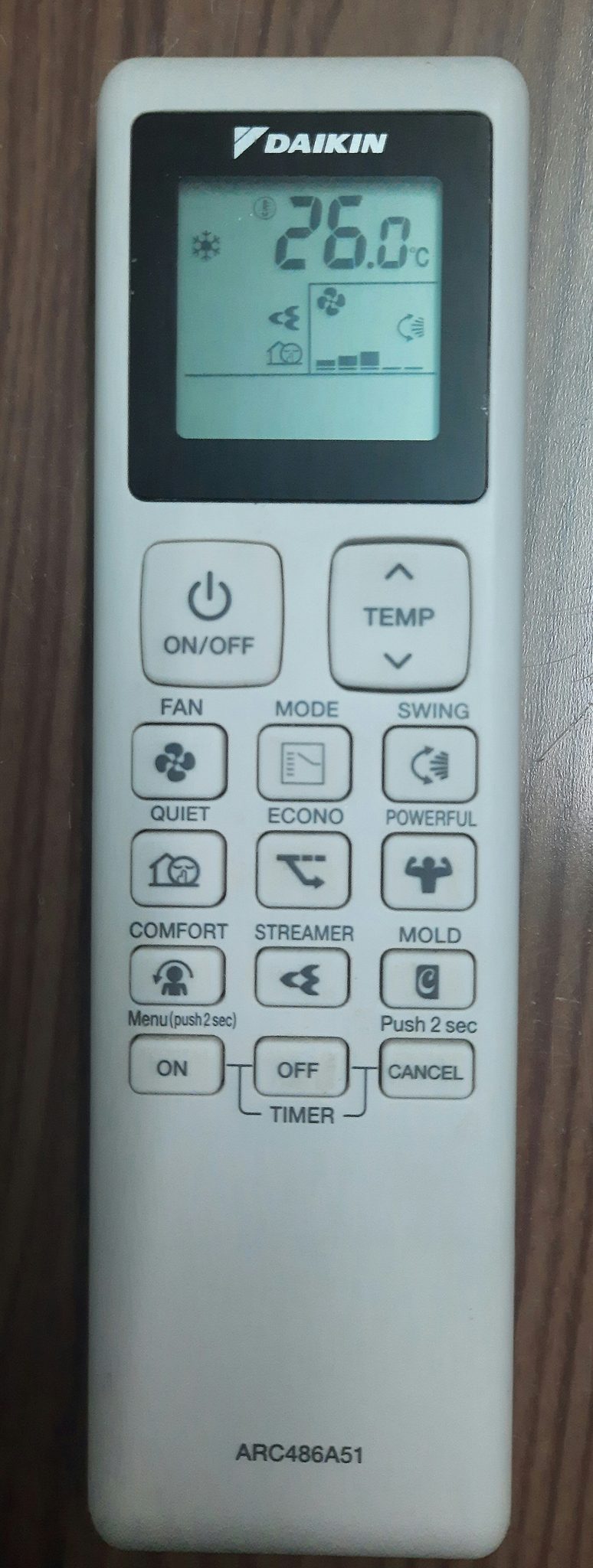
Photo: Lê Huỳnh Bộ / Wikimedia Commons, CC BY-SA 4.0
Step 2: take the filters out and look
Switch off the circuit breaker, lift the indoor unit's front cover, pull out the filters and hold them up to the light. If a grey layer of dust covers them, as in Figure 2, a significant part of the airflow is blocked. Wash them in water, dry them in the shade, refit them and run the unit for 15 minutes to test. Detailed instructions are in the lesson on cleaning an air conditioner at home, part of the air-conditioning trade roadmap.
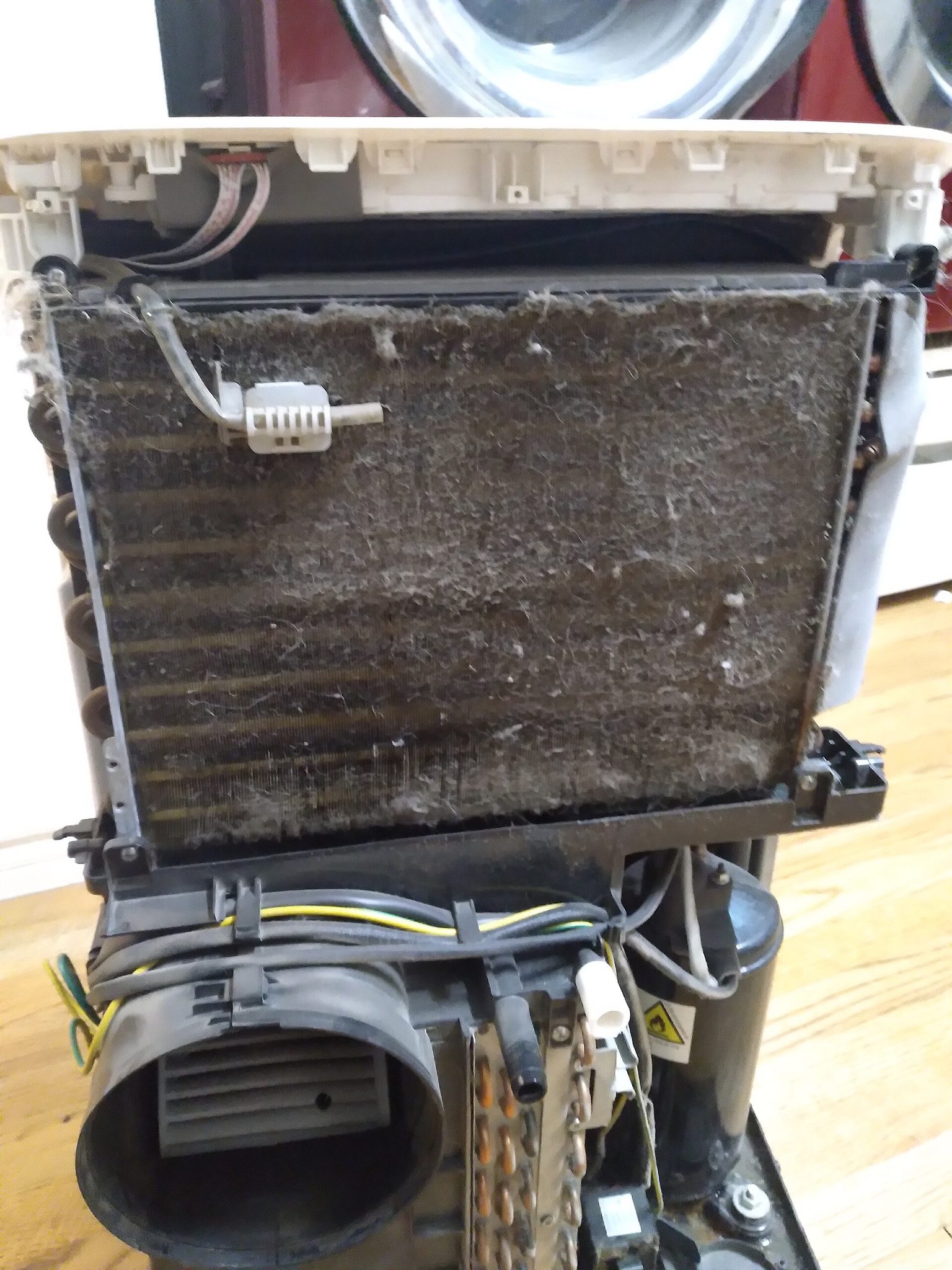
Photo: Gerardolagunes / Wikimedia Commons, CC BY-SA 4.0
Step 3: look at the outdoor unit
Once the unit has been in cooling mode for 3–5 minutes, the outdoor unit must be running: the fan turning, the compressor humming steadily, and warm or hot air blowing out. Check whether anything is blocking it: a tarpaulin cover, items piled against it, climbing plants, or a closed recess with no air outlet. Outdoor units packed close together on one wall, as in Figure 3, easily draw in each other's hot exhaust. Only look from a safe position — do not climb out over a balcony railing.
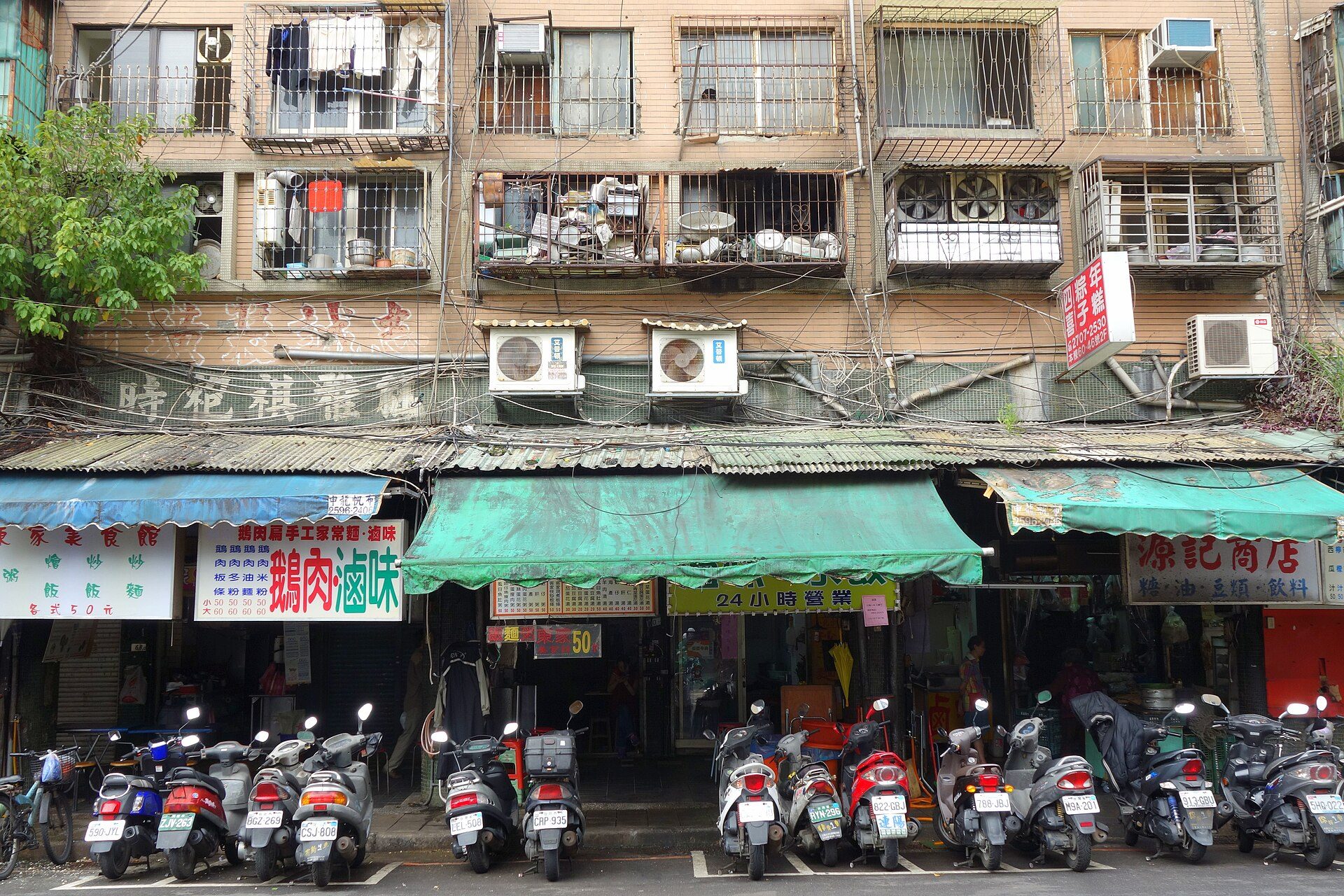
Photo: Daderot / Wikimedia Commons, CC0
Step 4: measure the air temperature difference
Use a probe or infrared thermometer. Measure the return air drawn in at the top of the indoor unit and the supply air blown out at the louvre, after the unit has run steadily for 10–15 minutes in cooling mode on high fan. For wall-mounted units the difference is usually about 8–12°C. Below 6°C means the unit has a real problem (dirt, low refrigerant, outdoor unit not running). If the difference is fine but the room is still hot, the unit is most likely undersized or the room is losing too much cool air.
The unit works but the room is still hot: check the capacity
Many units that "don't cool" are not actually broken. They are cooling as well as they can, but that is not enough for the room. The most common cases are top-floor rooms under the roof, west-facing rooms with large windows, and living rooms open to the kitchen.
Quickly working out the capacity a room needs
BTU is the unit for cooling capacity; in Vietnam a 9,000 BTU unit is commonly called a "1 horsepower unit". The table below is a common quick-selection guide for rooms with a ceiling height of about 3 m, good enough for initial advice.
| Room area | Usual capacity | Top floor, west-facing, lots of glass (add 15–20%) |
|---|---|---|
| Under 15 m² | 9,000 BTU | 12,000 BTU |
| 15–20 m² | 12,000 BTU | 12,000–18,000 BTU |
| 20–30 m² | 18,000 BTU | 18,000–24,000 BTU |
| 30–40 m² | 24,000 BTU | Calculate carefully or use 2 units |
Things that add to the heat load
Every person in the room and every heat-producing appliance (computers, a mini-fridge, a stove, incandescent bulbs) adds to the load. Doors often left open, gaps under doors and a bathroom extractor fan running constantly all pull hot air into the room. A room directly under an uninsulated metal roof can be several degrees hotter than the floor below in the afternoon.
Solutions that don't need a new unit
Hang sun-blocking curtains, apply heat-reflective film to windows, seal door gaps, insulate the roof. Set 26–27°C and use a standing fan to circulate the air instead of dropping the setting to 18°C. These are far cheaper than replacing the unit, and often enough for an old unit to reach the temperature you want.
Faults that need a technician: refrigerant, capacitors, sensors, boards
Once settings, dirt and capacity have been ruled out, what remains needs a technician with gauges. This section explains what the technician is doing, for owners, and how to diagnose, for trainees.
Low refrigerant: measure, don't guess
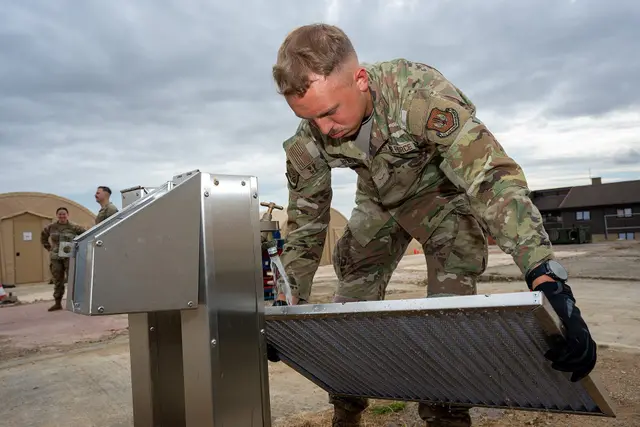
The refrigerant ("gas") circulates in a sealed loop and does not "run out" over time; low refrigerant means there is a leak, usually at a flare nut, a brazed joint or a corroded coil. The technician connects a manifold gauge to the service valve on the outdoor unit and reads the suction pressure at steady running (Figure 4). The normal range depends on the refrigerant type and the outdoor temperature; for domestic units using R32 or R410A, running suction pressure is typically about 115–145 psi, and for R22 about 60–80 psi (reference values; check the manufacturer's documentation). Clearly low pressure plus frost on the small pipe indicates low refrigerant.
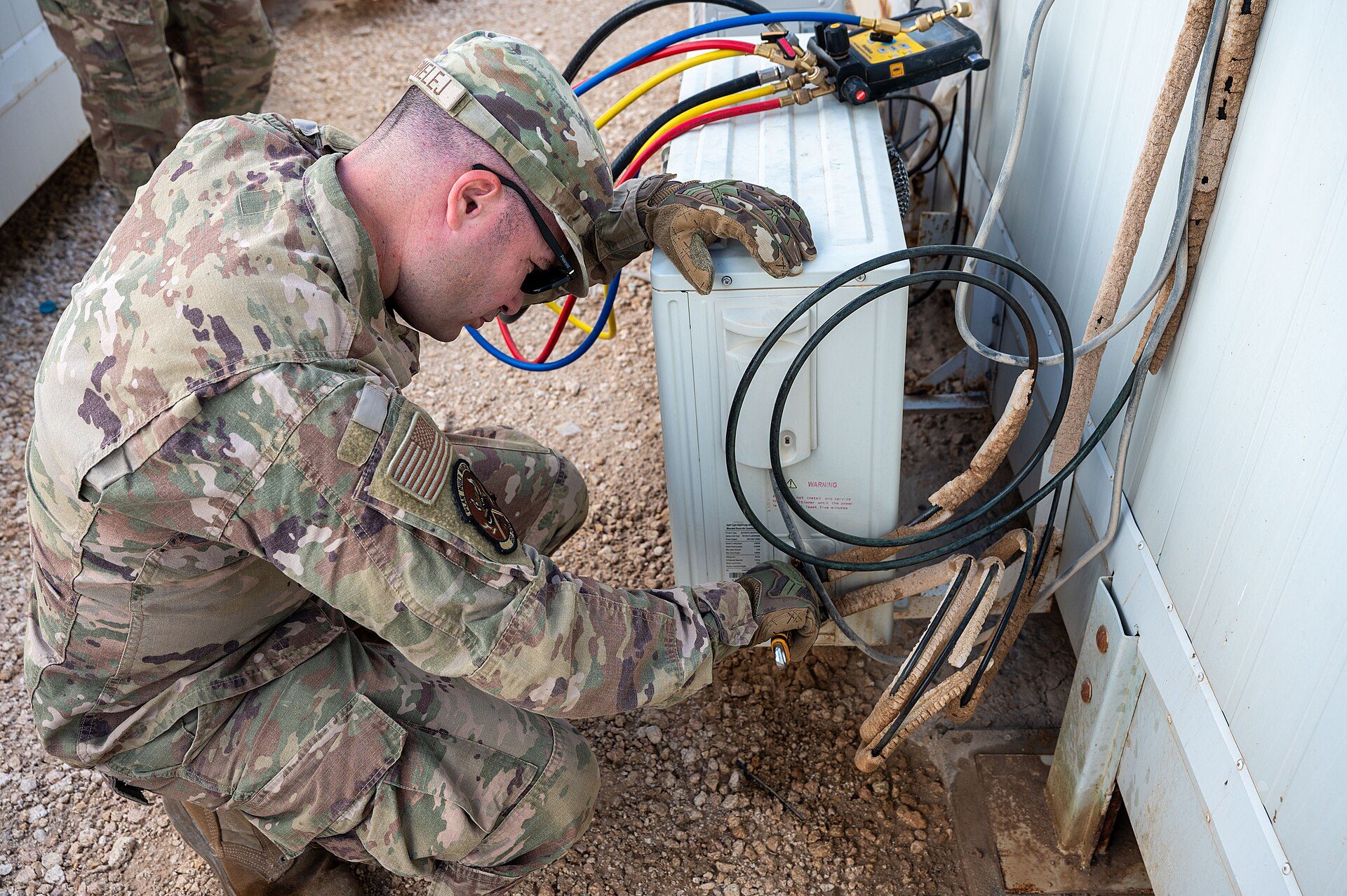
Photo: U.S. Air Force AFCENT by Senior Airman Grace Turpin / Wikimedia Commons, Public domain
The right approach: find the leak (soapy water, an electronic leak detector), fix it, and only then top up — ideally by weight using scales. On inverter units, once the system has been opened, many technicians recover the refrigerant, vacuum the system and recharge by the weight on the unit's rating plate. Topping up without fixing the leak means the unit stops cooling again a few weeks later.
Fan and compressor capacitors (non-inverter units)
A capacitor helps a motor start. If the outdoor fan capacitor is weak, the fan doesn't turn or turns slowly, the outdoor unit overheats and the compressor trips on its protection. The technician isolates the power, discharges the capacitor and measures its capacitance with a meter; if it is more than about 10% off the value printed on it, it is replaced. Inverter units have a fan and compressor controlled by the board, without start capacitors of this kind.
Temperature sensors
The indoor unit has a room temperature sensor and a pipe sensor. A faulty or drifting sensor makes the board "think" the room is already cold enough, so it reduces output or stops the compressor early. The technician removes the sensor, measures its resistance and compares it with the manufacturer's resistance-temperature table.
Inverter board and compressor
Inverter units usually report error codes by blinking lights or on the display. Look up the code in the user manual or the manufacturer's service documentation — don't rely on word-of-mouth "experience". Telling a board fault from a compressor fault requires measuring voltages, testing the compressor windings and checking the power module — skills from the "Diagnosing error codes and inverter boards" step of the roadmap.
Safety warning: do not open the outdoor unit or touch capacitors or the board until you have switched off the circuit breaker and waited for the filter capacitors on the inverter board to discharge fully — they can hold a dangerous voltage for several minutes after switch-off. Never charge refrigerant yourself: R32 is flammable, refrigerant sprayed on skin causes cold burns, and the wrong type or an overcharge damages the compressor. Work on outdoor units at height requires a full-body safety harness.
Worked example: attic bedroom, 9,000 BTU unit "not cooling in the afternoon"
Mr Tuan lives in a 4-storey tube house in Hanoi; his 20 m² bedroom is on the 4th floor right under a metal roof, with a west-facing glass window. The 9,000 BTU unit is 6 years old; it still cools in the morning, but from 2 pm to 6 pm it is "set to 18 degrees and the room is still 29–30 degrees". The figures below are illustrative.
Checking in order
- Remote: set to Dry mode because he "heard it saves electricity". Switch to Cool, 26°C, high fan.
- Filters: thickly coated in dust, last washed 5 months ago. Wash, dry and refit.
- Outdoor unit: fan turning steadily, compressor running, nothing blocking it.
- Measurement at 3 pm: before washing the filters, return air 31°C, supply air 24°C, a difference of 7°C. After washing and changing the mode: return air 31°C, supply air 21°C, a difference of 10°C — within the normal range.
- The technician measures the suction pressure: within the normal range for the unit's refrigerant, with no sign of low charge. No top-up.
Working out the capacity
- A 20 m² room needs about 12,000 BTU according to the quick-selection table.
- Room under a metal roof, west-facing, add 20%: 12,000 × 1.2 = 14,400 BTU.
- The existing unit is 9,000 BTU, meeting only about 9,000 ÷ 14,400 ≈ 62% of the afternoon demand.
Conclusion and cost
The unit isn't broken; the problems are the wrong mode, dirty filters and a unit too small for a hot room. The technician offers two options (2026 reference prices): (A) keep the old unit, a full service for 180,000 VND, heat-reflective window film and sun-blocking curtains for about 1–1.5 million VND; (B) replace it with a 12,000–18,000 BTU unit, with unit and installation from about 9 million VND (roughly 360 US dollars) depending on the model. Mr Tuan chooses A first and monitors it for a week; the room gets down to 27–28°C in the afternoon, which he finds acceptable. Next year he will insulate the roof before considering a new unit.
When to switch off and call a technician immediately
Some signs are not something to "run for a few more days and see", because waiting makes the damage worse or creates a hazard.
Electrical danger signs
- A burning smell, smoke or crackling from the indoor or outdoor unit.
- The air conditioner's circuit breaker trips repeatedly when you switch on.
- The power cable, socket or terminal block is unusually hot or shows scorch marks.
Signs of a refrigeration system fault
- The small copper pipe at the outdoor or indoor unit is covered in white frost.
- The outdoor unit hums loudly but the fan doesn't turn, or the compressor switches on and off every few minutes.
- Lights on the indoor unit blink in a pattern, or the display shows an error code.
What to prepare when you call
Note: the brand, capacity, year of purchase, whether it is inverter or non-inverter (see the label on the outdoor unit), the results of the 4-step self-check, and any error code. Photograph the rating label and the outdoor unit's location. A technician who knows in advance brings the right tools, sometimes even the right part, and saves a second trip.
Common mistakes when dealing with an air conditioner that isn't cooling
"Adding gas" without measuring
Sign: refrigerant is topped up every month but the unit is still weak. Cause: topping up without finding the leak, or the unit isn't short of refrigerant at all but dirty or undersized. Fix: measure the pressure and the air temperature difference, and find and fix the leak before charging.
Setting 16–18°C to cool down faster
Sign: high electricity bills, and the room is no cooler. Cause: the unit is already running at full capacity; lowering the setting doesn't make it colder, it just runs longer. Fix: set 25–27°C, reduce the room's heat load, and add a fan.
Putting the outdoor unit in a closed recess
Sign: cool in the morning, much weaker in the afternoon, the compressor cutting out often. Cause: hot exhaust air swirls around and is drawn back into the coil. Fix: move the outdoor unit to an open spot or enlarge the air outlet; leave the clearance in front of the unit specified in the manufacturer's installation guide.
Replacing the board when the fault is a sensor
Sign: an expensive new board and the unit still shows the fault. Cause: the technician guessed from the error code without measuring. Fix: always test the peripheral components (sensors, fan, connecting wires) before concluding that the board is faulty.
Frequently asked questions
The air conditioner isn't cooling but the fan still runs — what's wrong?
Check the mode on the remote, the filters, and whether the outdoor unit is running. If the outdoor unit isn't running, it may be the capacitor, a sensor, the board or the power supply to the outdoor unit — a technician needs to measure.
Is an air conditioner not cooling because it has run out of gas?
Not always. Refrigerant doesn't run out by itself; low refrigerant means a leak. Only measuring the pressure can confirm it. Most "not cooling" cases are caused by dirt, wrong settings or an undersized unit.
How much does it cost to fix an air conditioner that isn't cooling?
2026 reference: cleaning 150,000–350,000 VND per wall-mounted unit; capacitor replacement 150,000–500,000 VND; fixing a leak and recharging from a few hundred thousand to over a million VND; inverter board from 800,000 VND to several million. It depends on the region, the brand and the extent of the fault.
What if a newly installed unit doesn't cool?
It may be undersized, badly installed (no vacuuming, a leaking flare nut), or the pipe run may be too long for the factory refrigerant charge. Ask the installer to check it during the warranty period.
How long should it take for the unit to cool the room?
A normal room usually feels cool after 10–15 minutes. A room in the sun all day may take 30–45 minutes because the walls and ceiling have stored heat.
Practice exercises
- Carry out the 4-step check on an air conditioner at home and write down the result of each step.
- Measure the difference between return-air and supply-air temperatures after 15 minutes in cooling mode on high fan.
- Measure the room area and note which way it faces and which floor it is on; calculate the capacity needed from the table and compare it with the unit installed.
- Write a sample message to a technician: unit details, symptoms, self-check results.
Self-assessment criteria
- Pass: you switched off the breaker before lifting the front cover; you recorded the temperature difference as a number and concluded whether it is inside or outside the 8–12°C range.
- Pass: your capacity calculation includes an extra factor for a hot room, and the result clearly says "enough" or "not enough".
- Not yet: you concluded "low refrigerant" without measuring the pressure, or climbed over a railing to check the outdoor unit without a safety harness.
Diagnosing correctly is the foundation for doing complete jobs for customers. The next step on the roadmap is New installation and full maintenance of a flat: installing 2 air conditioners, vacuuming, recording running pressures and currents, and preparing a handover sheet. See the full 8-step roadmap for refrigeration and air-conditioning technicians.