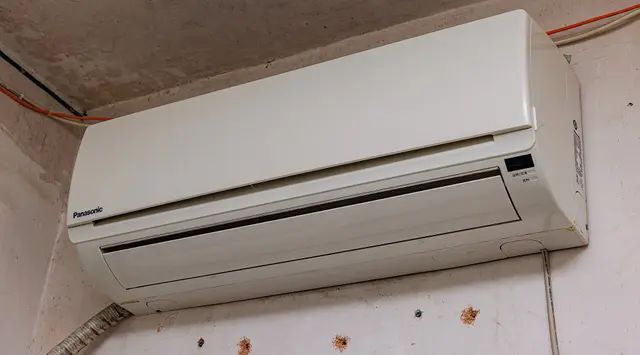
Cleaning an air conditioner at home has two parts: the owner washes the air filters every 2–4 weeks, while a technician pressure-washes the indoor coil and the outdoor unit and clears the drain line every 3–6 months. Many people only call a technician once the unit is dripping water, smells bad or never seems to cool — by then the indoor coil is usually caked in dust and the unit is using noticeably more electricity. This lesson shows you how to do both parts properly, the way an air-conditioning technician does it for a customer.
By the end of this lesson, you will be able to:
- Answer "how often should an air conditioner be cleaned" for 4 kinds of use: bedroom, living room, office, restaurant.
- Remove, wash and refit the filters of a wall-mounted split unit in 15 minutes without breaking the clips.
- Carry out the technician's 10-step maintenance routine: cover the control board, fit a cleaning bag, pressure-wash the indoor and outdoor coils, clear the drain line.
- Measure air temperatures and current before and after, to prove to the customer that the unit is clean.
- Quote 2026 air-conditioner cleaning prices for each type of unit and total up a flat with several units.
Want to learn the air-conditioning trade properly? See NAMBIN's 8-step roadmap for refrigeration and air-conditioning technicians: from electrical and refrigerant safety, the refrigeration cycle and installation, through vacuuming and gas charging, to maintenance and diagnosing inverter boards.
How often should an air conditioner be cleaned?
There is no single number for every home. What decides it is how many hours a day the unit runs and how much dust is in the room. A unit running 8 hours a night in a closed bedroom collects dust far more slowly than one running 12 hours in a restaurant full of cooking fumes. An experienced technician always asks the customer these two questions before setting a maintenance schedule.
Two intervals to remember: filters and full service
The air filters are the plastic mesh panels right behind the front cover of the indoor unit; they catch dust before it reaches the aluminium fins of the coil. Filters should be washed every 2–4 weeks in the hot season, and the owner can do this. A full service (pressure-washing the indoor coil, the fan, the drain tray and the outdoor unit) needs specialist equipment and should be done by a technician on the schedule in the table below.
| Type of use | Typical running hours | Wash filters | Full service (technician) |
|---|---|---|---|
| Bedroom, night use | 6–9 hours/day | Every 3–4 weeks | Every 4–6 months |
| Living room near a busy road | 8–12 hours/day | Every 2–3 weeks | Every 3–4 months |
| Office | 9–10 hours/day, 5–6 days/week | Every 2–3 weeks | Every 3 months |
| Restaurant, hair salon, rooms with cooking fumes | 10–14 hours/day | Every 1–2 weeks | Every 1–2 months |
In northern Vietnam, many homes only use air conditioning from May to September; there, do a full service once before the hot season (April) and once mid-season. In the south, units run almost all year round, so follow the table.
Signs that cleaning is needed sooner
- Weak airflow; you have to set 20–22°C before it feels cool.
- A musty or unpleasant smell when the unit starts.
- Water dripping from the indoor unit down the wall or onto the floor.
- A clear rise in the electricity bill although your habits haven't changed.
- Black streaks visible on the blower (cross-flow fan) through the air outlet.
Why dust makes the unit use more electricity
The indoor coil cools by passing air over thin aluminium fins, where the refrigerant ("gas") evaporates and absorbs heat. When the fins are coated in dust, less air flows through and heat transfers less well, so the compressor has to run longer to reach the set temperature. On an inverter unit you will see it running at high speed all the time without ever slowing down. Damp dust is also where mould grows, causing smells and affecting people with allergies or asthma.
What you need to know about the unit before cleaning
Before you pick up a spray nozzle, you must know where water is allowed to go and what it must never touch. A wall-mounted split air conditioner (often called a "2-piece unit" in Vietnam) consists of an indoor unit and an outdoor unit, connected by two copper pipes and an electrical cable.
Indoor unit: filters, fins, blower, drain tray
Lift the front cover and you will see two filters (Figure 1 shows what a dirty filter looks like). Behind them is the coil, with tightly packed aluminium fins that bend very easily if scrubbed hard. Below the coil is the blower — a long cylindrical fan that pushes the air out. Water that condenses on the fins runs into a plastic tray and then out through the drain line. At one end of the indoor unit is the electrical box containing the control board, temperature sensors and connecting wires — this area must be fully covered during washing.
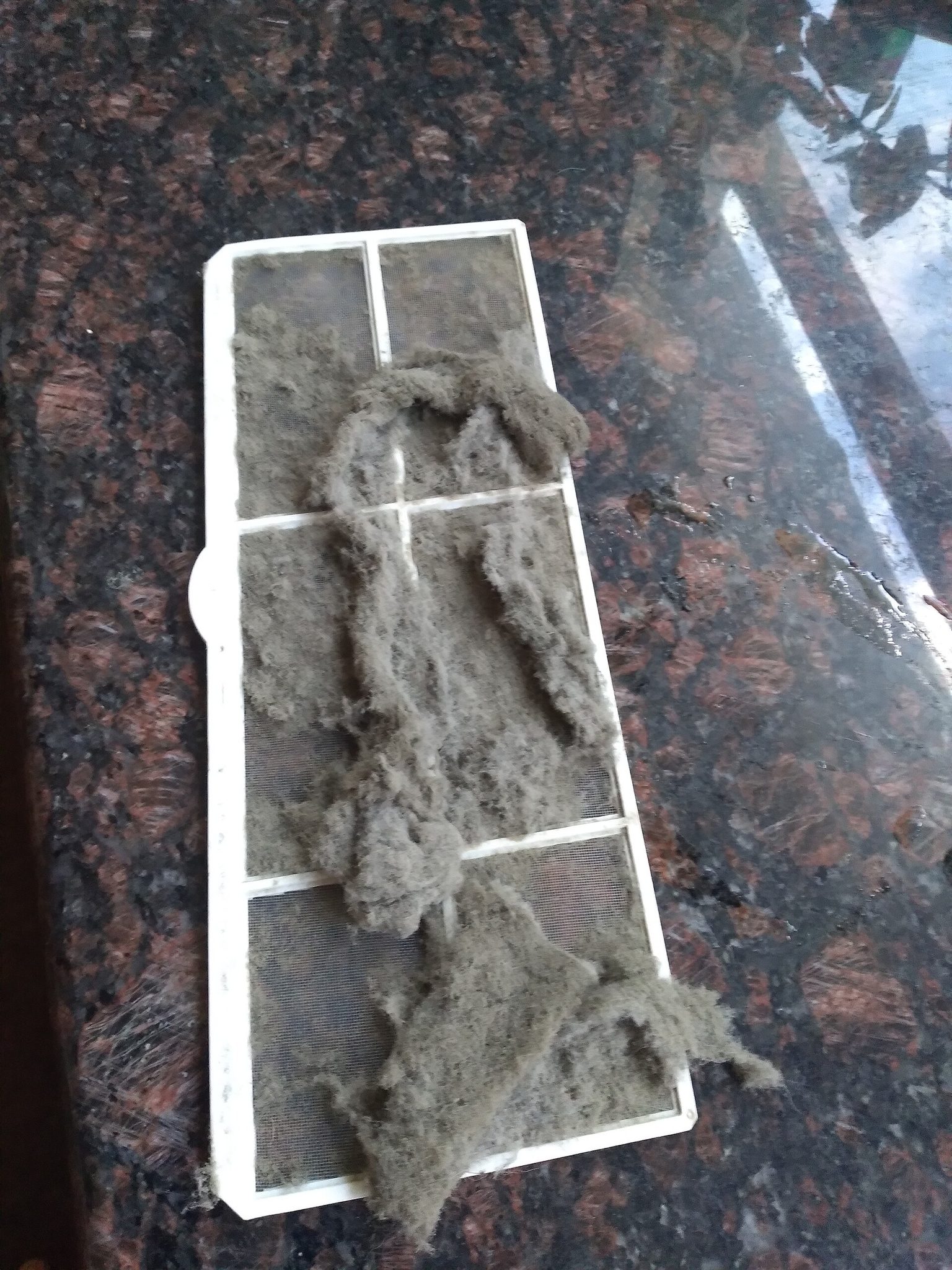
Photo: Gerardolagunes / Wikimedia Commons, CC BY-SA 4.0
Outdoor unit: where heat is released
The outdoor unit contains the compressor, a fan and the condenser coil. The heat removed from the room is released here (see Figure 2). Outdoor units sit on balconies, roofs or wall brackets, so they collect road dust, leaves and sometimes insect nests. A dirty outdoor unit raises the condensing pressure and temperature, so the compressor runs hotter and draws more current.
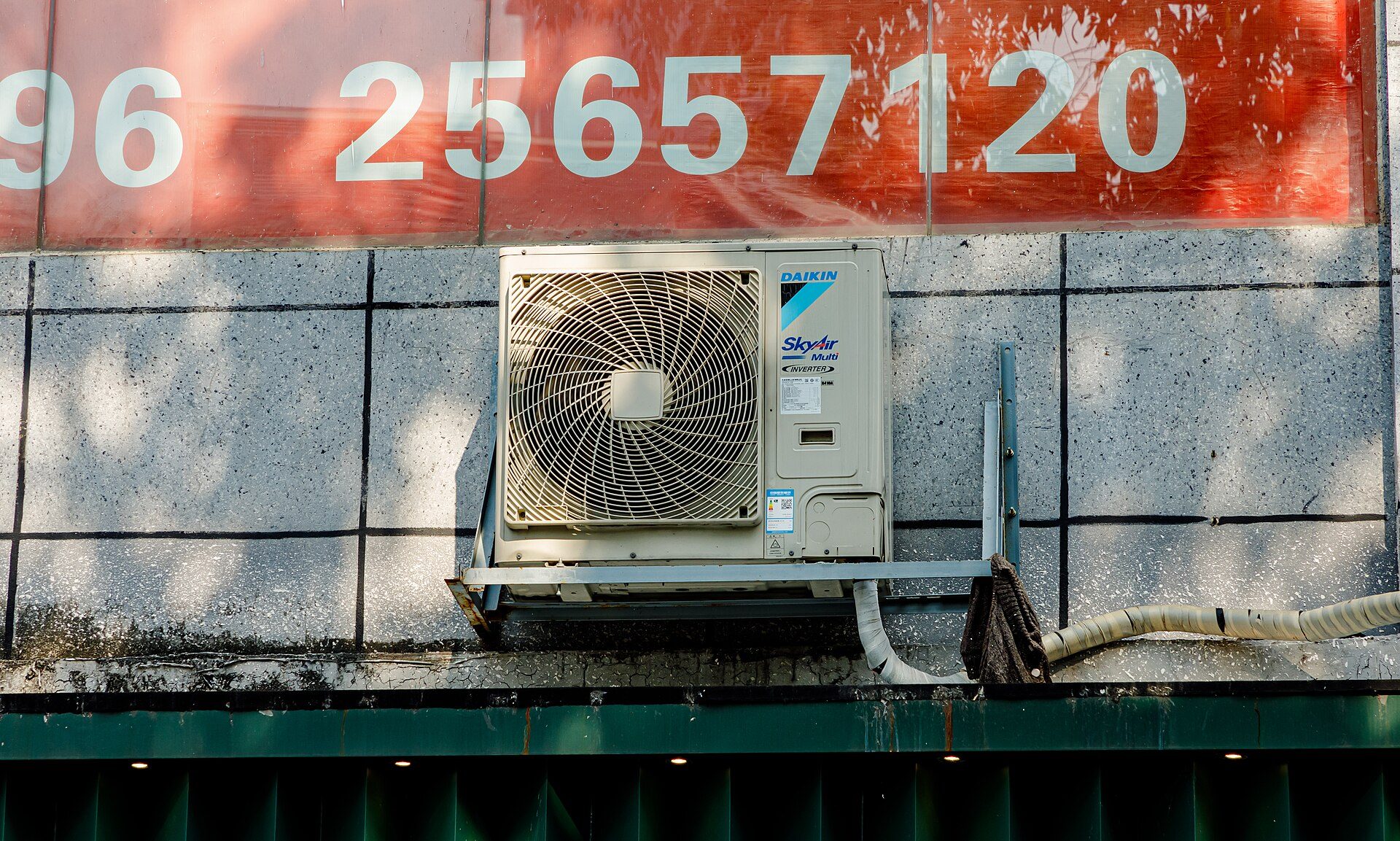
Photo: Dinkun Chen / Wikimedia Commons, CC BY-SA 4.0
Places water must never reach
The control board and electrical box of the indoor unit, the indoor fan motor, the terminal block, and the electrical box of the outdoor unit (where the capacitors and inverter board are). Water getting in can cause short circuits, error codes or a burnt board — a repair costing many times more than the cleaning.
What the owner can do: wash the filters and check the drain
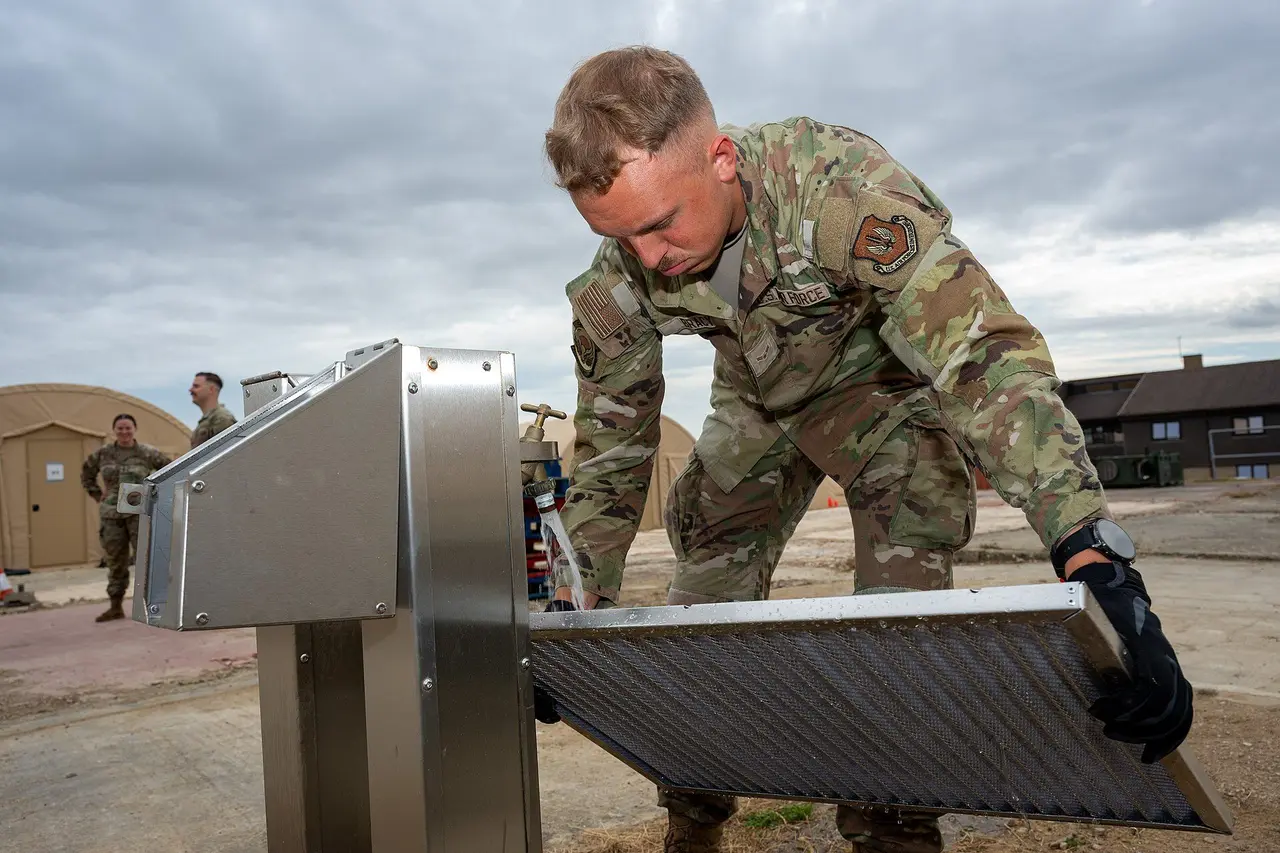
Washing the filters is safe, needs no tools and helps the unit keep its efficiency between technician visits. Figure 3 shows a technician cleaning a filter during a service; at home you do the same with a gentle tap.
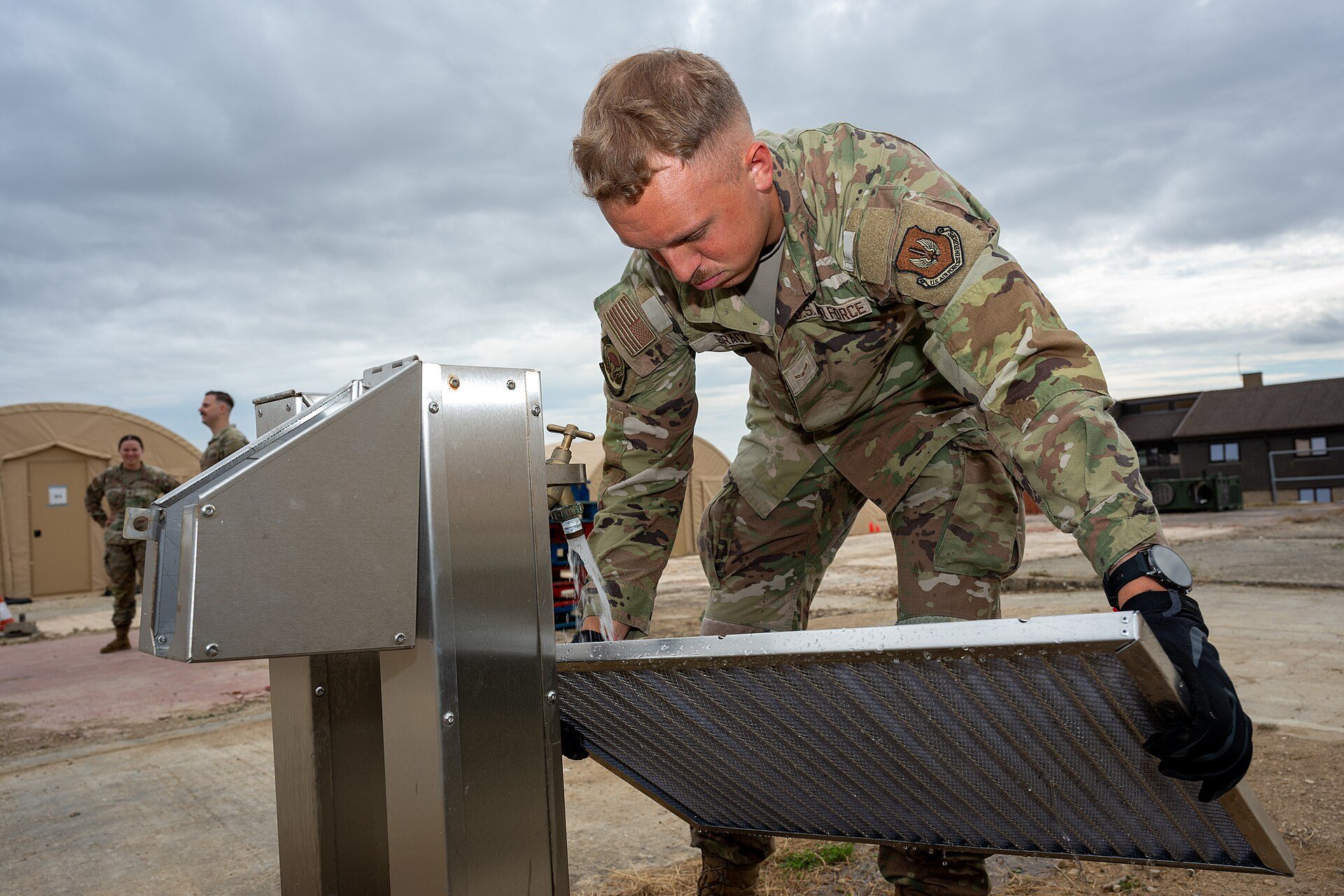
Photo: U.S. Air Force photo by Senior Airman Adam Enbal / Wikimedia Commons, Public domain
Steps for washing the filters of a wall-mounted unit
- Switch the unit off with the remote, then switch the air conditioner's circuit breaker (MCB) to OFF.
- Stand on a sturdy chair or an A-frame stepladder and lift the front cover with both hands until it clicks and stays up.
- Push the filter up slightly, then slide it down out of its guides. Don't bend it — old plastic clips break easily.
- Vacuum the dry dust first, then wash under a gentle tap, spraying from the back towards the front so the dust is pushed out. If it is greasy, soak it for 10 minutes in warm water with a little washing-up liquid.
- Dry it in the shade until completely dry, about 30–60 minutes. Do not leave it in strong sun or use a hot dryer — the plastic warps.
- Refit it the right way round (the side with lettering or an arrow facing out), close the cover, switch the breaker back on and run the unit for 10 minutes to test.
Wiping the cover and louvres, checking the drain
Wipe the front cover and the louvres with a well-wrung damp cloth. After running the unit for 15–20 minutes, go to the end of the drain line and check that water is dripping out steadily. If the indoor unit is dripping but the end of the drain line is dry, the line is blocked or kinked — call a technician; don't poke a metal rod deep inside, as you may puncture the pipe.
What owners should not do themselves
Don't remove the indoor unit's casing, don't spray water into the indoor unit without covering the board, and don't open the outdoor unit. Ready-made foam sprays only clean the surface of the fins; the dirt collects in the tray and easily blocks the drain line. Deep cleaning is the technician's job.
Safety warning: always switch off the circuit breaker before touching the indoor unit — turning it off with the remote does not cut the power. Never stand on swivel chairs or flimsy plastic stools. Never climb out over a balcony railing or onto an outdoor-unit bracket on a high floor yourself: professional technicians must wear a safety harness clipped to a secure anchor point. Don't disconnect copper pipes or release refrigerant yourself; R32 refrigerant is flammable, and liquid refrigerant sprayed on skin causes cold burns.
The technician's full cleaning routine (10 steps)
This is the standard maintenance routine for 9,000–24,000 BTU wall-mounted units that a master technician teaches an apprentice. Done thoroughly, one unit takes about 45–60 minutes. What sets a good technician apart is not speed but this: no water in the board, no flattened fins, and before-and-after measurements to show the customer.
Tools and materials
- A mini pressure washer with an adjustable jet, or a hand pressure sprayer; a bucket of 15–20 litres of clean water.
- An air-conditioner cleaning bag (a cover with a hose draining into a bucket), plastic bags and tape to cover the electrical box.
- A multimeter or clamp meter, and a thermometer for air temperature (probe or infrared).
- Screwdrivers, a soft brush, a fin brush, cloths, a torch.
- A neutral coil-cleaning solution made specifically for air conditioners (not strongly acidic cleaners).
- An A-frame ladder, gloves, safety glasses; a full-body harness when working on outdoor units at height.
Step by step
- Ask and check first: ask the customer what the unit has been doing; run it in Cool mode at 16–18°C, high fan, for 10 minutes, then record the return-air and supply-air temperatures and the outdoor unit's current.
- Isolate the power: switch the unit off, switch off the breaker, and confirm with a voltage tester that the indoor terminal block is dead.
- Remove the front cover, filters and louvres: set them aside and wash them in the bathroom or on the balcony.
- Cover the electrical box: wrap the board, sensors and terminal block tightly in plastic and tape it; this is the step beginners most often rush.
- Fit the cleaning bag: hook the bag around the underside of the indoor unit with its hose running into the bucket; lay a sheet on the floor if it is wooden.
- Spray solution and let it soak: spray evenly over the fins and wait 5–10 minutes for the dirt to loosen.
- Pressure-wash the indoor coil: spray along the direction of the fins, from top to bottom, at moderate pressure, holding the nozzle 15–20 cm from the coil so the fins don't bend. Wash the blower by spraying at an angle while turning it gently by hand.
- Clear the tray and drain line: pour about 1 litre of clean water into the tray and check that it runs out of the end of the drain quickly and clear; if blocked, blow it back through or use a suction pump.
- Clean the outdoor unit: isolate its power, cover its electrical box, and spray the condenser coil from the inside (fan side) outwards to push the dust out rather than deeper in. Figure 4 shows a pressure jet being used to wash an air conditioner's heat-exchange coil.
- Reassemble, test run, measure again: remove the plastic, wipe dry, refit all parts, run for 15 minutes, then measure air temperatures and current again; write them on the service sheet and show the customer.
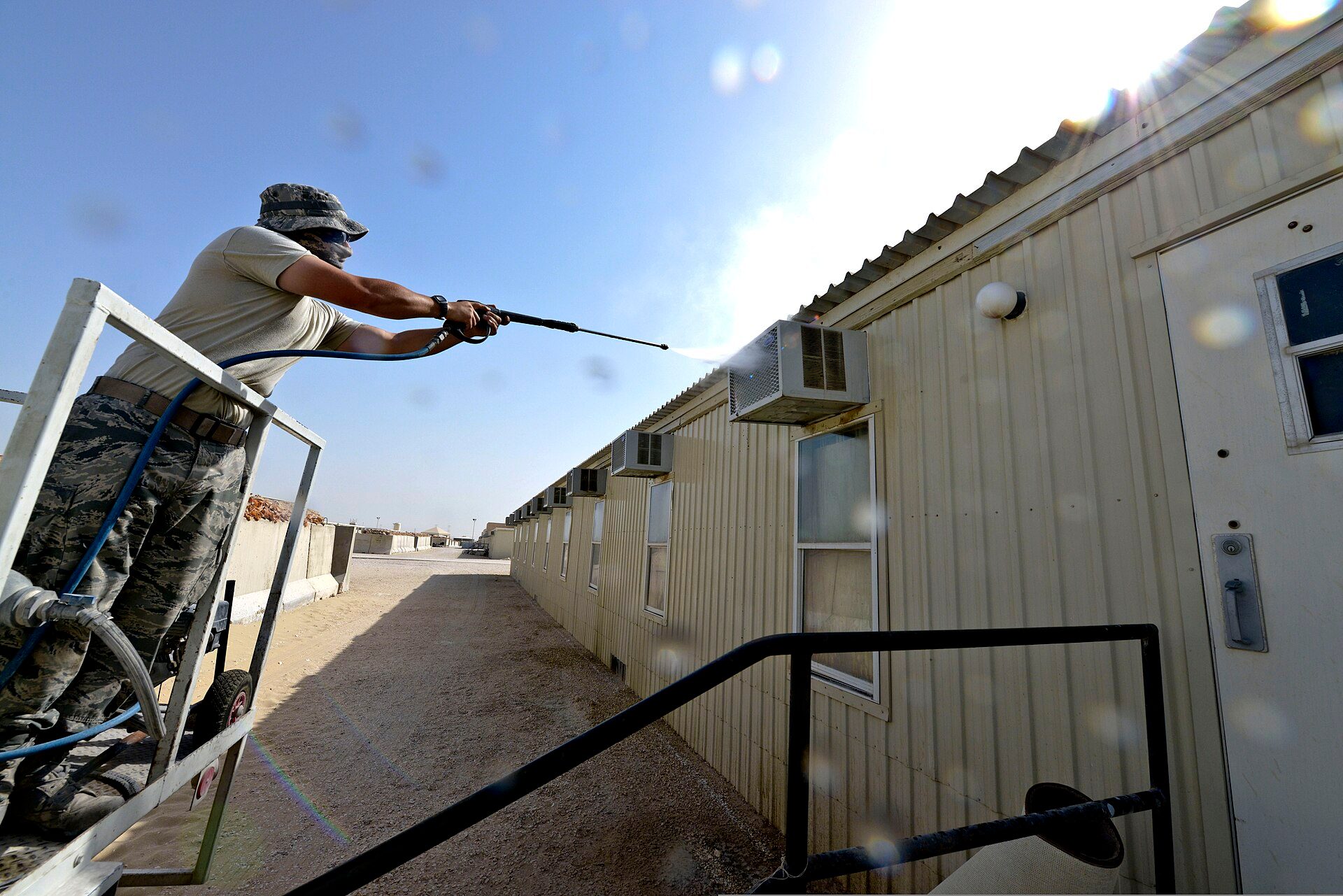
Photo: TSgt Joselito Aribuabo / Wikimedia Commons, Public domain
Cleaning the casing and internal frame
On older units near the sea or in damp places, the casing and internal metal frame rust easily, with dust caked on in patches. The technician scrubs them with a brush before spraying, as in Figure 5. Heavy rust should be noted on the service sheet and reported to the customer, because a frame that rusts for a long time can damage the bracket or cause water leaks.
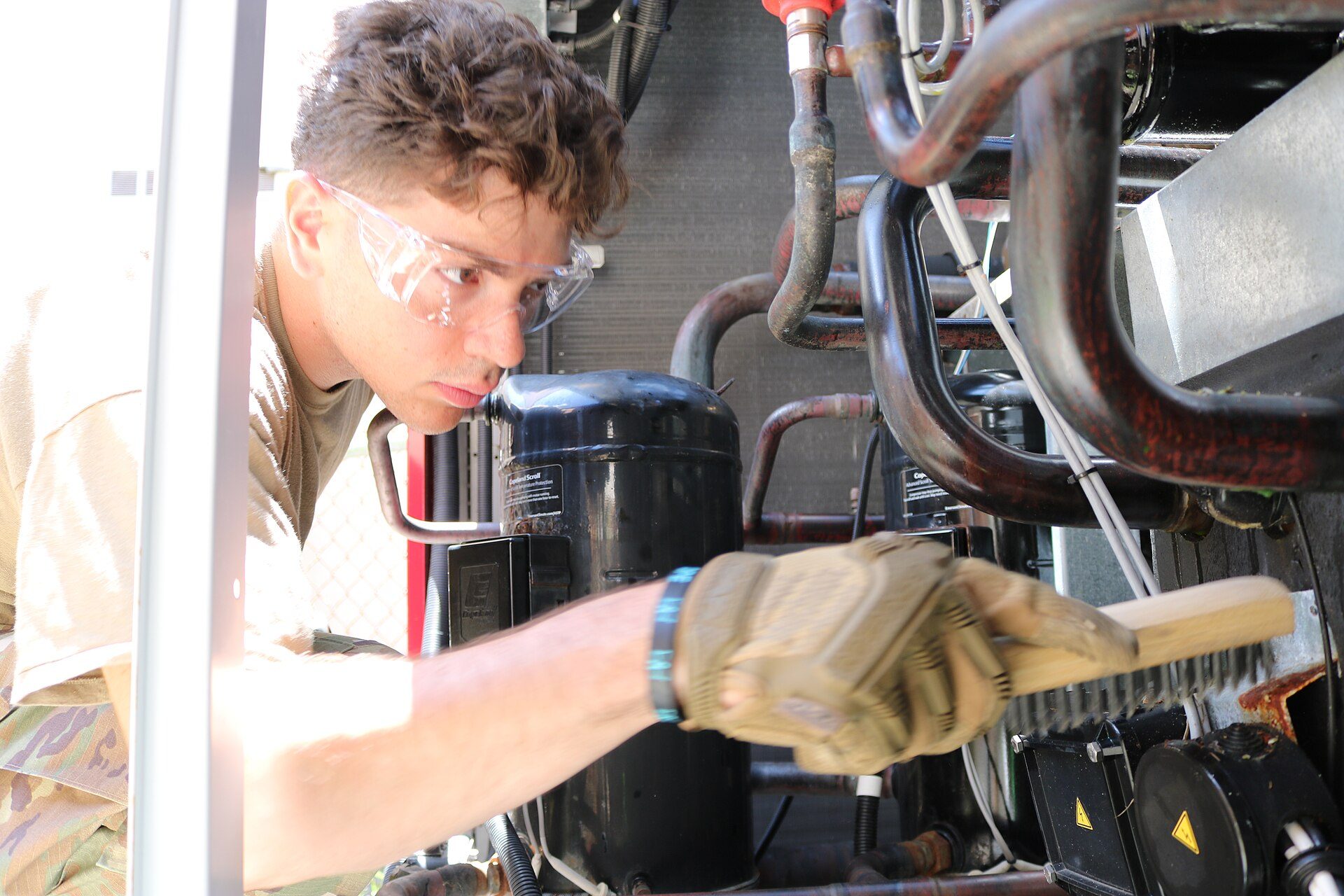
Photo: U.S. Air Force 108ARW by Staff Sgt. Maria Rella / Wikimedia Commons, Public domain
Extra checks while the unit is open
With the unit open, a technician should also check: the outdoor fan capacitor (measure its capacitance against the rating printed on it; if it is off by more than about 10%, recommend replacing it), whether the terminal block is loose or scorched, whether the pipe insulation is torn, and whether the outdoor unit bracket is still solid. These take an extra 5–10 minutes but catch faults before the unit dies in the middle of the hot season.
2026 reference prices for air-conditioner cleaning
The price of a cleaning depends on the type of unit, its capacity, where it is installed (outdoor unit on a roof or outside a high-floor balcony) and how many units are done on one visit. The table below gives reference ranges for 2026 in large Vietnamese cities, in Vietnamese dong (VND; 100,000 VND is roughly 4 US dollars). Prices in the provinces are usually lower. This is not the price list of any particular company.
| Unit type / service | Reference price 2026 (per unit) | Time |
|---|---|---|
| Wall-mounted 9,000–12,000 BTU | 150,000–250,000 VND | 40–50 minutes |
| Wall-mounted 18,000–24,000 BTU | 200,000–350,000 VND | 50–70 minutes |
| Floor-standing | 300,000–500,000 VND | 60–90 minutes |
| Ceiling cassette | 350,000–600,000 VND | 60–90 minutes |
| Taking the indoor unit down to wash (very dirty, mouldy) | 400,000–800,000 VND | 2–3 hours |
| Surcharge for hard-to-reach outdoor units (harness, long ladder) | 50,000–200,000 VND | Depends on location |
Items often charged on top
Topping up refrigerant, replacing a capacitor, the drain line or the pipe insulation are repairs; they must be quoted separately and agreed by the customer. A trustworthy technician measures the pressure and explains why a top-up is needed; not every cleaning needs "more gas". Customers with 3 or more units usually get 10–20% off the labour.
Worked example: cleaning 3 units in a flat in Ho Chi Minh City
Ms Lan lives in a 12th-floor flat with 3 wall-mounted units: an 18,000 BTU unit in the living room and a 9,000 BTU unit in each of two bedrooms. The living-room unit runs about 10 hours a day and was last cleaned 8 months ago; she says the living room is "set to 22 degrees and still hot". The figures below are illustrative, with 2026 reference prices.
Measuring before the work
- Living-room unit: return air 28°C, supply air 21°C, a difference of 7°C; outdoor unit current 7.4 A.
- Bedroom 1 unit: return air 27°C, supply air 17°C, a difference of 10°C; current 3.9 A.
- Bedroom 2 unit: return air 27°C, supply air 18°C, a difference of 9°C; current 4.0 A.
For a wall-mounted unit in cooling mode on high fan, the difference between return-air and supply-air temperature is usually about 8–12°C. The living-room unit is only 7°C, consistent with heavily dusty filters and coil; its outdoor unit, placed in a service recess, is also coated in dust.
Doing the work and measuring again
- Clean the 3 units in turn following the 10 steps: living room 60 minutes, each bedroom 45 minutes. Total: 60 + 45 + 45 = 150 minutes (2 hours 30 minutes).
- After cleaning, the living-room unit: return air 28°C, supply air 17°C, a difference of 11°C; current down from 7.4 A to 6.6 A.
- The difference on the two bedroom units rises to 11–12°C, with current down by about 0.2–0.3 A.
- The living-room unit's refrigerant pressure, measured at steady running, is within the normal range for its refrigerant type, so no top-up is needed.
Working out the bill
- 18,000 BTU unit: 250,000 VND. Two 9,000 BTU units: 2 × 180,000 = 360,000 VND.
- Subtotal: 250,000 + 360,000 = 610,000 VND.
- 10% discount for 3 units: 610,000 × 10% = 61,000 VND.
- Customer pays: 610,000 − 61,000 = 549,000 VND (about 22 US dollars), with no extra materials.
The handover sheet records all the measurements, with before-and-after photos of the filters and the dirty water in the cleaning bag. The technician books the next service in 3 months for the living-room unit and 5 months for the two bedrooms, following the table at the start of this lesson.
Common mistakes when cleaning air conditioners
Water gets into the board and the unit shows an error after washing
Sign: the unit won't start, a light blinks or an error code appears. Cause: the electrical box was covered carelessly, or sprayed too hard close to the board. Fix: isolate the power immediately, remove the board and let it dry naturally or with a cool fan for a few hours, and don't test it while it is still damp; next time cover it fully and keep the spray away from the electrical box.
The indoor unit drips after cleaning
Sign: a few hours after the technician leaves, water drips from the indoor unit. Cause: dirt washed into the tray blocks the drain line, or the tray was not refitted properly. Fix: always pour water to test the drain in step 8 and wait to see it run out of the end before reassembling.
Flattened fins, weaker airflow than before
Sign: you can see patches of flattened fins. Cause: the nozzle was too close, sprayed across the fins, or a hard brush was used. Fix: straighten them with a fin comb; keep the nozzle 15–20 cm away and spray along the fins.
Using harsh chemicals
Sign: the fins become dull and gradually corrode, and after a few washes the coil leaks refrigerant. Cause: using strongly acidic or alkaline cleaners and not rinsing with clean water. Fix: use only a solution made for air-conditioner coils, diluted as the label says, rinse thoroughly with clean water, and wear gloves and glasses when mixing.
Frequently asked questions
How often is it reasonable to clean an air conditioner?
Wash the filters every 2–4 weeks in the hot season. A full service every 3–6 months for homes, and every 1–3 months for offices, restaurants or places with lots of dust or cooking fumes.
How much does air-conditioner cleaning cost?
2026 reference: wall-mounted units 150,000–350,000 VND each depending on capacity, floor-standing 300,000–500,000 VND, ceiling cassette 350,000–600,000 VND. Several units usually get 10–20% off. Refrigerant top-ups and replacement parts are quoted separately.
Can I clean my air conditioner at home with a foam spray?
It can clean the surface of the fins between technician visits, but it does not replace pressure-washing with water. Isolate the power, don't spray into the electrical box, and run the unit in fan mode afterwards to dry it.
Does the unit need a refrigerant top-up after cleaning?
Not by default. Refrigerant is only lost through a leak. The technician must measure the pressure at steady running; only if it is below normal do they look for the leak, fix it, then top up — and explain this to the customer.
Why is the unit still not cooling after cleaning?
It may be short of refrigerant because of a leak, have a weak fan capacitor, a faulty sensor, or be undersized for the room. How to check for yourself, and when to call a technician, is covered in the trade roadmap at the step on diagnosing error codes and inverter boards.
Practice exercises
- Wash the filters of a wall-mounted unit at home following the 6 steps, timing the whole process (excluding drying time).
- Measure return-air and supply-air temperatures before and after washing the filters, after the unit has run steadily for 10 minutes in cooling mode on high fan.
- Write a sample service sheet for a flat with 2 units: unit type, capacity, before-and-after measurements, work done, price, and next appointment.
- Draw up a cleaning price list for your area: call at least 2 technicians or air-conditioning shops and note the price range for each type of unit.
Self-assessment criteria
- Pass: you wash and refit the filters in 15 minutes, with no broken clips, the right way round; you switched off the breaker before starting.
- Pass: the service sheet has all before-and-after measurements, the price adds up, and the next appointment matches the type of use.
- Not yet: you forgot to isolate the power, let water run into the electrical box, or the sheet only says "cleaned" with no measurements.
The next step on the roadmap is Diagnosing error codes and inverter air-conditioner boards — when a clean unit still doesn't cool or shows an error, you need to look up error codes, test sensors and fans, and tell a board fault from a compressor fault. See the full 8-step roadmap for refrigeration and air-conditioning technicians, which also includes lessons on air conditioners that won't cool, how long it takes to learn the trade, and technician pay in 2026.