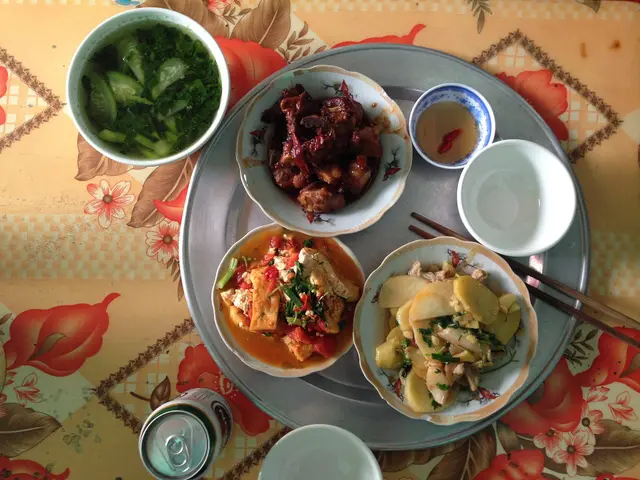
The four nutrient groups are protein, fat, carbohydrate and micronutrients (vitamins and minerals); add water and you have everything the body needs every day to make energy, build and repair tissue and keep vital functions running. No group is "bad" and needs to be cut out completely: what matters is the amount, the type and how foods are combined in a meal. This lesson helps you explain each group with everyday Vietnamese foods and untangle myths such as cutting out all carbs or replacing meals with detox drinks. Every figure here is a reference value for healthy adults based on general guidance from WHO and Vietnam's National Institute of Nutrition; people with a medical condition, pregnant women and anyone on long-term medication need a doctor or a clinical dietitian.
By the end of this lesson, you will be able to:
- Explain the role of protein, fat, carbohydrate, micronutrients and water to a client in plain words.
- Name at least 3 familiar Vietnamese food sources for each nutrient group.
- Use the right reference values (protein per kg, free sugars, fibre, salt, water) and know which ones change with age and sex.
- Analyse a client's day of eating and show which groups are short or in excess, with figures that add up.
- Politely correct common myths and know when to refer a client to a health professional.
Learning to be a nutrition coach? This is step 2 of the roadmap, after scope of practice and ethics. See the 8-step nutrition coach roadmap to learn in the right order.
What are the 4 nutrient groups?
Nutrients are split into macronutrients (needed in large amounts, measured in grams: protein, fat, carbohydrate) and micronutrients (needed in small amounts, measured in milligrams or micrograms: vitamins and minerals). Water provides no energy, but it makes up most of the body's weight and takes part in almost every reaction.
Energy-yielding and non-energy nutrients
Each gram of protein or carbohydrate gives about 4 kcal, and each gram of fat about 9 kcal. Micronutrients, water and fibre give no meaningful energy but are still essential. Working out total daily energy is covered in step 4 of the roadmap; this lesson answers the question that comes first: what each group does, which Vietnamese foods provide it and roughly how much is needed.
Why a coach must know this well
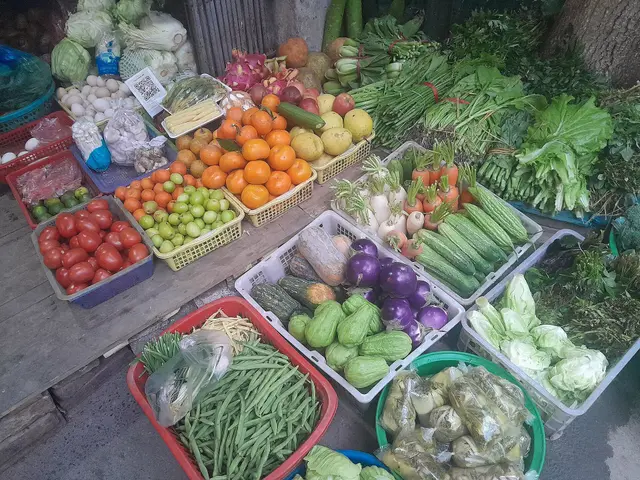
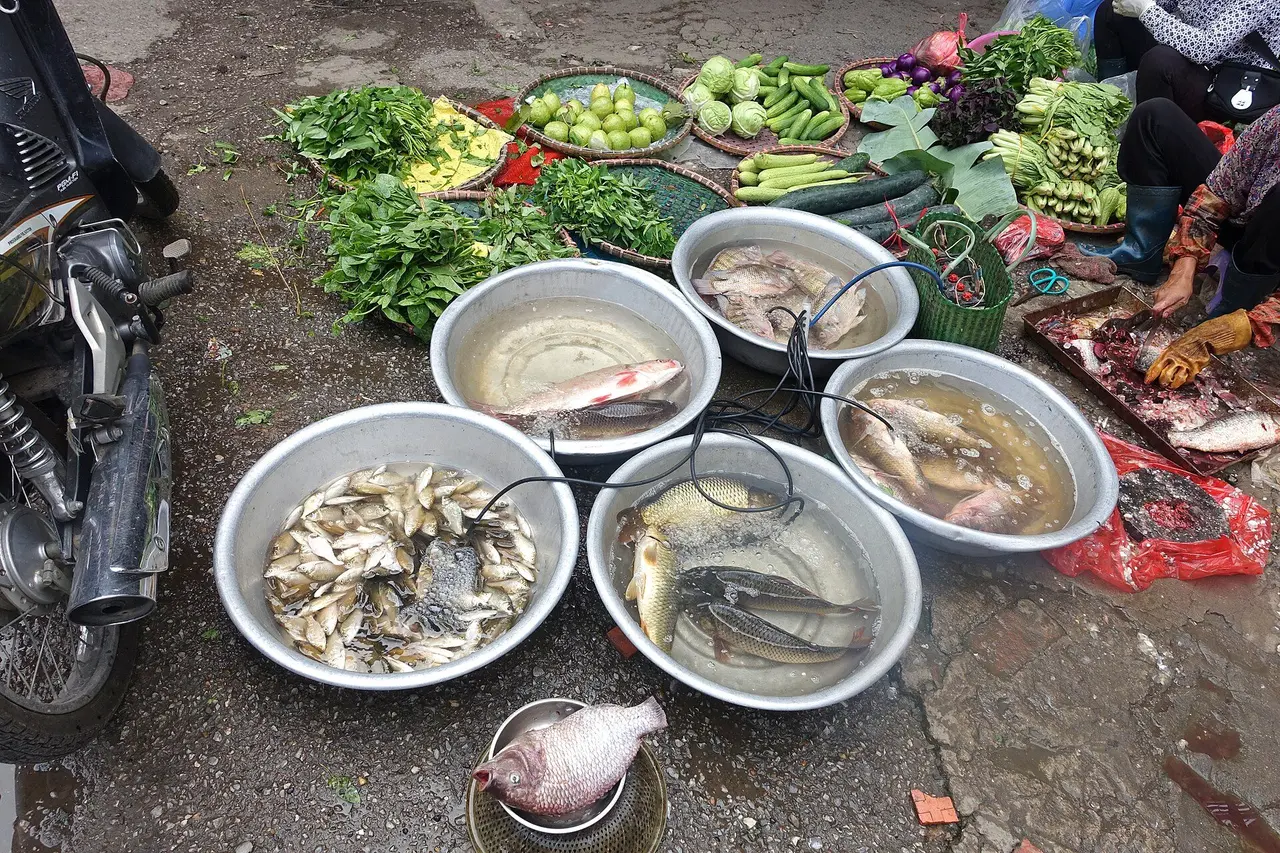
Clients rarely ask "how many grams of protein do I need?"; they ask "does rice make you fat?" or "will a vegetarian diet leave me short of nutrients?". A solid foundation lets you answer with evidence and stay within the scope you learned in What is nutrition coaching? What coaches may and may not do. A morning market stall like the one in Figure 1 shows all the groups at once: fish for protein and healthy fats, leafy greens for vitamins, minerals and fibre. A traditional Vietnamese family meal (rice, a protein dish, vegetables, soup) is already fairly balanced; your job is usually to adjust amounts and quality.
Protein: roles, food sources and reference needs
Protein is the building material for muscle, skin, hair, digestive enzymes, antibodies and many hormones. It is made of amino acids; some of them (essential amino acids) cannot be made by the body and must come from food. Long-term protein shortage leads to muscle loss and slow wound healing, while eating far more protein does not build bigger muscles without training.
Reference protein needs by body weight and group
For healthy adults, the widely used WHO/FAO reference is about 0.8 g of protein per kg of body weight per day. Recommendations for Vietnamese people from the National Institute of Nutrition usually state that protein should supply about 13–20% of total dietary energy.
| Group (healthy) | Reference protein | Notes |
|---|---|---|
| Adults with low activity | about 0.8 g/kg/day | Enough for most people |
| Older adults | about 1.0–1.2 g/kg/day | Many geriatric guidelines suggest more to preserve muscle |
| Regular strength training | about 1.2–2.0 g/kg/day | Depends on intensity and goal |
| Children, pregnancy, breastfeeding, kidney or liver disease | Set by a doctor or dietitian | Outside a coach's scope |
Example: a woman weighing 55 kg with low activity needs at least about 55 × 0.8 = 44 g of protein a day; if she starts lifting weights 3 times a week, 1.2 g/kg means 66 g.
Familiar protein sources in Vietnamese meals
| Food | Amount | Estimated protein |
|---|---|---|
| Skinless chicken breast (raw weight) | 100 g | about 22 g |
| Lean pork (raw weight) | 100 g | about 19 g |
| Tilapia or mackerel (flesh) | 100 g | about 18–20 g |
| Chicken egg | 1 egg (about 50 g edible) | about 6 g |
| Tofu | 100 g | about 8–11 g |
| Unsweetened fresh milk | 200 ml | about 6–7 g |
| White rice | 1 medium bowl (about 150 g cooked) | about 4 g |
Figures are rounded and vary with variety and cooking; use them for guidance.
Animal protein, plant protein and combining them
Protein from meat, fish, eggs and milk contains all the essential amino acids. Protein from soybeans, mung beans, peanuts, sesame and grains often lacks one or two, but combining several sources during the day (rice with tofu, sticky rice with mung beans, greens with a sesame and peanut dip) fills the gaps. Eggs are a cheap protein sold at every market (Figure 2); for families on a tight budget, eggs, tofu and fish are usually more economical than beef.
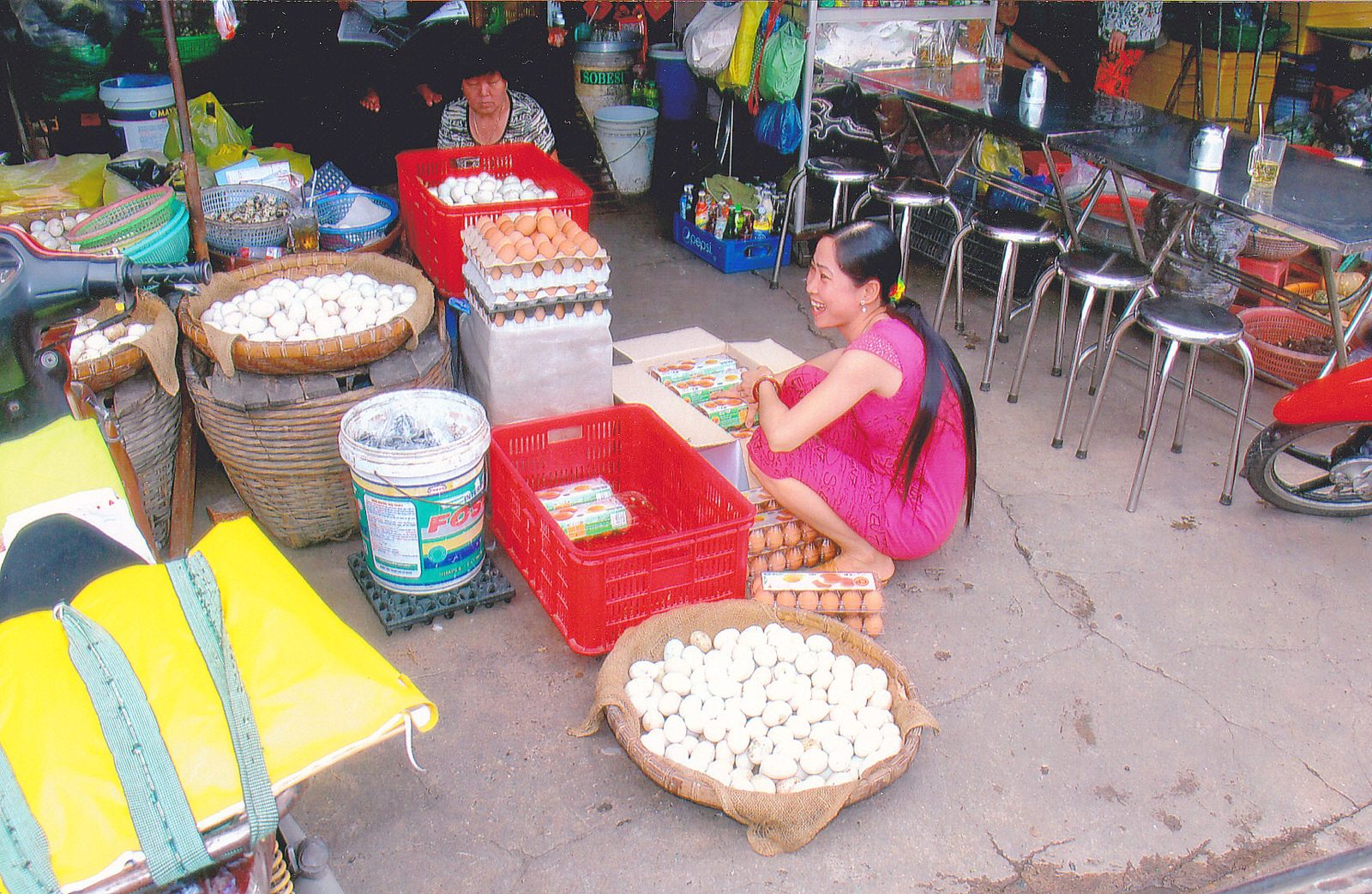
Photo: Peter van der Sluijs / Wikimedia Commons, CC BY-SA 3.0
Carbohydrate and fibre: the main energy source of a Vietnamese meal
Carbohydrates include starch in rice, rice noodles, pho noodles, bread, sweet potato and corn; sugars in fruit and milk; and added sugars such as table sugar, honey and condensed milk. The body turns most carbohydrate into glucose, the preferred fuel of the brain and muscles. Recommendations for Vietnamese people usually have carbohydrate providing about 55–65% of energy.
Good starches and free sugars
Brown rice, sweet potato, corn, beans, vegetables and whole fruit also provide fibre and vitamins. By contrast, "free sugars" as defined by WHO include sugars added to foods and drinks plus the sugars naturally present in honey, syrups and fruit juice. WHO recommends keeping free sugars below 10% of total energy, and ideally below 5%; on a 2,000 kcal diet, 10% is 200 kcal, or about 50 g of sugar, and 5% is about 25 g.
Fibre and the daily fruit and vegetable target
Fibre keeps you full longer, eases constipation and makes blood sugar rise more slowly. WHO's 2023 guideline on carbohydrates recommends that adults eat at least 25 g of naturally occurring fibre and at least 400 g of vegetables and fruit a day (not counting starchy roots). In Vietnamese terms, that is roughly a large plate of boiled greens, a bowl of vegetable soup and a banana.
Rice is the base of the Vietnamese meal (Figure 3). A medium bowl of rice (about 150 g cooked) holds about 40–45 g of carbohydrate; a medium bowl of pho or bun (about 200 g cooked noodles) about 50 g. For healthy people, adjusting the amount of rice to activity level, mixing in brown rice or swapping part of it for sweet potato or corn is usually easier to sustain than dropping rice entirely.
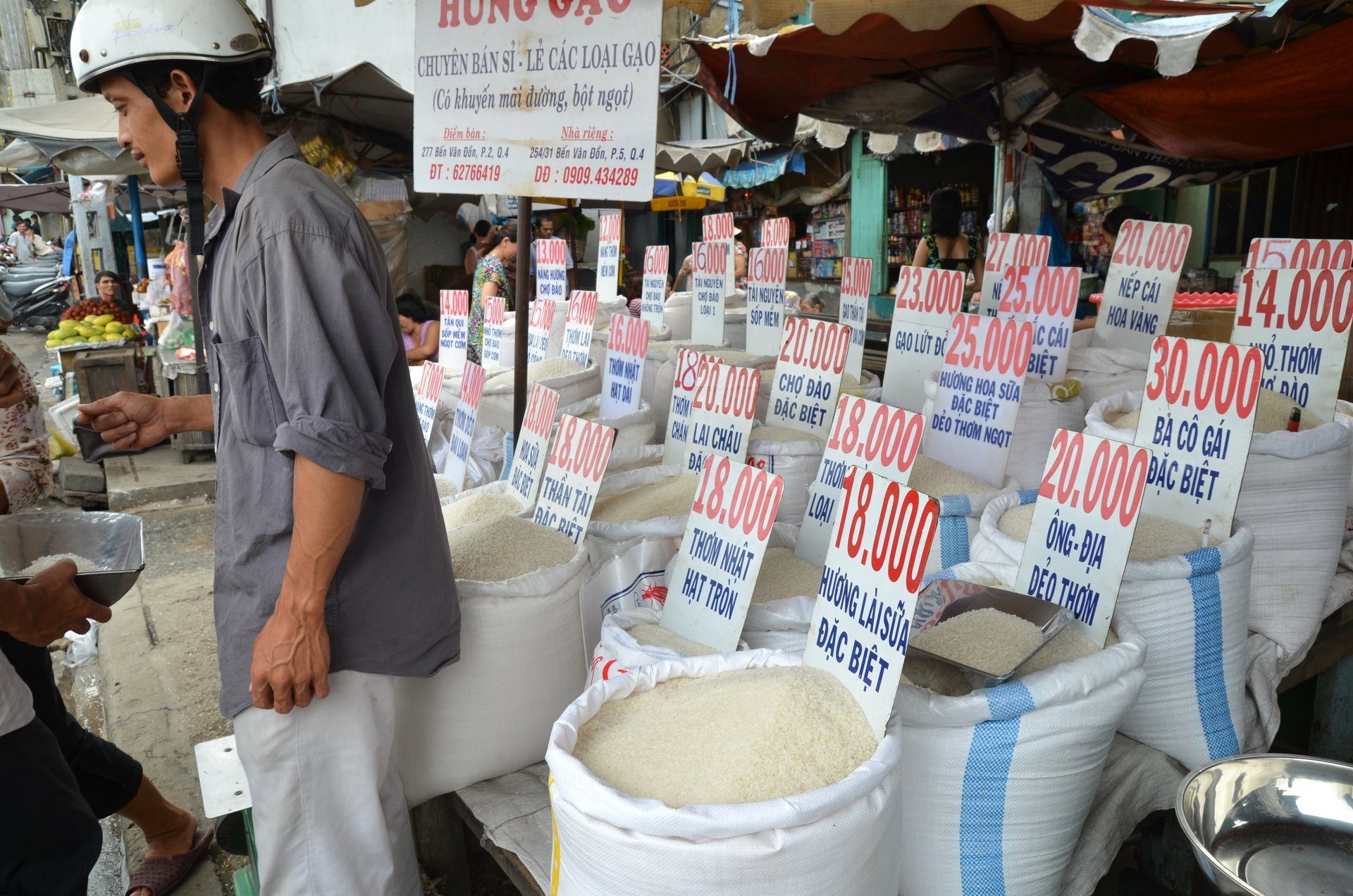
Photo: Takeaway / Wikimedia Commons, CC BY-SA 3.0
Fat: not the enemy, but choose the type
Fat provides concentrated energy, helps absorb fat-soluble vitamins (A, D, E, K) and is a building material for cell membranes and hormones. Some fatty acids, such as omega-3 and omega-6, are essential. That is why an absolutely "oil-free" diet is not the goal.
Types of fat and recommended limits
| Type of fat | Familiar Vietnamese sources | Reference (WHO, adults) |
|---|---|---|
| Unsaturated | Fish (especially mackerel and scad), peanuts, sesame, soybeans, vegetable oils | Should make up most of your fat |
| Saturated | Lard, chicken skin, fatty pork, butter, coconut oil, coconut milk | Below 10% of total energy |
| Trans | Some biscuits, industrial fried snacks, frying oil reused many times | Below 1% of total energy |
| Total fat | All sources | No more than 30% of total energy |
"Hidden" fat in Vietnamese dishes
One tablespoon of oil (about 10 g) already gives about 90 kcal. Deep-fried dishes, the fatty broth of pho and bun bo, caramelised braised pork and coconut-milk sweet soups push fat up quickly even when portions look small. Switching a few fried dishes a week to boiled, steamed or lightly braised ones, and not reusing frying oil many times, is more realistic than banning fat.
Micronutrients: vitamins and minerals to watch by age and sex
Micronutrients are needed in tiny amounts, but long-term shortages have big effects: low iron causes anaemia, low iodine affects the thyroid, and low calcium and vitamin D weaken bones. A colourful, varied diet is the simplest way to get enough.
Key micronutrients and Vietnamese food sources
| Micronutrient | Main role | Familiar Vietnamese sources | Groups to watch |
|---|---|---|---|
| Iron | Making red blood cells | Beef, lean pork, liver, eggs, beans, dark leafy greens | Women of childbearing age, vegetarians |
| Calcium | Bones, teeth, muscle contraction | Milk, yoghurt, small shrimp, small fish eaten with bones, tofu | Teenagers, postmenopausal women, older adults |
| Iodine | Thyroid hormones | Iodised salt, seafood, seaweed | Pregnant women, homes not using iodised salt |
| Vitamin A | Vision, immunity | Liver, eggs, gac fruit, carrots, pumpkin, sweet leaf (rau ngot) | People who eat few coloured vegetables |
| Vitamin C | Immunity, helps absorb iron from plants | Guava, oranges, pomelo, mandarins, tomatoes | People who eat little fresh produce |
| Vitamin D | Calcium absorption | Made by the skin in sunlight; oily fish, egg yolk | Indoor workers, older adults |
| Vitamin B12 | Blood formation, nerves | Meat, fish, eggs, milk | Strict vegetarians and vegans |
Needs differ by age and sex
According to general WHO/FAO recommendations, people aged 19–50 need about 1,000 mg of calcium a day, while teenagers, postmenopausal women and older adults need about 1,300 mg. Adults need about 150 micrograms of iodine a day, and pregnant women need more. Women who menstruate need considerably more iron than men because of monthly blood loss. Eating vitamin C-rich fruit and vegetables with beans and greens improves iron absorption, while strong tea or coffee right at mealtimes can reduce it. Never recommend raw pig blood pudding (tiet canh) to "build blood": it carries a risk of dangerous Streptococcus suis infection.
Salt and sodium
Vietnamese diets often contain too much sodium from salt, fish sauce, seasoning powder, instant noodles and dipping sauces. WHO recommends that adults eat less than 5 g of salt a day (under about 2 g of sodium), while surveys in Vietnam show adults eat close to double that. People with high blood pressure or kidney disease should follow their doctor's advice.
Vitamin pills: be careful
For healthy people with a varied diet, food is the main source of micronutrients; the fruit stall (Figure 4) is a cheap and safe source of vitamin C. High doses of vitamins A and D taken long term can build up and cause harm. Women planning a pregnancy or who are pregnant are prescribed folic acid and iron by their doctor; a coach never sets doses.
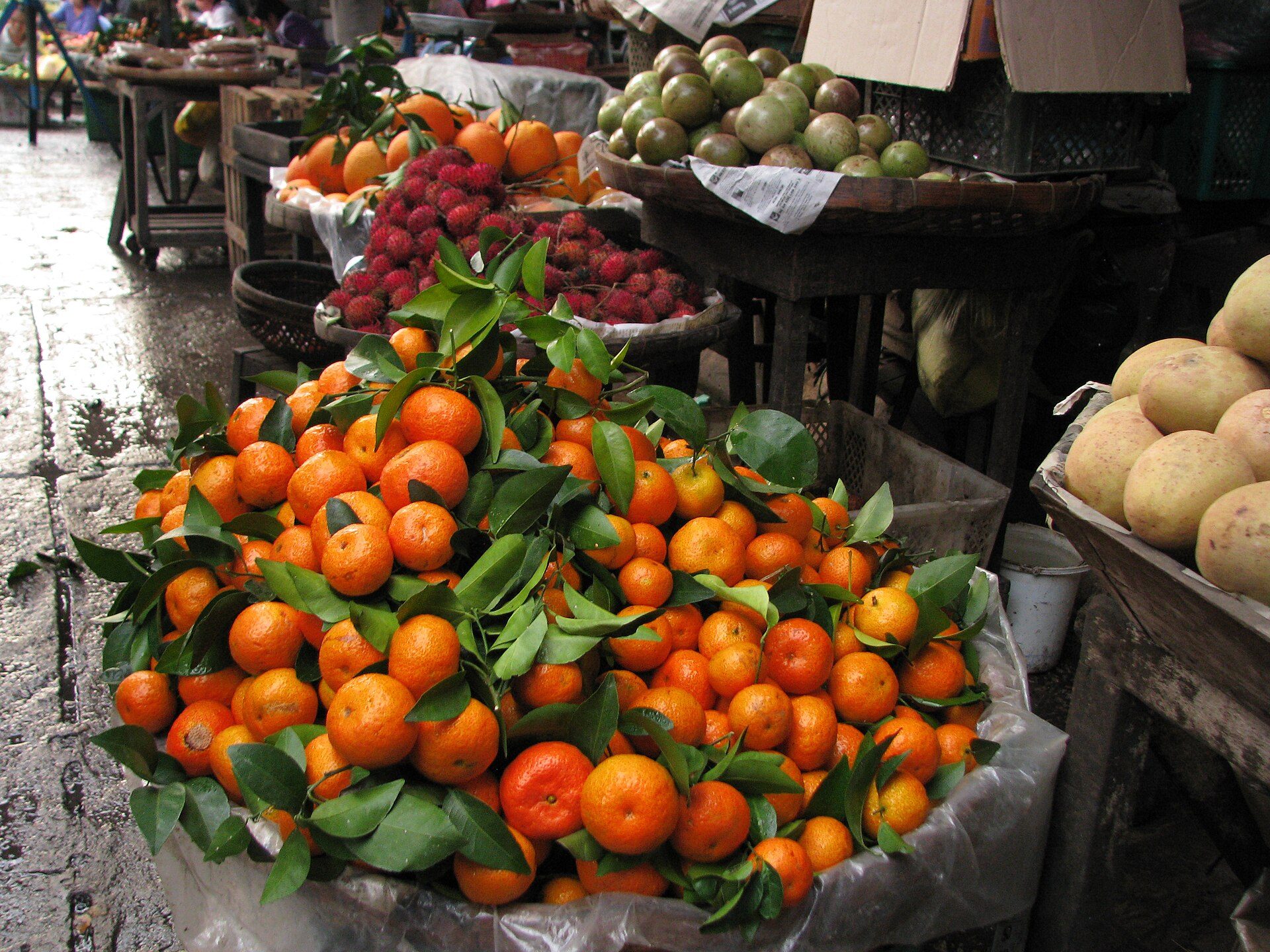
Photo: McKay Savage from London, UK / Wikimedia Commons, CC BY 2.0
Water: how much is enough?
Water regulates body temperature, carries nutrients and removes waste through the kidneys. Even mild dehydration can cause tiredness, headaches and constipation.
Reference values
A commonly quoted reference is from the European Food Safety Authority (EFSA): total water of about 2.0 litres a day for adult women and 2.5 litres for adult men, including water in food. If about 20% comes from food (soup, pho, vegetables, fruit), drinks provide roughly 1.6 litres for women and 2.0 litres for men; hot weather, outdoor labour and heavy training call for more. People with heart failure, kidney failure or cirrhosis must drink as their doctor advises, not follow general figures.
Simple self-checks
- Pale yellow urine usually means you are drinking enough; dark, scanty urine with thirst means drink more.
- Spread drinks through the day rather than gulping litres at once; drinking very large amounts in a short time can cause low blood sodium.
- Choose plain water or weak unsweetened tea (Figure 5); milk tea, soft drinks and coffee with condensed milk bring a lot of free sugar.

Photo: Kurt Kaiser / Wikimedia Commons, CC0
Common nutrition myths and how to explain them to clients
Cutting out carbs completely to lose weight
The client says: "I've stopped eating rice, I only eat vegetables and meat." Early weight loss is mostly water and stored glycogen, not all fat; dropping starch completely often causes tiredness, constipation, sugar cravings and overeating later. The US Institute of Medicine (IOM) sets a minimum reference of about 130 g of carbohydrate a day for adults, based on the brain's glucose needs. You say: "You don't need to give up rice; just adjust how much you eat to your activity and add more vegetables and protein." A person with diabetes on medication who cuts carbs on their own may get low blood sugar and must ask their doctor.
Replacing meals with detox drinks
The client says: "For dinner I only drink lemon and honey water to detox." The liver and kidneys are the body's detox organs; there is no solid evidence that juices or "detox" teas remove toxins better. Replacing meals with juice leaves you short of protein and fat and adds free sugar; honey and palm sugar are still free sugars. Some "slimming detox" teas contain laxatives or diuretics, so the weight lost is mostly water, and authorities have repeatedly warned about slimming products laced with banned substances. You say: "Juice can be a side drink, but it can't replace a meal of rice, fish and vegetables."
More protein is always better, or vegetarians must be short of protein
Protein beyond your needs does not turn into muscle without training, and people with kidney disease may need to limit protein on their doctor's advice. Vegetarians can get enough protein by combining tofu, beans, peanuts, sesame and grains; the bigger concerns are vitamin B12 and iron, and strict vegetarians should ask a doctor about B12 supplements.
Worked example: analysing a day of eating for Lan
Lan is 32, 1.60 m tall, weighs 55 kg, works in an office with low activity and has passed the screening form: no chronic disease, not pregnant, no long-term medication. She wants to lose belly fat, so she has dropped rice and drinks a detox drink for dinner. Her reference protein target is 0.8–1.2 g/kg, or 44–66 g a day. The figures below are rounded estimates.
Her current day (self-imposed diet)
| Meal | Food | Protein (g) | Carbs (g) | Whole vegetables and fruit (g) |
|---|---|---|---|---|
| Breakfast | 300 ml celery and apple juice | 1 | 25 | 0 |
| Lunch | Salad with 100 g chicken breast (raw weight), 100 g lettuce and cucumber, 1 tablespoon oil dressing | 23 | 3 | 100 |
| Afternoon | Iced coffee with about 30 g condensed milk | 2 | 16 | 0 |
| Dinner | 500 ml lemon and honey water instead of a meal | 0 | 17 | 0 |
| Total | 26 | 61 | 100 | |
- Protein 1 + 23 + 2 + 0 = 26 g, below the 44 g minimum (about 0.47 g/kg).
- Of the 61 g of carbs, 25 + 16 + 17 = 58 g are free sugars: she is "avoiding carbs" yet her free sugars already exceed the 50 g mark for a 2,000 kcal diet.
- Vegetables and fruit total 100 g, far short of 400 g.
- Energy: protein 26 × 4 = 104 kcal, carbs 61 × 4 = 244 kcal, fat about 12 g (10 g dressing, 2 g in the condensed milk) × 9 = 108 kcal; total 104 + 244 + 108 = 456 kcal, only about a third of her estimated resting energy (BMR) of about 1,229 kcal using the Mifflin-St Jeor equation.
Her day after adjustment
| Meal | Food | Protein (g) | Carbs (g) | Whole vegetables and fruit (g) |
|---|---|---|---|---|
| Breakfast | Medium bowl of beef pho (200 g noodles, 50 g cooked beef, herbs, bean sprouts) | 20 | 50 | 30 |
| Lunch | 1 bowl of rice (4 g protein, 42 g carbs), 80 g braised fish (16 g protein, 2 g sugar from the braise), 150 g boiled water spinach (4 g protein, 4 g carbs) | 24 | 48 | 150 |
| Afternoon | 1 banana (100 g edible), 1 pot of unsweetened yoghurt (100 g) | 5 | 28 | 100 |
| Dinner | 1 bowl of rice (4 g protein, 42 g carbs), 100 g tofu in 50 g tomato sauce (10 g protein, 3 g carbs), soup with 150 g mustard greens (2 g protein, 3 g carbs) | 16 | 48 | 200 |
| Total | 65 | 174 | 480 | |
- Protein 20 + 24 + 5 + 16 = 65 g, about 1.18 g/kg, within the 44–66 g range.
- Carbs 50 + 48 + 28 + 48 = 174 g, above the 130 g minimum; free sugars drop to about 2 g from the braise.
- Vegetables and fruit 30 + 150 + 100 + 200 = 480 g, meeting the 400 g target.
- Water: 7 glasses of 250 ml plain water or weak tea = 1,750 ml, plus the pho broth and soup.
The next step would be to estimate her total energy and set a moderate deficit if she wants to lose fat, as explained in How to calculate calories for weight loss: BMR, TDEE, safe deficit. At this stage the only goal is to bring her meals back to all the nutrient groups.
When to refer a client to a doctor or clinical dietitian
⚠ Safety first: A coach gives general eating guidance to healthy people only. Do not diagnose micronutrient deficiencies, do not interpret lab tests, and do not prescribe vitamins or minerals at treatment doses. Clients with unusual symptoms should be advised to see a doctor; in an emergency in Vietnam, call 115.
Refer before commenting on their diet
- Diabetes, kidney, liver or heart disease, high blood pressure, gout, thyroid disease.
- Pregnancy or breastfeeding; children and teenagers.
- Long-term medication; signs of an eating disorder (prolonged fasting, vomiting after meals).
Signs that call for an early doctor's visit
- Lasting tiredness, pale skin, dizziness, palpitations.
- Unexplained weight loss, unusual thirst and frequent urination.
- Long-lasting constipation or diarrhoea, black or bloody stools; swollen legs, shortness of breath.
Frequently asked questions
What are the 4 nutrient groups?
Protein, fat, carbohydrate and micronutrients (vitamins and minerals). Water is usually mentioned alongside because the body needs it every day even though it gives no energy; fibre belongs to the carbohydrate group but is not digested like starch.
How many grams of protein do I need a day?
Healthy adults can use about 0.8 g/kg as a reference; a 55 kg person needs about 44 g. Older adults and people who train usually need more; people with kidney or liver disease follow their doctor.
Does cutting out carbs help you lose weight?
You may lose weight quickly at first, mostly water, but it is hard to keep up and often leaves you short of fibre. Adjusting rice portions, choosing high-fibre starches and eating more vegetables is more sustainable; people with diabetes on medication should not cut carbs on their own.
Practice exercise and self-assessment
- Record everything you eat and drink for one day; build a table like Lan's with protein, carbs and vegetables-and-fruit columns, then add up each column.
- Work out your reference protein from your weight, mark every source of free sugar and estimate the total grams.
- Write 3 polite explanations for a client who cuts all carbs, one who replaces meals with detox drinks and one who eats "oil-free".
Self-assessment criteria
- Pass: every column in your table adds up, and you state that the figures are estimates.
- Pass: you quote the 0.8 g/kg protein, free sugars below 10% of energy, 400 g of fruit and vegetables and under 5 g of salt correctly and call them "reference" values.
- Not yet: you recommend vitamin doses, interpret a client's lab tests, or comment on a diet before asking about medical conditions.
Once you understand what each nutrient group does, move on to the next step of the roadmap: Reading labels & estimating portions, where you learn to read nutrition facts, find hidden sugar and sodium on packaging, and estimate portions using your hand, bowls and spoons.
Keep learning nutrition coaching: after nutrients come label reading, energy needs, budget Vietnamese meal plans and habit coaching. See the 8-step nutrition coach roadmap.