A one-way kitchen is a layout in which food moves in only one direction: receiving, then cold and dry storage, preparation, cooking, plating and the pass, while dirty dishes and rubbish take their own route and never go backwards or cut across the cooked-food area. Together with cold holding at 0–5°C, FIFO stock rotation, colour-coded boards and handwashing at the right moments, this is the food safety foundation every commis in a Western restaurant or hotel must know from day one. This lesson also explains the brigade system (commis, chef de partie, sous chef) so you know where you stand and whose orders you follow in the kitchen.
By the end of this lesson, you will be able to:
- Draw the one-way flow of a restaurant kitchen and point out 3 places where clean and dirty flows cross.
- Measure and log fridge temperatures of 0–5°C, freezers at -18°C, hot holding from 60°C, and cool a pot of stock fast enough to meet the time limits.
- Organise storage by FIFO, label containers with the 4 required details, and pick the right board colour for each food.
- Wash your hands at the 6 required moments in a shift.
- Name the positions in a Western kitchen brigade, the commis's job, and how to set up mise en place before service.
Starting out in Western cooking? Food safety and kitchen organisation are step 1 of the 8-step roadmap, before knife skills, stocks and mother sauces, heat techniques, pasta and plating. See the 8-step Western cuisine cook roadmap to learn in the right order.
What is a one-way kitchen, and why must Western kitchens follow it?
On a single evening, a 60-seat restaurant kitchen may handle dozens of kilos of raw meat, fish and vegetables and send out hundreds of cooked plates. If raw chicken passes the salad station, or a trolley of dirty plates is pushed through the pass, bacteria travel with it. The one-way principle prevents this by arranging the space, not by relying on everyone's memory.
The food flow from the delivery door to the guest
- Receiving: check temperature, appearance, labels and dates; remove dirty outer packaging.
- Storage: cold room, freezer, dry store, each item in its place.
- Preparation: separate washing and cutting areas for meat, fish and vegetables.
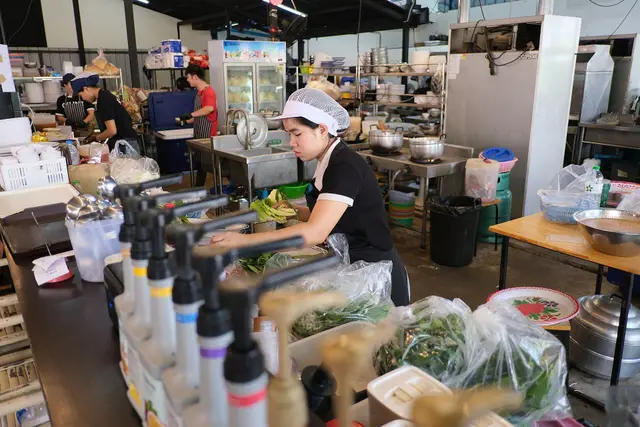
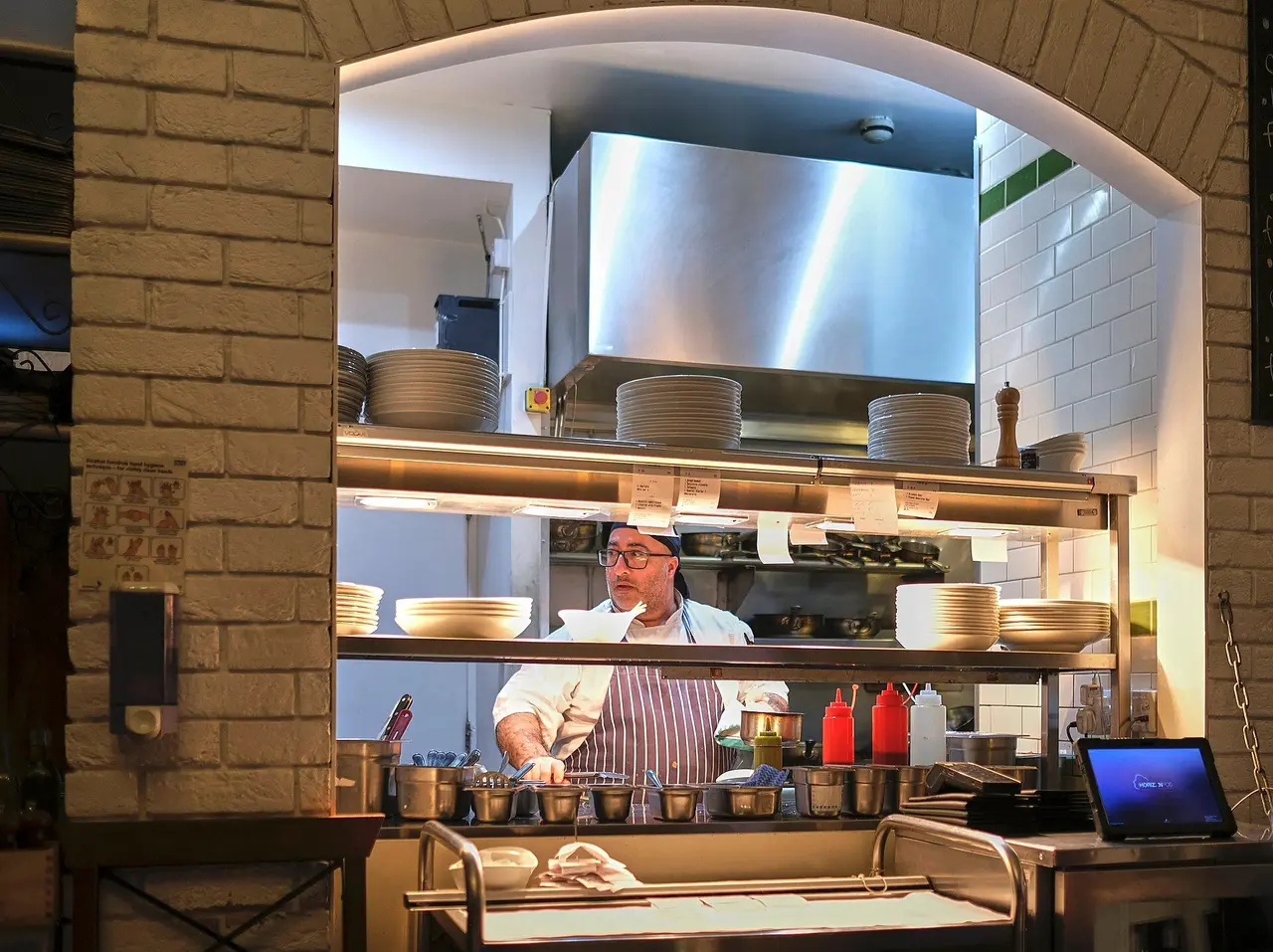
- Cooking: the hot stations (Figure 1).
- Plating and service: the pass, where the head chef checks each plate before it goes out.
The dirty flow takes its own route
Dirty dishes come from the dining room into the dishwash area through their own door or lane, and rubbish goes out by a different route from deliveries where the layout allows. Small kitchens without the space separate by time instead: deliveries and rubbish are handled outside service hours, then the route is cleaned.
Legal requirements in Vietnam
Laying out the preparation area on the one-way principle is a familiar part of Vietnam's food safety conditions for food service businesses. Premises usually also need food safety paperwork, and food handlers need food safety training and health checks as required. The exact requirements depend on the type and size of business and the current regulations, so check with the local food safety authority or your restaurant's management.
Storage temperatures: 0–5°C, -18°C and 60°C
Food poisoning bacteria grow fastest in the "danger zone", commonly given as about 5–60°C. Your job is to keep food outside that range, or move it through the range quickly.
Temperatures every commis must know
| Area or task | Target | How to check |
|---|---|---|
| Fridges, cold room | 0–5°C | Thermometer inside the unit, logged at the start and end of each shift |
| Freezer | -18°C or colder | Freezer thermometer; check for ice build-up and door seals |
| Cooking poultry, minced meat | Core of about 74°C (poultry) under common guidance | Probe thermometer in the thickest part |
| Hot holding before service (bain-marie) | 60°C or above | Probe thermometer, every 1 to 2 hours |
| Cooling cooked food | 57°C to 21°C within 2 hours, then to 5°C within the next 4 hours (reference) | Probe thermometer, time logged at each point |
| Reheating chilled food | Hot throughout, core about 74°C, reheat only once | Probe thermometer |
The cooking and cooling targets above are references from widely used international food safety guidance; your kitchen may use stricter procedures. Rare steak is a controlled exception; see how it is handled in how to pan-sear steak to the right doneness.
Loading the fridge: raw below, cooked above
- Top shelves: cooked dishes, ready-to-eat food, sauces, cakes.
- Middle shelves: washed vegetables, dairy, eggs.
- Bottom shelf: raw meat, fish and poultry, in rimmed trays so drips cannot reach other food.
- Everything in lidded containers (Figure 2); no open bowls of sauce, and no packing so tight that cold air cannot circulate.
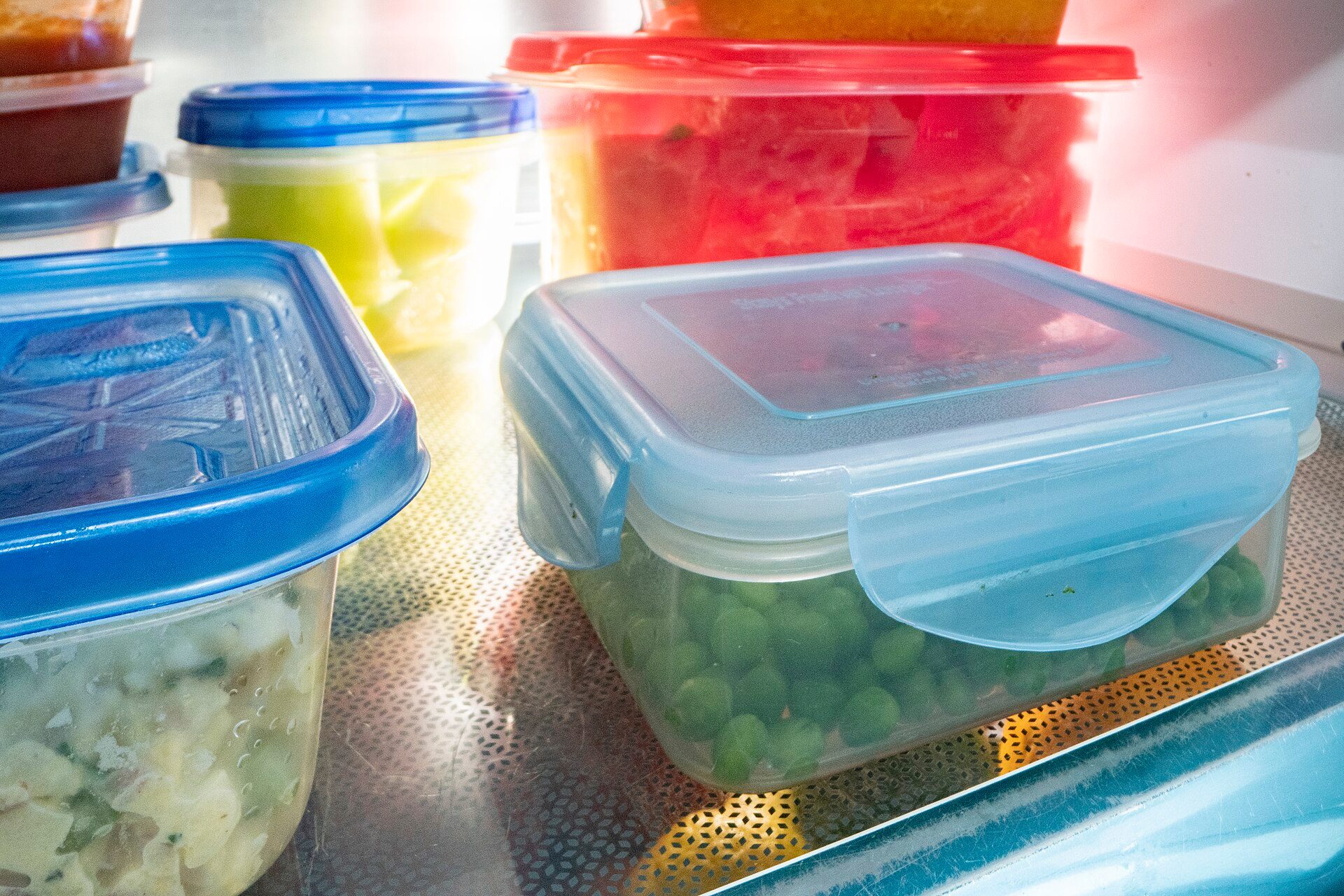
Photo: USDAgov / Wikimedia Commons, Public domain
Fast cooling: the biggest mistake in Western kitchens
Large pots of stock, demi-glace or soup left to cool naturally overnight are a classic cause of food poisoning: the centre of the pot sits in the danger zone for hours. The right method is to split it into shallow trays, set them in an ice bath, stir, take temperatures and log the times (see the worked example below).
FIFO, labelling and colour-coded boards
These three small habits decide whether a kitchen wastes stock, mixes things up and spreads contamination.
FIFO: first in, first out
FIFO means stock that arrived first is used first. When a delivery arrives, put new stock at the back or bottom and bring older stock to the front. For short-dated items, many kitchens also use FEFO (first expired, first out): the container with the nearest date goes first, even if it arrived later.
Container labels: 4 required details
- Name of the dish or product (for example "Bechamel sauce").
- Date and time prepared or opened.
- Use-by date according to the kitchen's rules.
- Name or initials of the person who made it.
An unlabelled container in the fridge is a container to throw away, because nobody can prove it is safe.
Colour-coded boards by food type
Many Western restaurants and hotels use the common board colour scheme below (Figure 3). Your kitchen may use a different code; what matters is that the whole team follows the same one.
| Board colour | Used for | Western kitchen examples |
|---|---|---|
| Red | Raw red meat | Trimming beef tenderloin, cutting lamb ribs |
| Yellow | Raw poultry | Breaking down chicken, trimming duck breast |
| Blue | Raw fish and seafood | Filleting salmon, cleaning prawns |
| Green | Washed fruit and vegetables, salad | Cutting lettuce, slicing tomatoes |
| Brown | Unwashed root vegetables | Peeling potatoes and carrots |
| White | Bread, dairy, cheese, cooked food | Slicing bread and cheese |
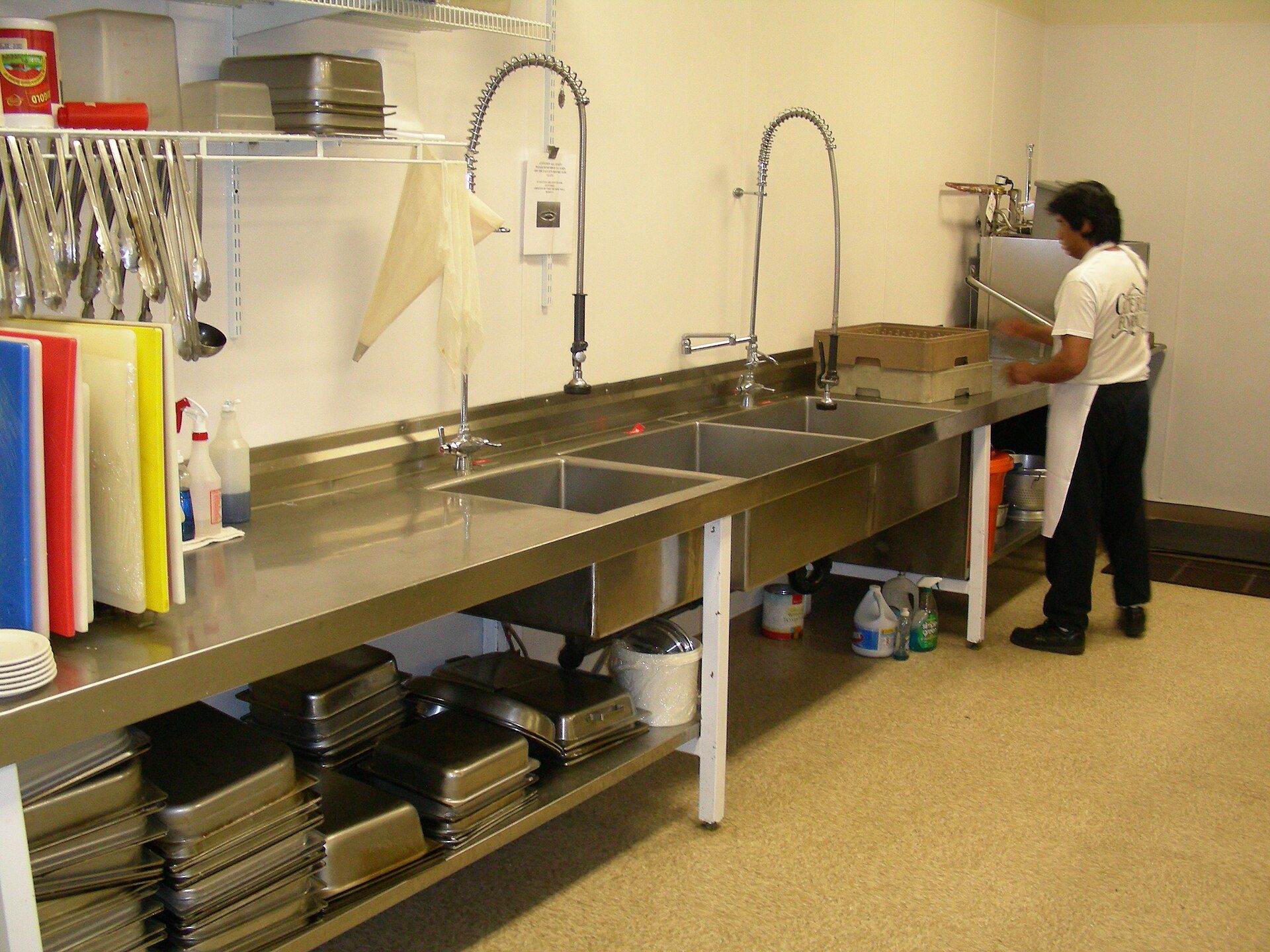
Photo: Tracy Hunter / Wikimedia Commons, CC BY 2.0
Handwashing and personal hygiene during the shift
Hands are the tool that touches food most in a kitchen. Washing at the right moments matters more than washing often at the wrong ones.
6 moments when you must wash your hands
- Before starting the shift, after changing into uniform.
- After using the toilet.
- After touching raw food and before touching cooked or ready-to-eat food.
- After handling rubbish, cleaning or chemicals.
- After touching your face, hair, phone or money.
- Before putting on new gloves.
How to wash hands properly
Wet your hands and rub with soap for at least 20 seconds: palms, backs, between fingers, fingertips, thumbs and wrists (Figure 4). Rinse under the tap, dry with a disposable paper towel, and use that towel to turn off a hand-operated tap. Professional kitchens have a dedicated handwash sink; never wash hands in the vegetable sink or the dish sink.

Photo: Shixart1985 / Wikimedia Commons, CC BY 2.0
Uniform and health
Clean chef's jacket, hat or hairnet, short unpolished nails, no rings or watches during prep. Anyone with diarrhoea, vomiting, fever or an open wound on the hands must tell the head chef before the shift; small cuts are covered with a waterproof dressing and a glove.
Safety warning: Western kitchens have sharp knives, ovens, hot oil, gas and cleaning chemicals. Carry knives point down, close to your body, and call "knife, behind" when passing behind a colleague; call "hot, behind" when carrying hot pots or trays. Never mix cleaning chemicals (for example chlorine bleach with acids), as toxic gas can form; use the dilution on the label and wear gloves. If a pan of oil catches fire, turn off the heat and cover it with a lid or a fire blanket; never throw water on it. For burns, cool under clean running water for 20 minutes; for large or deep burns, burns to the face or breathing difficulty, call emergency services (115 in Vietnam).
The brigade system: commis, chef de partie, sous chef
The kitchen brigade (brigade de cuisine) was formalised by Auguste Escoffier in the late 19th century. It divides the kitchen into stations and clear ranks, so each person is responsible for one part of the work and answers to one person.
Main positions
| Position | Main job | Reports to |
|---|---|---|
| Executive chef / Chef de cuisine (head chef) | Menu, food cost, staff, quality of the whole kitchen | Restaurant or hotel management |
| Sous chef | Runs the shift, checks the pass, stands in for the head chef | Head chef |
| Chef de partie (station chef) | Runs one station: sauces, fish, grill, cold kitchen, pastry | Sous chef |
| Demi chef de partie | Deputy station chef, covers the station when the chef de partie is off | Chef de partie |
| Commis (junior cook) | Prep, mise en place, supporting a station, learning | Chef de partie |
| Kitchen porter / steward | Washing equipment, rubbish, cleaning the kitchen | Sous chef or shift manager |
Stations in a classic Western kitchen
- Saucier: sauces and sauteed dishes; often the hardest station.
- Poissonnier: fish and seafood.
- Rotisseur, grillardin: roasts, grills, steaks.
- Entremetier: vegetables, soups, starches, eggs.
- Garde manger: cold kitchen, salads, cold starters, charcuterie.
- Patissier: pastry and desserts.
Small restaurants in Vietnam usually combine stations: one person on the hot line (sauces, grill, sauteing), one on cold starters and desserts. The French or English titles stay the same, so learn them to understand job ads.
What a commis does and says
A commis takes tasks from the station chef, does mise en place (prepping, weighing and setting everything in its place before service, Figure 5), keeps the station clean and reports shortages immediately. When given a task, answer "Yes, chef" to confirm you heard. Never change a recipe or portion size on your own.
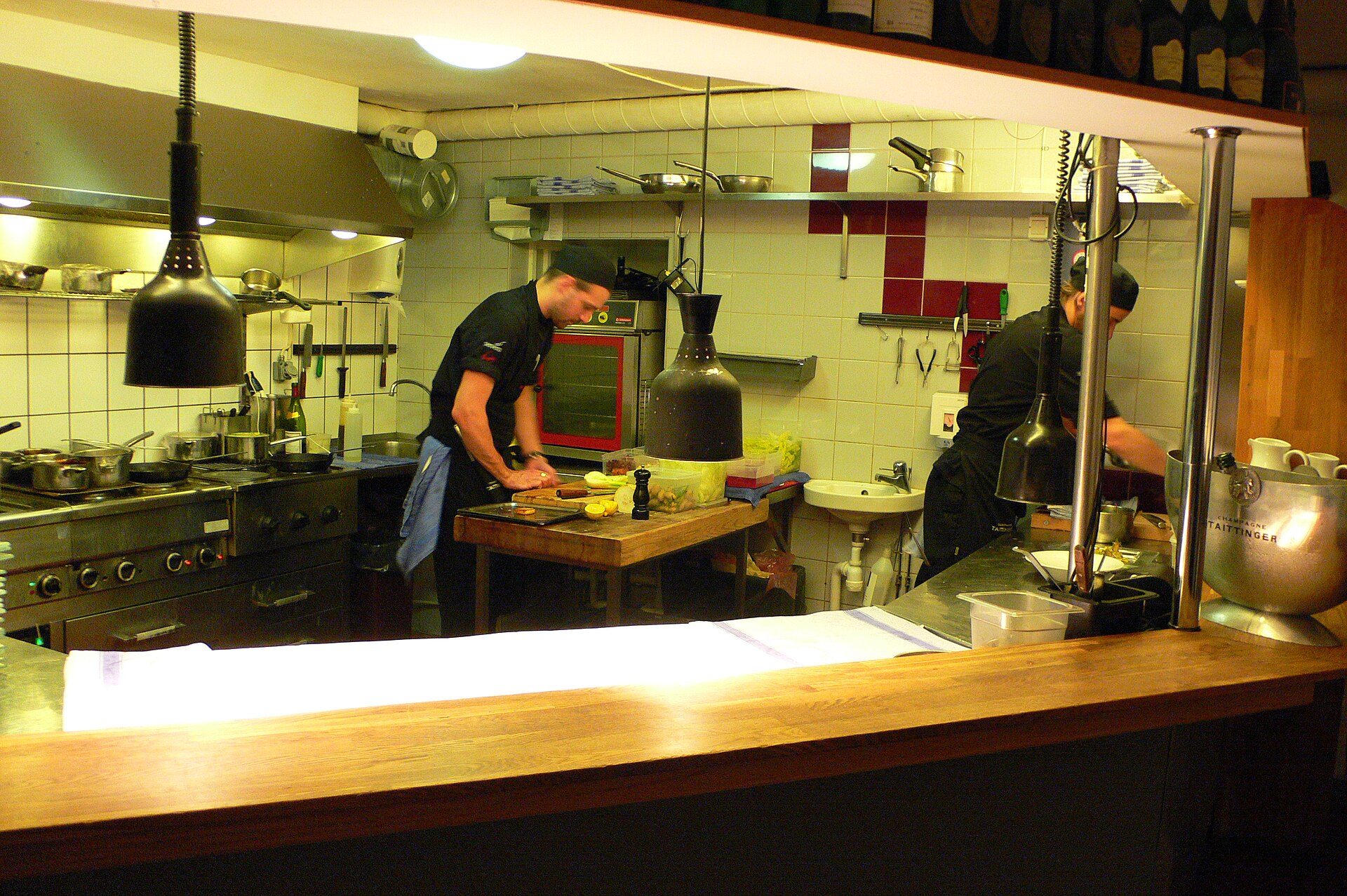
Photo: Heather Cowper from Bristol, UK / Wikimedia Commons, CC BY 2.0
Worked example: cooling 20 litres of chicken stock and cutting waste with FIFO
You are the afternoon commis in a 60-seat Western restaurant. At 14:00 a 20-litre pot of chicken stock has just finished, at about 95°C. The sous chef asks you to cool and store it.
Cooling to the time limits
- 14:00: strain the stock into 4 shallow stainless trays of 5 litres each (4 x 5 = 20 litres), set them in an ice bath and stir.
- 14:30: it reads 57°C. The 2-hour clock starts.
- 16:00: it reads 20°C, so it went below 21°C in 1.5 hours (pass, under 2 hours). Cover, label and move to the fridge.
- 19:00: it reads 5°C, 3 hours after 16:00 (pass, under 4 hours).
Check: from 57°C to 5°C took 1.5 + 3 = 4.5 hours, within the 6-hour total. Each reading goes in the cooling log with a signature.
The cost of not using FIFO
Last week, at the weekend stock check, the kitchen had to throw out expired stock because new deliveries were stacked in front of older items:
| Item discarded | Quantity x unit price (2026 reference) | Amount |
|---|---|---|
| Whipping cream, 1-litre cartons | 3 x 120,000 VND | 360,000 VND |
| Salmon fillet | 2 kg x 450,000 VND | 900,000 VND |
| Unsalted butter, 1 kg block | 1 x 250,000 VND | 250,000 VND |
| Total for one week | 1,510,000 VND | |
Check: 360,000 + 900,000 + 250,000 = 1,510,000 VND (about 60 USD). If it happens 4 weeks running, the restaurant loses 1,510,000 x 4 = 6,040,000 VND a month, close to a commis's monthly pay (around 6 to 9 million VND for reference, varies by region). FIFO, labelling and a daily stock check are the quickest way for a new commis to prove their value to the head chef.
Common mistakes of new commis and how to fix them
Taking a shortcut through the pass
Symptom: carrying a crate of muddy vegetables or a tray of raw meat across the pass to save time. Cause: not knowing the flow plan yet. Fix: use the correct route and ask your station chef on day one which route each type of goods takes.
Storing unlabelled containers
Symptom: a tub of sauce in the fridge that nobody can date. Fix: always carry a pen and label tape in your jacket pocket and label before putting the lid on.
Using the wrong board colour during a rush
Symptom: slicing salad tomatoes on the red board just used for meat. Fix: set out enough boards of each colour at your station during mise en place, and send dirty boards straight to the dishwash area.
Leaving a hot pot to cool before refrigerating
Symptom: a pot of soup left on the switched-off stove until the end of the shift. Fix: split into shallow trays, ice bath, measure and log as in the example above.
Frequently asked questions
What is a one-way kitchen, and can a small kitchen do it?
It is a layout where food moves one way from receiving to service and the dirty flow goes separately. Small kitchens can still achieve it by zoning within the same space and separating by time, for example handling deliveries and rubbish outside service hours.
What temperature should a restaurant fridge be?
Usually 0–5°C for fridges and cold rooms and -18°C or colder for freezers. Measure with a thermometer inside the unit and log it every shift.
What is FIFO in a kitchen?
First In, First Out: stock that arrived first is used first. New stock goes to the back, older stock comes forward, combined with date labels so you know which container to use first.
What is a commis, and how much do they earn?
A commis is the entry-level cook in the brigade, doing prep and supporting a station under the chef de partie. Reference pay in Vietnam is about 6 to 9 million VND a month (2026, varies by region and type of restaurant or hotel).
Why do kitchens use boards of different colours?
So that each type of raw food has its own board, stopping bacteria from raw meat, poultry or fish spreading to salad or cooked food. The colours let the whole team see it at a glance, even during a rush.
Practice exercises and self-assessment
- Draw a plan of the kitchen where you work, or your home kitchen, with arrows for the clean and dirty flows, and circle where they cross.
- Set up a fridge temperature log and fill it in morning and evening for 7 days.
- Cool 3 litres of stock or soup using shallow trays and an ice bath; log the times at 57°C, 21°C and 5°C.
- Write down the 6 brigade positions and the 6 classic stations with their main jobs, without looking.
Self-assessment criteria
- Pass: your plan identifies at least one point where flows cross and proposes a fix.
- Pass: your cooling log shows below 21°C within 2 hours and down to 5°C within 6 hours in total.
- Pass: every container in the fridge carries all 4 label details; you choose the right board colour for 6 food types.
- Not yet: raw food stored above cooked food, a large pot left to cool on its own, or hands washed in the vegetable sink.
With kitchen discipline in place, move on to the next step of the roadmap: Knife skills & classic vegetable cuts, where you learn to hold, sharpen and hone a chef's knife, cut brunoise, julienne and chiffonade, and fillet fish and break down chicken on the right colour board.
Keep learning Western cooking: after hygiene and kitchen organisation come knife skills, stocks and the five mother sauces, heat techniques, pasta and risotto, plating and a 3-course set menu. See the 8-step Western cuisine cook roadmap.