A good Vietnamese feast menu covers all 5 dish groups (starters, mains, soup, sticky rice or rice, dessert), follows the customs of the host's home region, suits the occasion (a joyful wedding, a solemn memorial feast, a relaxed housewarming) and fits the budget per table the host has in mind. Beginners often copy one "standard" menu from the internet and use it for every event, and end up with a Northern memorial feast without the offering chicken, a Southern wedding without hot pot, or a quote the host cannot afford. This lesson is step 2 of the banquet and catering cook roadmap: you will learn how a feast table is structured, the signature dishes of the North, Centre and South for each occasion, and how to swap dishes so the table still looks complete when the budget changes.
By the end of this lesson, you will be able to:
- Build a feast menu that covers all 5 dish groups and explain the role of each group.
- Tell Northern, Central and Southern feasts apart by people per table, serving style and signature dishes.
- Propose different menus for weddings, memorial feasts and housewarmings, including offering dishes when the host needs them.
- Prepare 3 menu options at 3 budget levels per table, with a cost table whose figures add up.
- Ask the host about taboos, vegetarian guests and allergies before confirming the menu.
Learning feast catering properly? Regional feast menus are step 2 of the roadmap, after large-batch food safety and before quantities and shopping for 10–100 tables. See the 8-step banquet and catering cook roadmap to learn in the right order.
The 5 dish groups of a feast table
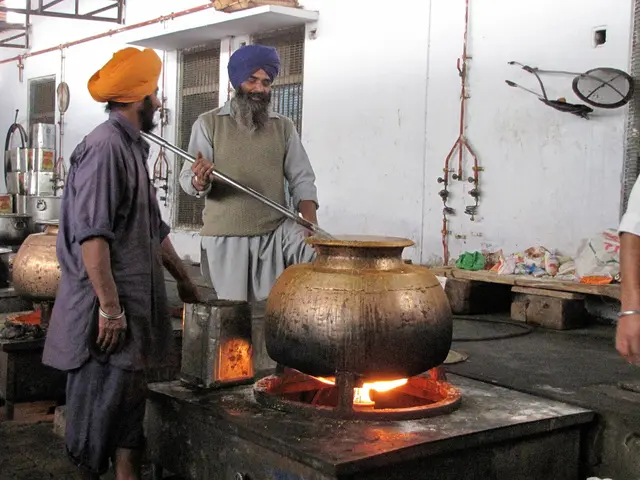
Whatever the region, a complete feast follows the same frame: a light opener, savoury mains as the backbone, a soup, a filling starch, and something sweet to finish. Once you know this frame, you can swap dishes by region and by budget without the table looking short (see Figure 1).
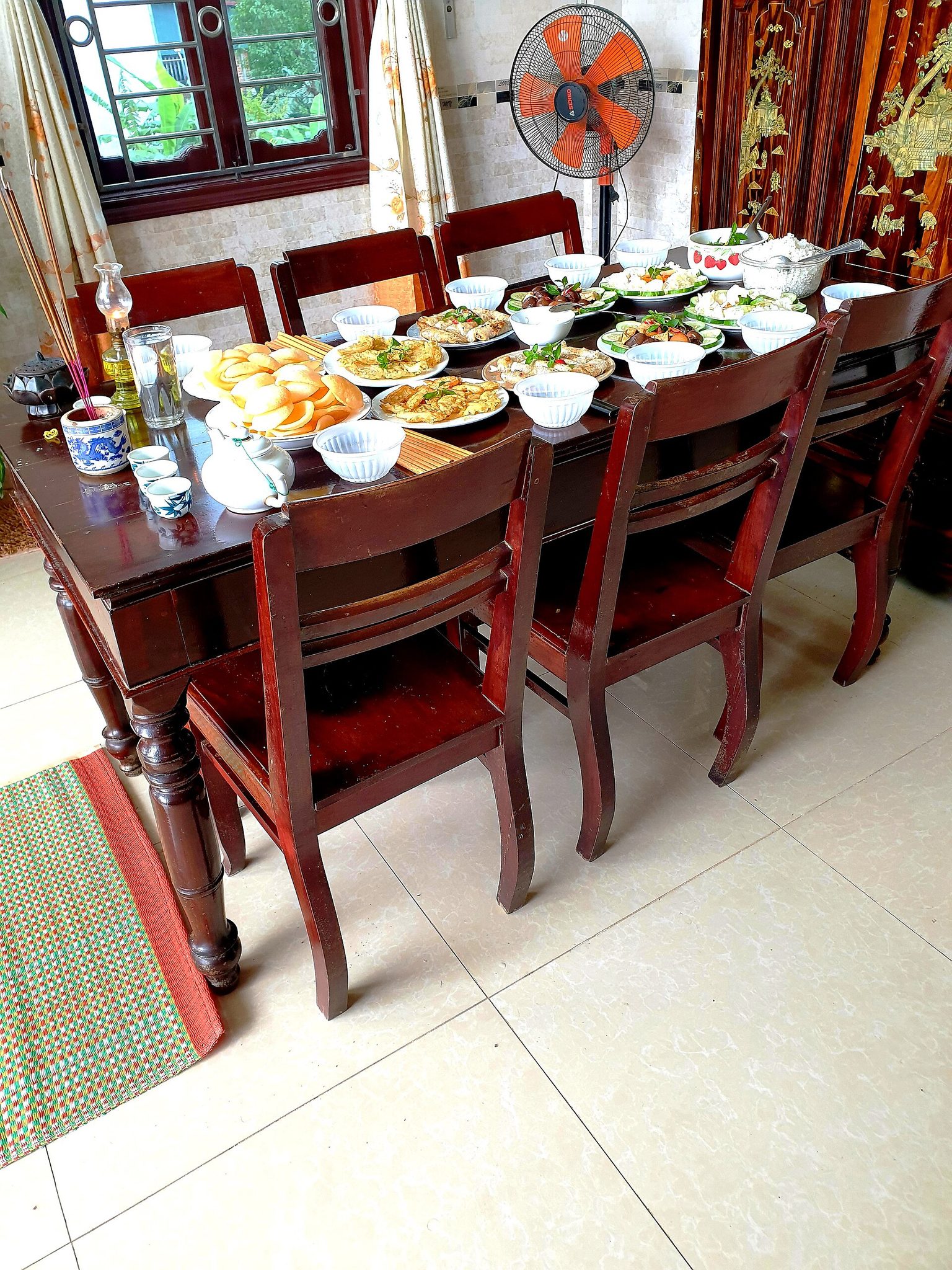
Photo: Phương Huy / Wikimedia Commons, CC0
The role of each dish group
- Starters: "nom" or "goi" salads, fried spring rolls, soup. Light dishes served first while guests arrive.
- Mains: chicken, pork roll ("gio") and pork patties ("cha"), beef, roast pork, prawns, fish. They decide whether a table looks generous or plain and take most of the budget.
- Soup or hot pot: bamboo shoot soup, fish maw soup, glass noodle soup, hot pot. They balance the dry and fried dishes.
- Sticky rice or rice: red gac fruit sticky rice ("xoi gac"), plain sticky rice, steamed rice, "banh hoi" rice vermicelli, bread on the side. The filling part.
- Dessert: fruit, sweet soups ("che"), agar jelly. A light finish after rich food.
How many dishes is right
A Northern table for 6 commonly has 8–12 dishes including sticky rice, rice and dessert; a Southern wedding table for 10 usually gets 5–7 courses. More dishes are not always better: the more dishes, the earlier the kitchen must start cooking and the longer the food waits. A good menu is one your crew can cook on time and serve while still hot.
Balancing a table
- No more than 2 fried dishes per table: less greasy, and less pressure on the frying station.
- At least 1 vegetable dish and 1 soup.
- Vary meats and methods: boiled chicken, roast pork, stir-fried beef, steamed prawns, without repeats.
- Vary colours: golden (chicken, spring rolls), red (gac sticky rice, prawns), white (pork roll), green (vegetables).
Northern feasts: weddings, memorials, housewarmings
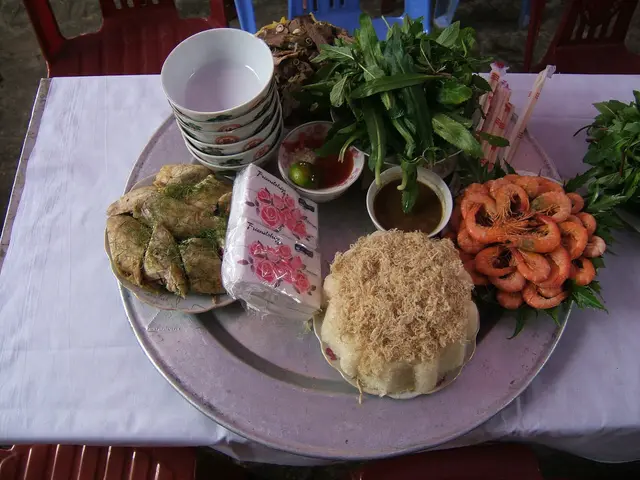
Northern feasts are served by the tray ("mam"), usually 6 people sitting on mats or at a table, with every dish served at once. Older people describe the traditional feast as "four bowls, six plates": four bowls of soup (many villages name fish maw, bamboo shoot, glass noodle and meatball soup) and six plates of savoury dishes such as chicken, pork roll, patties, spring rolls, sticky rice and salad. Menus are shorter today, but boiled chicken, pork roll, sticky rice and a bowl of soup are still close to essential (see the boiled chicken in Figure 2).
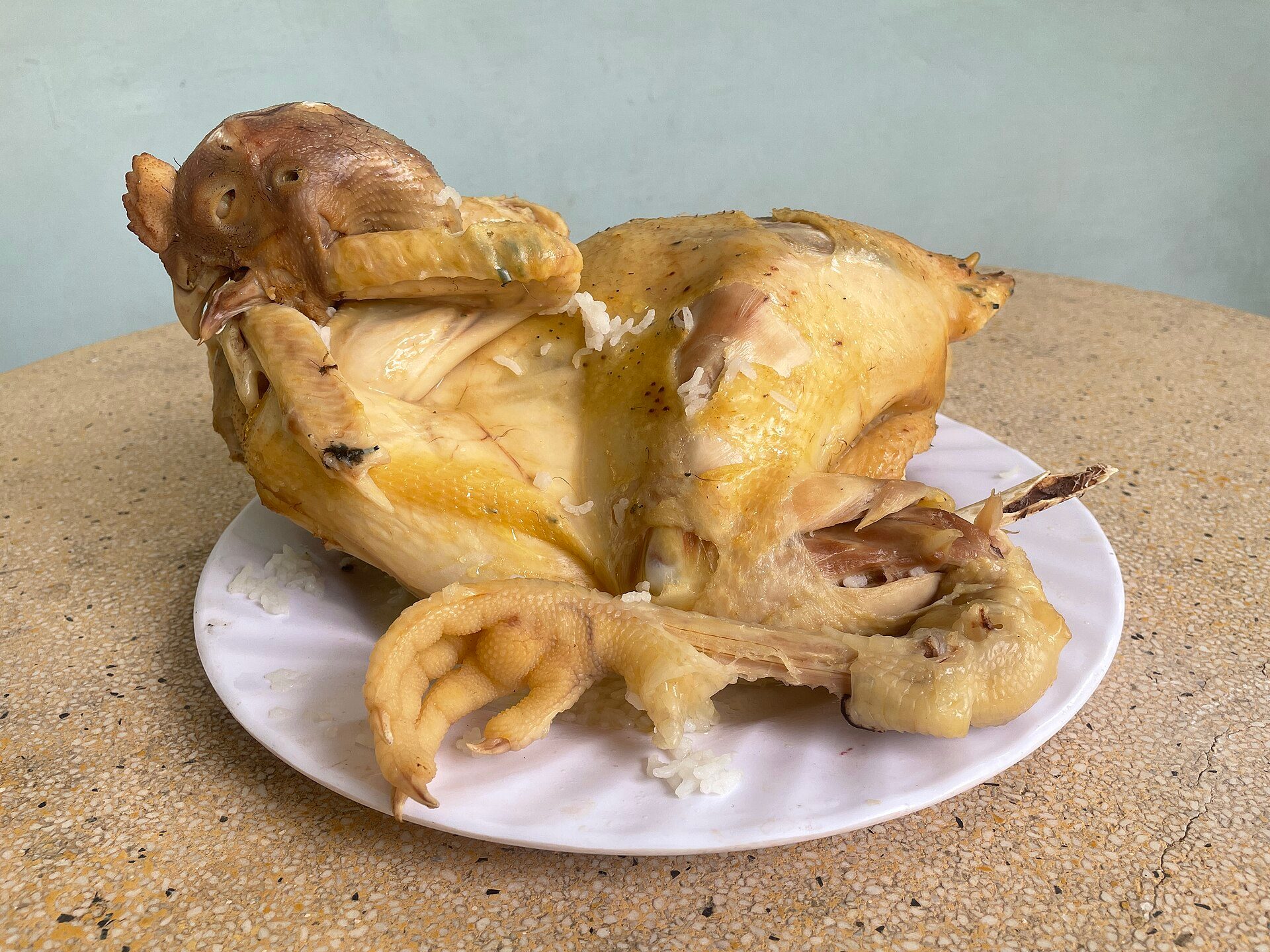
Photo: Baoothersks / Wikimedia Commons, CC BY-SA 4.0
Northern wedding feasts
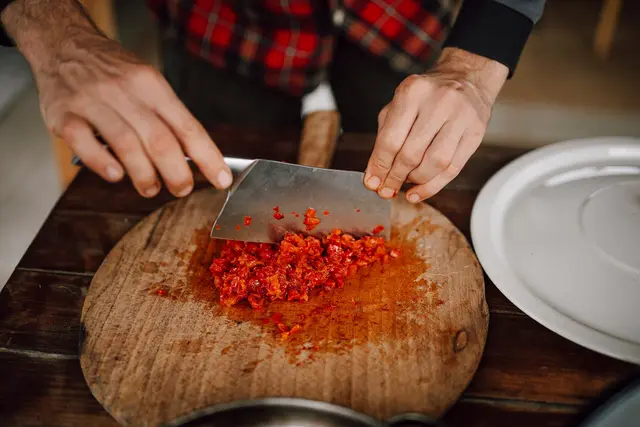
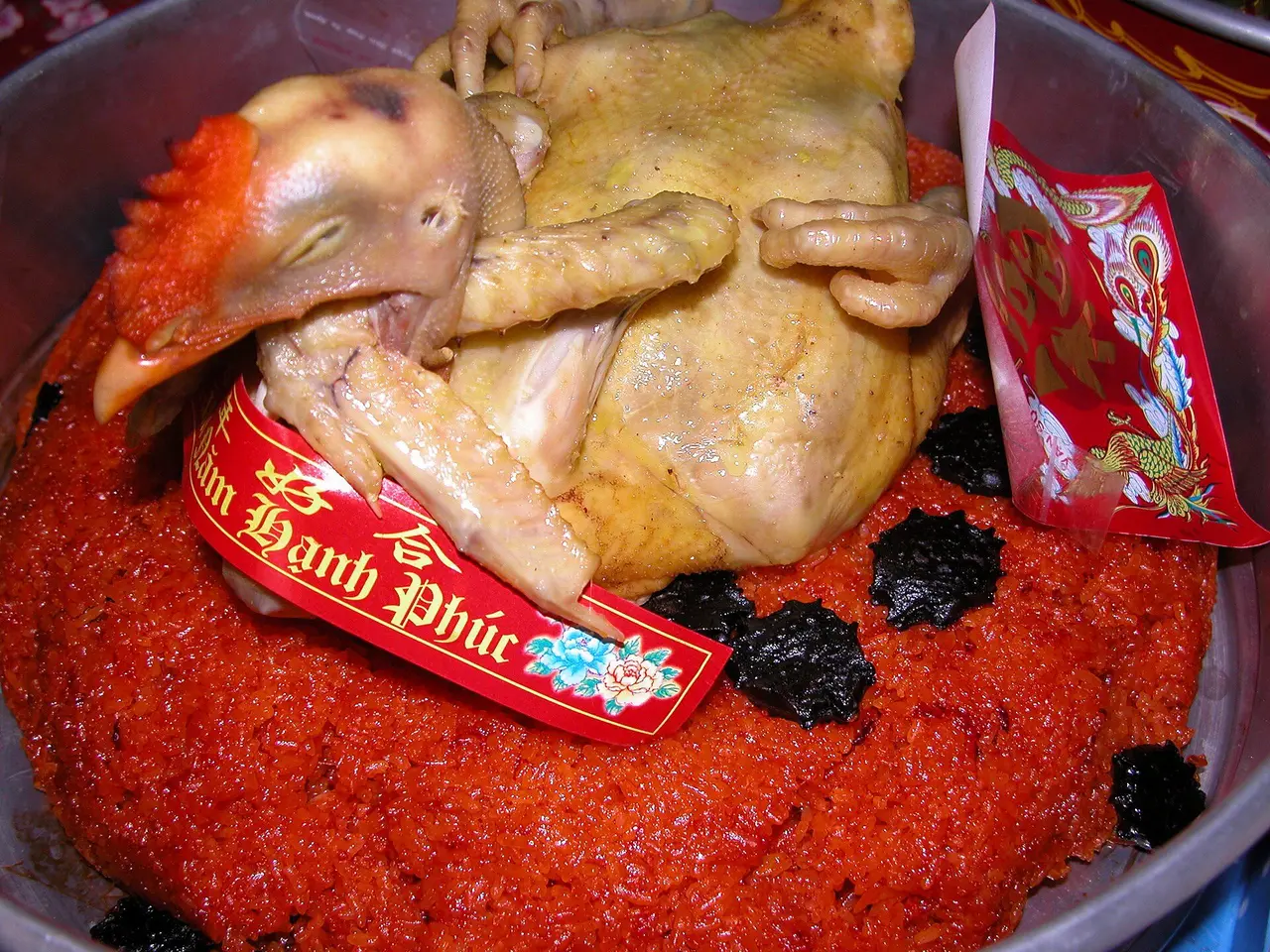
Wedding feasts favour red and cheerful dishes. Red gac sticky rice is almost a wedding symbol in many areas (see Figure 3). A common menu: salad, fried spring rolls, boiled chicken with lime leaves, pork roll, stir-fried beef or beef with lime, fried or steamed prawns, fish maw soup, gac sticky rice, stir-fried greens and fruit. City hosts often add 1–2 "premium" dishes such as steamed fish; rural hosts care most that the tray looks full.
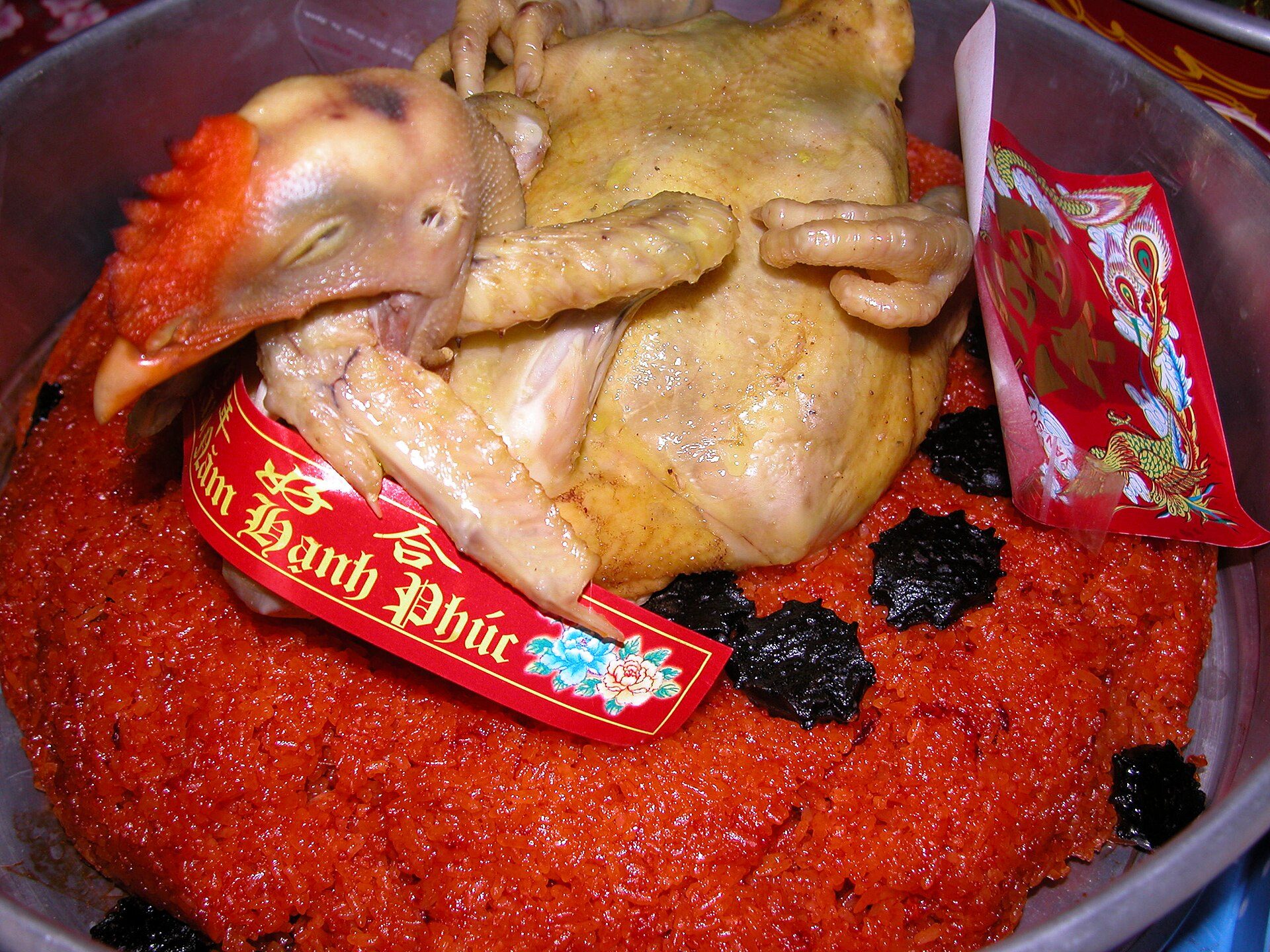
Photo: Nguyễn Thanh Quang / Wikimedia Commons, Public domain
Northern memorial feasts
A memorial feast ("gio") has two parts: the offering tray placed on the ancestral altar, and the feast for relatives. The offering tray usually has a whole boiled chicken, sticky rice, pork roll, soup, spring rolls or dishes the family always makes; many families keep a dish the deceased loved. The guest feast is simpler than a wedding, often with bamboo shoot soup and plain or mung bean sticky rice. Ask exactly what goes on the offering tray and when the rite starts, so the offering dishes come out first.
Northern housewarmings
A housewarming often starts with a moving-in offering in the morning (boiled chicken, sticky rice, fruit, depending on the family), then a party for friends. Guests are younger and drink beer, so the menu leans to bar snacks and hot dishes: fried fermented pork rolls, salt-roasted chicken, beef dipped in vinegar broth, hot pot, salad, with rice or noodles.
Central feasts: bold flavours, many small dishes
Central feasts differ by province, but share some traits: bolder, spicier and saltier than the North, more fish sauce and fermented sauces, many small dishes. Many places still seat 6–8 per tray; cities have switched to round tables like the South. When a host comes from the Centre, ask which province, because the must-have dishes in Hue differ from Quang Nam or Binh Dinh.
Common dishes in Central feasts
- Starters: fermented pork ("nem chua"), pork patties, salads (lotus stem salad, shredded chicken salad), Hue-style fried rolls ("ram").
- Mains: boiled or shredded chicken, boiled pork wrapped in rice paper with herbs, braised fish, caramelised prawns.
- Starch: sticky rice, rice, and in many South Central provinces "banh hoi" rice vermicelli with roast pork (see Figure 4).
- Soup and dessert: sour soup, bamboo shoot soup, bean sweet soups, tapioca dumpling sweet soup, fruit.
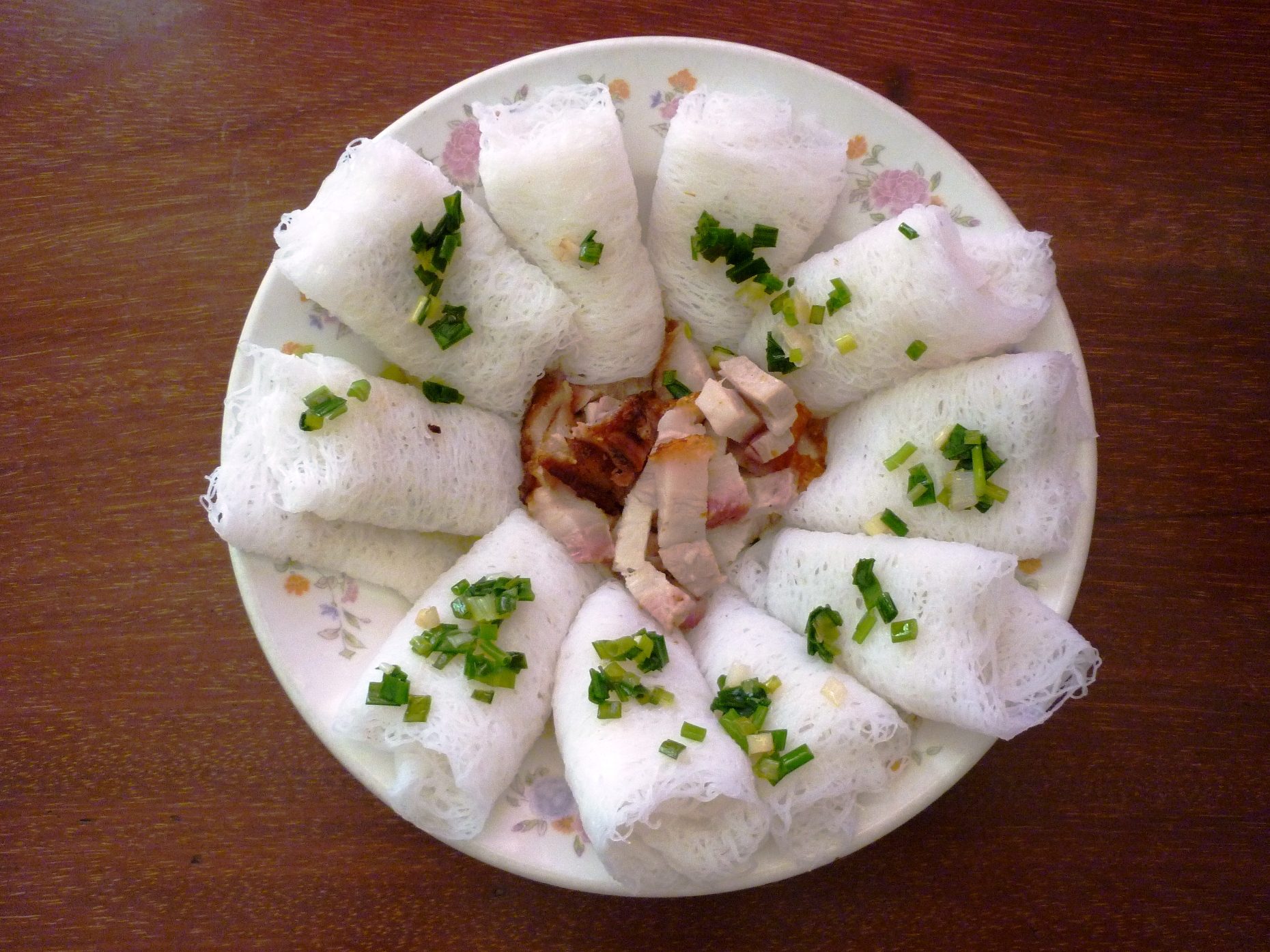
Photo: Ngô Trung / Wikimedia Commons, CC BY-SA 3.0
Central weddings and memorial feasts
In cities, Central weddings often serve course by course like the South, ending with hot pot. In the countryside, memorial feasts can have many small dishes and offering trays with a dozen plates: budget extra hands for plating, and choose dishes that hold well such as patties and wrapped boiled pork rather than fried dishes that must be eaten at once. Cook to a moderate level of salt and heat and put chillies and fermented anchovy sauce on the table for guests to add.
Southern feasts: round tables of 10, course by course
Southern parties usually seat 10 at a round table, with courses served one after another from starters to hot pot. The kitchen must cook to a rhythm, with someone tracking courses, instead of serving everything at once as in the North. Roast pork is very common at Southern ceremonies and parties (see Figure 5).
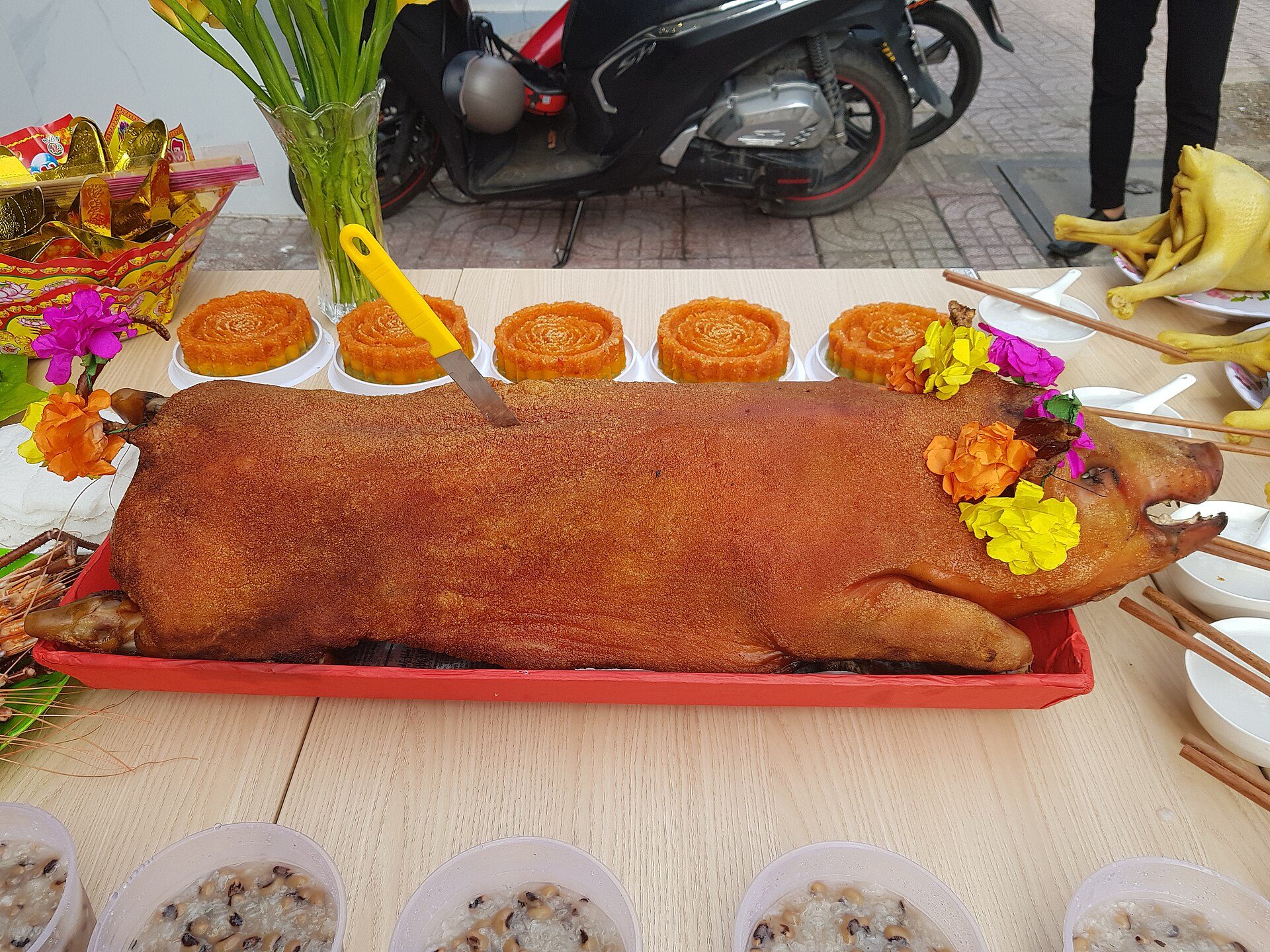
Photo: Hongtrakemsua7 / Wikimedia Commons, CC BY-SA 4.0
A typical Southern wedding menu
- Starters: lotus stem salad with prawn and pork or chicken salad, fried spring rolls ("cha gio"), crab soup.
- Main 1: roast pork or roast suckling pig with banh hoi or steamed buns.
- Main 2: prawns steamed in coconut water or prawns in tamarind sauce.
- Main 3: steamed chicken with lime leaves or roast chicken, or beef stew in red wine with bread.
- Hot pot: Thai-style seafood hot pot, fish hot pot or chicken hot pot with local herbs.
- Dessert: agar jelly, sweet soup, fruit.
Southern memorial feasts and housewarmings
Southern memorial feasts taste like home cooking: pork braised with eggs, stuffed bitter melon soup, salads, fried spring rolls, chicken curry with bread, clay pot fish, sticky rice and sweet soup. Many families cook exactly what the grandparents liked as the offering. Housewarmings are more relaxed: hot pot, grilled food, salads, beef in betel leaves, guests eating in groups. For hot pot at the end, agree in advance on mini gas or spirit burners for each table.
Menus by occasion: weddings, memorials, housewarmings
In the same region, each occasion needs a different spirit. The table below sums up what must be there and what to ask.
| Occasion | Character | Near-essential dishes | What to ask |
|---|---|---|---|
| Wedding | Joyful, generous, many guests who do not know each other | Chicken, gac sticky rice (North), roast pork and hot pot (South), 1–2 premium dishes such as prawns or fish | Guests from both families, time of the bride's procession, engagement offering trays if any |
| Memorial feast | Solemn, warm, mostly relatives | Offering tray (whole chicken, sticky rice, pork roll, soup in the North), dishes the deceased loved | Time of the rite, number of offering trays, vegetarian guests, first anniversary or regular |
| Housewarming | Relaxed, younger guests, beer | Moving-in offering (if the host holds one), bar snacks, hot pot | Time of the offering, whether the new house has a kitchen, number of guest waves |
First and regular memorial anniversaries
The first memorial anniversary after a death is usually larger and more solemn than later ones; some families serve a vegetarian or half-vegetarian feast. Do not guess; ask the host.
Advising a menu by budget per table
Hosts often ask "how much per table?". Do not answer with a number straight away: ask what budget they have in mind, then offer 2–3 options on the same 5-group frame, differing in the mains and how premium the ingredients are. Prices vary by region and season (wedding season and the weeks before Tet are usually more expensive), so every figure in this section is an illustrative example, not a price list.
Splitting the money by dish group
A common split when planning: mains take about half of the food money, starters about 15–20%, soup, sticky rice and rice, and vegetables about 5–10% each, dessert about 5–7%, and the rest goes to seasoning, dipping sauces and contingency. This split shows you where to cut when the host wants to spend less, while the table still looks complete.
Swapping dishes and keeping the table complete
- Lower cost: pork instead of beef, small prawns instead of large ones, one starter fewer, in-season fruit or sweet soup instead of out-of-season fruit.
- Upgrade: add prawns or steamed fish, fish maw soup instead of bamboo shoot soup, add patties.
- Keep: offering dishes and the regional signature dishes; cutting them makes the host lose face with relatives.
Worked example: a 15-table Northern memorial feast, 3 options
Situation: Mrs Lan in Nam Dinh is holding a memorial feast for her late husband (a regular anniversary, not the first). She invites 90 guests seated 6 per tray, so 15 guest trays plus 1 offering tray, 16 trays in total. She says "about 1.2 million VND of food per tray" (about US$45; a made-up figure for practising the method, not a market price). You prepare 3 options on the same 5-group frame.
Food cost per tray (illustrative, thousand VND)
| Group | Option A (1,000) | Option B (1,200) | Option C (1,500) |
|---|---|---|---|
| Starters | Spring rolls 120 | Salad 80 + spring rolls 120 = 200 | Salad 80 + spring rolls 120 = 200 |
| Mains | Boiled chicken 260 + pork roll 130 + stir-fried pork 100 = 490 | Boiled chicken 260 + pork roll 130 + beef with celery 190 = 580 | Boiled chicken 260 + pork roll 130 + beef with celery 190 + fried prawns 180 + patties 60 = 820 |
| Soup | Bamboo shoot soup 100 | Bamboo shoot soup 100 | Mixed fish maw soup 160 |
| Sticky rice, rice | 100 | 100 | 100 |
| Greens, pickles, dipping sauce | 70 | 70 | 70 |
| Dessert | Sweet soup or in-season fruit 50 | Fruit 80 | Fruit 80 |
| Seasoning, contingency | 70 | 70 | 70 |
| Total per tray | 1,000 | 1,200 | 1,500 |
Checking the sums
- Option A: 120 + 490 + 100 + 100 + 70 + 50 + 70 = 1,000 thousand VND.
- Option B: 200 + 580 + 100 + 100 + 70 + 80 + 70 = 1,200 thousand VND.
- Option C: 200 + 820 + 160 + 100 + 70 + 80 + 70 = 1,500 thousand VND.
- Option B for 16 trays (15 guest trays + 1 offering tray): 16 × 1,200 = 19,200 thousand VND, i.e. 19.2 million VND of food.
Reading the table to advise the host
In option B the mains take 580 of 1,200, about 48%, matching the "about half" rule. From B down to A you drop the salad (minus 80), replace beef with pork (minus 90) and replace fruit with sweet soup or in-season fruit (minus 30): 200 less in total, exactly 1,200 − 1,000. From B up to C you add fried prawns (180), add patties (60) and upgrade bamboo shoot soup to fish maw soup (plus 60): 300 more, exactly 1,500 − 1,200. Boiled chicken, pork roll and sticky rice stay in all three options because they are the offering dishes and the signature of a Northern memorial feast.
Confirming with the host
Send Mrs Lan the 3 options on Zalo, listing dish names, number of trays, offering dishes, the time of the rite and the time the feast starts. Only after she chooses and confirms by message do you move on to quantities and shopping; the written menu avoids "I thought there would be prawns".
Taboos, vegetarians and allergies: questions you must ask
A beautiful menu still fails if it breaks a family taboo or makes a guest ill with an allergy. Every family and region has its own customs, so ask from a list instead of guessing.
Questions before confirming the menu
- Where is the family from, and which region are most guests from?
- Is there an offering tray? How many, which dishes, and at what time?
- Is there any dish the family avoids for this occasion?
- Does anyone eat vegetarian (always, or on the 1st and 15th of the lunar month) and need a separate tray?
- Do any guests follow a religion that forbids pork or other foods?
- Is anyone allergic to seafood, peanuts, eggs or milk? Are there young children or elderly guests who need soft food?
A vegetarian tray at a meat feast
A vegetarian tray must be cooked with separate pots, pans and boards, with no fish sauce or lard. If your kitchen lacks the equipment, say so honestly so the host can order vegetarian dishes from a specialist.
Food allergies are not a small matter
Prawns, crab, squid, peanuts and eggs are common allergens. For guests who have reported an allergy, prepare a separate portion and mark it clearly when serving. Cooks do not diagnose allergies: if a guest has trouble breathing, swollen lips or tongue, a rash all over or feels faint, call 115 (Vietnam's emergency number) or take them to the nearest medical facility immediately.
Food safety when choosing feast dishes
The danger zone, the 2-hour rule and food sample retention were covered in step 1 (see Food safety for feast catering: prevent mass poisoning, 24h samples). At the menu stage, safety starts with which dishes you accept and which you decline.
⚠ Safety warning: for large feasts, avoid or decline raw, rare and highly perishable dishes such as raw blood pudding ("tiet canh"), raw fish salad, home-fermented pork of unknown origin and homemade raw-egg mayonnaise. Vietnam's health sector has repeatedly advised against eating raw blood pudding because of the risk of serious infection. Mix salads close to serving time and keep them cool; eat cooked dishes within 2 hours or keep them hot. If several guests get stomach pain, vomiting or diarrhoea after the feast, take them to a doctor, call 115 if it is serious and keep food samples.
High-risk dishes that need tight control
- Salads with boiled prawns and pork: cook through, cool quickly, mix close to serving time.
- Rare beef with lime, steamed seafood: easy to cook unevenly in large batches; consider fully cooked alternatives.
- Bought-in items (patties, pork rolls, cakes, fermented pork): buy only from traceable sources and check use-by dates.
Common mistakes when planning a feast menu
Using one template menu for every region
Sign: Southern guests complain there is no hot pot, Northern guests ask where the chicken is. Cause: not asking where the host and guests come from. Fix: always ask the region first, keep its signature dishes, then add free choices.
Cutting offering dishes to fit the budget
Sign: the host is upset because the offering tray lacks chicken or sticky rice. Cause: cutting the most expensive dish without asking what it means. Fix: keep offering dishes, cut a starter or change the meat in a main, as in the worked example.
Frequently asked questions
What dishes are on a Northern Vietnamese wedding feast tray?
Usually salad, fried spring rolls, boiled chicken with lime leaves, pork roll, a beef or prawn dish, fish maw or bamboo shoot soup, gac sticky rice, stir-fried greens, rice and fruit: about 8–12 dishes for a tray of 6. Exact dishes depend on the village and budget.
How can a memorial feast menu be simple but still proper?
Keep the offering dishes (whole boiled chicken, sticky rice, pork roll and soup in the North; the grandparents' favourite dishes in the South), add 1 starter, 1–2 savoury dishes, 1 vegetable dish and fruit. Cut side dishes, never offering dishes.
What should be served at a housewarming party?
If there is a moving-in offering, prepare the tray as the host asks. The party itself should be easy snacks and hot dishes: spring rolls, roasted chicken, beef dipped in vinegar broth or beef in betel leaves, hot pot, salad, with rice or noodles.
How do Southern feasts differ from Northern ones?
The South usually seats 10 at round tables, serves course by course, ends with hot pot and cooks sweeter; the North seats 6 per tray, serves everything at once and always has sticky rice, chicken and pork roll; the Centre cooks bolder, spicier and saltier.
Practice and self-assessment
- Write a Northern wedding menu for trays of 6 and a Southern wedding menu for tables of 10, each covering all 5 dish groups.
- Interview an older relative about your family's memorial offering tray and note which dishes are required and why.
- With your own made-up budget, build a 3-option table A, B, C like the example, with the sums checked.
- Turn the 6 questions on taboos, vegetarians and allergies into a Zalo message template for hosts.
Self-assessment criteria
- Pass: every menu covers 5 dish groups, has no more than 2 fried dishes, and includes a vegetable dish and a soup.
- Pass: every column in the 3-option table adds up, and offering and regional signature dishes stay in all three.
- Not yet: raw or rare dishes for a large feast, forgetting to ask about vegetarians or allergies, or sums that do not match.
Once the menu is agreed with the host, move on to the next step of the roadmap: Quantities & shopping for 10–100 tables, where the menu becomes grams per serving, shopping lists and a buying schedule. Read How to calculate feast ingredients: 6-person tray, 20-tray shopping to continue.
Keep learning feast catering: after regional menus come quantities for 10–100 tables, big-pot cooking, field kitchens, hot holding, synchronized service and per-table quotes. See the 8-step banquet and catering cook roadmap.