Staying safe when spray painting cars means doing three things at once: keeping solvent vapour and isocyanate hardener out of your lungs with a respirator fitted with activated-carbon cartridges (or a supplied-air mask when the paint maker requires it), keeping sanding dust down with dust-extracting sanders and a particle mask, and keeping flames, sparks and static away from the mixing and spraying areas. New apprentices often think a cloth mask is enough, but solvent vapour passes straight through fabric, and isocyanates can cause occupational asthma that lasts a lifetime. This is the first lesson of the auto body and paint roadmap: after reading it you will know what protection each job in the shop needs, how to check your respirator before a shift, and how to keep the paint store from becoming a fire hazard.
By the end of this lesson, you will be able to:
- Name the three hazard groups in a body and paint shop (chemical vapour, dust, fire) and where each one comes from.
- Choose the right protective equipment for 6 jobs: grinding, sanding, mixing paint, spraying, cleaning the gun and polishing.
- Put on a cartridge respirator, run a negative and positive pressure seal check, and log cartridge hours so you change them on time.
- Organise the paint store, deal with solvent-soaked rags and earth equipment to reduce the risk of fire.
- Work through the start-of-shift and end-of-shift safety checklist in about 10 minutes.
Starting out as an auto body and paint technician? Paint chemical, dust and fire safety is step 1 of the 8-step roadmap, before dent repair, body filler, colour matching and spraying. See the 8-step auto body and paint technician roadmap to learn in the right order.
The three hazard groups in a body and paint shop
A body shop looks like any other garage, but the air always carries things you cannot see. Splitting the hazards into three groups helps you remember what to wear and when.
Chemical vapour: solvents and isocyanates
Primers, basecoats, clearcoats and thinners all contain evaporating solvents. 2K (two-component) paints use a hardener containing isocyanates, chemicals that can irritate the eyes, nose and lungs and can "sensitise" the body. Most vapour is released when mixing, when spraying and when cleaning the gun.
Fine dust: filler, old paint, metal
Sanding body filler, primer and old paint produces very fine dust that hangs in the air for a long time. Grinding metal throws iron dust and sparks. Old paint on very old cars may contain heavy metals, so sanding dust is never "ordinary dust".
Fire, explosion and static
Solvent vapour is heavier than air, settles near the floor and collects in closed corners. A spark from a grinder, a light switch, a cigarette or static discharge is enough to ignite it. The paint store, the dirty thinner drum and solvent-soaked rags are the three most flammable spots in a shop.
| Hazard group | Comes from | Main harm | How to control it |
|---|---|---|---|
| Solvent vapour | Mixing, spraying, gun cleaning | Dizziness, headaches, liver and kidney damage with long exposure | Ventilated booth, carbon-cartridge respirator, lids on tins |
| Isocyanates (2K paint) | Hardener, spray mist | Respiratory irritation, occupational asthma, skin allergy | Spray in a booth, respirator as the paint maker advises, nitrile gloves, hooded coverall |
| Fine dust | Sanding filler and old paint, grinding | Lung and eye irritation | Dust-extracting sanders, wet sanding, particle mask, goggles |
| Fire and explosion | Solvents, paint rags, sparks, static | Shop fire, burns | Separate paint store, no flames, earthing, lidded metal rag bin |
Isocyanates and solvents: why 2K paint is more dangerous than you think
Most body shops in Vietnam use 2K primer and clearcoat because they are hard, glossy and durable. The price is the hardener: the smallest tin in the mixing kit, but the most dangerous.
Three routes into the body
- Breathing in: the main route. Spray mist contains tiny droplets of paint that travel deep into the lungs.
- Skin: solvents dry and crack the skin and help chemicals soak in. Washing your hands in thinner puts even more solvent into your skin.
- Eyes: vapour and splashes sting, redden and can damage the cornea.
Sensitisation: once it happens, there is no going back
With isocyanates, many people exposed for a long time without proper protection become sensitised: from then on even a tiny amount can trigger breathlessness, chest tightness and asthma-like coughing. Many painters have had to leave the trade because of it. There is no way to "get used to" isocyanates; the more you are exposed, the more likely it is to happen.
Read the label and the safety data sheet
Every tin of paint, hardener and thinner carries hazard pictograms (flame, skull, health hazard) and the maker publishes a safety data sheet (SDS). Before using a new product, ask the lead painter or read the SDS to learn the recommended respirator, glove type, flash point and first aid. If the paint maker says to use supplied air, do what the maker says and do not downgrade.
Protective equipment for each job
No single set of protection covers every job. The table below is the minimum; if the shop or the paint maker asks for more, follow the higher standard.
| Job | Breathing | Hands and eyes | Body and feet |
|---|---|---|---|
| Dent repair, grinding metal | Particle mask | Leather gloves, goggles or face shield | Long-sleeved cotton clothing, safety boots, earplugs |
| Sanding filler and primer | Fine-particle mask | Nitrile-coated work gloves, sealed goggles | Long sleeves |
| Mixing paint and hardener | Carbon-cartridge respirator + particle pre-filter | Nitrile gloves, chemical goggles | Long sleeves, chemical apron |
| Spraying primer, base, clear | Carbon-cartridge or supplied-air respirator, as the paint maker specifies | Nitrile gloves, goggles or full-face mask | Hooded anti-static coverall |
| Cleaning the spray gun | Carbon-cartridge respirator | Nitrile gloves, goggles | Apron, well-ventilated spot |
| Polishing | Particle mask | Goggles | Long sleeves, hair tied back |
Half-face respirators and cartridges
A half-face respirator in rubber or silicone takes two cartridges, one on each side (Figure 2). Activated-carbon cartridges are for organic vapours (solvents); a particle pre-filter on the outside stops spray mist. Carbon gradually becomes saturated with use and even when left out in the air, so write the opening date on each cartridge and store the respirator in a sealed bag after the shift. Replace cartridges when they reach the maker's recommended hours, when you can smell solvent through the mask, or when breathing gets hard because the pre-filter is clogged, whichever comes first.
Seal check before every use
- Shave clean: stubble breaks the seal and makes even good cartridges useless.
- Put the respirator on and tighten the crown and neck straps evenly.
- Negative pressure check: cover both cartridges with your palms and breathe in gently; the mask should pull in against your face and stay there for a few seconds.
- Positive pressure check: cover the exhalation valve and breathe out gently; the mask should bulge slightly with no air escaping at the edges.
- If it leaks, adjust the straps or change mask size. Never go in to spray with a mask that does not seal.
Gloves, goggles and clothing
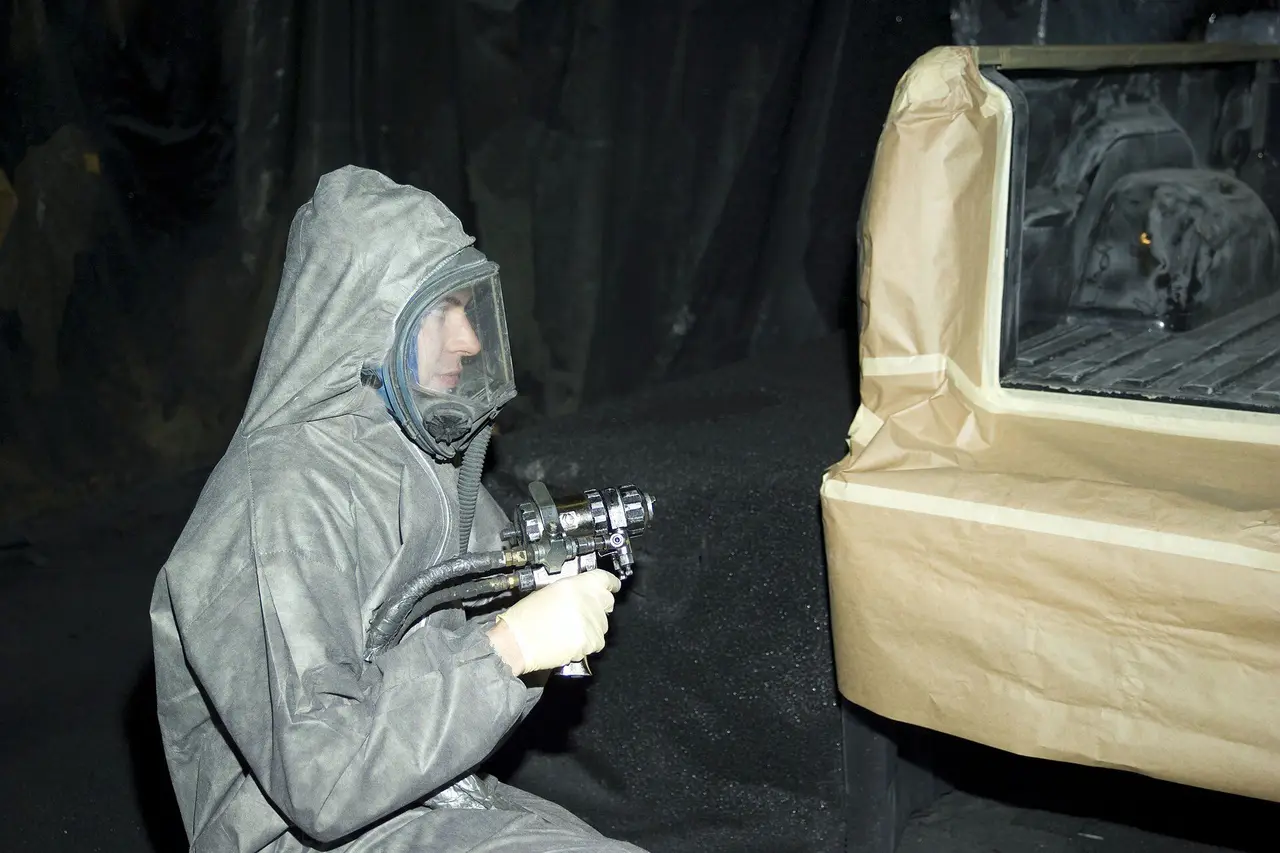
Use nitrile gloves, not thin latex, which solvents pass through quickly. Replace torn or paint-soaked gloves at once. When spraying, wear a hooded coverall so mist does not settle on hair and neck; anti-static material is best. Figure 1 shows full protection while spraying a liner into a pickup truck bed: hooded suit, full-face mask and gloves.
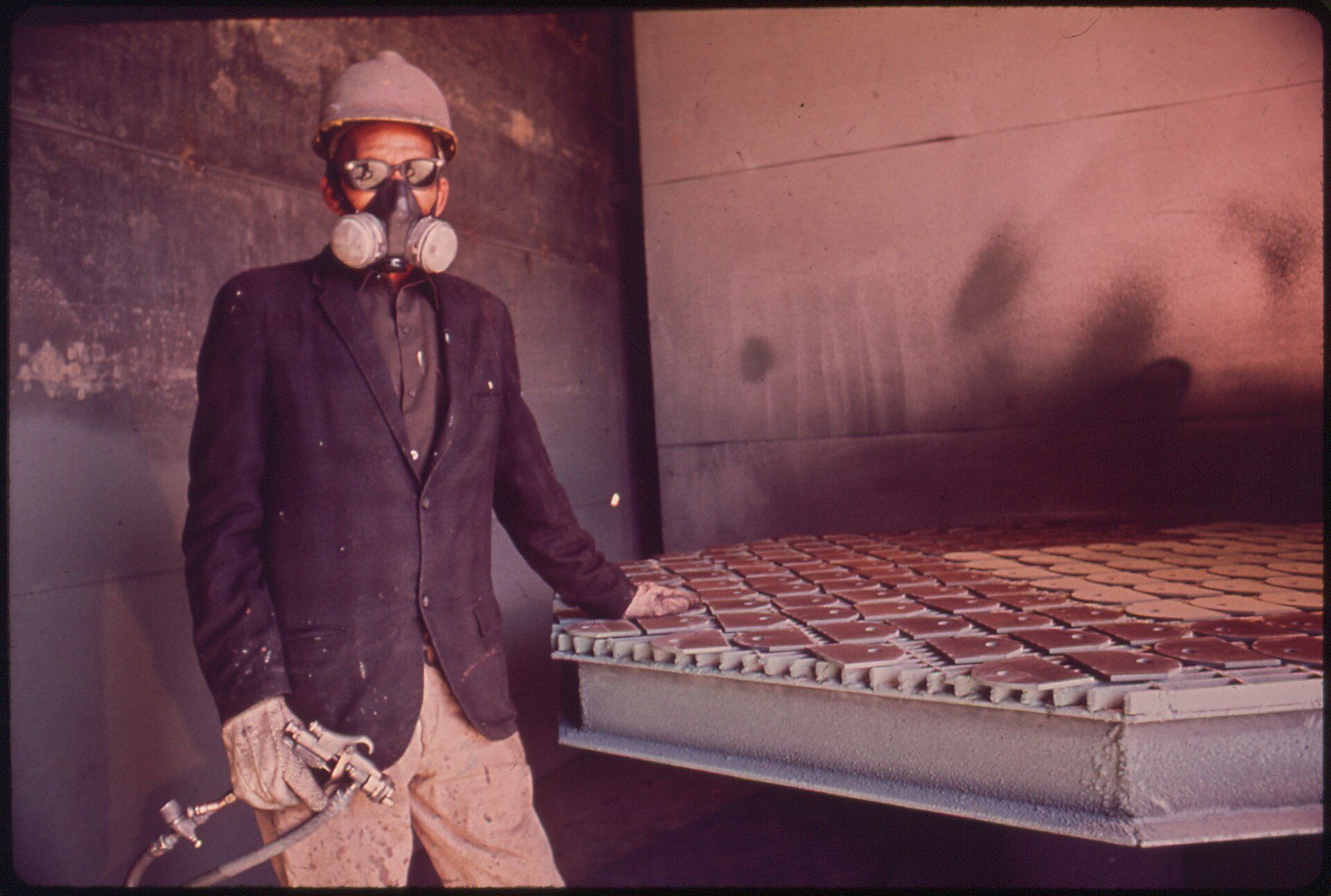
Photo: John Messina / Wikimedia Commons, Public domain
The paint booth and ventilation
The respirator is your last line of defence. The first is not letting vapour and mist build up around you at all, and that is the booth's job.
How a paint booth works
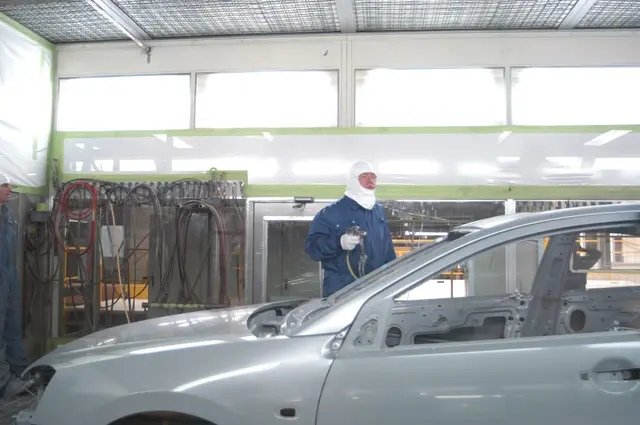
A car paint booth (Figure 3) blows filtered clean air down from the ceiling and extracts dirty air through a floor grate or filter wall, sending it outside through an exhaust fan. The downward airflow pulls spray mist out of the painter's breathing zone and away from the car. Many booths also have a bake cycle; nobody stays inside while it is baking.
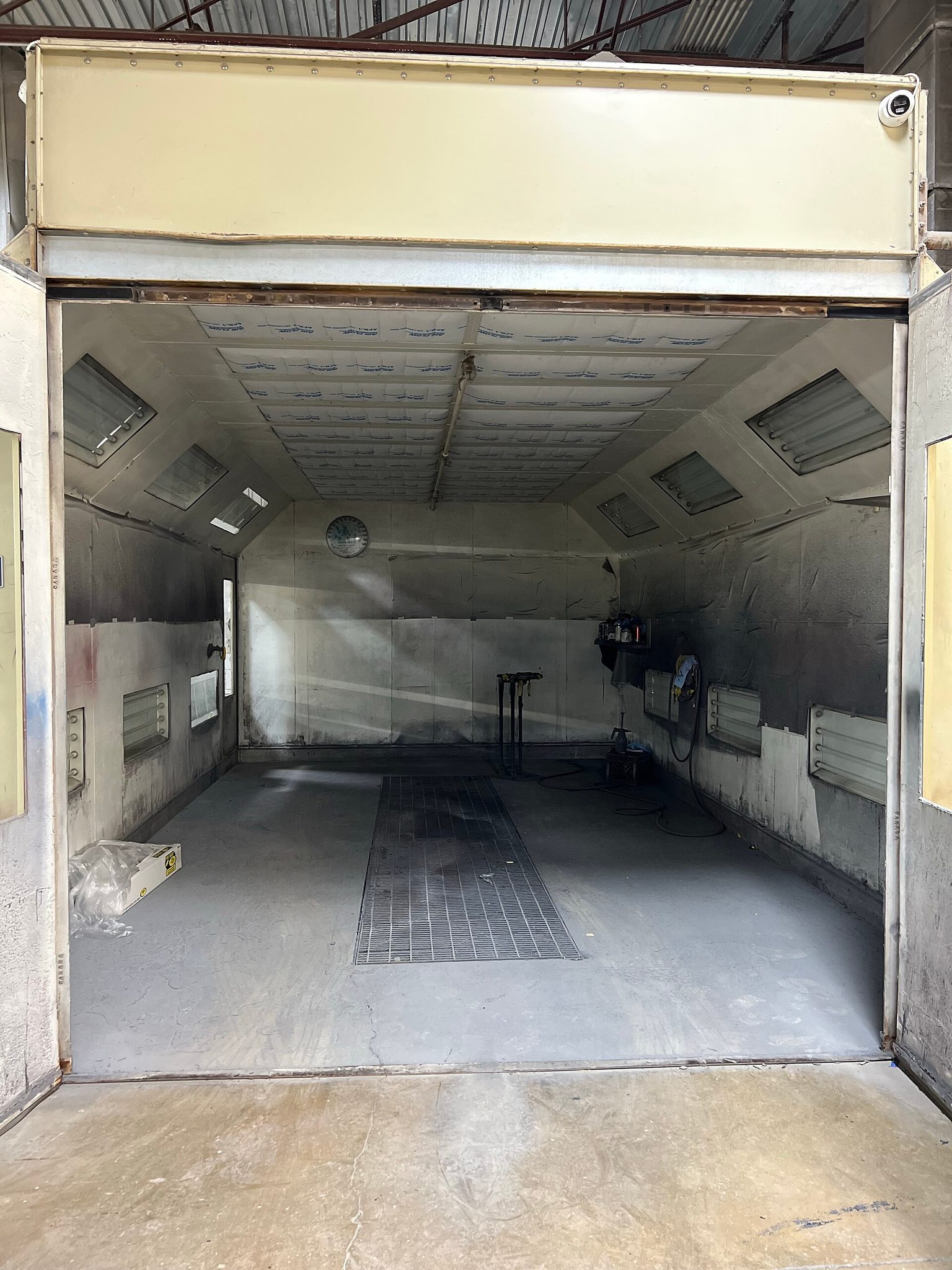
Photo: Scientificranking / Wikimedia Commons, CC BY 4.0
Check the booth before spraying
- Supply and exhaust fans running smoothly, with no unusual vibration.
- Ceiling and floor filters not overloaded; the pressure gauge (if fitted) within the shop's range.
- Booth lights sealed with intact covers; no portable lamps or ordinary fans taken inside.
- Doors closed while spraying; anyone not spraying stays outside.
When the shop has no booth
Many small shops touch up scratches in an open area. Then a properly fitted cartridge respirator matters even more: set an extraction fan blowing vapour outside away from people, keep clear of kitchens, food stalls and homes, and do not spray large amounts of 2K paint. See how shops build booth costs into their prices in the lesson on how much it costs to repaint a car.
Sanding dust and grinding metal
Apprentices spend most of their first month sanding, so this is the hazard you will meet most often, even if few people pay attention to it.
Why sanding dust is dangerous
Filler and primer dust is fine enough to float for hours, cling to hair and clothes and follow you home. In a closed garage without extraction the whole room turns white after a few minutes of sanding (Figure 4). Breathing it day after day irritates the nose, throat and lungs.
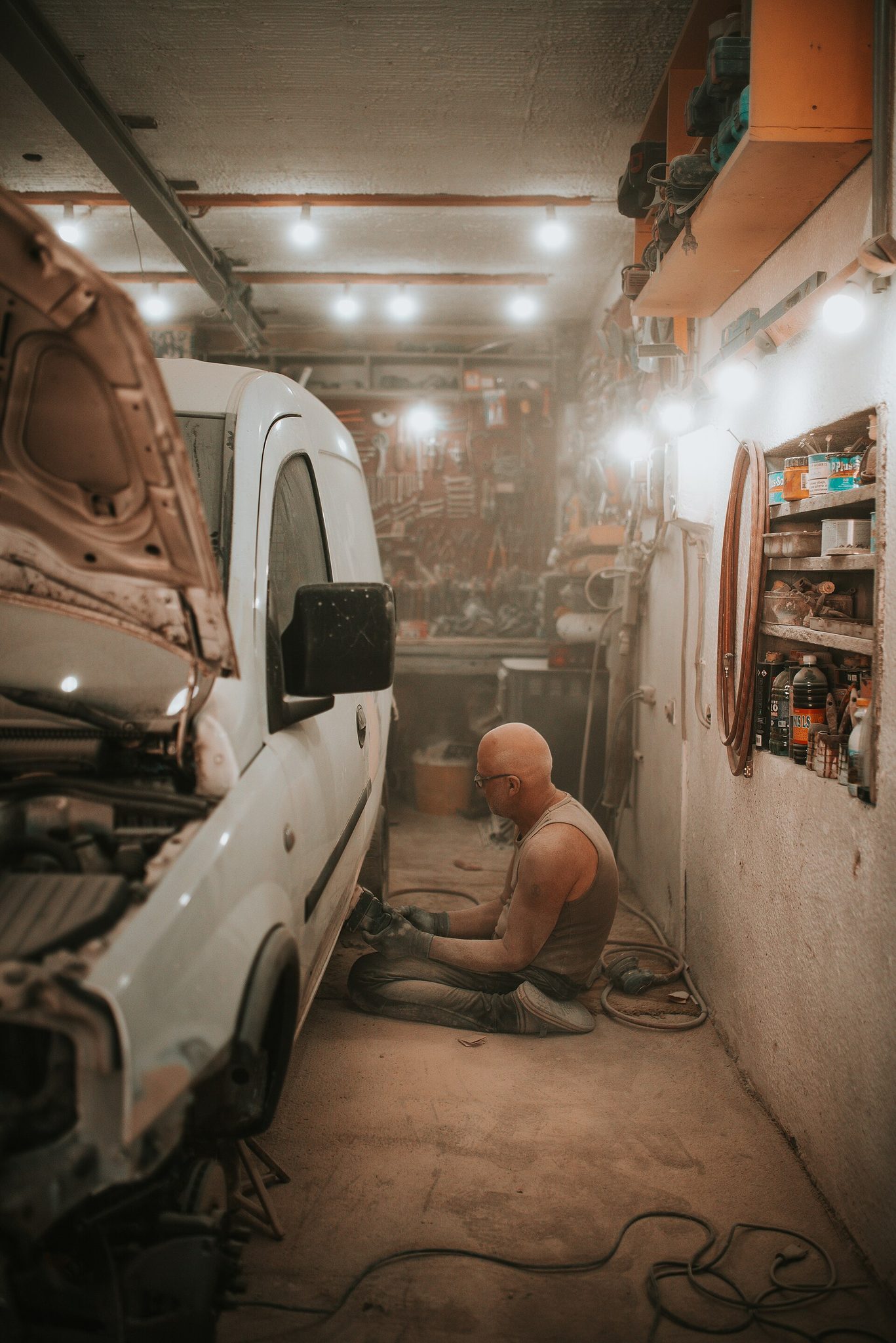
Photo: Nenad Stojkovic / Wikimedia Commons, CC BY 2.0
Three ways to cut dust
- Dust-extracting sanders: a perforated pad connected to a vacuum, with sandpaper holes that line up with the pad.
- Wet sanding on primer and clearcoat where the process allows: water traps the dust, but never wet-sand with an electric tool that is not rated for water.
- Vacuum instead of blowing: compressed air spreads dust all over the shop and into the booth; use a vacuum and tack cloths.
Grinders, sparks and solvents
A handheld grinder throws sparks several metres. Never grind, cut or weld near the mixing area, thinner drums or a freshly sprayed car. Wear a face shield and leather gloves, and check that the disc is not cracked and the guard is in place before switching on.
Fire prevention: paint store, rags and static
Fires in paint shops rarely start in the booth. They start in a messy store, a heap of solvent-soaked rags or a temporary power socket.
Organising the paint store
- Keep paint, thinner and hardener in a cabinet or room for flammable materials (Figure 5), ventilated and away from heat sources and electrical panels.
- Keep only one day's supply in the mixing area, and put the lid back on every tin straight away.
- Keep hardener tightly sealed and dry (isocyanates react with moisture, swelling the tin and spoiling the product).
- Never decant thinner into drinking-water bottles: someone may drink it by mistake.
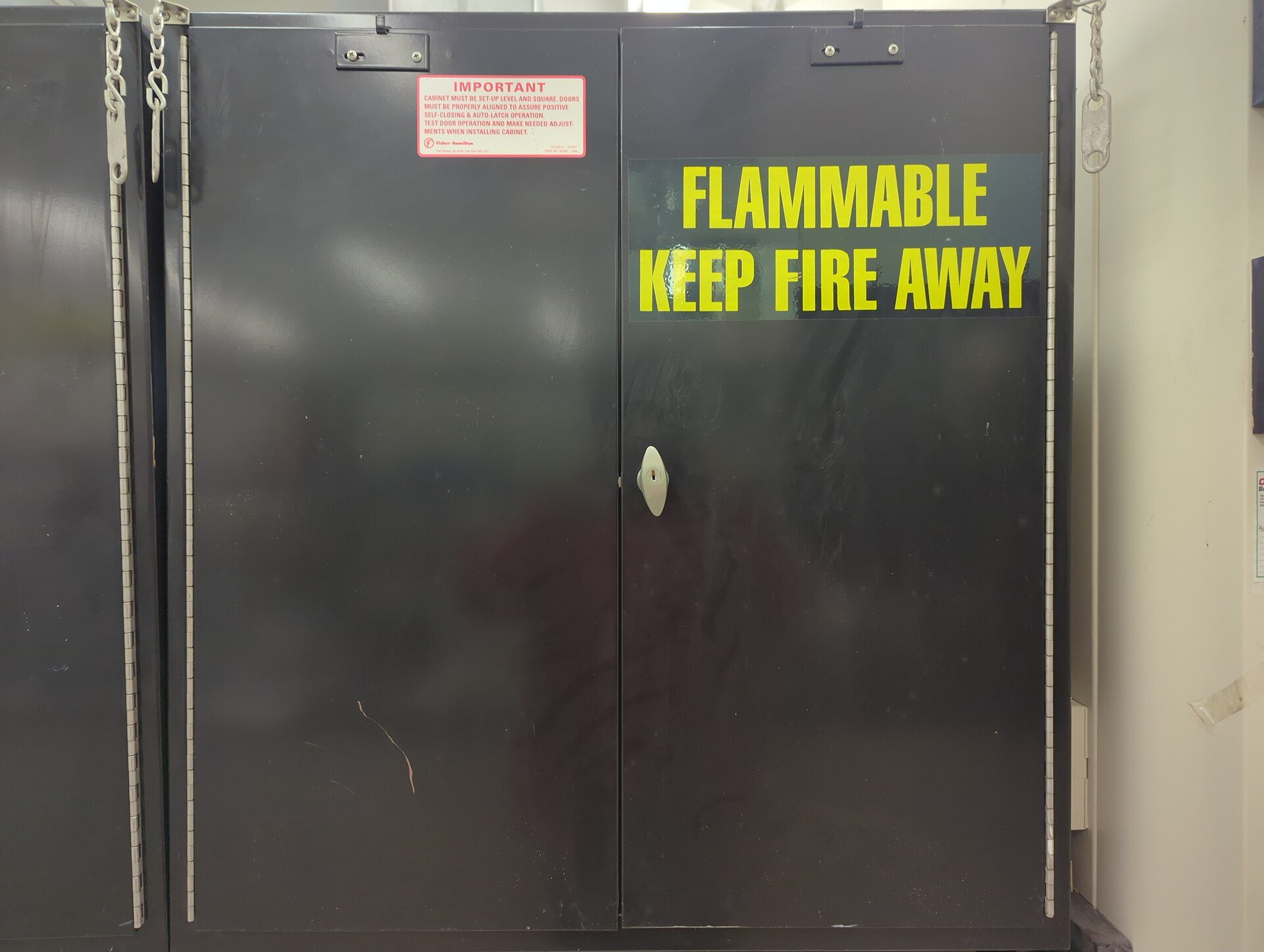
Photo: Reconrabbit / Wikimedia Commons, CC0
Rags and waste
Rags, masking paper and booth filters soaked with paint and solvent go into a lidded metal bin and out to the waste area at the end of the day. Dirty thinner from gun cleaning goes into a separate labelled can. This is hazardous waste: hand it to a licensed collector under current regulations, and never pour it down a drain or burn it.
Static and electricity in the shop
When you pour solvent, the fast-moving liquid can build up a static charge. Earth containers, the compressor and the booth as the installation instructions say; pour slowly with the can spout close to the receiving container. Do not plug fans, lamps or phone chargers into temporary sockets in the mixing and spraying areas.
Extinguishers and exits
Know where the extinguishers are, which type works on flammable liquids (the type your fire-safety adviser recommends for the shop), how to use one, and your two ways out. Never park cars or stack tins in front of extinguishers or exits.
Safety warning: Do not spray 2K paint without the correct respirator that has passed a seal check; cloth and surgical masks do not stop solvent vapour or isocyanates. No smoking, no grinding or cutting and no open flames in the mixing, spraying and storage areas. Never wash your hands or skin with petrol or thinner. If you feel dizzy, sick, short of breath or tight in the chest while working, stop at once, get to fresh air and tell the lead painter; if breathing does not improve or someone collapses, call 115 (the emergency medical number in Vietnam). In a fire, raise the alarm and call 114 (the fire service in Vietnam); only use an extinguisher on a small fire with your back to an exit.
Worked example: protective kit for a painter's first month
Tuan, 22, starts as an apprentice in a body shop in Binh Duong. His first week is mostly sanding; from the second week he helps spray primer. The lead painter asks him to list his protective kit and plan cartridge changes for the first month.
Working out cartridge hours
- Time wearing the carbon-cartridge respirator (mixing, spraying, gun cleaning): about 2 hours/day × 26 working days = 52 hours/month.
- Assume the cartridge maker recommends a change after about 40 hours of use in shop conditions (check the real figure on the box you use).
- 52 / 40 = 1.3, so 2 pairs of cartridges for the month. Change earlier if you can smell solvent through the mask.
- Particle pre-filters: about one pair a week, so 4 pairs a month.
Cost table (2026 reference prices in Vietnam, varying by area and product)
| Item | Quantity × unit price | Total |
|---|---|---|
| Half-face respirator | 1 × 400,000 VND | 400,000 VND |
| Activated-carbon cartridges (pair) | 2 pairs × 250,000 VND | 500,000 VND |
| Particle pre-filters (pair) | 4 pairs × 30,000 VND | 120,000 VND |
| Nitrile gloves, box of 100 | 2 boxes × 150,000 VND | 300,000 VND |
| Anti-static spray coverall | 1 × 600,000 VND | 600,000 VND |
| Chemical goggles | 1 × 120,000 VND | 120,000 VND |
| Particle masks for sanding | 30 × 15,000 VND | 450,000 VND |
| First-month total | 2,490,000 VND | |
Check: 400,000 + 500,000 + 120,000 + 300,000 + 600,000 + 120,000 + 450,000 = 2,490,000 VND (about USD 98). From the second month the respirator, coverall and goggles are still usable, so the recurring cost is only cartridges, pre-filters, gloves and masks: 500,000 + 120,000 + 300,000 + 450,000 = 1,370,000 VND per month. Many shops supply protective kit; you should still know the list and the change schedule so you never work with expired cartridges.
Start-of-shift and end-of-shift safety checklist
Print this checklist and stick it next to the mixing area. One pass takes about 10 minutes per shift.
Start of shift
- Respirator clean, valves intact, cartridges within their logged hours; negative and positive pressure checks passed.
- Nitrile gloves, goggles and spray coverall in the right sizes; particle masks ready for sanding.
- Booth: fans running, filters not clogged, lights sealed; sanders connected firmly to their extraction hoses.
- Paint store and mixing area: lids on, no flames, no temporary sockets or stray items.
- Extinguishers in place and exits clear.
End of shift
- Clean the gun in a ventilated spot and pour dirty thinner into the labelled can.
- Put rags and masking paper in the lidded metal bin and take it to the waste area.
- Store cartridges in a sealed bag and log the hours used; wipe the respirator clean.
- Change out of work clothes and wash hands and face with soap before eating; do not wear paint-dusty clothes home.
Common beginner mistakes and how to fix them
Wearing a dust mask to spray paint
Sign: you can still clearly smell paint and have a headache by the end of the shift. Cause: particle masks only stop particles, not solvent vapour. Fix: always use a carbon-cartridge respirator, or whatever the paint maker requires, for mixing, spraying and gun cleaning.
Cartridges that never get changed
Sign: cartridges opened last month and left on a shelf. Cause: not knowing that carbon slowly saturates by itself. Fix: store in a sealed bag, write the opening date and hours used, and change as the maker says or when you can smell vapour.
Washing hands in thinner
Sign: dry, cracked, itchy hands. Cause: solvent strips the skin's natural oils and soaks in. Fix: wear gloves from the start; if paint gets on your skin, wipe it off with a cloth, wash with soap and use hand cream at the end of the shift.
When to see a doctor
This lesson does not replace medical advice. See a doctor early if you notice any of the following, and tell them you work in car painting with exposure to solvents and isocyanates:
- Coughing, wheezing, chest tightness or breathlessness that comes on at work and eases over the weekend.
- A long-lasting runny nose or stinging eyes, or frequent headaches and dizziness at the end of a shift.
- Rashes, itching or cracking on your hands or wrists after contact with paint.
- Paint or solvent in the eye: rinse with clean running water for at least 15 minutes, then see a doctor straight away.
As a principle in Vietnam, employers must provide safety training, suitable protective equipment and health checks for people working with chemicals; check the current occupational safety and health regulations or ask the local labour authority for the specific requirements.
Frequently asked questions
Do I need a supplied-air respirator for car spray painting?
It depends on the paint and the maker's advice. Many 2K paint makers recommend supplied air for spraying; some accept a cartridge respirator inside a compliant booth. Read the product SDS, and when in doubt follow the higher level.
Can I use an N95 mask when spraying car paint?
No. N95 and other particle masks only stop dust, not solvent vapour. Use them for sanding and grinding; for mixing and spraying you need a mask with activated-carbon cartridges.
How often should I change respirator cartridges?
At the number of hours the cartridge maker recommends for your working conditions, or sooner if you can smell vapour through the mask or breathing gets hard. A cartridge taken out of its bag and left in the open also loses capacity even if it has not been used much.
Can a pregnant woman work in a paint shop?
Ask a doctor first and tell the shop owner so that she can be given work without exposure to solvents or paint dust. Do not decide based on word-of-mouth advice.
Practice tasks and self-assessment
- Put on the shop's cartridge respirator, carry out the negative and positive pressure checks, and ask the lead painter to check you.
- Walk around the shop, note 5 fire-risk spots (store, rag bin, temporary sockets and so on) and suggest a fix for each.
- Work out how many cartridge pairs you need in a month if you wear the respirator 3 hours a day for 26 days and cartridges last 40 hours.
Self-assessment criteria
- Pass: you name the right protection for each job and never confuse a dust mask with a carbon-cartridge respirator.
- Pass: your respirator passes the negative and positive pressure checks; your cartridges carry an opening date and logged hours.
- Pass: your cartridge calculation is correct (3 × 26 = 78 hours, 78 / 40 = 1.95, so 2 pairs).
- Not yet: solvent rags are still left outside the bin, you wash your hands in thinner, or you spray with a mask that does not seal.
With safety in hand, move on to the next step of the roadmap: Dent repair & removing body parts, where you learn to read a dent, use a hammer and dolly, and take off doors, bumpers and trim in the right order without snapping plastic clips. The grinding and panel-beating protection in the table above is what you bring from day one.
Keep learning auto body and paint: after safety come dent repair, frame straightening, body filler, colour matching by code, spraying in the booth and polishing. See the 8-step auto body and paint technician roadmap.