What qualifications a pharmacy assistant needs in Vietnam depends on the job: the person in professional charge of a pharmacy must be a pharmacist with a university pharmacy degree and a valid pharmacy practising certificate; staff who sell medicines and advise customers directly are usually expected to hold a pharmacy qualification (intermediate, college or university level); and people without a pharmacy qualification should only do support work such as cashier, stockroom and shelving, under the supervision of the person in professional charge. Many applicants miss out because they apply for the wrong position, or start work and then "advise on medicines" beyond what they are allowed to do. This lesson helps you match a position to the qualifications you have now, revise for the job skills test and prepare a pharmacy job application.
By the end of this lesson, you will be able to:
- Tell apart the three groups of positions in a pharmacy (person in professional charge, medicine sales, support) and the qualifications usually required for each.
- State clearly what pharmacy staff must not do: diagnose, sell prescription-only medicines without a prescription, or swap a medicine on a prescription.
- Recognise 8 warning signs that a customer must be referred to the pharmacist, sent to a doctor or helped to call 115 (the Vietnamese emergency number) right away.
- Work out a month's take-home pay from base salary, allowances, sales bonus and insurance deductions.
- Prepare a CV and documents and answer 5 situational questions commonly asked at pharmacy interviews.
Want to become a pharmacy assistant properly? This lesson belongs to the final step, "Job skills test & applying", of the 8-step roadmap, after legal limits, drug groups, storage, stock software, sales and customer care. See the 8-step pharmacy assistant roadmap to learn in the right order.
What qualifications does a pharmacy assistant need: the answer by position
In a pharmacy, "staff" covers several positions with different requirements. Understanding this helps you apply to the right job and never work beyond your authority.
The person in professional charge
This person is legally responsible for the pharmacy's dispensing and sales. The firm principle: the person in professional charge of a pharmacy must hold a university pharmacy degree and a valid pharmacy practising certificate. Detailed conditions, such as the years of practice and the certificate application, are set by Vietnam's Law on Pharmacy and its guiding documents; when you need them, read the current documents or ask the provincial Department of Health where you work.
Staff who sell medicines and advise
Pharmacies in Vietnam operate to the "Good Pharmacy Practice" standard for retail outlets (GPP). In the spirit of GPP, staff who sell medicines directly must have pharmacy training suited to the work assigned and work under the supervision of the person in professional charge. Job ads for this position usually say "intermediate, college or university pharmacy graduate". The exact minimum qualification for staff who sell medicines can change over time, so check the current Ministry of Health documents rather than relying on word of mouth.
Support roles: cashier, stockroom, shelving
People without a pharmacy qualification can still start in support roles: cashier, receiving and counting stock in the software, shelving, cleaning the counter, recording temperatures, and selling non-medicine products (common medical devices, personal care items) as assigned. You work under the supervision of the person in professional charge and never decide on your own to sell a medicine or advise on how to take it. Many people work in a support role while studying for an intermediate or college pharmacy diploma.
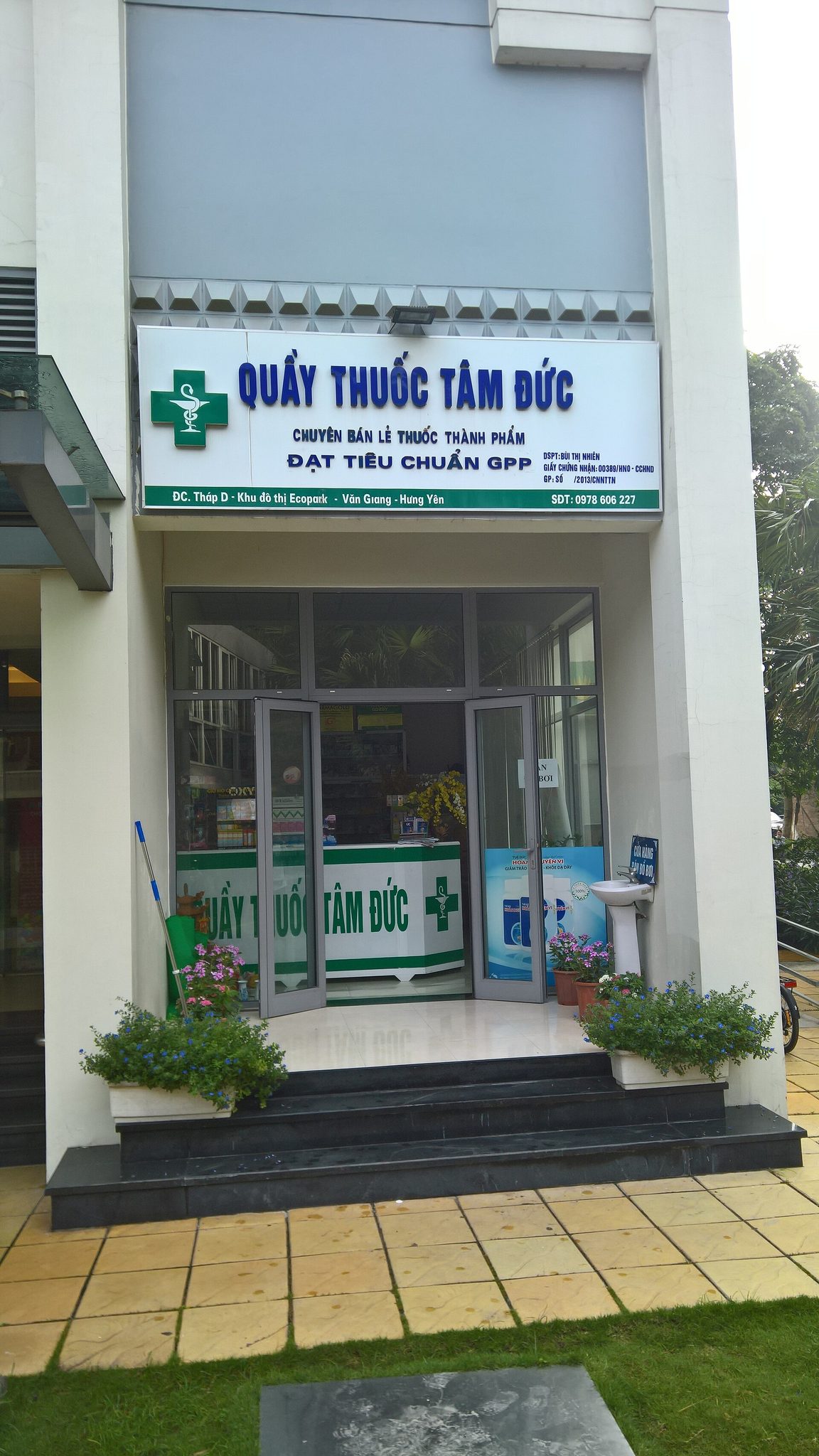
Photo: Donald Trung / Wikimedia Commons, CC BY-SA 4.0
How a pharmacy differs from a drug counter
As Figure 1 shows, besides the "pharmacy" ("nha thuoc") there is also the "drug counter" ("quay thuoc"). These are two different types of retail outlet, with different conditions for the person in professional charge and a different scope of activity. A pharmacy must have a university-trained pharmacist in charge; a drug counter usually allows a person in charge with a lower qualification as the regulations set out. When reading a job ad, note whether the outlet is a pharmacy or a drug counter, and check the exact conditions in the current documents if you plan to be the person in charge one day.
Do you need a pharmacy qualification to sell medicines? The limits you must know
The short answer: selling and advising on medicines directly requires pharmacy training; people without it only support. Whatever your qualification, some limits must never be crossed.
Prescription-only medicines are sold only with a prescription
Prescription-only medicines (the box usually shows "Rx" or a line saying it is sold on prescription) may only be sold when the customer has a valid doctor's prescription. Antibiotics, blood pressure medicines, diabetes medicines and sedatives are the groups customers most often ask for without one. The right answer: "This medicine needs a doctor's prescription. May I see it, or I can ask the pharmacist to talk with you." Never sell "just a few tablets for now", and never sell based on an old empty box.
Pharmacy staff do not diagnose
You do not guess the illness, do not say "it's probably a sore throat" or "probably your stomach", do not swap a prescribed medicine for another one, and do not change the dose. Your job is to listen, note the symptoms the customer describes and call the pharmacist in charge. Even for over-the-counter medicines, explaining how to take them is done by someone with pharmacy training.
When to refer to the pharmacist, a doctor or 115
Refer straight away to the pharmacist in charge and advise the customer to see a doctor when: the customer is pregnant or breastfeeding, a young child, or an older person on several medicines; symptoms have lasted several days or medicine has not helped; or the customer asks for an unusual quantity of a medicine.
Warning, call 115 at once: difficulty breathing, swelling of the lips, tongue or face, or a rash spreading fast after taking a medicine; chest pain with sweating; drowsiness, seizures, slurred speech or weakness on one side; a suspected overdose or a young child who swallowed medicine by accident; vomiting blood or black stools. Do not give the customer a medicine to "handle it for now". Tell the pharmacist in charge, call 115, and keep the box of the medicine the customer took to hand to the medical team. Pharmacy staff do not replace a doctor.
A pharmacy assistant's work during one shift
The work repeats shift after shift but demands great care. A typical shift at a pharmacy chain has two main parts; at the end you close the till, note items out of stock and hand over to the next shift.
Start of shift
- Clean the counter and shelves and wash your hands; check temperature and humidity and record them (GPP usually requires storage areas at no more than 30°C and 75% humidity; the medicine fridge at 2–8°C).
- Count the opening cash, open the sales software, read messages from the manager (recalls, new stock, promotions).
- Shelve stock on the first-expiry, first-out principle (FEFO) and check items close to expiry.
During the shift
- Greet customers, ask what they need, and refer cases that need professional advice to the pharmacist.
- Pick medicines according to the prescription or the slip approved by the pharmacist, count loose tablets with a counting tray (Figure 2), and label them with the name, strength and directions as the pharmacist instructs.
- Take payment, issue invoices, and enter the correct product code and batch number in the software.
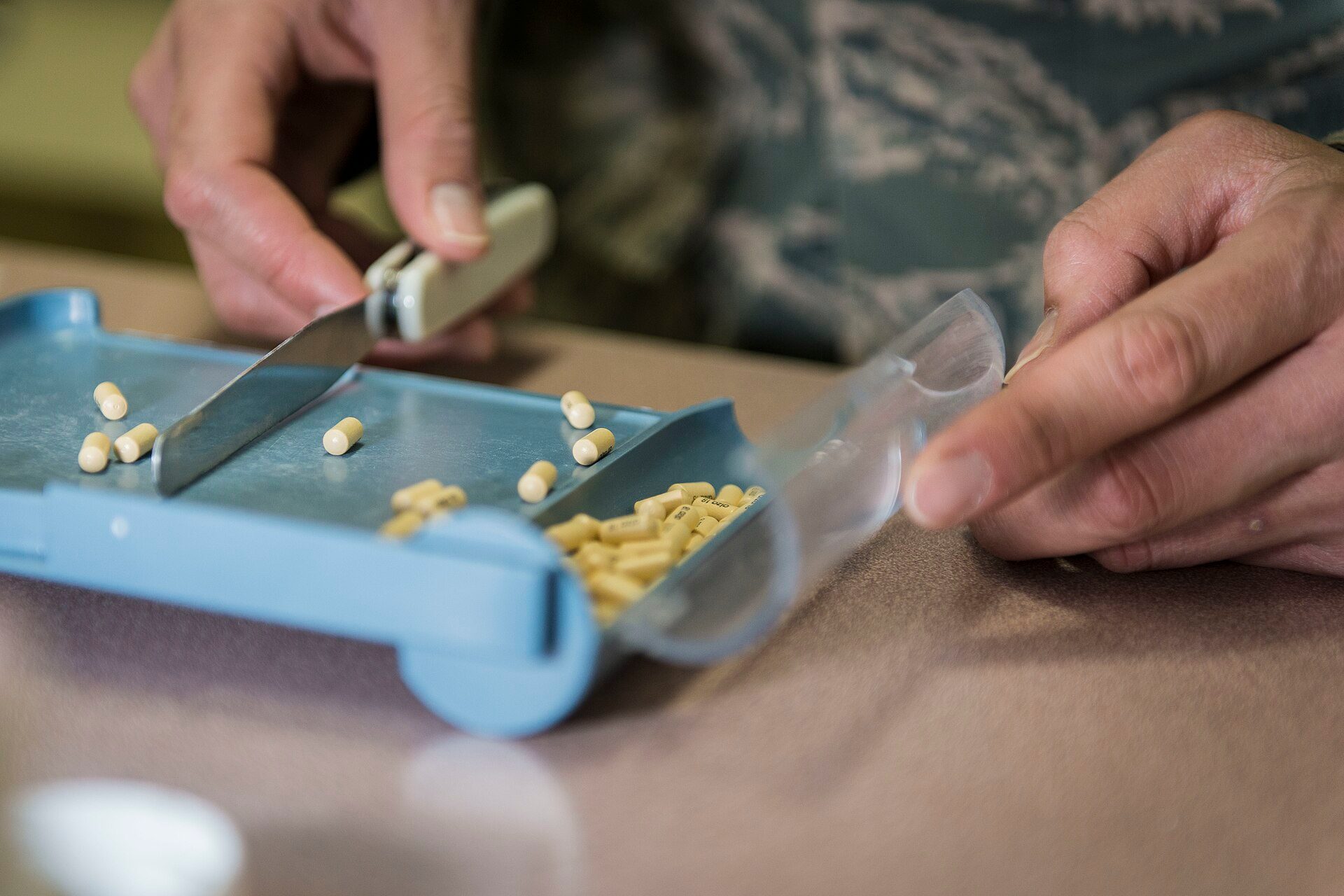
Photo: Staff Sgt. Benjamin Stratton / Wikimedia Commons, Public domain
Task table by position
| Task | Support staff (no qualification) | Sales staff with pharmacy training | Pharmacist in professional charge |
|---|---|---|---|
| Cleaning, shelving, temperature log | Does it | Does it | Supervises |
| Cashier, invoices | Does it | Does it | Supervises |
| Receiving stock, stock counts in software | As assigned | Does it | Approves |
| Explaining how to take an over-the-counter medicine | No, calls a trained colleague | Within the assigned scope | Does it, takes responsibility |
| Selling prescription medicines against a prescription | No | Under supervision | Checks and decides |
| Diagnosing, changing a prescribed medicine | No | No | Does not diagnose; contacts the prescriber when needed |
Qualification paths to work and move up in a pharmacy
A pharmacy qualification does not just let you sell medicines; it also sets your income ceiling and whether you can be the person in charge later.
Comparing qualifications
| Level | Usual study time | Typical positions | Notes |
|---|---|---|---|
| No pharmacy qualification | A few weeks of in-house training | Cashier, stockroom, shelving, non-medicine sales | No advising, no prescription sales |
| Intermediate pharmacy diploma | About 1.5–2 years | Medicine sales, pharmacy stockroom | Can top up to college or university |
| College pharmacy diploma | About 2.5–3 years | Medicine sales, shift leader, pharmacy stockroom | Can top up to university |
| University pharmacy degree (pharmacist) | Usually 5 years | Advising pharmacist; person in charge once certified | Being in charge of a pharmacy also needs the required practice time |
The study times are common patterns; each school has its own programmes (full-time, part-time, top-up). Before enrolling, ask the school exactly which qualification you will receive and which positions it can be used for.
Pharmacy assistant pay in 2026 and working out take-home pay
Pay is a base salary plus allowances and a sales bonus; large chains often pay bonuses on store sales or on product groups.
Reference pay table
| Position | Reference income 2026 (million VND/month) | What raises it |
|---|---|---|
| New support staff (cashier, stockroom) | 6–8 | Evening and weekend shifts, attendance |
| Medicine sales staff, intermediate or college | 7–11 | Sales bonus, experience, English |
| Shift leader, chain staff with bonuses | 9–14 | Running a shift, store targets |
| University pharmacist in professional charge | 12–20 | Being the named person in charge, managing a store |
These are estimated reference ranges for 2026 in Vietnam, varying by region, chain size and employer policy; they are not an income guarantee. As a rough guide, 6 million VND is about US$230. Big cities usually pay more than small provinces, but living costs are higher too.
Worked example: one month's pay for a sales assistant
Lan has a college pharmacy diploma and sells medicines at a chain store in Hanoi. Her terms: base salary 6,500,000 VND, lunch allowance 600,000 VND, evening shift allowance 400,000 VND, attendance bonus 300,000 VND, and a sales bonus of 1% of her personal sales. This month she sold 110,000,000 VND. Assume the company pays insurance on the base salary (an assumption for illustration).
- Sales bonus: 110,000,000 × 1% = 1,100,000 VND.
- Total before deductions: 6,500,000 + 600,000 + 400,000 + 300,000 + 1,100,000 = 8,900,000 VND.
- Employee insurance (social insurance 8% + health insurance 1.5% + unemployment insurance 1% = 10.5%): 6,500,000 × 10.5% = 682,500 VND.
- Take-home: 8,900,000 − 682,500 = 8,217,500 VND (at this level personal income tax is usually not due after family deductions, but ask the company's accountant how it is calculated).
Check: 682,500 + 8,217,500 = 8,900,000 VND, matching the total. At interview, ask about each item above, especially the salary used for insurance, because it affects sickness and maternity benefits later.
Never chase sales by selling wrongly
A sales bonus is never a reason to sell prescription medicines without a prescription or to overstate what a supplement does. In a pharmacy, trust comes from selling correctly.
Revising for the job skills test before applying
Pharmacy chains often test applicants with a short multiple-choice quiz and sales role-plays. This is also the content of the roadmap's final step.
Knowledge to learn by heart
- Drug groups: tell active ingredient names from brand names, recognise prescription and non-prescription medicines from the box, and know the dosage forms (tablets, capsules, syrups, eye drops, suppositories).
- Storage: temperature, humidity, medicines that need refrigeration or protection from light; FEFO; handling expired, broken and recalled medicines.
- Sales rules: prescription medicines only on prescription, no medicines of unknown origin, keep invoices and documents.
The role-play part
The interviewer plays a customer and watches how you greet, ask, pick and charge. They score your attitude and accuracy and, most importantly, whether you know when to stop and call the pharmacist (Figure 3).
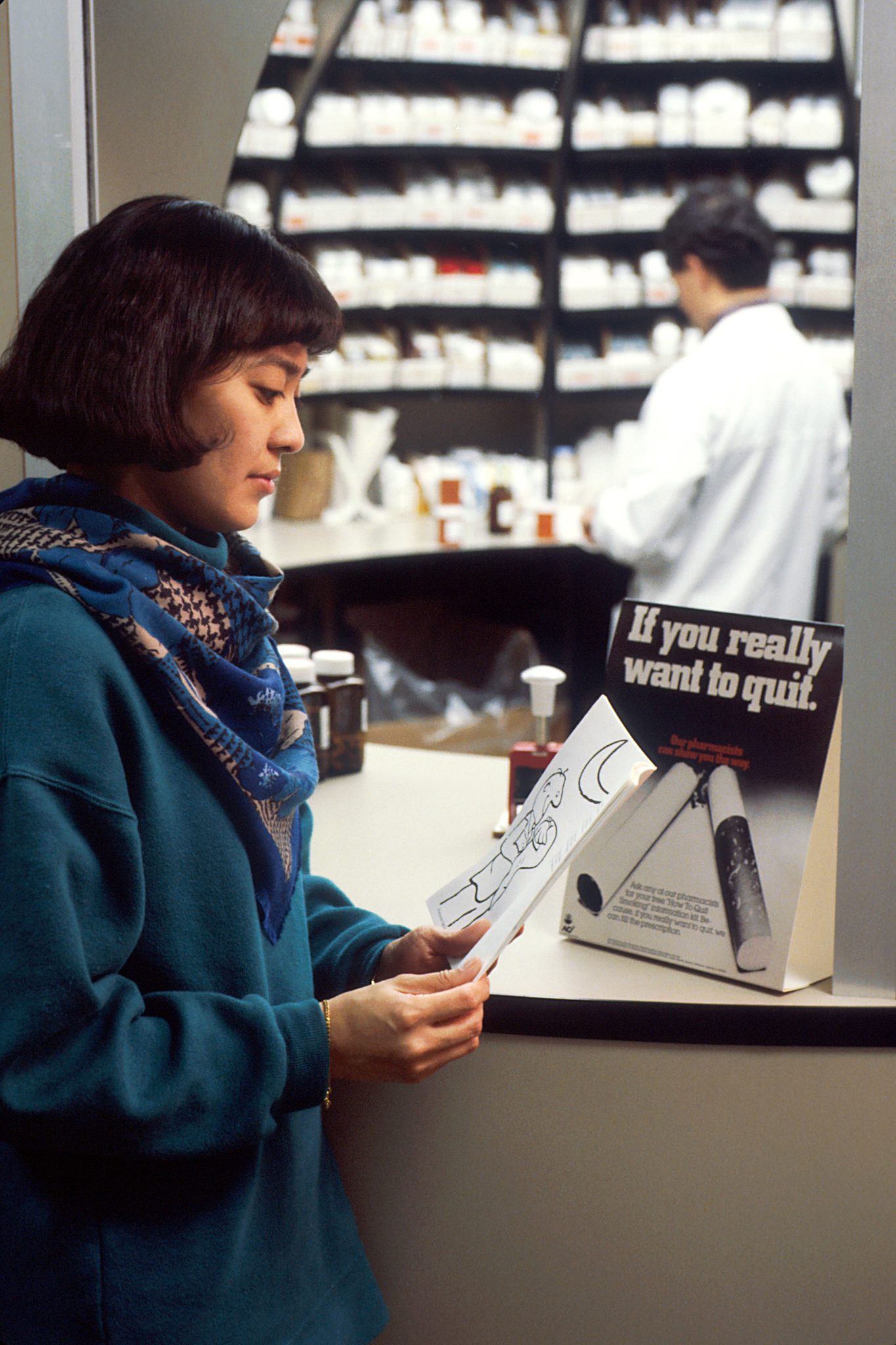
Photo: Bill Branson (Photographer) / Wikimedia Commons, Public domain
5 common situational questions
- A customer wants the same antibiotic as last time but has no prescription: what do you say?
- A customer hands over a prescription and that exact medicine is out of stock: do you give another one with the same use on your own?
- A mother carrying a 1-year-old with a high fever asks for a fever medicine: what do you do first?
- A stock count shows 3 boxes expiring in 2 months: how do you handle it?
- At the end of the shift the cash is 50,000 VND short against the software: how do you report it?
The right answers share one spirit: do not exceed your authority, call the pharmacist in charge, record and report honestly. For question 3, a young child with a high fever must be referred to the pharmacist at once and the mother advised to take the child to a doctor; if the child has a seizure, is unusually drowsy or struggles to breathe, call 115.
Applying for pharmacy jobs: documents, CV and interview
Getting a pharmacy job is not hard if you apply for the right position and show that you are careful and honest.
Documents to prepare
- A one-page CV stating the position (cashier, stockroom, medicine sales) that matches your current qualification.
- Copies of your pharmacy qualification (if any), a transcript or a letter confirming you are studying.
- ID, a health certificate if the employer requires one, and related short course certificates (office IT, sales skills).
Writing a CV without experience
Instead of vague words like "hardworking, enthusiastic", write concrete tasks: "Cashier at a convenience store for 8 months, no cash discrepancies at shift close", "4-week placement at a pharmacy, shelved by FEFO, kept the temperature log". Pharmacy employers value care with numbers and money.
At the interview
- Ask clearly about the position, shifts, base salary, the salary used for insurance, how bonuses work and the probation period.
- State your limits: "I don't have a pharmacy qualification yet, so I'll work as cashier and in the stockroom and call the pharmacist when a customer needs advice." This shows you understand the job; it does not cost you points.
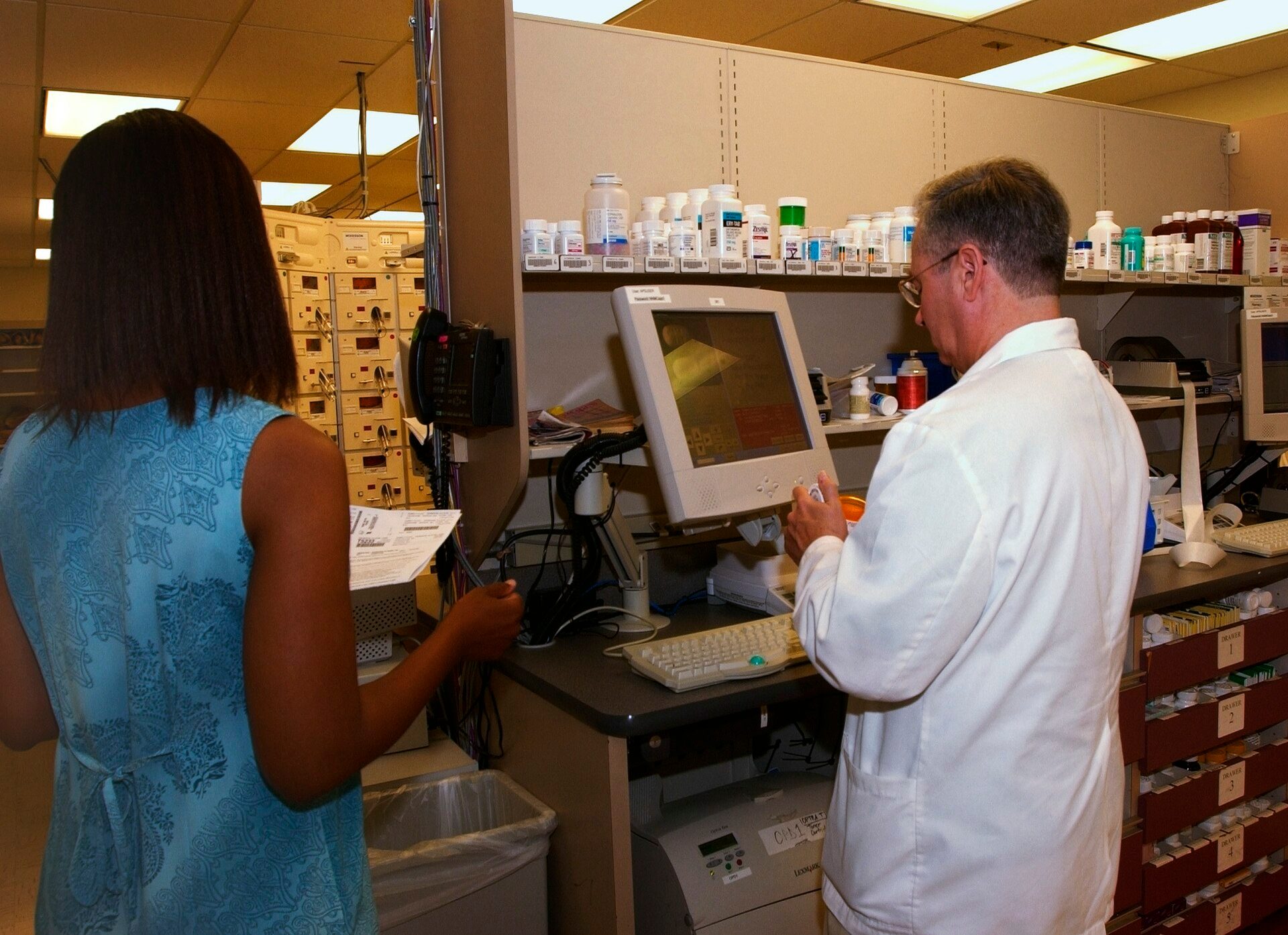
Photo: U.S. Navy photo by Chief Warrant Officer 4 Seth Rossman. / Wikimedia Commons, Public domain
Common beginner mistakes
Advising from personal experience
Sign: telling a customer "just take this one, I use it too". Cause: wanting to seem helpful. Fix: use the standard line "let me ask the pharmacist to advise you", and note the symptoms the customer describes so the pharmacist can pick up quickly.
Picking the wrong strength or form
Sign: the right name but the wrong strength (500 mg instead of 250 mg) or form (effervescent instead of plain tablets). Cause: similar products shelved side by side, picking in a hurry. Fix: read the name, strength and form aloud as you pick, and check against the prescription before passing it to the pharmacist.
Frequently asked questions
What qualifications does a pharmacy assistant need to sell medicines?
Staff who sell and advise on medicines directly are usually required to have pharmacy training (intermediate, college or university) and to work under the supervision of the person in professional charge. The person in charge of a pharmacy must be a university-trained pharmacist with a practising certificate. Check the current documents for the exact requirements for sales staff.
Do I need a pharmacy qualification if I only work as a cashier?
Many pharmacies take people without a pharmacy qualification as cashier, stockroom or shelving staff. But you must not advise or decide on medicine sales yourself; every question about how to take a medicine goes to someone with pharmacy training.
How much does a pharmacy assistant earn in 2026?
For reference in 2026, varying by region: new support staff about 6–8 million VND/month, qualified sales staff about 7–11 million, shift leaders or chain staff with bonuses 9–14 million, and pharmacists in professional charge 12–20 million. Ask about base salary, the insurance salary and how bonuses work.
Is pharmacy work hard?
You stand a lot, work shifts including evenings and weekends, and must be careful with every tablet and every banknote. In return the work is stable, the environment is clean and there is a clear path to study and move up.
What should I prepare to apply for a pharmacy job?
A one-page CV for the position that matches your current qualification, copies of qualifications and ID; revise drug groups, storage and prescription rules, and practise the 5 situational questions above.
Practice exercises and self-assessment
- Write down the position that fits your current qualification and 3 things you must not do in it.
- Answer the 5 situational questions above out loud, record yourself and listen back.
- Work out take-home pay for: base salary 7,000,000 VND, allowance 800,000 VND, sales 90,000,000 VND with a 1% bonus, insurance at 10.5% of the base salary.
- Write a one-page CV for the position you chose.
Self-assessment criteria
- Pass: all 5 situational answers include referring to the pharmacist or advising a doctor at the right point, and none diagnoses or sells a prescription medicine without a prescription.
- Pass: the pay exercise gives 7,000,000 + 800,000 + 900,000 = 8,700,000 VND before deductions, minus 735,000 VND insurance, take-home 7,965,000 VND.
- Pass: the CV names the right position and has at least 2 concrete, measurable tasks.
- Not yet: you still say "I will advise customers on medicines" without pharmacy training, or you do not know which signs mean calling 115.
This is the final step of the roadmap. Once you are working, keep revising the earlier steps: Drug groups, active ingredients & dosage forms, Storage, shelving & expiry control, Customer care & referral situations, and aim to study for an intermediate or college pharmacy diploma so you can sell medicines directly, then top up to a university degree if you want to be the person in professional charge.
Keep learning to be a pharmacy assistant: revise legal limits, drug groups, storage and expiry, stock software, sales and customer care before your interview. See the 8-step pharmacy assistant roadmap.