How much does a barista earn in Vietnam? As a 2026 reference, a new barista typically makes about 5–7 million VND a month plus tips, while a lead barista or bar supervisor earns about 9–15 million, depending on the region and the type of café (1 million VND is roughly 40 US dollars). The gap between those two levels does not come from years of service alone but from measurable skills: consistent espresso extraction, latte art, and running the bar during the rush. This lesson gives you a pay table by level, realistic training times, and a guide to preparing the practical test you will face when applying for a job.
By the end of this lesson, you will be able to:
- Estimate barista pay across 5 levels, by type of workplace and by region, using 2026 reference figures.
- Answer "how long does it take to learn to be a barista" in terms of three milestones: working the bar under supervision, running a shift alone, and becoming a lead barista.
- Compare 3 ways of learning by time and reference tuition, and draw up your own 12-month plan with income and costs.
- Prepare a 15-minute practical test, a CV and a latte art video for job applications.
Where to start? NAMBIN has not opened a barista course yet, but the 8-step Barista roadmap already lists everything a café will check when hiring: bar hygiene, coffee beans, espresso, milk steaming, phin and cold brew, bar operations and the skills test.
Quick answer: how much does a barista earn?
There is no single barista wage, because street-side cafés, large chains, specialty shops and hotels pay in very different ways. It is easier to look at it by skill level: each level matches the tasks you can do on your own without someone supervising. Every figure below is a 2026 reference range for large cities, not a promise of income.
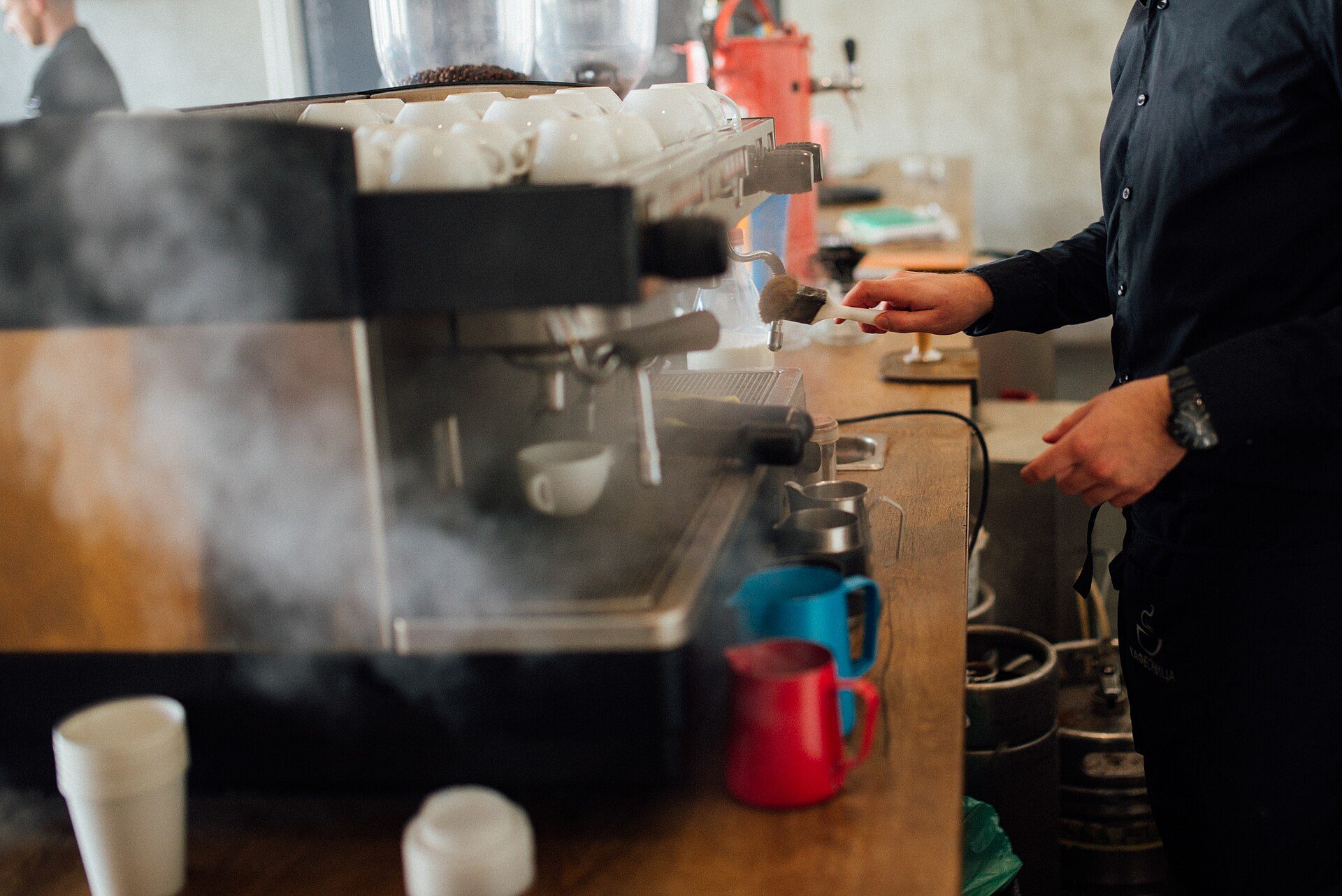
Photo: Shixart1985 / Wikimedia Commons, CC BY 2.0
| Level | Typically after | What you can do | Reference pay, 2026 |
|---|---|---|---|
| Trainee, part-time | 0–2 months | Clean the bar, make phin coffee, simple iced drinks from a recipe | 20,000–30,000 VND per hour |
| New barista | 2–6 months | Make the full basic menu, pull espresso from a set recipe | 5–7 million per month |
| Experienced barista | 6–18 months | Consistent latte art, dial in alone, run the bar solo | 7–10 million per month |
| Lead barista, shift leader | 1.5–3 years | Train newcomers, assign shift tasks, control quality | 9–12 million per month |
| Head barista, bar manager | from 3 years | Build the menu, calculate cost of goods, train staff, work with roasters | 12–15 million per month or more |
Tips, bonuses and allowances
On top of base pay, many cafés pool tips and share them by hours worked, pay a monthly sales bonus, or pay a Tet (Lunar New Year) bonus. Tips at cafés busy with tourists, or at specialty shops, can add a few hundred thousand to 1–2 million VND a month; at budget cafés they are usually negligible. At the interview, ask clearly how tips are shared and whether there is a meal allowance or free parking — added together, the difference can be a million VND or more.
Part-time work is paid by the hour
Students usually work 4–5 hour shifts at 20,000–30,000 VND per hour. For example, 5 hours × 25 days × 25,000 VND = 3,125,000 VND a month. This is a good way to learn the trade while getting paid before you commit to full-time work.
How barista pay differs by workplace and region
With the same skills, where you work can make your income differ by 30–50%. Understanding each type of café helps you pick the one that fits your stage: a place to learn fast, a place to earn, a place to move into management.
Large coffee chains
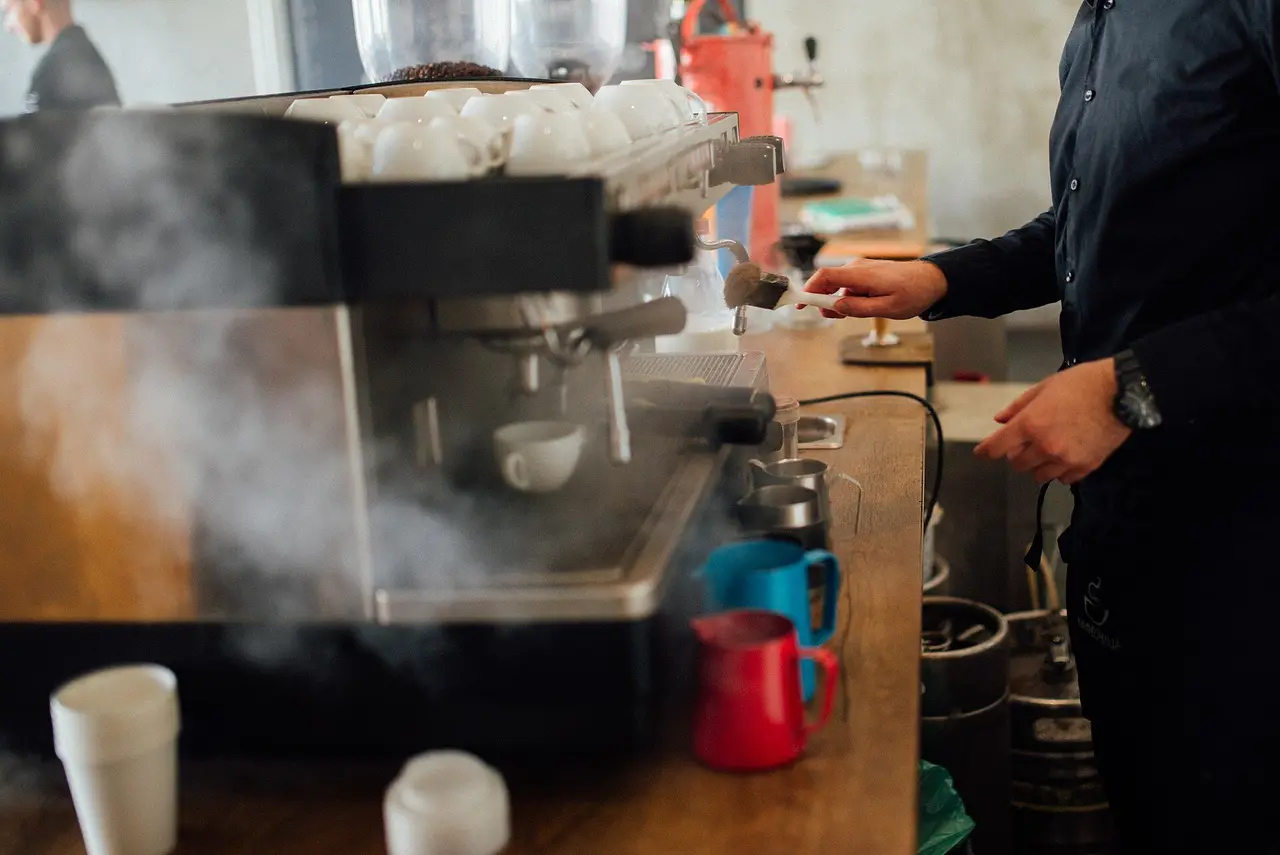
Chains hire continuously and have procedures, in-house training and a clear path to shift leader (Figure 2). Starting pay is usually average, with social insurance once you sign an official contract, and rotating shifts. In return, you rarely get to adjust recipes yourself, because the menu and machines are standardised across the chain.
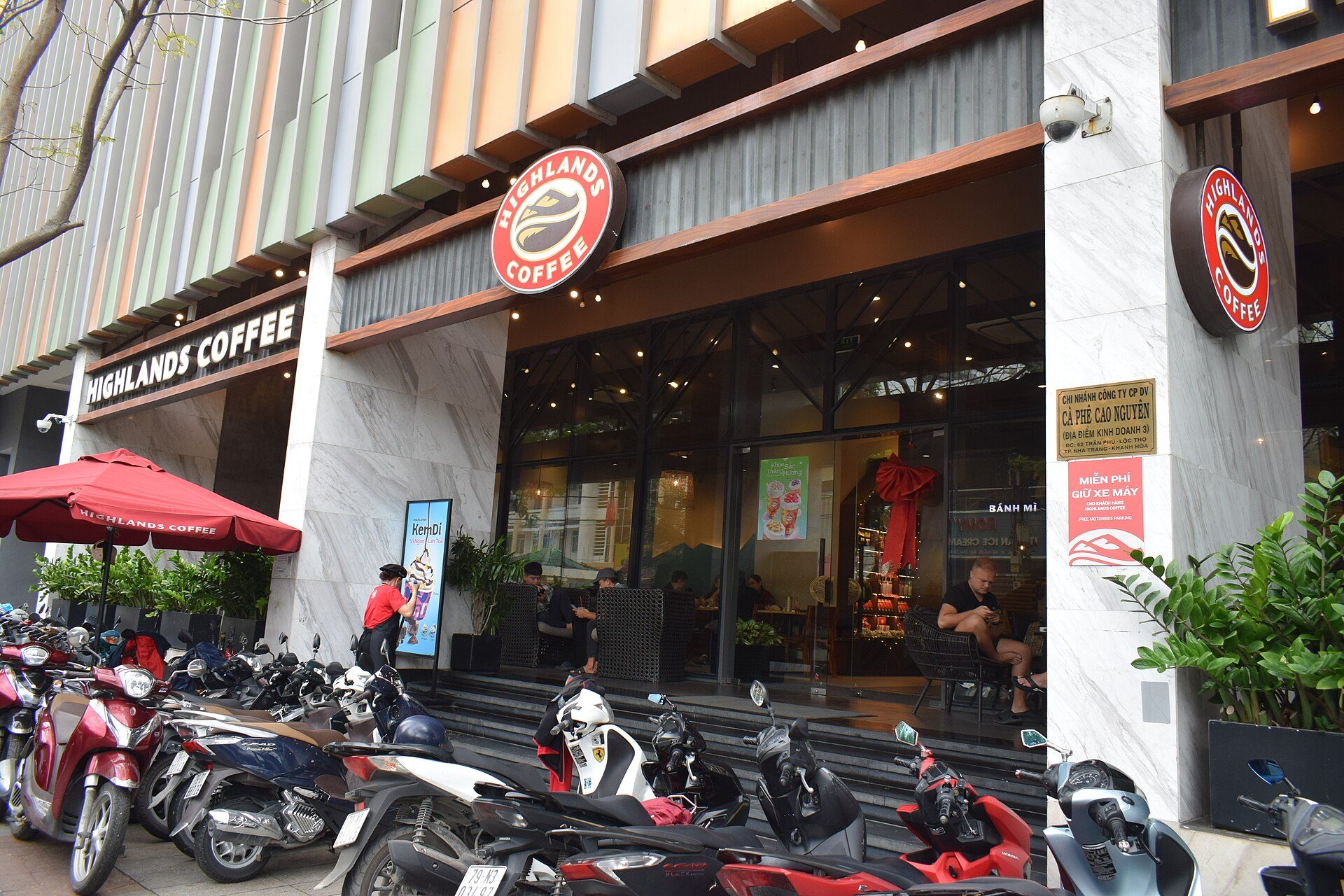
Photo: Ravi Dwivedi / Wikimedia Commons, CC BY-SA 4.0
Specialty and independent cafés
Specialty cafés use high-quality beans, good machines and serve discerning customers. Baristas learn in depth about beans, dial-in and pour-over; those who are good at latte art and can talk about coffee are paid above the market average. Small independent cafés vary widely: some pay little but let you do everything, so you learn fast.
Hotels, resorts and restaurants
Baristas at 4–5 star hotels usually have stable base pay, a monthly share of the service charge, staff meals and uniforms. Requirements often include conversational English and a service manner. This is a good direction if you want steady income and full insurance.
Region
Ho Chi Minh City, Hanoi, Da Nang and tourist destinations usually pay 10–25% more than the provinces, but rent and transport also cost more. In the provinces pay is lower, but many cafés provide meals and accommodation. Compare what is left after costs, not just the number in the job ad.
| Workplace | New barista | Lead barista | Extras |
|---|---|---|---|
| Budget café, coffee cart | 4.5–6 million | 7–9 million | Some provide meals and lodging, few tips |
| Coffee chain | 5–6.5 million | 8–11 million | Insurance, training, clear career path |
| Specialty café | 5.5–7 million | 9–13 million | Decent tips, in-depth bean knowledge |
| 4–5 star hotel | 6–7.5 million | 10–15 million | Service charge, staff meals, English needed |
The table shows 2026 reference ranges in VND per month for large cities, excluding tips and service charge. It is not the pay scale of any particular employer.
How long does it take to learn to be a barista?
"Finishing" barista training really means three milestones in a row, as in any hands-on trade: safe enough and accurate enough with recipes to work the bar under supervision; fast enough to run a shift alone; and good enough to train others. A course helps you reach the first milestone sooner; the other two need real hours behind the bar.
Milestone 1: working the bar under supervision — 1–2 months
You know bar hygiene, safety around the steam wand and boiling water, phin coffee, Vietnamese iced milk coffee, bac xiu (a milk-heavy iced coffee), blended ice drinks and teas from a recipe. You can pull espresso from a set recipe and steam basic milk. With intensive practice of about 15–20 hours a week, most learners reach this milestone in 4–8 weeks.
Milestone 2: running a shift alone — 3–6 months
You make the full menu, dial in every morning on your own, pour a heart and a tulip consistently, and keep up a pace of about one drink every 1–2 minutes at peak time. What decides it is the number of drinks you have made: many cafés only let you run a shift alone after you have made a few thousand drinks without recipe or hygiene errors.
Milestone 3: lead barista — usually 1.5–3 years
A lead barista can handle machine faults, difficult customers and short-staffed shifts; knows how to train newcomers and calculate cost of goods. This milestone cannot be learned quickly in a classroom. Complex latte art like that in Figure 3 also only comes after thousands of real pours.

Photo: Takeaway / Wikimedia Commons, CC BY-SA 3.0
3 ways to learn: time and reference tuition in 2026
There are three common paths. Choose based on how much money you have, how soon you need income, and whether you want a certificate straight away.
| Path | Duration | Reference tuition | Advantages | Watch out for |
|---|---|---|---|---|
| Basic course at a training centre | 1–2 months | 3–7 million VND | Structured syllabus, machines to practise on | Ask how many shots you pull yourself and how much milk you get to use |
| Advanced espresso and latte art course | 1–3 months | 6–15 million VND | In-depth dial-in, pouring patterns | Best taken after a few months behind a real bar |
| Apprenticeship at a café | 2–3 months | Free, with trainee pay | Income, learning at real speed | Foundation knowledge is often taught superficially |
Training centres: what to ask before you pay
Ask three questions: how many shots does each student pull and how many pitchers of milk do they steam; how many students share one machine; and is there an internship at a café? In a class of 8–10 people sharing one machine, each person barely touches it. A small class where everyone gets plenty of practice, as in Figure 4, is the kind you should look for.
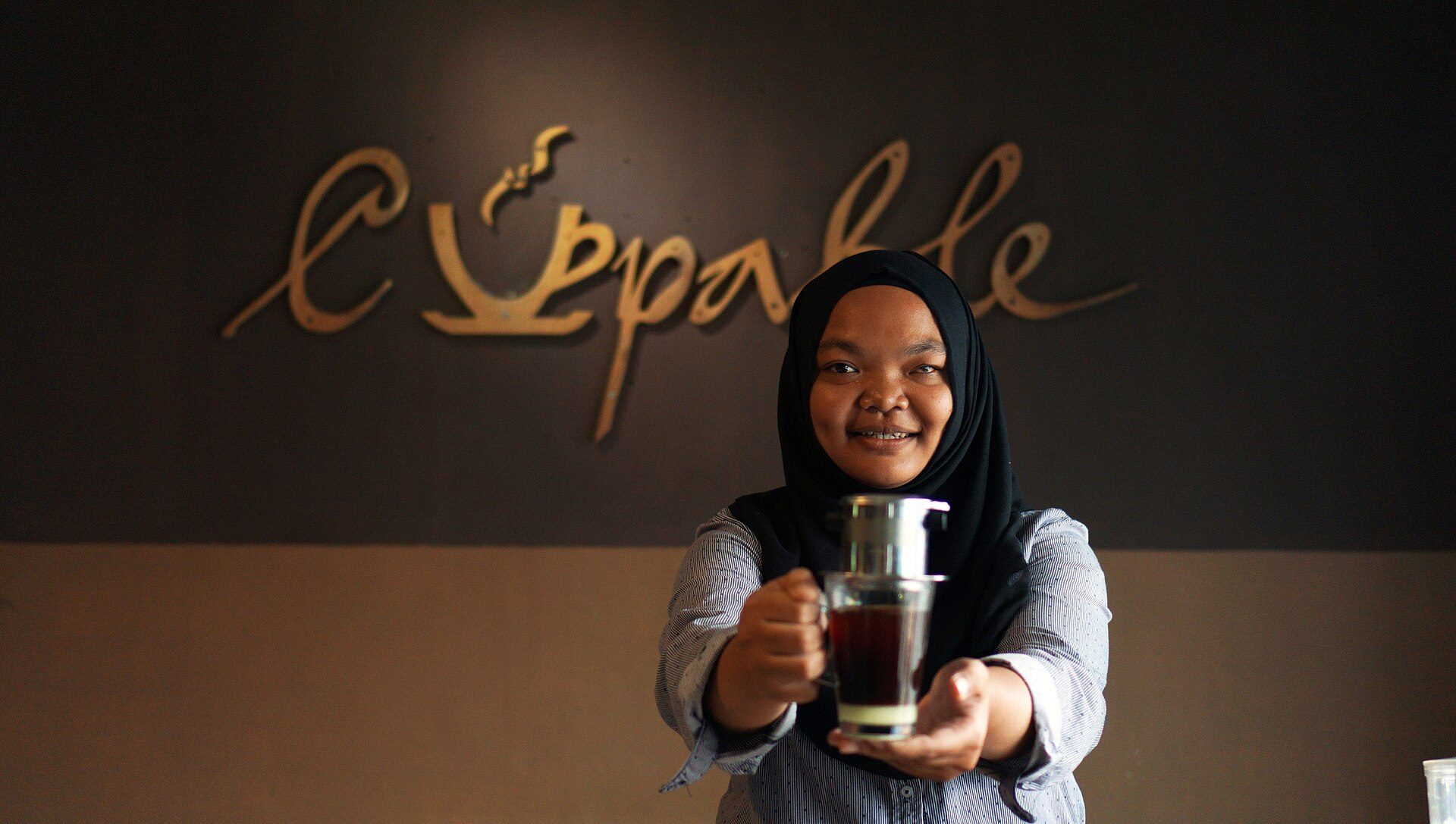
Photo: Department of Foreign Affairs and Trade / Wikimedia Commons, CC BY 4.0
Apprenticeship at a café
Many cafés take complete beginners, pay them trainee wages and raise their pay once they reach the standard. You learn at real speed and earn money, but the theory of beans and extraction is often skipped when the café is busy. Fill the gap yourself by following the steps in the Barista roadmap.
Combining both: the best value for many people
Do an apprenticeship or part-time job first to find out whether the trade suits you; only after 3–6 months pay for an advanced espresso and latte art course. By then your hands are trained, you learn faster and you know what you are missing.
The practical test when applying for a barista job
Well-run cafés usually give candidates a short practical test at the bar. At the final step of the roadmap, NAMBIN suggests a 15-minute mock test: 2 espressos, 2 cappuccinos, 2 lattes with a pattern, plus tasting and bar cleaning. Professional barista competitions (Figure 5) are judged in a similar spirit: taste, technique and cleanliness.
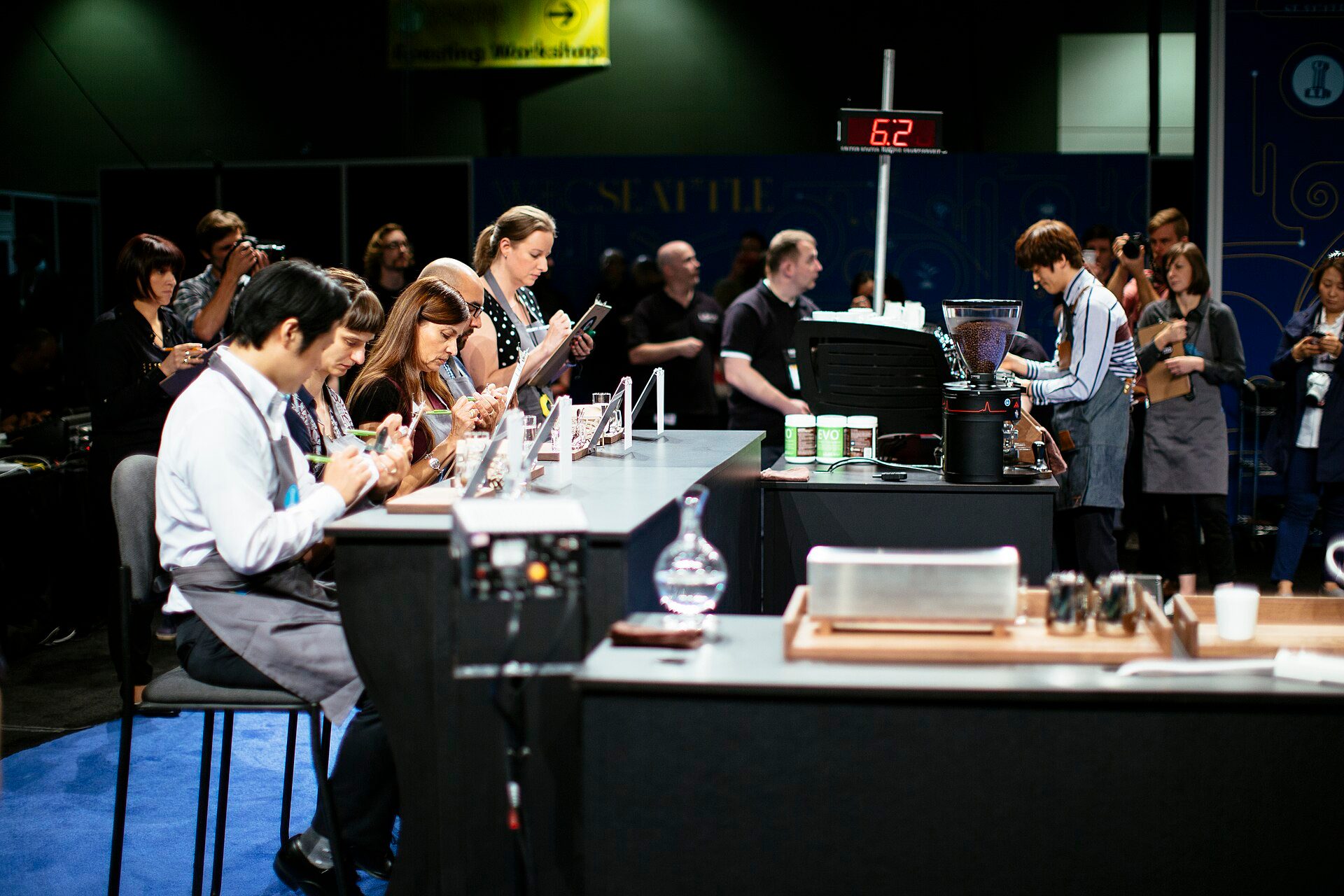
Photo: baristahoon / Wikimedia Commons, CC BY-SA 2.0
What the 15-minute test includes
- 2 minutes of bar preparation: flush the group head, dry the basket, line up pitchers and cloths.
- A quick dial-in and 2 double espressos: 18 g → 36 g in 25–30 seconds.
- 2 cappuccinos: foam about 1.5 cm thick, milk at 55–65°C.
- 2 lattes with a heart or tulip, symmetrical and centred in the cup.
- Clean-down: flush the group head, wipe the steam wand straight after every use, and leave the bar dry when time is up.
What the recruiter looks at
They care less about competition-level patterns than about whether you use a scale and a timer; whether two drinks of the same kind are identical; whether you wipe the steam wand straight away; and whether the bar is tidy at the end. A candidate who is slow but clean and consistent is usually chosen over one who is fast but messy.
CV and latte art video
A one-page CV: where you have worked, for how many months, the drinks you are fluent in, the machines you have used and the courses you have taken. Attach a 1–2 minute video filmed from above of you pouring 3 lattes in a row, with no cuts. A real video matters more than a photo of your best cup.
Safety and employment rights: during mock tests and at work, the steam wand and group head are above 90°C — always purge the steam wand towards the drip tray, wipe it with a separate damp cloth, and never point it at anyone. Standing for an 8-hour shift easily causes back and heel pain: wear cushioned, non-slip shoes. Before accepting a job, ask clearly about the contract, the probation period, how pay and tips are calculated; be wary of anywhere that asks you to pay a "placement fee" or promises unusually high pay.
Worked example: Minh, 19, and his 12-month plan
Minh lives in Bien Hoa, has just finished high school and wants to work as a barista in Ho Chi Minh City. He has 8 million VND in savings. All figures are an illustrative example using 2026 references.
Months 1–2: foundations and part-time work
- A 2-month basic course at a training centre: 5 million VND; non-slip shoes and a notebook: 0.5 million.
- At the same time, part-time work at a budget café: 5 hours × 20 days × 22,000 VND = 2.2 million a month, so 4.4 million over 2 months.
Months 3–12: full-time work
- Months 3–6: new barista at a chain, 6 million × 4 months = 24 million.
- Months 7–12: reaches the experienced level (dials in alone, consistent latte art), 7.5 million × 6 months = 45 million.
- Shared tips in months 3–12 average 0.5 million × 10 months = 5 million.
Summary
Total income: 4.4 + 24 + 45 + 5 = 78.4 million VND (about 3,100 US dollars). Spent on training: 5 + 0.5 = 5.5 million VND. After 12 months, Minh has made roughly 3,000–5,000 drinks, has a latte art video and qualifies to apply as an experienced barista at a specialty café. If in month 10 he takes an advanced latte art course (say 8 million), his training costs rise to 13.5 million, but it opens the way to the 9–12 million level sooner.
Common mistakes about pay and training
Looking only at base pay
Sign: choosing a café that pays 500,000 VND more but has no tips, no staff meals and a long commute. Cause: not adding up everything. Fix: calculate total income minus transport and food costs for each option.
Paying for an expensive course before ever working a bar
Sign: finishing a 15-million course and still fumbling at rush hour. Cause: courses teach technique, not speed. Fix: work part-time behind a bar first, take the advanced course later.
Changing jobs too early
Sign: 2–3 months at each place, a long CV but no improvement in skill. Cause: chasing a few hundred thousand VND in difference. Fix: stay in one place long enough to pass the "running a shift alone" milestone and earn a reference.
No evidence of your skills
Sign: telling the interviewer "I can do latte art" with no video. Fix: film a video of consecutive pours every month and keep your dial-in log as proof.
Frequently asked questions
How much does a newly trained barista earn?
As a 2026 reference, about 5–7 million VND a month in large cities, excluding tips; in the provinces it is usually lower, though some places provide meals and lodging.
How long do you need to train before you can work?
After 1–2 months of training you can work the bar under supervision; after 3–6 months you can run a shift alone; becoming a lead barista usually takes 1.5–3 years.
Can I become a barista without qualifications?
Yes. Most cafés hire based on a practical test and attitude. A course certificate is a plus, not a requirement.
Can a barista move into management or open a café?
Yes. The common path is lead barista → shift leader → store manager, or opening your own coffee cart or small café once you understand cost of goods, menus and operations.
Do baristas need English?
Budget cafés do not require it. Specialty cafés, hotels and tourist areas prefer people with basic conversational English and usually pay more.
Exercises: mock test and planning
- Time yourself doing the full 15-minute test: 2 espressos, 2 cappuccinos, 2 lattes with a pattern; ask someone else to score you using the criteria above.
- List 3 places you want to apply to, noting the type of café, reference pay, tips, allowances and commuting costs.
- Draw up a 12-month plan like Minh's: total income, total costs and the milestones for moving up.
- Film 3 consecutive latte pours and write a one-page CV.
Pass / not yet
- Pass: you finish the test within 15 minutes; both espressos fall within 25–30 seconds; both lattes have a recognisable pattern; the bar is clean at the end.
- Pass: your 12-month plan has income and cost figures that add up correctly and concrete milestones for moving up.
- Not yet: you go over 15 minutes, work without a scale, do not wipe the steam wand, or your plan only says "finish the course, then get a well-paid job".
This is the final step of the roadmap. To revise, go back to the two most important foundation steps: grinding and pulling espresso properly (dial-in) and phin coffee, bac xiu, cold brew and pour-over — this week's lessons on pulling espresso and making phin coffee are both in the 8-step Barista roadmap. Once you are working, the next directions are deeper knowledge of beans and roasting, advanced latte art, then bar management and menu costing.