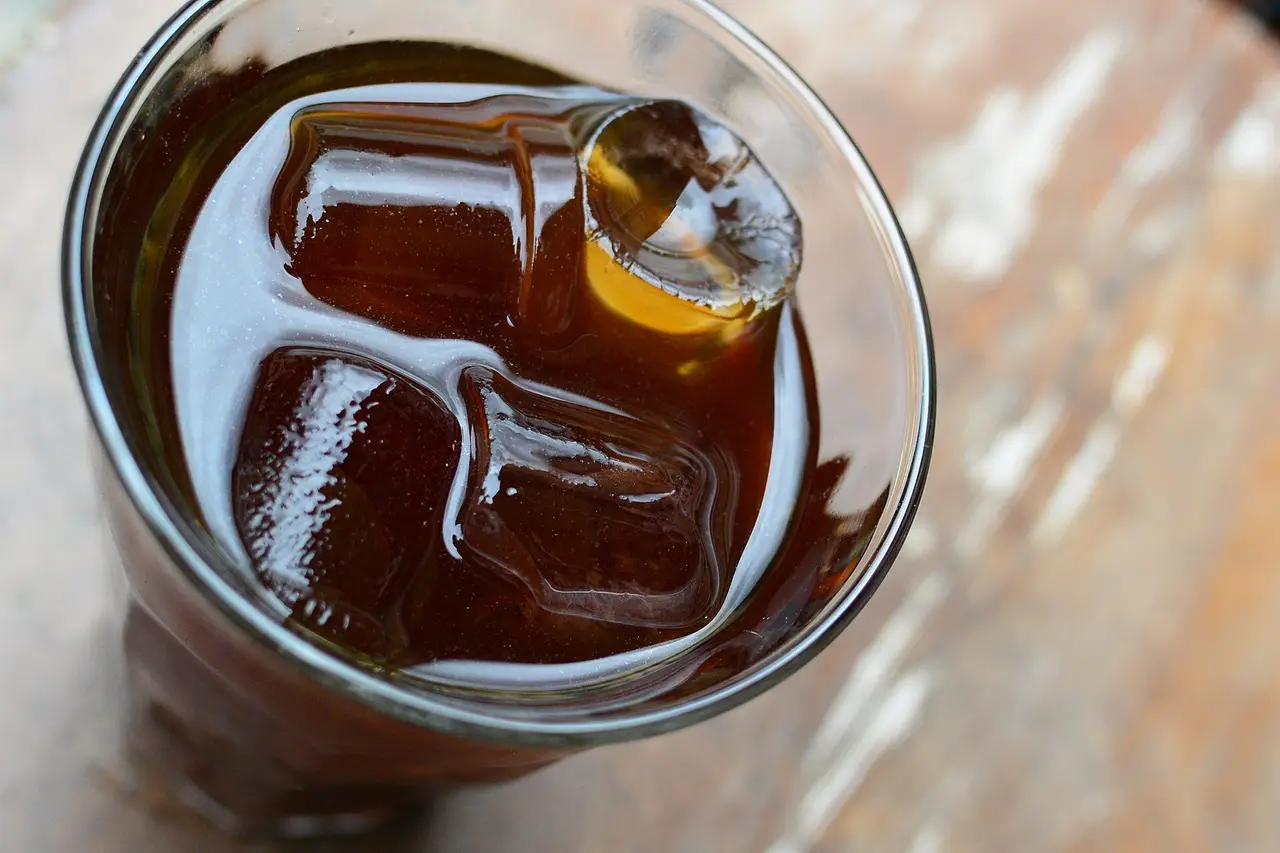
Making cold brew for a coffee bar comes down to four numbers: coarsely ground coffee and filtered water at about 1:5 (1 kg of coffee to 5 litres of water) for a strong concentrate, 12–18 hours steeping in the fridge, two filtrations, then diluting about 1:1 with water or milk when you serve. The concentrate goes into sealed bottles kept at 0–5°C, labelled with the date and time and used within the shop's internal shelf life (usually 3–5 days). This lesson covers choosing beans, grind size, steeping and filtering, food-safe storage, serving recipes, and how to cost a cup so you can set a price that does not lose money.
By the end of this lesson, you will be able to:
- Choose beans, roast level and grind size for cold brew and explain why the grind must be coarse.
- Steep a batch of cold brew concentrate at 1:5 for 12–18 hours and filter it clear, with no sediment.
- Store the concentrate at the right temperature, label it, rotate stock and recognise a spoiled batch that must be thrown away.
- Measure out 3 cold brew drinks for the bar in exact millilitres.
- Work out the cost of a cup from a 1 kg batch and set a selling price from a target cost percentage.
Learning the barista trade? Cold brew is part of step 5 of the roadmap, together with phin coffee, bac xiu and pour over. See the 8-step barista roadmap to learn in the right order, from bar hygiene, coffee beans and espresso to finding a job.
What cold brew is, and how it differs from hot coffee over ice
Cold brew is coffee extracted with cool water over many hours instead of hot water over a few minutes. Cold water dissolves more slowly and extracts less of some compounds that taste harsh, sour or burnt, so cold brew is usually smooth, sweet in the finish and less acidic than hot coffee poured over ice. The trade-off is aroma: it does not have the big fragrance of a hot phin; cold brew smells gentle and pairs well with ice, milk and fruit.
Cold brew versus iced phin coffee
Iced phin coffee is brewed hot for 4–6 minutes and poured over ice; it is strong, clearly bitter and smells of roast (see the lesson on Vietnamese phin coffee). Cold brew is made in batches the day before and only poured at service, so drinks go out much faster during a rush. That is why many takeaway shops in Vietnam make cold brew a core item.
Cold brew is not automatically low in caffeine
The caffeine in a cup depends on the bean (Robusta has more than Arabica), the steeping ratio and the dilution. A 1:5 concentrate is very strong; an iced cold brew diluted 1:1 can match a hot-brewed coffee. Do not advertise "low caffeine" unless you have measured it; for caffeine-sensitive customers, suggest a small cup or a weaker dilution.
Beans, roast level and grind
Beans and roast
- Arabica (Cau Dat, Son La): bright acidity and fruity notes; a medium roast gives sweet, fragrant cold brew that works black.
- Robusta (Dak Lak, Gia Lai): strong, bitter, high in caffeine, heavy body; good for cold brew with milk.
- Blends: many shops use about 70% Arabica and 30% Robusta, sweet enough black and strong enough with milk.
- Roast level: medium to medium-dark. Too dark and cold brew turns burnt and harsh; too light and it is sour and thin when steeped cold.
Use beans rested about 5–7 days after roasting and within roughly a month of the roast date for stable flavour. Very fresh beans hold a lot of gas, so the grounds float and wet unevenly.
Grind: as coarse as raw sugar
Cold brew needs a coarse grind, particles the size of raw sugar or small sea salt crystals, coarser than for a phin. Use a burr grinder with adjustable coarseness (Figure 1) and grind just before steeping. Steeping fine grounds for many hours over-extracts and tastes bitter and astringent, and the fines pass through the filter bag, making the concentrate cloudy with sediment. Grounds that are too coarse (like broken beans) taste thin and waste coffee.
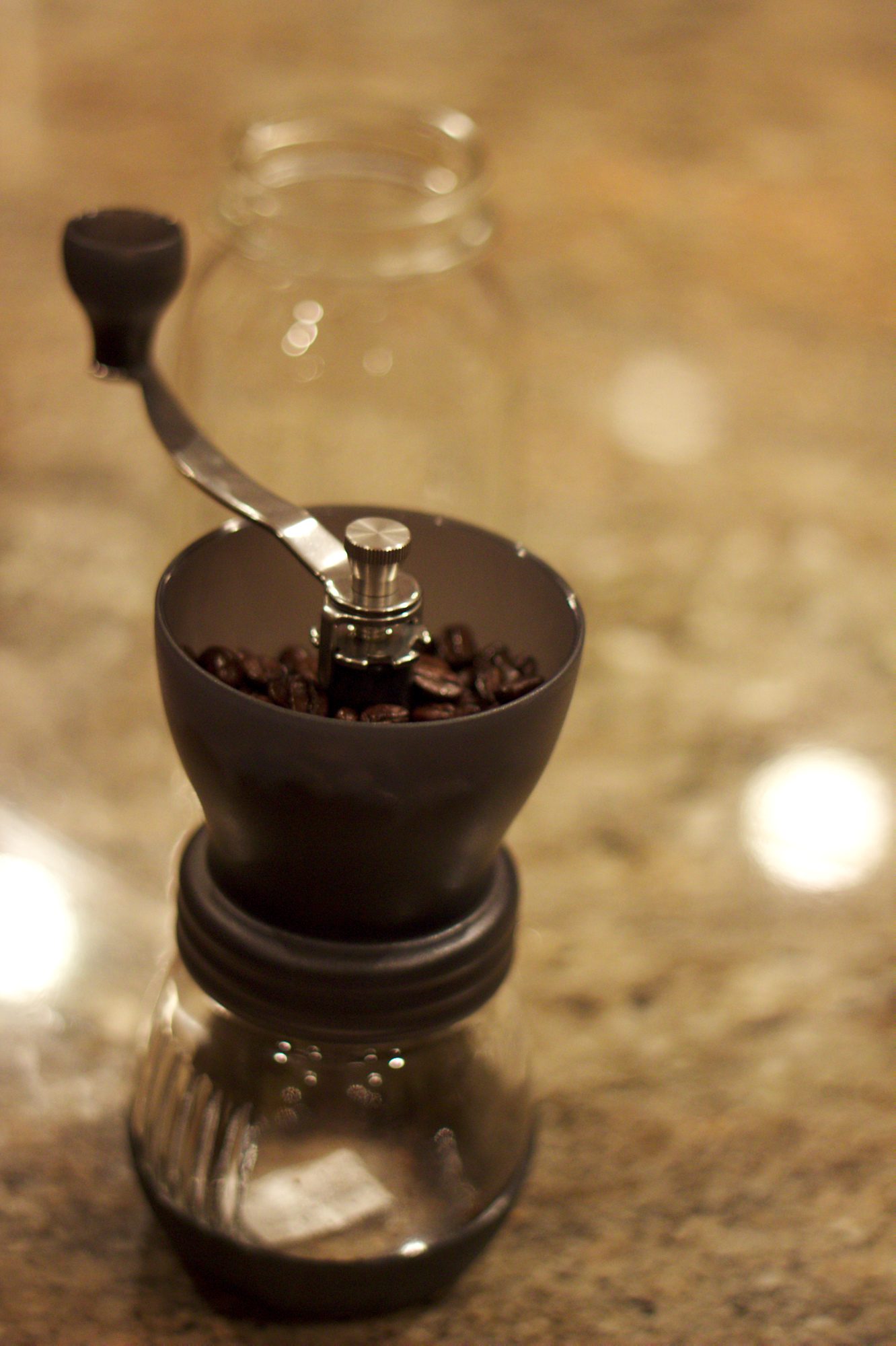
Photo: Sage Ross / Wikimedia Commons, CC BY-SA 3.0
Cold brew ratio and steeping time
There are two approaches: steep a strong concentrate and dilute it at service, or steep a weaker brew to drink as is. A bar should make concentrate: it takes less fridge space and can become several different drinks.
Reference ratios
| Style | Coffee : water (by weight) | Steeping time in the fridge | At service |
|---|---|---|---|
| Strong concentrate (for the bar) | 1:4 to 1:5 | 12–18 hours | Dilute about 1:1 with water, milk or juice |
| Ready to drink | 1:8 to 1:10 | 12–16 hours | Pour straight over ice |
| Small test batch | 100 g : 500 g water | Taste at 12, 15 and 18 hours | Pick the best point for the beans you use |
Steeping much under 12 hours tends to taste thin and sour; going beyond about 20 hours tends to taste woody and astringent. Each bean has its own sweet spot in this range, so taste the first batch of any new bean at several time points.
Why steep in the fridge
Many foreign guides allow steeping at room temperature. In Vietnam, room temperature in the hot season is often 28–35°C; leaving a jar of wet, low-acid coffee at that temperature for 12–18 hours invites bacteria and yeast. A bar should steep in the fridge from the start; it is safer and the flavour is cleaner too.
Making cold brew step by step
Equipment
A digital scale (1 g increments), a grinder with adjustable coarseness, a glass, stainless steel or food-grade plastic steeping container with a tight lid, a cloth filter bag or fine stainless mesh, a funnel and paper filters, bottles with lids for the concentrate, a pen and labels, and clean filtered water. Wash everything, rinse with boiling water or sanitise it according to your shop's procedure, and let it dry before use.
Steps for one batch
- Weigh the beans to the ratio (for example 1,000 g) and grind coarse just before steeping.
- Put the grounds in the filter bag and place the bag in the container.
- Pour cool filtered water in circles so all the grounds get wet (Figure 2), using the ratio (for example 5,000 g).
- Press gently and stir slowly with a clean spoon until no dry pockets remain, without stirring hard enough to break up the grounds.
- Close the lid and label it: start date and time, planned filtering time, and who made it.
- Put it in the fridge and steep 12–18 hours, to the time point chosen for the bean.
- Lift out the filter bag and let it drain naturally; do not squeeze it hard, which adds astringency and fines.
- Filter a second time through a paper filter (Figure 3) so the concentrate is clear without sediment.
- Pour into clean bottles, seal, label with the filtering date, time and use-by date, and put it in the fridge straight away.
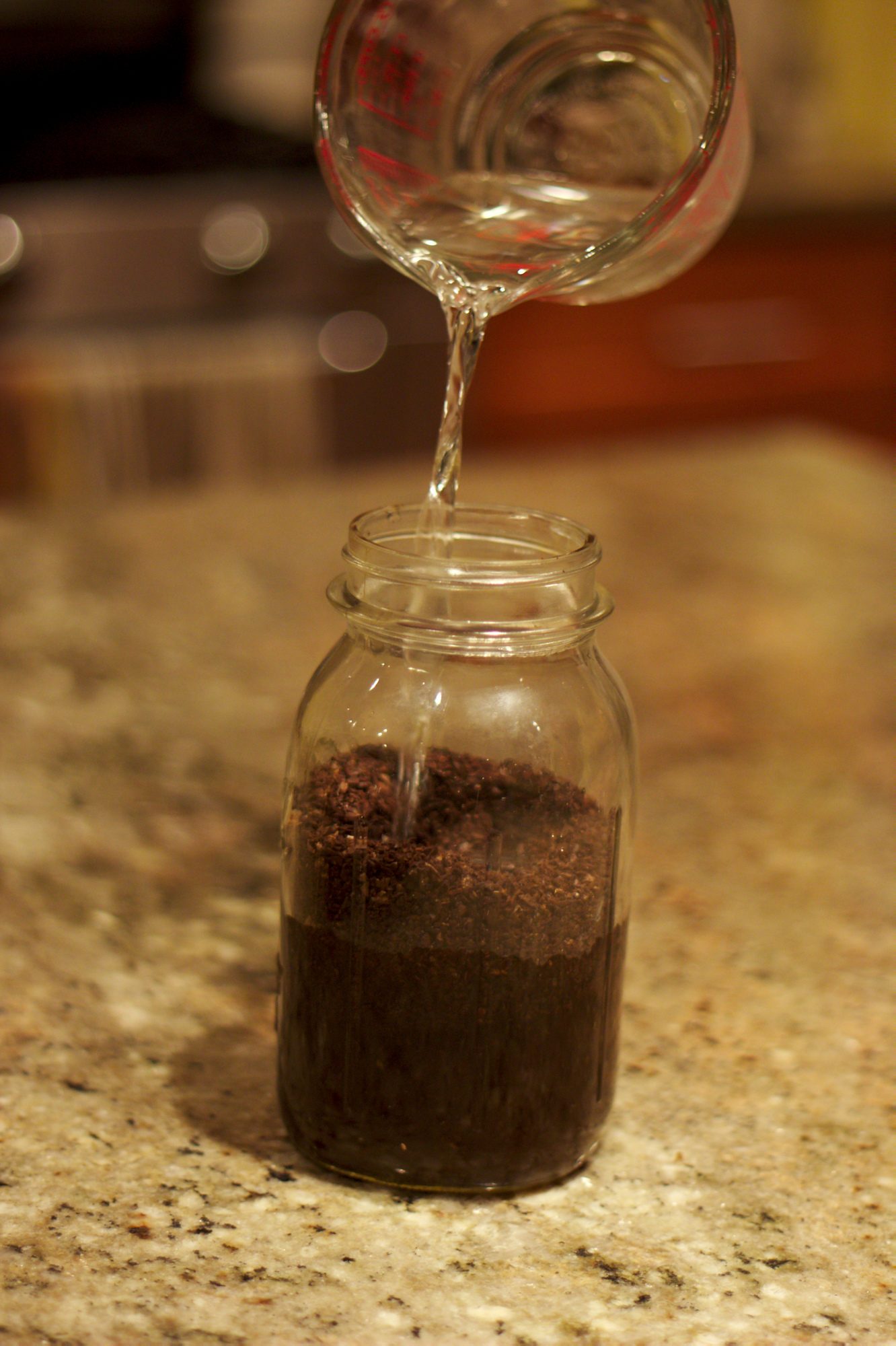
Photo: Sage Ross / Wikimedia Commons, CC BY-SA 3.0
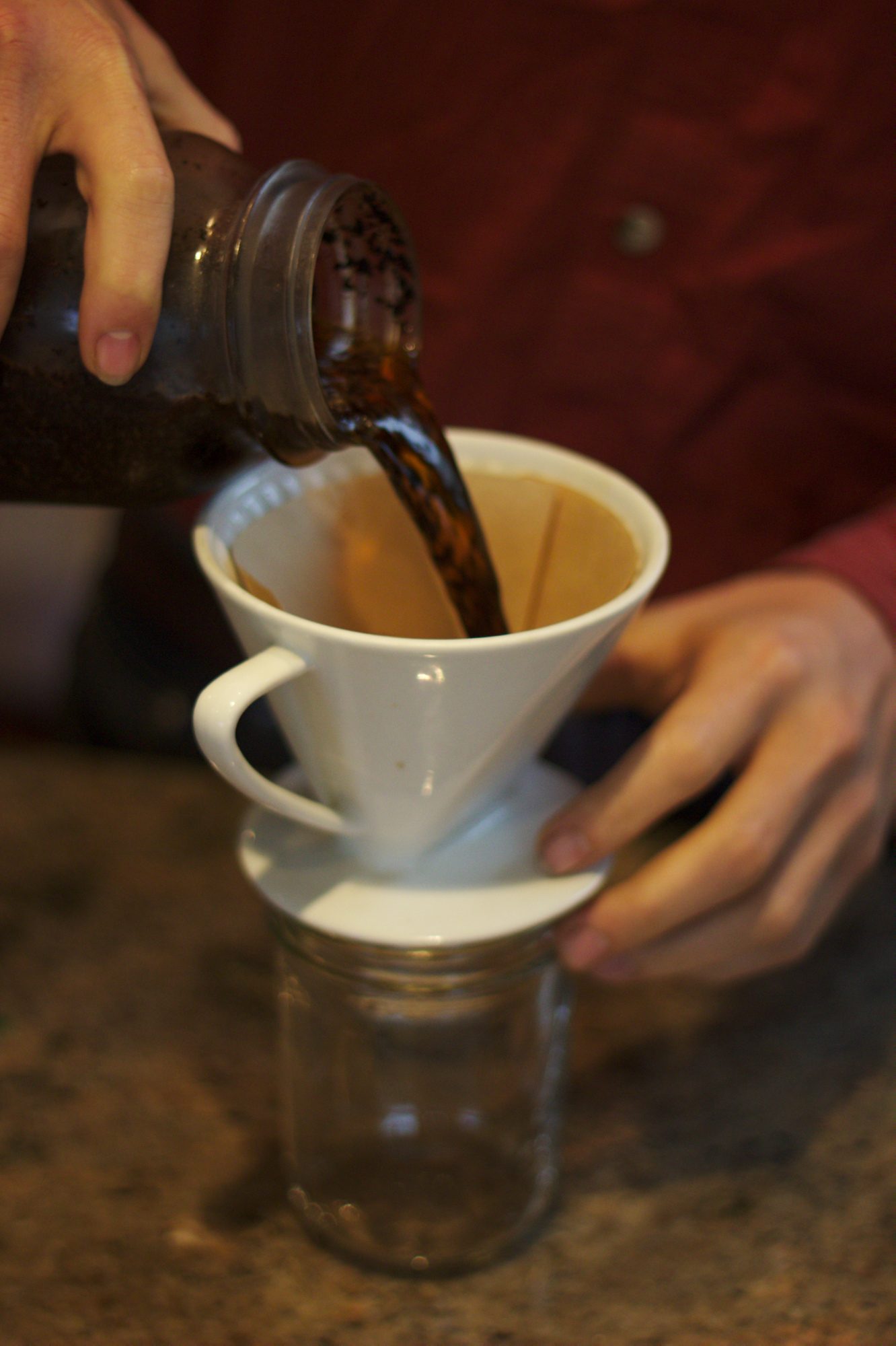
Photo: Sage Ross / Wikimedia Commons, CC BY-SA 3.0
Storing the concentrate and food safety
Cold brew is a low-acid drink that is never boiled, so treat it as a perishable food. Write the bar's rules down and post them on the fridge.
Storage rules
- Glass or food-grade plastic bottles with tight lids, filled close to the top to limit air.
- Fridge at 0–5°C, with a thermometer inside and the temperature logged every shift. Never leave it on the counter for a whole shift (Figure 4).
- Internal shelf life: many shops set about 3–5 days for concentrate from the filtering time; drinks already mixed with milk are sold the same day. Follow your shop's limit and check the current food safety rules where you trade.
- Rotation: old bottles out first, new bottles in behind; never top up the remains of an old batch with a new one.
- Wash containers, bottles and filter bags after every batch; launder cloth bags thoroughly, dry them fully and replace them when stained or smelly.
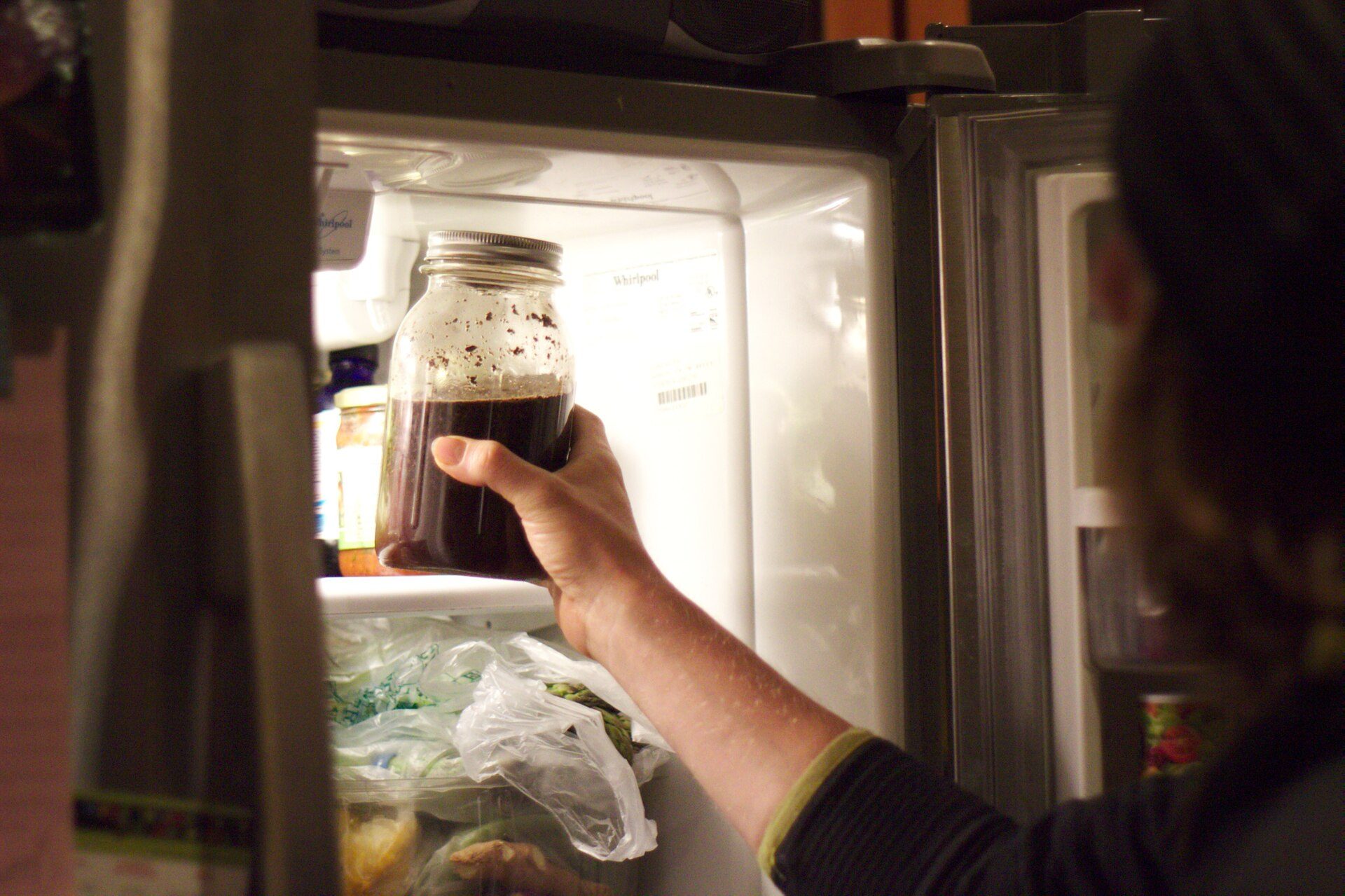
Photo: Sage Ross / Wikimedia Commons, CC BY-SA 3.0
Signs a batch is spoiled and must be discarded
A fermented smell like vinegar or alcohol, a film or strands of mould on the surface, fine bubbles rising without stirring, a sharp sourness unlike the standard batch, or a passed use-by date on the label. Any one of these means discarding the whole bottle, not "adding more milk to cover it".
Safety warning: Do not steep cold brew at room temperature behind a hot bar, do not use unfiltered water, and do not leave concentrate out of the fridge for hours. Spoiled drinks can make customers ill: when in doubt, throw it out. When rinsing containers with boiling water, wear heat-resistant gloves, pour slowly and stand glass containers on a towel so they do not crack from thermal shock. The grinder is electric: unplug it before cleaning the burrs and never put your hand in the hopper while it is plugged in. If customers ask about caffeine during pregnancy, with heart conditions or while on medication, do not advise in place of a doctor; suggest a small or weaker cup, or a coffee-free drink.
Cold brew recipes for the bar
Fixed measurements with a measuring cup or jigger let every barista make the same drink. The three drinks below use a 16 oz (about 480 ml) cup filled with ice.
| Drink | 1:5 concentrate | Mixer | Notes |
|---|---|---|---|
| Iced black cold brew | 80 ml | 80 ml filtered water | Offer 10–15 ml sugar syrup |
| Cold brew with milk | 80 ml | 60 ml fresh milk + 15 ml condensed milk | Suits a concentrate with Robusta |
| Orange cold brew | 70 ml | 90 ml fresh orange juice + 10 ml syrup | Pour orange first, concentrate second for clean layers |
Keep the dilution the same across shifts. If a customer finds it too strong or weak, adjust the water in that cup, not the steeping ratio of the batch in progress.
Worked example: pricing a black cold brew from a 1 kg batch
A takeaway shop sells about 15 cold brews a day using a 70% Arabica, 30% Robusta blend. Each batch steeps 1 kg of coffee in 5 litres of water (1:5). The prices below are 2026 references in Vietnam, varying by region and supplier.
Concentrate yield
- Water in: 5,000 ml. The spent grounds hold about 2 ml of water per gram: 1,000 × 2 = 2,000 ml.
- Concentrate out: 5,000 − 2,000 = 3,000 ml.
- Each black cold brew uses 80 ml of concentrate: 37 cups × 80 ml = 2,960 ml, leaving 40 ml for tasting the batch. 2,960 + 40 = 3,000 ml.
- At 15 cups a day, 37 cups last about 37 ÷ 15 ≈ 2.5 days, within the 3–5 day shelf life.
Cost per cup
| Item | Calculation | Amount |
|---|---|---|
| Roasted coffee, 1 kg | 1 kg × 350,000 VND | 350,000 VND |
| Filtered water | 5 litres × 1,000 VND | 5,000 VND |
| Paper filters, filter bag wear | Whole batch | 10,000 VND |
| Cost of the batch | 365,000 VND | |
| Coffee per cup | 365,000 ÷ 37 cups | ≈ 9,865 VND |
| Cup, lid, straw | 1 set | 3,500 VND |
| Ice | 1 cup | 1,000 VND |
| Cost of 1 black cold brew | ≈ 14,365 VND, rounded to 14,400 VND | |
Check: 350,000 + 5,000 + 10,000 = 365,000 VND; 9,865 + 3,500 + 1,000 = 14,365 VND (about 0.55 USD).
Setting the price
Many shops aim for an ingredient cost of about 25–35% of the selling price. With a 30% target: 14,400 ÷ 0.30 = 48,000 VND. The shop picks 49,000 VND, an actual cost percentage of 14,400 ÷ 49,000 ≈ 29.4%. The rest has to cover rent, staff, utilities, equipment wear and waste (spoiled or expired batches), so do not cut the price just because "the cost is only 14 thousand". If slow sales mean discarding 5 cups per batch, the coffee cost per cup sold rises to 365,000 ÷ 32 ≈ 11,406 VND, which shows why a batch must match your sales.
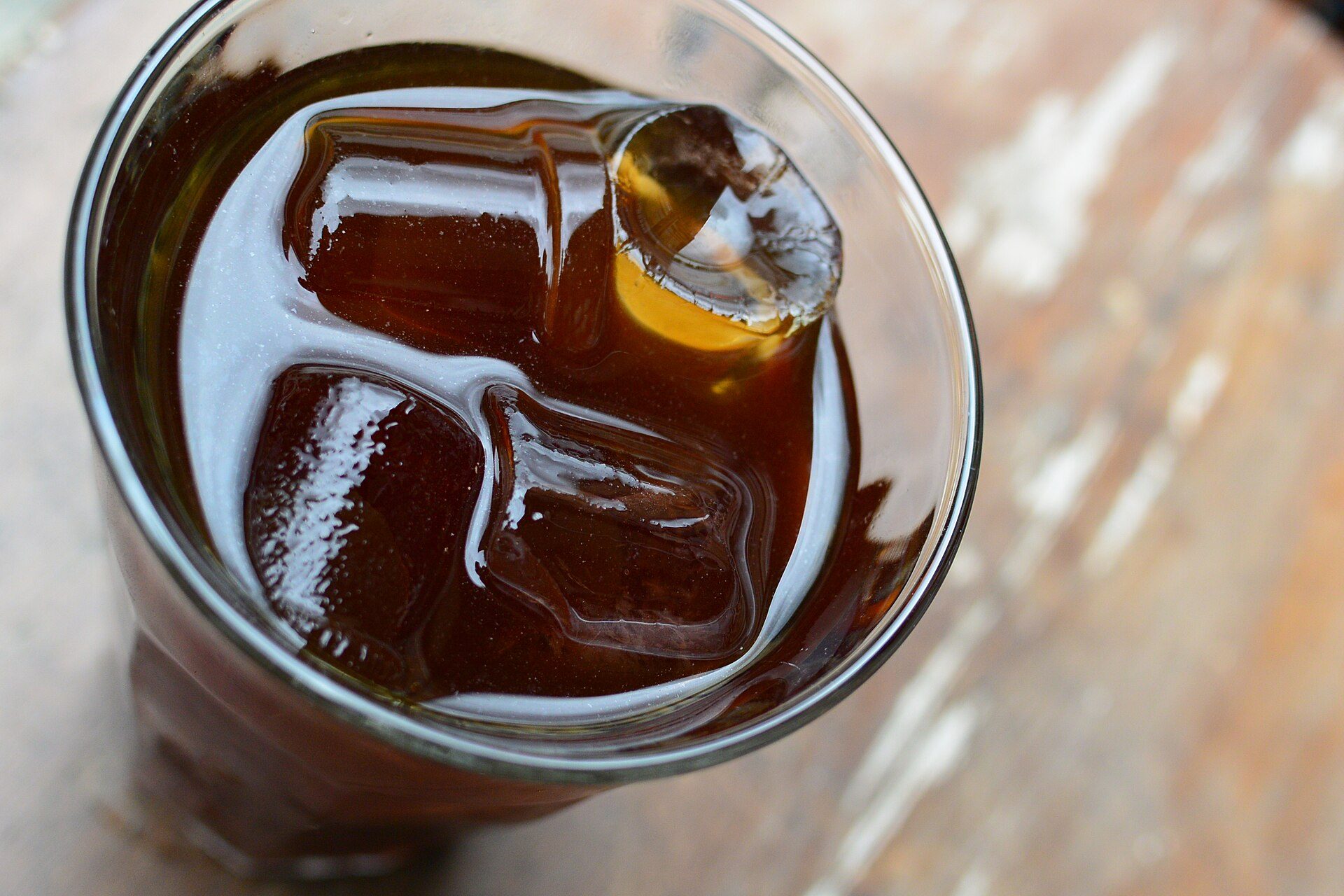
Photo: Roland Tanglao / Wikimedia Commons, CC0
Common cold brew mistakes
Bitter, astringent, woody
Sign: a dry mouthfeel and a long bitter finish. Cause: fine grind, steeping too long, squeezing the filter bag, beans roasted too dark. Fix: grind coarser, cut 2–3 hours, let the bag drain naturally.
Thin and sour
Sign: still watery and sour at 1:1. Cause: too weak a ratio, too coarse a grind, not steeped long enough, beans roasted too light. Fix: go back to 1:5, grind one step finer, steep 2–3 hours longer.
Cloudy, with sediment
Sign: grit in the cup and sludge at the bottom of the bottle. Cause: only one filtration, a torn or loose filter bag. Fix: always filter a second time through paper and check the bag before each batch.
Fermented smell, surface film
Sign: a vinegar or alcohol smell, a film on top. Cause: steeping at room temperature, dirty equipment, past its date, a fridge that is not cold enough. Fix: discard the whole batch, clean the equipment again, check the fridge temperature and steep in the fridge.
Frequently asked questions
How long should cold brew steep?
In the fridge, usually 12–18 hours for a 1:5 concentrate. For the first batch of a new bean, taste at 12, 15 and 18 hours, pick the best and write it into the bar's recipe.
How long does cold brew keep?
Sealed concentrate at 0–5°C is typically used by shops within about 3–5 days of filtering; drinks mixed with milk are sold the same day. This is a cautious internal limit, not a legal figure; anything unusual means throwing it away.
Can I make cold brew with Robusta?
Yes, especially for cold brew with milk. Robusta is strong, bitter and high in caffeine; roast it medium and grind coarse to avoid harshness. Many shops blend it with Arabica for a smoother black cup.
What is the difference between cold brew and cold drip?
Cold brew immerses all the grounds in water for many hours and then filters. Cold drip lets melting ice water drip slowly through a column of coffee over several hours using dedicated equipment; it is usually cleaner and more aromatic but needs special gear and someone to watch the drip rate.
Do I need a separate grinder for cold brew?
Not necessarily, but it must adjust coarseness and grind evenly. If you share the espresso grinder, return it to the espresso setting afterwards and purge a few grams so the grind sizes do not mix.
Practice tasks and self-assessment
- Steep a 100 g test batch with 500 g of water, taste at 12, 15 and 18 hours and note the flavour at each point.
- Filter the test batch twice, and after a day compare it with a bottle filtered only once for clarity and sediment.
- Make the 3 drinks in the recipe table, measure exactly and ask 3 people to taste and score them.
- Work out the cost of a cold brew with milk using the table above and ingredient prices where you live.
Self-assessment criteria
- Pass: the concentrate is clear, without sediment, bitterness or astringency; you have chosen a steeping time for your bean.
- Pass: every bottle has a filtering date, time and use-by date; the fridge temperature is logged every shift.
- Pass: the cost table adds up and the proposed price gives a 25–35% cost percentage.
- Not yet: steeping at room temperature, no labels, or adding milk to mask a batch that smells off.
Once you can make consistent cold brew and know the cost of every cup, move on to the next roadmap step: Running the bar at peak hours and machine maintenance, where you learn to organise the bar, make several drinks in parallel and keep the espresso machine running reliably.
Keep learning the barista trade: after phin, cold brew and pour over come peak-hour bar operations, an 8-drink menu project and the skills test. See the 8-step barista roadmap.