Brewing great Vietnamese phin coffee comes down to four numbers: about 20–25 g of ground coffee, water at 92–96°C, a 30-second bloom and a drip time of 4–6 minutes. Master those four numbers and every cup will be strong and aromatic, neither sour nor burnt-bitter — good enough to work the bar at a street-side stall or a coffee chain. This lesson teaches you to brew with a phin, the small Vietnamese drip filter, from choosing the grounds to serving the glass, and then moves on to the three best sellers: iced coffee with condensed milk (ca phe sua da), bac xiu and salted coffee.
By the end of this lesson, you will be able to:
- Brew a black phin coffee with 20–25 g of grounds in 4–6 minutes of dripping, yielding 40–50 ml of concentrate.
- Adjust the grind, the tamp and the water when the phin drips too fast or too slowly.
- Make iced milk coffee, bac xiu and salted coffee to standardised bar recipes.
- Calculate the ingredient cost of one iced milk coffee and keep the taste consistent during rush hour.
Looking for a way into the barista trade? See the 8-step barista roadmap on NAMBIN — from bar hygiene, Vietnamese coffee beans, espresso and latte art to phin brewing, cold brew and job hunting.
How the phin works: understand it before you brew
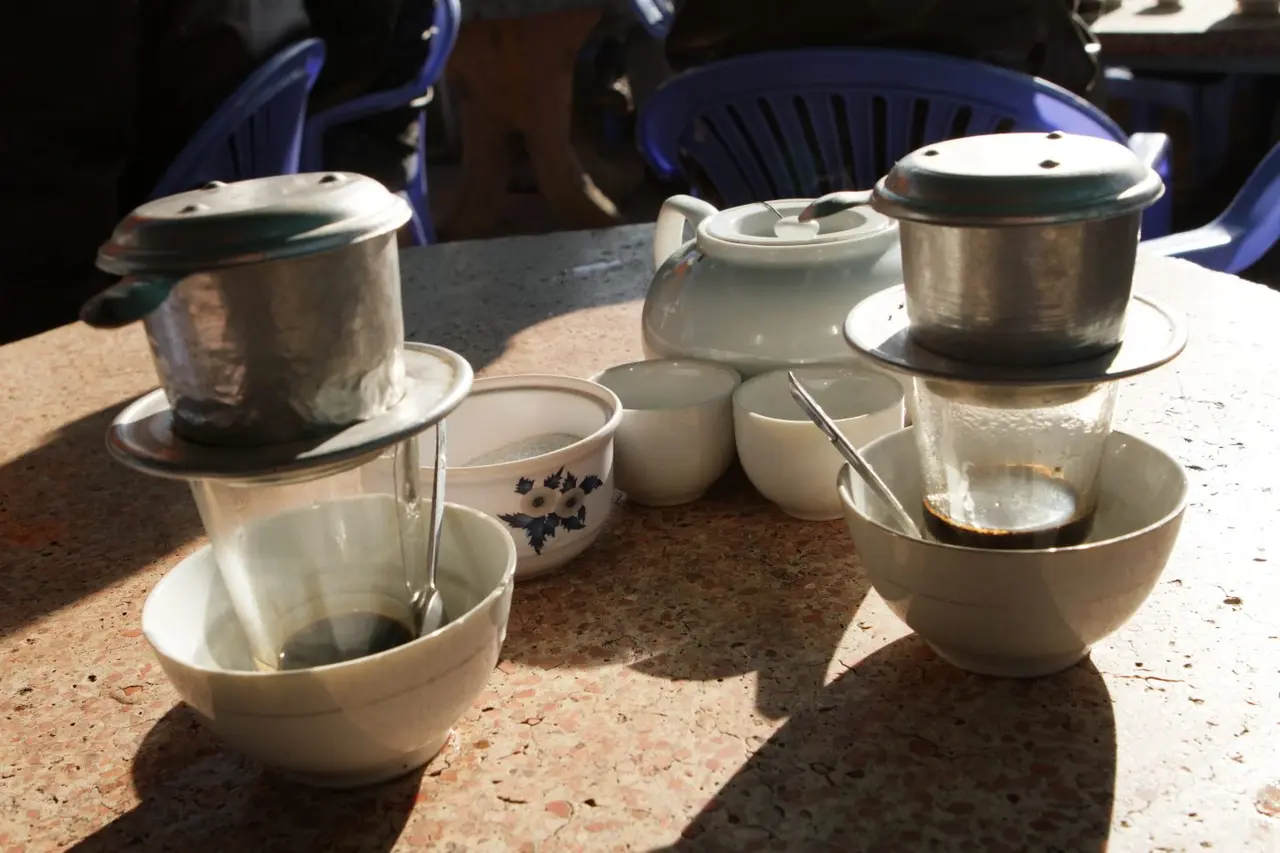
A phin is a small drip filter made of aluminium or stainless steel, with four parts: a perforated base plate, a brewing chamber, a press insert (the tamper) and a lid. Hot water soaks through the bed of grounds, dissolves the flavour compounds and drips slowly through the holes in the base. Unlike espresso, which uses machine pressure, the phin relies on gravity and time, so anything that makes the water run faster or slower decides how the cup tastes.
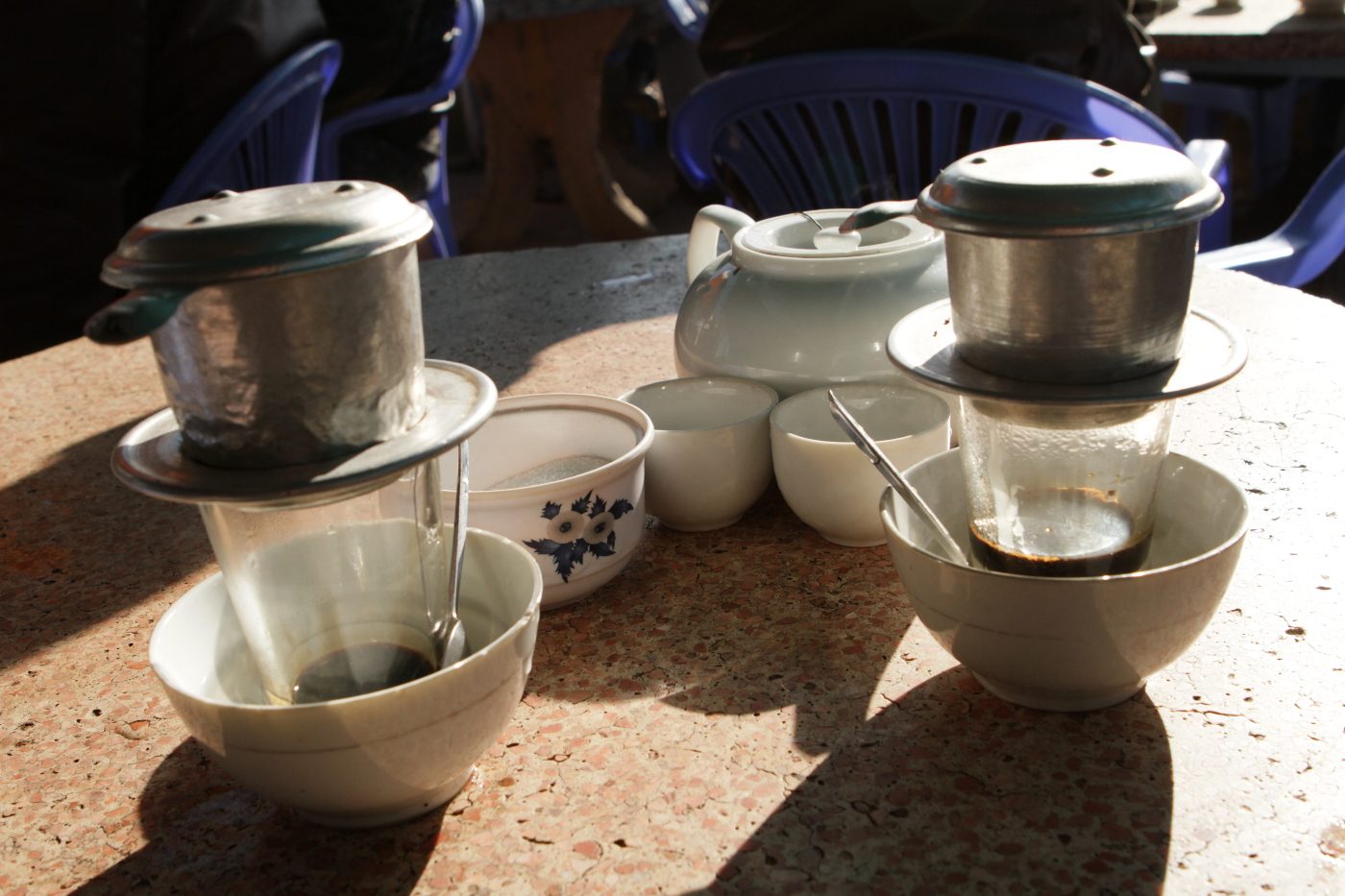
Photo: Frank Fox / Wikimedia Commons, CC BY-SA 4.0
Extraction: why too fast tastes sour and too slow tastes bitter
Extraction is the process of water pulling compounds out of the grounds and into the cup. Acids and aromatics dissolve first, sweetness next, and bitter, astringent compounds last. Water that runs through too quickly (under 3 minutes) only picks up the sour, thin part — this is under-extraction. Water that sits too long (over 8 minutes) also pulls out the bitter, harsh part — over-extraction. The target is 4–6 minutes: sweet and strong without harshness.
Three things decide the drip speed
First, the grind: the finer the grounds, the slower the water flows. Phin coffee should be ground medium to slightly coarse, about the size of granulated sugar, not as fine as espresso. Second, the tamp of the press insert: pressing hard slows the flow, resting it lightly speeds it up. Third, the dose: a size 6–7 phin (about 7 cm across) holds 20–25 g comfortably; above 30 g the grounds swell and jam, and the drip becomes very slow.
Robusta, Arabica or a blend?
Most Vietnamese cafes use Central Highlands Robusta or a Robusta–Arabica blend, dark roasted. Robusta is high in caffeine, strong and bitter, which pairs well with condensed milk. Arabica (from Cau Dat or Son La) is aromatic with a bright acidity and is often blended at 20–30% to make the cup easier to drink. Details on growing regions and roast levels are in the "Vietnamese coffee beans and roast levels" step of the barista roadmap.
Tools and ingredients
A phin bar does not need expensive machines, but it does need measuring tools so that every glass tastes the same. The habit of "guessing with a spoon" is the number one reason customers complain that "the coffee is weak today".
Minimum equipment
- Aluminium or stainless steel phins, size 6–7, each with its own well-fitting press insert.
- A digital scale reading to 0.1 g or 1 g; a measuring scoop you have weighed yourself (a heaped scoop is often about 8–10 g, but weigh your own).
- A kettle, a thermometer or a temperature-controlled kettle; a gooseneck kettle helps you pour evenly.
- 200–300 ml glasses, a 50 ml measuring jug and a timer.
Ingredients
Ground coffee used within 2–4 weeks of the roast date, stored in a bag with a one-way valve and folded shut after every use. Sweetened condensed milk, unsweetened fresh milk and clean ice. If you sell salted coffee, you also need whipping cream and fine salt; egg coffee needs fresh eggs from a known source.
Checks before opening the bar
Rinse the phins with boiling water to warm them and remove any metallic smell. Brew one test phin and time it: if it is far from 4–6 minutes, adjust the grind before the rush starts. Note the batch of coffee and the drip time in the bar log.
How to brew black phin coffee, step by step
The routine below is for one phin with 22 g of grounds, yielding about 45 ml of strong concentrate — enough for one iced black coffee or one iced milk coffee. See Figures 2 and 3 for adding the grounds and pouring the water.
- Bring the water to the boil, then let it rest for 30–60 seconds to drop to 92–96°C. Water at a rolling 100°C scorches the grounds and makes the cup harsh and bitter.
- Rinse the phin and glass with hot water and discard the rinse water.
- Weigh 22 g of grounds into the chamber and shake gently so the bed is level.
- Place the press insert on the grounds and press lightly with one finger (do not twist, do not push hard).
- Bloom: pour about 20 ml of water and wait 30 seconds for the grounds to swell and release gas. Fresh coffee will puff up and form small bubbles.
- Pour more water until the phin is almost full, about 70–80 ml, and put the lid on. Do not fill it all at once from the start, because unbloomed grounds make the water channel unevenly.
- Time it: the first drop should fall after about 30–60 seconds, dripping steadily and then gradually slowing. Total time: 4–6 minutes.
- When the last drop falls, lift off the phin and stir the concentrate. Taste: strong, with a sweet finish and moderate bitterness, means it is right.
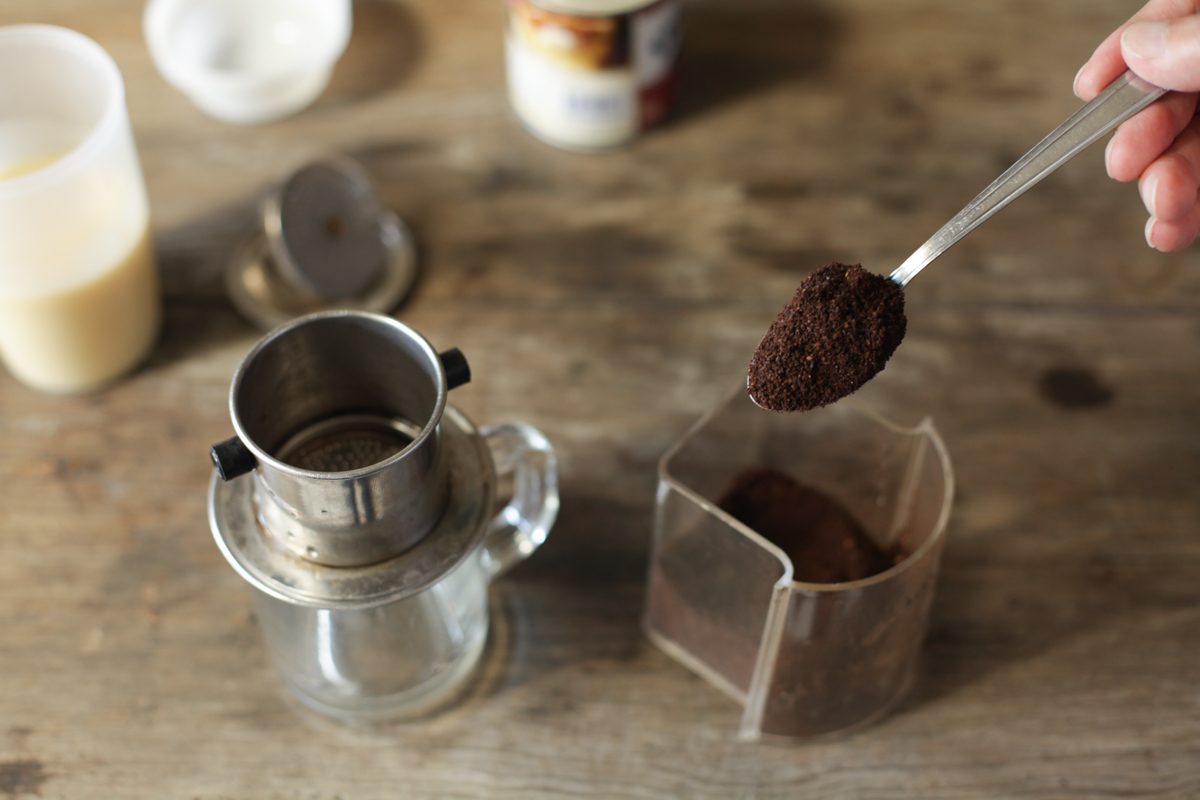
Photo: HungryHuy / Wikimedia Commons, CC BY 2.0
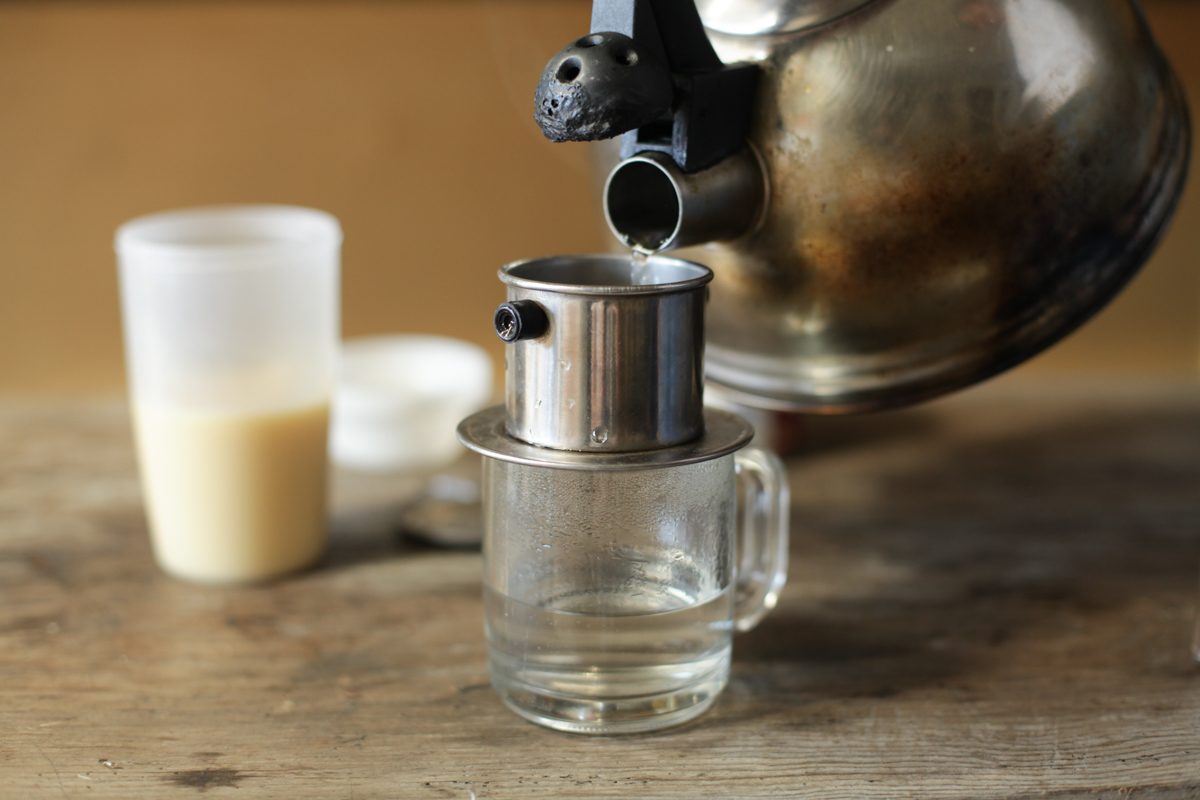
Photo: HungryHuy / Wikimedia Commons, CC BY 2.0
Why bloom for 30 seconds?
Freshly roasted coffee still holds a lot of CO₂. If you fill the phin straight away, the gas bursts up and creates channels; the water runs through the channels instead of soaking the grounds evenly — and the cup ends up both weak and bitter. Wetting the grounds with a small amount of water first lets the gas escape, so the bed soaks evenly and the drip stays steady.
Signs of a good phin
Drops fall steadily, never in a stream; the concentrate is dark brown, slightly syrupy, with a thin layer of reddish-brown foam. The spent grounds are flat and evenly damp, with no crater in the middle. See Figure 4: once the phin has settled, an even drip like this means you have the grind and tamp right.
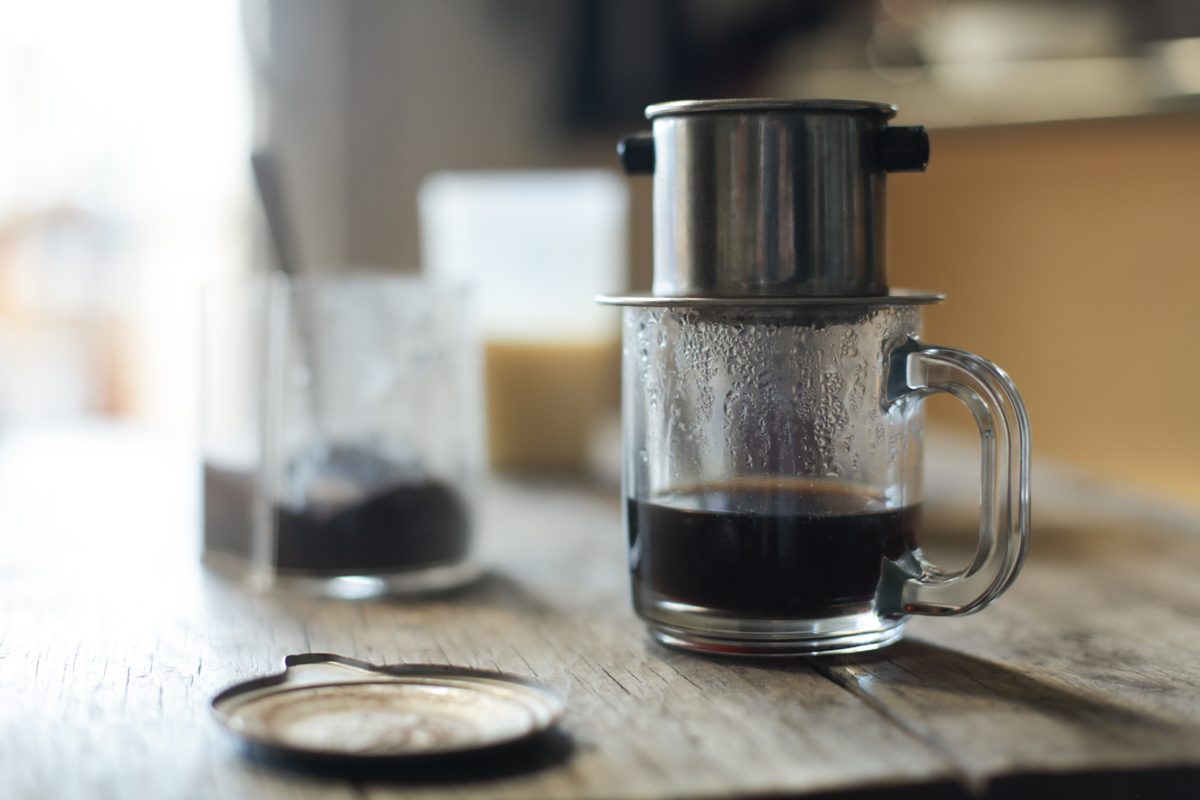
Photo: HungryHuy / Wikimedia Commons, CC BY 2.0
Safety warning: a kettle at 92–100°C and a metal phin just rinsed with boiling water can cause burns. Hold the phin by its tabs or with a dry cloth, and never lift a full phin with bare hands. At the bar, keep the kettle at the back, away from the counter edge and walkways; call out "hot" when carrying the kettle past colleagues. For a minor burn, run cool water over it for 15–20 minutes; do not apply toothpaste or ice directly.
Recipe table and how to adjust the phin
The table below shows doses commonly used at Vietnamese coffee bars in 2026; each cafe fine-tunes them for its beans and customers. The general rule: fix the dose and the water, and change only one variable at a time when adjusting.
| Drink | Grounds | Water | Concentrate | Add |
|---|---|---|---|---|
| Hot black coffee | 18–20 g | 80–90 ml | 50–60 ml | Sugar to taste |
| Iced black coffee | 22–25 g | 80–90 ml | 40–50 ml | Sugar 10–15 g, glass full of ice |
| Iced milk coffee (ca phe sua da) | 22–25 g | 80–90 ml | 40–50 ml | Condensed milk 25–30 g, glass full of ice |
| Bac xiu | 12–15 g | 50–60 ml | 25–30 ml | Condensed milk 30 g, fresh milk 70–80 ml, ice |
| Salted coffee | 20–22 g | 80 ml | 40–45 ml | Condensed milk 20 g, salted cream 40–50 ml, ice |
The phin drips too fast (under 3 minutes)
Symptom: the water runs in a stream; the cup is thin and sour. Cause: grind too coarse, too little coffee, or a loose press insert. Fix: grind one notch finer; weigh a full 22 g; press the insert a little more firmly. Change only one thing each time, then time it again.
The phin drips too slowly or clogs (over 8 minutes)
Symptom: drops fall very slowly, water pools on top of the grounds, the cup is bitter and astringent. Cause: grind too fine, tamped too hard, too much coffee, or the base holes clogged with coffee oils. Fix: grind coarser; rest the press insert gently; soak the phins in warm water with baking soda for 15 minutes every evening and scrub the base holes.
Taste varies from glass to glass
The usual cause is that each person brews their own way. Post the recipe table at the bar, use the same weighed scoop and the same water temperature, and taste a sample glass at the start of each shift.
Iced milk coffee, bac xiu and salted coffee
These three drinks make up most orders at both street-side cafes and chains. What they share: the concentrate must be strong, because melting ice and milk dilute the flavour. If the concentrate is right but the drink still tastes weak, check the ice and milk ratio before adding more coffee.
Iced milk coffee (ca phe sua da)
Put 25–30 g of condensed milk in the glass, place the phin on top and brew as for black coffee. When it has finished dripping, stir the concentrate and milk together thoroughly before adding ice — add the ice first and the condensed milk sets hard at the bottom and will not dissolve. In a 300 ml glass, fill about two-thirds with ice. Figure 5 shows an iced milk coffee served at a cafe in Hanoi.
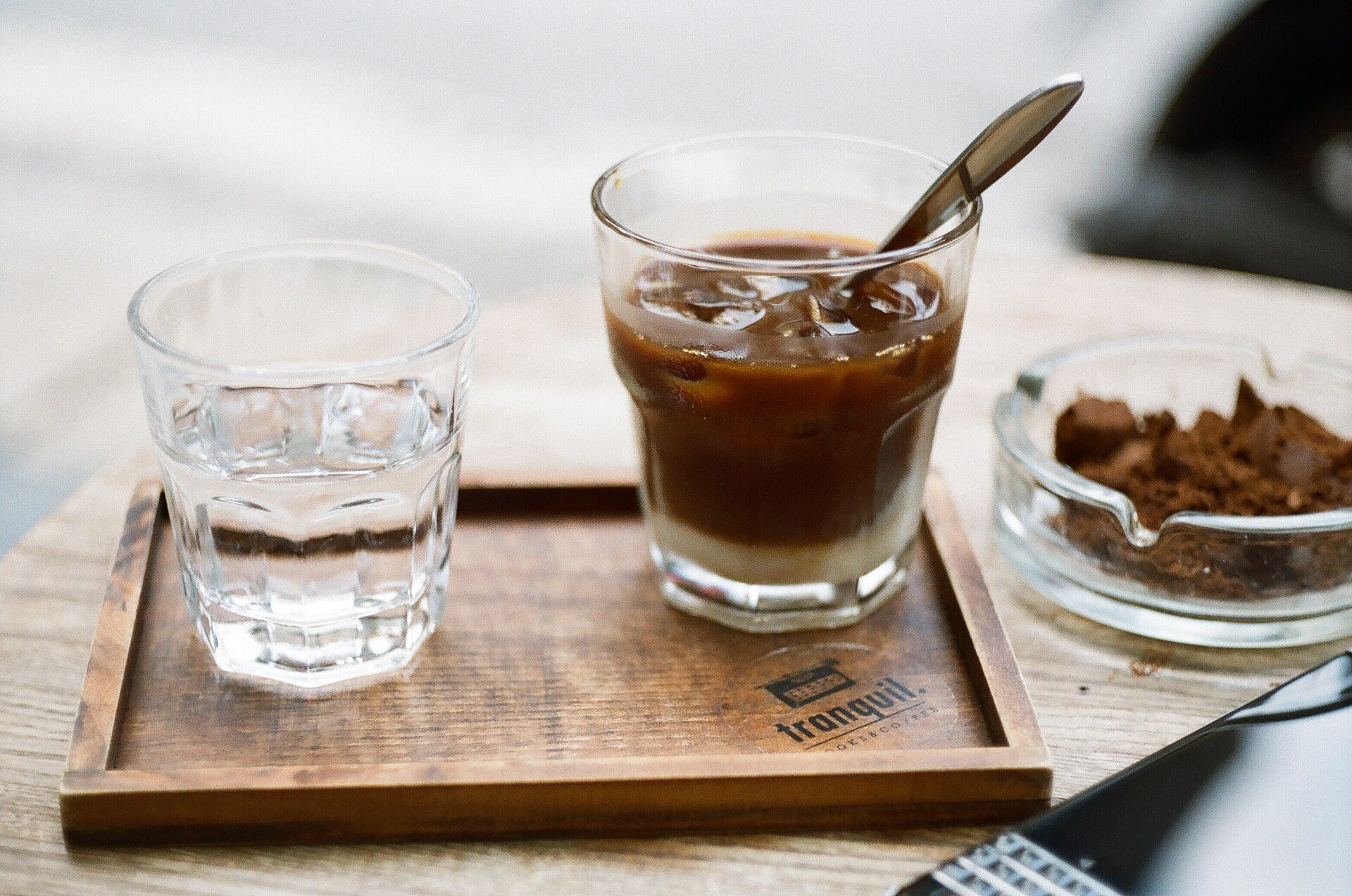
Photo: ePi.Longo / Wikimedia Commons, CC BY-SA 2.0
Bac xiu: lots of milk, a little coffee
Bac xiu comes from "bac tay xiu", a name used by the Chinese community in Saigon for a glass of hot milk with a little coffee. Today iced bac xiu is usually made in this order: 30 g condensed milk, 70–80 ml unsweetened fresh milk, stir well, add ice, then pour 25–30 ml of phin concentrate over the top to create layers. The milk-to-coffee ratio is about 3:1. Do not use weak concentrate for bac xiu: with so little coffee, the coffee must be strong to be tasted at all.
Salted coffee: the salted cream makes the drink
Salted coffee originated in Hue and is now sold everywhere. Make the salted cream in batches: 200 ml whipping cream, 60 ml fresh milk, 30 g condensed milk and 2–3 g fine salt; whisk with an electric mixer at medium speed for 2–3 minutes until it thickens and flows slowly like drinking yoghurt — do not whip it to stiff peaks. One batch makes about 6 drinks. For each glass: 20 g condensed milk, 40–45 ml phin concentrate, ice, then pour 40–50 ml of salted cream on top. The salt is only there to round out the flavour; the customer should taste creamy, sweet and strong, never salty.
Variation: egg coffee
Hanoi egg coffee uses egg yolk whisked with condensed milk into a thick golden cream, spooned over hot phin concentrate (Figure 6). One cup usually uses 1 yolk and 15–20 g condensed milk, whisked for 3–5 minutes. Because the egg is raw, use only fresh eggs from a known source, wash the shells, separate them with clean tools, and use the egg cream within the same shift — never keep it overnight.
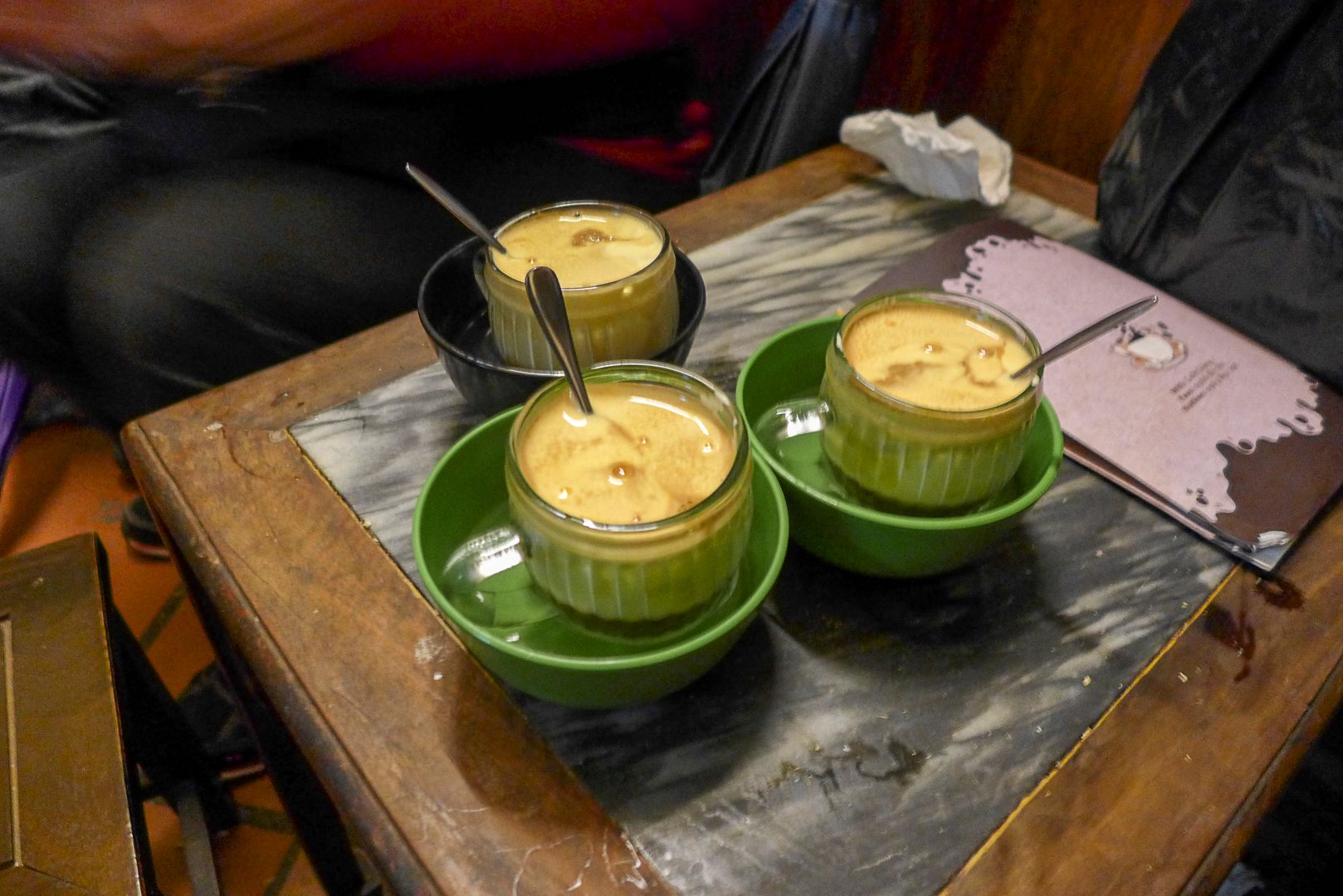
Photo: [email protected] / Wikimedia Commons, CC BY-SA 2.0
Food hygiene: salted cream and egg cream spoil easily. Store salted cream in a sealed container in the fridge at 2–5°C, label it with the time it was made and use it within 24 hours; use egg cream within the shift. Keep opened fresh milk in the fridge and never leave it on the counter for more than 30 minutes. If it smells sour or has separated, throw it away.
Worked example: standardising iced milk coffee for a 60-cup-a-day cafe
Lan has just started working the bar at a pavement cafe in Thu Duc (Ho Chi Minh City) that sells about 60 drinks a day, 40 of them iced milk coffee. Customers complain that the coffee is strong one day and weak the next. Lan rebuilds the recipe from scratch (reference prices for 2026, varying by area; 1,000 VND is roughly 4 US cents).
Step 1: measure the current state
Lan brews 3 phins the cafe's old way (one heaped scoop, boiling water poured in one go). Weighing them: the 3 scoops are 16 g, 19 g and 21 g; the drip times are 2 min 40 s, 3 min 50 s and 5 min 10 s. The problem is obvious: doses vary by up to 5 g, and the boiling water is poured straight in with no bloom.
Step 2: lock in the recipe
- Coffee: 22 g per phin, switching to an 11 g scoop, measured as 2 level scoops.
- Water at 94°C (boiled, rested 45 seconds), 20 ml bloom for 30 seconds, then 70 ml more.
- Grinder set one notch finer; three test phins all finish in 4 min 30 s to 5 min, with 45 ml of concentrate.
- Condensed milk 28 g, stirred in fully before adding ice.
Step 3: calculate the ingredient cost per glass
Ground coffee at 250,000 VND/kg is 250 VND/g: 22 g × 250 = 5,500 VND. A 380 g can of condensed milk at 25,000 VND is about 66 VND/g: 28 g × 66 ≈ 1,850 VND. Ice 500 VND; plastic cup, straw and lid 1,150 VND. Total: 5,500 + 1,850 + 500 + 1,150 = 9,000 VND per glass (about 0.35 USD). At a selling price of 20,000 VND, each glass makes a gross margin of 11,000 VND before rent and labour. Forty iced milk coffees a day use 40 × 22 = 880 g of coffee, so buying 1 kg a day is about right and the grounds never sit open for long.
Step 4: check after one week
Every morning Lan logs the coffee batch, the test phin's drip time and whether the taste passes. After a week, drip times stay between 4 min 20 s and 5 min 10 s, customers have stopped complaining, and daily coffee use is steady at 880–900 g. The lesson: standardise first, and only then think about changing beans or raising prices.
Common mistakes when brewing with a phin
Pouring 100°C boiling water straight in
Symptom: a harsh, bitter cup with a burnt smell; large bubbles that collapse quickly. Cause: water too hot and no bloom. Fix: let the water rest 30–60 seconds after boiling, and always bloom for 30 seconds.
Brewing a whole jug of concentrate in the morning
Symptom: by afternoon the coffee is sour and has lost its aroma. Cause: the concentrate oxidises when left at room temperature. Fix: if you must brew ahead for the rush, only make enough for 2–3 hours and keep it in a sealed bottle in the fridge; better still, brew by the glass or switch to cold brew for iced drinks.
Not cleaning the phins every day
Symptom: the phins drip slower and slower, and the coffee tastes of stale oil. Cause: coffee oils building up in the base holes. Fix: wash the phins after every shift, soak them in baking soda at the end of the day and dry them upside down.
Leaving grounds in an open bag for days
Symptom: the grounds do not swell during the bloom, and the cup is weak even at the correct weight. Cause: pre-ground coffee loses aroma quickly within 1–2 weeks of opening. Fix: buy only 3–7 days' worth, fold the bag shut, store it somewhere cool and dry, out of the sun.
Frequently asked questions
How many grams of coffee should go in a phin?
A standard-size phin takes 20–25 g for an iced drink and 18–20 g for a hot drink. More important than the exact number is weighing accurately and keeping the dose the same for every glass.
Is an aluminium or a stainless steel phin better?
Aluminium phins are cheap and light but hold heat less well; stainless steel phins are durable and easy to clean, but heavier. At a working bar, thick stainless steel phins dent less, so their drip speed stays consistent for longer.
What is the difference between bac xiu and iced milk coffee?
In milk coffee the coffee is the main ingredient and condensed milk just sweetens it. In bac xiu the milk is the main ingredient (condensed and fresh milk), and coffee makes up only about a quarter, so the taste is lighter and creamier.
Does salted coffee taste salty?
It should not. There are only about 2–3 g of salt in a 6-glass batch of cream, just enough to soften the bitterness and bring out the richness of the cream.
Should I brew with bottled filtered water?
Use filtered water with no chlorine smell and moderate hardness. Tap water that smells of chlorine, or well water high in lime, gives the coffee an off taste and scales the kettle.
Practice exercises and self-assessment
- Brew 5 black phin coffees in a row with the same 22 g dose, recording the drip time and volume of concentrate for each.
- Deliberately grind one notch coarser and then one notch finer, brew one phin at each setting and taste them side by side for sourness and bitterness.
- Make 1 iced milk coffee, 1 bac xiu and 1 salted coffee from the recipe table; ask someone to taste them blind and give feedback.
- Calculate the ingredient cost of these three drinks using ingredient prices where you live.
Pass / not yet criteria
- Pass: all 5 phins finish within 4–6 minutes, no more than 60 seconds apart; 40–50 ml of concentrate each.
- Pass: you can explain why a coarse grind tastes sour and a fine grind tastes bitter; your cost calculation adds up correctly.
- Not yet: you do not weigh the coffee, a phin finishes under 3 minutes or over 8 minutes, or you leave salted cream or egg cream at room temperature.
Consistent phin brewing is the foundation for the next step in the roadmap: Running the bar at rush hour and machine maintenance — making many drinks in parallel while keeping every recipe exact. The two companion lessons on pulling a proper espresso and barista pay will help you round out the machine side and your job plan. See the full 8-step barista roadmap to know where you are.