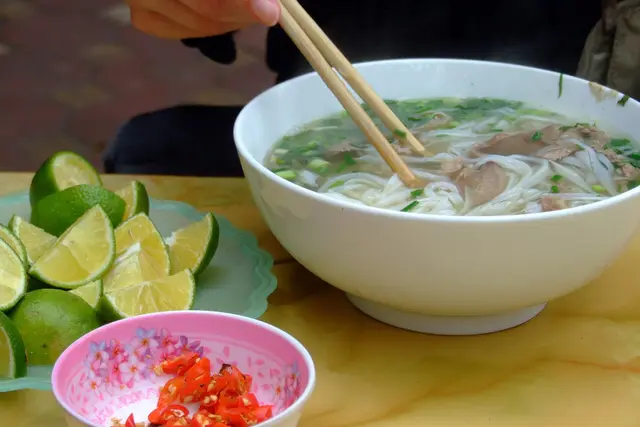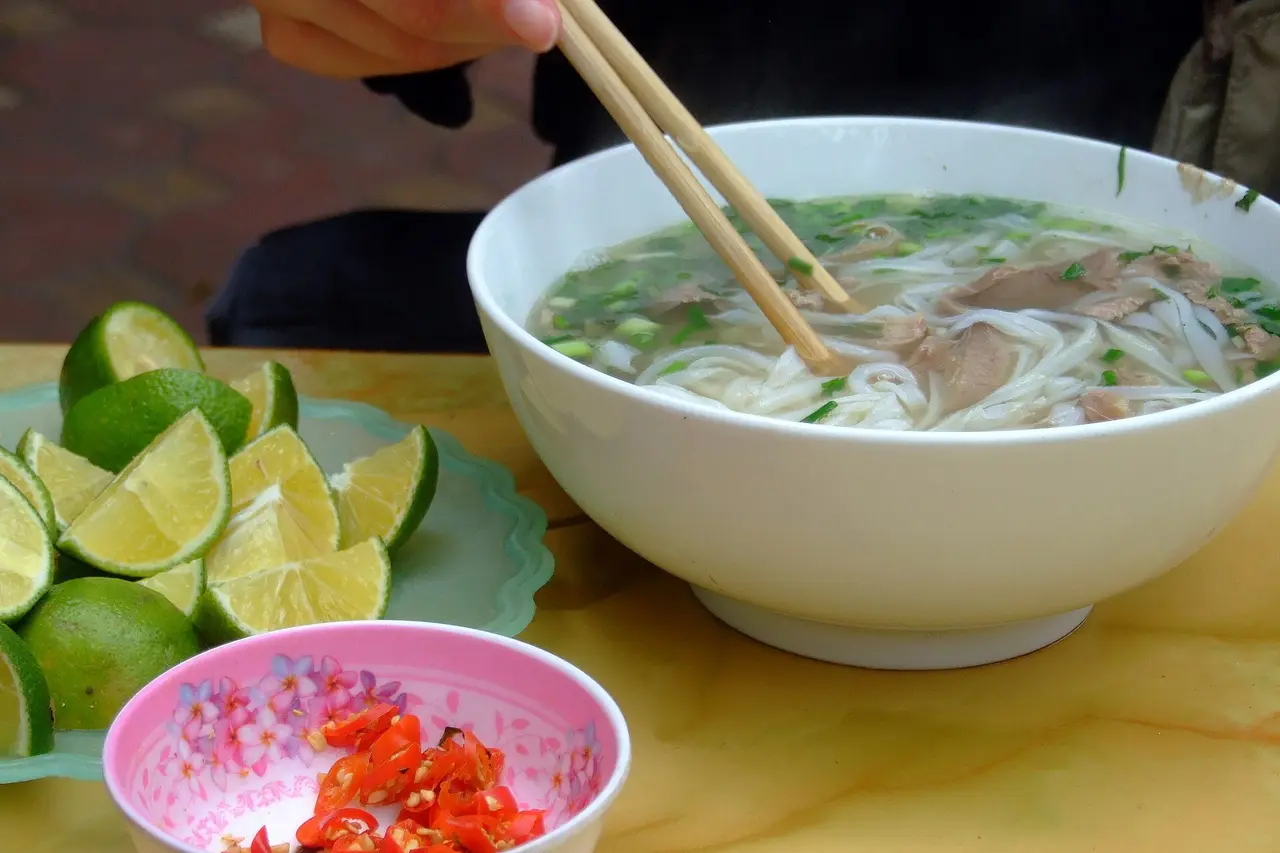
Pricing a dish properly takes 3 steps: weigh each ingredient in one portion, convert it to a cost that includes losses from trimming and cooking, then divide that cost by your target food cost percentage (Vietnamese eateries usually aim for 30–40%) to get the selling price. For example, a bowl of rare beef pho with an ingredient cost of 25,000 VND and a 38% food cost target sells for about 25,000 ÷ 0.38 ≈ 65,790 VND, rounded to 65,000 VND (about US$2.50). Many eateries lose money despite being busy because they price "like the shop next door" without knowing what one of their own bowls costs in ingredients. This lesson goes from weighing the beef to pricing on delivery apps, with a worked table where every line adds up.
By the end of this lesson, you will be able to:
- Write a standard portion recipe for a dish, in grams and millilitres per serving.
- Measure yield (after trimming, after boiling) and the true cost of ingredients with losses.
- Calculate cost per portion, food cost % and a selling price from a target percentage, rounded sensibly.
- Set a separate price for delivery apps after commission and packaging.
- Compare theoretical and actual food cost each month to spot waste and leakage.
Learning to open an eatery properly? Menu, standard recipes and food cost are step 3 of the roadmap, after legal basics and choosing a location and budget. See the 8-step small eatery roadmap to learn in the right order.
What is food cost, and why does copying the shop next door lose money?
Food cost is the money in ingredients inside one serving: meat, noodles, herbs, broth, seasoning. Food cost % is that amount as a percentage of the selling price. A bowl of pho sold at 65,000 VND with 25,000 VND of ingredients has a food cost of 25,000 ÷ 65,000 ≈ 38.5%.
Three formulas to memorise
- Food cost % = cost per portion ÷ selling price × 100.
- Selling price = cost per portion ÷ target food cost %.
- True ingredient cost = purchase price ÷ yield.
Food cost does not include rent, wages, electricity, gas or takeaway boxes. Those belong to fixed costs and other variable costs, used for the break-even calculation in the lesson how much it costs to open a small restaurant in Vietnam.
Reasonable food cost levels
| Type of dish | Typical food cost % | Notes |
|---|---|---|
| Everyday rice, vermicelli, pho, noodle dishes | 35–40% | Beef or seafood dishes can reach 40–45% |
| Snacks, sweet soups, cakes | 25–35% | Cheap ingredients, more labour |
| Mixed drinks, iced tea, fruit drinks | 15–30% | Offset high food cost main dishes |
| Drinking snacks, hot pot | 35–45% | Depends on seasonal seafood and meat prices |
These are 2026 reference levels and vary by region and business model. There is no right number for every shop: a shop with cheap rent can carry a higher food cost, while one paying high rent in the centre must keep it lower.
Why copying a competitor's price is risky
The shop next door may buy meat cheaper through a long-standing supplier, waste less because it sells more, or be losing money without knowing it. Use competitors' prices only to check that your price is not far off the market, after you have worked out your own cost.
Step 1: write a standard portion recipe
Portion specs are the grams and millilitres of each ingredient in one serving. Without them there is no cost, and every cook does it differently, so a customer's bowl today differs from yesterday's.
Weigh, do not eyeball
A digital scale with 1 g divisions is essential. At the start, weigh every ingredient of 5–10 servings made by the head cook as usual, take the average and fix it as the standard portion. In industrial catering kitchens each component is weighed on a digital scale to keep every meal at the defined weight (Figure 1); a small eatery does not need that for every serving, but should spot-check daily.
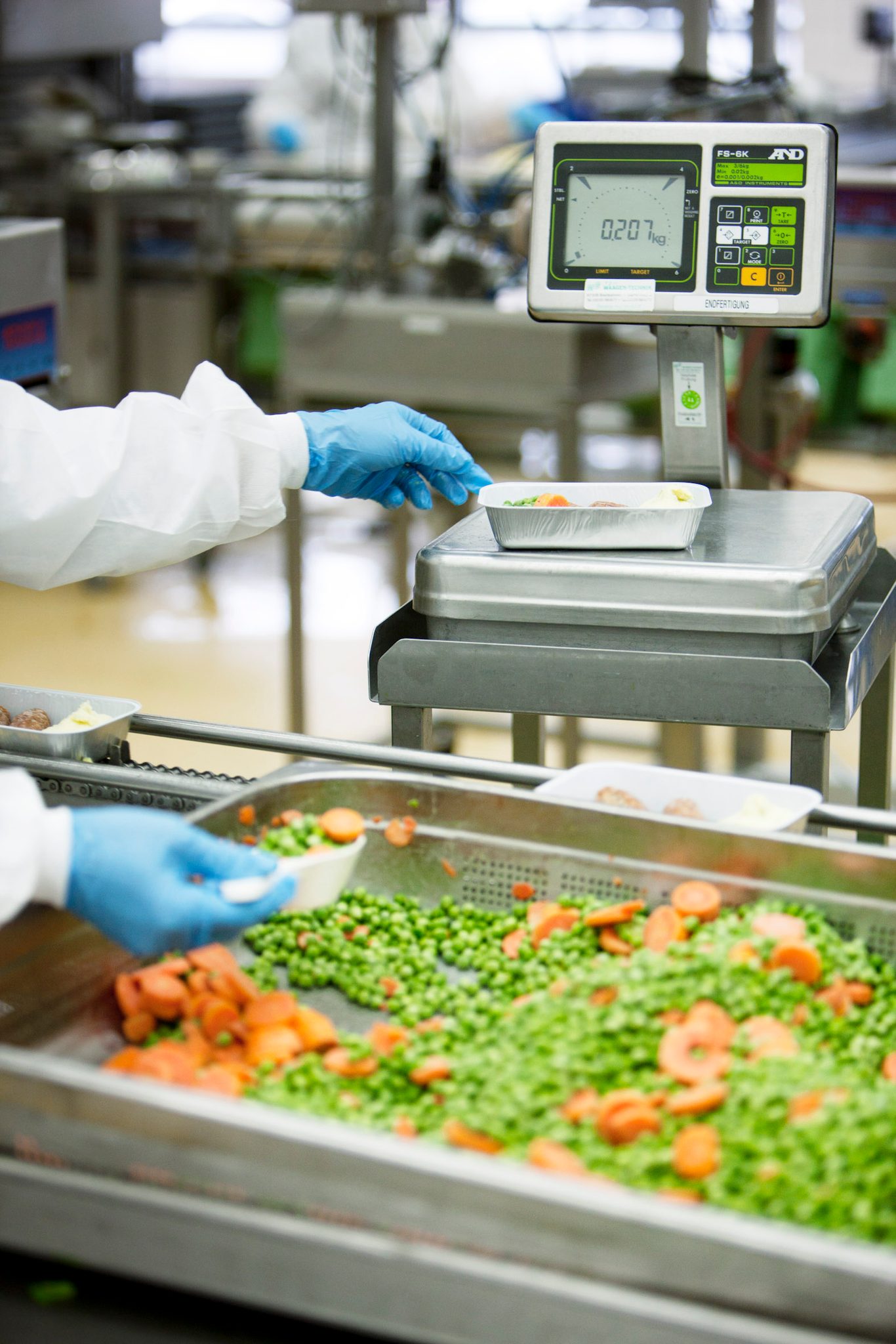
Photo: LSG Sky Chefs / Wikimedia Commons, CC BY-SA 3.0
Portioning tools
- Ladles with a fixed volume for broth and sauce (for example a 200 ml ladle, two ladles per bowl).
- Trays with meat pre-portioned into equal servings before the rush.
- Bowls and plates of the same size: switch to a bigger bowl and customers see less, so cooks add more.
Standard recipe card
One card per dish: name, quantity of each ingredient, preparation, the order of assembly in the bowl, and a photo of a correct serving. Post it at the pass. The card trains staff and feeds your costing sheet.
Step 2: measure yield and the true cost of ingredients
You buy 1 kg of meat but do not sell the full 1 kg: sinew and fat are trimmed, and boiled meat shrinks. Ignoring yield is the biggest error in pricing dishes.
How to measure yield
- Weigh the ingredient as bought (purchase weight).
- Prepare it as usual (trim sinew, peel, pick herbs) and weigh the usable part.
- For boiled or grilled items, weigh again after cooking if the portion is specified as cooked meat.
- Yield = usable weight ÷ purchase weight. Measure 3 times on 3 different batches and average.
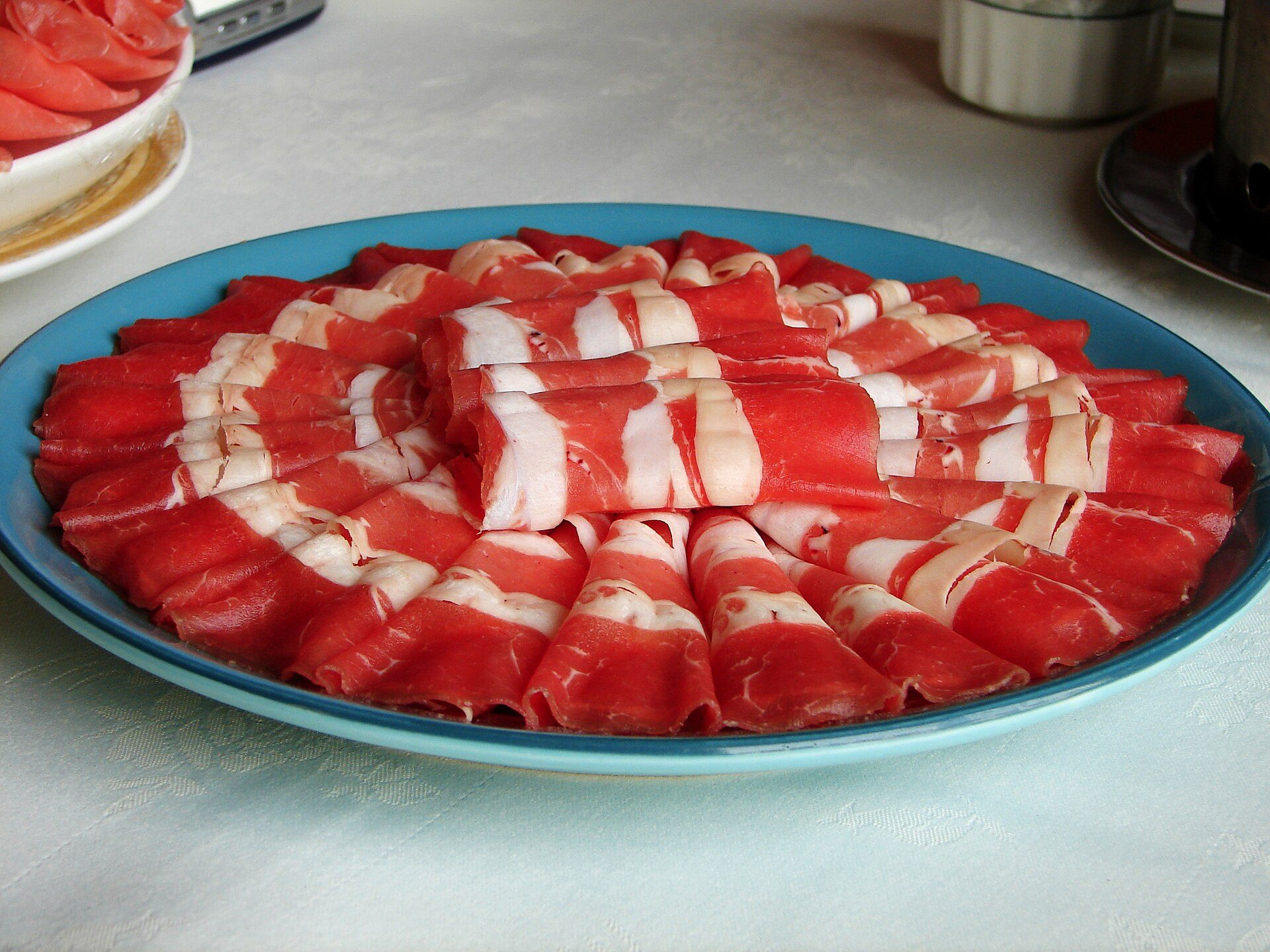
Photo: J. Samuel Burner / Wikimedia Commons, CC BY 2.0
Reference yield table
| Ingredient | Process | Typical yield |
|---|---|---|
| Beef tenderloin, shank | Trim sinew and fat, slice for rare beef | 85–92% |
| Beef flank, brisket | Boil, slice | 55–65% |
| Whole free-range chicken | Boil, debone for meat | 40–50% |
| Herbs, spring onions | Pick, remove roots and wilted leaves | 70–85% |
| Fresh prawns | Peel, remove heads | 45–60% |
These are reference ranges; your own figures depend on the quality of supply and who does the prep, so measure them yourself.
Example: true cost
Beef tenderloin bought at 270,000 VND/kg with a 90% yield. True cost = 270,000 ÷ 0.9 = 300,000 VND/kg, or 300 VND per gram. With 45 g of rare beef per bowl, the meat costs 45 × 300 = 13,500 VND, not 45 × 270 = 12,150 VND. That is 1,350 VND per bowl; at 150 bowls a day, more than 200,000 VND a day "disappears" if you calculate it wrong.
Step 3: calculate cost and selling price per portion
With portions and true costs, multiply each line and add them up. Components cooked in large batches, such as broth or sauce, are costed per batch and divided by the number of servings.
Batch-cooked components
Record every ingredient in one pot and the number of servings that pot actually produces. For example, a 50-litre pot of broth at 400 ml per bowl gives 125 bowls; if the bottom of the pot is discarded at the end of the day, use the real number of bowls sold, not the theoretical one.
From cost to selling price
- Choose a target food cost % by dish type and rent level (for example 38%).
- Theoretical selling price = cost ÷ 0.38.
- Round to an easy price to remember and pay (45,000, 50,000, 55,000 VND…).
- Recalculate food cost % at the rounded price and check it is still acceptable.
- Compare with similar shops nearby: if far off, review portions or the business model, not just the price.
Look at profit in money, not only percentages
A lower percentage is not always better. Dish A sells at 40,000 with a cost of 14,000 (35%) and a gross profit of 26,000; dish B sells at 65,000 with a cost of 25,000 (38.5%) and a gross profit of 40,000. Dish B has a higher food cost but earns more per serving. When designing the menu, put high-profit dishes where they are easy to see.
Worked example: pricing a bowl of rare beef pho in Hanoi
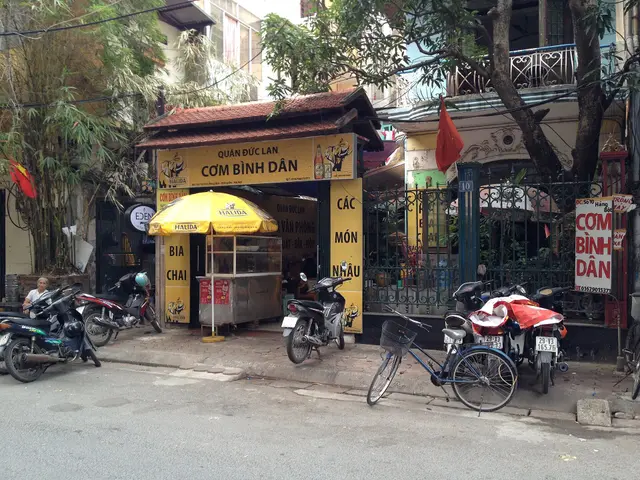
Tung opens a 25 m² pho shop on a busy residential street in Hanoi and plans to sell rare beef pho. Similar shops nearby charge about 50,000–70,000 VND per bowl (2026 reference, varies by area). He buys meat and bones at the wholesale market and a local wet market (Figure 3), and fresh pho noodles from a regular workshop.
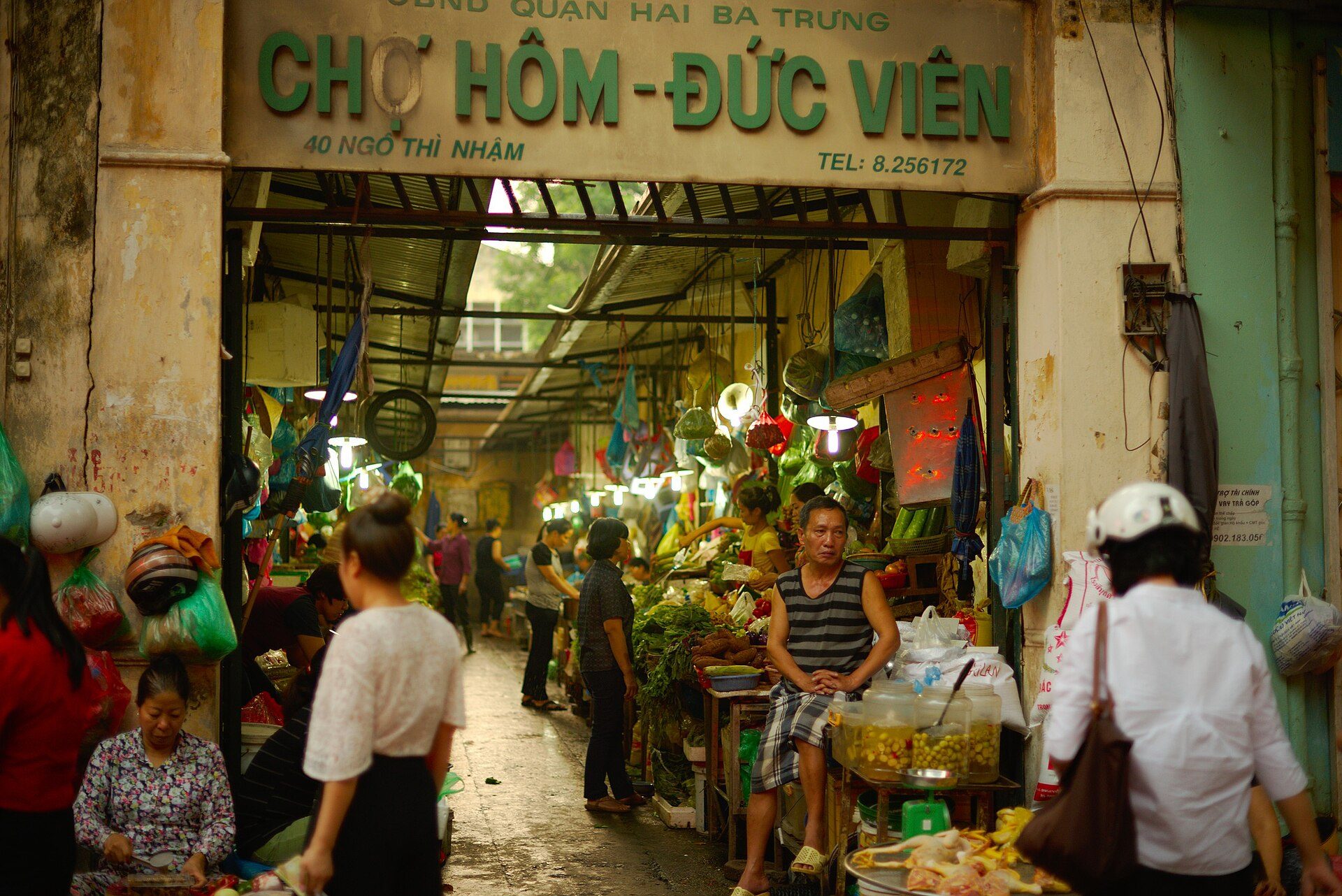
Photo: Nicolas Lannuzel from Singapore, Singapore / Wikimedia Commons, CC BY-SA 2.0
A 50-litre pot of broth
- Beef marrow bones 10 kg × 55,000 VND = 550,000 VND.
- Charred ginger and onion, cinnamon, star anise, black cardamom, fish sauce, salt, rock sugar: 200,000 VND.
- Pot total: 750,000 VND. At 400 ml per bowl → 125 bowls → 750,000 ÷ 125 = 6,000 VND per bowl.
Cost of one bowl
| Ingredient | Per bowl | Purchase price | Yield | True cost | Amount |
|---|---|---|---|---|---|
| Fresh pho noodles | 200 g | 15,000 VND/kg | 100% | 15 VND/g | 3,000 VND |
| Beef tenderloin, sliced rare | 45 g | 270,000 VND/kg | 90% | 300 VND/g | 13,500 VND |
| Broth | 400 ml | 750,000 VND per 125-bowl pot | — | — | 6,000 VND |
| Spring onion, herbs, onion | about 25 g | — | — | — | 1,500 VND |
| Lime, chilli, pickled garlic, sauces | shared plate | — | — | — | 1,000 VND |
| Cost per bowl | 25,000 VND | ||||
Check: 3,000 + 13,500 + 6,000 + 1,500 + 1,000 = 25,000 VND.
In-store selling price
- Target food cost 38%: 25,000 ÷ 0.38 ≈ 65,790 VND → rounded to 65,000 VND.
- Actual food cost at 65,000: 25,000 ÷ 65,000 ≈ 38.5%, within range. Gross profit: 65,000 − 25,000 = 40,000 VND per bowl.
- Against the market: 65,000 sits in the upper half of the local 50,000–70,000 VND range, so Tung must keep the full 45 g of beef and a clear, rich broth for customers to feel it is worth the price.
- To sell at 55,000 VND instead: food cost becomes 25,000 ÷ 55,000 ≈ 45.5% and gross profit drops to 30,000 VND. He would then need a deliberate smaller portion (for example a small bowl with 35 g of beef) or accept lower margins for more bowls.
Delivery app price
Food delivery apps take a commission on the selling price, often about 20–30% depending on the app and partnership plan (2026 reference; read each app's current contract). Takeaway orders also need a box and bag, about 3,000 VND per bowl. Assume a 25% commission:
- Selling at 65,000 VND on the app: the shop receives 65,000 × 0.75 = 48,750, minus 3,000 for packaging leaves 45,750 VND. Food cost on what the shop actually receives: 25,000 ÷ 45,750 ≈ 54.6%, almost no profit after fixed costs.
- To receive the same as in-store: (65,000 + 3,000) ÷ 0.75 ≈ 90,670 VND, which customers find too expensive.
- Tung's choice: 85,000 VND on the app. He receives 85,000 × 0.75 = 63,750, minus 3,000 leaves 60,750 VND; food cost ≈ 25,000 ÷ 60,750 ≈ 41.2%, acceptable.
When ingredient prices rise: how to update costs
Meat and vegetable prices in Vietnam change with the season, animal disease outbreaks and holidays such as Tet. Dish costs must be a living number, not something calculated once at opening.
Update schedule
- Weekly: log the purchase prices of the 5–7 main ingredients in a spreadsheet.
- When a main ingredient rises by more than about 5–10%: recalculate the cost of every dish that uses it.
- Quarterly: re-measure yields, because a new supplier or a new prep cook changes them.
Example: tenderloin rises to 300,000 VND/kg
True cost = 300,000 ÷ 0.9 ≈ 333,333 VND/kg, so 45 g ≈ 15,000 VND. The bowl now costs 25,000 − 13,500 + 15,000 = 26,500 VND, and food cost at 65,000 is 26,500 ÷ 65,000 ≈ 40.8%. Options: hold the price if the rise looks temporary; renegotiate with the supplier; or move to 69,000–70,000 VND if the higher price persists, telling regulars in advance.
Do not quietly cut portions
Cutting the beef from 45 g to 35 g at the same price is noticed quickly by regulars, and they talk. If portions must change, change them openly: add a smaller, cheaper bowl size, or state it on the menu.
Compare theoretical and actual food cost each month
Food cost on the recipe card is theoretical: exact portions, nothing spilled. Actual food cost comes from purchase records and stock counts.
Actual food cost formula
Actual food cost % = (opening stock + purchases − closing stock) ÷ food revenue for the month × 100. Example: opening stock 8 million, purchases 95 million, closing stock 6 million VND: ingredients used 97 million. Food revenue 240 million: actual food cost 97 ÷ 240 ≈ 40.4%.
What the gap tells you
If the menu's average theoretical food cost is 38% but the actual is 40.4%, the gap is about 2.4 points, or roughly 5.8 million VND of ingredients that month that never became revenue (240 million × 2.4%). Common causes: over-portioning, spoilage from poor storage, cooking too much at day's end, short-weight deliveries or theft. A gap under about 1–2 points is normal for a small shop; larger gaps need checking cause by cause.
Controlling waste in the kitchen
Safety note: When weighing and portioning raw meat, use separate boards, knives and gloves for raw and cooked food to avoid cross-contamination; keep portioned meat chilled and use it the same day, first in, first out. A large pot of broth is very heavy and hot: lift it with two people, keep the burner stable and keep children out of the kitchen. Check gas valves and hoses regularly; if you smell gas, close the valve, open doors and windows, do not switch any electrical device on or off, and call the gas supplier. Throw away spoiled or expired ingredients rather than keeping them to protect your food cost.
Common mistakes when pricing dishes
Using purchase price and forgetting yield
Sign: the spreadsheet shows good profit but the money is not there at month end. Cause: using market prices instead of true cost after trimming and boiling. Fix: measure yield for every main ingredient and recalculate.
Forgetting small items
Sign: the cost on paper is a few thousand dong per serving below reality. Cause: leaving out side herbs, dipping sauce, seasoning and the table plate of lime and chilli. Fix: add a "seasoning and sides" line to each card, estimated from daily usage divided by servings.
One price for every channel
Sign: app orders grow but profit does not. Cause: selling on the app at the in-store price without allowing for commission and packaging. Fix: calculate a separate app price as in the example above.
A menu that is too long
Sign: the fridge is always full and stock is thrown out every weekend. Cause: each dish needs its own ingredients, and slow sellers spoil. Fix: keep 1–3 signature dishes and a few side dishes that share ingredients.
Frequently asked questions
What food cost percentage is reasonable?
Main dishes at Vietnamese eateries usually sit around 35–40% of the selling price; beef and seafood dishes can be higher, drinks lower. What matters is the average food cost across the menu and enough gross profit in money to cover fixed costs.
Should dish pricing include gas, electricity and labour?
Not in food cost. Gas, electricity, wages and rent are operating costs, used for break-even and net profit. Keeping them separate tells you whether a loss comes from ingredients or from fixed costs.
How often should portions be weighed?
Weigh everything when writing the recipe card and whenever you change supplier. During operations, spot-check a few servings every day, especially meat and broth.
Should delivery app prices be higher than in-store?
Many shops do this because apps take commission and takeaway needs packaging. The markup varies; calculate it so that food cost on what you actually receive stays acceptable, and read each app's partnership terms carefully.
Practice exercise and self-assessment
- Pick your signature dish (or the one you plan to sell). Weigh 5 servings, average them and write a recipe card.
- Measure the yield of the most expensive ingredient in the dish across 3 batches.
- Build a cost table like the pho example, calculate selling prices at 35% and 40% food cost, round them, then calculate an app price with 25% commission and your real packaging cost.
Self-assessment criteria
- Pass: every line in the table has a portion and a true cost; the hand total matches the spreadsheet.
- Pass: the rounded selling price has a recalculated food cost within target and sits within the local market range.
- Pass: the app price is based on what you actually receive after commission and packaging.
- Not yet: using market prices instead of true cost, or pricing only from the shop next door.
Once each dish has a cost and a selling price, move on to the next roadmap step: Kitchen layout, equipment & purchasing, where you choose meat and produce suppliers, check deliveries and count stock weekly to protect the costs you just calculated.
Keep learning to run an eatery: after menu and food cost come kitchen layout, purchasing, staff management, delivery apps and reading profit and loss. See the 8-step small eatery roadmap.