Good massage technique alone is not enough to make clients come back. Clients remember the whole experience: how they were welcomed, whether the room was ready, whether anyone checked on them while they lay there, and what advice they were given on the way out. This is a project lesson: you combine everything you have learned — hygiene, consultation, body massage and basic facial care — into one seamless 90-minute treatment that ends with a complete client record.
By the end of this lesson, you will be able to:
- Build a time plan and count backwards from the end time so you never run late for your next client.
- Prepare a tool tray complete enough that you never have to leave the room.
- Keep the client safe and preserve their privacy when moving from body work to the face.
- Handle a client who arrives late, feels pain at one spot or is unhappy with the treatment.
- Write a 5-part record that a colleague can read and follow.
At the end there is a worked case and a self-scoring table for the project session (see Figure 1 for the whole client journey).
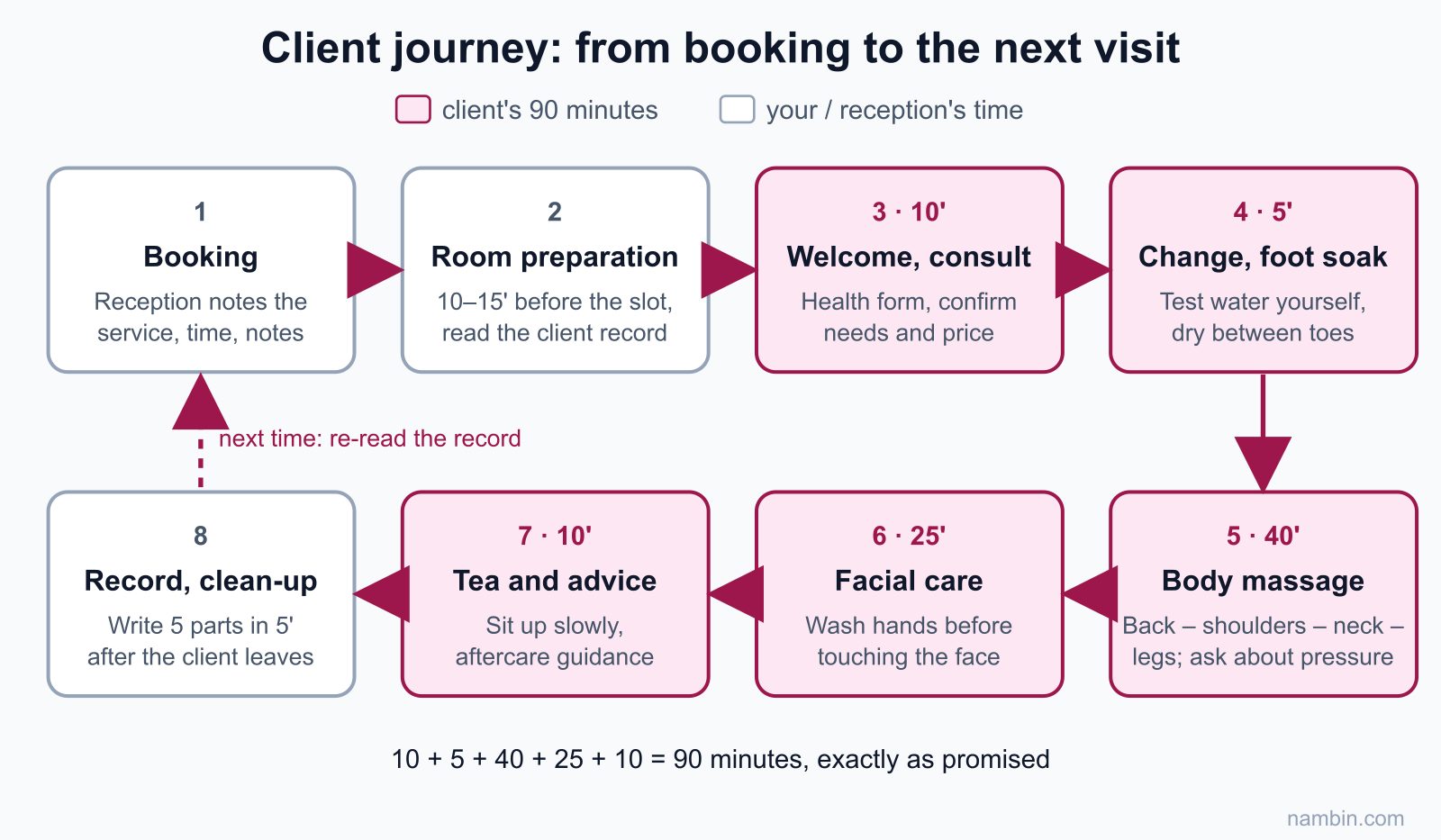
Time plan for a 90-minute treatment
Example: a package combining body massage and a basic facial. The length of each part can vary with the spa's service menu, but the total must be exactly what the client was told.
| Stage | Reference duration | Main tasks |
|---|---|---|
| Room preparation | 10–15 minutes before the appointment (your time) | Clean room, towels, products, temperature, music |
| Welcome and consultation | 10 minutes | Health form, confirm needs and treatment |
| Changing, foot soak | 5 minutes | Show where to store belongings, check the water temperature |
| Body massage | 40 minutes | Back – shoulders – neck – legs in the sequence you have learned |
| Facial care | 25 minutes | Cleansing, facial massage, mask, moisturiser |
| Closing and aftercare advice | 10 minutes | Offer tea, help the client sit up slowly, give aftercare instructions |
| Client's total time | 90 minutes | 10 + 5 + 40 + 25 + 10 |
Note: room preparation, record-keeping and cleaning up are your time; they are never taken out of the client's treatment time.
Counting backwards from the end time
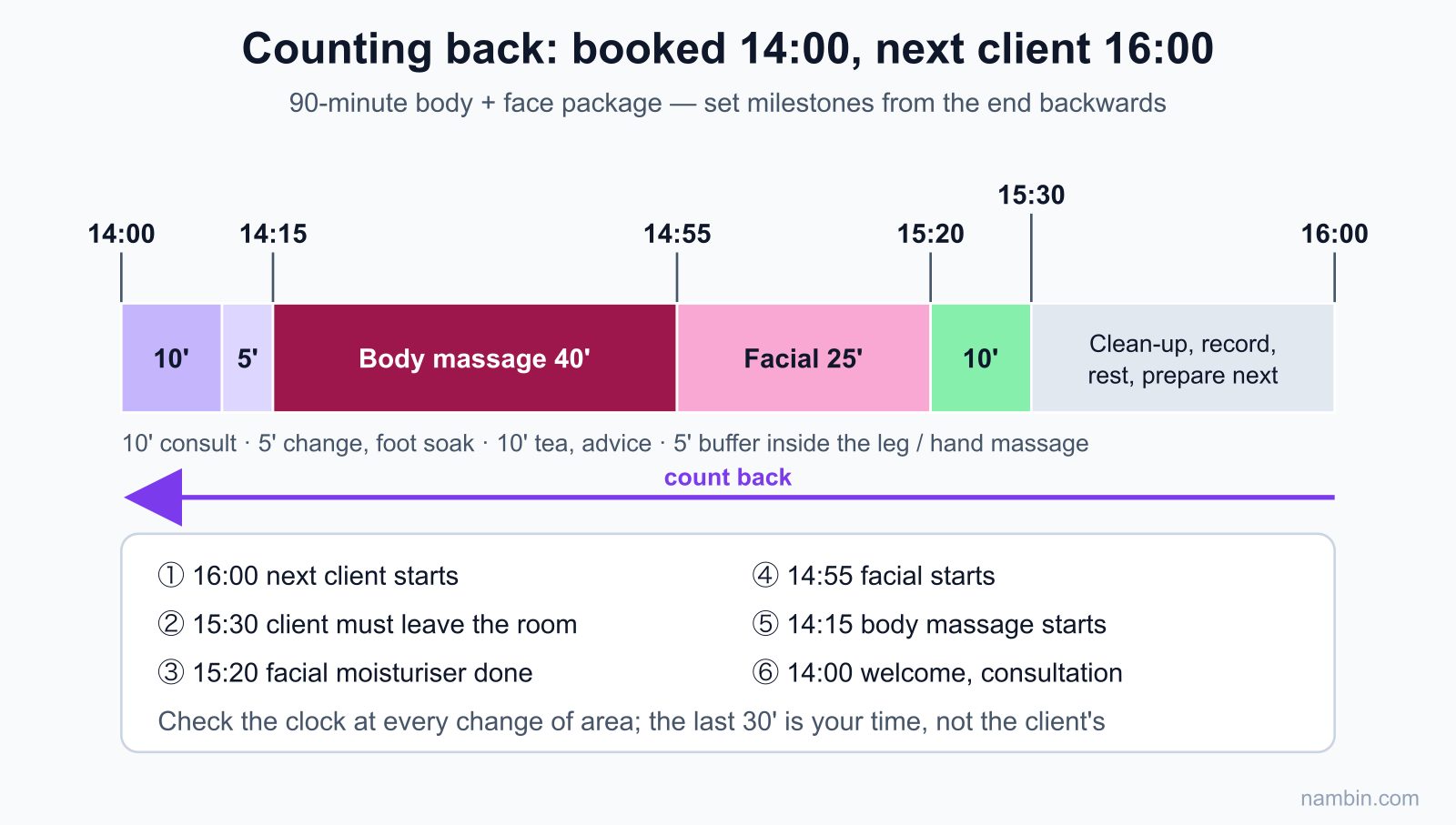
The simplest way not to run late is to plan backwards. The client is booked at 14:00 for a 90-minute package, and your next client starts at 16:00. You know: by 15:30 the client must leave the room; by 15:20 the facial moisturising step must be finished; at 14:55 the facial starts; at 14:15 the body massage starts; 14:00–14:15 is the welcome, consultation, changing and foot soak.
Write these milestones on a small piece of paper or keep them in your head, and check the clock every time you move to a new area. The 30 minutes between 15:30 and 16:00 are for cleaning the room, writing the record, a drink of water and preparing for the next client (see Figure 2).
Buffer time
Do not schedule the steps back to back down to the minute. Keep about 5 minutes of buffer, usually inside the foot massage or the hand massage while the face mask is on — parts that can be shortened or extended without the client feeling short-changed. If the consultation runs long because you find a contraindication, take the time from the buffer; never cut important steps such as cleansing the skin or aftercare advice.
Before the client arrives: preparing the room
- Hygiene: bed, pillows and surfaces disinfected according to procedure; freshly changed clean towels and sheets; single-use items still sealed.
- Products: enough oil, cleanser, mask and moisturiser for the skin type in the record (for returning clients); check expiry dates.
- Environment: a comfortable room temperature (usually about 24–26°C), soft lighting, quiet music, no unusual smells.
- Yourself: neat uniform, short nails, hair tied back, hands washed, no strong perfume.
- Read the record: for returning clients, read the notes from last time — preferred pressure, areas to avoid, products that caused irritation.
The tool tray: prepared so you never leave the room
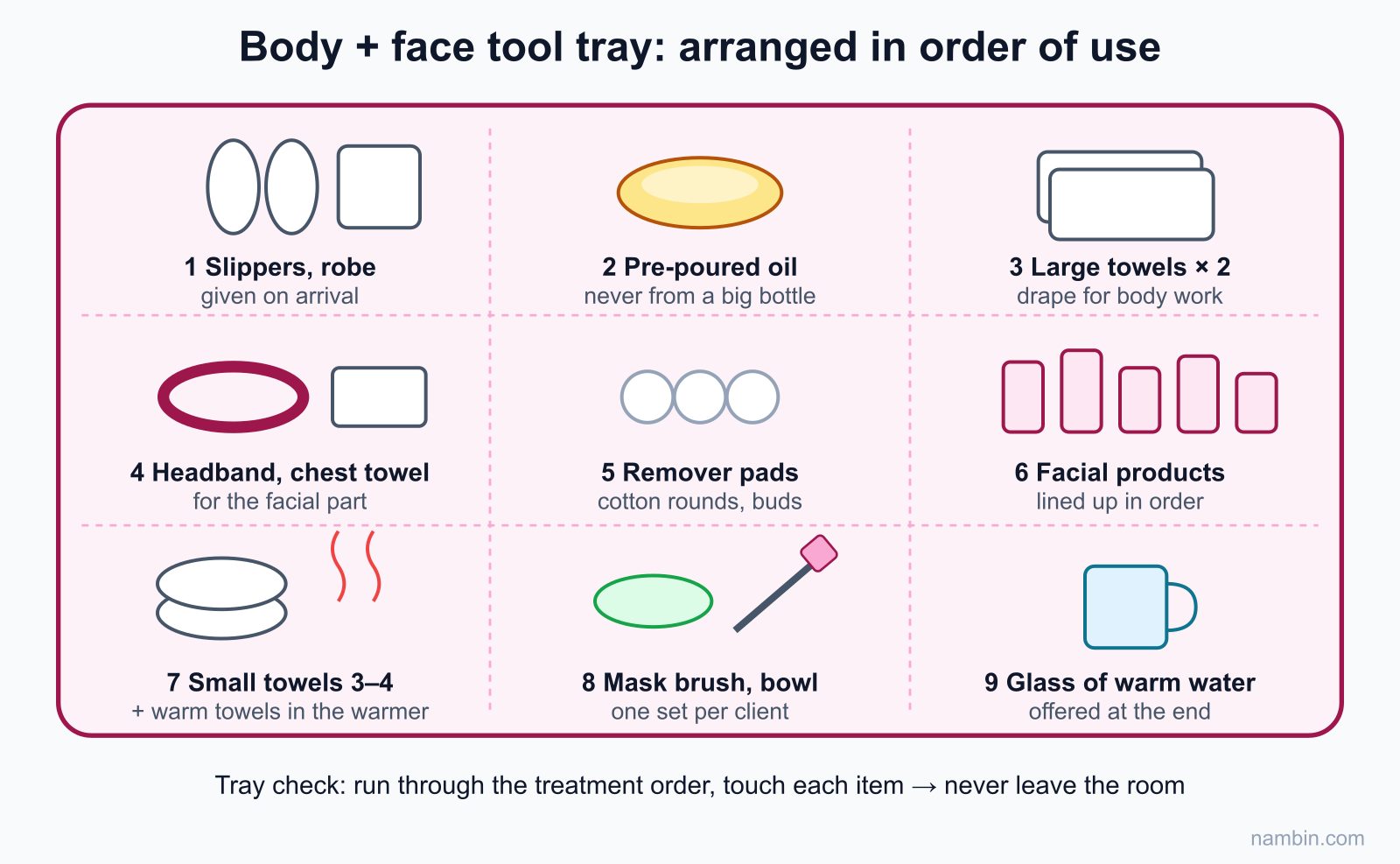
The goal is that from the moment the client lies down until they sit up, you never have to step out to fetch anything. A tray for a body + face package usually holds: massage oil already poured into a small bowl (never pour straight from a large bottle onto the client), make-up remover pads, cotton rounds, 3–4 small face towels, 2 large towels to cover the body, warm towels in the towel warmer, a mask brush and bowl, facial products lined up in order of use, a headband, a chest towel, slippers and a robe for the client, and a glass of warm water.
Check the tray by silently running through the treatment sequence and touching each item in turn (see Figure 3).
Planning the session from the client record
With returning clients you have a big advantage: you already know their preferred pressure, tired areas and skin type. Read the record and answer three questions for yourself: What should I avoid from last time? What did the client like? What do I need to ask again this time? For example, a note saying "cheeks slightly red after the clay mask last time" → today, prepare a soothing mask instead. For new clients, prepare a gentle product set suitable for most skin types, then adjust after the skin analysis.
During the treatment: delivering and monitoring the client
Welcome and consultation
Greet the client by name, offer a drink and lead them to the consultation area. Complete the health form and reconfirm their needs as in the consultation lesson. If you find a contraindication, adjust or change the treatment before the client changes, and tell reception if the price changes.
Foot soak and moving into the room
The foot soak is a transition that helps the client relax. Test the water temperature with your wrist or elbow first — pleasantly warm, not hot. For clients with diabetes or reduced sensation in the feet, do not rely on what the client feels; check carefully yourself and keep the water only mildly warm. Dry the feet, especially between the toes, before the client walks into the room, to avoid slipping.
Smooth transitions
- Explain how to change and how to lie, then leave the room while the client gets ready; knock and ask before coming back in.
- Keep the client fully draped and uncover only the area you are working on — this keeps them warm and protects their privacy.
- When moving from body to face, wipe the oil off your hands and wash or sanitise them before touching the client's face.
- When the client needs to turn over, hold the towel and say it first: "Could you turn onto your back for me? I'll hold the towel for you." Place a bolster under the knees when the client lies face up.
Monitoring feedback
Ask about pressure after the first few minutes and every time you move to a new area: "Is this pressure all right for you?" Watch for signs of discomfort: tensing muscles, holding the breath, clenched fists, unusually red skin. If the client falls asleep, talk less and keep your hand rhythm even. Never keep your personal phone in the treatment room.
Safety: If the client feels dizzy or nauseous, has unusual pain or develops a rash, stop the treatment immediately, wipe the product off the skin, let the client lie and rest, and inform the manager; call emergency services (115 in Vietnam) if they have difficulty breathing or severe symptoms. After lying down for a long time, remind the client to sit up slowly and stay seated for a moment before standing, to avoid fainting from postural low blood pressure. Never leave a client alone in a steam room.
Worked case: a 38-year-old regular client who arrives 15 minutes late
Ms T., 38, a regular client, has booked a 90-minute package at 14:00. Her record says: dry skin, tired lower back, likes medium pressure, cheeks slightly red after the clay mask last time. Your next client is at 16:00. She arrives at 14:15 because of traffic.
Handling the time
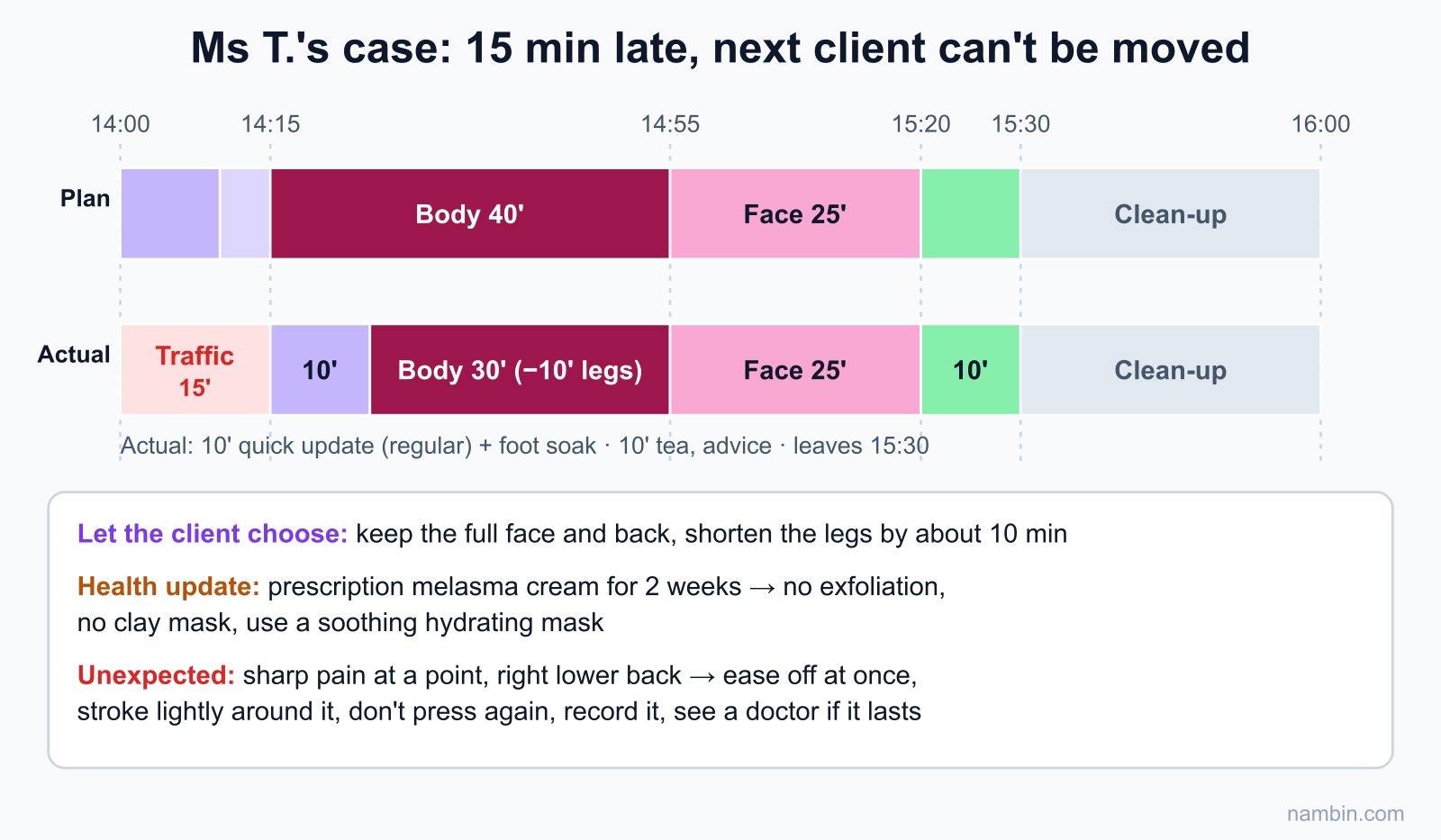
You do not quietly cut the treatment short. You greet her, offer a drink and say gently: "Since you're a little late, there are two options: I can do the full 90 minutes if reception can move my next appointment, or I can keep the full facial and back massage and shorten the leg part by about 10 minutes. Which would you prefer?" Reception says the next appointment cannot be moved, so she chooses to shorten the legs.
You make up the other five minutes with a shorter consultation — she is a regular, so you only need an update. Both of you know in advance and nobody is surprised — that is the difference between a professional therapist and someone who only knows the techniques.
Quick consultation and plan
You ask for a health update: nothing has changed, but she started using a prescription melasma cream from her doctor two weeks ago. You note it down and decide: skip exfoliation, no clay mask, use a soothing hydrating mask instead. New milestones: 14:15–14:25 update and foot soak; 14:25 start the body massage, with extra work on the lower back; 14:55 finish the body, wash hands, move to the face; 15:20 finish moisturising; 15:20–15:30 tea and aftercare advice (see Figure 4).
What happened during the session
While you massage her lower back, she flinches slightly at one point on the right. You reduce the pressure immediately and ask: "Is this spot painful or just tired?" She says it is a sharp pain. You switch to light stroking around it, stop pressing that point and make a mental note for the record. The facial goes normally and her skin does not redden. At the end, you raise the head of the bed, remind her to sit up slowly and to sit for a minute before standing.
Closing
Aftercare advice: avoid the sun and use sunscreen because she is using a melasma cream; if the sharp pain on the right of her lower back persists or spreads down her leg, she should see a doctor. The record covers all five parts, including "sharp pain point, right lower back — avoid pressing, monitor" and "using prescription melasma cream — no exfoliation, no clay". She leaves at 15:30, and you have 30 minutes to clean the room, write the record and prepare for the next client.
After the treatment: aftercare advice and the client record
Advice for the client
- Drink warm water and rest; avoid very hot showers or strenuous exercise right after a massage.
- After facial care: avoid the sun and use sunscreen; if redness or stinging persists, contact the spa.
- Suggest how often to come back based on real needs; never pressure the client into buying a package.
- If you found an unusual pain point during the session, tell the client clearly and suggest seeing a doctor if it persists — do not try to explain the cause yourself.
Writing the client record
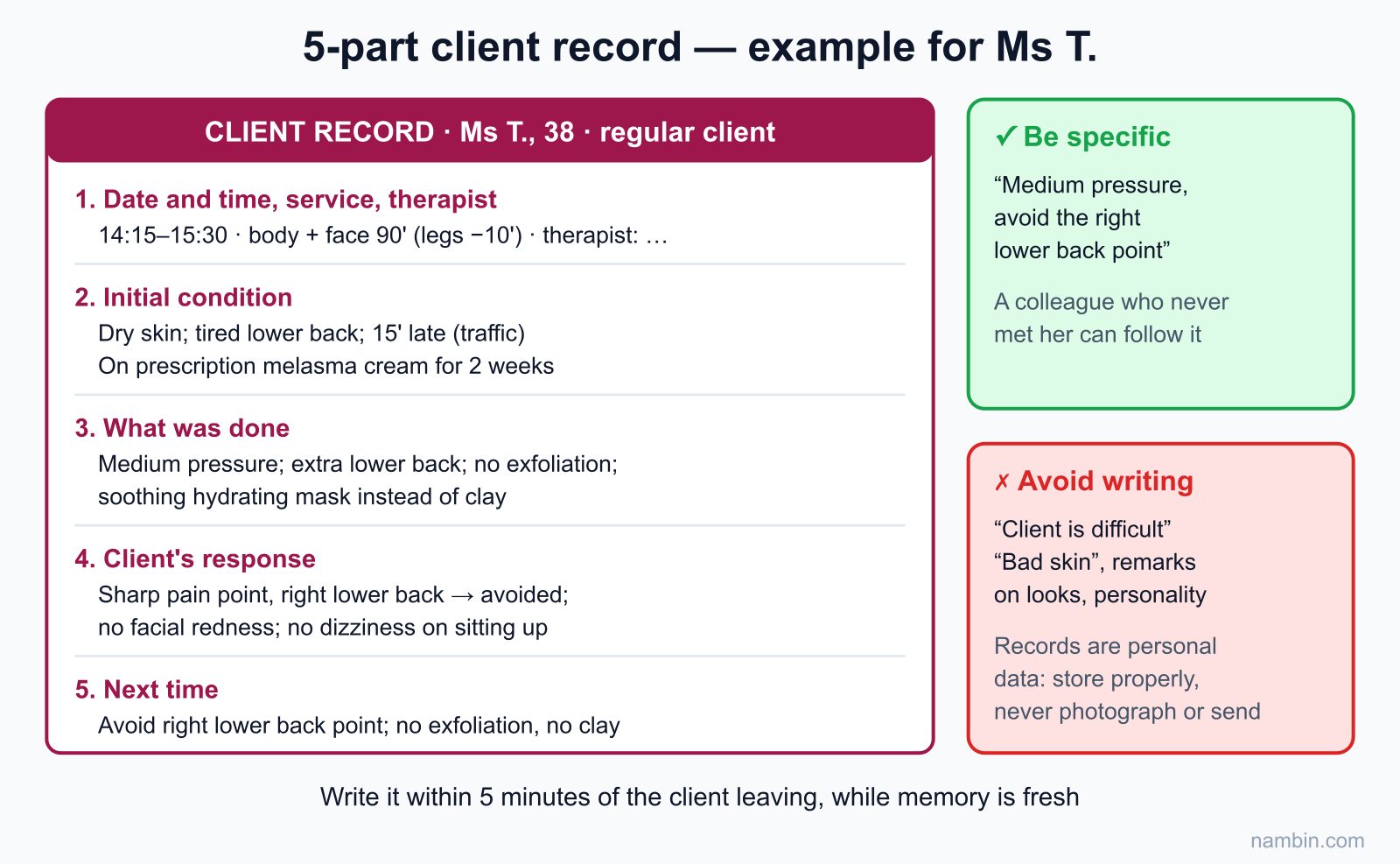
Write it immediately after the session, while you still remember accurately. A good record includes:
- Date and time, service, therapist's name.
- Initial condition: tired areas, skin type, notes from the health form.
- What was done: techniques, products, pressure, deviations from the standard protocol.
- The client's response: comfort, painful areas, any irritation.
- Recommendations for next time: pressure, products to avoid, areas needing attention.
Write so that a colleague who has never met the client can read it and do the job: use specific words ("medium pressure, avoid pressing the right lower back point") rather than vague ones ("client is a bit difficult"). Never write personal comments about the client's personality or appearance. The record is the client's personal information: store it where the spa specifies, and never photograph it, send it outside or gossip about it (see Figure 5).
Cleaning the room
Put dirty towels into a separate bag, discard single-use items, disinfect tools and surfaces, and air the room before the next client. Restock the tool tray while you clean — do not wait until the next client arrives to discover something is missing.
Handling unexpected situations
The client is unhappy mid-session
The client says "the pressure is too light" or "that really hurts" — adjust immediately, thank them for telling you, and check again after a minute. Do not argue that "this is the standard technique". If the client is still unhappy, ask permission to call the shift leader to see whether to change therapist or adjust the treatment.
The client complains after the session
Listen to everything without interrupting, and do not blame the products or your colleagues. Write down the specifics: what, when and how bad. Report to the manager to handle according to spa policy. If the client reports persistent redness, stinging, a rash or significant pain after the massage, advise them to see a doctor and note it in the record.
The client behaves inappropriately
If a client makes inappropriate remarks or gestures, you have the right to stop the treatment, leave the room and report to the manager immediately. Stay calm and keep it short: "I'm going to stop here." Do not deal with it alone. Professional spas have rules to protect their therapists — ask your manager about them from your very first day at work.
Common mistakes
- Running over time or cutting the treatment short because preparation was slow — the client loses trust and the next appointment is squeezed. How to avoid it: count backwards and keep a 5-minute buffer.
- Missing items in the room, so you have to step out mid-treatment and leave the client alone. How to avoid it: check the tray in treatment order before the appointment.
- Talking too much when the client wants to rest, or chatting about your private life or other clients. How to avoid it: let the client set the pace of conversation and only ask questions that serve the treatment.
- Forgetting aftercare advice — the client goes out in the sun straight after a light peel, the skin reacts and they blame the spa. How to avoid it: make aftercare advice a fixed step in the time plan.
- Not writing the record: next time a colleague uses the wrong pressure or the wrong product. How to avoid it: write it within 5 minutes after the client leaves.
- Forgetting hand hygiene when changing area: body oil on the face clogs pores and risks cross-contamination. How to avoid it: wash or sanitise your hands every time you move from body to face.
Frequently asked questions
Should I do the face first and then the body massage?
The order depends on the spa's menu. Many spas do the body first so the client relaxes, then move to the face and finish with clean, moisturised skin — avoiding body oil getting back onto the face. What matters is having one agreed order in the spa and washing your hands when changing area.
What if the client wants to talk the whole time?
Reply politely and briefly, and keep your hand rhythm even. Avoid sensitive topics, other clients and internal spa matters. As the client gradually falls silent, talk less yourself.
How do I wake a client who is fast asleep at the end?
Rest a hand lightly on their shoulder over the towel, say their name softly, and wait until they are fully awake before raising the head of the bed and reminding them to sit up slowly. Never switch on bright lights suddenly.
How many 90-minute treatments should I take in a day?
It depends on your health and the spa's rules. Beginners should usually take only a few long treatments per shift, with breaks in between so their hands and back can recover. If you overwork, your pressure weakens and you are more likely to injure your wrists.
Are paper records or computer records better?
Either works if all five parts are filled in, updated after every session and kept confidential. Follow the system your spa already uses.
Project exercise
- Deliver a complete 90-minute treatment to a classmate or family member playing the client, with an instructor observing and timing each stage.
- Complete the health form and the client record using the 5 parts above.
- Ask the "client" to score you 1–5 on: welcome, privacy, pressure, punctuality and aftercare advice. Write down 3 things you will improve.
- Self-check: did you wash your hands when moving from body to face, ask about pressure at least 3 times, and remind the client to sit up slowly?
- Ask the "client" to act out an unexpected situation you do not know about in advance (arriving late, pain at one spot, unhappy with the pressure), then handle it.
Self-assessment table
| Criterion | Pass when |
|---|---|
| Preparation | You never left the room during the treatment |
| Time | Total time is off by no more than 5 minutes; every change was explained to the client in advance |
| Safety | You asked for a health update, adjusted correctly when there was a concern, and reminded the client to sit up slowly |
| Hygiene | Hands washed when changing area; no single-use items shared |
| Communication | Asked about pressure at least 3 times; handled the unexpected situation calmly |
| Record | All 5 parts complete; someone else can read, understand and follow it |
Once you have completed this project, you are ready for the roadmap step safety and service skills assessment — where you answer questions about contraindications and hygiene and demonstrate your techniques in front of an instructor.