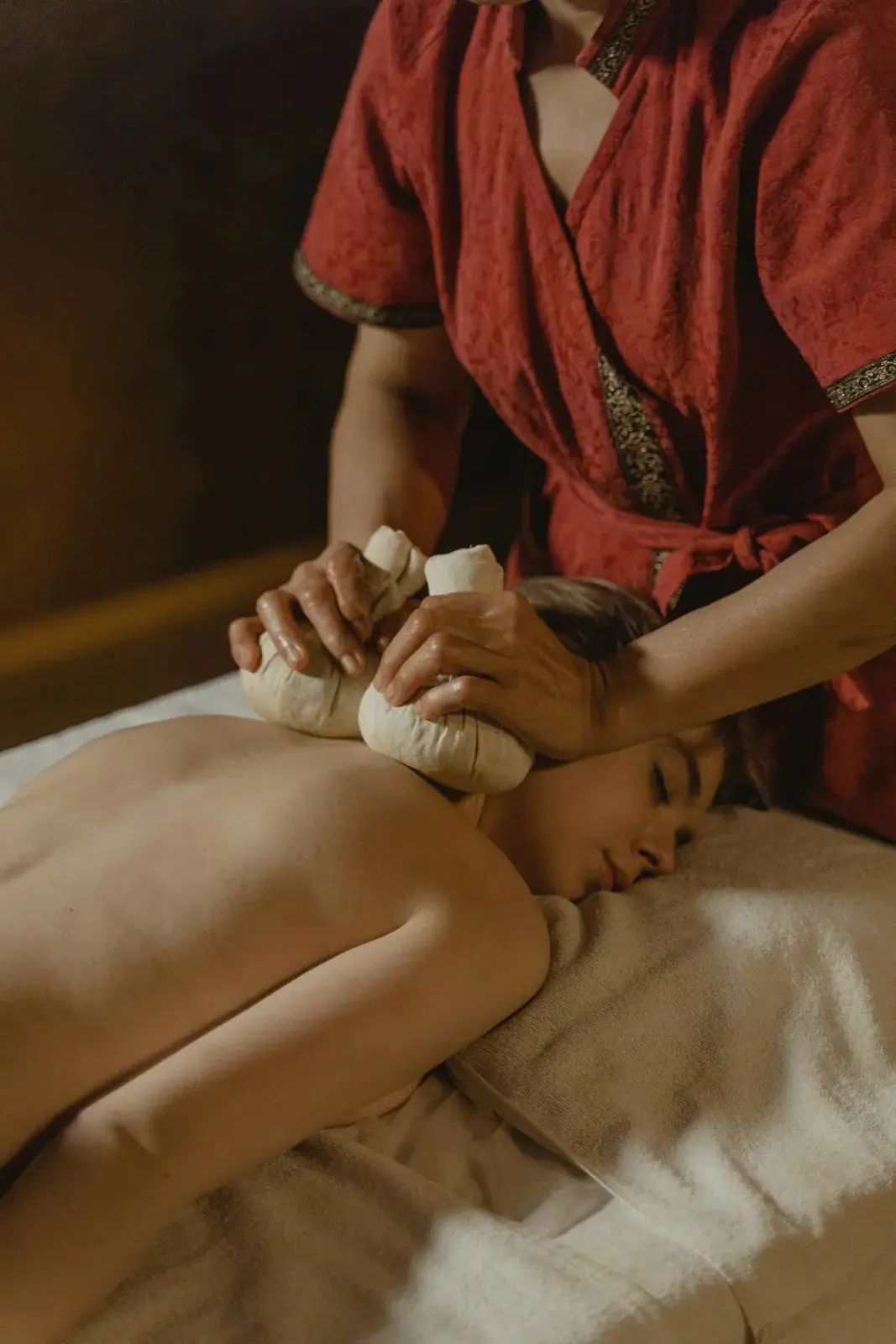
A client books a body massage with herbal compress. You lift two freshly steamed balls out of the pot, the room smells of lemongrass and ginger, and you are about to press them onto her back because "it should feel properly hot". Then she mentions that she has diabetes and her feet often feel numb. That one sentence changes the whole session: a client who cannot feel heat properly may not notice that a compress is too hot, and a small burn on someone with diabetes can take longer than usual to heal.
A herbal compress looks gentle, but it is moist heat applied directly to the skin. Doing it well means: screen the client first, test the heat on your own inner wrist before every touch, use quick taps while the ball is hot, press and roll only once it has cooled a little, and never leave a hot compress resting in one place.
Scope. This guide is for spa therapists who add herbal compresses to a relaxing body massage. In a spa, the herbs bring warmth, a pleasant scent and a feeling of relaxation. Do not tell clients that a compress "detoxes", "cures back pain" or treats any illness. Every time given here is for reference only: always follow the compress supplier, the steamer maker and your spa's procedure. Hot stones, hot towels, body wraps, massage oils and general aftercare have their own articles.
What is a Thai herbal compress?
A herbal compress (in Thai luk pra kob, often sold as a "herbal ball") is a handful of dried or fresh herbs wrapped tightly in cotton or muslin and tied into a round head with a handle. It comes from traditional Thai massage and is now used in many spas across Southeast Asia. The ball is moistened, steamed, then tapped, pressed and rolled over the body.
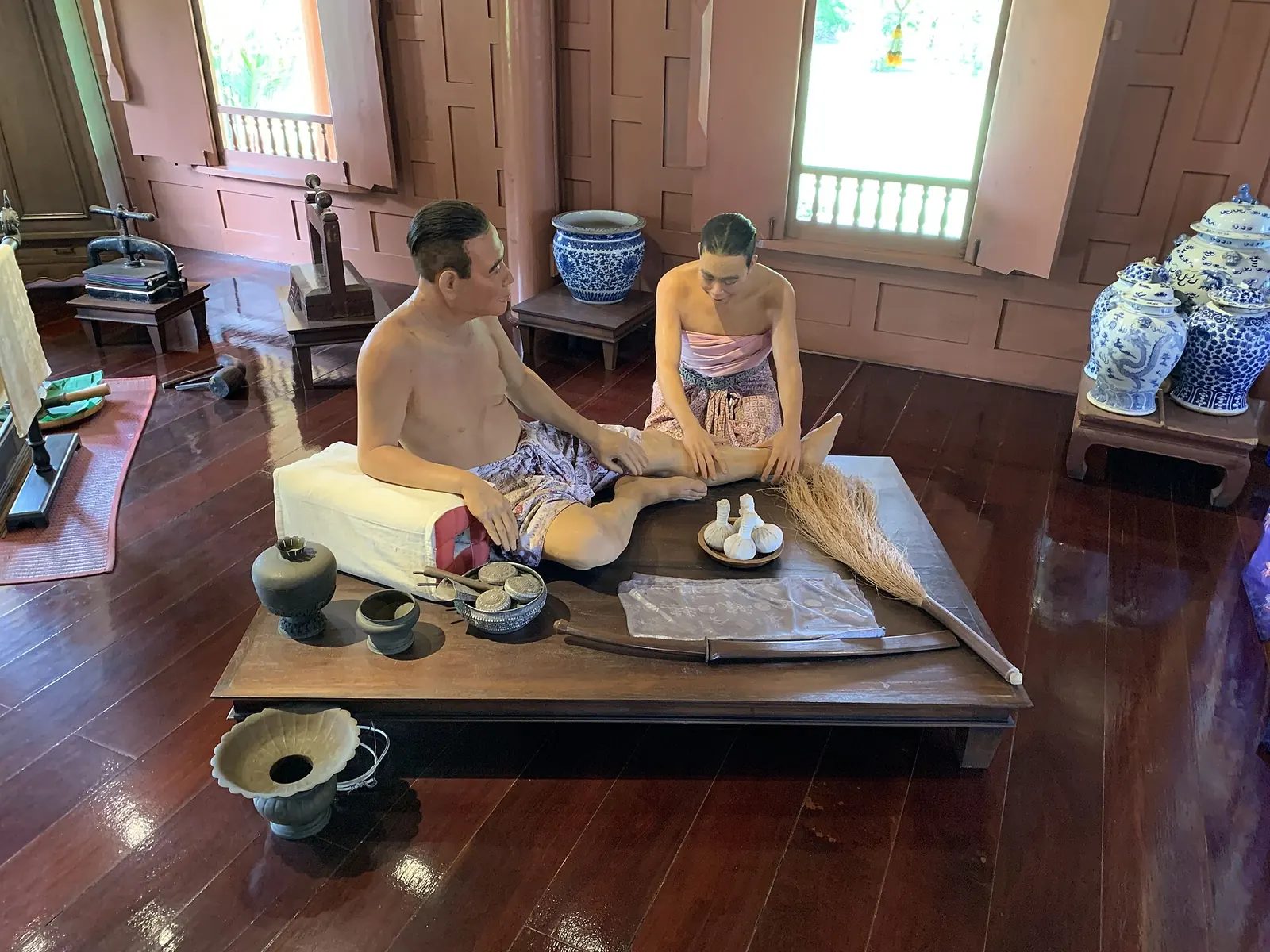
Figure 1. A museum display at King Rama II Memorial Park in Amphawa, Thailand, shows a traditional Thai massage scene with life-size figures. A plate of white herbal compress balls sits on the wooden platform beside them, with small bowls and a long brush. Herbal compresses come from this tradition and are now on many spa menus. (Photo: Chainwit., Wikimedia Commons, CC BY 4.0)
Unlike a hot stone (hard, holds heat for a long time) or a hot towel (laid over an area and left still), a compress is soft and damp, cools fairly quickly, works one small spot at a time, must keep moving, and can leave herbal colour on skin and towels.
Tools and preparation
What you need
A steamer with a lid: a dedicated compress steamer or a lidded pot with a steaming rack, used only for compresses. The balls sit above the water, never in it.
Compress balls: at least two per client, usually two pairs for back, shoulders, arms and legs.
A tray to squeeze water into and a dry towel to tap the ball on.
Tongs or heat-resistant gloves for the lid and the balls.
Draping towels kept for compress work only, because herbs such as turmeric stain.
A thermometer (optional): if your supplier gives a target temperature for the steamer, use it to check the steamer is working. It never replaces the wrist test, because the surface of a ball can feel very different from the number on a display.
A client record card and a cool, damp cloth within reach.
Know what is inside the ball
Recipes differ. Common ingredients for external use include lemongrass, ginger or galangal, turmeric, lime or kaffir lime leaves and peel, tamarind leaves, and sometimes camphor, menthol, salt or essential oil. Camphor and menthol smell strong and may make scent-sensitive clients feel dizzy; turmeric causes most yellow stains; and any ingredient can irritate sensitive skin, camphor, menthol and essential oils more often than the rest. Read the label or your spa's recipe so you can answer when a client asks, "What's in it?"
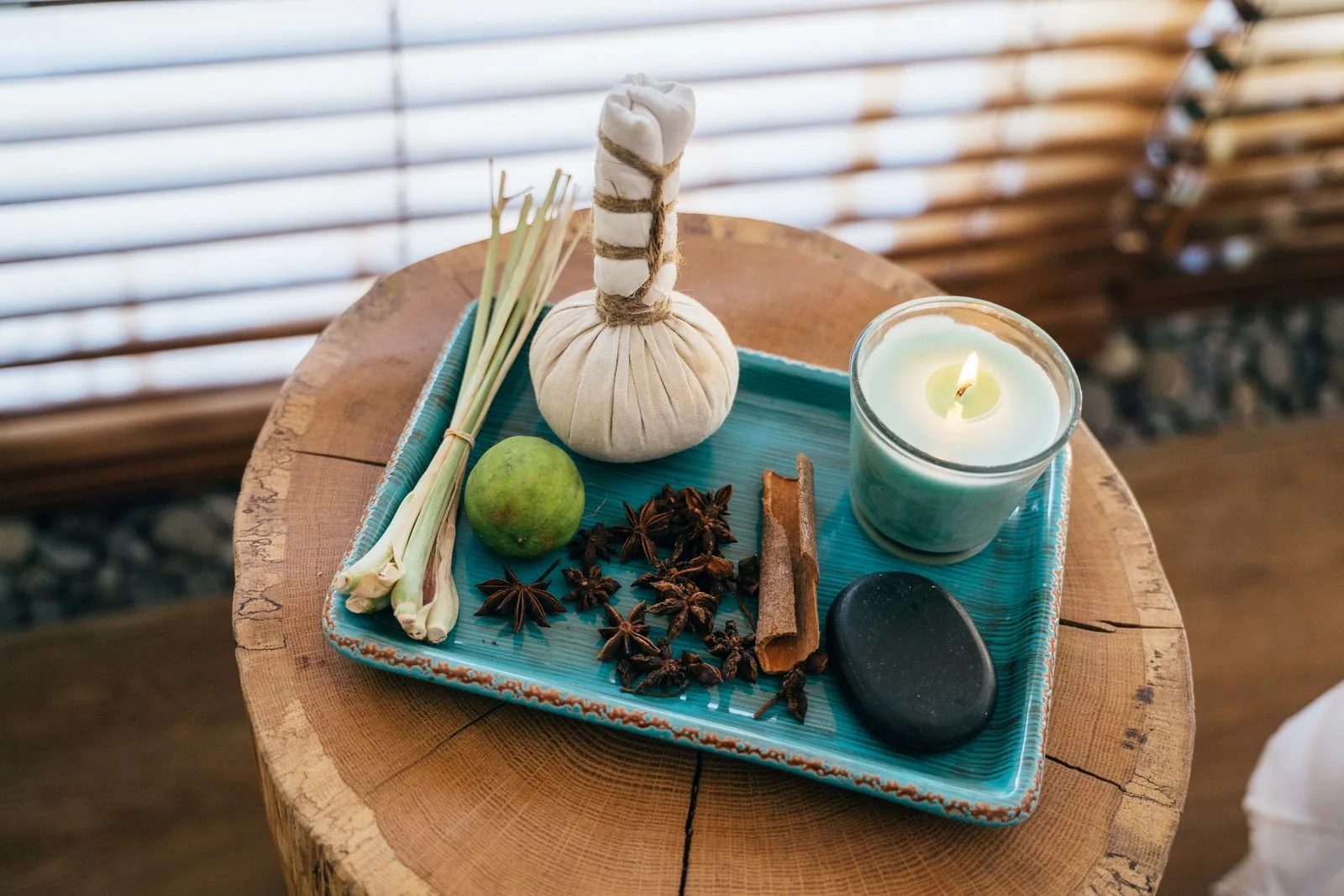
Figure 2. A herbal compress tied with jute twine stands on a turquoise ceramic tray beside lemongrass stalks, a small green citrus fruit, star anise, a cinnamon stick, a smooth black stone and a lit candle in a glass. Recipes differ between suppliers, so read the ingredient list before the session and ask the client about allergies to any of them. (Photo: Anna Tarazevich, Pexels, Pexels License)
Check each ball before use
Fabric: no tears, thin patches or holes at the base.
Tie: tight, with a firm handle.
Smell: herbal. Sour, musty or stale means it goes in the bin.
Surface: no white, green or black spots (mould) and no slimy feel.
Limits: within the number of uses or time limit set by the supplier and your spa.
Client screening and when not to use heat
Ask and record before the client gets on the table, not when the balls are already hot.
Do not use a compress (or skip that area)
Reduced feeling of heat: numbness, diabetes with nerve problems, after a stroke, other nerve damage. A client who cannot feel heat will not tell you it is burning.
Damaged skin: wounds, scratches, freshly waxed or shaved skin, sunburn, rashes, skin infections, flare-ups of eczema or psoriasis.
Visible varicose veins: no pressing, rolling or heat on those areas.
Recent injury, or an area that is swollen, hot, red and newly painful.
Fever, flu, exhaustion or recent alcohol.
Allergy to any ingredient, or a past rash from herbal products.
Unexplained lumps, or a recent operation site.
Take extra care
Ask a manager, or the client's doctor where needed, and usually use milder heat and a shorter time for: pregnancy (many spas do not offer hot compresses to pregnant clients; if yours has a protocol, use only a mildly warm ball and avoid the abdomen and lower back completely); older clients with thin skin; heart conditions or unstable blood pressure; and clients on blood thinners or medicines their doctor says make the skin sensitive.
Ask plainly: "Do you have diabetes, numbness, a heart condition or blood pressure problems? Are you pregnant? Are you allergic to lemongrass, ginger, turmeric, menthol balms or essential oils? Is anywhere sore, swollen, scratched or sunburnt?" Write the answers down.
Allergy and scent check
For sensitive skin or a first-time client, follow your spa's patch-check rule. A common approach is a brief touch with a slightly warm (never hot) ball on the inner forearm at the start, then a few minutes' wait. Let the client smell an unheated ball from a short distance too. If they dislike the scent, feel unwell or notice itching or redness, use a plain warm towel instead and note it on the card.
Moistening and steaming the balls
A completely dry ball often heats unevenly, so many suppliers recommend dipping or spraying it with clean water until evenly damp, then squeezing gently. Some balls need a longer soak; follow the packaging.
Steam the balls above the water with the lid on. Getting them evenly hot usually takes about 15–30 minutes (for reference), depending on size, dampness and equipment.
Keep the balls off the hot base and sides of the pot, which can scorch the fabric.
Never boil the balls in the water: a soaked ball drips very hot water onto the skin.
Microwave only if the supplier allows it and your spa has a clear rule; it heats unevenly, warm outside and very hot inside.
Use tongs or gloves when lifting the lid. The rising steam can burn your hand.
Keep the lid on so the waiting balls stay hot, and place the steamer on a stable surface away from the walkway, cable tidy. Never rest a hot ball on the table beside the client.
Testing the temperature on yourself first
Every time a ball comes out of the steamer:
Lift it with tongs or by the handle, not by the freshly steamed head.
Squeeze out excess water. A dripping ball is a ball that can burn.
Tap it a few times on a dry towel to release surface heat.
Touch it briefly to your inner wrist or inner forearm. That skin is thinner and reacts more like the client's than your palm, which is used to heat.
If it stings and you want to pull away, it is not ready. Wait and test again.
Touch the client briefly on a less sensitive area, such as the upper back, and ask: "How does that feel? Tell me straight away if it's too hot."
Agree from the start: when the client says "hot", you lift the ball. There is no "a bit too hot is good for you". Never test on, or work over, an area the client cannot feel properly; your wrist tells you nothing about how a numb foot will react.
Reference table: heat stages of a compress
Stage (for reference) | What you notice | How to use it on the client |
|---|---|---|
Just out of the steamer | Visible steam, very hot, may drip | Do not touch the client. Squeeze, tap on a dry towel, test on your wrist |
Hot | Clearly hot on your wrist, bearable only very briefly | Quick taps only: touch, lift, keep moving |
Comfortably warm | Your wrist can hold it a few seconds without stinging | Short presses, slow rolling |
Cooling | Little steam left, gently warm | Rolling and longer presses; get the next ball ready |
Cool | Close to hand temperature | Return it to the steamer and take the next ball |
There is no fixed number of minutes per stage. The real measure is your wrist and what the client tells you.
Tapping, pressing and rolling
Tapping: while the ball is hot, place its base on the skin for about one count, lift, and move to the next spot.
Pressing: once it has cooled a little, place it, lean a little body weight through your arm, hold a few seconds and release. Light to medium pressure; ask if it feels right.
Rolling: when it is only warm, tilt it and roll slowly along the muscle, or make small circles so the warmth and scent spread evenly.
The rule: the hotter the ball, the shorter the contact; the cooler the ball, the longer you can press and roll. Never set a hot ball down on the client and turn away.
Working by body area
Compresses usually follow the oil massage on each area, or alternate with it: massage the back, compress the back, then move to the legs. Some spas work on skin with a thin layer of oil, others through a thin cloth; follow your procedure. Uncover only the area you are working on.
Back
Tap from the upper back to the waist along both sides of the spine, on the muscles, not on the spine itself. Use only light pressure on the lower back, which has no ribs to protect it. As the ball cools, roll along the muscles and around the shoulder blades.
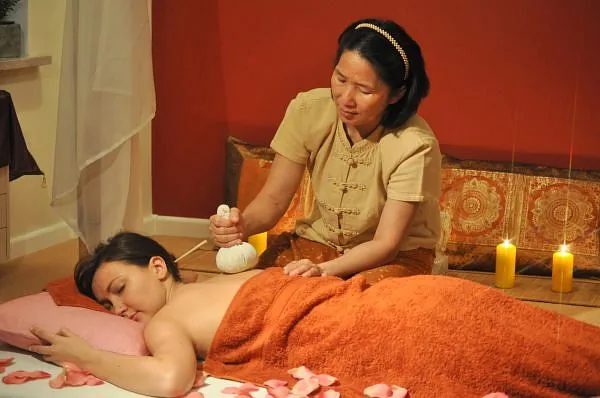
Figure 3. A therapist kneels beside a client lying face down on a floor mattress and presses a white herbal compress onto the client's upper back, her other hand resting on the client's back. An orange towel covers the client from the upper back down. Uncover only the area you are working on and keep the rest of the body draped. (Photo: Marcin Bober, Wikimedia Commons, CC BY 3.0)
Shoulders and neck
Press evenly on the muscles on top of the shoulders. Do not press on the bones of the neck, and never touch the front or sides of the neck.
Arms
The inner arm and inside of the elbow have thinner skin, so use a ball that has cooled a little. Tap from the shoulder down to the palm. Ask the client to remove metal rings and bracelets beforehand, as metal can heat up when the ball touches it.
Legs
Face down, tap and roll along the backs of the thighs and calves; face up, the fronts of the thighs, shins and feet. Do not press into the back of the knee, roll only lightly on the shins, skip varicose veins, and leave out the feet of clients with numbness or diabetes with nerve problems.
Reference table: time and safety by area
Area | Main movements | Time (for reference) | Safety notes |
|---|---|---|---|
Back | Tap along both sides of the spine, roll the muscles | 5–10 minutes | Not on the spine; light pressure on the lower back |
Shoulders and neck | Press shoulder muscles, roll around shoulder blades | 3–5 minutes | Not on the neck bones; never the front of the neck |
Arms (each) | Tap, light rolling | 2–4 minutes | Thin skin on the inner arm; jewellery removed |
Legs (each) | Tap, roll along thighs and calves | 3–6 minutes | Avoid the back of the knee and varicose veins; light on shins |
These times only help you plan; the total depends on the treatment package and your spa.
Keeping heat steady: rotating two balls
Compresses cool quickly, so steam two pairs (A and B). Work with pair A while pair B stays in the closed steamer. When A has cooled, return it to the steamer, take out B and test it on your wrist again from the start.
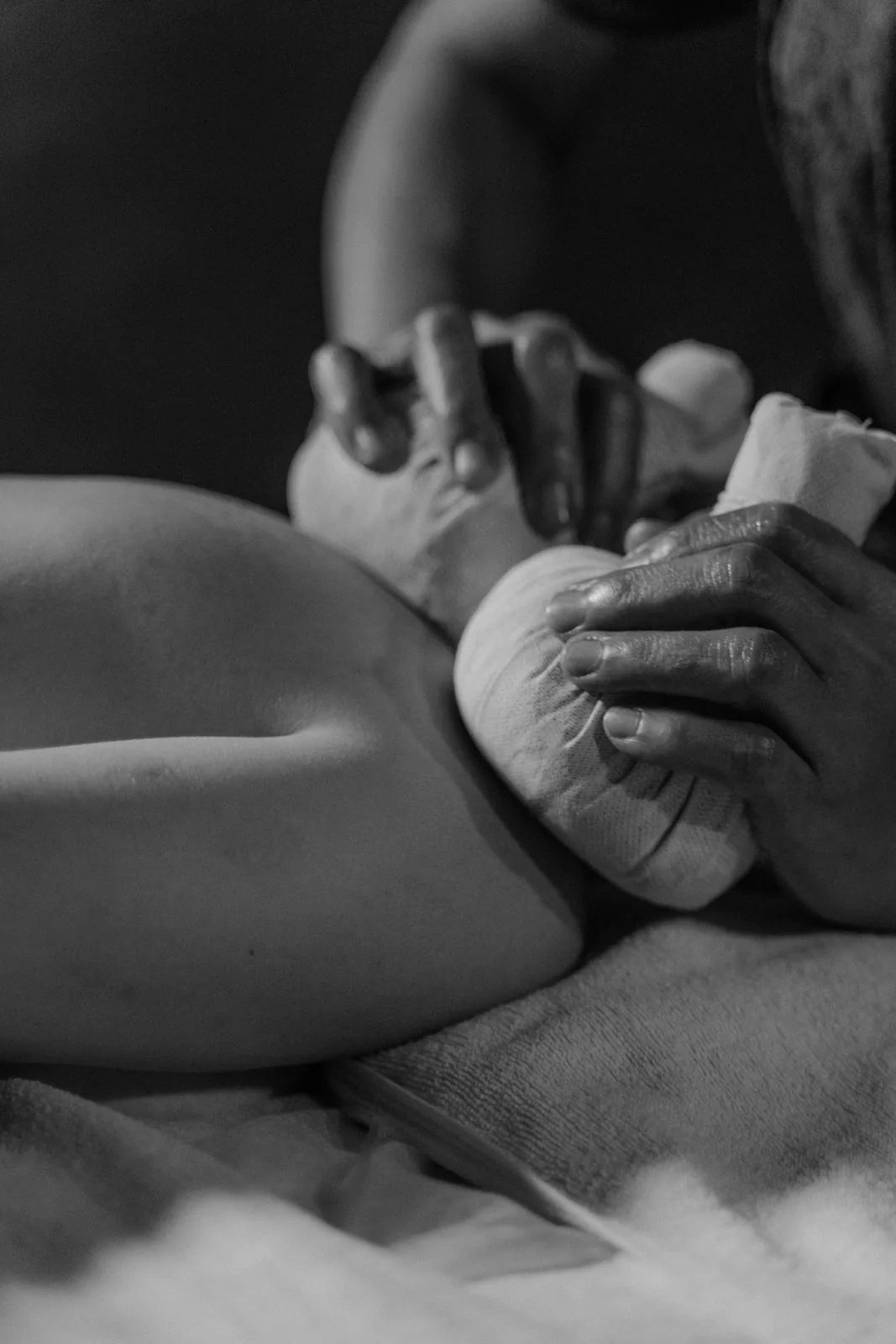
Figure 4. Black-and-white close-up of a therapist's two hands, each pressing a cloth herbal compress onto the upper back of a client lying face down on a towel. A pair of balls covers an area evenly; when the pair cools, swap it for the second pair from the steamer and test the new pair on your wrist first. (Photo: Tima Miroshnichenko, Pexels, Pexels License)
A common mistake: pair A is just gently warm after the back, you pick up pair B without testing, and a much hotter ball lands on the client's shoulder. Every swap is a new wrist test.
A sample session sequence
One way to fit a compress into a body massage (times for reference):
Before the client arrives: check and moisten the balls, start the steamer, set out tray, dry towel, tongs and record card.
Consultation: screening, ingredient and allergy check, the "say hot and I lift" rule, jewellery off, heating balms wiped off.
Face down: oil massage on the back, then compress on back and shoulders (about 8–15 minutes), tapping first, pressing and rolling as the balls cool.
Swap pairs when the first pair cools; wrist test again.
Backs of the legs: massage, then compress (about 3–6 minutes per leg), avoiding the backs of the knees.
Face up: arms (about 2–4 minutes each) and fronts of the legs, skipping the feet if feeling is reduced.
Finish: wipe the skin with a warm, damp towel, check for redness, and record the session.
Burn prevention and what to do if the skin reacts
Preventing burns
Test every new ball on your wrist and squeeze it so nothing drips.
Hot ball = quick taps, always moving. Ask often, especially when moving to a new area.
A client who falls asleep cannot say it is too hot, so keep contacts short.
If the client has applied tiger balm or another heating rub, ask them to wipe or wash it off first; the skin may already feel hot.
If the skin turns unusually red or the client says it burns
Slight pink warmth that fades is a normal reaction. If the skin turns bright red, keeps stinging, blisters or hurts:
Stop using the compress on that area.
Cool it under cool, clean running water (not ice) for about 20 minutes, in line with standard burn first aid.
Do not pop blisters or put toothpaste, fish sauce, oil or herbs on the burn.
Tell the manager and record the area, the ball and the time.
Refer: for a blistered or large burn, a burn on a client with diabetes or an older client, or pain that does not ease, advise the client to see a doctor.
If itching or red bumps appear, stop, wipe the skin with a cool, damp cloth, record the ball and its ingredients and tell the manager. If a rash spreads quickly, or the client has difficulty breathing or swelling of the lips or eyes, call emergency services immediately. Discard that ball.
After the session: what to tell the client
Herbal colour: turmeric can leave a yellow tint. Warn the client beforehand ("this ball contains turmeric, so you may see a little yellow on your skin; it fades with washing") and suggest avoiding light-coloured clothes straight away. It is colour from the herbs, not "toxins coming out".
Skin check: ask the client to contact the spa if any area stays red, stings or blisters later.
Get up slowly: offer water and let the client sit up gradually after the warm treatment.
Cleaning, drying, storing and when to discard
Fabric and plants cannot be disinfected like a steel tool or a stone, so the safest practice is one ball (or pair) per client; many spas give the balls to the client to take home. If your spa reuses a ball for the same client at a later visit, label it with their name and store it separately. Do not share balls between clients unless your spa and the supplier clearly allow it.
After use, let the balls cool somewhere airy and dry them completely, handle up; a ball put away damp goes mouldy fast. Once dry, store each in a clean bag or box labelled with the client's name and date, in a cool, dry place or as the supplier recommends (some suggest the refrigerator). Empty, rinse and dry the steamer daily, and wash compress towels promptly.
The number of uses is set by the supplier and your spa. Even within that limit, discard a ball that has mould spots, smells sour or musty, feels slimy, is torn or leaking, has lost its scent, or was used on a client who reacted. If in doubt, throw it out.
Practical examples
Example 1: Numb feet. Back to the client at the start. You record her diabetes and numbness and tell the manager. Following your spa's rule, you leave out her feet and lower legs and use only cooled balls on her back and shoulders, with short contacts and frequent questions: "Your feet are a bit numb, so it's hard to feel heat there. I'll leave them out to keep you safe."
Example 2: "Make it really hot." A client insists he can take the heat. You still test on your wrist and tap quickly: "I'll keep lifting it, because skin can burn before you feel it."
Example 3: A rash. A few minutes in, a client feels itchy and red bumps appear on her back. You stop, wipe with a cool, damp cloth, record the ball and ingredients and tell the manager. The ball is discarded, and her card now says "plain warm towel instead".
Safety checklist
Screening recorded (diabetes, numbness, varicose veins, pregnancy, heart, blood pressure, fever, damaged skin, sunburn); ingredients read, no allergy.
Balls intact, no mould or sour smell; at least two balls.
Steamed above water, lid on, steamer stable and out of the way.
Jewellery off; heating balms wiped off.
Every new ball: squeeze, tap, wrist test, brief touch, ask.
Hot ball = quick taps; never left resting on the client.
Not on the spine, front of the neck, back of the knee, varicose veins, wounds or numb areas.
Client warned about herbal colour; separate towels; skin wiped afterwards.
Burn plan known: stop, cool running water about 20 minutes, record, refer.
Balls dried and labelled or discarded; steamer cleaned.
Frequently Asked Questions
What does a herbal compress do?
In a spa it is part of a relaxation treatment: warmth, scent and gentle pressure help many clients feel comfortable. Do not present it as a treatment for back pain, arthritis or colds, or as a "detox". Clients with a health condition should see a doctor.
How many times can a herbal ball be used?
There is no general number. Each supplier states its own limit and storage method, and spas set their own rules. A ball with mould, a sour smell or a tear must be discarded even within the limit. The safest option is one ball per client.
Why test on the wrist and not the palm?
Your palm is used to heat and feels it less sharply. The inner wrist has thinner skin and gives a better idea of how the client will feel it.
Can I boil the balls instead of steaming them?
No. A boiled ball becomes soaked and drips very hot water. Steam it above the water with the lid on.
Why does the client's skin turn yellow?
Usually because of turmeric. It is herbal colour, not toxins. Warn the client, use separate towels and wipe the skin afterwards.
Practice Exercises
Check the balls. Take five of your spa's balls, including older ones. List the ingredients that may irritate or stain, check each ball against the five points above, and note which you would discard and why.
Wrist test. Steam two balls, then test on your inner wrist once a minute after taking them out. Record what you feel and compare it with the heat stage table.
Tap, press, roll. Practise on a pillow, then on a consenting colleague's back, swapping pairs at the right moment. Your colleague scores your rhythm and whether you asked how it felt.
Consultation role play. A colleague plays a client with numb feet, a pregnant client and a client who wants it "really hot". Decide which areas you will work or leave out, and explain kindly.
Burn drill and end of shift. Practise stop, cool, record and report for a stinging shoulder, then the end-of-shift routine: cool, dry, label or discard the balls and clean the steamer.