Clients who walk into a spa often just say "I'd like the relaxing package, please" — but she may be in the first weeks of pregnancy, taking blood thinners, or applying an acne treatment that thins the skin. Five to ten minutes of proper consultation helps you avoid accidents, choose the right treatment and earn the client's trust so she comes back.
By the end of this lesson, you will be able to: use a 7-section health information form and read it back together with the client; ask closed and open questions at the right moments; place each client in one of three action levels (proceed as normal, proceed with adjustments, postpone/ask a doctor); refuse or change a treatment while keeping the client happy; and give home-care advice without pressure selling. At the end of the lesson there is a worked consultation, from the greeting to the signature, for you to practise as a role-play.
Why consultation is a skill, not a formality
In the foundation step, you learned the list of contraindications. Consultation is how you turn that list into practical action with each individual client.
Three goals of a consultation
- Safety: spot conditions that must be avoided, that require an adjusted technique, or that need the client to ask a doctor first.
- The right need: understand whether the client wants to relax, ease neck and shoulder tension, or care for dry skin, so you can choose a suitable treatment and pressure.
- The right expectations: the client knows in advance what will be done, how long it takes, what it will feel like and what result is realistic — avoiding disappointment or complaints.
Missing any of these goals has consequences. Skip safety and the client may end up bruised, dizzy or irritated. Misunderstand the need and you can do everything technically right while the client still feels it was "not what I expected". Fail to set expectations and the client thinks one facial will clear her acne, then comes back to complain.
The therapist's scope of practice
A therapist does not diagnose illness. Your role is to ask – record – decide within the scope of the profession, and to know when you must say "you should ask your doctor first". You do not interpret test results, you do not advise clients to stop or change medication, and you do not suggest supplements in place of medicine. When a client asks about such things, the standard answer is: "That's outside my expertise — please ask the doctor who is looking after you. I'll just adjust the treatment so it's safe for you."
Consultation affects the whole shift
Discovering a contraindication after the client has changed and lain down on the bed is the most awkward situation: the treatment changes halfway, the schedule slips, the price changes and the client is annoyed. Five to ten minutes of consultation at the start lets the receptionist, therapist and manager all know in advance and arrange the room and price correctly.
What goes on a health information form
Seven sections of a workable form
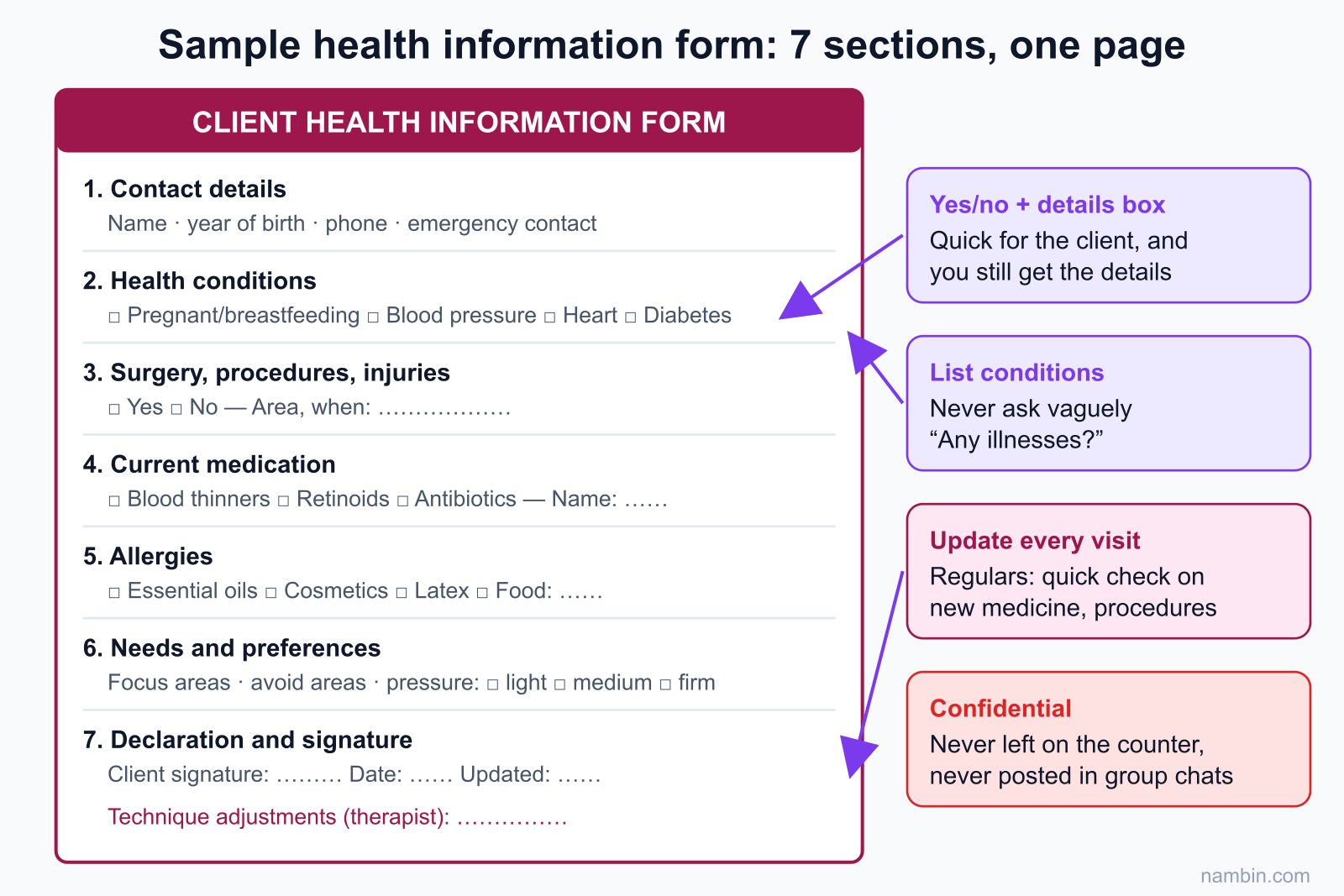
Every spa has its own template, but a workable form usually contains these sections:
- Contact details: full name, year of birth, phone number, emergency contact.
- Health conditions: pregnant or breastfeeding, high/low blood pressure, heart disease, diabetes, epilepsy, varicose veins, skin conditions, recent fever or illness.
- Surgery and injuries: surgery, cosmetic injections, tattoos or laser in recent months; areas that are painful, sprained, or old fractures.
- Current medication: blood thinners (anticoagulants), oral or topical acne treatments containing retinoids, antibiotics, hormonal medication.
- Allergies: essential oils, cosmetics, latex (gloves), and food ingredients found in products such as nuts, milk or honey.
- Needs and preferences: the goal of the session, areas to focus on, areas not to touch, preferred pressure, scents.
- Declaration: the client confirms the information is correct and agrees to the treatment, signs and dates it. The spa commits to keeping the information confidential.
Designing the questions on the form
Questions on the form should be yes/no with a details box, for example "Do you take any medication regularly? □ Yes □ No — If yes, name of medication: ……". This format lets the client fill it in quickly while still giving you the details. Avoid vague questions such as "Do you have any illnesses?" — most clients will tick "no" because they do not think of high blood pressure that is stable on medication as an "illness". List each condition specifically so the client can tick it. Make the print large enough and easy to read for older clients; if a client has not brought her glasses, read each question aloud and fill it in for her, then read it back before she signs.
Updating the form and keeping it confidential
The form is updated every time the client returns — health changes over time, especially for clients who are pregnant, have just had surgery or have changed medication. For regular clients you do not need to fill in the whole form again; just ask quickly, "Has anything changed with your health since last time — any new medication or procedures?" and write the update date. The form is personal health information: store it where the spa requires, never leave it on the reception counter, never photograph it and post it in a group chat, and only the therapist serving the client and the manager may see it.
The client's answers → what you do
| The client reports | Suggested action |
|---|---|
| Pregnancy | No standard body treatments; only provide a dedicated pregnancy service if the spa has a procedure and a trained therapist; avoid essential oils whose safety is unclear; advise the client to ask her obstetrician |
| Fever, flu, infectious illness | Postpone the session and rebook once she has recovered |
| High blood pressure, heart disease | Avoid hot steam, strong pressure and long sessions; if not under stable control, ask the client to consult her doctor first |
| Varicose veins, bruises | Do not massage directly over the area; only stroke lightly around it |
| Taking blood thinners | Reduce pressure clearly, avoid deep-pressure techniques, watch for signs of bruising |
| Using retinoids, recent laser or peel | No exfoliation and no acid-based products; choose a soothing, moisturising treatment |
| Inflamed skin, pustular acne, open wounds, fungal infection | Do not work on that area; if it is widespread, postpone and advise a dermatology check |
| Ingredient allergy | Note it clearly on the form and change products; if in doubt, patch test on a small area of skin first |
| Diabetes | Ask about sensation in the feet; use warm (not hot) water for foot soaks and check the temperature yourself; light pressure on the legs; ask whether the client has eaten, to avoid low blood sugar while lying down for a long time |
| Recent surgery or injury | Avoid that area completely; after recent major surgery, ask the client to get her doctor's opinion before a body massage |
The table above is general guidance. Always follow the rules of the spa where you work, and tell the shift leader when you meet a case you are unsure about.
Three decision levels
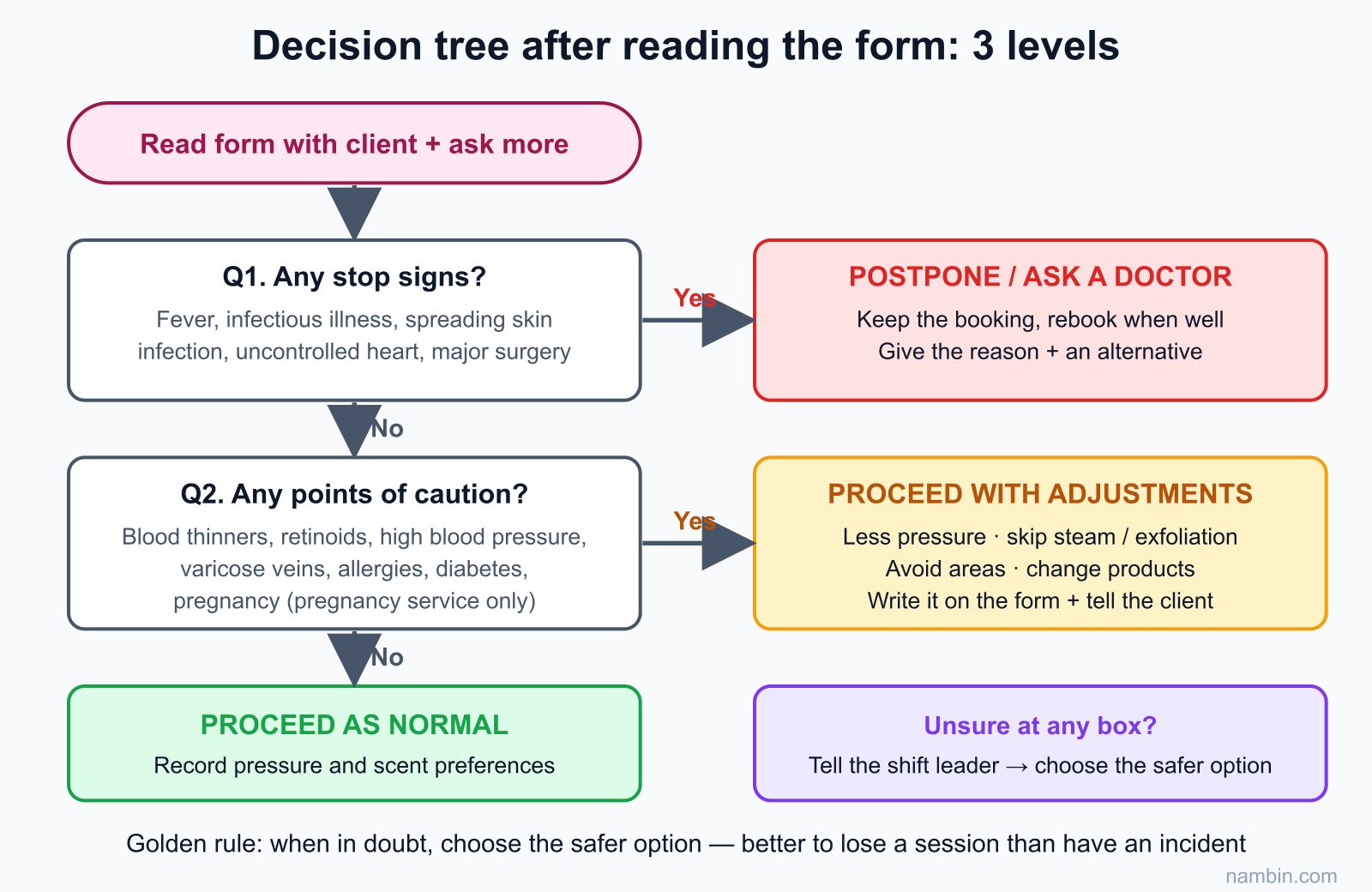
After reading the form, every client falls into one of three levels:
- Proceed as normal: nothing to watch for; just record pressure and scent preferences.
- Proceed with adjustments: reduce pressure, drop a step (steam, exfoliation), avoid an area, change products. Write the adjustment clearly on the form and tell the client.
- Postpone or ask a doctor: fever, infectious illness, widespread skin infection, uncontrolled heart disease, recent major surgery, or any case where you and the shift leader are unsure.
The golden rule: when in doubt, choose the safer option. Losing one session is better than letting a client have an incident.
What to say when you must refuse or change a treatment
Clients accept a change more easily when you give the reason and offer an alternative. Instead of "You can't have that", say: "Because you're taking blood thinners, strong massage could easily bruise you. Today I'd suggest the relaxing package with light pressure — it still focuses on your neck and shoulders like you wanted. Would that be all right?" If you must postpone: "You have a fever, so massage right now wouldn't be good for you. I'll keep your booking open and we'll reschedule once you're feeling better." Never joke about, or show excessive worry over, a client's health condition.
A 5–10 minute consultation, step by step
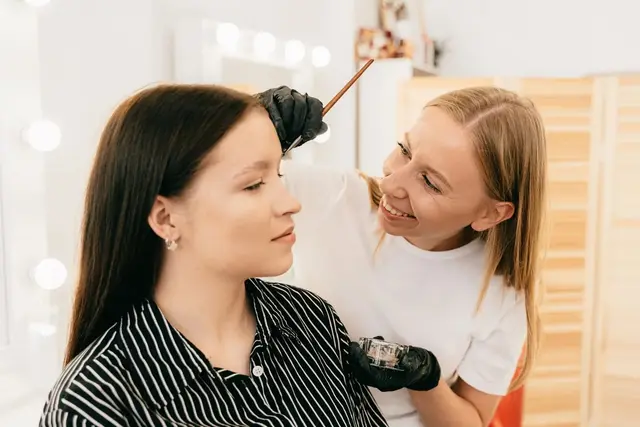
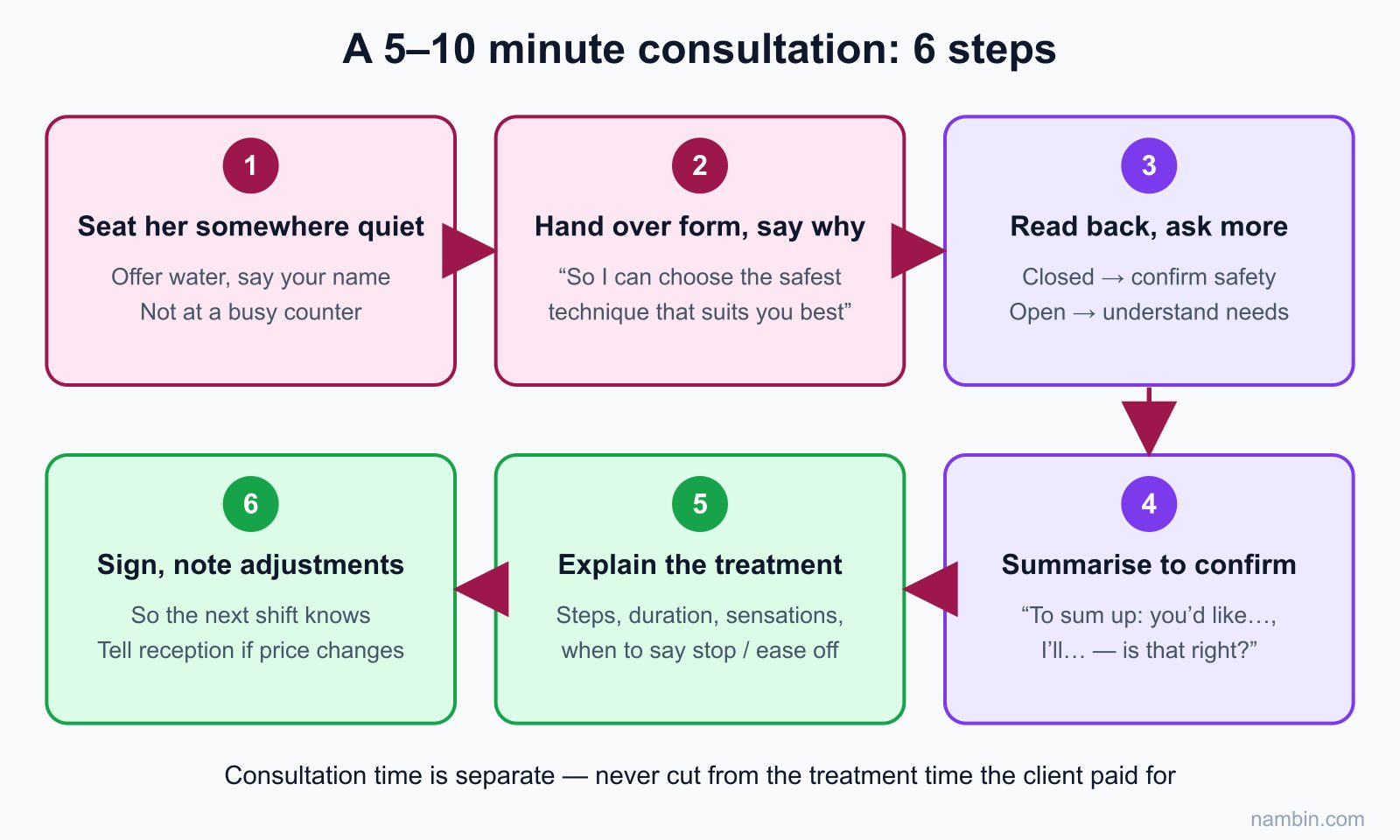
- Seat the client somewhere quiet, offer water and introduce yourself. Do not consult standing at a busy counter — clients are reluctant to talk about their health there.
- Hand over the form and explain why: "Please fill this in so I can choose the safest technique that suits you best."
- Read the form back with the client, asking more about items she has ticked or left blank. Use open questions: "When do your neck and shoulders feel tightest these days?" rather than "Are you tense?".
- Summarise to confirm: "So, to sum up: you'd like me to focus on your neck and shoulders, medium pressure, no peppermint scent, and since you're using an acne cream I won't exfoliate your face — is that right?"
- Explain the treatment: the steps, the duration, the sensations she may feel, and when she should tell you to stop or ease off.
- Ask for confirmation and a signature, and write any technique adjustments on the form so colleagues on the next shift know too.
Open and closed questions
Closed questions ("Do you…?") are for confirming safety information: pregnancy, medication, allergies. Open questions ("How does… feel?", "When…?") are for understanding needs. For example, if the client ticks "back ache", ask: "Is it your upper or lower back, and is it worse after sitting or standing for a long time?" The answer tells you whether to spend extra time on the neck and shoulders or on the lower back. If the client describes pain spreading down the leg, numbness, or pain after a fall, it is no longer ordinary "tension" — note it down and advise her to see a doctor before you massage that area.
Listening and staying neutral
Look at the client while she talks, nod, take notes and do not interrupt. Do not show surprise when a client describes an illness, and never comment on weight, appearance or age. Sit at the client's eye level instead of standing and looking down. A client who feels respected will tell you the truth and tell you everything — that is your most valuable source of safety information.
Safety: If a client shows unusual signs during the consultation or treatment — chest pain, shortness of breath, severe dizziness, a rapidly spreading rash, swelling of the lips or eyes — stop immediately, inform the manager and call emergency services (115 in Vietnam) if needed. Never advise a client to take medication yourself, and never promise a cure.
Worked consultation: a 45-year-old client with high blood pressure who wants a steam session
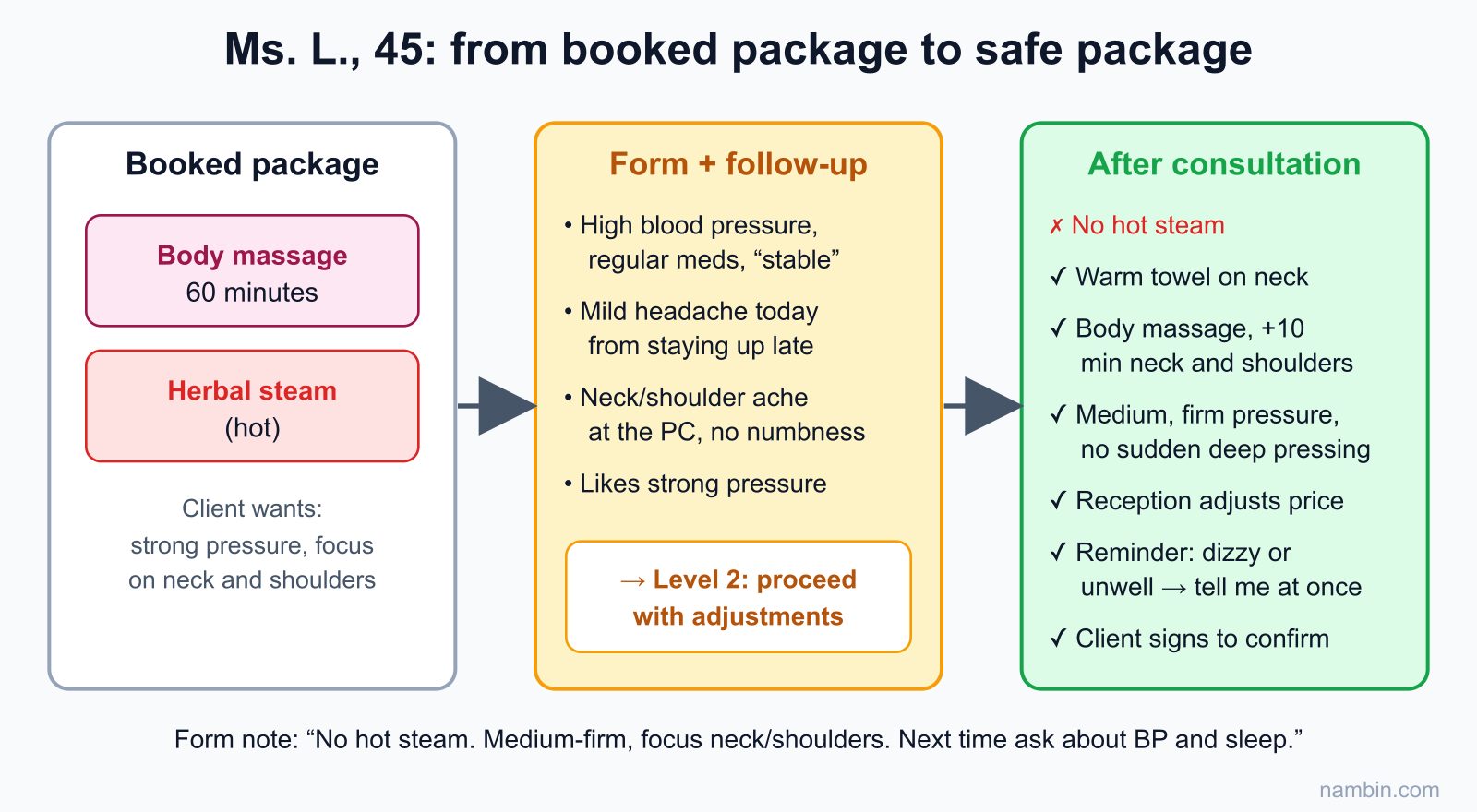
Ms. L., 45, an accountant, books the "60-minute body massage + herbal steam" package. On the form she ticks "high blood pressure", notes that she takes medication daily, has a lot of neck and shoulder tension, and likes strong pressure.
Gathering information
You ask: "Do you take your blood pressure medication regularly, and have your recent readings been stable?" She says she takes it regularly and her doctor says it is fine, but today she has a slight headache from staying up late. You continue: "Does the neck and shoulder tension come with numbness in your arms or dizziness?" She says it only aches after long hours at the computer. You write: "High blood pressure under treatment, stable according to the client; mild headache today from lack of sleep; neck and shoulder tension from posture, no arm numbness."
Decision and explanation
With high blood pressure, hot steam and very strong pressure are things to avoid, especially on a day when the client is tired. You check with the shift leader, then tell her: "With high blood pressure, hot steam makes the heart work harder, and you've got a slight headache today, so I suggest we skip the steam and replace it with a warm towel compress on your neck and shoulders, plus an extra 10 minutes of neck and shoulder massage. I'll use medium, firm pressure with no sudden deep pressing. The package price will change a little — reception will let you know. Is that OK with you?"
Ms. L. agrees. You remind her: "During the treatment, if you feel dizzy or uncomfortable, or the pressure is too strong, tell me straight away." You write the adjustments on the form, ask her to sign and tell reception to change the package.
Notes for next time
The form at the end of the session reads: "No hot steam. Medium, firm pressure, focus on neck and shoulders. Client stood up without dizziness. Next time, ask again about blood pressure and sleep that day." The next time a different colleague serves Ms. L., they do not need to start the questions from scratch and the session is still safe.
Home-care advice without pressure selling
Principles
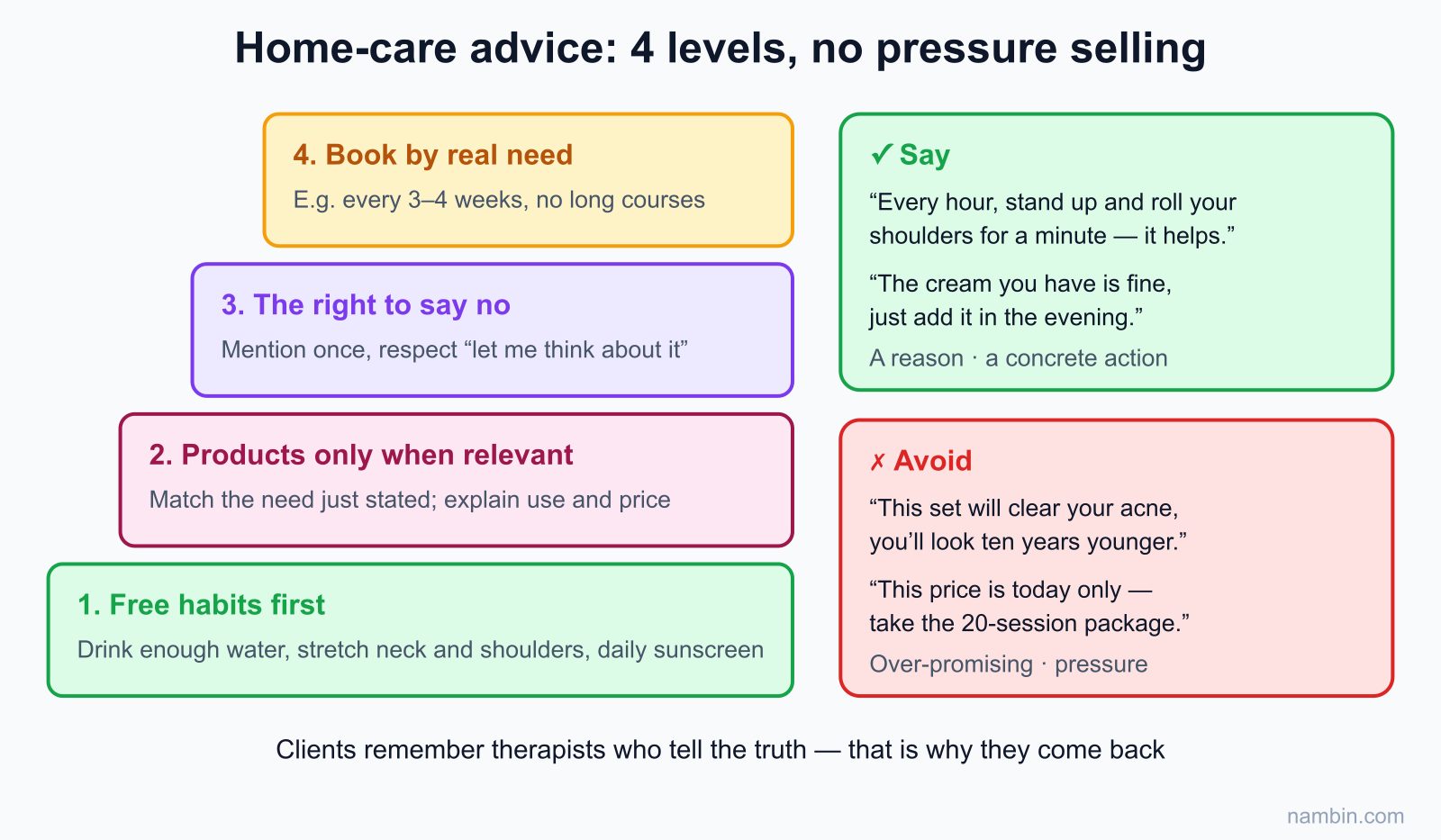
Clients value therapists who tell the truth. At the end of the session, you can suggest home care following these principles:
- Start with free habits: drink enough water, stretch the neck and shoulders during long computer sessions, use sunscreen every day.
- Recommend a product only when it relates directly to the need the client has just described; explain what it does and how to use it, and state the price clearly.
- Give the client the right to say no: "Keep using the product you already have; if your skin still feels dry, we can look at it next time." Do not repeat the suggestion, and do not exaggerate the results.
- Book sensibly: suggest a frequency based on real needs, not a long course designed to sell a package.
Advice versus pressure selling
| Good advice | Pressure selling |
|---|---|
| Suggestions based on what the client just said and what you observed | Pushing whatever product is on promotion, regardless of need |
| Stating the real benefits, how to use it and the price | Promising "no more acne" or "ten years younger", hiding the price until payment |
| Mentioning it once and respecting "let me think about it" | Repeating it constantly while the client is lying down trying to relax |
| Recommending a frequency based on need | Drawing up a 20-session package and pushing "this price is today only" |
Sample home-care advice
"Your shoulders are tight mainly from sitting for long periods. Every hour, stand up, roll your shoulders and tilt your neck gently for about a minute — it helps a lot. The skin on your cheeks is a little dry; add a moisturiser in the evening — the one you already have is fine. Coming back about every three to four weeks would suit you." This advice has a reason, gives concrete actions and is not tied to a product she must buy — the client will remember you as a therapist who genuinely cares.
Common mistakes
The form is filled in and filed away
Sign: you only find out the client is pregnant or on medication once she is on the bed. Cause: the client filled in the form alone and it was filed without being read back; the form was skipped for a regular client because "she's been coming here for ages". Fix: always read the form back with the client and ask regular clients for updates before every session.
The client holds back information
Sign: the client answers vaguely, "Oh, it's nothing". Cause: rapid-fire questioning like an interrogation, consulting in a crowded place, using hard-to-understand technical terms. Fix: move somewhere quiet, explain why you are asking, use everyday words and ask one question at a time.
Going beyond your scope
Sign: you say "you've probably got a slipped disc" or "stop your medicine for a few days and then come in". Cause: wanting to seem knowledgeable or to please the client. Fix: do not guess at illnesses in place of a doctor and do not advise on medication; only decide on treatment adjustments and pass medical questions to the doctor.
Leaking client information
Sign: colleagues discuss a client's illness in the staff room, or forms are left on the counter. Cause: not realising this is personal information. Fix: never discuss a client's health in front of other clients, never photograph forms for group chats, and store forms where the spa requires.
Frequently asked questions
What if the client refuses to fill in the form?
Explain that the form is there to protect the client herself. If she still refuses, follow the spa's rules; many spas then only offer the lightest treatment, or ask the client to sign a statement that she declined to provide the information. Tell the shift leader rather than deciding on your own.
Is "my doctor says it's fine" enough?
Write the client's exact words on the form and still adjust your technique towards safety. For major cases such as recent surgery or pregnancy, the spa may require a written note from the doctor — follow the rules where you work.
Do I need to re-check regular clients every time?
Yes, but briefly: one update question about health, new medication and recent procedures. It takes thirty seconds and can prevent an accident.
A male client is uncomfortable talking about his health with a female therapist. What should I do?
Stay professional, briefly explain why you ask, let him fill in the sensitive sections himself, and then only ask about items that need clarifying. If the spa has one, you can offer a therapist of the same gender for the consultation.
Does a long consultation eat into the client's treatment time?
Consultation time should be counted separately, about 5–10 minutes, and never cut from the treatment time the client has paid for. Let reception know in advance so they schedule correctly.
Self-check exercises
- Draft a one-page health information form with the 7 sections above, using yes/no questions with details boxes.
- Role-play 3 situations with a classmate: a client 3 months pregnant who wants a body massage; a client on acne medication who wants exfoliation; a client with high blood pressure who wants a steam session. Write down what you said and your final decision.
- Ask your instructor for feedback: did you use open questions, summarise to confirm, and give the client the right to say no?
- Write three sentences refusing or changing a treatment that state the reason and offer an alternative.
Self-assessment criteria
- The role-play consultation is completed within 10 minutes, in a quiet place.
- You asked about everything: pregnancy, chronic conditions, medication, allergies, recent surgery or procedures.
- Each situation ends with a clear decision at one of the three levels: proceed as normal, proceed with adjustments, postpone/ask a doctor.
- Not a single sentence guesses at an illness or advises on medication.
- The role-play "client" felt comfortable and not pressured to buy (ask them to score it 1–5).
Good consultation is the first half of a professional service. The next step in the roadmap is delivering a complete client treatment, where you combine consultation, technique and aftercare into one seamless experience.