Swedish massage is a full-body relaxation massage done with oil. It combines five basic groups of strokes — gliding (effleurage), kneading (petrissage), friction, percussion (tapotement) and vibration — worked towards the heart with light to medium pressure. It is the "alphabet" of the massage trade: almost every body treatment in a Vietnamese spa, from aromatherapy oil massage to hot stone massage, is built on these five strokes. Beginners often memorise the names of the strokes but get the pressure and rhythm wrong, and do not know when to stop. This lesson helps you fix exactly those points.
By the end of this lesson, you will be able to:
- Explain what Swedish massage is and how it differs from Thai massage, acupressure and deep tissue massage on four criteria: oil, strokes, pressure and goal.
- Perform the five basic groups of massage strokes correctly, with the right pressure, rhythm and direction for each area of the body.
- Organise a 60-minute session in six stages, and split the 20 minutes spent on the back between the individual strokes.
- Recognise three groups of contraindications: stop completely, avoid locally, and needs a doctor's opinion.
- Grade your own practice against five pass/not-yet criteria.
Want to learn body massage with someone correcting your hands? The NAMBIN course Spa Therapist Level 1 – Apprentice Therapist teaches the five groups of classic massage strokes, body mechanics that protect the therapist from pain, bed preparation and towel draping, plus a contraindications module with a mandatory safety test that must be passed at 100%.
What is Swedish massage? Origins and how to recognise it
When a client books a "body oil massage" or a "full-body relaxation massage" in Vietnam, most therapists are actually doing Swedish massage without calling it by its proper name.
Why is it called "Swedish"?
The name is usually linked to Per Henrik Ling (see Figure 1), a Swede who, in the early 19th century, built a system of therapeutic gymnastics that included rubbing and kneading. The French names for the strokes that textbooks still use today — effleurage, petrissage, friction, tapotement — were popularised by the Dutch physician Johan Mezger in the late 19th century. That is why many countries call this "classic massage": a system that has been taught in much the same way for more than a hundred years, so there is a clear standard to learn from and to be assessed against.
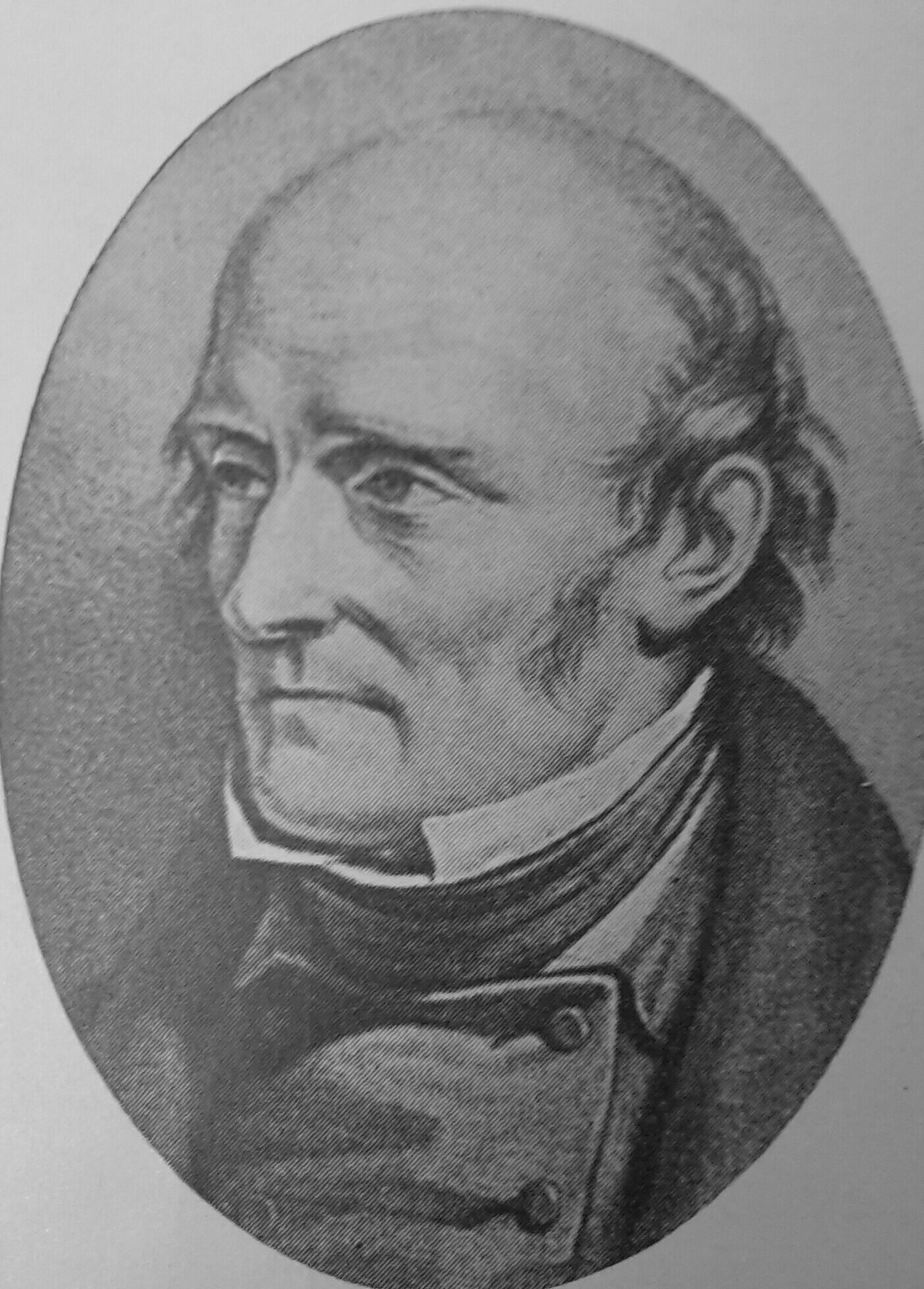
Photo: Okänd bildupphovsman / Wikimedia Commons, CC BY-SA 4.0
Four features that identify Swedish massage
- Oil or cream is used: the hands glide continuously over the skin, the client lies on a massage bed, and every area not being worked on is covered with a towel.
- Towards the heart: gliding strokes on the arms and legs travel from the end of the limb towards the trunk (ankle up to thigh, wrist up to shoulder); the return stroke only skims lightly.
- Light to medium pressure: the goal is to relax, warm and soften the muscles, not to "crack" anything or press until it hurts.
- Continuous rhythm: the strokes are linked by gliding, and your hands almost never leave the client during the whole session.
Quick comparison with other spa massage styles
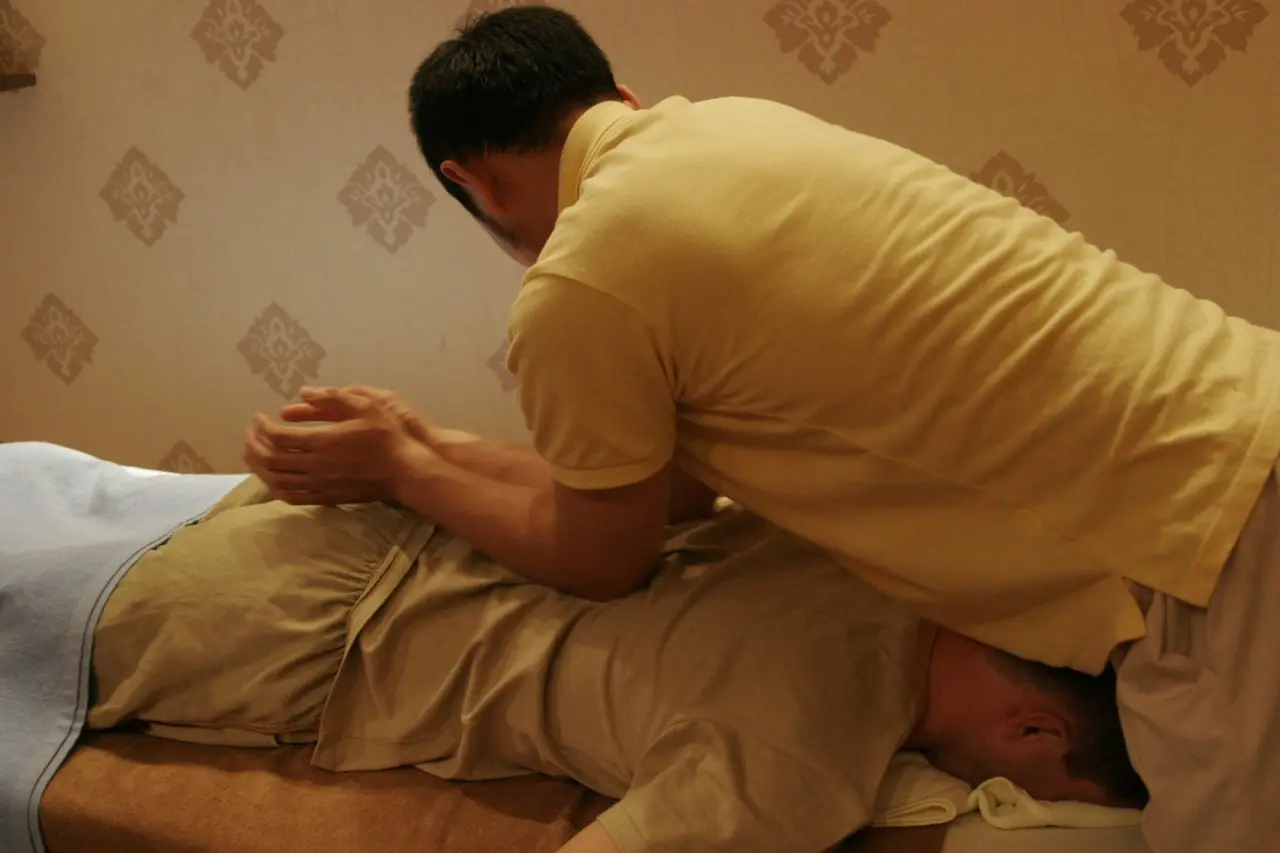
Clients often ask "how is this different from Thai massage or acupressure?" — the table below helps you answer briefly. Figure 2 shows a Thai massage session for comparison.
| Criterion | Swedish massage | Thai massage | Acupressure / point pressing | Deep tissue massage |
|---|---|---|---|---|
| Oil | Yes | Usually no, the client wears loose clothes | Little or none | Yes, less oil |
| Main techniques | Gliding, kneading, friction, percussion, vibration | Pressing, stretching, gentle twisting | Pressing and holding points | Slow, deep stripping along muscle layers |
| Pressure | Light – medium | Medium – strong | Medium – strong, on points | Strong, slow |
| Goal | Relaxation, warming the muscles | Stretching, joint mobility | Easing local tension points | Treating chronically tight muscles |
| Who does it in the NAMBIN pathway | Apprentice therapist (Level 1) | Needs separate training | Needs separate training | Specialist therapist (Level 3) |
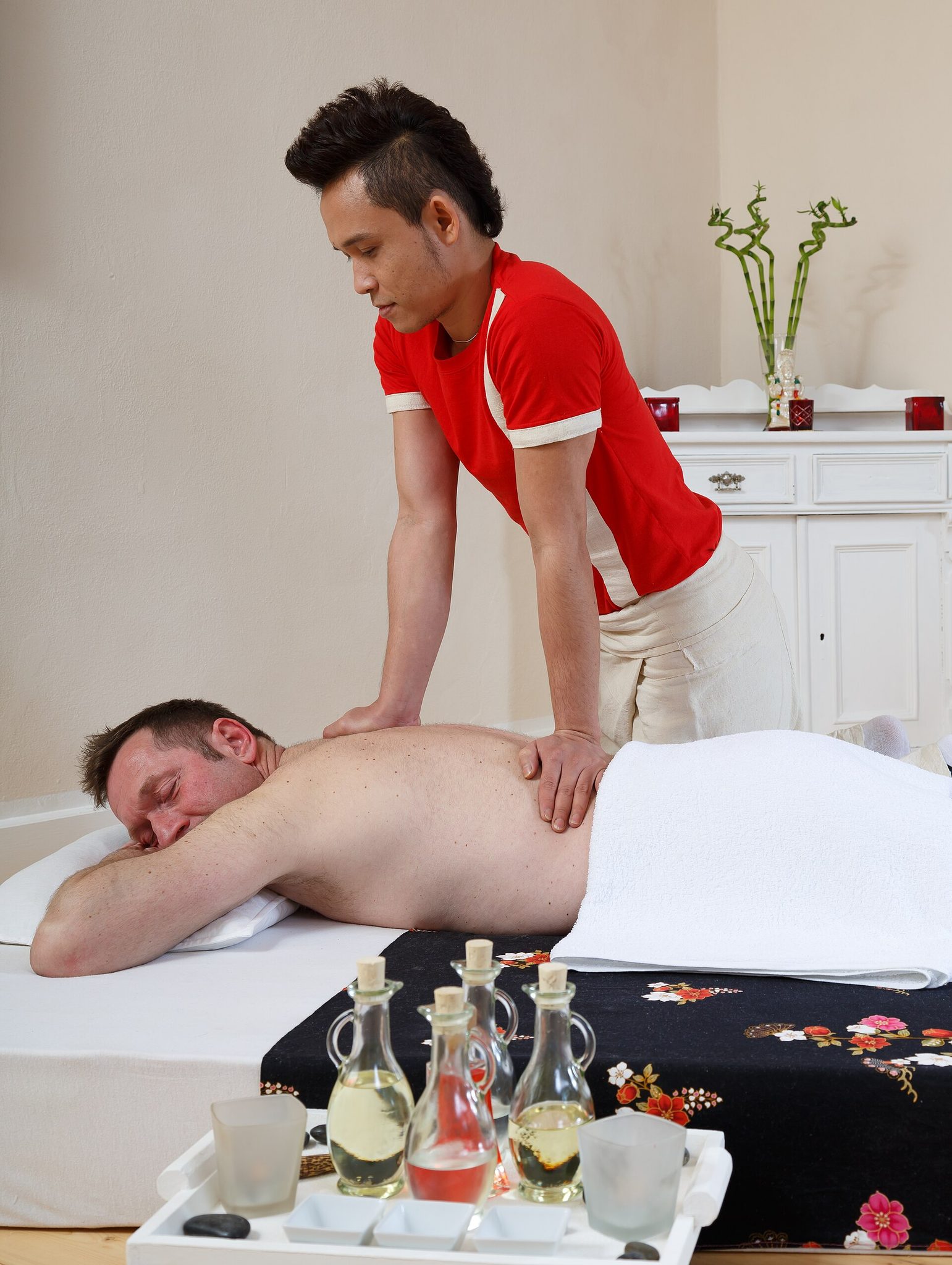
Photo: CEphoto, Uwe Aranas / Wikimedia Commons, CC BY-SA 3.0
The 5 basic massage strokes: how to do them, how much pressure, when to use them
The five groups of strokes below are the entire "toolkit" of Swedish massage. Each group has many variations, but the principle stays the same. In the lesson on the 60-minute relaxing body massage (in Vietnamese), they are called by the everyday shop names — stroking, kneading, rubbing, press-and-hold, shaking and patting. Here you learn the standard names so you can read textbooks and talk with therapists from other countries.
1. Gliding (effleurage) — to open, link and close
The whole palm and the fingers lie flat on the skin, relaxed, and glide in long strokes along the muscle fibres. Use light pressure for the first 3–5 passes to spread the oil and let the client get used to your hands, then increase to medium. Keep the rhythm slow: one long glide up the back, from the waist to the shoulders, takes about 4–6 seconds. Use gliding to start each area, to move between two other strokes, and to finish the area. Do not let your fingers lift up — the client will feel "scratching" instead of "holding".
2. Kneading (petrissage) — softening the muscle mass
Lift the muscle away from the bone, squeeze it gently between the thumb and the other fingers (or between both hands), then release, as if you were kneading dough. The two hands alternate in a wave-like rhythm, each cycle taking about 1–2 seconds. Use it on muscular areas: the shoulders and trapezius, upper arms, thighs, calves and the sides of the waist. Never pinch the skin with your fingertips; if the client winces, you are squeezing, not kneading.
3. Friction — working on small tight spots
Press with the tip of the thumb, the fingertips or the heel of the hand just firmly enough that the skin moves with your hand, then make small circles or short back-and-forth strokes on the spot. Unlike gliding, friction does not slide over the skin; it works on the layer underneath. Use medium pressure that builds up gradually, about 20–40 seconds per spot. Use it around the edge of the shoulder blade, on both sides of the spine and on the sole of the foot. This is the stroke most likely to hurt your thumb, so keep the thumb in line with your forearm and alternate with the heel of the hand.
4. Percussion (tapotement) — waking up the muscles, use sparingly
These are fast, light, rhythmic tapping strokes: cupping with a hollow palm, hacking with the edge of the hand, and tapping with the fingertips. Keep the wrist loose; the bounce comes from the wrist, not from swinging the shoulder, and each burst lasts only 10–20 seconds. In a relaxation session, use percussion sparingly, at the end of the back or the back of the thighs. Figure 3 shows percussion and tapping in a massage textbook from 1891. Never use percussion over the kidneys, the spine, the abdomen, the back of the knee or areas with visible veins.
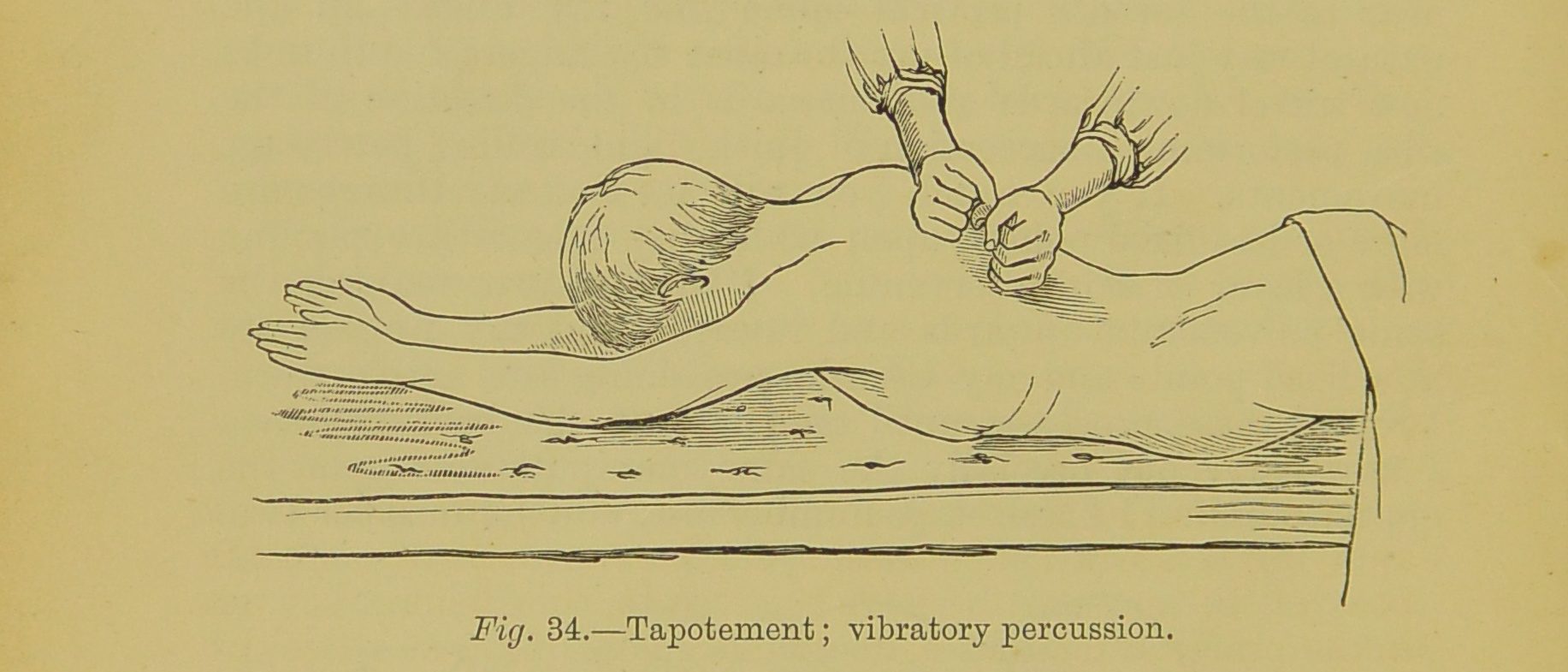
Photo: Dowse, Thomas Stretch / Wikimedia Commons, Public domain
5. Vibration — calming and changing state
Place your palm or fingertips on one area and keep them there, then vibrate quickly and evenly by gently tensing and relaxing the forearm muscles, without your hand leaving the skin. Use light pressure, 10–30 seconds at a time. Vibration is often used on the calves, thighs, along both sides of the spine, or as a gentle shake of the whole arm or lower leg before you finish an area. Beginners often vibrate from the shoulder and tire quickly; practise on a table covered with a towel until you can vibrate for 20 seconds with your shoulder still relaxed.
Summary table: hand pressure and when to use each stroke
| Stroke | Standard name | Part of the hand | Pressure | Rhythm / duration | Use for | Avoid |
|---|---|---|---|---|---|---|
| Gliding | Effleurage | Palm, forearm | Light → medium | 4–6 s per long stroke | Opening, linking and closing each area | Strong strokes away from the heart on the limbs |
| Kneading | Petrissage | Thumb + fingers, both hands | Medium | 1–2 s per cycle | Shoulders, trapezius, upper arms, thighs, calves | Pinching the skin, bony areas with little muscle |
| Friction | Friction | Thumb tip, heel of hand | Medium, building up | 20–40 s per spot | Tight spots around the shoulder blade, beside the spine | On the spine, bruises, varicose veins |
| Percussion | Tapotement | Cupped hand, edge of hand | Light, bouncing | 10–20 s per burst | End of the back, back of the thighs | Kidneys, abdomen, back of the knee, neck, a sleeping client |
| Vibration | Vibration | Palm, fingertips | Light | 10–30 s | Calming, before finishing an area | Vibrating from the shoulder, jerky shaking |
Hand pressure: create pressure with your body, not your fingers
When clients praise a therapist for having "skilled hands", it is almost always because the pressure is even and warm, not because it is strong. Even pressure comes from posture and body weight. If you treat 4–6 clients a day using the strength of your thumbs, your joints will start to hurt within a few months.
A three-level pressure scale and how to ask the client
Use a simple scale: light (the skin moves, the muscle is barely compressed), medium (you feel the muscle soften under your hands and the client breathes evenly), deep (the client feels "tight but pleasant"). For a first-time client, start at medium. Ask about pressure at minute 2–3 and every time you change area: "Is this pressure on your shoulders all right for you?". If the client says it is "sharp", holds their breath or curls their toes, reduce the pressure immediately.
Lunge stance and horse stance
For strokes along the length of the body (gliding up the back or the legs), use the lunge stance: one foot in front of the other, shifting your weight from the back foot to the front foot. For strokes across the body (kneading and friction around the shoulder blade), use the horse stance: feet wider than your shoulders, knees slightly bent. The amount of oil also affects pressure: too much and your hands slip, so kneading cannot "catch" the muscle; too little and gliding drags the skin. Pump the oil into your palm, rub your hands to warm it, then place your hands on the client.
The sequence of a 60-minute Swedish massage for new therapists
The general rule: in every area, always follow the order gliding → kneading → friction → (percussion, vibration) → gliding, that is from superficial to deep and back to superficial — warm up before going deep, and calm down before moving to the next area.
The six stages of a 60-minute session
- Welcome, intake form and preparation (5 minutes): ask about tight areas, preferred pressure and oil allergies; screen for contraindications (see the section below); help the client lie face down and cover them with towels.
- Back and shoulders, face down (20 minutes): the area where clients are usually tightest; use all five strokes.
- Back of the legs (10 minutes): 5 minutes per side; glide from the ankle up to the thigh, knead the calf and the back of the thigh, skip the back of the knee.
- Turn over, front of the legs and feet (10 minutes): put a bolster under the knees; do not press on the kneecap or the shin bone.
- Arms, neck and shoulders from the head of the bed (10 minutes): glide from the wrist up to the shoulder, knead the upper arm; on the neck, work only the back and sides, with lighter pressure than on the back.
- Closing (5 minutes): let the client rest for a moment, guide them to sit up slowly, offer water and fill in the client card.
Total: 5 + 20 + 10 + 10 + 10 + 5 = 60 minutes. If a client wants you to focus on one area, move minutes over from another area, but never cut the welcome and closing stages.
Draping: uncover only the area you are working on
Swedish massage uses oil on bare skin, so towel draping is mandatory. Uncover only the area you are working on, tuck the edge of the towel to keep sensitive areas covered, and cover the area again as soon as you finish. When the client turns over, lift the towel like a "screen", hold the edge on your side firmly, then guide the client to turn. Bed preparation and draping have their own lesson, with a graded practical, in the Level 1 course.
A 20-minute back routine, stroke by stroke
This is the area you will be assessed on most, so learn how the minutes are split:
- Rest both hands on the client's back for a few seconds and tell them you are starting. Glide long strokes from the waist up to the shoulders and round down both sides of the ribs: 5 minutes (including spreading the oil).
- Knead the shoulders, trapezius and both sides of the waist, one side at a time: 7 minutes.
- Friction on both sides of the spine from the bottom up, and around the inner edge of the shoulder blades: 5 minutes.
- Light cupping on the large muscles of the upper back, avoiding the lower back: 1 minute.
- Palm vibration along both sides of the spine: 1 minute.
- Closing glides that become lighter and lighter, then cover with the towel to keep warm: 1 minute.
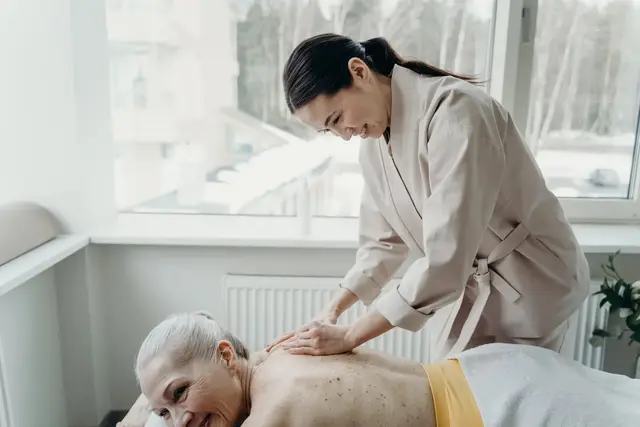
Total: 5 + 7 + 5 + 1 + 1 + 1 = 20 minutes. Notice the proportions: gliding and kneading take 13 of the 20 minutes, while percussion and vibration take only 2 — exactly in the spirit of "relaxation first". Figure 4 shows a back massage in a spa, in the face-down position you will practise most.
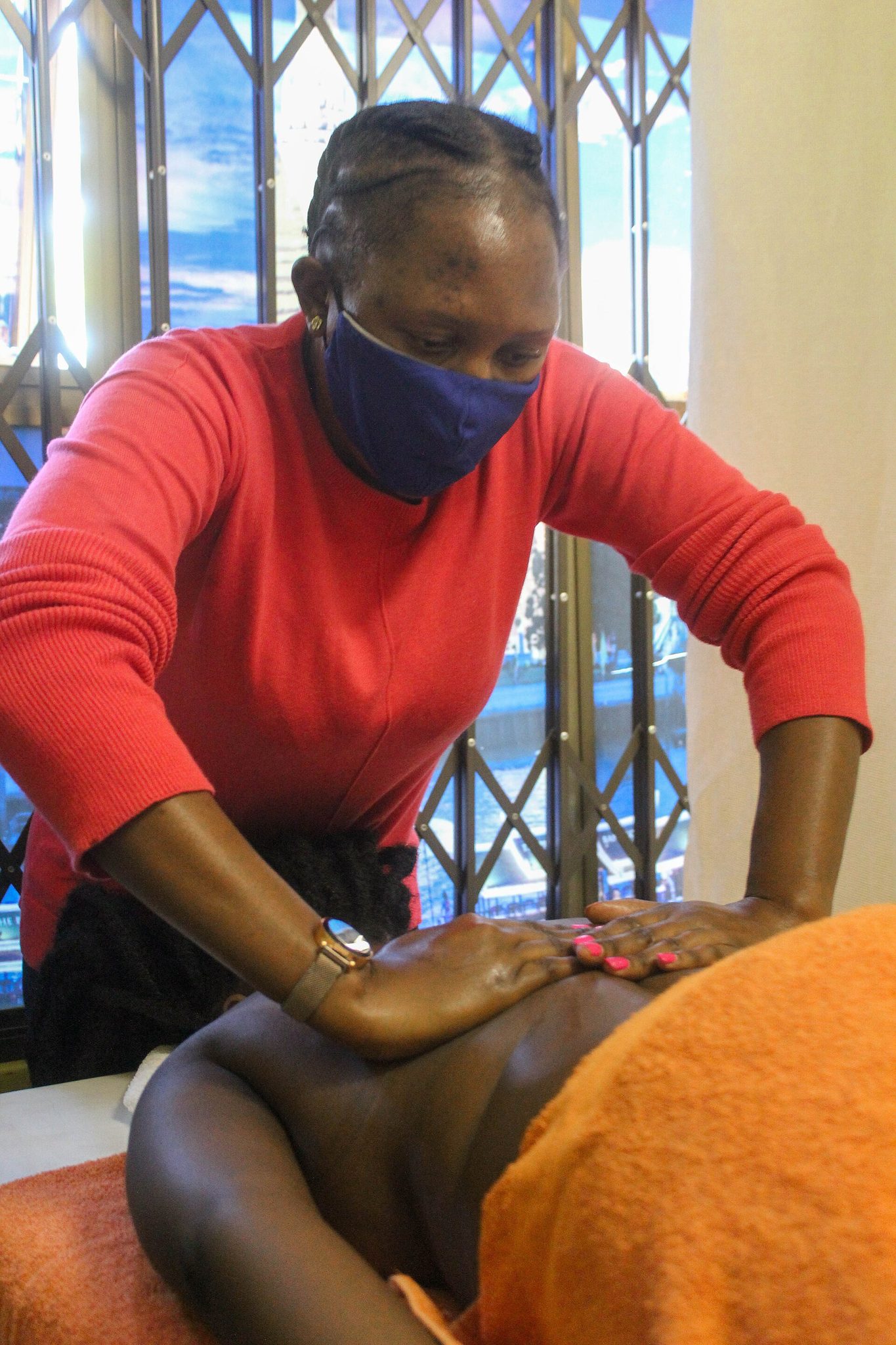
Photo: Kolobetsoo / Wikimedia Commons, CC BY-SA 4.0
Contraindications: when Swedish massage must not be done
Light pressure does not mean that everyone can be massaged. Gliding, kneading and friction all increase local circulation, and in some cases that is exactly what causes harm. To make them easy to remember, contraindications are split into three groups. The full content is in the lesson on skin structure and the contraindications every spa therapist must know by heart (in Vietnamese).
Group 1: stop completely, do not give the massage
- Fever, acute illness, or a condition that may be contagious (severe flu, contagious skin conditions such as fungal infections, scabies or chickenpox).
- Suspected deep vein thrombosis: a calf that is swollen, hot, red and painful on one side — never rub or massage it; advise the client to see a doctor immediately.
- Recent surgery, an acute injury (a sprain, a fresh fracture), or active bleeding.
- A client who is drunk or has just taken drugs and cannot answer clearly.
Group 2: avoid the spot, still work other areas
- Open wounds, bruises, sunburned skin, inflamed acne, freshly tattooed skin.
- Varicose veins: no deep pressure, no percussion; only very light gliding above the area, or skip it.
- Areas that are swollen, hot and red, or lumps and bumps of unknown cause.
Group 3: needs a doctor's opinion or a specially trained therapist
Pregnancy (pregnancy massage belongs to the "Special clients" step at Level 3), heart disease, uncontrolled high blood pressure, diabetes with numbness in the feet, ongoing cancer treatment, anticoagulant (blood-thinning) medication, severe osteoporosis, herniated discs. An apprentice therapist does not decide alone for this group: report to the senior therapist or the manager, and only proceed with a doctor's guidance.
Safety warning: do not press on the spine, the back of the knee, the front of the neck, the kidney area in the lower back, or areas with visible veins. If during the session the client feels numbness spreading down an arm or leg, dizziness, shortness of breath, chest pain or a sharp pain when you press, stop immediately, help the client sit up slowly and inform the manager; for serious symptoms, call the emergency number (115 in Vietnam). A relaxation massage does not cure disease — never promise a client that "massage will fix your herniated disc" or "get rid of your sciatica".
Worked example: a 38-year-old office worker trying Swedish massage for the first time
Ms Lan, 38, an accountant who sits at a computer for about 9 hours a day, books a 60-minute body oil massage. Her health form: no fever, no underlying conditions, not pregnant, no medication; mild varicose veins on the left calf; prefers medium pressure; most tired in the neck and shoulders.
Step 1: adjust the time plan
Because of her tired neck and shoulders, you increase the back and shoulders from 20 to 25 minutes, taking 3 minutes from the back of the legs (10 → 7) and 2 minutes from the front of the legs (10 → 8). New plan: 5 + 25 + 7 + 8 + 10 + 5 = 60 minutes. The varicose veins on her left calf are a local contraindication (group 2), so spending less time on the legs also makes sense.
Step 2: carry out the session
- Back and shoulders, 25 minutes: gliding 5 minutes, kneading the shoulders and trapezius 9 minutes, friction around the edge of the shoulder blades and beside the spine 8 minutes, cupping on the upper back 1 minute, vibration 1 minute, closing glides 1 minute (5 + 9 + 8 + 1 + 1 + 1 = 25). At minute 3 you ask about pressure and she wants it "a bit stronger on the shoulders" — you switch to the heel of your hand and the horse stance instead of pressing with your thumb.
- Back of the legs, 7 minutes: on the right leg you do the full gliding – kneading – vibration sequence; on the left leg you only glide very lightly on the thigh, skip the calf area with visible veins, and do no percussion.
- Front of the legs and feet, 8 minutes: bolster under the knees, glide the front of the thighs, friction on the soles with your thumb.
- Arms, neck and shoulders from the head of the bed, 10 minutes: knead the upper arms; light pressure on the back and sides of the neck, no twisting of the neck.
- Closing, 5 minutes: offer water and show her how to sit up by rolling onto her side and pushing up with her arm.
Step 3: check the result and fill in the client card
Ms Lan turns her neck and lifts her shoulders and they feel lighter; there is no bruising; your thumbs are not sore. Client card note: "Tight neck and shoulders, likes medium pressure – slightly deeper on the shoulders; varicose veins on the left calf – do not work that area; next time keep 25 minutes on the back".
Common mistakes new therapists make in Swedish massage
Pressure that keeps changing
Signs: the pressure is good at the start, but after 20 minutes your hands get weaker and the client feels it is "superficial". Cause: you are generating pressure with your wrists and thumbs, so they tire quickly. Fix: go back to the lunge and horse stances and use your body weight; switch to the heel of the hand or the forearm on large muscles.
Too much percussion, too hard
Signs: a client who was drifting off suddenly jumps, and the skin turns red. Cause: believing that lots of percussion looks "professional". Fix: no more than 1–2 minutes of percussion per large area, with the bounce coming from the wrist; if the client is asleep, replace percussion with gentle vibration.
Breaking contact when you take oil or change position
Signs: the client opens their eyes and tenses slightly every time you come back. Cause: lifting both hands off the client. Fix: keep the oil bottle within reach, and always keep one hand on the client while the other hand takes oil.
Frequently asked questions
What is Swedish massage? Is it the same as aromatherapy oil massage?
Swedish massage is a system of full-body relaxation massage with oil, using five groups of strokes: gliding, kneading, friction, percussion and vibration. The "aromatherapy oil massage" on a spa menu is usually Swedish massage with essential oils added to the carrier oil — the essential oils only add scent; the technique is still these five strokes.
What are the basic massage strokes?
In classic massage there are five groups: effleurage (gliding), petrissage (kneading), friction, tapotement (percussion) and vibration. Many Vietnamese spas also teach press-and-hold on points — a technique borrowed from acupressure and used only a little in a relaxation session.
How long does it take to learn basic body massage well enough to work on clients?
It usually takes about 3–4 weeks of regular practice (1–2 hours a day) to complete the 60-minute sequence on time, plus a few more weeks of supervised work for the pressure to become even. The lesson how long it takes to learn spa work (in Vietnamese) has a table of hours for each group of skills.
Does Swedish massage hurt?
It should not; the right feeling is "warm, soft, pleasantly tight". A client who wants "it has to hurt to work" actually needs a deep tissue massage — a technique for specialist therapists.
How much can I earn once I can do Swedish massage?
Body massage is the most requested treatment, so it is the skill that gets an apprentice therapist their first paid sessions soonest. Reference income by level and region in Vietnam is in the lesson how much a spa therapist earns (in Vietnamese).
Practice exercises and self-assessment
- Week 1: practise each stroke on its own for 20 minutes a day on the upper arms and calves of a family member; practise vibration on a towel-covered table until you can hold it for 20 seconds.
- Week 2: do the full 20-minute back routine with the 5 – 7 – 5 – 1 – 1 – 1 split, timing every stroke.
- Week 3: do a complete 60-minute session with draping, and ask the person being massaged to rate your pressure in each area.
- Week 4: practise adjusting the time plan for a "client" with varicose veins or a tired neck and shoulders, as in the worked example, then fill in a client card.
Self-assessment criteria
- Pass: you name and perform all five strokes correctly; the person being massaged can tell the difference between gliding, kneading and friction.
- Pass: your 60-minute session is no more than 3 minutes off in total, and every area follows the superficial → deep → superficial order.
- Pass: you can name at least 3 situations where you must stop completely and 3 where you only avoid the spot.
- Not yet: your thumb or wrist hurts after a session, you use more than 2 minutes of percussion on one area, or you uncover more than the area you are working on.
- Not yet: you break hand contact more than twice in a session, or you press on the spine or the back of the knee.
Once you meet all five criteria, you are ready for the milestone Complete Level 1 – Apprentice Therapist: the safety and hygiene test and the module quizzes, before you serve basic treatments under the supervision of a senior therapist.
Learn body massage properly, with a certificate: the course Spa Therapist Level 1 – Apprentice Therapist brings together the five groups of strokes, pain-free body mechanics, draping, contraindications and first aid in one path with quizzes, so you can confidently apply for an apprenticeship at a spa.