Good phone communication for a customer service agent fits into a four-step frame: greet properly, confirm the real need, resolve it clearly, then close the call with a summary and a thank-you. Running through all four steps are a clear voice, a steady pace, forms of address that suit the caller's age and region, and the habit of listening and then repeating back what the customer said. This lesson is step 2 of the roadmap, for learners who already know the role, the process and identity verification from step 1.
By the end of this lesson, you will be able to:
- Lead a full call through the four steps (greet, confirm the need, resolve, close) with sample lines for each step.
- Measure your own speaking pace and adjust volume, phrasing and intonation so customers understand you the first time.
- Choose forms of address that fit the caller's age and region, and understand common regional words without imitating the accent.
- Listen actively, take quick notes and summarise the customer's point in one or two sentences before resolving it.
- Put callers on hold, transfer calls and handle silence correctly, and work out the duration of a sample call.
Learning customer service properly? Voice, listening and phone communication is step 2 of the roadmap, right after the customer service role, processes and customer data protection. See the 8-step customer service agent roadmap to learn in the right order.
Why is phone communication harder than face to face?
Face to face, customers read your expression and gestures. On the phone, everything rests on your voice and your words. A caring agent who speaks fast, speaks too quietly or goes silent while looking something up can still come across as "indifferent".
The customer only has your voice
Customers judge you on your words, your voice, your pace and your silences. A smile or a nod does not travel down the line, so you have to put those signals into words: "yes, I'm listening", "could you give me about 30 seconds?". A headset microphone also picks up heavy typing, colleagues laughing and your own sighs.
Building on step 1
In step 1 you learned the request-handling process, the CSAT, FCR and AHT metrics, and identity verification (see the lesson what customer service is). This lesson does not repeat that material; it focuses on speaking and listening.
In a call centre there are often dozens of people talking at once in one room, and background noise easily leaks into the microphone. In that environment, speaking clearly at the right pace matters more than having a beautiful voice.
The 4-step call flow: greet, confirm the need, resolve, close
Almost every customer service call goes through four steps; each company's script only differs in wording. When the call involves an account or an order, the identity check slots in before the resolve step.
Step 1: Greet
A standard greeting has three parts: the company or department name, your name, and an invitation for the customer to speak. In Vietnamese it might be: "Da, tong dai cham soc khach hang An Phat xin nghe, em la Mai..." ("Hello, An Phat customer care, this is Mai, how can I help you?"). Many call centres set how many rings before you pick up and a fixed greeting; follow the rules where you work.
Say the greeting more slowly than the rest of the call and do not swallow your own name. If the customer gives their name, use it straight away: "Good evening, Ms Hoa."
Step 2: Confirm the need
Customers usually tell the story first and state the need later. Listen to the end, ask follow-up questions until you have the facts, then summarise and wait for the customer to say "yes, that's right" before you resolve anything. Skipping this step is an easy way to solve the wrong problem and make the customer call back.
Step 3: Resolve
Say what you are about to do before you do it, then give the solution in short points, one concrete action per point. If you are not sure about something, say "I'll check and call you back before 4 pm today" instead of making a promise just to end the call.
Step 4: Close
Summarise what you did and what the customer needs to do, ask whether they need anything else, thank them and say goodbye using their name. Many call centres train agents to wait for the customer to hang up first so the customer never feels cut off.
| Step | Goal | Sample line | Mistakes to avoid |
|---|---|---|---|
| Greet | The customer knows they reached the right place and knows your name | "Hello, [company] customer care, this is Mai." | Rushing, swallowing your name, sounding tired |
| Confirm the need | Understand the issue correctly; the customer says "that's right" | "Let me sum up to make sure I've understood: ..." | Interrupting, guessing, jumping straight to a fix |
| Resolve | The customer knows what you are doing and what the outcome is | "I'll check, it takes about a minute. Could you hold for me?" | Silent pauses, promising beyond your authority, jargon |
| Close | The customer knows the next step and feels respected | "Is there anything else I can help you with?" | Abrupt hang-up, no summary, no thank-you |
Your voice: clear, steady pace, natural intonation
You do not need a radio presenter's voice, just a voice customers understand the first time. Three things decide that: pace, clarity and intonation.
Speaking pace: measure it and adjust it
Nervous beginners usually speak faster than normal. A simple self-test: take a Vietnamese passage of about 150 syllables, start a timer and read it aloud as if speaking to a customer. A suggested practice target is roughly 60–75 seconds for that passage; if you are faster, practise pausing between ideas; if you are much slower, customers will get impatient. This figure is a practice benchmark, not a general standard; your shift lead may set a different one.
Slow down when reading out phone numbers, order codes, amounts of money, dates and times. With older customers or slow speakers, slow down to match them.
Clear pronunciation, phrasing and volume
Open your mouth properly, especially at the end of sentences, because many people trail off at the end. One idea per sentence. Keep your volume as if talking to someone one desk away; there is no need to speak loudly, since the headset already puts your voice right at the customer's ear.
Read phone numbers in groups the way customers usually write them, for example 4 – 3 – 3. For sounds that are easy to confuse in Vietnamese (l/n, s/x, tr/ch, d/gi/v), spell with a reference word: "L as in Lan, N as in Nam", "S as in Soc Trang".
Intonation and a smile in your voice
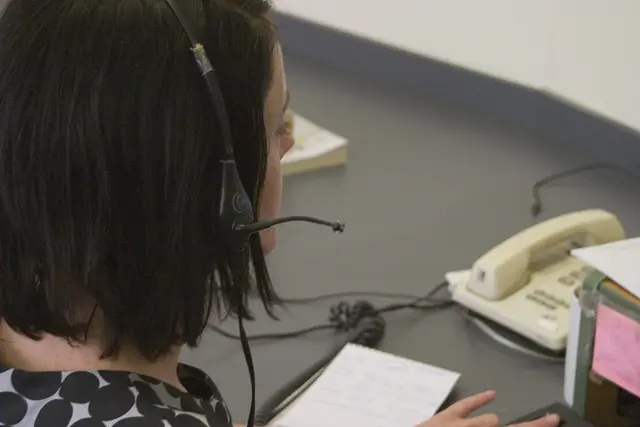
A flat, announcement-style voice makes customers think you are reading the script just to get it over with. Stress the key words ("this Thursday", "before 4 pm"). A genuine smile while speaking makes your voice softer and warmer, and customers can hear it even though they cannot see you (see Figure 1).
Looking after your voice through a long shift, and when to see a doctor
Sit up straight so your breathing is not compressed. Talking for most of a shift is hard work for the vocal cords: sip plain water, avoid harsh throat-clearing, and use your breaks to be genuinely quiet rather than chatting loudly.
Health note: This lesson does not replace a doctor's advice. If hoarseness lasts a few weeks without improving, if you have pain when speaking or swallowing, sudden loss of voice, coughing up blood, or ringing in the ears or reduced hearing after shifts, see an ear, nose and throat (ENT) doctor. Keep the headset volume just loud enough to hear clearly, do not turn it up to drown out room noise, and tell your shift lead if the headset crackles or makes a sharp screeching sound.
Forms of address for age and region
Vietnamese has no neutral "you": the pronoun you pick signals age and relationship. The wrong form of address can offend a customer from the very first sentence, however well you handle the rest. The rules: polite first, familiar later; follow the way the customer refers to themselves; never imitate the customer's regional accent.
General principles
- Age unknown: call the customer "anh" (older brother) or "chi" (older sister) and refer to yourself as "em" (younger sibling). This is the safe choice for most adult customers.
- Clearly older customer (from the voice, or a birth year in the record): use "co/chu" (aunt/uncle) or "bac" (elder aunt/uncle) and call yourself "con" or "chau" (child/niece/nephew), depending on company rules and how the customer refers to themselves.
- The customer names themselves first ("chu" just wants to ask...): follow them and call them "chu" in your next sentence.
- Include the polite particles "da" and "a" in your replies; never say "u" (yeah) or "ok" to a customer; do not call the customer "ban" (friend/you) unless the company script says so.
North, Centre and South differences worth knowing
The table below shows common tendencies, not absolute rules; everyone is different. The point is to understand customers, not to change your accent to match theirs.
| Situation | North | Centre | South |
|---|---|---|---|
| Saying "yes" | "vang", "vang a" | "da", "vang" (varies by area) | "da", "da duoc" |
| Addressing older people | Often "bac", "co", "chu" | "bac", "o" (aunt), "di", "chu" | Often "co", "chu", "di"; "bac" less often |
| Words customers may use | "the", "the nao" (how), "bao gio" (when) | "mo" (where), "rang" (why), "rua" (so), "te" (there) | "hong" (no/not), "ong/ba" (he/she), "nhieu" (how much) |
| How you should reply | Your own natural accent, standard vocabulary, polite "da/vang", never mimicking the customer | ||
When a regional accent is hard to follow
Do not pretend to understand. Ask again about one specific part: "I'm sorry, the line is a little faint, could you read the street name again for me?". Blaming the line spares the customer the feeling that their accent is being criticised. For names and addresses, read them back letter by letter for the customer to confirm.
Active listening and summarising the customer's point
Active listening means listening to understand, not listening while waiting for your turn to talk. On the phone it involves three things: not interrupting, signalling that you are listening, and noting down the facts you need to solve the problem.
Listening signals
Every few sentences, drop in a short signal: "da", "yes, I see". Too many and the customer feels rushed. When a customer is annoyed, a single line such as "I understand you're worried about this" is worth more than a long explanation; detailed de-escalation comes in step 5 (see the lesson handling difficult customers).
Quick notes in five boxes
Write as the customer talks, in keywords, not full sentences. Split your scrap paper or the notes field in your software into five boxes:
- Who: name, form of address, calling number (if the system does not show it).
- What: product, service, order code.
- When: purchase date, date of the fault, the customer's deadline.
- Already tried: what the customer has done, whether they have called before.
- Wants: repair, exchange, refund, or just information.
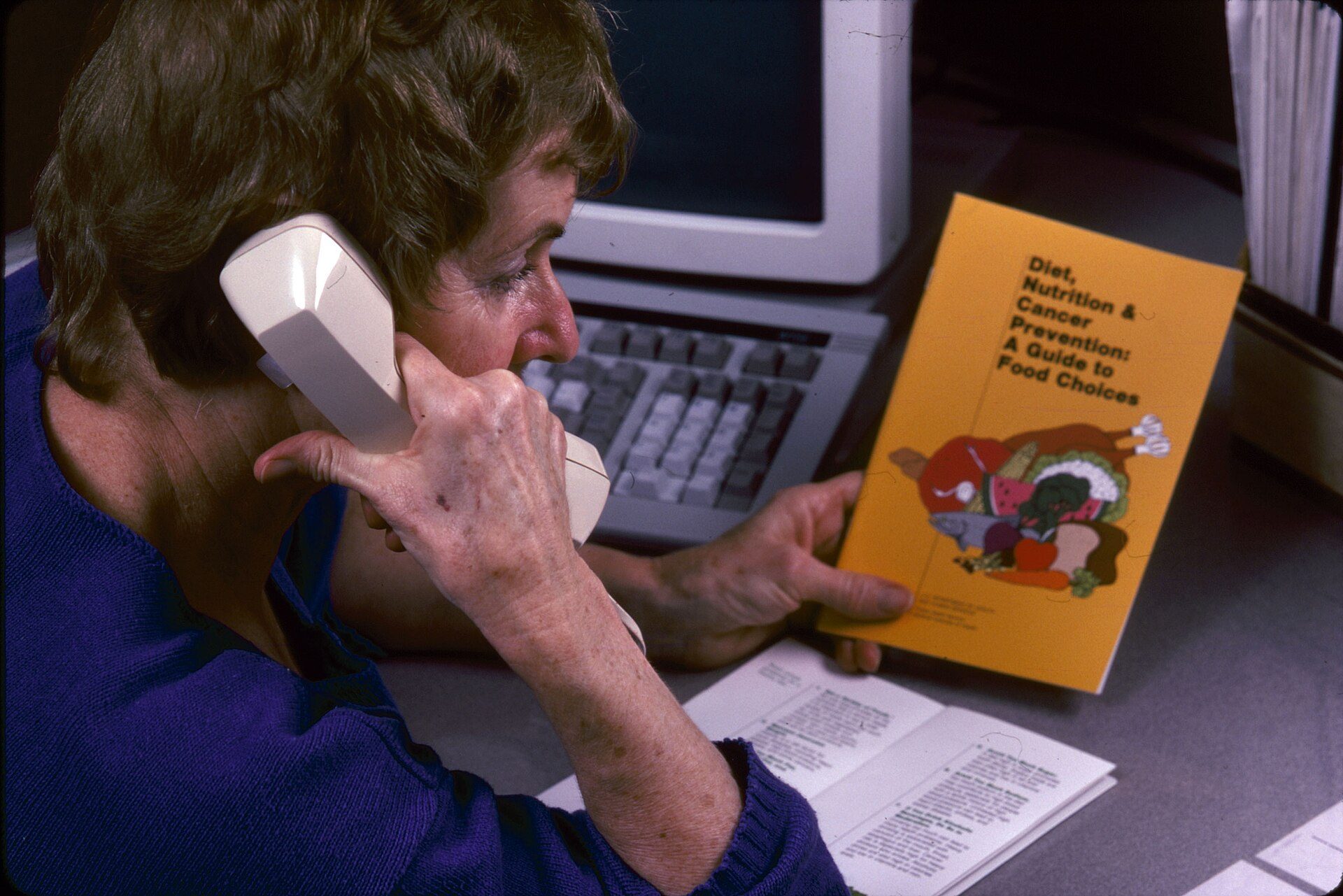
Photo: Unknown photographer / Wikimedia Commons, Public domain
Summarising the customer's point
When the customer finishes, sum up in one or two sentences using this formula: "Let me sum up to make sure I've understood: [who/what] + [problem] + [what you want]. Is that right?". As in Figure 2, you read from your five-box notes rather than relying on memory.
Example: "Let me sum up: the water purifier at your home was bought in March last year, and you'd like to book a filter replacement and ask about the cost. Is that right?". If the customer corrects you ("no, just filter number 1"), you have just avoided solving the wrong problem.
Open and closed questions
Open questions ("could you tell me what the machine is doing?") get the customer talking at the start of the confirm step; closed questions ("is there a red warning light?") pin down facts. Ask one question at a time, because if you ask three at once, the customer only answers the last one.
Holding, transferring and silence on the phone
Many complaints about attitude come from moments when customers are left waiting without knowing what they are waiting for.
Ask before putting someone on hold, and come back on time
Ask permission, give the reason and an estimated time, and thank the customer when you return: "I need to check the technicians' schedule, could you hold for about a minute?" ... "Thank you for waiting." If it takes longer than expected, come back midway to update the customer instead of leaving them on hold indefinitely.
Transfer with an introduction
Tell the customer which team you are transferring them to and why; if the system allows, brief the receiving colleague first so the customer does not have to repeat everything. If a call drops, follow company procedure, which usually means calling the customer back.
Equipment: headset, microphone and mute button
Place the microphone about two finger-widths from the corner of your mouth, slightly to the side so you do not breathe into it (see Figure 3). Use mute when you need to cough or sneeze, but never use mute instead of hold, because the customer still hears silence without being told why.

Photo: Zephyris at English Wikipedia / Wikimedia Commons, CC BY-SA 3.0
Many call centres record calls for quality checks. Treat every call as recorded: never comment on the customer, even with mute on.
Worked example: a call to book a filter replacement
The situation: Mr Bay, 62, in Can Tho, calls a water purifier company's hotline. He wants to replace the filter but cannot remember when he bought the machine and worries about being overcharged. The agent is Mai, who has a northern accent. Company rules require verifying the customer by registered phone number and full name before opening the record.
Condensed dialogue, step by step
- Greet (15 seconds): "Hello, customer care, this is Mai, how can I help you?" – "Uncle here wants to change the filter, but I can't remember when I bought it." (He uses the southern "hong" for "not".) – Mai greets him as "chu" (uncle) and refers to herself as "con".
- Verify (40 seconds): Mai asks for his full name and registered phone number, reads back the last 4 digits in a group for him to confirm, and only then opens the record.
- Confirm the need (60 seconds): Mai asks an open question, "Has anything changed with the machine lately?", then a closed one, "Is the water flowing more weakly?". Summary: "Let me sum up: the purifier at your home was bought in March last year, the water flow is weaker than before, and you'd like to book a filter replacement and ask about the cost. Is that right?" – "That's right."
- Resolve (105 seconds talking + 45 seconds on hold): Mai asks him to hold for about a minute while she checks the technicians' schedule for his area, thanks him for waiting, offers a free slot on Thursday morning, reads out the cost range from the company price list and makes clear that the technician will give an exact quote at the house before doing any work.
- Close (30 seconds): "To sum up: a technician will come to your home on Thursday morning, between 8 and 10, and will call you before arriving. Is there anything else I can help you with? ... Thank you, have a good evening." Mai waits for him to hang up first.
Note: once the customer calls himself "uncle", Mai switches straight to the uncle/child forms of address but keeps her own accent and never mimics his "hong".
Working out the call duration
After hanging up, Mai spends 60 seconds writing the ticket notes. Handling time for a call (used to calculate AHT in step 1) is talk time plus hold time plus after-call work.
| Part | Time (seconds) | Type |
|---|---|---|
| Greet | 15 | Talk |
| Verify | 40 | Talk |
| Confirm the need | 60 | Talk |
| Resolve (talking part) | 105 | Talk |
| Hold while checking the schedule | 45 | Hold |
| Close | 30 | Talk |
| After-call notes | 60 | After-call work |
| Total | 355 | = 5 min 55 s |
Check: talk time 15 + 40 + 60 + 105 + 30 = 250 seconds; add 45 seconds on hold and 60 seconds of notes: 250 + 45 + 60 = 355 seconds, or 5 minutes 55 seconds. The time the customer actually spent on the line is 250 + 45 = 295 seconds, or 4 minutes 55 seconds.
Scoring the call against a checklist
The shift lead scores 10 criteria, 1 point each: a three-part greeting; verification before opening the record; suitable form of address; open then closed questions; a summary confirmed by the customer; asking before hold with a time estimate; thanking the customer on return; stating the cost as a range and who gives the exact quote; a summary at the close; waiting for the customer to hang up. Mai scores 9/10: her only miss is that the opening greeting did not include the company name. The checklist where you work may differ; this is a template for practice.
Common mistakes on the phone
Each mistake is laid out as sign, cause and fix, so you can spot it when you listen back to your own recordings.
Speaking too fast, reading the script like a machine
Sign: customers ask "sorry, what?" or cut into your greeting. Cause: nerves, memorising word for word. Fix: measure your pace as above, learn the purpose of each step and say it in your own words, and slow right down for numbers.
Interrupting and guessing ahead
Sign: the customer has to say "let me finish". Cause: you hear the first few words and already have an answer in mind. Fix: take five-box notes while the customer talks and answer only after summarising and getting confirmation.
Unannounced silence and abrupt endings
Sign: the customer says "hello? hello?" while you look things up, or calls back asking "what did you say earlier?". Cause: forgetting to warn them, hanging up in a hurry. Fix: warn the customer before any silence longer than a few seconds, and never skip the closing summary, however long the queue.
Frequently asked questions
Is there a sample phone script for customer service?
Yes, the four-step frame and the sample lines in Table 1 work for most calls. Once you start a job, the company will give you its own product-specific script; learn the purpose of each line so you sound natural rather than recited.
Can I work in customer service without a "nice" voice, or with a regional accent?
Yes, as long as customers hear you clearly and understand you immediately. Call centres need a clear voice, a steady pace and correct pronunciation of easily confused sounds, not the "standard" accent of any particular region. Record yourself, listen back and fix one point at a time: pace, sentence endings, l/n, s/x.
How should I talk on the phone with older customers?
Speak more slowly, one idea per sentence, repeat important numbers twice, follow the way the customer refers to themselves, and be patient while they look for documents. The lesson on communicating with older people covers more about how older people think and feel.
How can I train my listening skills with customers?
Listen back to your own call recordings and count how many times you interrupted and how many of your summaries were confirmed the first time. When a customer drifts off topic, acknowledge it in one sentence and steer back to the main issue.
Practice exercises and self-assessment
- Measure your speaking pace with a passage of about 150 syllables, three times during the week, and record the seconds.
- Role-play with a friend: one plays the customer (pick at random: a northern, central or southern customer, or an older customer), the other plays the agent. Act out Mr Bay's call through the four steps and record it on your phone.
- Listen back, score it against the 10 criteria in the worked example, and work out the duration of each part and the total as in Table 3.
Self-assessment criteria
- Pass: your greeting has all three parts, and on playback the company name and your name are clear.
- Pass: you summarise the customer's point and the customer confirms "that's right" before you resolve it.
- Pass: there is no silence longer than a few seconds without warning; numbers, dates and times are read slowly and clearly.
- Pass: your duration table adds up to the total, and you score at least 8/10 on the checklist.
- Not yet: you interrupt the customer, use casual "ban/toi" or "yeah, ok" with customers, hang up without a summary, or mimic the customer's regional accent.
Once you are confident speaking and listening on the phone, move on to the next step of the roadmap: Professional chat, Zalo and email replies, where your voice is replaced by written words and you learn to reply quickly yet fully, spell correctly and avoid written promises you are not sure you can keep.
Keep learning customer service: after phone communication come chat and email replies, CRM and call-centre software, complaint handling, upselling and basic English, and a simulated shift project. See the 8-step customer service agent roadmap.