The training principles a personal trainer must master come in three layers: knowing which muscles and joints an exercise uses; knowing where the body gets its energy for each kind of effort; and knowing how to raise difficulty gradually (progressive overload) while giving clients enough time to recover. Beginners who get injured or quit usually did not pick the wrong exercises; they progressed faster than their muscles, tendons and joints could adapt. This lesson covers anatomy and physiology at the level a PT uses every day, with a worked 4-week plan whose numbers add up.
By the end of this lesson, you will be able to:
- Name and point to 10 major muscle groups, and say what movement each one produces and which exercises train it.
- Tell the 3 energy systems apart and choose rest periods between sets that fit the client's goal.
- Apply progressive overload with the "2 extra reps, 2 sessions in a row" rule and the reps-in-reserve (RIR) scale.
- Tell normal post-workout muscle soreness apart from signs of injury or overtraining that mean stopping and seeing a doctor.
- Build a 4-week progression table for a new client and calculate the training volume for each week.
Learning to be a PT? Anatomy, exercise physiology and training principles are step 2 of the roadmap, right after gym safety and health screening. See the 8-step personal trainer roadmap to learn in the right order.
Why must a PT understand anatomy and exercise physiology?
Clients pay for someone who knows why an exercise suits them, why the weight has to come down today, and which kind of pain means stopping.
From "exercises" to "which muscle, which joint"
New PTs remember programmes by exercise name: squats on Monday, bench press on Wednesday. A trainer with a solid foundation reads the same programme by muscle group and joint: how many sets the front of the thigh has done this week, how many overhead presses the shoulder has taken. That way you avoid piling load onto one area, and you can swap an exercise in time when a client has a sore joint.
How much does a PT need to know?
You do not need to memorise every small muscle like a medical student. What you need is the location and function of the large muscle groups, the joints that take the most load, and how the body responds to training from day to day and week to week. PT certification exams all include a theory section on this (see the article on personal trainer salary and certificates).
Building on the screening step
In step 1 you learned which clients need a doctor's approval first (see pre-exercise health screening for gym clients). This step answers the next question: how much training is enough, and how fast is it safe to progress? Anatomy knowledge is not for diagnosing; when a client has unusual pain, you stop, record it and advise them to see a doctor.
The major muscle groups a PT must know
Learn muscles by function: once you know which way a muscle pulls the bone, you know which exercise trains it (see Figure 1).
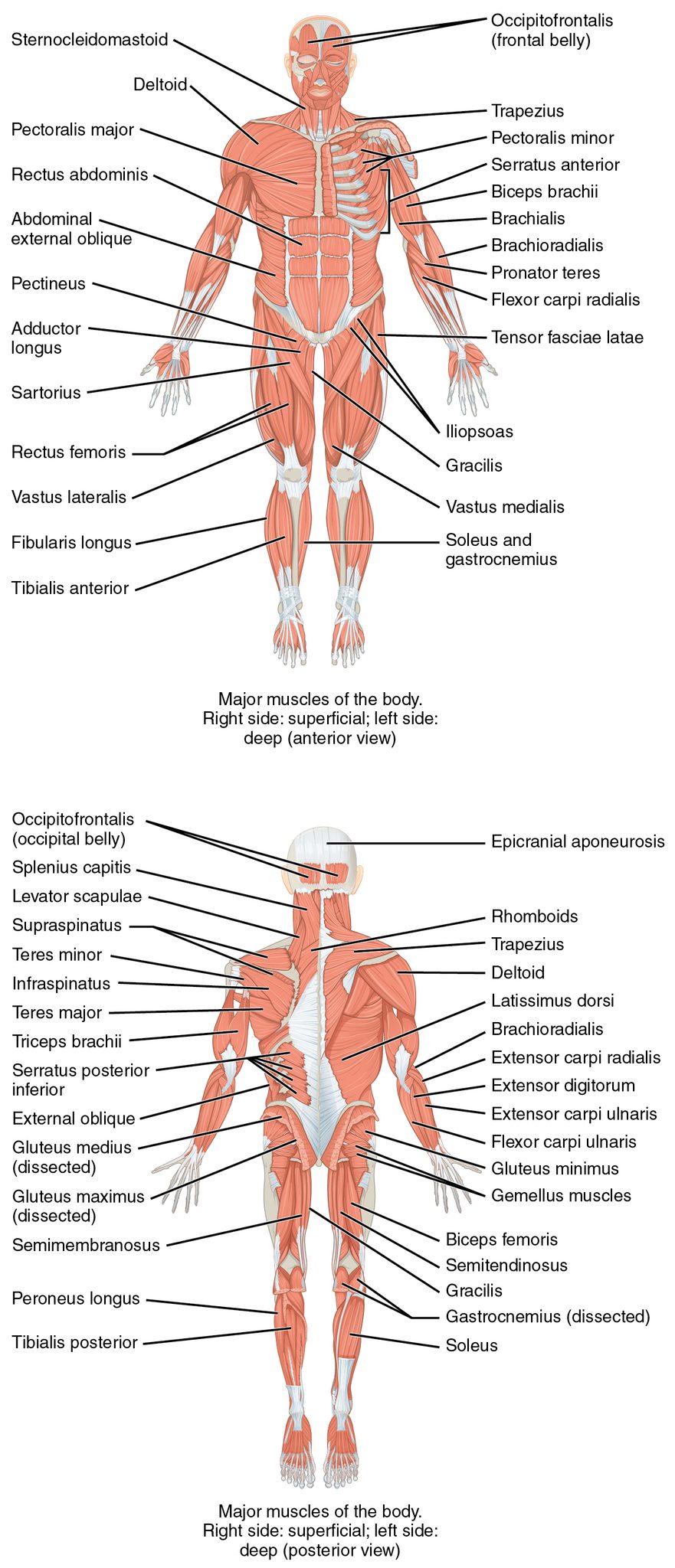
Photo: OpenStax / Wikimedia Commons, CC BY 4.0
Lower body: glutes, thighs and calves
The gluteus maximus extends the hip (drives the hips forward as you stand up) and does most of the work in squats, deadlifts and uphill walking. The quadriceps extend the knee; the hamstrings bend the knee, assist hip extension and are often strained when people sprint without warming up. The calf muscles raise the heel and take load with every running stride and jump.
Upper body: chest, back, shoulders and arms
The pectoralis major brings the arm forward and across the body. The latissimus dorsi pulls the arm down and back. The trapezius and the muscles between the shoulder blades control the shoulder blades, which matters a lot for office workers with rounded upper backs. The deltoid wraps the shoulder joint; beneath it sits the rotator cuff, four small muscles that keep the head of the upper arm bone centred in its socket.
The core and how muscles cooperate
The core is the abdominal muscles plus the spinal erectors; its main job is to keep the trunk stable so force travels from the legs to the arms, not just to crunch. Every movement has a prime mover (does the main work), an antagonist (on the opposite side, lengthens) and stabilisers (keep joints from shifting). In a biceps curl, the biceps is the prime mover, the triceps is the antagonist and the core keeps the trunk from swinging.
A muscle shortens while lifting a weight (concentric contraction), lengthens while still controlling the weight on the way down (eccentric contraction), or holds still as in a plank (isometric contraction). The eccentric phase causes the most soreness in beginners, so the first sessions should not include many sets of very slow lowering.
| Muscle group | Main function | Typical exercises |
|---|---|---|
| Gluteus maximus | Hip extension | Squat, hip thrust, deadlift |
| Quadriceps | Knee extension | Squat, lunge, leg press |
| Hamstrings | Knee flexion, assist hip extension | Romanian deadlift, leg curl |
| Calves | Raise the heel | Standing and seated calf raises |
| Pectoralis major | Bring the arm forward and across | Bench press, push-up |
| Latissimus dorsi | Pull the arm down and back | Pull-up, lat pulldown, row |
| Deltoid | Raise the arm forward and to the side | Overhead press, lateral raise |
| Biceps, triceps | Bend and straighten the elbow | Curl, cable pushdown |
| Abdominals (rectus, obliques, transverse) | Stabilise, bend and rotate the trunk | Plank, dead bug |
| Spinal erectors | Keep the back straight, extend the trunk | Deadlift, bird dog |
Joints, tendons, ligaments and movement patterns
Muscles produce force, but gym injuries usually land on joints and tendons.
The four joint areas that take the most load
The knee mainly bends and straightens; it takes heavy load in squats, lunges and jumps and does not tolerate twisting while loaded (see Figure 3). The hip moves in many directions and is the "engine" of the lower body. The shoulder is the most mobile joint but the least stable, relying heavily on the rotator cuff. The lower back is safest when kept neutral, not rounded, while lifting heavy.
Six basic movement patterns
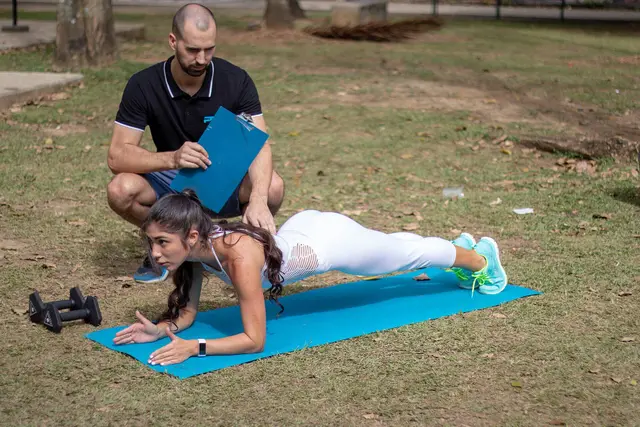
Instead of memorising hundreds of exercises, PTs group them by movement pattern: squat, hinge (such as the deadlift in Figure 2), push (bench press, overhead press), pull (rows, pull-ups), step (lunges, step-ups) and carry (walking with weights). A balanced beginner programme covers all six patterns each week. Correct technique for each exercise belongs to the next step; here you need to understand which muscles and joints each pattern loads.
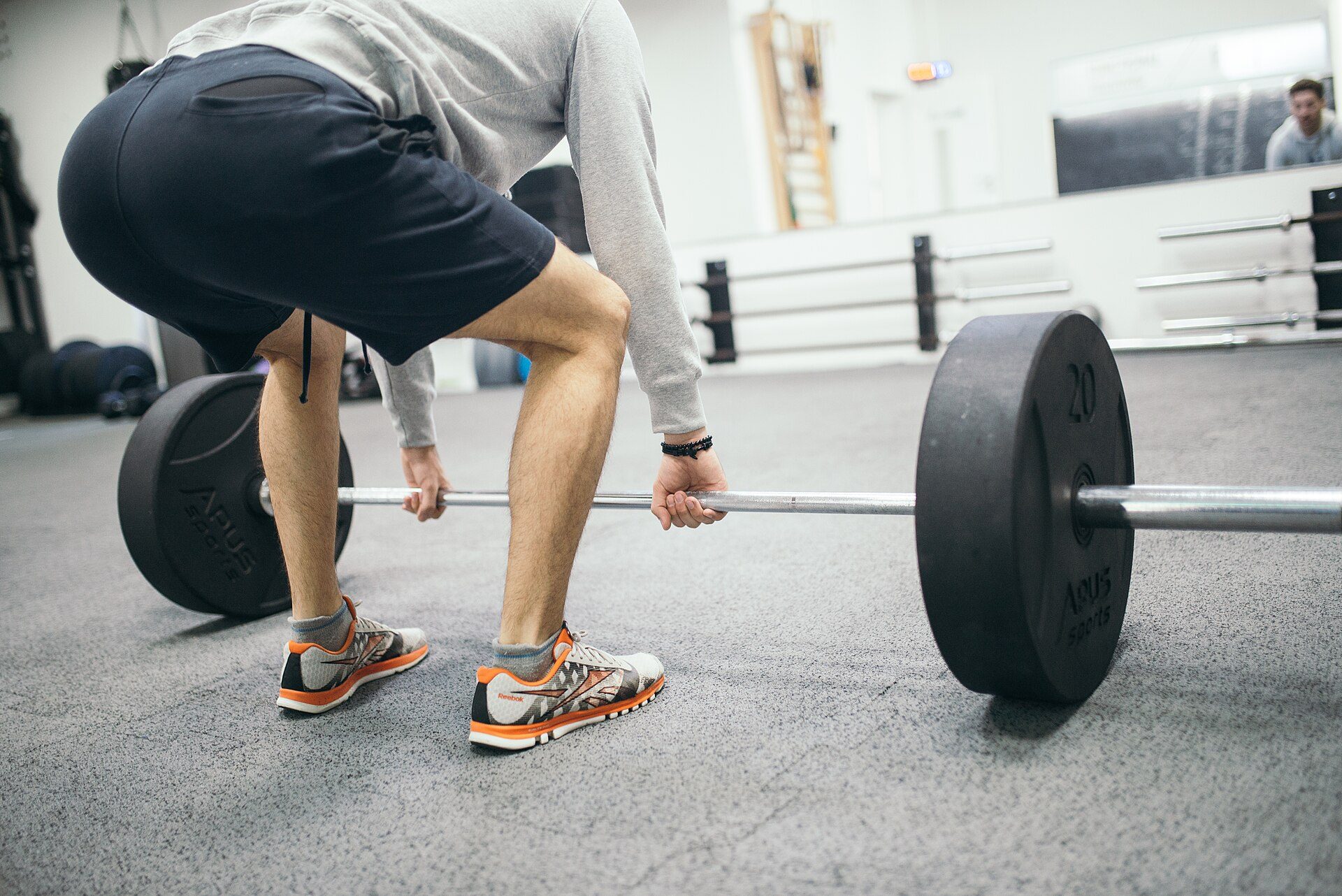
Photo: Nenad Stojkovic / Wikimedia Commons, CC BY 2.0
Tendons and ligaments adapt more slowly than muscle
Tendons connect muscle to bone; ligaments connect bone to bone. Both have a poorer blood supply than muscle, so they adapt and heal more slowly, typically over months rather than weeks. In the first few weeks beginners get stronger quickly, mostly because the nervous system learns to recruit muscle better, while the tendons have not yet toughened. That is why people who add weight whenever they "feel strong" often develop tendon pain after 1 to 2 months.
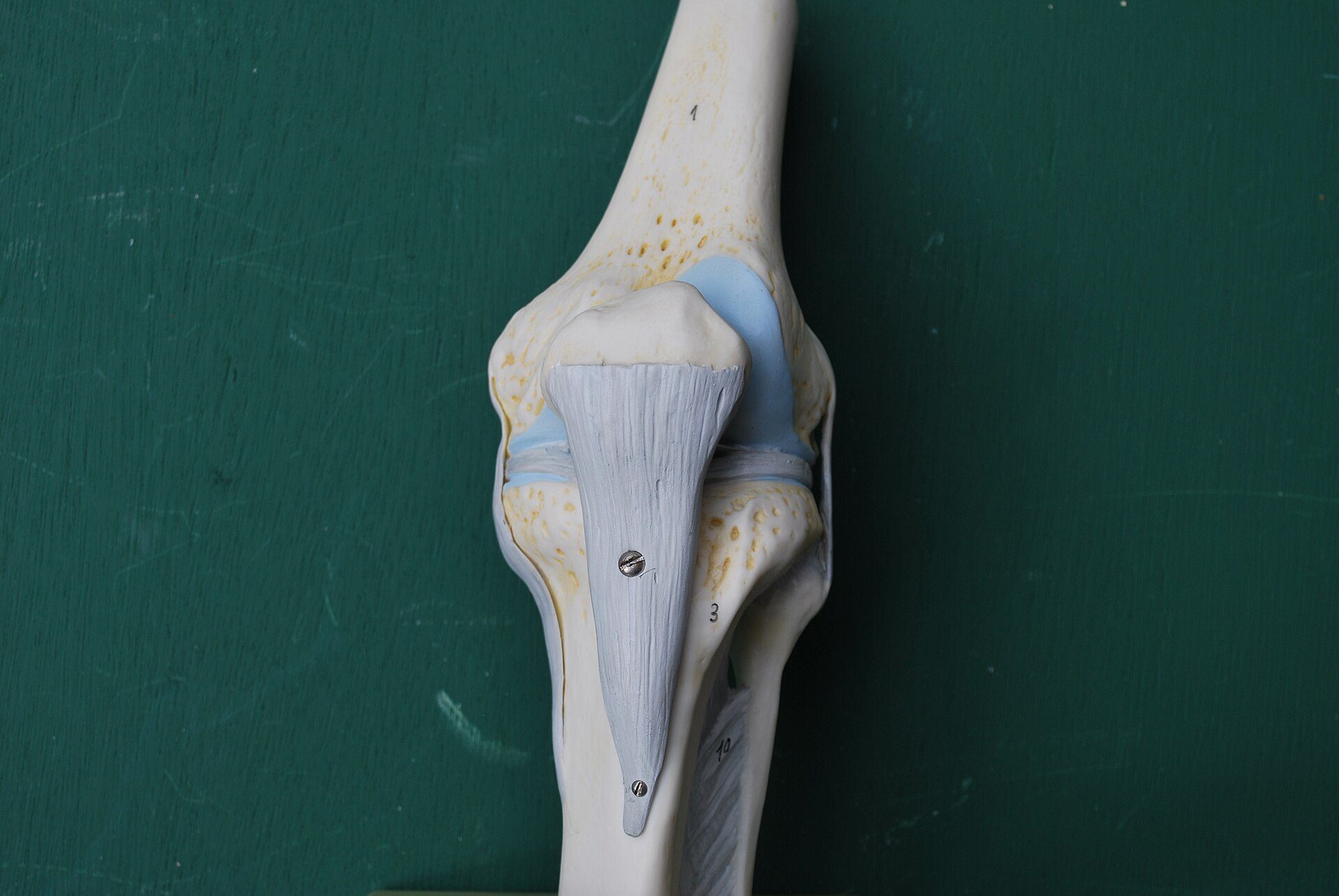
Photo: John Campbell / Wikimedia Commons, CC BY 2.0
The three energy systems and how to use them in programming
Muscles can only spend one energy "currency", ATP, and the body has three systems for regenerating it. All three run at the same time; what changes is which one dominates, depending on the intensity and duration of the effort.
The phosphagen system: fastest and shortest
This system uses creatine phosphate stored in the muscle and supplies energy very quickly for maximal efforts of about the first 10 seconds: a single heavy lift, a short sprint, a jump. The store is small and needs roughly 3 to 5 minutes of rest to mostly refill. So when a client lifts heavy for low reps and rests too briefly, the next set is clearly weaker.
The anaerobic glycolytic system: powerful but tires quickly
From about 10 seconds to 2 minutes of hard effort, muscles break down glucose and glycogen without enough oxygen. This is the burning feeling at the end of a set of 12 to 15 reps, or during a 1-minute all-out bike sprint. It is the main system in muscle-building sessions and circuit training.
The aerobic system: endurance, uses oxygen
When moderate effort lasts more than 2 to 3 minutes, there is enough oxygen to burn glucose and fat. Brisk walking, cycling or steady rowing for 20 to 40 minutes relies mostly on this system (see Figure 4). Check intensity with the "talk test": if the client can speak in short sentences, the intensity is moderate; if they can only manage single words, it has become high.
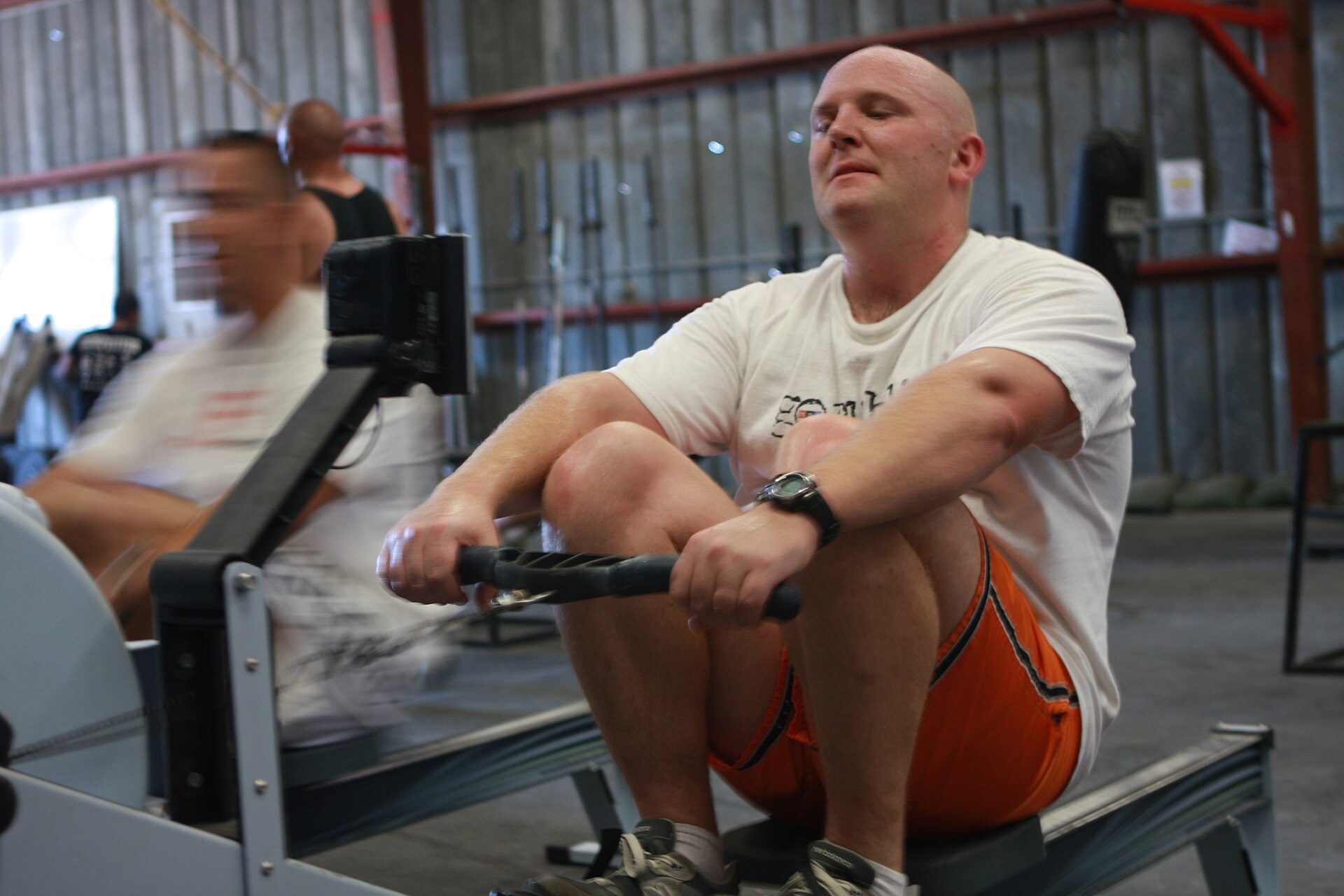
Photo: Lance Cpl. M. C. Nerl / Wikimedia Commons, Public domain
Quick reference: energy systems, examples and rest periods
The rest periods in this table are common reference values from PT course materials; adjust them to each client.
| Dominant system | Effort duration | Gym examples | Typical rest between sets |
|---|---|---|---|
| Phosphagen | Up to about 10 seconds | Heavy lifts of 1–5 reps, jumps | 2–5 minutes |
| Anaerobic glycolytic | About 10 seconds to 2 minutes | Muscle-building sets of 8–15 reps, circuits | 1–2 minutes |
| Aerobic | Over 2–3 minutes | Brisk walking, cycling, steady rowing | No rest, or short 30–60 second breaks between intervals |
Core training principles
Fat-loss and muscle-gain programmes both rest on the principles below; leave one out and progress stalls or the client gets hurt.
Progressive overload
Progressive overload means gradually increasing the demand on the body over time so it has to keep adapting. You can add reps, add sets, add weight, cut rest or use a harder variation. For beginners, the safe order is: correct technique first, then more reps, then more sets, and only then more weight. Change only one variable at a time.
The "2 extra reps, 2 sessions in a row" rule and the RIR scale
A common rule: if on the last set the client can do 2 or more reps beyond the target, and repeats that in 2 consecutive sessions, increase the weight at the next session. Typical increases in course materials are about 2.5–5% for upper-body exercises and 5–10% for lower-body exercises. To gauge difficulty, use the reps-in-reserve (RIR) scale: "if you had to keep going, how many more reps could you do?". Beginners should end each set with roughly 2–4 reps in reserve, not train to complete failure.
Specificity, individualisation and reversibility
Specificity: the body adapts to exactly the kind of training it gets; if you want stronger legs for climbing stairs, you must train legs, not only run. Individualisation: two clients of the same age can respond very differently because of sleep, work and old injuries. Reversibility: stop training for a few weeks and fitness drops, so a client returning after the Lunar New Year (Tet) holiday should start lighter than before.
Recovery: when the body actually gets stronger
A session creates a stimulus and fatigue; the body gets stronger during rest, when it repairs and rebuilds above its previous level (often called supercompensation). Training again and again before recovering takes the client backwards, not forwards.
Rest between sets, between sessions and between weeks
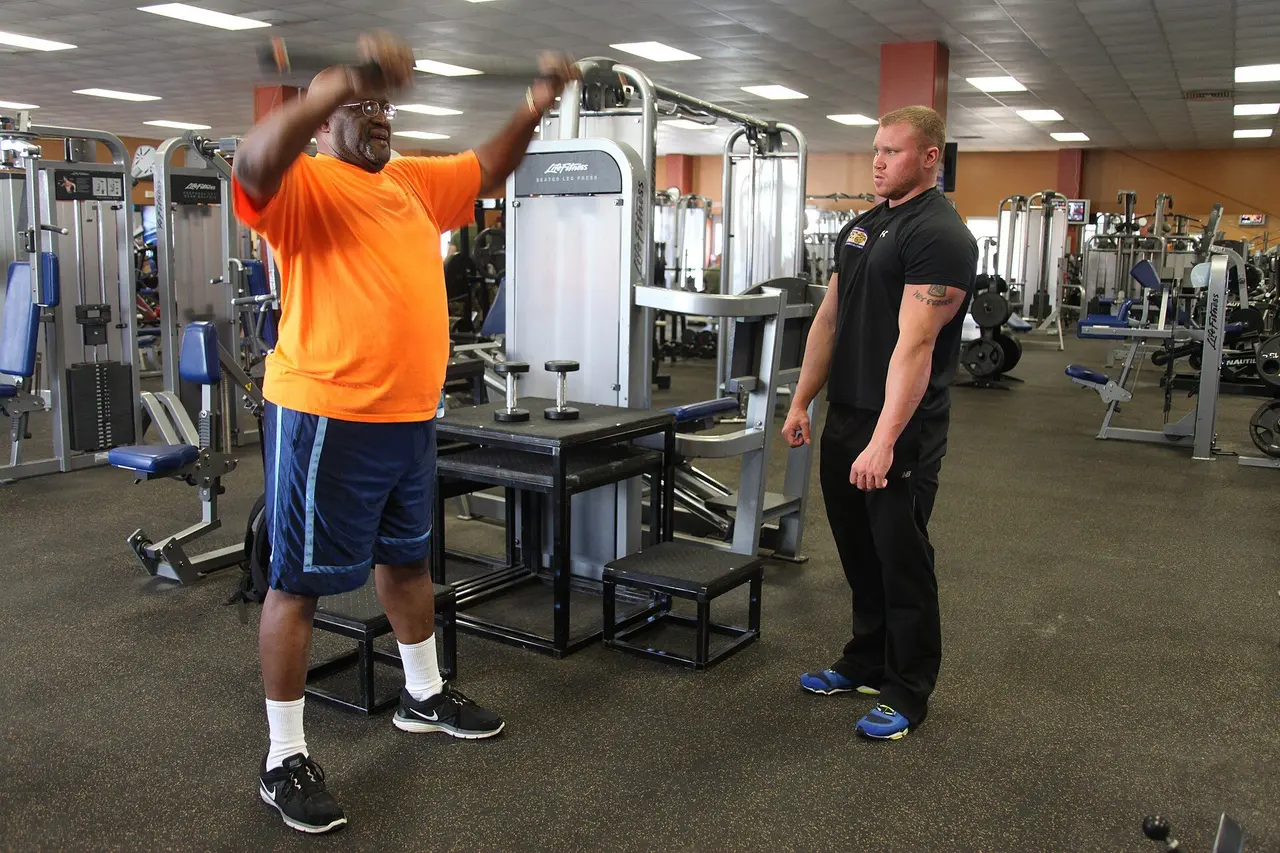
Between sets: follow the energy systems table and time the rest instead of letting the client rest by feel (see Figure 5). Between sessions: the same muscle group usually needs about 48–72 hours after a hard session; for beginners, 2–3 full-body sessions a week on alternate days is reasonable. Between weeks: after 4–8 weeks of steadily increasing load, many PTs schedule a lighter week (cutting roughly a third to a half of the sets) so the body can catch up.
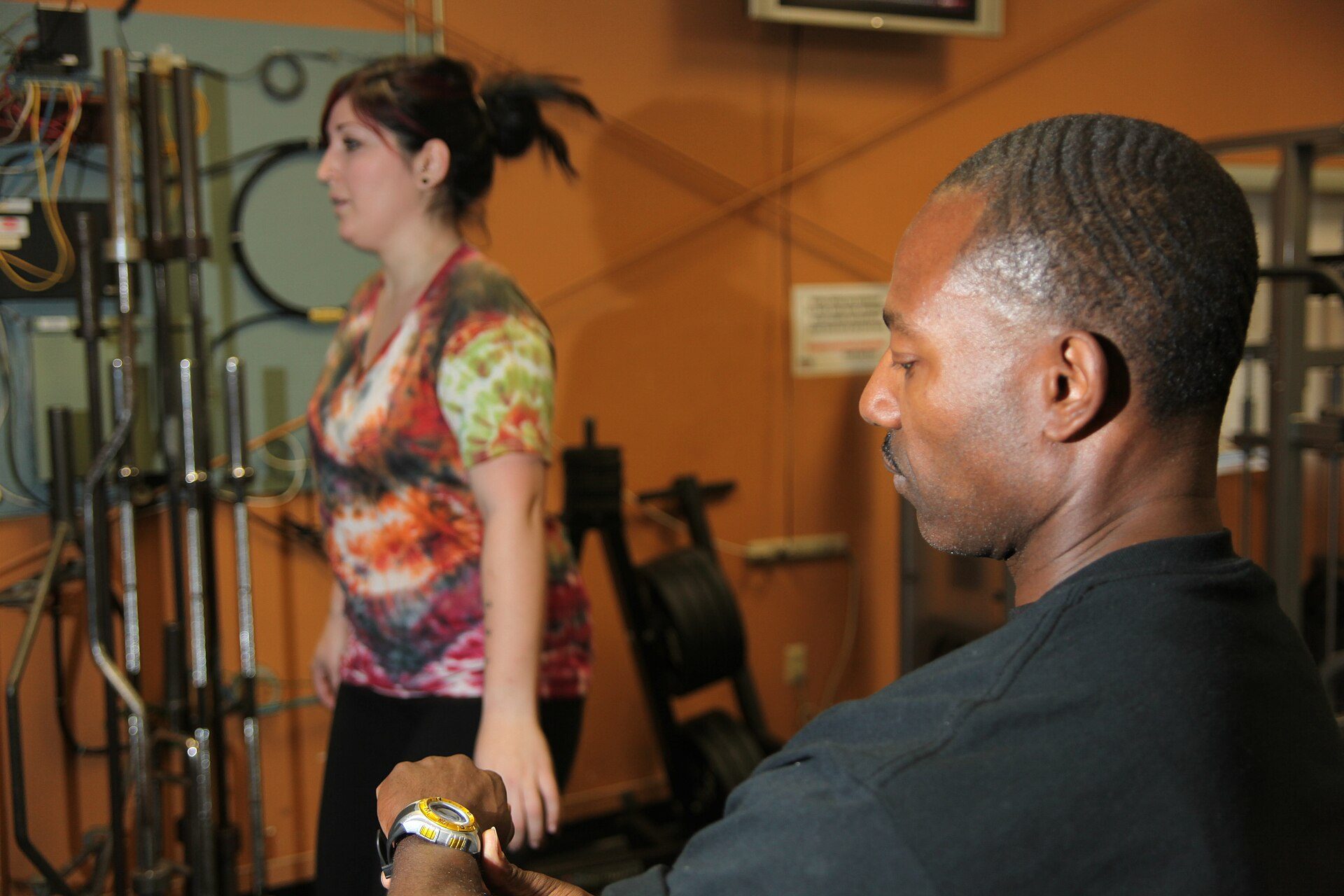
Photo: http://www.marines.mil/unit/mcascherrypoint/PublishingImages/120113-M-EY704072.JPG / Wikimedia Commons, Public domain
Sleep, food and stress
Enough sleep (adults usually need about 7–9 hours a night) and enough protein and energy decide how fast a client recovers. Clients on night shifts or with a new baby recover more slowly, so their programme must be lighter.
Post-workout soreness is different from injury pain
Delayed onset muscle soreness (DOMS) is a dull ache in the muscles you trained that appears a few hours to a day after the session. Injury pain is usually sharp and localised to one spot, sometimes with a "pop". The table below helps tell them apart; when in doubt, treat it as an injury and advise the client to see a doctor.
| Feature | Post-workout soreness (DOMS) | Signs of injury or overtraining |
|---|---|---|
| Timing | 12–24 hours after training, worst at 1–3 days | During training, or lasting and getting worse |
| Type of pain | Dull, spread over the muscle, both sides | Sharp, one spot, one side, joint pain |
| Other signs | Stiffness that eases with light movement | Swelling, bruising, loss of strength, numbness, dark urine |
| What the PT does | Train other muscle groups lightly, walk, stretch gently | Stop training that area, advise seeing a doctor |
Why overtraining injures beginners and kills their motivation
Beginners are most eager in their first week and want to "make up" for years at a desk. A PT who goes along with that eagerness is making the most common mistake in the profession.
Muscles race ahead, tendons and technique lag behind
Strength rises quickly thanks to the nervous system, while tendons, ligaments and cartilage adapt slowly. Technique is not yet stable either: when tired, beginners round their backs and let their knees cave in. Add quickly rising weights and you have the recipe for knee, shoulder and lower back pain after 4 to 8 weeks.
A first session that is too hard makes clients quit
A first session with hundreds of squats and lunges plus a run leaves the client so sore that even stairs are hard for 3 to 4 days. They skip the second session, lose the habit and do not renew their package. The first session should end while the client still feels "I could do more".
Signs of prolonged overload
With hard training and too little recovery, a client may sleep badly, have a higher morning resting heart rate than usual, lose strength, lose interest and catch colds often. The PT should cut sets and intensity straight away and ask again about sleep and eating.
Safety warning: stop the session immediately if the client has chest pain, unusual shortness of breath, dizziness, blurred vision, sharp joint pain, or feels a "pop" followed by weakness. After an overly hard session, if the client has unusually severe muscle pain, swollen and hard muscles, marked weakness, or urine as dark as tea or cola, they need to see a doctor right away, because this can be a sign of rhabdomyolysis, a condition that can affect the kidneys. For severe symptoms such as chest pain, fainting or difficulty breathing, call emergency number 115 (Vietnam). A PT does not diagnose and never suggests painkillers so the client can keep training.
Worked example: a 4-week plan for Lan, aged 34
Lan is 34, works as an accountant, sits most of the day and has never lifted weights. Her screening form had no "yes" answers, so she is in the "train normally" group. Her goals: stronger legs and less back fatigue. Schedule: 3 full-body sessions a week (Monday, Wednesday, Friday), 60 minutes each.
Splitting a 60-minute session
- Warm-up (brisk walking, joint circles): 10 minutes.
- Four main exercises by movement pattern (squat, hinge, push, pull), 1–2 minutes rest between sets: 32 minutes.
- Moderate aerobic cardio, checked with the talk test: 12 minutes.
- Cool-down, gentle stretching, logging: 6 minutes.
Check: 10 + 32 + 12 + 6 = 60 minutes.
Progression table for the goblet squat (dumbbell held at the chest)
Volume per session = sets × reps × weight.
| Week | Sets × reps × weight | Volume per session | Reps in reserve (RIR) | Change |
|---|---|---|---|---|
| 1 | 2 × 10 × 8 kg | 160 kg | About 4 | Learn the movement |
| 2 | 3 × 10 × 8 kg | 240 kg | About 3 | Add 1 set |
| 3 | 3 × 12 × 8 kg | 288 kg | About 2–3 | Add 2 reps per set |
| 4 | 3 × 10 × 10 kg | 300 kg | About 3 | More weight, fewer reps |
Check the maths: 2 × 10 × 8 = 160; 3 × 10 × 8 = 240; 3 × 12 × 8 = 288; 3 × 10 × 10 = 300. Only one variable changes each week. In week 3, on the last set of both the Wednesday and Friday sessions, Lan completed all 12 reps and reported at least 2 more in reserve, meeting the "2 extra reps, 2 sessions in a row" rule, so the weight goes up in week 4.
Why the reps drop when the weight goes up
Dumbbells usually go up in 2 kg steps: moving from 8 to 10 kg is a 25% jump, far more than the 5–10% suggested for the lower body. To compensate, the PT cuts the reps from 12 to 10 per set, so volume only rises from 288 to 300 kg, an increase of 12 kg or about 4%.
Compared with an "all-out" first session
A friend of Lan's trained alone on day one: 5 sets × 20 bodyweight squats, 50 lunges, then a 30-minute run. The squats alone came to 5 × 20 = 100 reps, 5 times Lan's 20 reps in week 1. Result: 4 days of sore thighs and a skipped second session. Lan started slower, but by week 4 her volume per session had nearly doubled (300 versus 160 kg) without missing a session.
Common mistakes new PTs make and how to avoid them
Increasing several variables at once
Sign: next week adds sets, adds weight and cuts rest all at once. Cause: wanting the client to see quick results. Fix: change one variable at a time and log every session.
Judging a session by next-day soreness
Sign: praising a session as "effective" because the client ached for three days. Fix: measure progress by reps, weight, body measurements and consistency; heavy soreness is a sign of overload.
Ignoring rest between sets and between sessions
Sign: no timed rest, the same muscle group trained two days in a row. Fix: write rest periods into the programme and schedule alternate days for the same muscle group.
Practice tasks and self-assessment
- Stand in front of a mirror, point to and name the 10 muscle groups in the first table, and state the main function of each.
- Pick 6 exercises you often do, sort them into the 6 movement patterns and note the prime mover of each.
- Write a 4-week progression table for one exercise for a beginner you know, with volume and RIR columns like Lan's example.
- Do one heavy exercise yourself and compare the reps you manage on the next set after 1 minute of rest versus 3 minutes.
Self-assessment criteria
- Pass: you correctly name, locate and describe the function of all 10 muscle groups without notes.
- Pass: your 4-week table changes only one variable per week, the volume calculations are correct and the condition for adding weight is written down.
- Pass: you can state at least 4 differences between muscle soreness and injury, and 3 signs that mean seeing a doctor immediately.
- Not yet: you add weight by feel, take beginners to failure on every set, or cannot tell DOMS from joint pain.
Frequently asked questions
What is progressive overload?
It is gradually increasing difficulty (reps, sets, weight) over time so the body keeps adapting. With beginners, progress slowly, one variable at a time, using the "2 extra reps in 2 sessions in a row" rule.
How many times a week should a beginner go to the gym?
Usually 2–3 full-body sessions a week on alternate days, 45–60 minutes each, is enough to progress while still recovering. Add sessions only once the client is used to training and recovers well.
How long should you rest between sets?
As a guide: about 2–5 minutes for heavy low-rep lifting, about 1–2 minutes for muscle-building sets of 8–15 reps, and 30–60 seconds for light endurance work.
Is muscle soreness after the gym a problem?
A dull ache for 1–3 days after a new session is usually normal. Sharp joint pain, swelling, marked weakness on one side, or severe pain with dark urine means stopping training and seeing a doctor.
Once you understand muscles, joints, energy systems and how to progress load, move on to the next step of the roadmap: Foundational lifts & form coaching, where you learn to coach the squat, deadlift, bench press, row, overhead press and plank, correct rounded backs and knee cave, and spot clients safely when they lift heavy.
Keep learning to be a PT: after anatomy and training principles come foundational lift technique, fitness assessment, fat-loss and muscle-gain programming and basic nutrition. See the 8-step personal trainer roadmap.