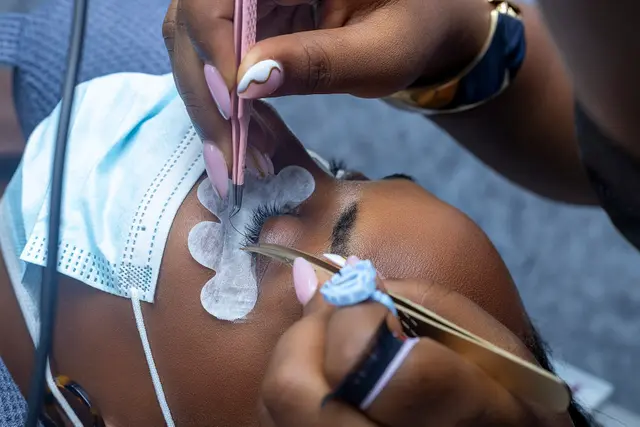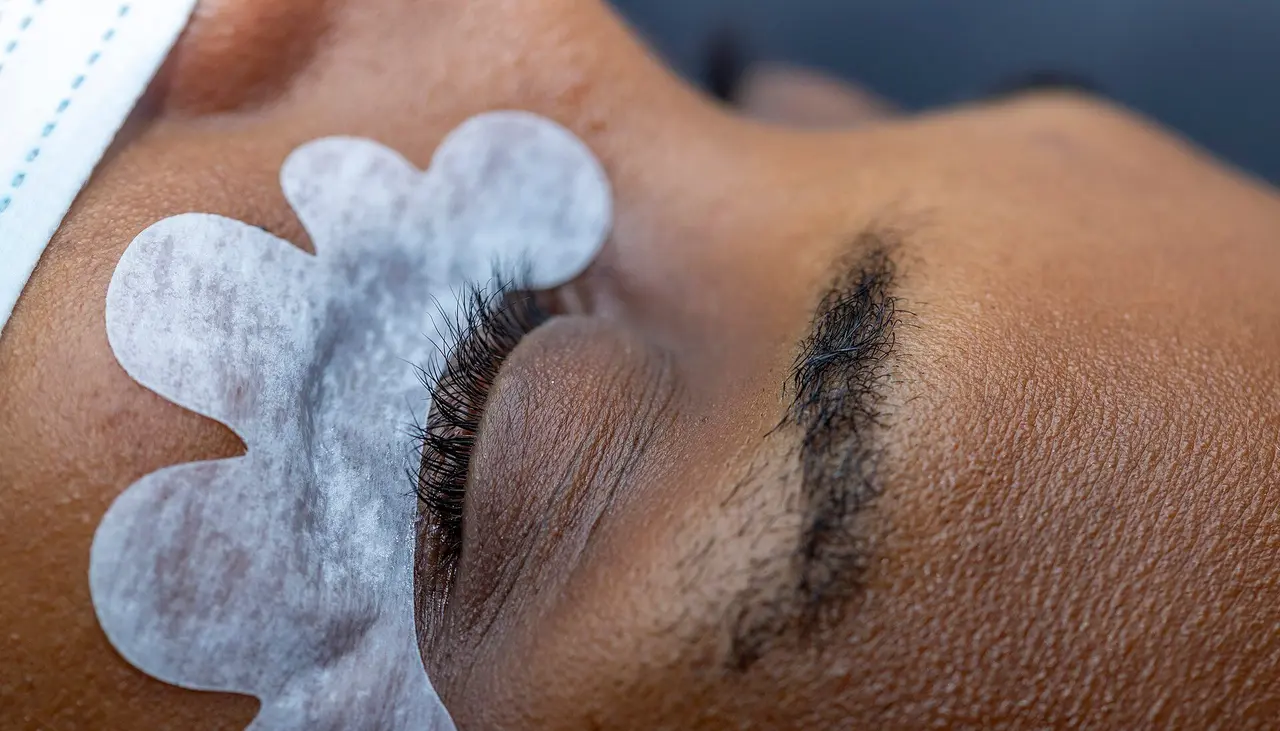
Lash extensions are classified by three numbers printed on every tray: curl (J, B, C, D and so on), thickness (mm) and length (mm), and choosing well means choosing for the client's natural lashes: an extension should be no more than about 2–3 mm longer than the natural lash, no heavier than the lash can carry, and curled to suit the way the lash grows. Lash adhesive is chosen for the room temperature and humidity you measure with a thermo-hygrometer every shift, not by feel. This lesson teaches you to read natural lashes, understand the growth and shedding cycle, and read a lash tray and an adhesive bottle before you pick up your isolation tweezers for the first time.
By the end of this lesson, you will be able to:
- Assess a client's natural lashes: length, thickness, direction of growth, and the share of baby lashes versus healthy lashes strong enough to extend.
- Explain the three phases of the lash growth cycle and why extensions should not go on baby lashes or lashes about to shed.
- Read tray labels such as "C 0.12 10mm" and choose curl, thickness and length for a classic set.
- Choose an adhesive by drying speed and room conditions, use cleanser and primer correctly, and read a thermo-hygrometer to adjust the room.
Learning lash extensions? Natural lashes, growth cycles and materials is step 2 of the roadmap, after hygiene and eye-area safety and before isolation and classic 1:1 sets. See the 8-step lash technician roadmap to learn in the right order.
Natural lashes: structure, numbers and what healthy looks like
A good lash technician looks at the natural lashes first and the lash tray second. Extensions only stick to natural lashes, so if the natural lashes are weak, even expensive materials are wasted.
The parts of a natural lash
Each lash has a root sitting in a follicle under the eyelid skin, a shaft that you can see, and a tip that tapers. The extension is attached to the shaft about 1 mm from the base, never touching the eyelid skin; you will practise the placement technique in the next step. The tip is thin and soft, so an extension placed too far out droops, twists and falls off early.
Typical numbers and lengths
Sources commonly quote about 90–160 upper lashes per eye and fewer on the lower lid, roughly 70–80; upper lashes are often about 8–12 mm long, and lower lashes much shorter. These are reference ranges and every person is different. Vietnamese clients often have straight, slightly downward-pointing lashes that are not very long, so curl and length need more care than foreign sample charts suggest.
Healthy and weak lashes: what to check before you start
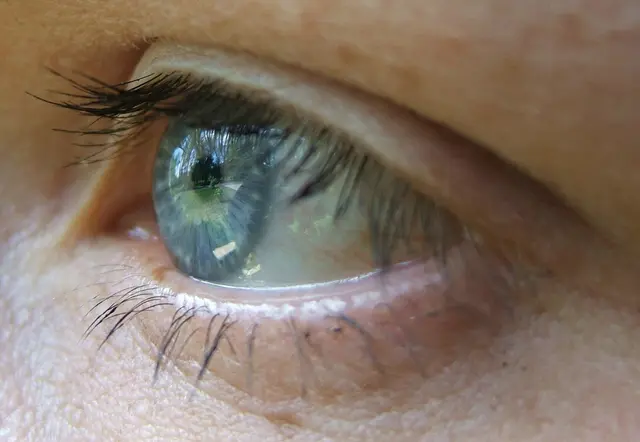
Look at the lashes under a bright lamp, brush them gently with a clean spoolie and observe them as in Figure 1. Healthy lashes have dark, even shafts, firm roots, enough thickness and fairly even spacing. Weak lashes are fine, pale, sparse in patches and break when brushed. Natural lash thickness is often quoted as about 0.07–0.15 mm depending on the person; you cannot measure it with a ruler, so compare it by eye with sample extensions held alongside.
The lash growth and shedding cycle and why it matters
Every natural lash passes through a growth phase, a transition phase and a resting phase, then sheds, and the follicle grows a new one. Lashes on the same lid are not in sync: at any moment some are growing, some resting and some about to fall (Figure 2). That is why a set of extensions always sheds a few at a time rather than all at once.
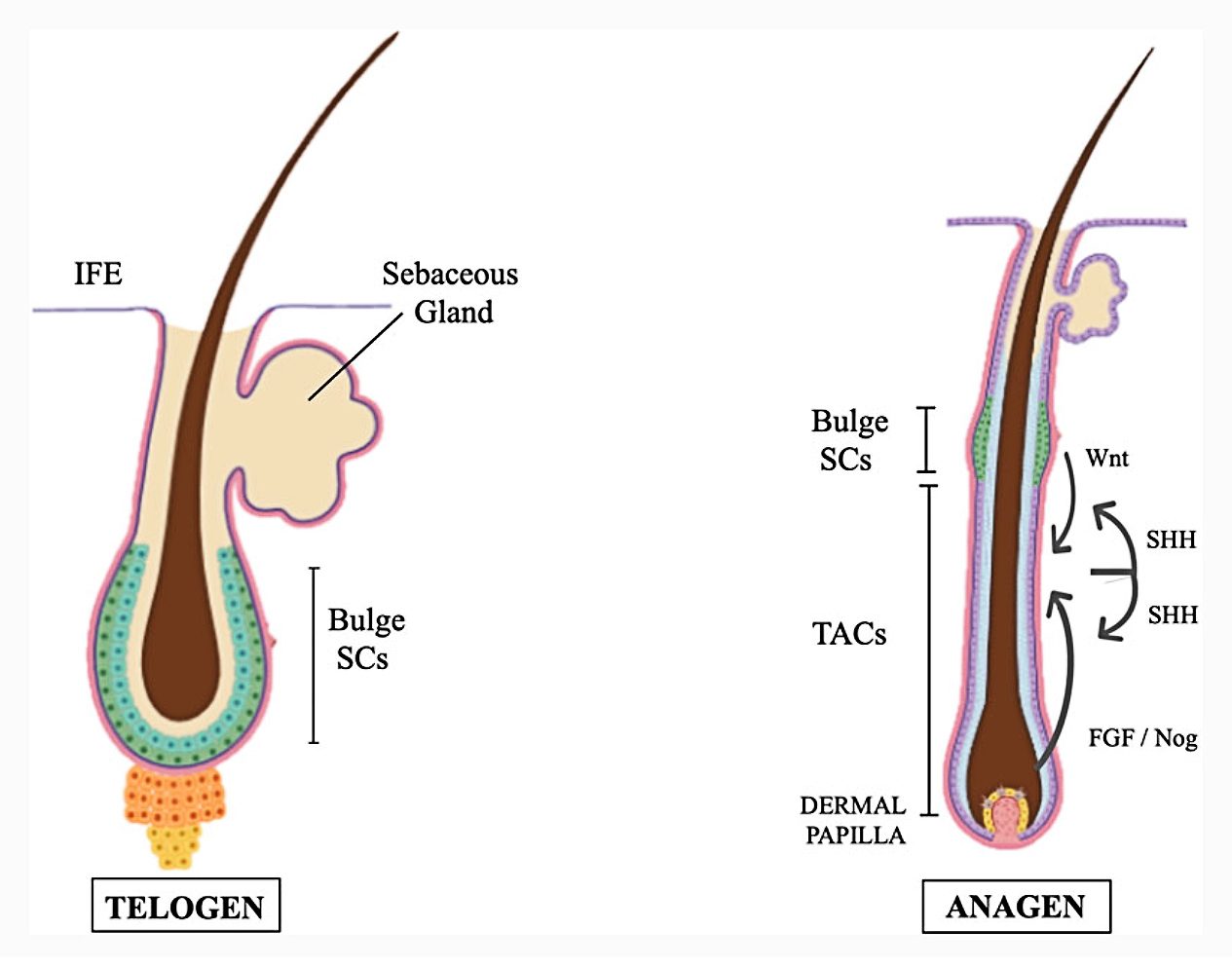
Photo: Cancedda R and Mastrogiacomo M / Wikimedia Commons, CC BY 4.0
The three phases of a lash
| Phase | Commonly quoted duration | What you can see | For the technician |
|---|---|---|---|
| Growth (anagen) | About 1–1.5 months | Short, fine lash, pale at the tip, still getting longer every day | Too short or fine: skip it or use the shortest, lightest extension |
| Transition (catagen) | About 2–3 weeks | Lash has stopped growing and reached full length | Can be extended normally |
| Resting (telogen) | Can be several months | Long, dark lash whose root may loosen before it sheds | Can be extended, but when it sheds it takes the extension with it |
These are ranges commonly found in the literature, not fixed numbers for everyone.
Why not extend baby lashes
Baby lashes are still growing every day and are fine. Attach a long, heavy extension and it is pushed away from the base very quickly, sticks out at an angle from the rest of the lash line, and its weight can break the young lash. While practising, skip lashes that are too short or too fine; if you need to fill a gap, use the shortest and finest extension on the tray and leave the rest for the next infill, once the lash is long enough.
The lash cycle sets infill timing and retention
Because natural lashes shed a few every day, a set usually needs an infill after about 2–3 weeks; how to count lashes and plan infills is covered in How long do eyelash extensions last? Infills, removal, aftercare. However good the glue is, an extension still falls out when its natural lash sheds.
Lash extension fibres: material, length and thickness
Extensions are sold in trays with several rows (lines), each row a single length. The tray label always shows the three numbers: curl, thickness and length, for example "C 0.15 10mm" means a C curl, 0.15 mm thick and 10 mm long. A "mix" tray holds several lengths in one tray, which is handy for a classic set.
Material and the names on the packet
Most extensions today are synthetic fibres, many made of PBT plastic. Names such as "mink", "silk" or "cashmere" on packets are usually trade names describing how soft, glossy or matte the fibre is, not real fur or silk. When choosing, look at the specifications, how even the fibres are, and a clear label showing where the product comes from.
Length: no more than 2–3 mm longer than the natural lash
Common extension lengths run from about 6 mm to 15 mm. A rule many trainers give beginners is that the extension should be at most about 2–3 mm longer than the natural lash. Anything longer acts as a lever: every blink, the long tip pulls on the root, and over time the natural lash breaks or sheds early. If the natural lashes are 8 mm, the longest zone usually goes only to about 10–11 mm.
Thickness: a thicker fibre is much heavier than the number suggests
Classic 1:1 (one extension on one natural lash) usually uses 0.10–0.15 mm fibres; volume uses fine 0.03–0.07 mm fibres grouped into fans. What beginners forget is that, at the same length, weight rises with the square of the diameter. A 0.15 mm fibre is about (0.15 ÷ 0.10)² = 1.5² = 2.25 times as heavy as a 0.10 mm fibre, even though the numbers differ by only 0.05 mm.
| Fibre thickness | Usually used for | Suits natural lashes that are | Notes |
|---|---|---|---|
| 0.03–0.07 mm | Volume, fans of 2D and up | Any type; count the weight of the whole fan | Learned in the volume step, not for classic |
| 0.10 mm | Classic on fine or young lashes | Fine, sparse, first-time clients | Natural look, less dramatic |
| 0.12 mm | Most common classic | Average | Balance of fullness and lightness |
| 0.15 mm | Bolder classic | Healthy, thick | Not for fine lashes |
| 0.18–0.20 mm | Rarely used | Only very strong lashes | Heavy, can break natural lashes; beginners should avoid |
J, B, C, D curls and other styles
Curl decides whether extensions look natural or "doll-like", and it also affects retention. The letters describe the amount of curl, but there is no shared measuring standard between brands: two brands' C curls can differ slightly, so when you switch brands, compare real fibres side by side.
Curl comparison table
| Curl | Shape | Suits | Notes |
|---|---|---|---|
| J | Almost straight, very slight curl at the tip | Clients who want length without visible curl | Rarely used; on downward lashes it makes the eye look heavy |
| B | Gentle curl, like a natural lash | Natural styles, lashes that already curl a little | Little lift |
| C | Medium curl, the most common | Most clients, straight lashes that need a more open eye | A safe choice for beginners |
| CC, D | Strong curl, tip clearly lifted | Doll styles, eyes that need a lot of lift | On very straight lashes the base has little contact, so it holds less well |
| L, M | Straight base, then a sharp bend | Downward lashes, some monolid eyes | Use when C or D will not lie along the lash shaft |
How curl affects retention
An extension holds well when its base lies flat along a section of the natural lash shaft. Put a strongly curled D on a straight natural lash and the base touches the lash at only one point, the adhesive has little surface to grip, and the extension pops off within days. So with straight lashes, beginners should start with C; for more lift, consider L or M rather than forcing a D.
Lash adhesive, cleanser, primer and hygrometers
Adhesive affects retention more than any other material and is also the most sensitive to the environment. Understanding how it cures helps you handle weather changes yourself.
How lash adhesive cures
Lash adhesive is usually cyanoacrylate-based, the same chemical family as instant super glue but formulated for lashes, often with a black pigment added. It hardens when it meets moisture in the air: high humidity makes it cure fast, low humidity makes it cure slowly, and higher temperatures also speed it up. The bottle states a drying speed (for example about 0.5–1 second, 1–2 seconds or 2–3 seconds) and recommended temperature and humidity ranges; many brands state about 20–25°C and 40–60% humidity.
Beginners whose hands are still slow should choose a slower adhesive (about 2–3 seconds): a fast glue cures before you can place the extension correctly, so it bonds loosely and falls early. Move to faster adhesives gradually as your speed improves.
Using and storing adhesive correctly
- Shake the bottle as the manufacturer directs before dispensing, because the pigment can settle.
- Place a small drop on a glue ring, jade stone or adhesive sticker; when the drop thickens and strings, replace it, and many brands suggest about every 15–30 minutes (Figure 3).
- Wipe the nozzle and close the cap tightly at once; write the opening date on the bottle and use it within the period the manufacturer gives after opening.
- Store in a cool, dry place out of the sun; whether an open bottle should go in the fridge depends entirely on the manufacturer's instructions, because taking it in and out can cause condensation that spoils the glue.
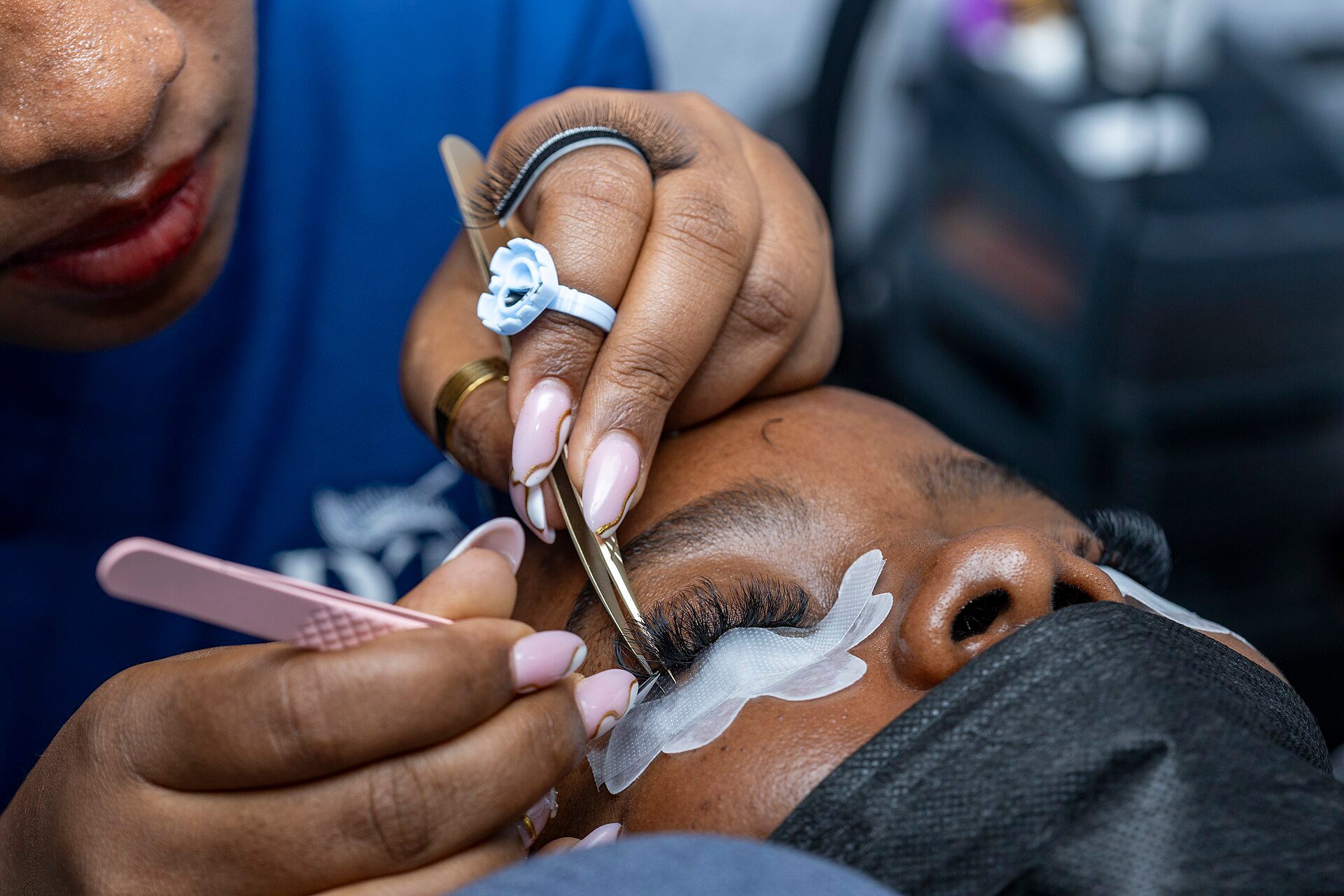
Photo: Jameswasswa / Wikimedia Commons, CC BY-SA 4.0
Cleanser and primer: clean first, prepare second
Oil, dust and make-up on lashes stop the adhesive from bonding. So before extensions go on, lashes are cleaned with a lash cleanser (lash shampoo) and a soft single-use brush, then blotted or blown dry (Figure 4). Many technicians then use a primer, a surface preparation liquid that helps the adhesive bond, brushed onto the lash shaft with a small applicator, away from the base and the eyelid skin.
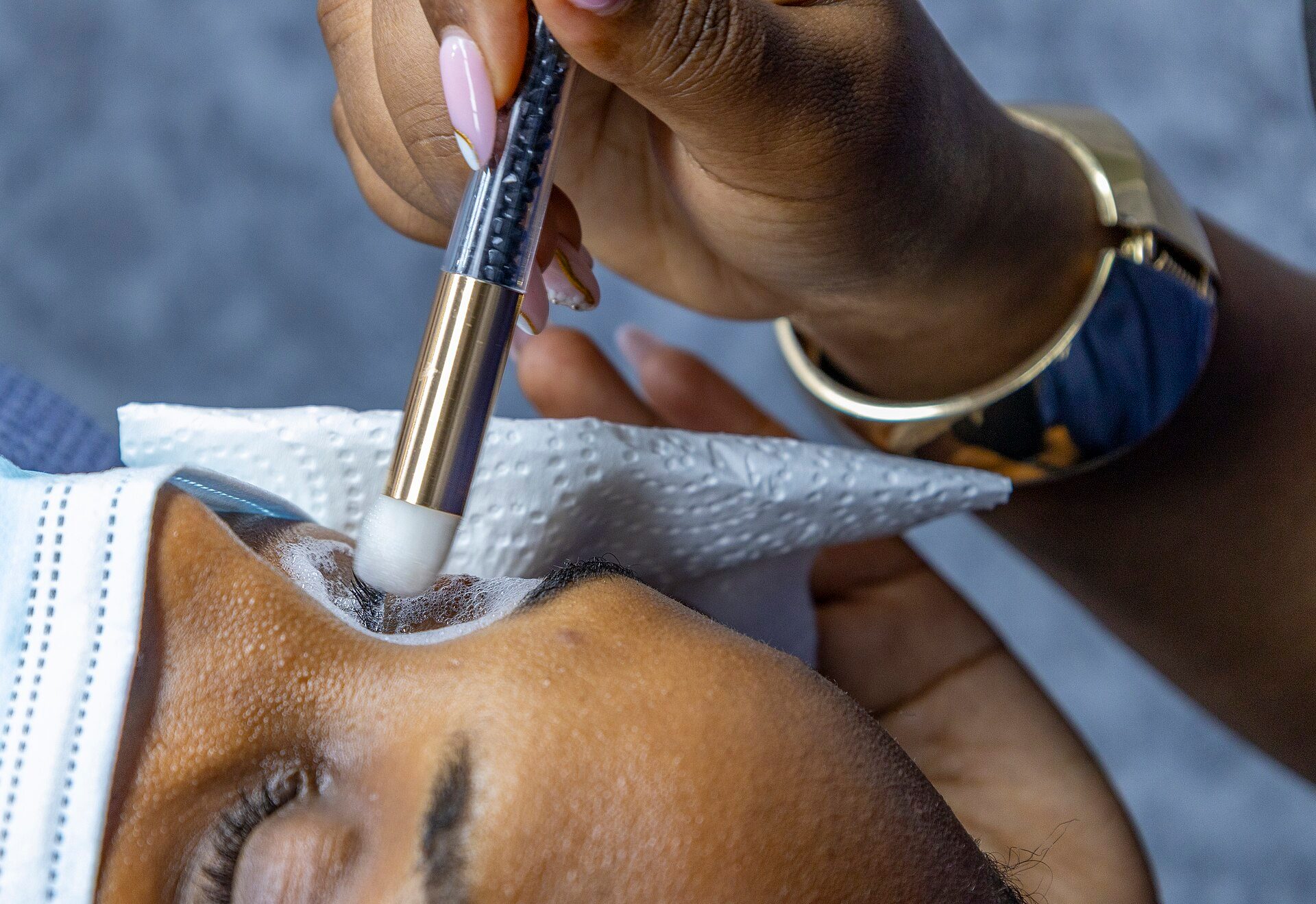
Photo: Jameswasswa / Wikimedia Commons, CC BY-SA 4.0
Primer and cleanser are both chemicals used close to the eye: use only small amounts, exactly as the label directs, and never let them run towards the eye.
Thermo-hygrometers and adjusting the room
A thermo-hygrometer is a small device that measures temperature and humidity (Figure 5). Put it on your trolley, near the client's head and your working hands, not right next to an air-conditioner vent or a humidifier, where readings are off. Record a reading at the start of the shift, mid-shift and whenever the adhesive behaves oddly.
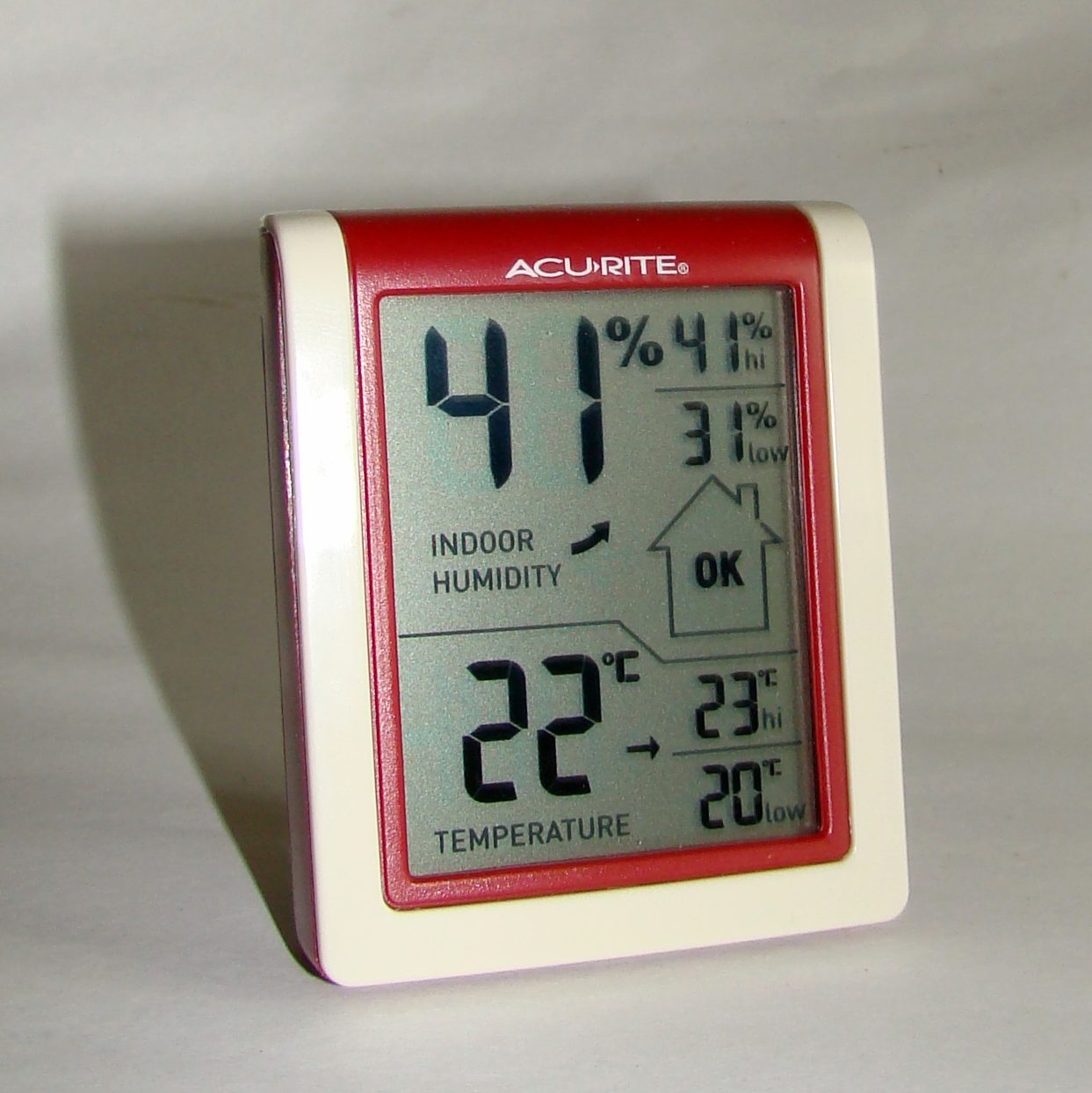
Photo: Pogrebnoj-Alexandroff / Wikimedia Commons, CC BY 3.0
In Vietnam, room conditions swing strongly with the seasons: northern Vietnam has damp "nom" days with very high humidity, and the southern rainy season is humid too; on the other hand, a room with the air-conditioner running all day can be drier than the adhesive needs.
| Room reading | How the adhesive usually behaves | What to do |
|---|---|---|
| Humidity above about 60–65% | Cures too fast, thickens quickly on the ring, extensions bond loosely | Run a dehumidifier or the air-conditioner's dry mode; change the glue drop more often; consider an adhesive made for humid rooms |
| Humidity about 40–60%, 20–25°C | Cures at the speed on the bottle | Keep it there and keep recording readings |
| Humidity below about 35–40% | Cures slowly, stickies are more likely, more fumes | Use a humidifier placed away from the work station, stop the air-conditioner blowing straight at you; consider a faster adhesive |
Safety warning for adhesive, primer and cleanser: Cyanoacrylate adhesive gives off fumes as it cures and can cause stinging, red eyes or allergy. The client must keep her eyes closed throughout, the room must be well ventilated and the technician should wear a mask; never pass the glue drop across the client's face. Never use nail glue, all-purpose glue or instant super glue instead of lash adhesive. If adhesive, primer or cleanser gets into the eye: stop at once, rinse with plenty of clean water or sterile saline, then take the client to an eye doctor; do not apply any eye drops yourself. If the client has difficulty breathing or rapid swelling of the lips or face, call emergency services immediately (115 in Vietnam).
When not to extend and when to refer the client to a doctor
While assessing natural lashes, if you see lashes falling out in patches, unexplained sparseness, red, scaly or swollen lid margins, a stye, or an eye that is red or has discharge, do not apply extensions and advise the client to see an eye doctor or dermatologist. Unusual lash loss can be linked to medical conditions that only a doctor can identify. Clients with a past adhesive allergy or ongoing eye treatment should also ask a doctor first; you do not diagnose and do not recommend medicines.
Worked example: choosing materials for a classic set on a damp day
A 32-year-old woman is getting extensions for the first time; she has completed the consultation form and shows no signs of eye disease. Her natural lashes are straight and point slightly downward, the longest are about 9 mm and of average thickness. A rough count gives about 100 visible upper lashes per eye, of which about 20 are baby lashes too short and fine to use; about 80 are strong enough to extend.
Step 1: choose curl, thickness and length
- C curl: straight lashes, and the client wants a more open but still natural look; avoid D because straight lashes hold it poorly.
- 0.12 mm thickness instead of 0.15 mm, because her lashes are average and this is her first set. Each fibre weighs (0.12 ÷ 0.15)² = 0.8² = 0.64 as much, about 36% lighter than a 0.15 mm fibre of the same length.
- Length: longest natural lash 9 mm, plus at most 2 mm, so the longest extension is 11 mm; the inner corner uses shorter ones.
Step 2: number of extensions by length (per eye)
| Zone | Extension length | Number |
|---|---|---|
| Inner corner | 8 mm | 15 |
| Inner middle | 9 mm | 20 |
| Outer middle | 10 mm | 25 |
| Outer corner | 11 mm | 20 |
| Total per eye | 80 | |
Check: 15 + 20 + 25 + 20 = 80 extensions, exactly the number of healthy natural lashes per eye. Both eyes need 80 × 2 = 160 extensions in C 0.12 mm, so choose an 8–11 mm mix tray or the four matching rows of a tray. Zoning by eye shape comes later, in the lash mapping step.
Step 3: measure the room and choose the adhesive
It is a damp "nom" morning and the thermo-hygrometer on the trolley reads 27°C and 78% humidity. The salon's adhesive states a 1–2 second drying speed and recommends 20–25°C and 40–60%. You switch the air-conditioner to dry mode at 24°C, turn on the dehumidifier and close the window. After about 30 minutes the reading drops to 24°C and 55% humidity, inside the manufacturer's range, so you begin.
During the set you record a mid-shift reading and change the glue drop about every 20 minutes. The client card reads: C 0.12 mm, 8–11 mm, 160 extensions, adhesive code and opening date, 24°C and 55%. At the next infill, this card helps you find the cause if retention is poor.
Common mistakes when choosing fibres and adhesive
Choosing fibres that are too long and too thick for a "bold" look
Signs: the client says her lashes feel heavy, and after 1–2 weeks many natural lashes have shed or broken. Cause: following a sample photo, using 0.15–0.20 mm fibres 4–5 mm longer than the natural lashes. Fix: go back to the rule of at most 2–3 mm longer than the natural lash, and use 0.10–0.12 mm on average lashes.
Using too much curl on straight lashes
Signs: extensions pop off within a few days, with the base sticking out sideways. Cause: a D curl touches the natural lash at only one point. Fix: use C, or L and M for downward lashes; check that the base lies along the lash shaft before releasing the tweezers.
Frequently asked questions
Which lash extension curl looks most natural?
B looks closest to a natural lash, and C is the most popular because it opens the eye while still looking natural. Since Vietnamese lashes are often straight, C is the safe choice for beginners; D gives a doll look and needs natural lashes with enough curl to hold it.
Are 0.15 or 0.12 lash extensions better?
Neither is better for every client. A 0.15 mm fibre looks bolder but is about 1.56 times as heavy as a 0.12 mm fibre of the same length; average or fine lashes should get 0.10–0.12 mm, and only strong lashes should get 0.15 mm for classic.
How long is the eyelash growth cycle?
Each lash goes through growth, transition and resting phases; sources often quote a growth phase of about 1–1.5 months and a resting phase that can last several months, varying from person to person. The lashes are not in sync, so a few shed every day.
How long does lash adhesive last once opened?
As long as the manufacturer states on the bottle for an opened product; it differs by brand. Write the opening date on the bottle, keep the cap tight and store it as directed; if the glue is thick, lumpy or curing unusually slowly even in a correctly set room, open a new bottle.
Practice and self-assessment
- Examine the natural lashes of 3 people (friends or family) under a lamp and record estimated length, thickness, direction and the number of visible baby lashes on a card.
- For each person in exercise 1, draw up a table choosing curl, thickness, length and number of extensions per eye as in the example, and check that the totals add up.
- Measure the temperature and humidity of your practice room 3 times a day for 5 days, and record how fast a glue drop actually cures on the ring.
Self-assessment criteria
- Pass: the longest extension in your table is no more than 2–3 mm longer than the natural lash, and thickness matches the lash type (fine 0.10, average 0.12).
- Pass: the zone counts add up to the number of healthy natural lashes, with baby lashes excluded.
- Pass: you can explain whether adhesive cures faster or slower as humidity rises or falls, and bring the room back into the manufacturer's range.
- Not yet: choosing D 0.15 mm extensions 4 mm longer than fine natural lashes, or starting work without measuring the room.
Once you can read natural lashes and choose the right fibres and adhesive for each client, move on to the next step of the roadmap: Isolation & classic 1:1 sets, where you use the materials you chose to isolate each natural lash and attach an extension about 1 mm from the base. If you have not read the step 1 lesson, review Eyelash extension safety: tweezer hygiene, eye pads, glue allergy before practising on real people.
Keep learning lash extensions: after natural lashes and materials come isolation and classic 1:1 sets, lash mapping, hand-made volume fans, and safe infills and removal. See the 8-step lash technician roadmap.