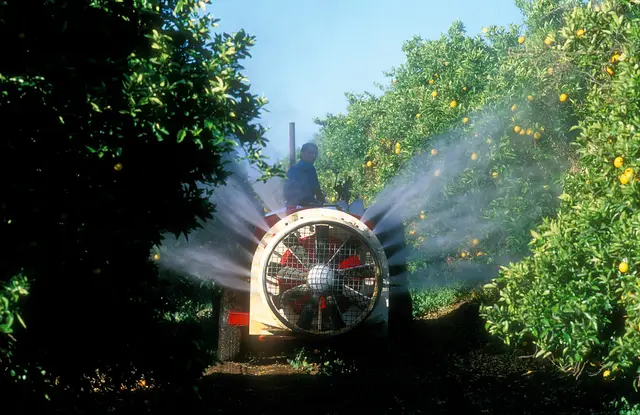
An agricultural spray drone is built from three blocks: the flight block (frame, arms, motors, propellers, battery), the spraying block (tank, pump, centrifugal or pressure nozzles, plus a spreader for fertiliser) and the control, positioning and safety block (flight controller, GNSS/RTK, radar, camera, remote controller). It comes with a set of ground equipment: several batteries in rotation, a fast charger, a generator and spare parts. Knowing what each part does lets you run a pre-flight check in minutes, read a catalogue, and avoid buying a machine that is too big or too small for the fields you will spray.
By the end of this lesson, you will be able to:
- Name the 12 main parts of a spray drone and say what each one does.
- Tell pressure nozzles from centrifugal nozzles, standard GNSS from RTK, and obstacle radar from altitude radar.
- Check the frame, propellers, motors, spray system and sensors with a quick pre-flight table.
- Work out the number of flights, battery uses and spraying time for one round to choose a tank size.
- Ask a dealer the right questions when choosing a spray drone by field size, terrain and charging power.
Learning to fly agricultural drones properly? This is step 2 of the roadmap, right after flight rules, flight safety and pesticides. See the 8-step agricultural drone pilot roadmap to learn in the right order.
What parts does a spray drone have?
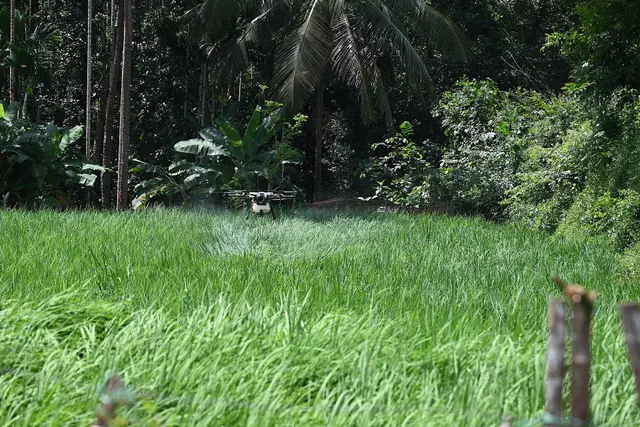
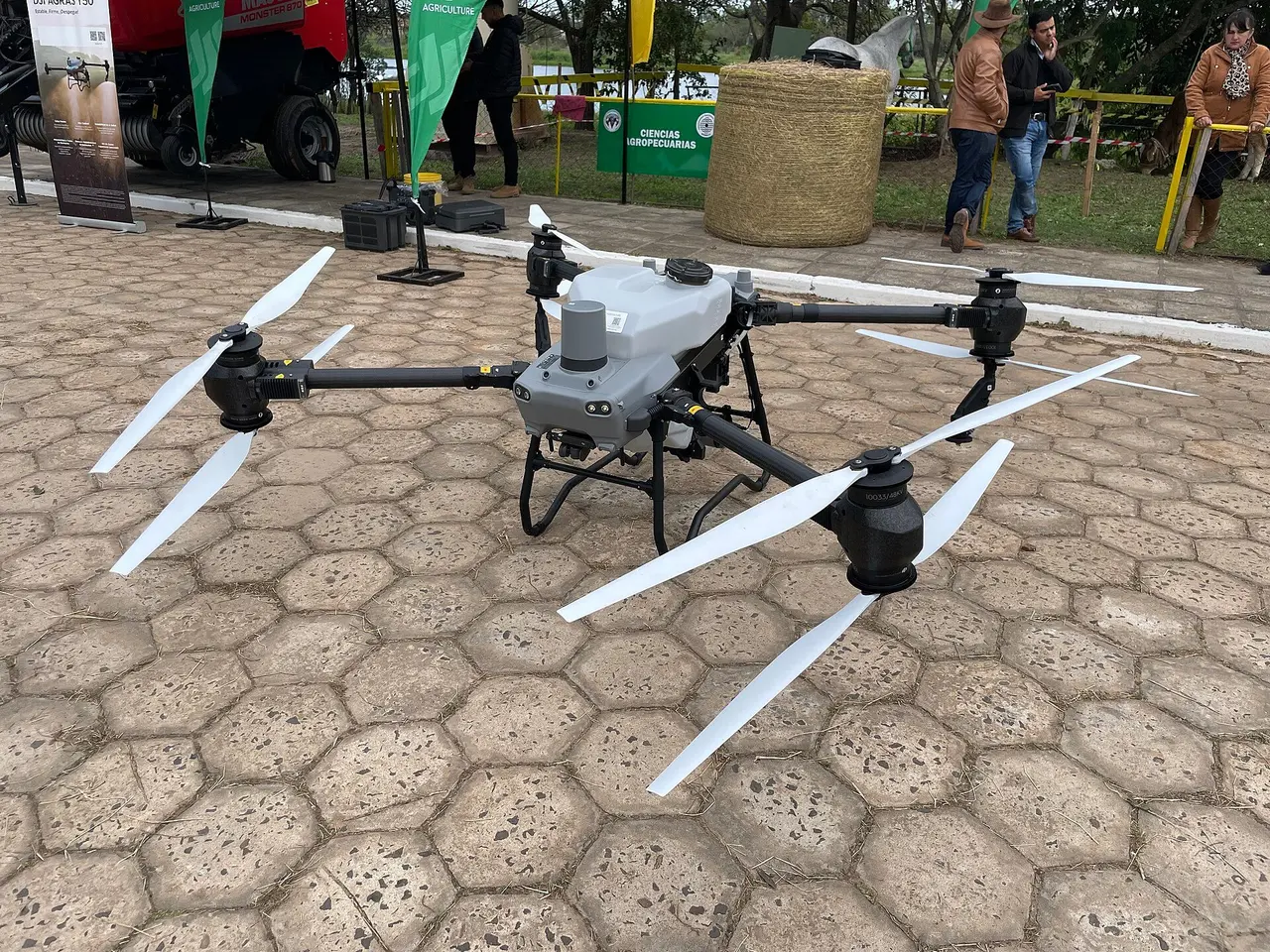
From the outside, a spray drone is a large plastic tank hanging between four or six long arms, each ending in a motor and a big propeller (Figure 1). Inside are a flight controller that keeps the machine level, a satellite receiver that knows where it is, radar that warns of obstacles, and a pump and nozzles that turn liquid into fine droplets. A pilot does not repair circuit boards, but must know what each part does to notice when something is wrong.
Parts at a glance and quick checks
| Part | What it does | Quick pre-flight check |
|---|---|---|
| Frame, arms | Carries the load, folds for transport | Arm locks fully closed, no cracks, no loose bolts |
| Motors, speed controllers | Spin the propellers for lift | Turn by hand: smooth, no grit, not unusually hot |
| Propellers | Push air down to lift the drone | No chips or cracks, correct direction, bolts tight |
| Battery | Powers the whole drone | Not swollen or dented, clean contacts, enough charge |
| Tank | Holds the spray liquid | Lid sealed, strainer clean, no leaks at the base |
| Pump, flow meter | Moves liquid, measures output | Test run: steady, no air bubbles, no error |
| Nozzles | Make droplets and spread them | Spray clean water: every nozzle even |
| Radar, camera | Detect obstacles, measure height | Radar face and lens clean, no sensor error |
| GNSS/RTK, flight controller | Know position, keep level | Enough satellites, RTK "fixed" if used |
| Remote controller | Sends commands, shows data | Charged, antennas aimed, strong signal |
Frame, motors and propellers: what lifts the drone
A spray drone lifts its body, heavy batteries and tens of litres of liquid, so its flight block is much larger and stronger than a camera drone's. It is also the part most likely to injure people while the drone is running.
Frame and folding arms
Frames are usually carbon fibre tubes and aluminium that resist vibration and chemicals. The arms fold for transport and lock open for flight. The weak point is the arm lock: one unlatched lock can let an arm fold in flight. Make a habit of pressing every lock after unfolding.
Brushless motors and speed controllers
Each arm carries a brushless electric motor, driven by an electronic speed controller (ESC) that constantly adjusts speed to keep the drone level. These motors are durable and need little maintenance, but they dislike sand, mud and dried chemical residue. A strange whine, one motor much hotter than the others, or an ESC error in the app means the drone should be checked.
Large propellers and rotor layouts
Spray drone propellers range from a few tens of inches to more than 50 inches depending on the model (reference only, check the manufacturer's catalogue). There are 4-, 6- and 8-rotor machines, or four arms with two stacked propellers each, called coaxial, as in Figure 1. Each propeller has its own spin direction; swap them and the drone flips on take-off. The downwash also pushes droplets into the canopy, so flight speed and height directly affect spray quality.
The spray system: tank, pump and centrifugal nozzles
The spray block decides whether the chemical lands in the right place at the right dose. It is the part a pilot handles most: filling, cleaning strainers, changing nozzles, flushing lines.
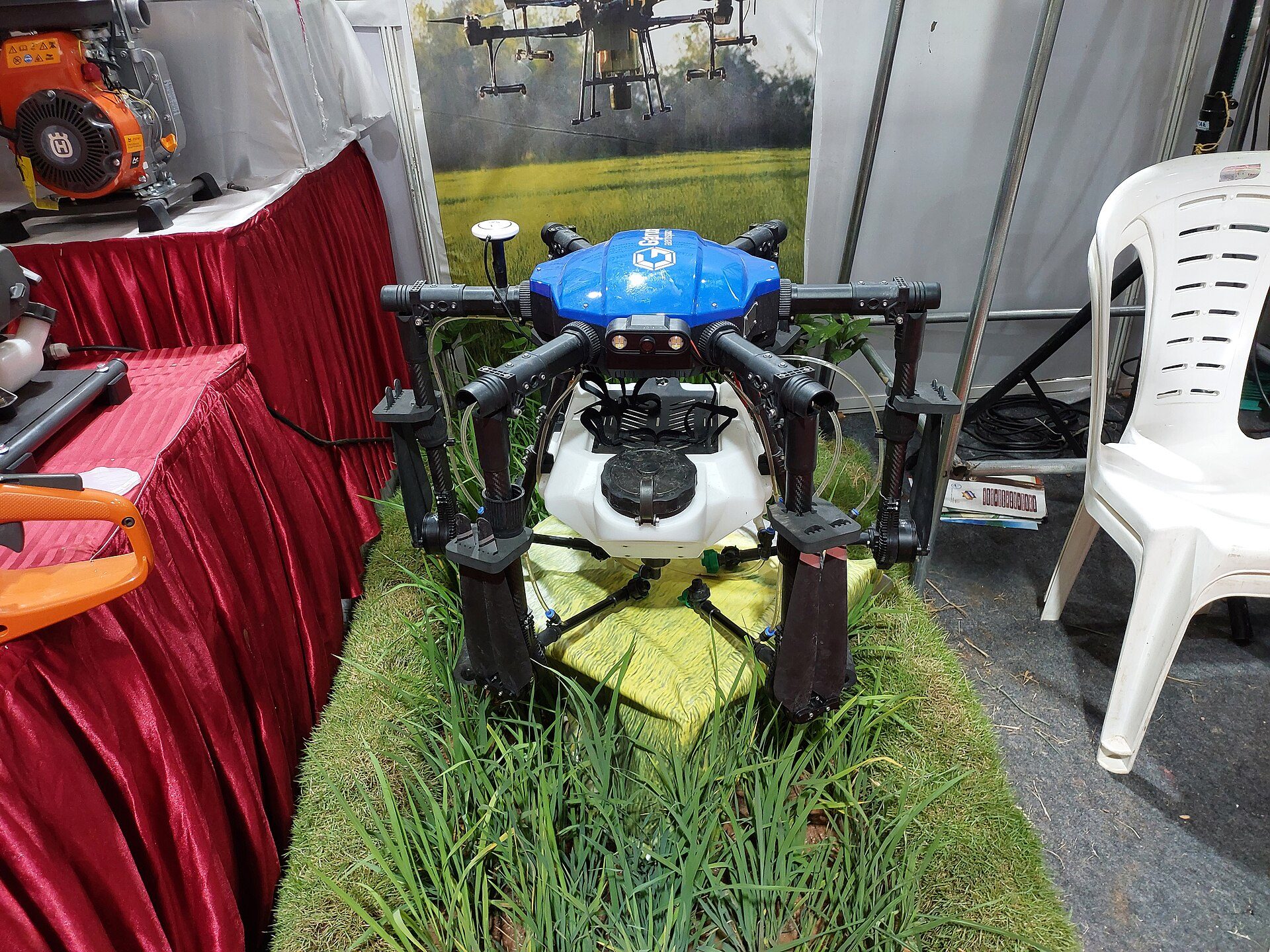
Photo: Vis M / Wikimedia Commons, CC BY-SA 4.0
Tank, strainer and level sensor
The tank sits right under the body so the weight stays centred (Figure 2). Common sizes run from about 10 to over 50 litres depending on the model (reference only, check the catalogue). A strainer at the filler catches powder residue and must be washed after every session, or it will block the pump and nozzles. A level sensor tells the drone how much liquid is left so it can return when empty.
Pump and flow meter
The pump pushes liquid to the nozzles and the flow meter measures litres per minute. The flight controller combines these with flight speed to hold the litres per hectare you set. A dirty or uncalibrated flow meter can report the right dose while the real output is too low or too high. Calibration is step 5 of the roadmap; for now, know where these parts are and what they do.
Pressure nozzles and centrifugal nozzles
Pressure nozzles force liquid through a small hole to make a fan-shaped jet; droplet size depends on nozzle type and pressure. Centrifugal nozzles use a fast-spinning disc: liquid flows onto it, is flung off the edge and breaks into droplets, and the faster it spins the finer the droplets (Figure 3). Centrifugal nozzles let you change droplet size in the app and clog less, but very fine droplets drift easily in wind. Many models can swap the tank for a spreader with a spinning disc for fertiliser or seed; ask the dealer whether one is included.
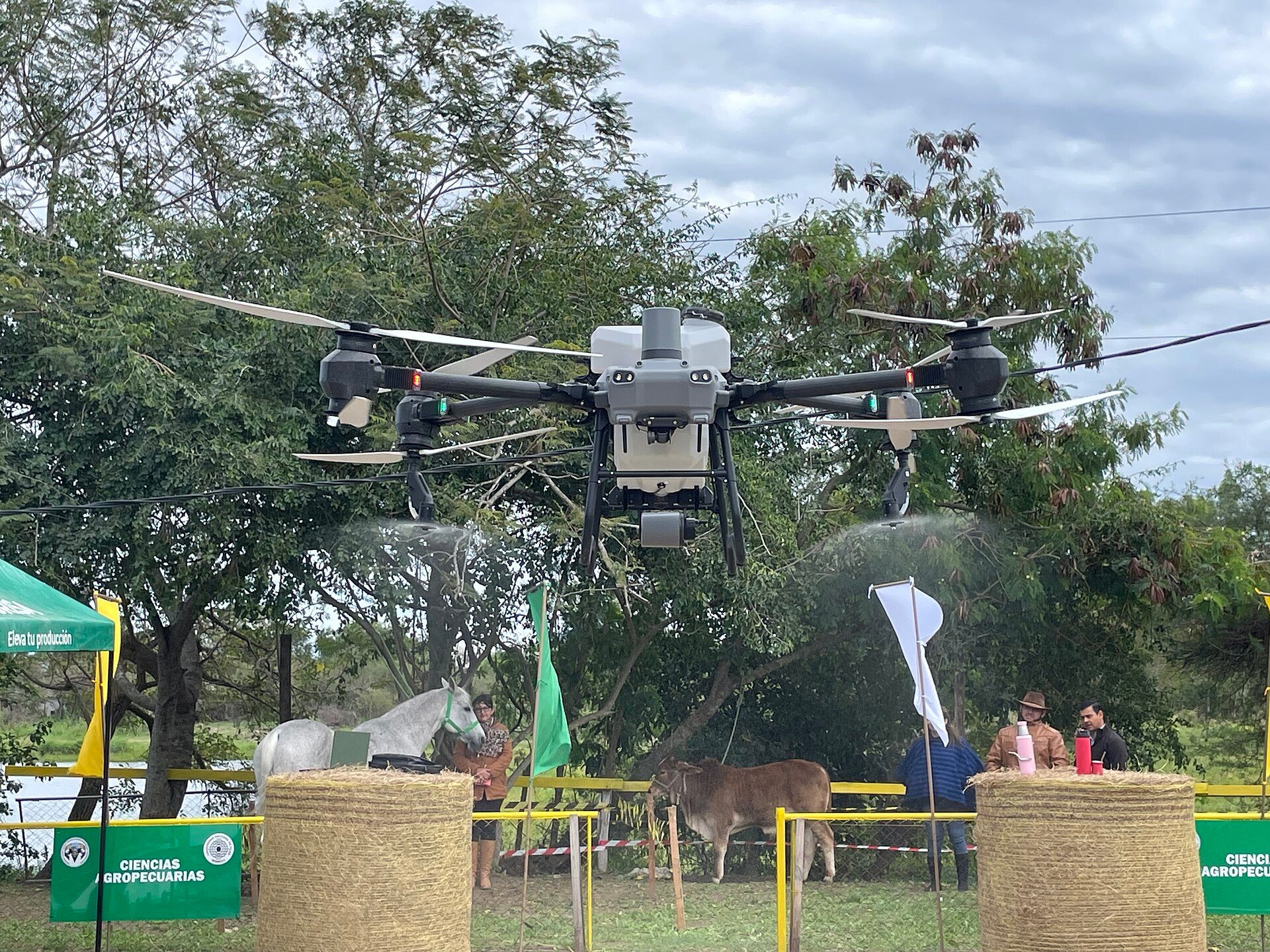
Photo: Blervis / Wikimedia Commons, CC0
Safety sensors: obstacle radar, terrain following and camera
A spray drone flies only a few metres above the crop, so it needs to know its distance to the ground and to obstacles ahead. Two kinds of radar do two different jobs.
Obstacle avoidance radar
Front and rear radar (often millimetre-wave radar, sometimes with stereo cameras) scans for tall trees, poles, houses and people on the flight path. When it detects something, the drone slows, stops or flies around it depending on the setting. Radar is not a perfect shield: thin power lines, clothes lines, dry branches and bamboo poles may not be detected in time, especially at speed.
Altitude radar and terrain following
Downward radar measures the distance to the canopy or ground, so the drone keeps a steady spray height over uneven bunds or hillside orchards. Mud or chemical on the radar face causes wrong readings, and the drone may fly too low or too high.
Camera and sensor limits
The front camera streams video to the controller, and lights show the drone's heading and status. Fog, dust, direct sun and rain all weaken the sensors. Surveying the field and marking obstacles before flying, as covered in the spray drone safety lesson, remains the main layer of protection.
GNSS and RTK positioning: why the drone flies in straight lines
Automatic spraying means following a map, row after row spaced exactly one swath width apart. For that, the drone must know its position very precisely.
Standard GNSS versus RTK
GNSS is the general name for satellite positioning systems such as GPS. A standard receiver is accurate to a few metres, not enough to spray close to field edges or repeat the same rows. RTK (real-time kinematic) adds a correction signal from a base station to cut the error to a few centimetres once it reaches a "fixed" status. The drone then sprays without overlaps or gaps, and today's map can be reused next season.
Portable base station and network RTK
One option is a portable base station on a tripod at the edge of the field. The other is network RTK: the equipment receives corrections over a mobile data connection, which needs a stable signal and usually a service subscription. In weak-signal areas, keep a portable base station as backup. Using radio transmitters and positioning services may have its own requirements in Vietnam; ask your dealer and the local authorities about current rules.
Handheld RTK for mapping field boundaries
Many spray teams also carry an RTK receiver on a survey pole (Figure 4). The surveyor walks the field, marking every corner and obstacle such as poles, tall trees and roofs to build the map for automatic flight. Detailed mapping is step 4 of the roadmap.
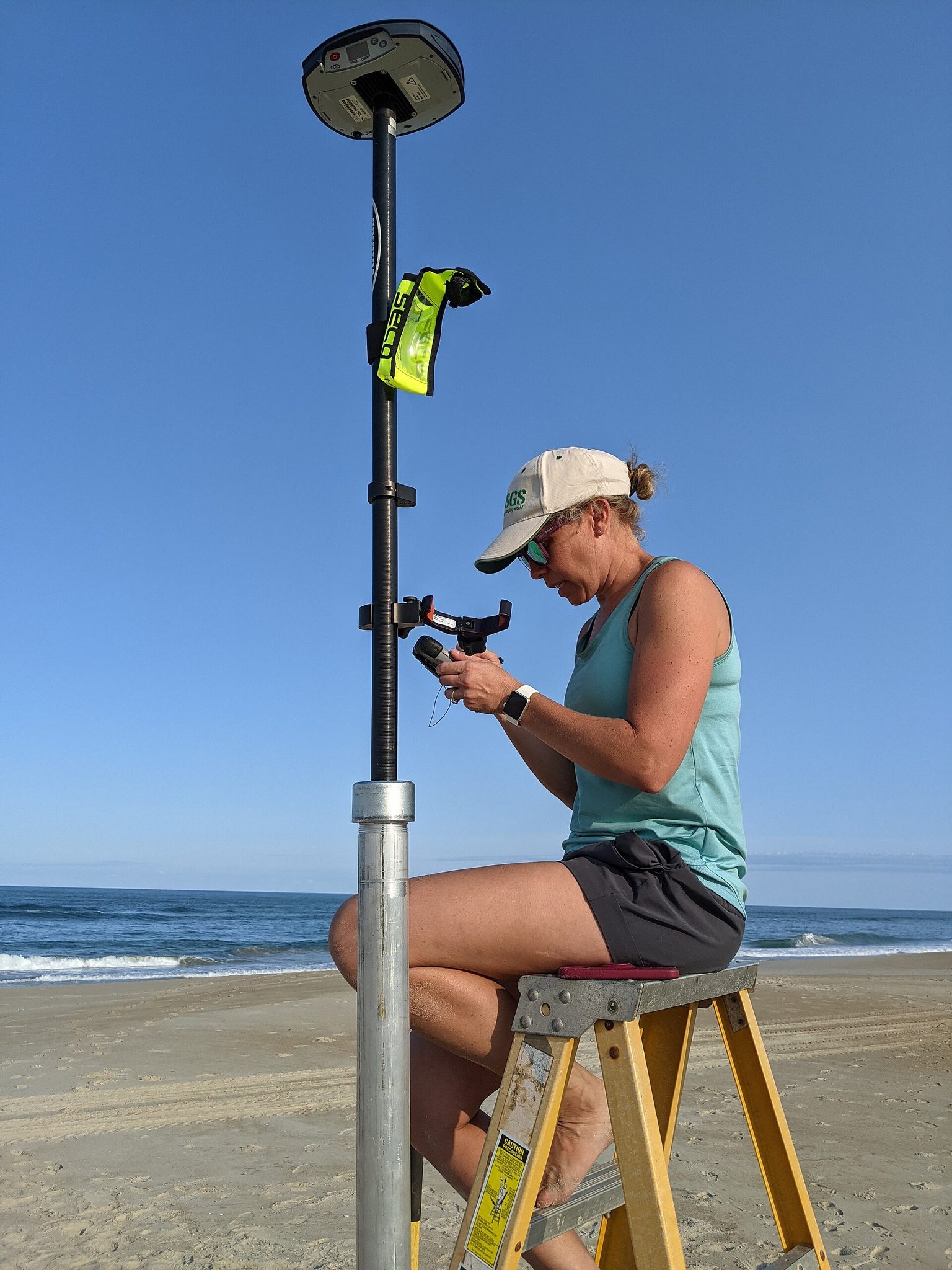
Photo: USGS Woods Hole Coastal and Marine Science Center / Wikimedia Commons, Public domain
Ground equipment: controller, batteries, charger and generator
In the field, the number of hectares you spray per day usually depends on batteries, charging and power supply, not on flight speed.
Remote controller with a screen
The controller usually has a large built-in screen running the manufacturer's app for mapping, spray settings, camera view and warnings. The range in the catalogue is for open conditions; trees, houses and hills cut it a lot. Always keep the drone in sight and carry a spare battery for the controller.
Large smart batteries
Spray drone batteries are high-voltage lithium packs with a management system that reports charge cycles, temperature and cell health. Each one weighs from a few kilograms to over 10 kg and costs tens of millions of VND (2026 reference, check with dealers). A full-tank flight usually lasts a few minutes to about ten minutes, so each drone needs 2 to 4 batteries in rotation. Retire any battery that is swollen, dented, dropped hard or soaked, and ask a technician.
Fast charger, generator and spare parts
Fast chargers draw a lot of power, and many have cooling so they can charge hot batteries. In the field, teams use a generator rated from a few kW to over 10 kW depending on the charger (reference only, check the manufacturer's requirement); an undersized generator charges slowly, throws errors or wears out quickly. If you charge from a house supply, ask an electrician whether the wiring can handle it, and never tap power illegally. Carry quick spares: propellers, nozzles, strainers, hoses. One missing spare propeller can cost a whole spraying session.
Safety warning: Spray drone propellers are long and spin very fast and can cause serious injury: only fit, remove or check propellers and motors with the battery unplugged. Large lithium batteries can catch fire or explode if punctured, swollen, overheated or short-circuited: charge on a non-flammable surface, away from fuel and chemicals, with someone watching and a suitable fire extinguisher, and never open or repair a battery yourself. Generators emit toxic carbon monoxide: run them in open air and switch off before refuelling. The spray system always carries pesticide residue: wear gloves, goggles and a mask when changing nozzles or washing strainers.
Choosing a spray drone by field size and terrain
In Vietnam, many spray teams use machines from brands such as DJI (the Agras line), XAG and others. This lesson does not recommend any brand; what matters more is matching the machine size to your area and terrain, and having a dealer with warranty service and spare parts near where you work.
Three groups by tank size
| Group | Tank size (reference) | Suits | Notes |
|---|---|---|---|
| Small, compact | About 10 to 20 litres | Scattered plots, fruit orchards, slopes, a few hectares a day | Easy to transport, light batteries, but many refills and battery swaps |
| Medium | About 25 to 40 litres | Teams spraying rice or maize for cooperatives, tens of hectares per round | Balance of output and cost; needs a big enough generator |
| Large | About 40 to 50 litres and up | Large flat fields, hundreds of hectares per season | Expensive and heavy drone and batteries, needs a small truck and strong power |
These ranges are 2026 references only; every model has its own specifications and they change each year, so always check the manufacturer's catalogue and the dealer's spec sheet. A full set of drone, batteries, charger and generator typically costs about 250 to 700 million VND (roughly 10,000 to 27,000 USD) depending on size and number of batteries (2026 reference, varies by dealer).
Questions to ask the dealer
- How many minutes does a full tank fly in a real field, not in ideal conditions?
- How long does one battery take to charge on a generator of how many kW? How many batteries for continuous flying?
- Does it have front and rear radar and terrain following? Can it use network RTK, or do I need a base station?
- What does the warranty cover and for how long, and how are batteries covered by cycle count? Where is the nearest repair shop and parts stock?
- Do you provide flight training and guidance on registering the drone and getting flight permission under current rules?
See a real machine before paying
Go to a field demonstration and talk to someone who has used the machine for at least one season (Figure 5). Listen to the motors, watch how even the spray curtain is, how the drone handles obstacles, and how long it takes from landing to take-off again. Registration and flight permission rules can change: ask the local authorities and read the current regulations, rather than trusting a dealer who says "this drone needs no paperwork".
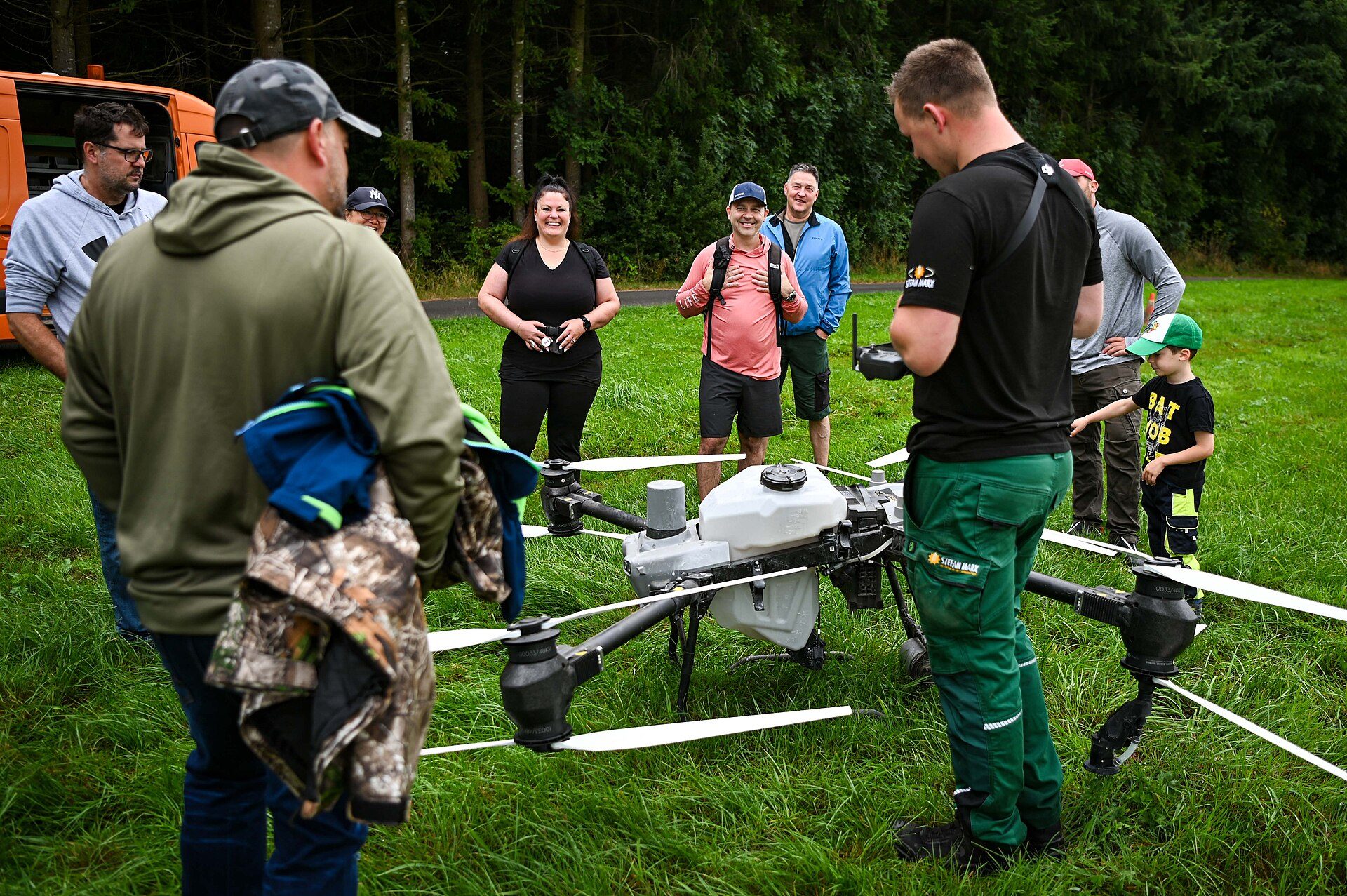
Photo: U.S. Air Force photo by Senior Airman Albert Morel / Wikimedia Commons, Public domain
Worked example: 40 hectares of rice, 30-litre or 40-litre tank?
Khoa, in Dong Thap province, plans to buy a drone with friends to spray for a farming cooperative, 40 hectares of rice per round. Assume a spray volume of 20 litres per hectare (an assumption for the example; in real work follow the product label). He compares a 30-litre drone with a 40-litre drone, each with 3 batteries and one battery per flight.
Step 1: total liquid and number of flights
Total liquid: 40 ha x 20 L/ha = 800 litres.
- 30-litre drone: each flight covers 30 / 20 = 1.5 ha. Flights: 800 / 30 = 26.7, rounded up to 27 (26 full flights of 780 litres + 1 flight of 20 litres = 800 litres).
- 40-litre drone: each flight covers 40 / 20 = 2 ha. Flights: 800 / 40 = 20 full flights.
Step 2: time for the whole round
According to current users, the 30-litre drone sprays for about 7 minutes per flight and the 40-litre one for about 9 minutes; both need about 4 more minutes to return, swap the battery and refill.
| Item | 30-litre drone | 40-litre drone |
|---|---|---|
| Number of flights | 27 | 20 |
| Time per flight | 7 + 4 = 11 minutes | 9 + 4 = 13 minutes |
| Total time | 27 x 11 = 297 minutes (almost 5 hours) | 20 x 13 = 260 minutes (4 hours 20 minutes) |
| Battery uses (3 batteries) | 27 uses, 9 per battery | 20 uses, 6 to 7 per battery |
| Rest time per battery to cool and charge | 2 x 11 = 22 minutes | 2 x 13 = 26 minutes |
Step 3: can charging keep up?
With 3 batteries in rotation, while one flies the other two are on the ground: one charging, one full and waiting. Each battery therefore has two flights' worth of time to cool and charge: 22 minutes for the 30-litre drone, 26 minutes for the 40-litre drone. If the charger needs 25 minutes per battery, the 30-litre drone waits 3 minutes every cycle, while the 40-litre drone keeps up. To avoid waiting, the 30-litre drone needs a fourth battery or faster charging; real charging times must come from the catalogue and the dealer.
Step 4: conclusion
Both drones finish 40 hectares in one good day, 297 - 260 = 37 minutes apart. On flat delta fields with straight bunds, the 40-litre drone is slightly faster. If the cooperative has many small plots, trees and poles, or Khoa wants to take orchard work too, the 30-litre drone is lighter, easier to transport and easier to manoeuvre. Profit and depreciation are covered in the lesson Learning to fly agricultural drones: training time, papers, income.
Common beginner mistakes with the machine
Propellers on the wrong motors or arms not locked
The drone lurches or flips as it lifts off, because clockwise and counter-clockwise propellers were swapped or a lock was left open. Fix: colour-mark the spin direction on propellers and motors, and walk around checking every arm before each session.
Trusting the radar completely
The drone hits a power line or branch with no radar warning, because the object was too thin, the drone too fast or the radar dirty. Fix: survey the field, set no-fly zones around power lines and clean the radar often.
A big drone with a weak generator
Batteries cannot charge in time and the team waits in the midday sun, because only tank size was considered. Fix: count battery uses as in the example, ask for the minimum generator rating, and buy extra batteries if needed.
Frequently asked questions
What are the main parts of a spray drone?
Frame and arms, motors with speed controllers, propellers, battery, tank, pump and flow meter, nozzles, obstacle radar, altitude radar, GNSS/RTK receiver, flight controller and remote controller; plus charger, generator and spare parts.
How do centrifugal nozzles differ from pressure nozzles?
Pressure nozzles force liquid through a small hole; centrifugal nozzles use a spinning disc to fling liquid into droplets, with droplet size set by disc speed. Centrifugal nozzles clog less and are easier to adjust, but very fine droplets drift in wind.
Does a spray drone need RTK?
Not every drone requires it, but RTK gives centimetre-level automatic flight, spraying close to edges and reusable maps. Service teams spraying many fields almost always use it.
What tank size should I buy?
Small plots and hillside orchards suit about 10 to 20 litres; teams spraying tens of hectares of rice per round suit about 25 to 40 litres; only large fields need bigger machines. These are reference ranges: check the catalogue and count flights and battery uses as in the example.
Practice and self-assessment
- At a dealer or demonstration, photograph a switched-off spray drone and label its 12 parts.
- Read one model's catalogue and note: tank size, nozzle type, radar, RTK, charging time and required generator rating.
- Redo the example for 60 ha at 15 L/ha with a 30-litre drone, 3 batteries, 11-minute flights and 25-minute charging.
Self-assessment criteria
- Pass: you name at least 10 of 12 parts with their functions, and tell centrifugal from pressure nozzles and obstacle radar from altitude radar.
- Pass: flights, total time and battery uses add up, and you can show when charging cannot keep up.
- Not yet: you touch propellers with the battery plugged in, or choose a drone by tank size alone without counting charging and power supply.
Once you know the machine, move on to the next roadmap step: Basic manual flight & emergencies, where you practise take-off and landing, square and circle patterns and altitude hold on an open field with no chemicals, and handling signal loss, low battery and strong wind.
Keep learning agricultural drone piloting: after drone anatomy come manual flight, field mapping and automatic routes, mixing, batteries and maintenance, then spraying real fields. See the 8-step agricultural drone pilot roadmap.