Safe pesticide spraying in a fruit orchard comes down to three things you must never skip: read the label before mixing (rate, toxicity class, withholding period), wear full protective equipment while mixing and spraying, and dispose of containers in the right place afterwards. Alongside that, orchard workers must keep grafting knives and pruners sharp and clean, and wear a safety harness when climbing tall trees such as durian and jackfruit. Most accidents in this trade do not come from hard tasks but from habits: spraying into the wind, cutting towards your own hand, climbing a tree after rain. This is the first lesson of the roadmap, with a checklist you can use from your very first day in the orchard.
By the end of this lesson, you will be able to:
- Read a pesticide label: active ingredient, toxicity class, mixing rate and withholding period.
- Choose and wear the right protective gear for mixing and spraying, and give first aid for suspected poisoning.
- Sharpen, disinfect and hold grafting knives and pruners correctly so you do not cut yourself or spread disease between trees.
- Climb tall trees safely with a ladder, a harness and a helper on the ground.
- Work out the amount of pesticide for one spray round and the earliest harvest date, with figures that add up.
Learning to grow and graft fruit trees properly? Tool, climbing and pesticide safety is step 1 of the 8-step roadmap, before soil and climate, grafting, fertilising, pruning and flower induction. See the 8-step fruit orchard grower roadmap.
The main hazards for fruit orchard workers
Orchard work looks gentle, but four groups of hazards come up every day. You need to know the hazards before you know what to protect against.
Chemicals: pesticides and fertilisers
Insecticides, fungicides and herbicides enter the body through the skin, through the lungs when you breathe spray mist, and through the mouth when you eat, drink or smoke with unwashed hands. Mixing the concentrate is the most dangerous moment because you handle undiluted product. Poisoning can be acute during a spray round or build up silently after years of spraying without protection.
Sharp blades: grafting knives, pruners, saws
A grafting knife must be very sharp to cut a flat graft surface, so one slip means a deep cut. Pruners pinching fingers and chainsaw kickback are common accidents during post-harvest pruning.
Falls and falling objects
Mature durian, jackfruit and mango trees reach well over ten metres. Falls from high branches and ladders sliding on soft ground are the most serious accidents in the trade. In durian orchards at fruiting time, falling fruit can hit your head, so wear a hard hat under the canopy.
Heat, insects and power lines
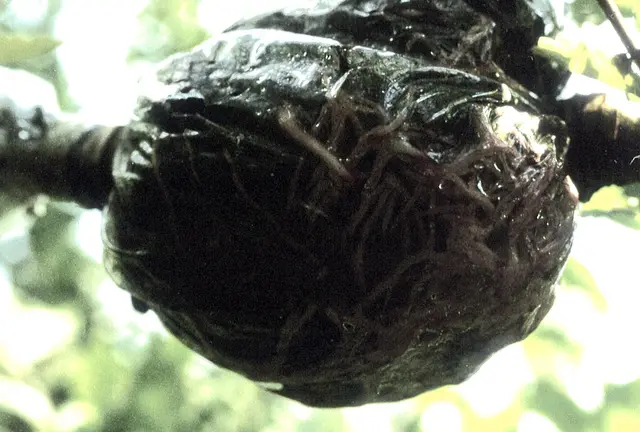
Working at midday easily leads to heatstroke, especially in sealed protective clothing. Weaver ants and wasps nest in canopies, snakes hide in undergrowth. Power lines crossing an orchard are a danger when using poles and aluminium ladders.
Reading the pesticide label before mixing
The label is a legally binding set of instructions. Every number for rate, withholding period and protective gear comes from the label, not from word of mouth or "double it to be sure".
Five things to find on the label
- Active ingredient and concentration: trade names differ but may share an active ingredient. Note the active ingredient so you can rotate products and avoid resistance.
- Registered crops and targets: a product may only be used on the crops and pests listed on the label.
- Rate and mixing instructions: usually in ml or grams per tank or per hectare, with the spray volume.
- Withholding period: the minimum number of days from the last spray until harvest is allowed.
- Toxicity class and warnings: the colour band at the bottom of the label and the hazard symbols. Under the classification used in Vietnam, red is the most toxic, followed by yellow, blue and green. Also read the protective gear and first aid sections printed on the label.
Use only approved products
Vietnam has a list of pesticides approved for use and a list of banned ones, issued and updated regularly by the agricultural authority. Buy only from licensed shops with clear Vietnamese labels; never buy unlabelled products, products labelled only in a foreign language, or cheap products of unknown origin. This lesson does not list document numbers; when needed, ask the local crop production and plant protection station or extension officer about the current list.
Why the withholding period matters
The withholding period protects the people who eat the fruit and protects the orchard's market. Fruit picked before the period ends may carry residues above the permitted limit; an export shipment found with residues can be returned and affect the whole growing area. Record the spray date, product and rate in the orchard log every time you spray.
Protective gear for mixing and spraying
Protective gear only works if you wear the full set from the moment you open the bottle, not just while spraying. Spraying fruit trees usually means pointing the lance up into the canopy, so mist falls back onto you and full cover matters even more (Figure 1).
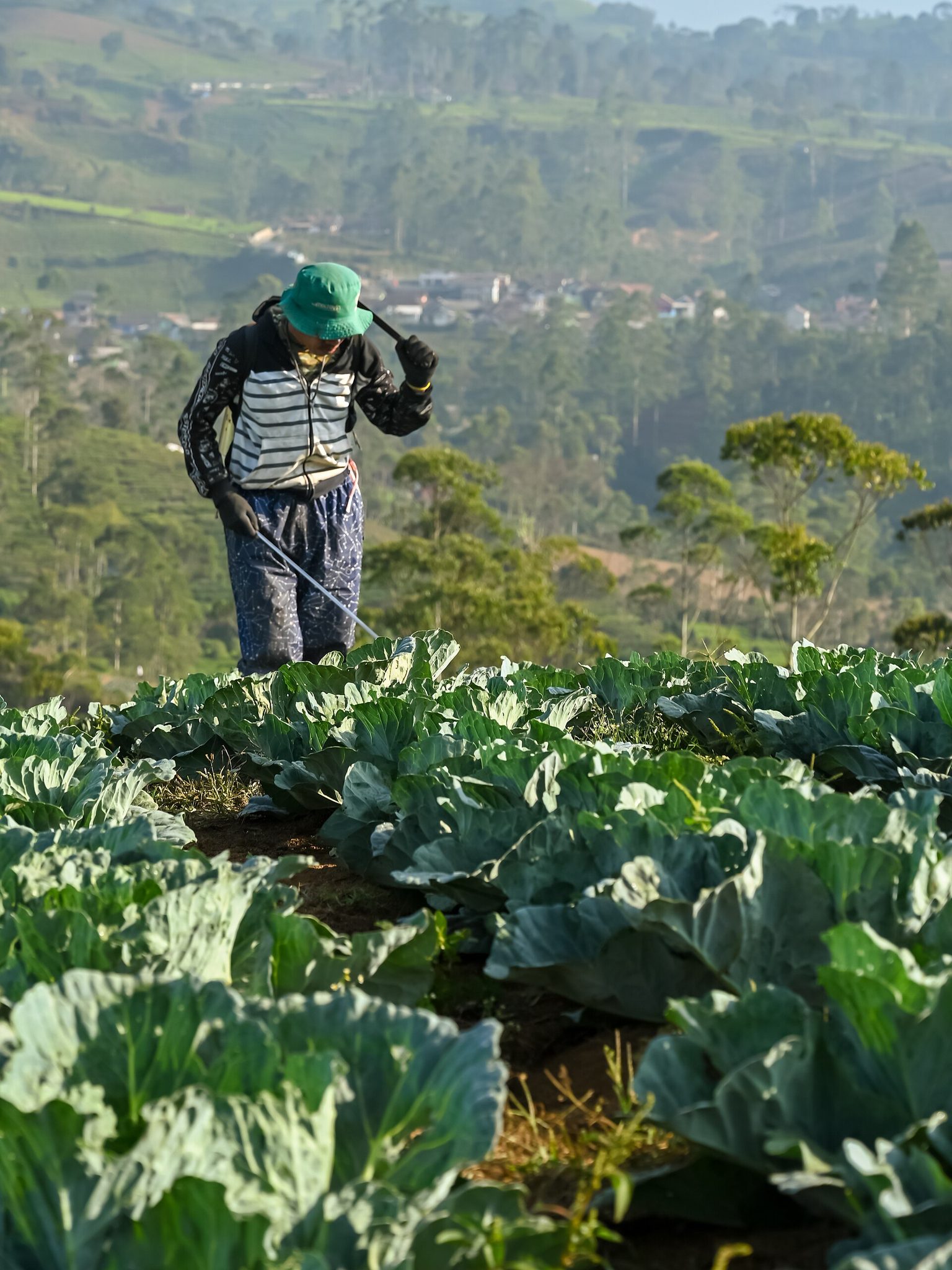
Photo: Doyanmoto / Wikimedia Commons, CC BY-SA 4.0
The minimum protective kit
| Item | Requirement | Why |
|---|---|---|
| Respirator | Mask with chemical vapour cartridges, not a cloth mask | Cloth masks do not stop pesticide vapour |
| Safety goggles | Sealed at the sides | Splashes during mixing and spray falling from the canopy |
| Chemical-resistant gloves | Thick rubber or nitrile, long cuff | Hands absorb the most product during mixing |
| Long waterproof clothing | Long sleeves and trousers, ideally a raincoat or waterproof suit | Mist settles on shoulders and back |
| Rubber boots and hat | Trouser legs over the boots | Runoff does not get inside the boots |
Mixing and spraying correctly
- Mix in a ventilated place away from wells, fish ponds and the kitchen; measure with dedicated tools, never kitchen cups or spoons.
- Put some water in the tank, add the product, then top up to volume and stir well.
- Spray early in the morning or late afternoon, never in strong wind, harsh sun or before rain.
- Move so the wind carries mist away from you, never spray into the wind, and never blow into a blocked nozzle.
- Do not eat, drink or smoke while mixing or spraying; rest upwind, remove gloves and wash hands before drinking.
- Put up a sign at the orchard entrance so nobody comes in to pick fruit or cut grass.
If the orchard uses spray drones, the flight and protection rules are quite different from backpack sprayers; see spray drone safety from the agricultural drone pilot track.
After spraying and container disposal
Triple-rinse empty bottles with clean water and pour the rinse water into the sprayer to use it up. Put empty bottles and sachets in the pesticide container pit or bin in the field, or a local collection point; never burn them, bury them near water, throw them into canals or reuse them for water or fish sauce. Wash the sprayer away from water sources. Shower with soap and wash protective clothing separately from family laundry.
Safety warning: Pesticides are poisons. Always read the label before mixing and wear a chemical respirator, goggles, gloves, waterproof clothing and boots; do not spray when tired, hungry or with open cuts on your hands. Pregnant or breastfeeding women and children must not mix or spray and must not enter a freshly sprayed orchard. Suspected poisoning (dizziness, headache, nausea, sweating, drooling, difficulty breathing, seizures): move the person out of the spray area, remove contaminated clothing, wash skin with soap and plenty of clean water; for splashes in the eye, rinse continuously with clean water for at least 15 minutes; call 115 (Vietnam's ambulance number) or go straight to a health facility, taking the bottle or label with you. Do not induce vomiting unless a health worker tells you to.
Grafting knives, pruners and saws: sharpening, disinfecting, handling
A sharp tool is safer than a blunt one: a blunt blade needs more force, slips more easily and leaves a crushed cut that heals slowly and invites disease.
Grafting knives
A grafting knife has a thin blade bevelled on one side to cut a flat graft surface; many have a tip for lifting bark (Figure 2). Sharpen on a wet stone at a steady angle, bevel side first, then lightly stroke the flat side to remove the burr. When cutting, hold the branch behind the blade and pull the blade away from your body; never cut towards your fingers or thigh. Fold the blade or sheath it when walking or climbing.
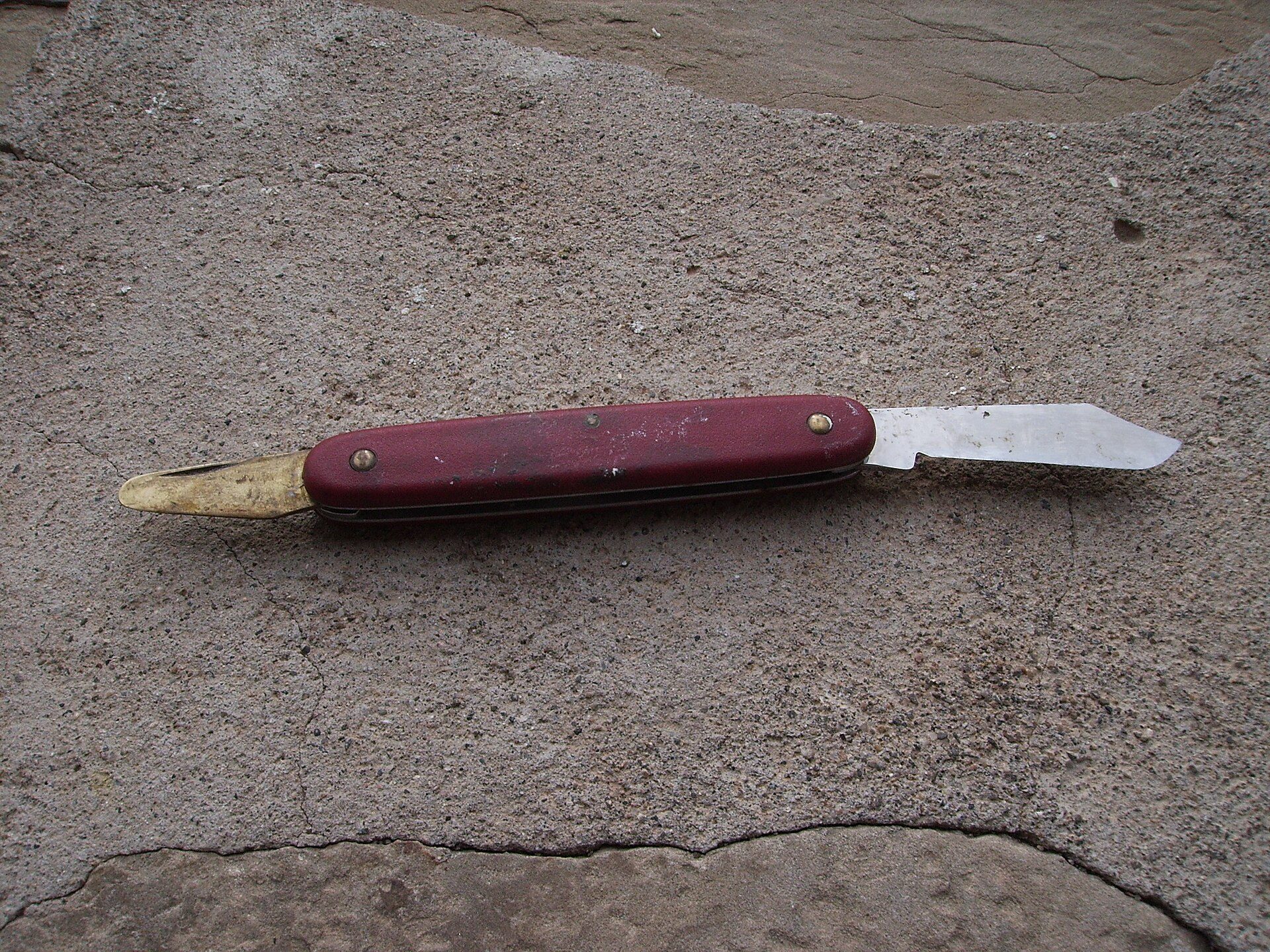
Photo: Victor M. Vicente Selvas / Wikimedia Commons, Public domain
Pruners and saws
Bypass pruners, with two blades sliding past each other, give a clean cut on live wood (Figure 3). Each pruner has a maximum branch size; for thicker branches use loppers or a hand saw rather than twisting the pruner and tearing bark. Wipe off sap and oil the blades after every session, and lock the pruner when not in use. Chainsaws are only for trained people: two hands on the saw, and no chainsaw use on a ladder or in a tree without climbing training; for avoiding kickback, see tree pruning safety.
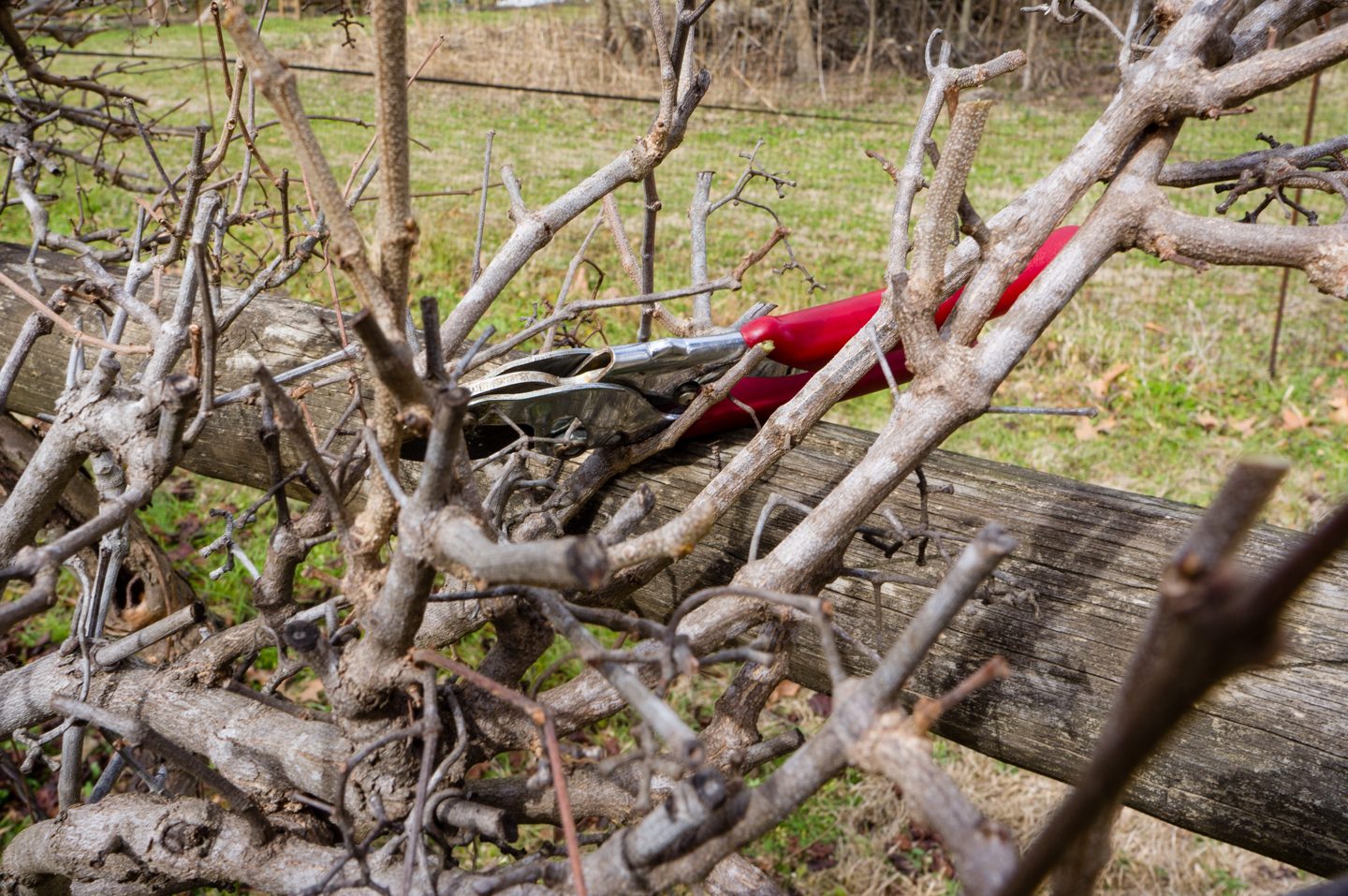
Photo: Joe Wise / Wikimedia Commons, CC BY-SA 3.0
Disinfecting tools between trees
Disease-causing fungi and bacteria can travel on blades from a sick tree to a healthy one. When cutting diseased wood, moving between mother trees or between orchard blocks, wipe the blade with 70% alcohol and let it dry for a few seconds. At the end of the day, clean off sap, dry and oil the blades against rust. You will learn bark ringing and wrapping for propagation in how to air layer fruit trees.
Climbing tall trees safely
Durian, jackfruit and mango workers often climb to prune, tie fruit, hand-pollinate or harvest. The first rule: if a task can be done from the ground with long-handled pruners or a pole, do not climb.
Ladders and footing
Use an A-frame or tripod ladder for low canopies, on firm ground, with someone holding it. A ladder leaning against a trunk must be tied to the trunk at the top. Never stand on the top step or lean out beyond the ladder. Never step onto small, dead or cracked branches, and do not climb after rain when bark is slippery.
Safety harness
When working above about 2 m, wear a full-body harness clipped to a main branch or the trunk, strong enough and above your head. Professional tree climbers also use climbing ropes, helmets and tool bags hung from the harness (Figure 4). Tools are hauled up on a rope, not carried in your hand while climbing. Beginners must be taught in person and practise at low height first.
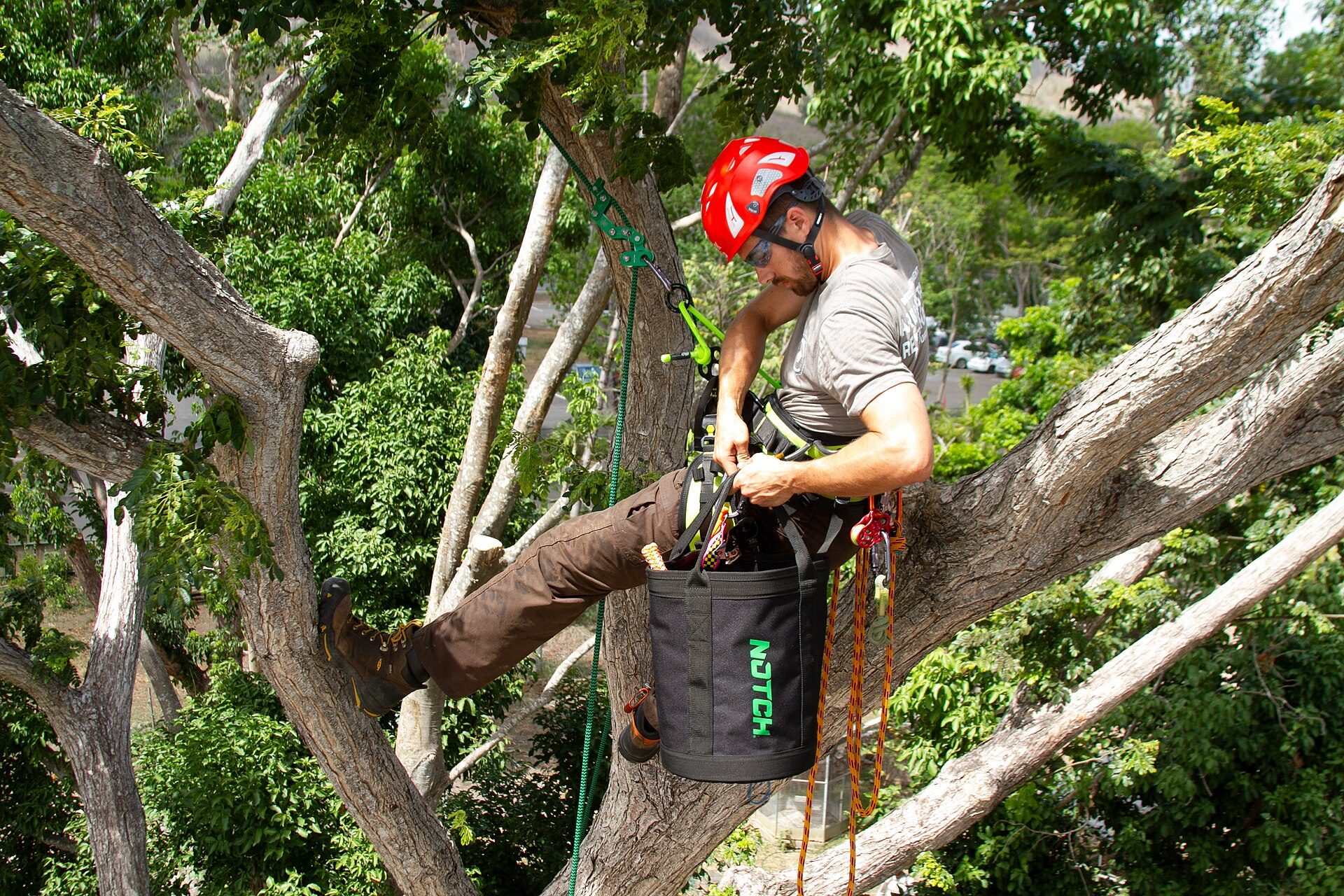
Photo: TreeMinion15 / Wikimedia Commons, CC BY-SA 4.0
When not to climb
- Rain, strong wind or lightning.
- Branches near power lines: call the power company or professionals, do not cut them yourself.
- Wasp or fire ant nests in the canopy: deal with the nest first or skip that tree.
- You feel tired or dizzy, have just sprayed, or are working alone with nobody on the ground.
Worked example: one spray round for 128 pomelo trees
Scenario: an orchard of 128 green-skin pomelo trees carrying fruit needs one insecticide spray. The label figures below are a hypothetical example for practice; in real work, use the numbers on the label of the product you buy.
Step 1: water and product
- Spray volume estimated from canopy size: 2.5 litres per tree. Total: 128 × 2.5 = 320 litres.
- 16-litre backpack sprayer: 320 ÷ 16 = 20 tanks.
- The (hypothetical) label gives 25 ml per 16-litre tank: 20 × 25 = 500 ml, that is 2 bottles of 250 ml.
Step 2: working time and harvest date
Each tank, including mixing, spraying and walking, takes about 15 minutes: 20 × 15 = 300 minutes, or 5 hours. Do not spray 5 hours straight at midday; split it into 2 sessions, 6:00–8:30 in the morning (10 tanks) and 15:30–18:00 in the afternoon (10 tanks). The label gives a 14-day withholding period: spray on 3 June and the earliest picking date is 17 June. Write both dates in the orchard log.
Step 3: personal protective gear cost (2026 reference prices, vary by region)
| Item | Quantity × unit price | Amount |
|---|---|---|
| Half-face respirator with cartridges | 1 × 350,000 VND | 350,000 VND |
| Replacement cartridges | 2 pairs × 120,000 VND | 240,000 VND |
| Sealed safety goggles | 1 × 60,000 VND | 60,000 VND |
| Long-cuff nitrile gloves | 3 pairs × 40,000 VND | 120,000 VND |
| Waterproof suit | 1 × 250,000 VND | 250,000 VND |
| Rubber boots | 1 pair × 120,000 VND | 120,000 VND |
| Total | 1,140,000 VND | |
Check: 350,000 + 240,000 + 60,000 + 120,000 + 250,000 + 120,000 = 1,140,000 VND (about 45 USD). Compared with an orchard worker's daily wage of about 250,000–450,000 VND (2026 reference, varies by region), the kit costs a few days' pay and lasts for months; cartridges must be replaced according to the maker's instructions.
Common beginner mistakes
Raising the rate "to be sure"
Sign: mixing stronger than the label, or several products in one tank. Cause: fear the pests will survive. Result: leaf burn, young fruit drop, high residues, faster resistance. Fix: mix at the label rate, rotate active ingredients, and only tank-mix when the label allows.
Picking fruit right after spraying
Sign: picking a few days early because prices are good. Cause: no log, forgotten spray date. Fix: write the spray date and the allowed picking date in the log and post a board at the orchard entrance.
Climbing without a harness because "I know this tree"
Sign: climbing a tall durian tree holding on by hand. Cause: overconfidence. Fix: always wear a harness, clip to a main branch before working, and have someone on the ground.
One knife for the whole orchard, never wiped
Sign: disease spreading along the rows just pruned or grafted. Cause: blades not disinfected. Fix: carry a bottle of 70% alcohol and wipe the blade when changing mother trees and after cutting diseased wood.
Frequently asked questions
What is a pesticide withholding period?
It is the minimum number of days from the last spray until harvest is allowed, printed on the label of each product. Each product has its own period; if you use several, go by the longest.
What protective gear do you need to spray pesticides?
At minimum a respirator with chemical cartridges, sealed goggles, chemical-resistant gloves, long waterproof clothing, boots and a hat. Wear them from mixing until the sprayer has been washed.
How should empty pesticide containers be disposed of?
Triple-rinse, pour the rinse water into the sprayer, then put the container in the pesticide container pit or bin or a local collection point. Never burn, throw into canals or reuse them.
What do you disinfect a grafting knife with?
Wipe the blade with 70% alcohol, let it dry for a few seconds and carry on. Do it when changing mother trees, after cutting diseased wood and at the end of each session.
Checklist and self-assessment
Checklist before every orchard session
- Label read: rate, toxicity class, withholding period; recorded in the log.
- Full protective kit, cartridges in date, sprayer not leaking.
- Knives and pruners sharpened, a bottle of 70% alcohol on hand; chainsaws only for trained people.
- Ladder, harness and helmet checked for fraying and cracks; someone on the ground when climbing.
- Drinking water, a shady rest spot, the 115 number and the address of the nearest clinic.
Practice tasks
- Pick 2 pesticide bottles at a farm supply shop and copy the 5 label items listed above.
- Work out water, tanks, product and picking date for a 90-tree mango orchard at 3 litres per tree, following the example.
- Sharpen a grafting knife until it cuts a flat, smooth scion surface in a single stroke.
Self-assessment criteria
- Pass: the calculation adds up: 90 × 3 = 270 litres, with tanks and product worked out from your chosen label.
- Pass: you put on all 5 items of protective gear in under 5 minutes, trouser legs over the boots.
- Not yet: you cannot find the withholding period on the label, or you cut towards your hand.
With safety in hand, move on to the next step of the roadmap: Soil, climate & orchard layout, where you learn to choose crops by region, test soil pH, build raised beds and drainage ditches and plan planting density.
Keep learning fruit tree growing: after safety come soil and orchard layout, budding, grafting and air layering, planting, watering and fertilising, pruning and flower induction. See the 8-step fruit orchard grower roadmap.