Lockout-tagout (LOTO) is the mandatory sequence before you touch an electrical panel or motor: identify every energy source, notify the people affected, stop the machine, isolate the power, lock it with your personal padlock, attach a tag, release stored energy and test for absence of voltage with an instrument you have checked. In factories, most electrical accidents among maintenance staff do not happen because people do not understand electricity, but because a step was skipped: trusting someone who said "it is off", isolating only the control circuit, forgetting a second supply. This is the first lesson of the industrial electrician path, written from the point of view of distribution boards, motor control panels and three-phase motors, with a worked example of replacing a pump contactor from start to finish.
By the end of this lesson, you will be able to:
- Recognise the two main hazards inside industrial panels: electric shock and arc flash.
- Carry out an 8-step LOTO procedure on a motor control panel and motor, including second supplies.
- Test for absence of voltage correctly with the test, measure, re-test method on every phase pair.
- Choose and inspect insulating gloves, insulating mats and protective equipment before work.
- Give first aid to an electric shock victim in the right order and report the incident.
Want to become an industrial electrician the right way? Electrical safety and lockout-tagout are step 1, before electrical drawings, motors, VFDs and PLCs. See the 8-step industrial electrician roadmap to learn in the right order.
Shock and arc flash: the two hazards inside an industrial panel
Industrial power in Vietnam is usually three-phase 380/400 V at 50 Hz, with control circuits at 220 V or 24 V. Fault currents at a factory distribution board can reach tens of thousands of amps, a completely different world from household wiring.
Electric shock
Shock happens when your body becomes part of the circuit: a hand on a phase and feet on the ground, or two hands on two phases. Current through the heart can cause ventricular fibrillation and cardiac arrest within moments. Phase-to-phase 380 V is more dangerous than 220 V, and damp factories, wet concrete floors and sweaty hands all lower the body's resistance.
Arc flash
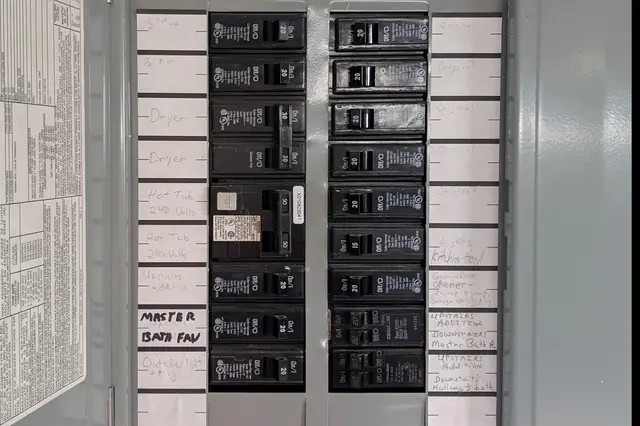
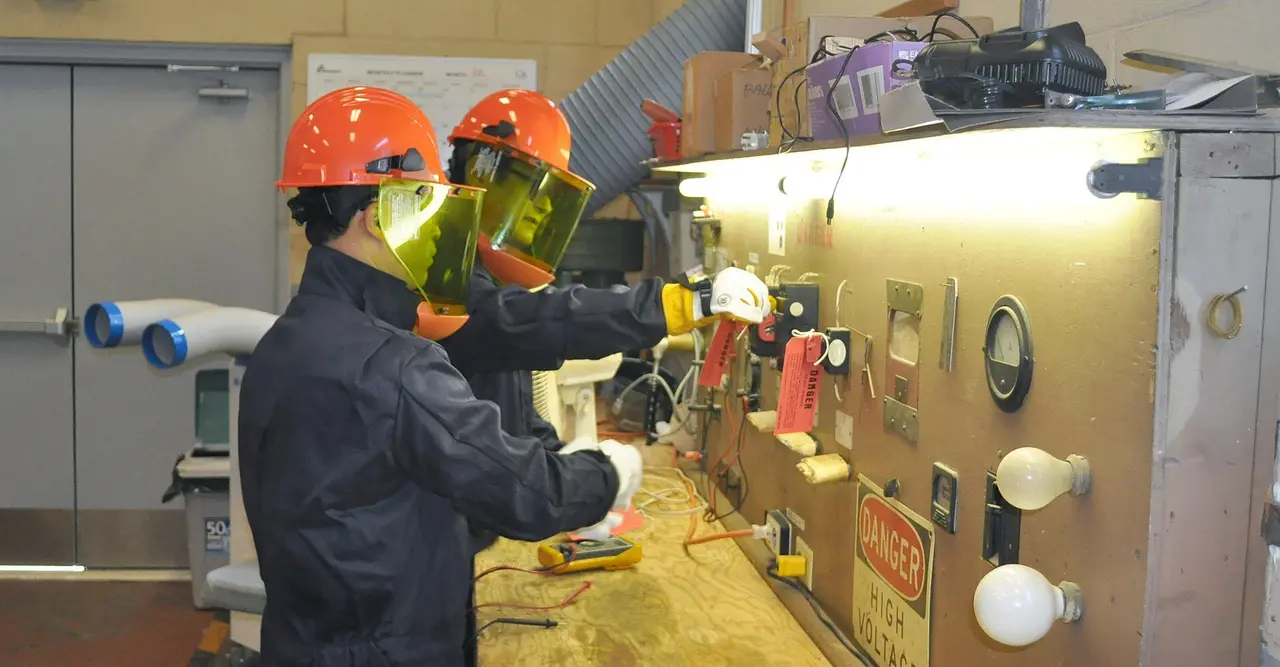
An arc flash is an extremely powerful electrical discharge through the air during a short circuit, for example a screwdriver slipping across two busbars, test leads plugged into the wrong socket, or switching a faulty device. The arc is extremely hot and comes with a blast, molten metal spray and a light that damages the eyes. Someone standing in front of the panel can be badly burned without touching anything (see Figure 1).
Energy sources beginners tend to forget
- Second supplies: control circuits fed from another panel, motor anti-condensation heaters, UPS units, standby generators, power factor correction banks.
- Capacitors: DC bus capacitors in VFDs and power factor capacitors keep dangerous voltage for minutes after isolation.
- Mechanical energy: motors, fans and pumps coasting; a fan turned backwards by the wind can generate voltage.
- Air, hydraulics and gravity: cylinders, valves and suspended loads can move when you disconnect a sensor or solenoid valve.
What is LOTO and when is it mandatory?
LOTO stands for lockout-tagout: locking the isolating device in the off position with a personal padlock (lockout) and attaching a tag that says who is working and why (tagout). The goal is that nobody can re-energise the equipment while you are working, including people who do not know you are there.
When you must apply LOTO
- Repairing or replacing devices in a panel: contactors, overload relays, breakers, terminals.
- Connecting or removing motors, opening terminal boxes, changing bearings, aligning couplings.
- Cleaning, re-torquing lugs inside a panel, insulation resistance testing.
- Putting hands or your body into a danger zone: conveyors, presses, fan blades.
Everyday operation such as pressing start and stop or reading meters does not need LOTO. Some measurements and fault finding can only be done live; that work is for assigned, fully equipped people following the factory's own procedure, never for beginners.
The LOTO kit
Each electrician has a personal padlock with a single key, marked with a name or number. Factories usually keep a LOTO station near the switchrooms (Figure 2).
| Item | Used to | Notes |
|---|---|---|
| Personal padlock | Lock the isolating device | One person, one lock, one key; never lend it |
| Lockout hasp | Let several people lock one point | The isolation opens only when the last lock is removed |
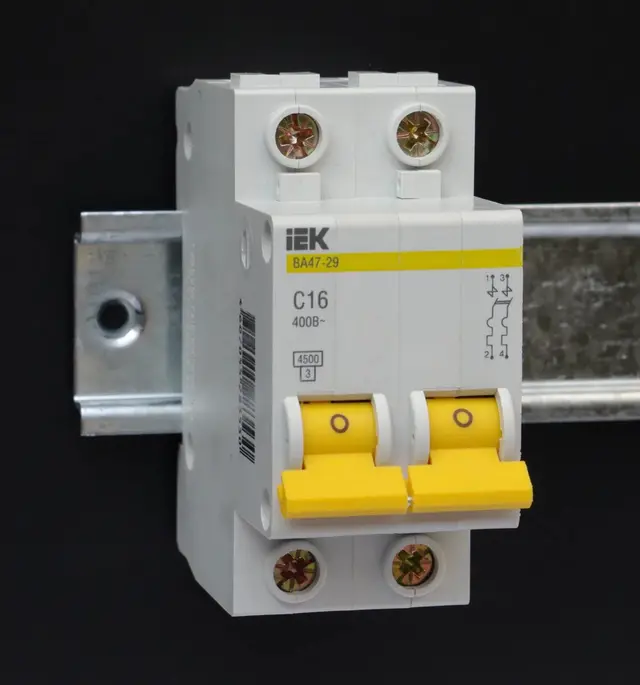
| Breaker and switch lockouts | Hold an MCB or MCCB in the OFF position | Pick the size that fits the device's toggle |
| Tags | Show name, department, phone, date and time, reason | A tag never replaces a lock |
| Group lock box | Many isolation points and many workers | Isolation keys go in the box and each worker locks the box |
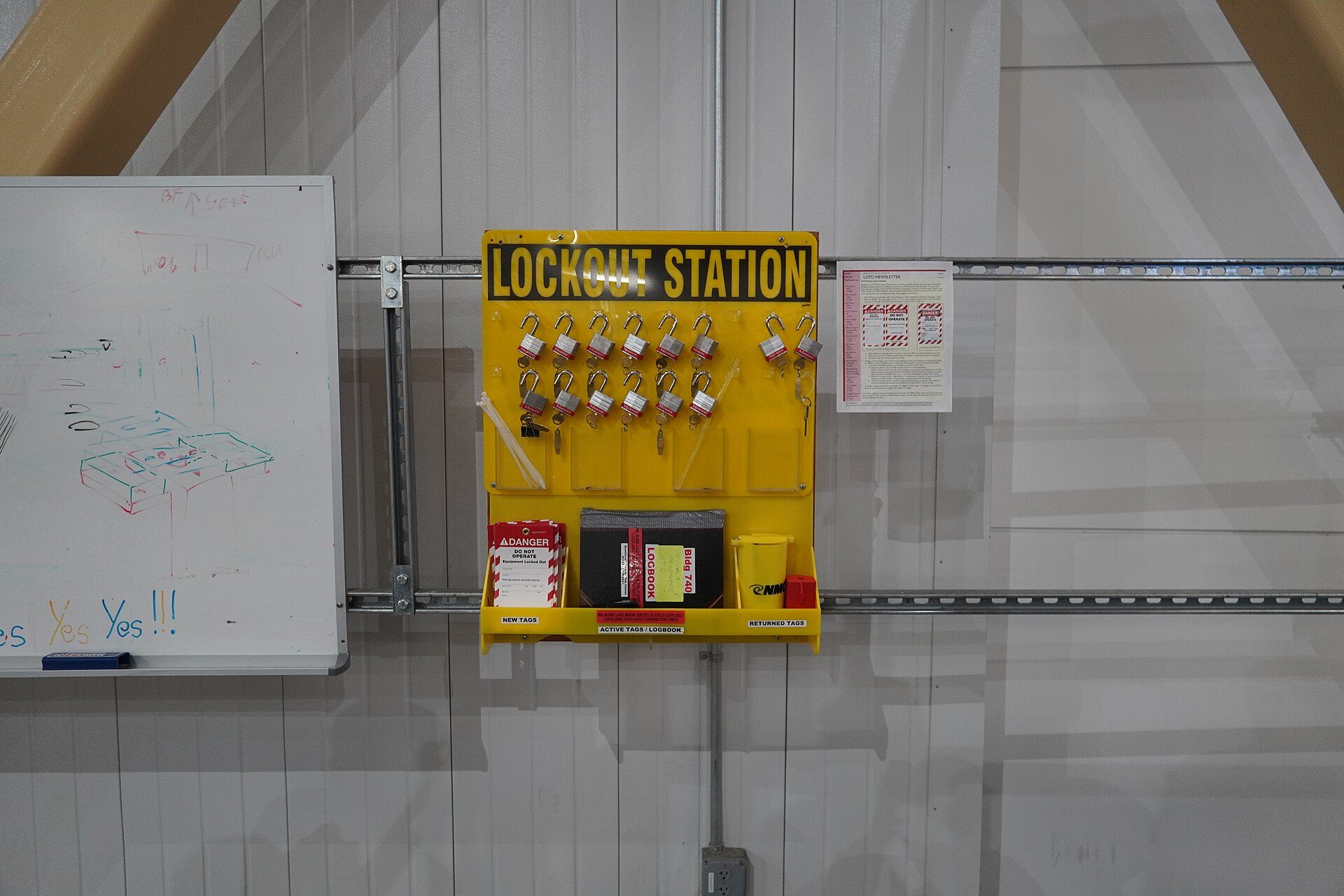
Photo: Henrysz / Wikimedia Commons, CC BY 4.0
The 8-step LOTO procedure for panels and motors
Factories may word it slightly differently, but all include the steps below. Always follow the written procedure of the factory where you work.
Steps 1 to 5: prepare, isolate, lock
- Prepare: read the single-line diagram and control schematic and list every supply to the equipment: power, control, heaters, PLC signals, compressed air.
- Notify: tell your team leader, the machine operator and any affected departments (for example, warn the line before a pump stops).
- Normal stop: stop with the Stop button and wait until the motor has fully stopped. Avoid breaking a heavily loaded running motor with the breaker unless you have to.
- Isolate: switch off the breaker or isolator feeding the equipment; pull fuses where used; unplug equipment with a plug. Stand to one side of the panel while switching, not directly in front of the device.
- Lock and tag: fit a breaker lockout or hasp, lock it with your personal padlock and attach a tag with your name, phone number, date and time and reason (Figure 3). Keep the key on you.
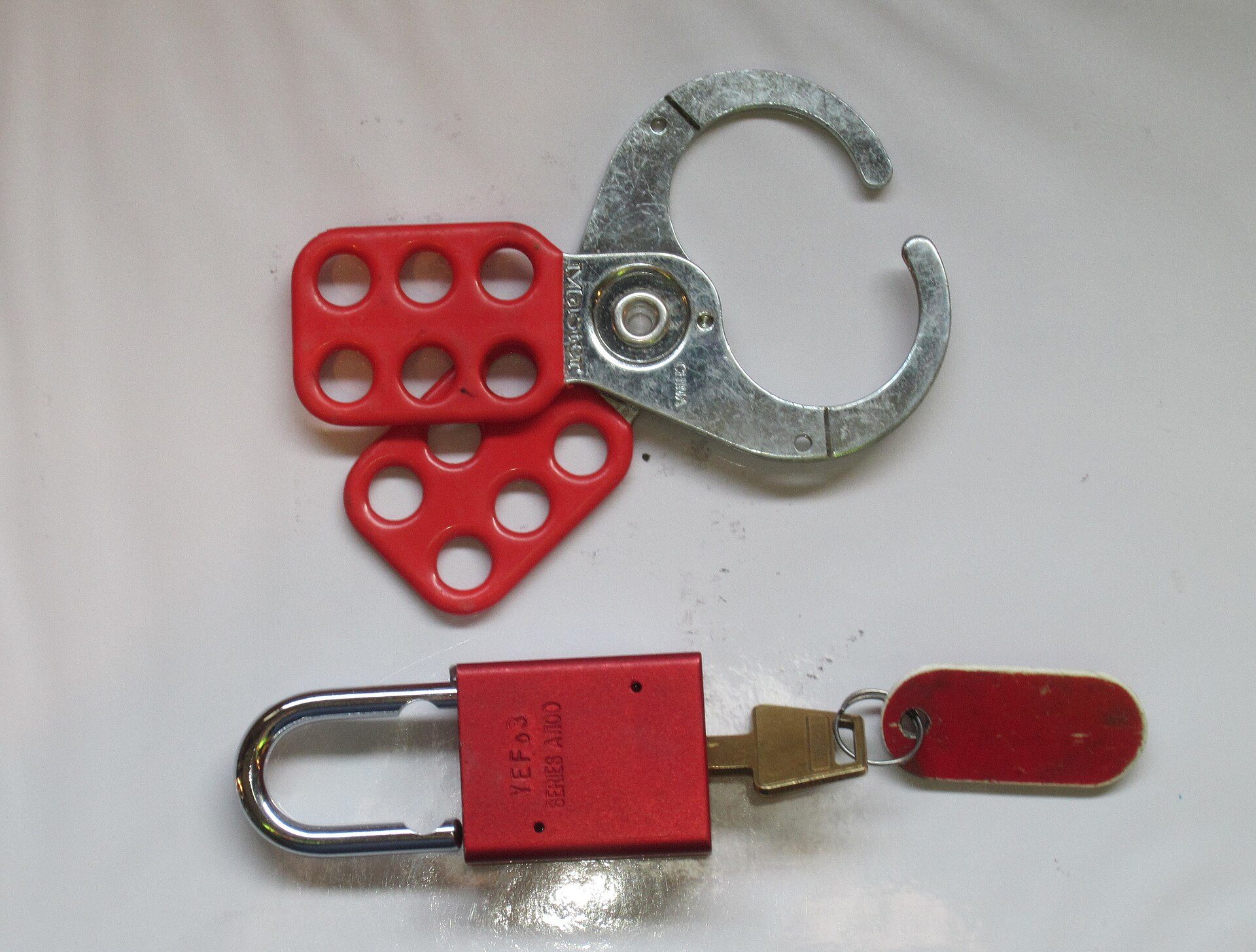
Photo: Wtshymanski / Wikimedia Commons, CC BY-SA 4.0
Step 6: release stored energy
Wait for the VFD to discharge for the time on its label, discharge power factor capacitors as the maker instructs, block or lock fan and pump shafts that could turn, vent compressed air and lower suspended loads. DC bus capacitor safety in VFDs is covered in How to wire a VFD to a three-phase motor.
Step 7: test for absence of voltage (test, measure, re-test)
This is the most important step and the one most often rushed. Use a voltmeter or two-pole voltage tester with a suitable rating (usually marked CAT III or CAT IV with a voltage), in this order:
- Prove the tester on a known live source (a socket, the next panel) to be sure it works.
- Measure at the point of work: on three-phase, measure L1–L2, L2–L3 and L1–L3, then L1–PE, L2–PE and L3–PE (and each phase to N if there is a neutral). Every reading must be 0 V.
- Prove the tester again on the live source straight afterwards, so you know it did not fail halfway.
A single-pole neon screwdriver must not be used to conclude a panel is dead: it depends on the person holding it, cannot tell induced voltage from real voltage and can give false readings.
Step 8: try to start, work, then remove locks
Once everyone is clear of the machine, press the local Start button to confirm it does not run, then return it to Stop. When the job is done: clear tools, refit covers, count people, let each worker remove their own lock, and tell operations before re-energising. Nobody removes another person's lock; if that person is absent, the factory's special procedure applies, with a manager's sign-off.
Insulating gloves, mats and electrical PPE
LOTO removes the hazard; personal protective equipment (PPE) is the last layer of protection for the moments when you are not yet sure the equipment is dead: while testing for absence of voltage and while switching.
Insulating gloves
Rubber insulating gloves have a voltage class printed on the cuff; choose the class for your working voltage. Before each use, roll the cuff to trap air and squeeze to check for leaks, cracks and holes. Leather protectors go over the rubber to stop it being cut (Figure 4). Gloves must be within the test date on their label; store them in their own bag away from sunlight, oil and sharp objects.
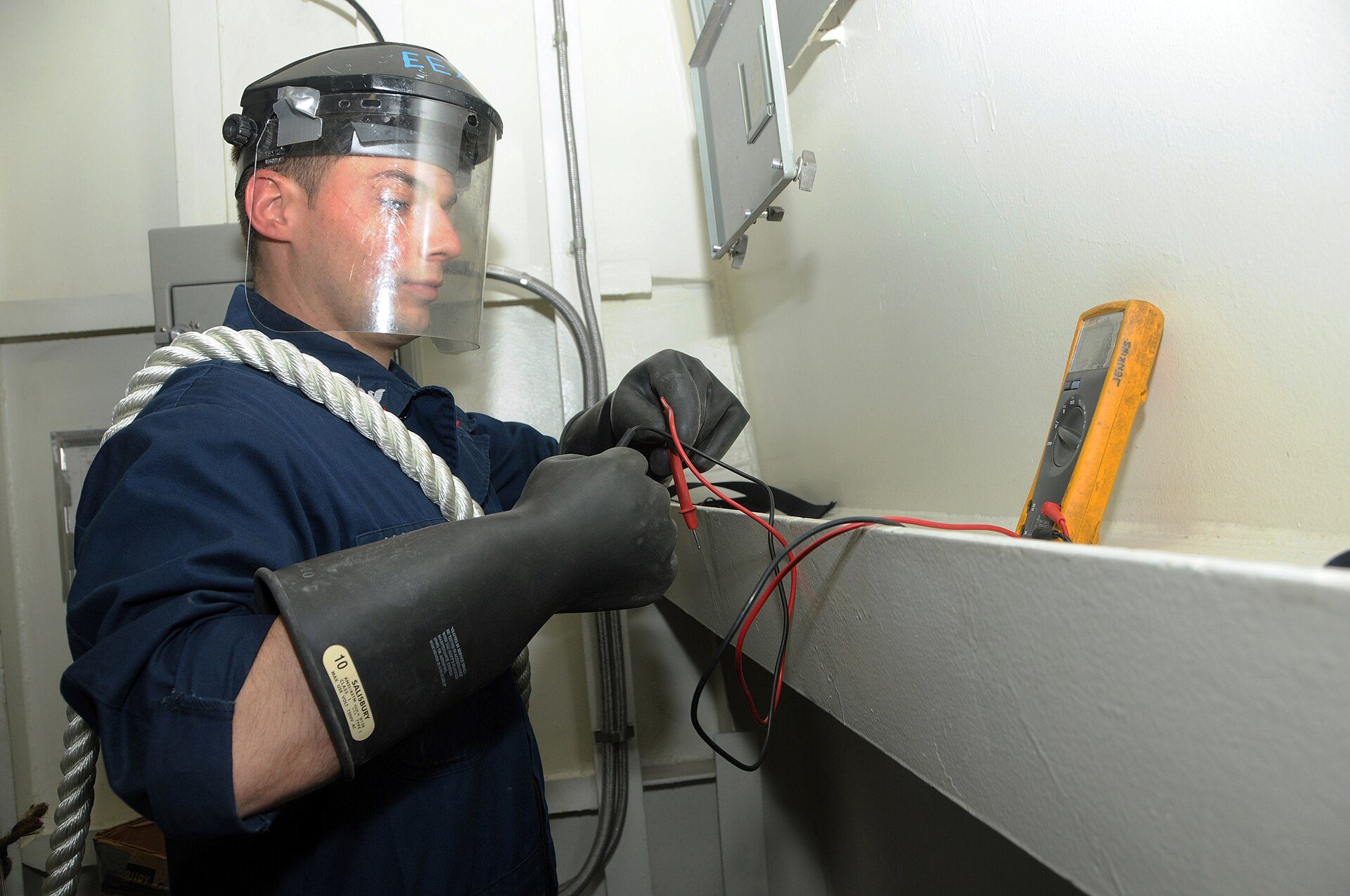
Photo: U.S. Navy photo by Mass Communication Specialist Seaman Jerine Lee / Wikimedia Commons, Public domain
Insulating mats and insulated tools
Lay an insulating mat in front of distribution boards to isolate your feet from the floor. Use screwdrivers and pliers with insulated handles marked for 1000 V; discard any with cracked handles. Test instruments must have a category rating suitable for the measuring point, leads without cracked insulation and probe tip shrouds.
Clothing, face and eyes
Wear long-sleeved cotton or flame-resistant clothing; never synthetic fibres, which melt onto the skin in an arc. Wear safety glasses, a face shield when switching large panels, a hard hat and electrical safety footwear. Remove rings, metal watches and necklaces.
| Equipment | Check before use | Discard when |
|---|---|---|
| Rubber insulating gloves | Voltage class, test date label, air roll test | Leaking, cracked, swollen, past test date |
| Leather protectors | No holes, no oil | Torn, metal fragments embedded |
| Insulating mat | Clean, dry, not torn | Torn, hardened, cracked |
| 1000 V insulated tools | Handles intact, marking clear | Cracked handle, exposed metal |
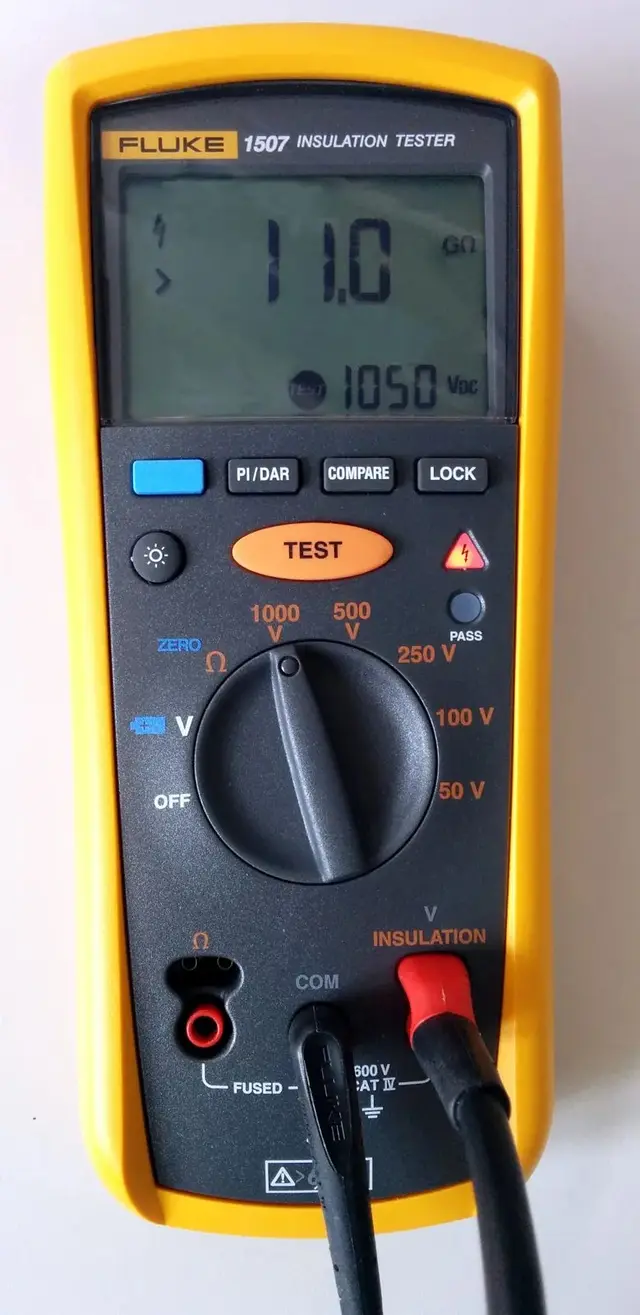
| Meter, two-pole tester | CAT rating, leads, proved on a live source | Cracked leads, unstable readings |
Worked example: LOTO to replace a contactor on a 15 kW pump panel
Situation: a factory has a 15 kW cooling water pump with a star-delta starter (wired as in Star-delta starter wiring diagram). The main contactor has burnt contacts and must be replaced. Nam, a new electrician, works with Tung, the senior electrician. The standby pump has already been started in its place.
Identifying sources from the drawings
- Source 1: the MCCB feeding the pump panel from the main distribution board, three-phase 400 V.
- Source 2: the motor's anti-condensation heater, 220 V, fed from the pump room lighting panel and not through the source 1 MCCB. This is the second supply beginners often forget.
- The 220 V control circuit in the panel is taken after the source 1 MCCB, so it is isolated with source 1.
Steps and time
| Step | Work | Time (minutes) |
|---|---|---|
| Prepare | Read drawings, list 2 sources, collect LOTO kit and the new contactor | 10 |
| Notify, stop | Tell team leader and operations; stop the pump with the Stop button | 8 |
| Isolate, lock, tag | 2 isolation points × 2 workers locking through hasps | 7 |
| Test for dead | Prove tester, 9 measurements, re-prove tester | 10 |
| Replace contactor | Remove, fit, torque lugs correctly | 35 |
| Check, tidy | Check wiring against the drawing, count tools, refit covers | 10 |
| Remove locks, re-energise, test run | Each worker removes their own lock, tell operations, test run | 10 |
| Total | 90 | |
Check: 10 + 8 + 7 + 10 + 35 + 10 + 10 = 90 minutes. Measurements in the test-for-dead step: at the contactor input, 3 phase-to-phase + 3 phase-to-PE = 6; at the heater terminal box, L–N, L–PE and N–PE = 3; total 6 + 3 = 9 measurements, plus proving the tester on a live source twice (before and after). Time spent on safety (preparation through testing, plus removing locks) is 10 + 8 + 7 + 10 + 10 = 45 minutes, exactly half the job; that is a normal ratio for a small repair.
What saved Nam
Measuring at the motor terminal box, Nam read 220 V across the heater leads even though the MCCB was locked off. Because step 1 had listed source 2, Tung knew at once to isolate and lock the heater breaker in the lighting panel too. If they had simply trusted "the MCCB is off", Nam would have touched a 220 V conductor while opening the terminal box.
First aid for electric shock and incident reporting
Safety warning: Never touch a person who is being electrocuted with bare hands. The first thing is to cut the power (the nearest breaker or isolator). If you cannot cut it at once and it is low voltage, stand on something dry and insulating and use a dry wooden pole or other insulating object to separate the victim from the conductor. For medium- or high-voltage lines, do not go near; call the power company and 115 (Vietnam's emergency medical number) immediately. Beginners never work live, never re-energise without permission and never work alone inside a distribution board.
First aid sequence
- Cut the power and make sure you are safe first.
- Call 115 and the factory first aider; send someone for an automated external defibrillator (AED) if there is one.
- Check whether the victim is conscious and breathing. If not breathing or only gasping, start chest compressions if you are trained and use the AED as it instructs.
- If breathing: place them in the recovery position, keep them warm and monitor until medical staff arrive.
- Burns: cool with clean water and cover with a clean dressing; do not apply toothpaste or grease.
Why even a mild shock needs a medical check
Electric current can cause delayed heart rhythm problems and deep internal burns that show only as a small mark on the skin. Anyone who has had current pass through their body, especially hand to hand or hand to foot, should be taken for a medical check even if they look fine.
Reporting incidents
Report immediately to your team leader and the safety department: time, panel location, task, people involved and what was done. Report near misses too, such as finding voltage on equipment thought to be isolated or a small arc while switching. Do not clean up or change the scene before you are allowed to.
Common LOTO mistakes
Isolating only the control circuit
Sign: switching off the control switch or control breaker, then opening the motor terminal box. Cause: thinking a stopped machine has no power. Fix: always isolate and lock the power supply and test for dead at the point of work.
Trusting someone else's tag or word
Sign: seeing the previous shift's "Do not switch on" tag and assuming it is safe. Cause: not wanting to add a lock. Fix: every worker fits their own lock and does their own test for dead.
Using a neon screwdriver or not re-proving the tester
Sign: the screwdriver does not light, so the panel is declared dead. Cause: convenience. Fix: use a properly rated meter or two-pole tester and always test, measure, re-test.
Sharing locks or removing someone else's lock
Sign: one padlock for the whole team, key hanging on the panel. Cause: saving money. Fix: one person, one lock, one key; use a hasp or group lock box when several people work.
Frequently asked questions
What is LOTO in electrical safety?
LOTO (lockout-tagout) is the procedure of locking an isolating device in the off position and attaching a warning tag, so nobody can re-energise equipment while someone is repairing or maintaining it. The lock prevents switching on; the tag tells others who is working and why.
How is panel LOTO different from elevator LOTO?
The principle is the same, but factory panels have many second supplies, capacitor banks, VFDs and high fault currents, so the emphasis is on testing for dead and arc flash protection. Elevators add the hazards of the car, the counterweight and working in the hoistway; see Elevator technician safety.
Can I use a neon test screwdriver to check a panel is dead?
A single-pole tester is for reference only. Absence of voltage must be confirmed with a properly rated meter or two-pole tester, on every phase pair and phase to earth, proving the instrument before and after.
What safety certificate does an industrial electrician need in Vietnam?
People doing electrical work in a company must receive electrical safety and occupational safety training under current regulations, and many workplaces grade electrical safety levels by job. The details change with the regulations and the workplace, so ask your safety or HR department and check the current official documents.
How often must insulating gloves be tested?
Follow the manufacturer's schedule and your workplace's rules; the test date is usually printed or stickered on the glove. On top of periodic testing, do the air roll check yourself before every use.
Practice tasks and self-assessment
- Pick a motor control panel at school or work, read its drawings and list every supply into it, including second supplies.
- Write an 8-step LOTO sheet for that panel, with a list of isolation points and measurement points.
- Under a senior electrician's supervision, practise test, measure, re-test on an isolated panel and record the 6 three-phase readings.
- Work out the total time for replacing an overload relay on the pump panel in the example, with 20 minutes for the replacement itself.
Self-assessment criteria
- Pass: you list every source correctly, including at least one beyond the main power supply if the drawing has one.
- Pass: your LOTO sheet has all 8 steps, with names, lock numbers and lock locations.
- Pass: you take all 6 three-phase readings and prove the tester on a live source before and after.
- Pass: your time table adds up (90 − 35 + 20 = 75 minutes).
- Not yet: you use a neon screwdriver to conclude, forget the second supply, or leave the key on the panel.
Once you have LOTO firmly in hand, move on to the next roadmap step: Reading electrical drawings and switchgear, where you learn TCVN and IEC symbols, single-line diagrams, control schematics and how to use clamp meters and insulation testers. Being able to read drawings is what makes step 1 of LOTO, identifying every source, reliable.
Keep learning industrial electrical work: after safety come electrical drawings, three-phase motors and starters, VFDs, PLCs, panels and factory maintenance. See the 8-step industrial electrician roadmap.